
Analysis of dike breach sensitivity using a conceptual
Analysis of dike breach sensitivity using a conceptual method followed by a comprehensive statistical approach to end up with failure probabilities P. Peeters 1, R. Van Looveren², L. Vincke³, W. Vanneuville 1 and J. Blanckaert 2 1 Flanders Hydraulics Research, Flemish Government, Berchemlei 115, Antwerp 2140, Belgium Marine and Dredging Consultants, Wilrijkstraat 37 -45, Antwerp 2140, Belgium 3 Geotechnical Division, Flemish Government, Tramstraat 52, Gent 9052, Belgium 2 International 4 th International Symposium on Flood Defence, Toronto, Canada
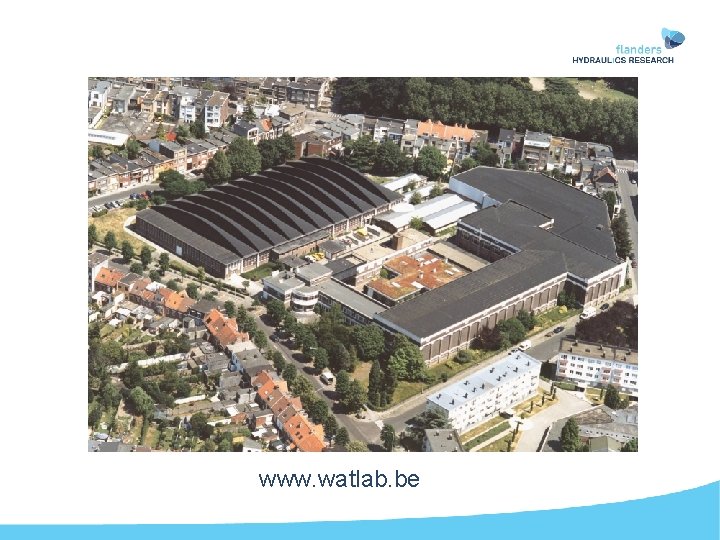
www. watlab. be
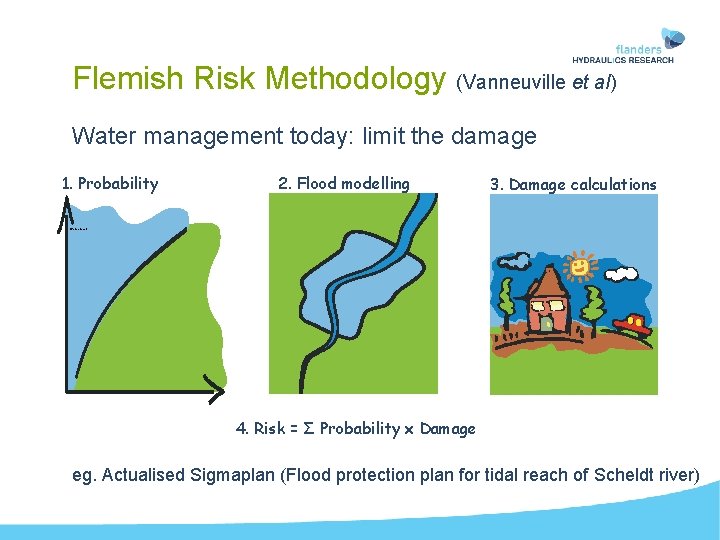
Flemish Risk Methodology (Vanneuville et al) Water management today: limit the damage 1. Probability 2. Flood modelling 3. Damage calculations Water level 4. Risk = Σ Probability x Damage eg. Actualised Sigmaplan (Flood protection plan for tidal reach of Scheldt river)
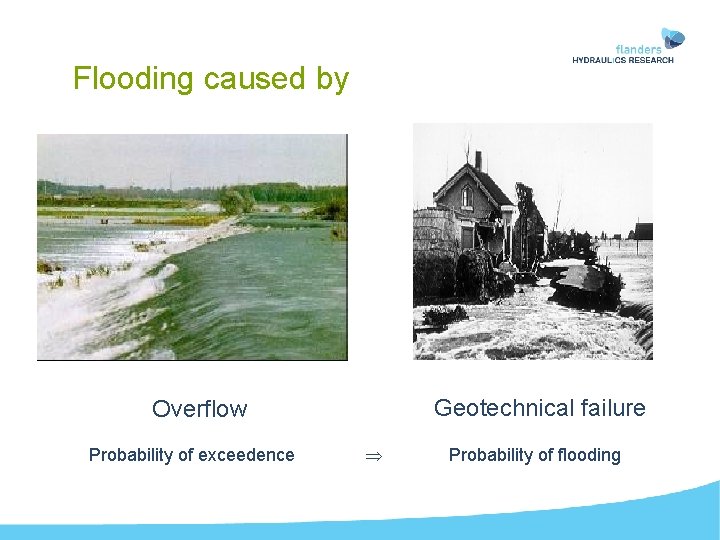
Flooding caused by Geotechnical failure Overflow Probability of exceedence Probability of flooding

Failure mechanisms (of earth dikes)
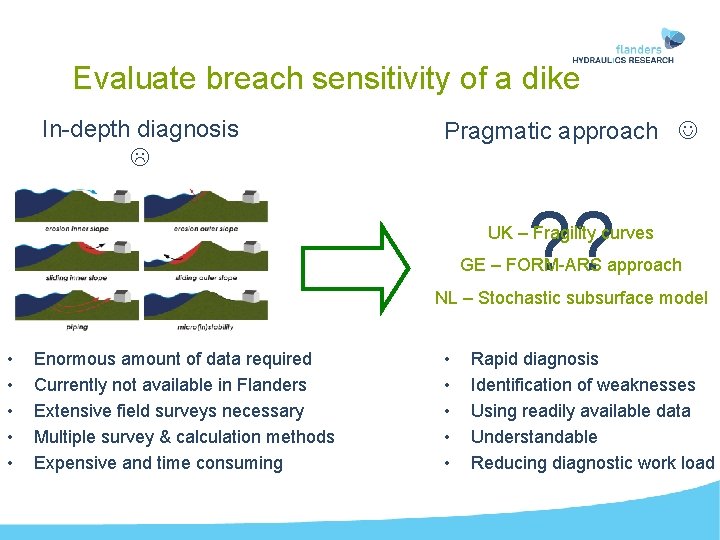
Evaluate breach sensitivity of a dike In-depth diagnosis Pragmatic approach ? ? UK – Fragility curves GE – FORM-ARS approach NL – Stochastic subsurface model • • • Enormous amount of data required Currently not available in Flanders Extensive field surveys necessary Multiple survey & calculation methods Expensive and time consuming • • • Rapid diagnosis Identification of weaknesses Using readily available data Understandable Reducing diagnostic work load
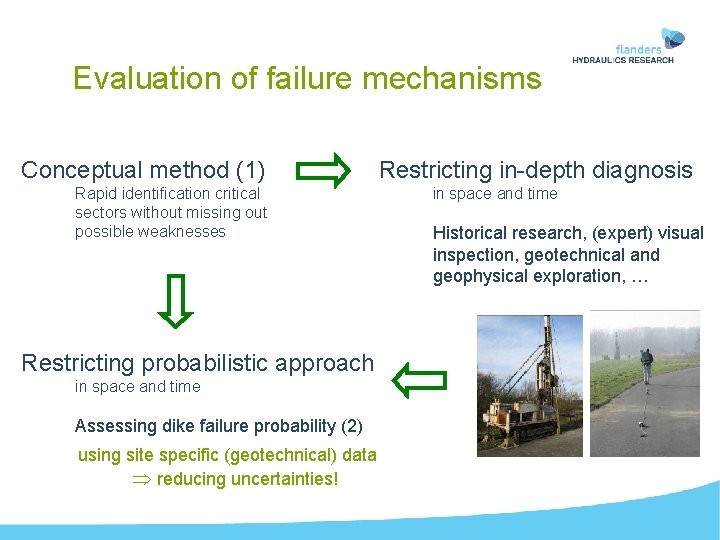
Evaluation of failure mechanisms Conceptual method (1) Rapid identification critical sectors without missing out possible weaknesses Restricting probabilistic approach in space and time Assessing dike failure probability (2) using site specific (geotechnical) data reducing uncertainties! Restricting in-depth diagnosis in space and time Historical research, (expert) visual inspection, geotechnical and geophysical exploration, …
(1) Conceptual method 1 e Orientating (geotechnical) calculations • • Comparison of calculation methods Sensitivity-analysis of model parameters Outcome: selection of calculation methods & list of (more) sensitive variables 2 e Weighting driving and resisting forces • • • Using literature threshold values (eg. Maximum tolerable flow velocities) Based on numerous (geotechnical) calculations For typical dike configurations Only varying (more) sensitive parameters Less sensitive parameters set worst-case Outcome: Safety assessment in terms of Failure Indexes (low Failure Index breaching is more likely!)
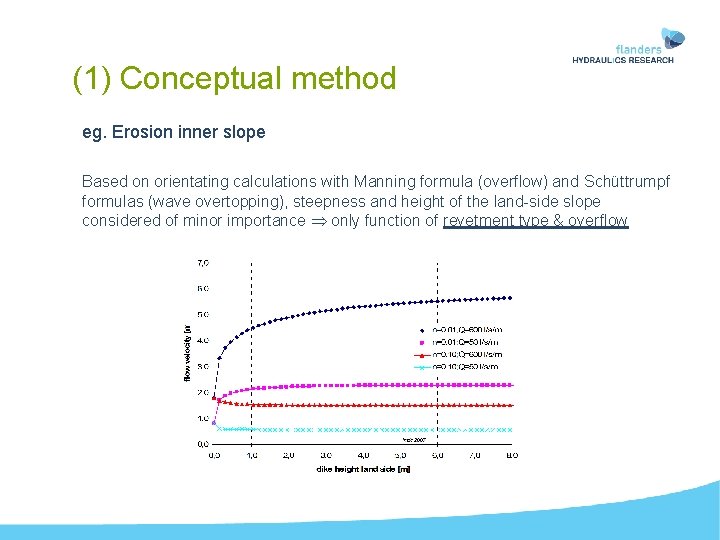
(1) Conceptual method eg. Erosion inner slope Based on orientating calculations with Manning formula (overflow) and Schüttrumpf formulas (wave overtopping), steepness and height of the land-side slope considered of minor importance only function of revetment type & overflow
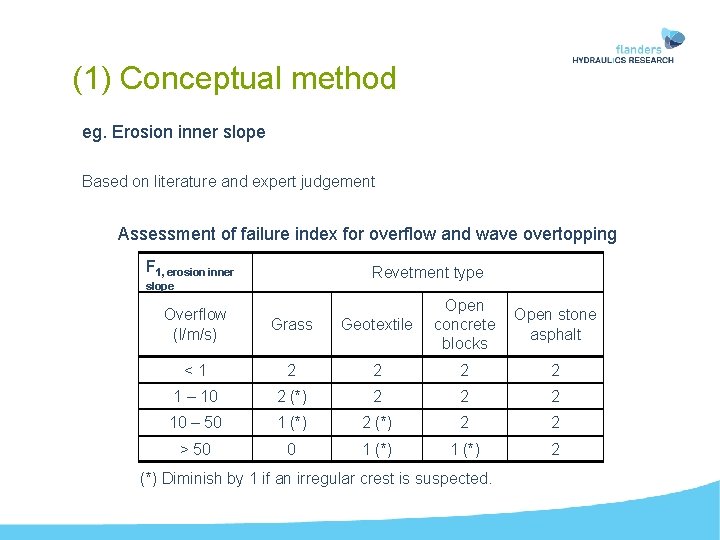
(1) Conceptual method eg. Erosion inner slope Based on literature and expert judgement Assessment of failure index for overflow and wave overtopping F 1, erosion inner Revetment type slope Geotextile Open concrete blocks Open stone asphalt 2 2 1 – 10 2 (*) 2 2 2 10 – 50 1 (*) 2 2 > 50 0 1 (*) 2 Overflow (l/m/s) Grass <1 (*) Diminish by 1 if an irregular crest is suspected.
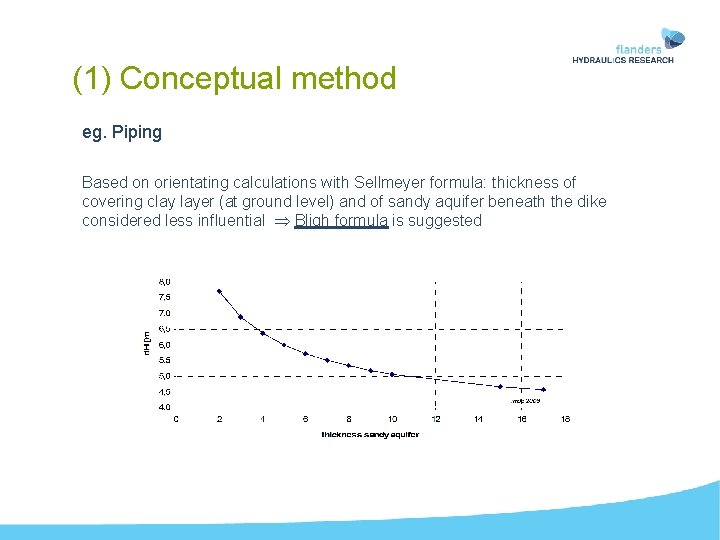
(1) Conceptual method eg. Piping Based on orientating calculations with Sellmeyer formula: thickness of covering clay layer (at ground level) and of sandy aquifer beneath the dike considered less influential Bligh formula is suggested
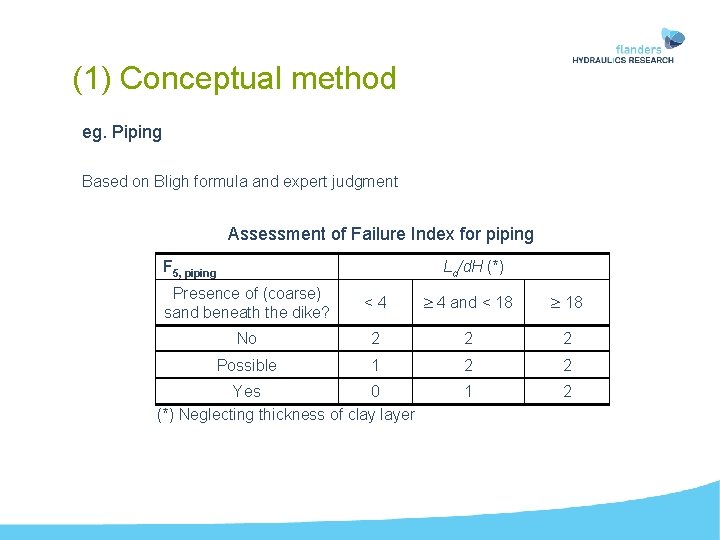
(1) Conceptual method eg. Piping Based on Bligh formula and expert judgment Assessment of Failure Index for piping F 5, piping Ld/d. H (*) Presence of (coarse) sand beneath the dike? <4 4 and < 18 No 2 2 2 Possible 1 2 2 1 2 Yes 0 (*) Neglecting thickness of clay layer
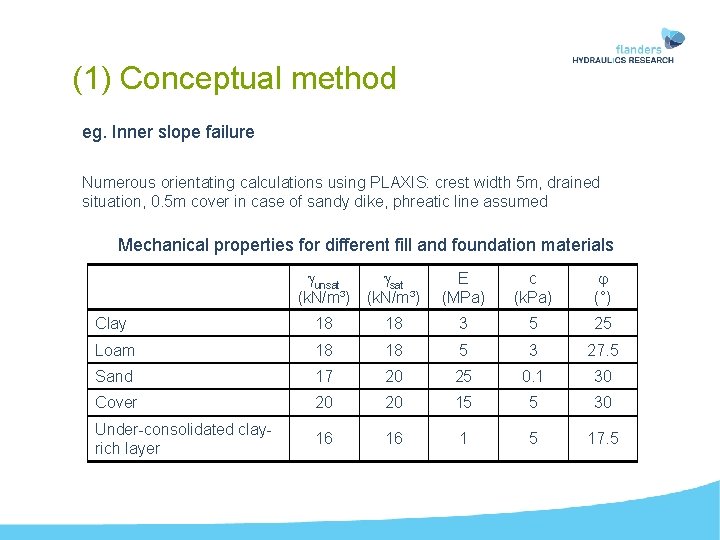
(1) Conceptual method eg. Inner slope failure Numerous orientating calculations using PLAXIS: crest width 5 m, drained situation, 0. 5 m cover in case of sandy dike, phreatic line assumed Mechanical properties for different fill and foundation materials unsat (k. N/m³) E (MPa) c (k. Pa) (°) Clay 18 18 3 5 25 Loam 18 18 5 3 27. 5 Sand 17 20 25 0. 1 30 Cover 20 20 15 5 30 Under-consolidated clayrich layer 16 16 1 5 17. 5
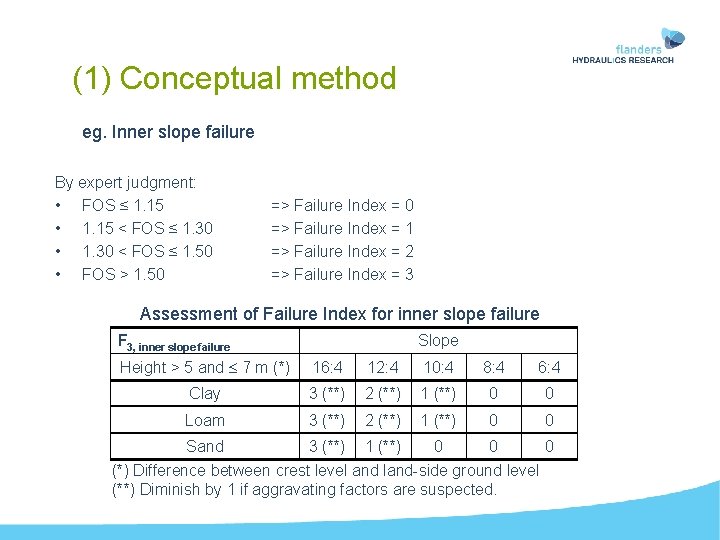
(1) Conceptual method eg. Inner slope failure By expert judgment: • FOS ≤ 1. 15 • 1. 15 < FOS ≤ 1. 30 • 1. 30 < FOS ≤ 1. 50 • FOS > 1. 50 => Failure Index = 1 => Failure Index = 2 => Failure Index = 3 Assessment of Failure Index for inner slope failure F 3, inner slope failure Slope Height > 5 and 7 m (*) 16: 4 12: 4 10: 4 8: 4 6: 4 Clay 3 (**) 2 (**) 1 (**) 0 0 Loam 3 (**) 2 (**) 1 (**) 0 0 Sand 3 (**) 1 (**) 0 0 0 (*) Difference between crest level and land-side ground level (**) Diminish by 1 if aggravating factors are suspected.
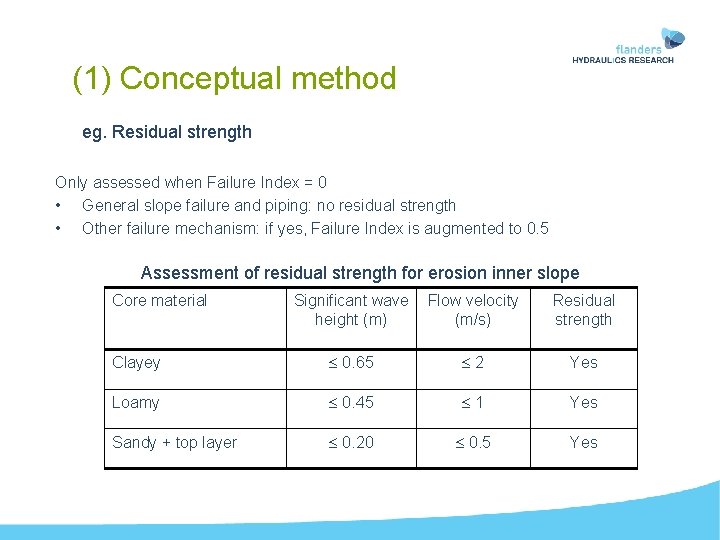
(1) Conceptual method eg. Residual strength Only assessed when Failure Index = 0 • General slope failure and piping: no residual strength • Other failure mechanism: if yes, Failure Index is augmented to 0. 5 Assessment of residual strength for erosion inner slope Core material Significant wave height (m) Flow velocity (m/s) Residual strength Clayey 0. 65 2 Yes Loamy 0. 45 1 Yes Sandy + top layer 0. 20 0. 5 Yes
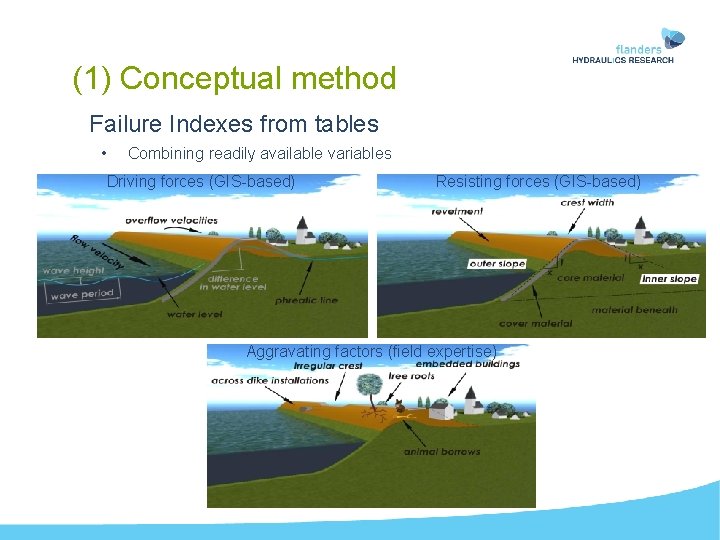
(1) Conceptual method Failure Indexes from tables • Combining readily available variables Driving forces (GIS-based) Resisting forces (GIS-based) Aggravating factors (field expertise)
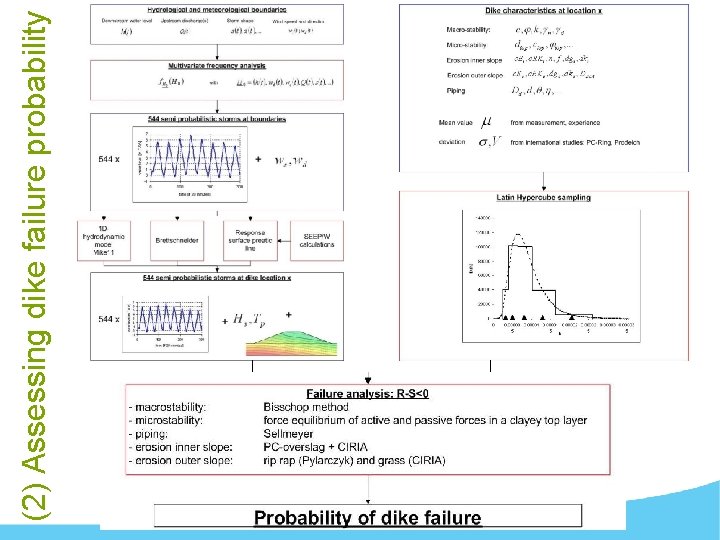
(2) Assessing dike failure probability
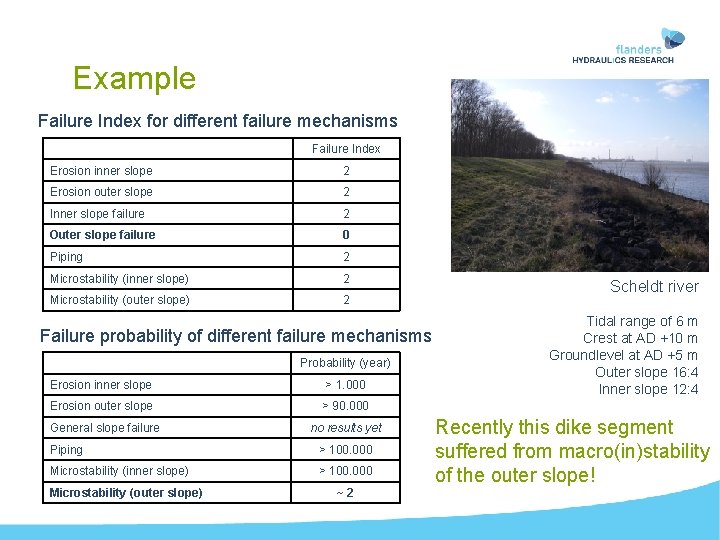
Example Failure Index for different failure mechanisms Failure Index Erosion inner slope 2 Erosion outer slope 2 Inner slope failure 2 Outer slope failure 0 Piping 2 Microstability (inner slope) 2 Microstability (outer slope) 2 Failure probability of different failure mechanisms Probability (year) Erosion inner slope > 1. 000 Erosion outer slope > 90. 000 General slope failure no results yet Piping > 100. 000 Microstability (inner slope) > 100. 000 Microstability (outer slope) ~2 Scheldt river Tidal range of 6 m Crest at AD +10 m Groundlevel at AD +5 m Outer slope 16: 4 Inner slope 12: 4 Recently this dike segment suffered from macro(in)stability of the outer slope!
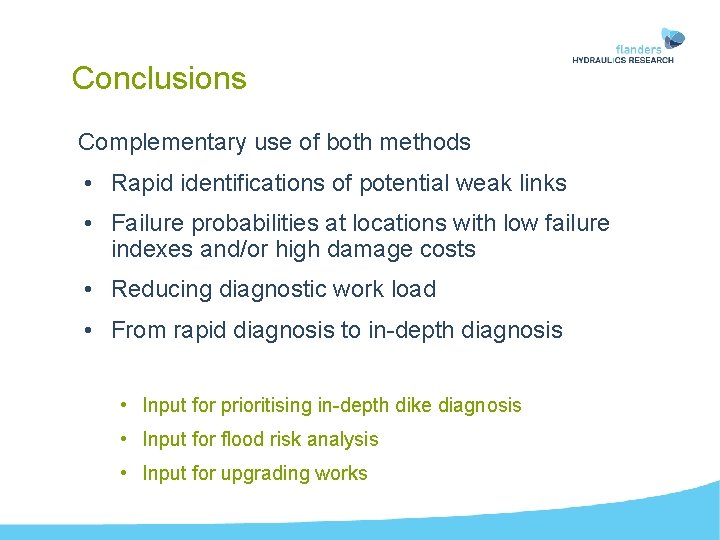
Conclusions Complementary use of both methods • Rapid identifications of potential weak links • Failure probabilities at locations with low failure indexes and/or high damage costs • Reducing diagnostic work load • From rapid diagnosis to in-depth diagnosis • Input for prioritising in-depth dike diagnosis • Input for flood risk analysis • Input for upgrading works
Thanks Questions, suggestions, … ABOVE BELOW THE LEVEL OF WATER WITH A PROBABILITY OF FLOODING (i. e. a dike) “Lawrence Weiner” patrik. peeters@mow. vlaanderen. be
- Slides: 20