
Analysis of Arsenic in Wine by XRF Hannah
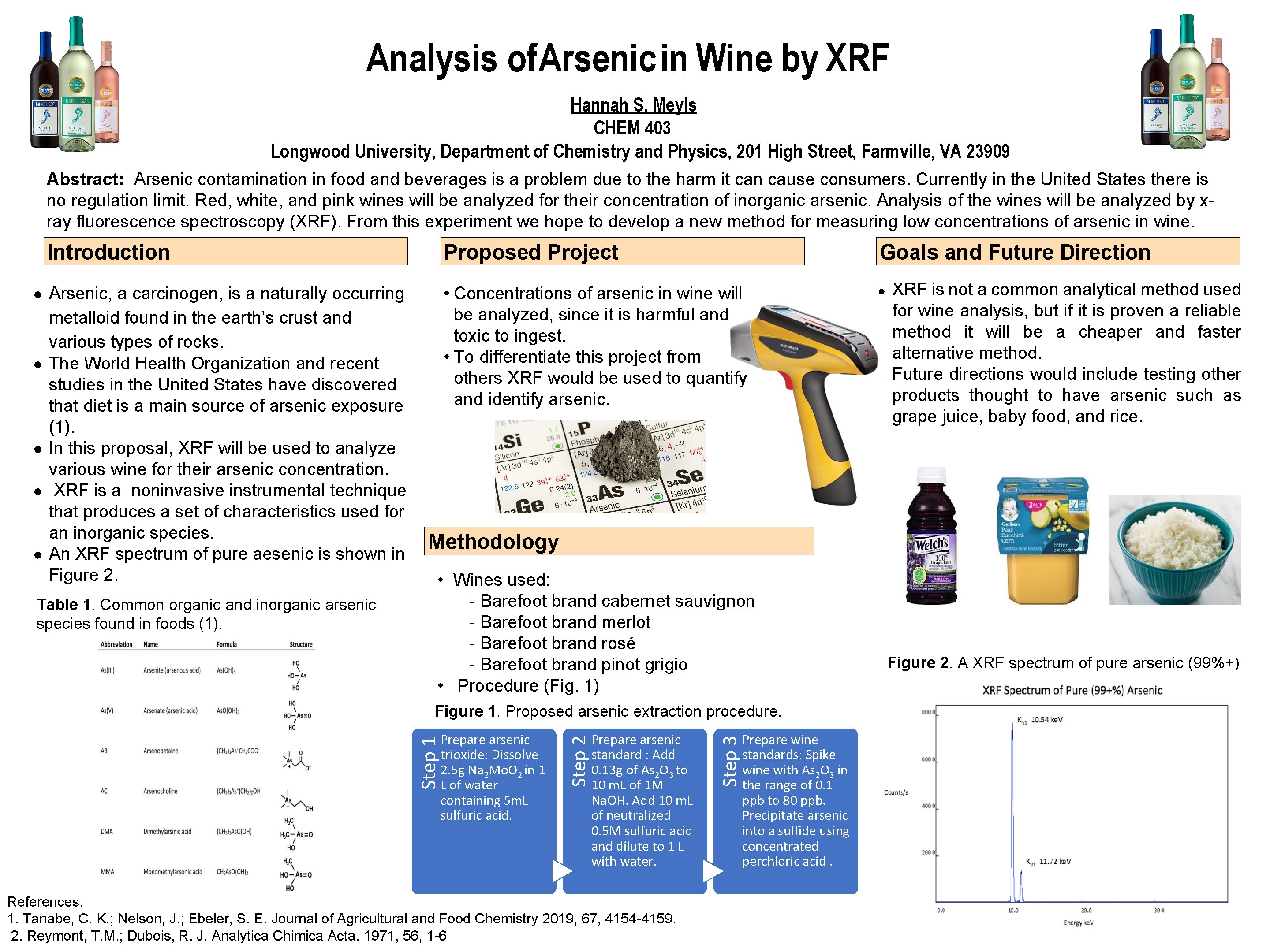
Analysis of. Arsenic in Wine by XRF Hannah S. Meyls CHEM 403 Longwood University, Department of Chemistry and Physics, 201 High Street, Farmville, VA 23909 Abstract: Arsenic contamination in food and beverages is a problem due to the harm it can cause consumers. Currently in the United States there is no regulation limit. Red, white, and pink wines will be analyzed for their concentration of inorganic arsenic. Analysis of the wines will be analyzed by xray fluorescence spectroscopy (XRF). From this experiment we hope to develop a new method for measuring low concentrations of arsenic in wine. Introduction ● Arsenic, a carcinogen, is a naturally occurring ● ● metalloid found in the earth’s crust and various types of rocks. The World Health Organization and recent studies in the United States have discovered that diet is a main source of arsenic exposure (1). In this proposal, XRF will be used to analyze various wine for their arsenic concentration. XRF is a noninvasive instrumental technique that produces a set of characteristics used for an inorganic species. An XRF spectrum of pure aesenic is shown in Figure 2. Table 1. Common organic and inorganic arsenic species found in foods (1). Proposed Project Goals and Future Direction • Concentrations of arsenic in wine will be analyzed, since it is harmful and toxic to ingest. • To differentiate this project from others XRF would be used to quantify and identify arsenic. ● ● XRF is not a common analytical method used for wine analysis, but if it is proven a reliable method it will be a cheaper and faster alternative method. Future directions would include testing other products thought to have arsenic such as grape juice, baby food, and rice. Methodology • Wines used: - Barefoot brand cabernet sauvignon - Barefoot brand merlot - Barefoot brand rosé - Barefoot brand pinot grigio • Procedure (Fig. 1) Prepare arsenic standard : Add 0. 13 g of As 2 O 3 to 10 m. L of 1 M Na. OH. Add 10 m. L of neutralized 0. 5 M sulfuric acid and dilute to 1 L with water. References: 1. Tanabe, C. K. ; Nelson, J. ; Ebeler, S. E. Journal of Agricultural and Food Chemistry 2019, 67, 4154 -4159. 2. Reymont, T. M. ; Dubois, R. J. Analytica Chimica Acta. 1971, 56, 1 -6 Step 3 Step 1 Prepare arsenic trioxide: Dissolve 2. 5 g Na 2 Mo. O 2 in 1 L of water containing 5 m. L sulfuric acid. Step 2 Figure 1. Proposed arsenic extraction procedure. Prepare wine standards: Spike wine with As 2 O 3 in the range of 0. 1 ppb to 80 ppb. Precipitate arsenic into a sulfide using concentrated perchloric acid. Figure 2. A XRF spectrum of pure arsenic (99%+)
- Slides: 1