
Analysis of Algorithms Solving Recurrences Continued The Master
![The Heap Property ● Heaps also satisfy the heap property: A[Parent(i)] A[i] for all](https://slidetodoc.com/presentation_image_h2/669fdc0b7b9b2325588902f6fa0cbbaf/image-31.jpg "The Heap Property ● Heaps also satisfy the heap property: A[Parent(i)] A[i] for all")
![Heapsort(A) { Build. Heap(A); for (i = length(A) downto 2) { Swap(A[1], A[i]); heap_size(A)](https://slidetodoc.com/presentation_image_h2/669fdc0b7b9b2325588902f6fa0cbbaf/image-53.jpg "Heapsort(A) { Build. Heap(A); for (i = length(A) downto 2) { Swap(A[1], A[i]); heap_size(A)")
- Slides: 56
Analysis of Algorithms Solving Recurrences Continued The Master Theorem Introduction to heapsort
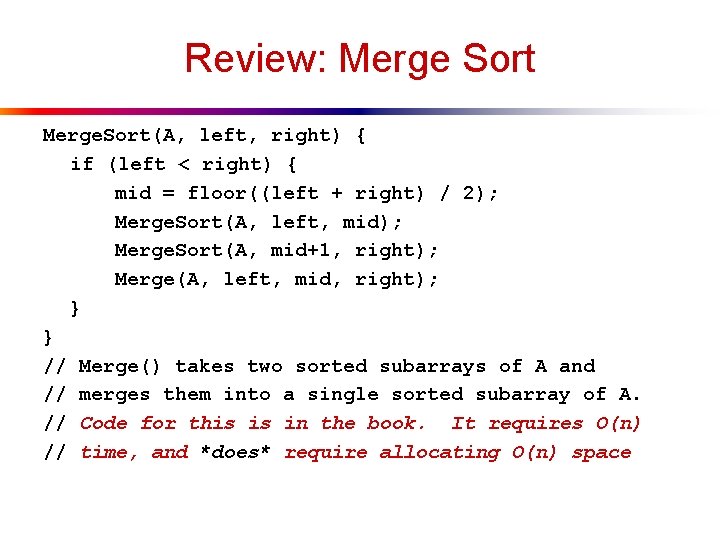
Review: Merge Sort Merge. Sort(A, left, right) { if (left < right) { mid = floor((left + right) / 2); Merge. Sort(A, left, mid); Merge. Sort(A, mid+1, right); Merge(A, left, mid, right); } } // Merge() takes two sorted subarrays of A and // merges them into a single sorted subarray of A. // Code for this is in the book. It requires O(n) // time, and *does* require allocating O(n) space
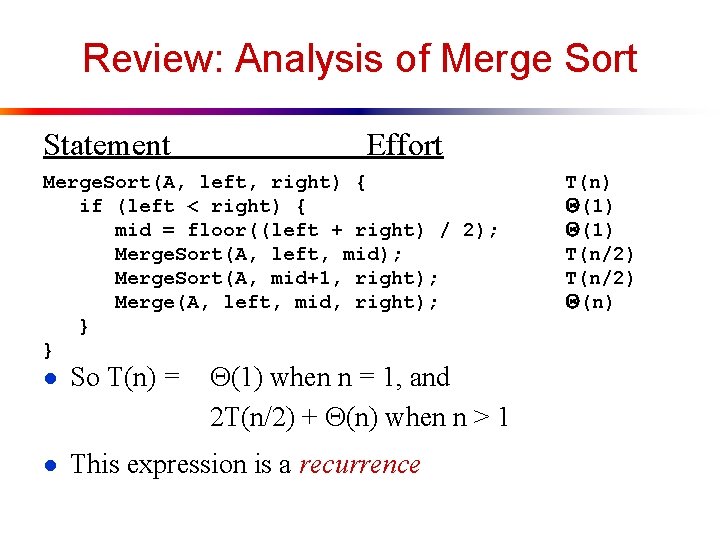
Review: Analysis of Merge Sort Statement Effort Merge. Sort(A, left, right) { if (left < right) { mid = floor((left + right) / 2); Merge. Sort(A, left, mid); Merge. Sort(A, mid+1, right); Merge(A, left, mid, right); } } ● So T(n) = (1) when n = 1, and 2 T(n/2) + (n) when n > 1 ● This expression is a recurrence T(n) (1) T(n/2) (n)
Review: Solving Recurrences ● Substitution method ● Iteration method ● Master method
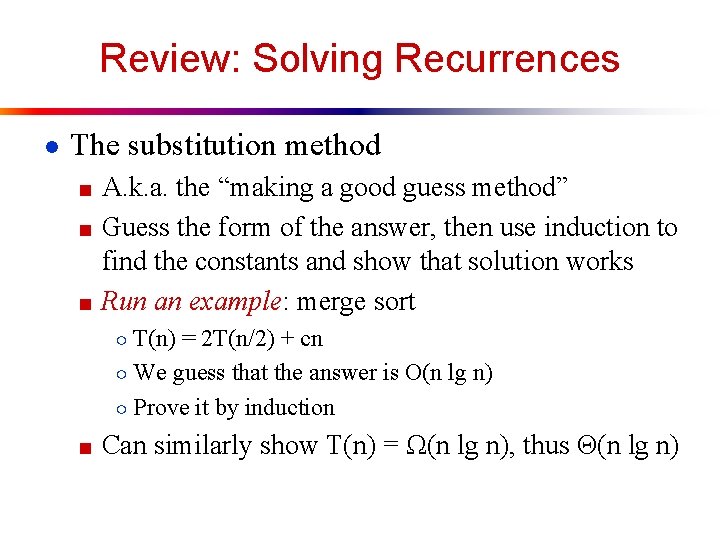
Review: Solving Recurrences ● The substitution method ■ A. k. a. the “making a good guess method” ■ Guess the form of the answer, then use induction to find the constants and show that solution works ■ Run an example: merge sort ○ T(n) = 2 T(n/2) + cn ○ We guess that the answer is O(n lg n) ○ Prove it by induction ■ Can similarly show T(n) = Ω(n lg n), thus Θ(n lg n)
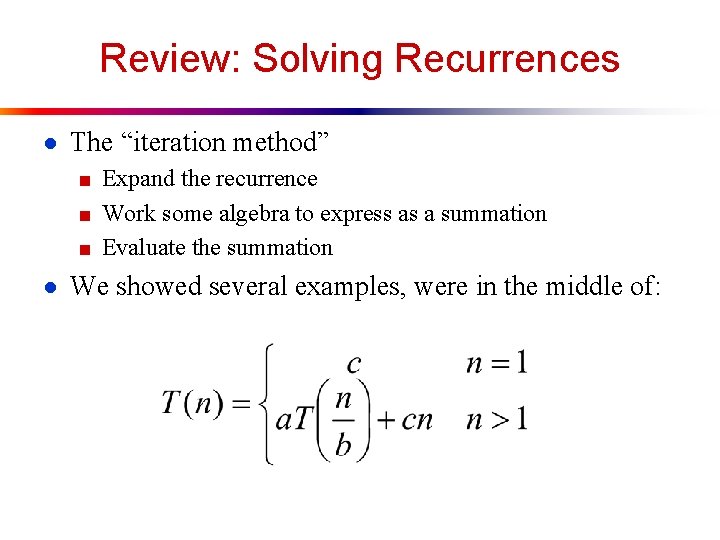
Review: Solving Recurrences ● The “iteration method” ■ Expand the recurrence ■ Work some algebra to express as a summation ■ Evaluate the summation ● We showed several examples, were in the middle of:
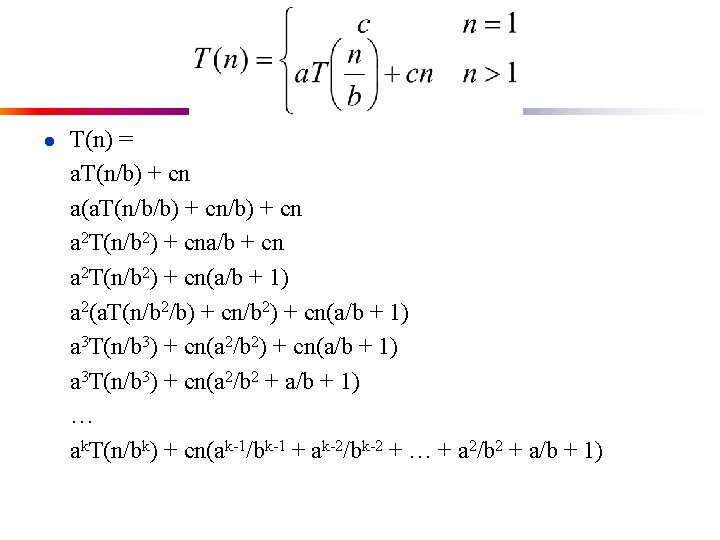
● T(n) = a. T(n/b) + cn a(a. T(n/b/b) + cn a 2 T(n/b 2) + cna/b + cn a 2 T(n/b 2) + cn(a/b + 1) a 2(a. T(n/b 2/b) + cn/b 2) + cn(a/b + 1) a 3 T(n/b 3) + cn(a 2/b 2 + a/b + 1) … ak. T(n/bk) + cn(ak-1/bk-1 + ak-2/bk-2 + … + a 2/b 2 + a/b + 1)
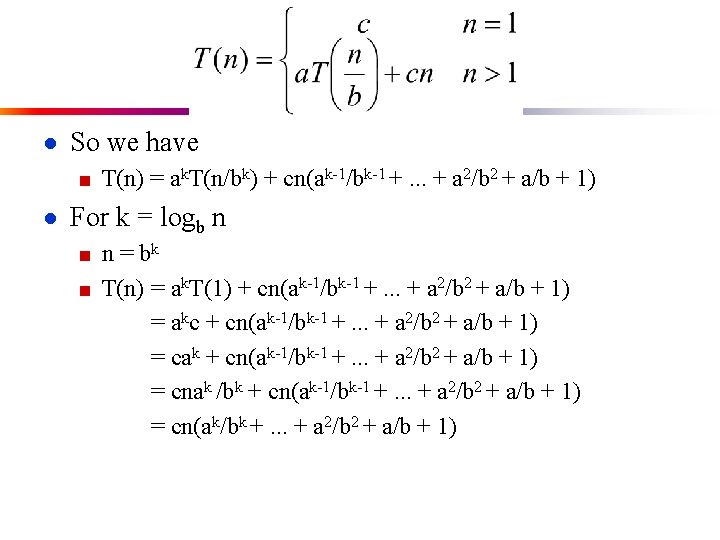
● So we have ■ T(n) = ak. T(n/bk) + cn(ak-1/bk-1 +. . . + a 2/b 2 + a/b + 1) ● For k = logb n ■ n = bk ■ T(n) = ak. T(1) + cn(ak-1/bk-1 +. . . + a 2/b 2 + a/b + 1) = akc + cn(ak-1/bk-1 +. . . + a 2/b 2 + a/b + 1) = cak + cn(ak-1/bk-1 +. . . + a 2/b 2 + a/b + 1) = cnak /bk + cn(ak-1/bk-1 +. . . + a 2/b 2 + a/b + 1) = cn(ak/bk +. . . + a 2/b 2 + a/b + 1)
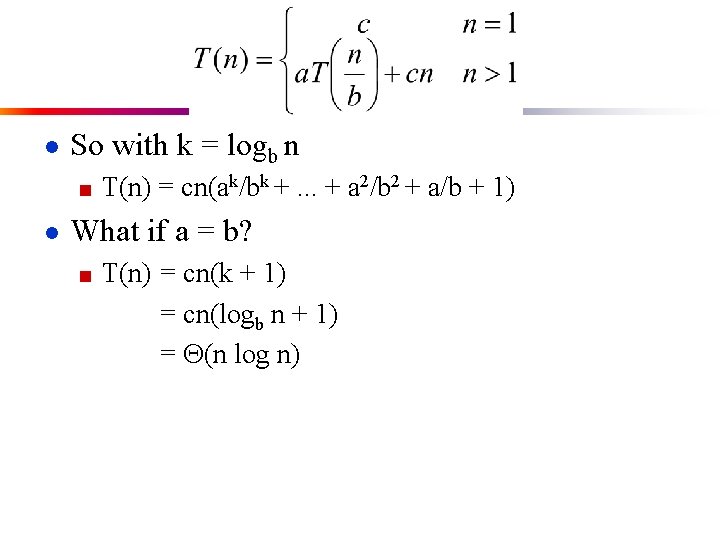
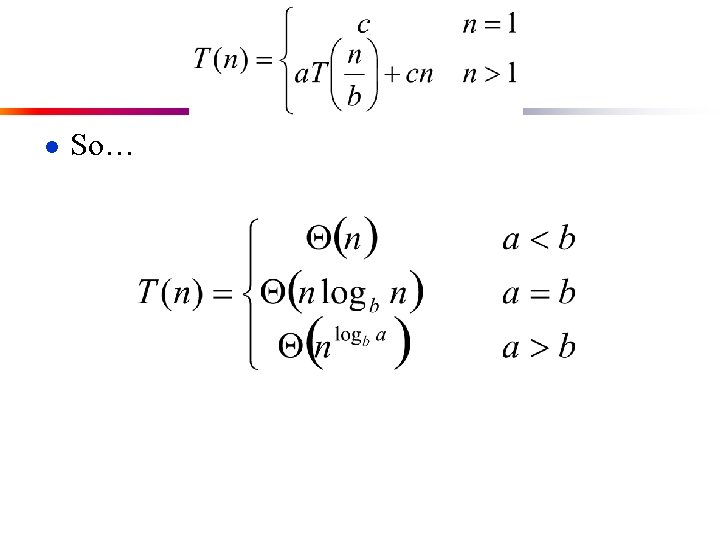
● So with k = logb n ■ T(n) = cn(ak/bk +. . . + a 2/b 2 + a/b + 1) ● What if a = b? ■ T(n) = cn(k + 1) = cn(logb n + 1) = (n log n)
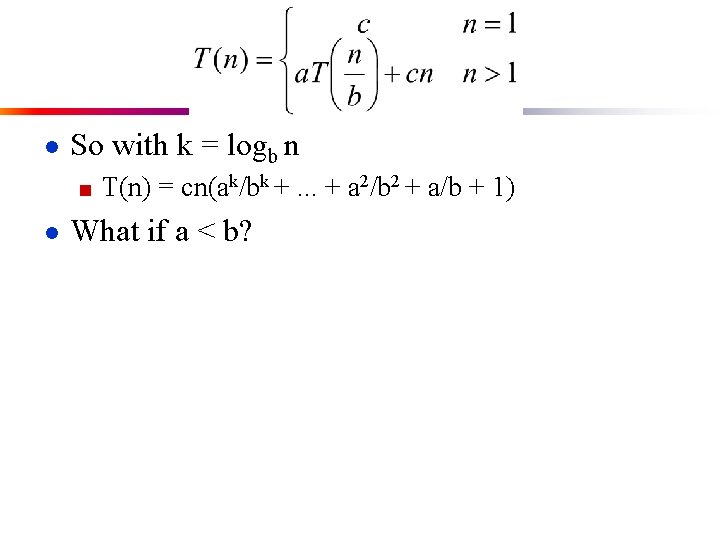
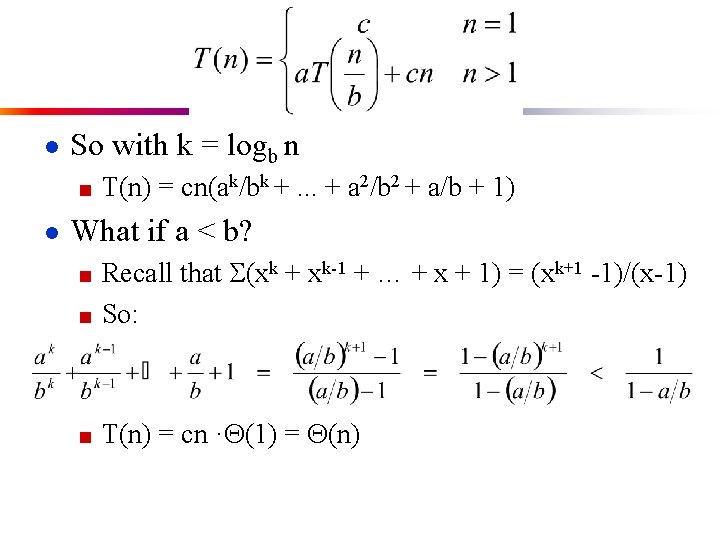
● So with k = logb n ■ T(n) = cn(ak/bk +. . . + a 2/b 2 + a/b + 1) ● What if a < b?
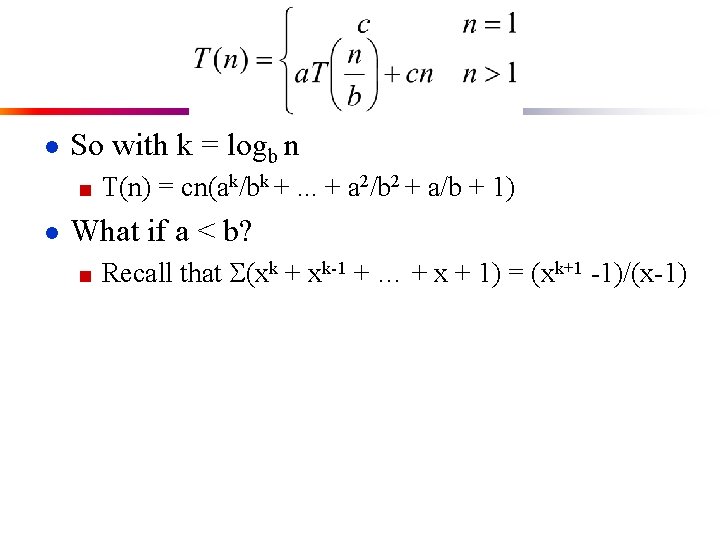
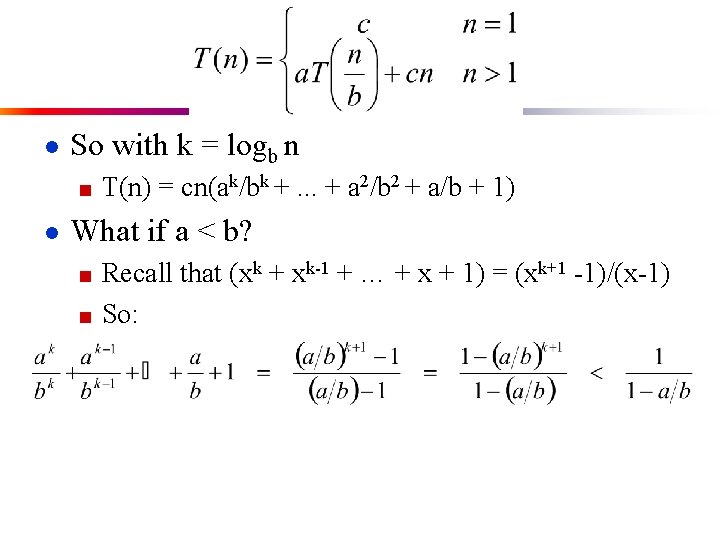
● So with k = logb n ■ T(n) = cn(ak/bk +. . . + a 2/b 2 + a/b + 1) ● What if a < b? ■ Recall that (xk + xk-1 + … + x + 1) = (xk+1 -1)/(x-1)
● So with k = logb n ■ T(n) = cn(ak/bk +. . . + a 2/b 2 + a/b + 1) ● What if a < b? ■ Recall that (xk + xk-1 + … + x + 1) = (xk+1 -1)/(x-1) ■ So:
● So with k = logb n ■ T(n) = cn(ak/bk +. . . + a 2/b 2 + a/b + 1) ● What if a < b? ■ Recall that (xk + xk-1 + … + x + 1) = (xk+1 -1)/(x-1) ■ So: ■ T(n) = cn · (1) = (n)
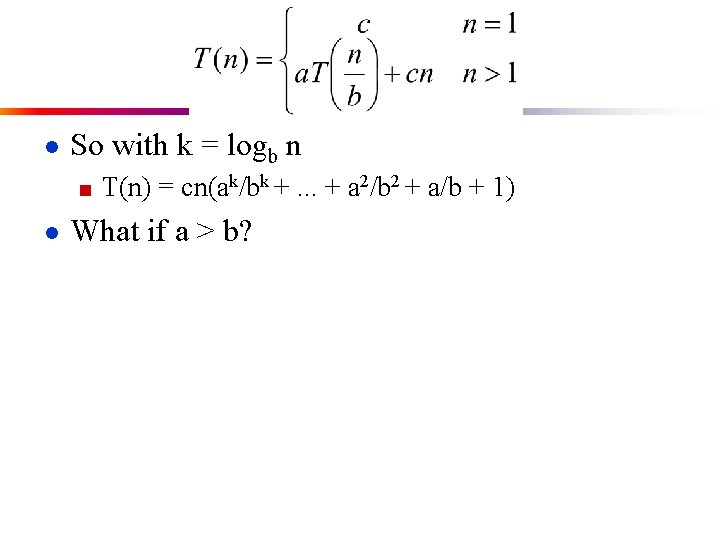
● So with k = logb n ■ T(n) = cn(ak/bk +. . . + a 2/b 2 + a/b + 1) ● What if a > b?
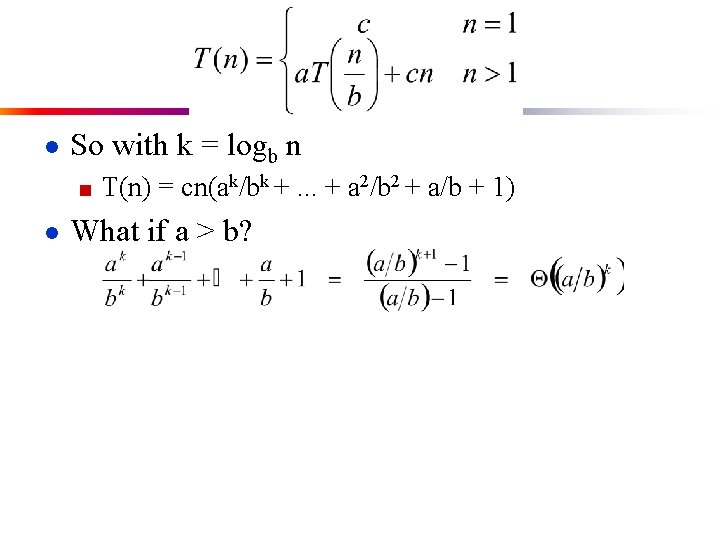
● So with k = logb n ■ T(n) = cn(ak/bk +. . . + a 2/b 2 + a/b + 1) ● What if a > b?
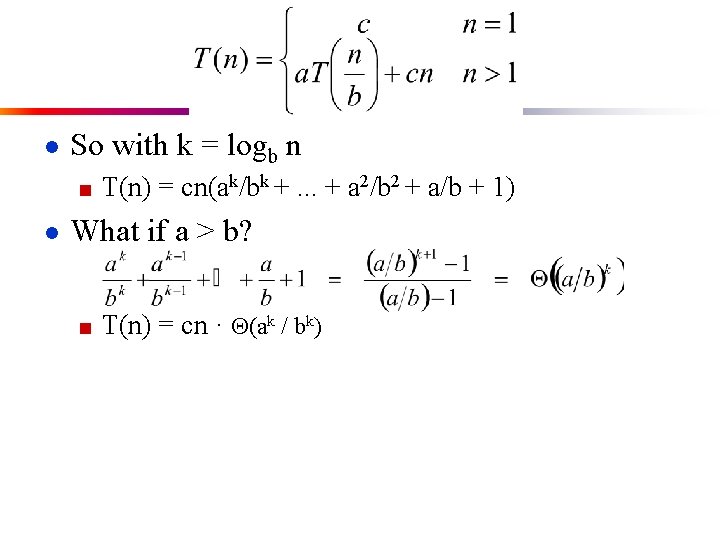
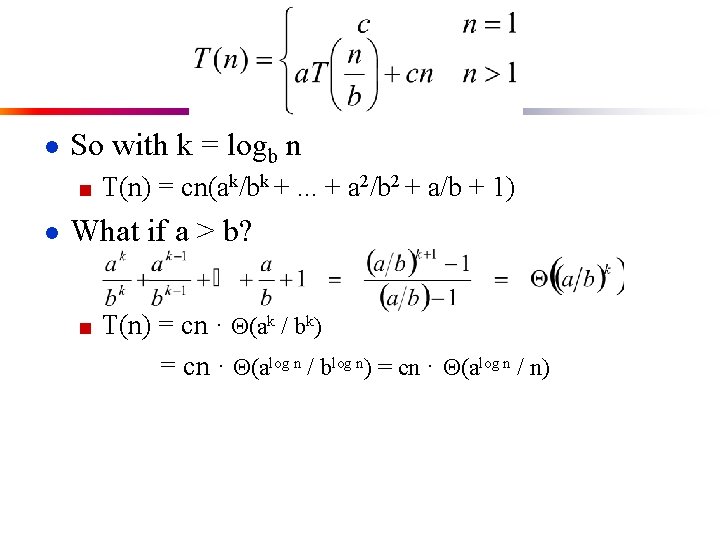
● So with k = logb n ■ T(n) = cn(ak/bk +. . . + a 2/b 2 + a/b + 1) ● What if a > b? ■ T(n) = cn · (ak / bk)
● So with k = logb n ■ T(n) = cn(ak/bk +. . . + a 2/b 2 + a/b + 1) ● What if a > b? ■ T(n) = cn · (ak / bk) = cn · (alog n / blog n) = cn · (alog n / n)
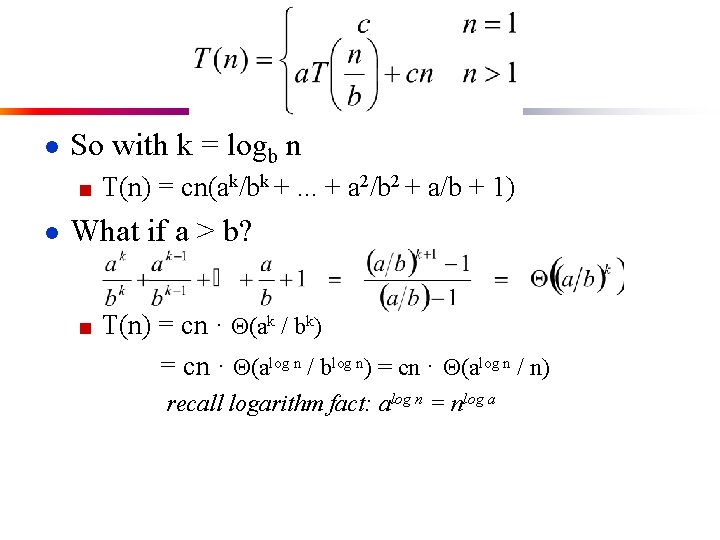
● So with k = logb n ■ T(n) = cn(ak/bk +. . . + a 2/b 2 + a/b + 1) ● What if a > b? ■ T(n) = cn · (ak / bk) = cn · (alog n / blog n) = cn · (alog n / n) recall logarithm fact: alog n = nlog a
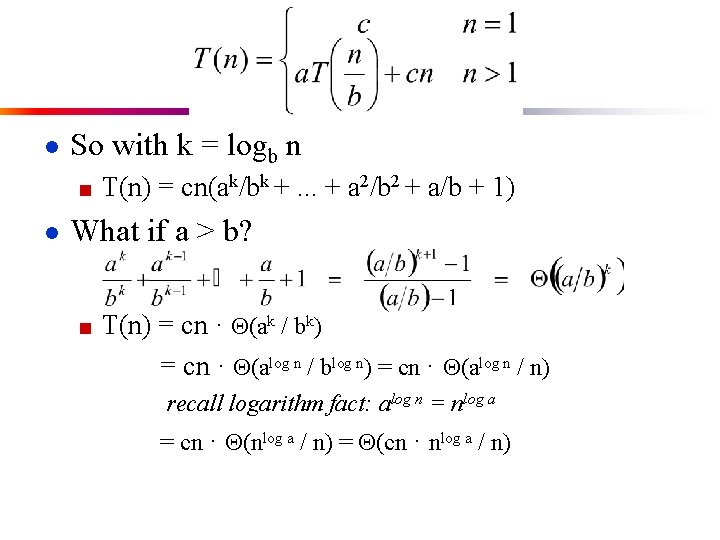
● So with k = logb n ■ T(n) = cn(ak/bk +. . . + a 2/b 2 + a/b + 1) ● What if a > b? ■ T(n) = cn · (ak / bk) = cn · (alog n / blog n) = cn · (alog n / n) recall logarithm fact: alog n = nlog a = cn · (nlog a / n) = (cn · nlog a / n)
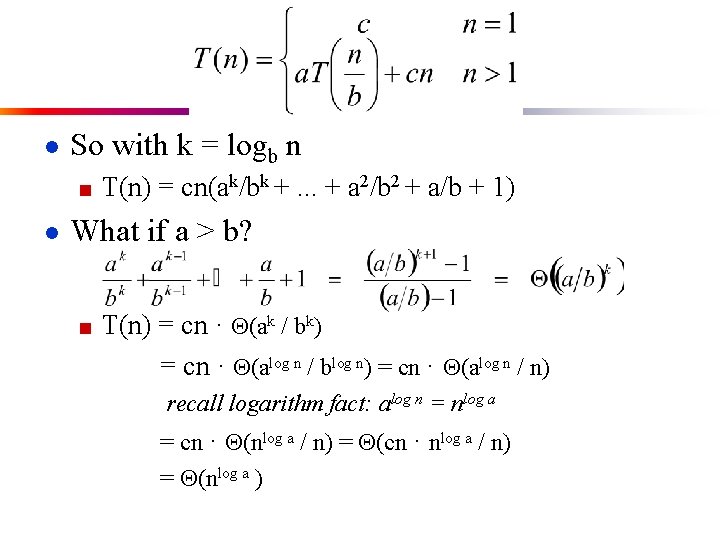
● So with k = logb n ■ T(n) = cn(ak/bk +. . . + a 2/b 2 + a/b + 1) ● What if a > b? ■ T(n) = cn · (ak / bk) = cn · (alog n / blog n) = cn · (alog n / n) recall logarithm fact: alog n = nlog a = cn · (nlog a / n) = (cn · nlog a / n) = (nlog a )
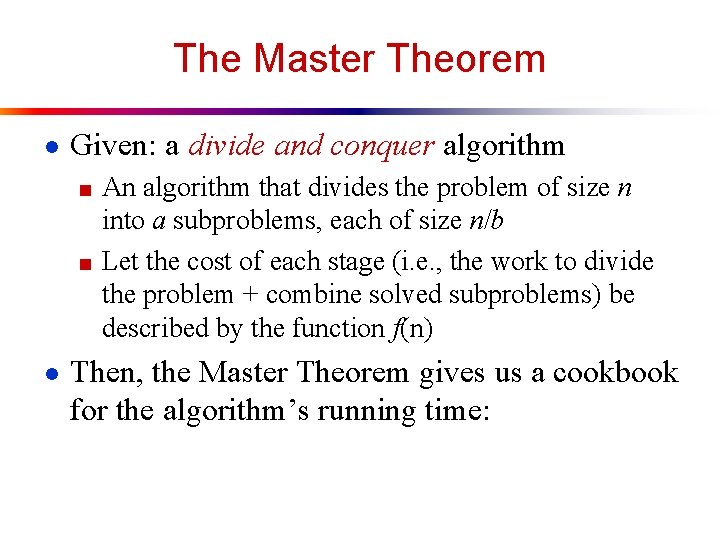
The Master Theorem ● Given: a divide and conquer algorithm ■ An algorithm that divides the problem of size n into a subproblems, each of size n/b ■ Let the cost of each stage (i. e. , the work to divide the problem + combine solved subproblems) be described by the function f(n) ● Then, the Master Theorem gives us a cookbook for the algorithm’s running time:
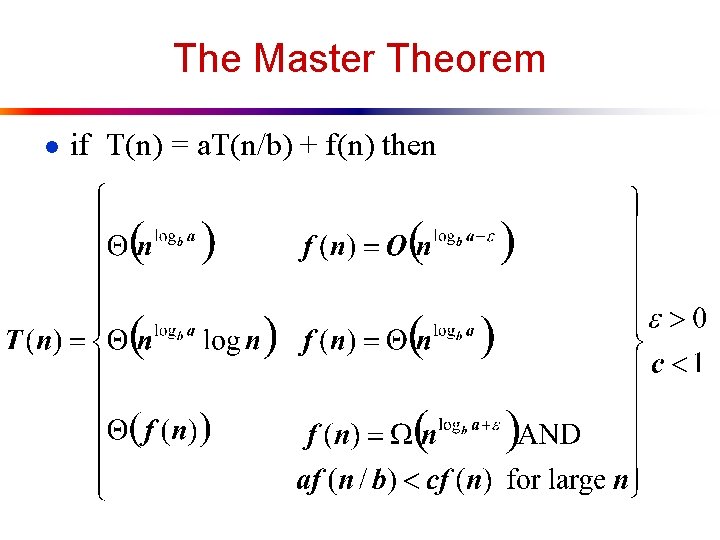
The Master Theorem ● if T(n) = a. T(n/b) + f(n) then
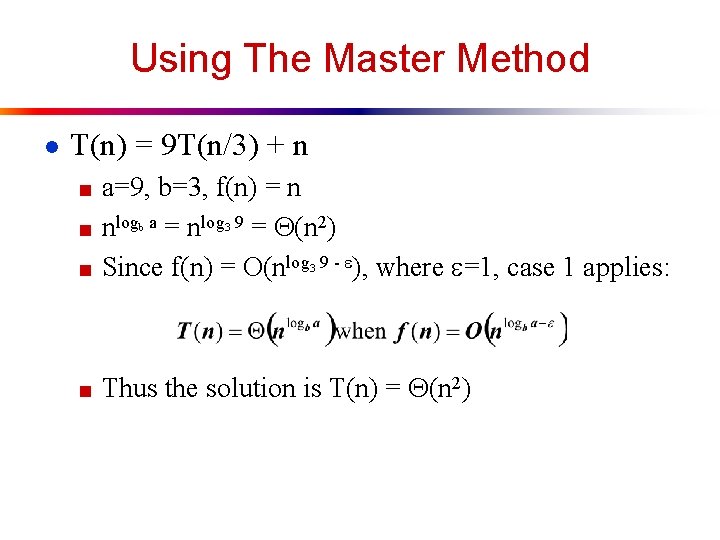
Using The Master Method ● T(n) = 9 T(n/3) + n ■ a=9, b=3, f(n) = n ■ nlog a = nlog 9 = (n 2) ■ Since f(n) = O(nlog 9 - ), where =1, case 1 applies: b 3 3 ■ Thus the solution is T(n) = (n 2)
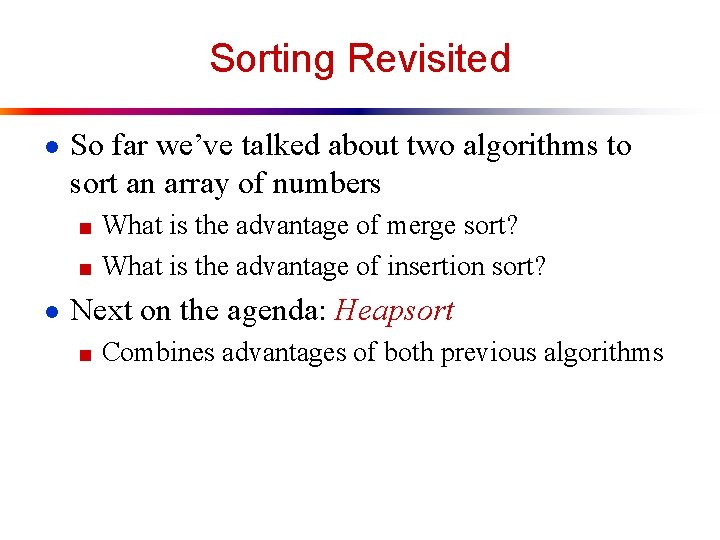
Sorting Revisited ● So far we’ve talked about two algorithms to sort an array of numbers ■ What is the advantage of merge sort? ■ What is the advantage of insertion sort? ● Next on the agenda: Heapsort ■ Combines advantages of both previous algorithms
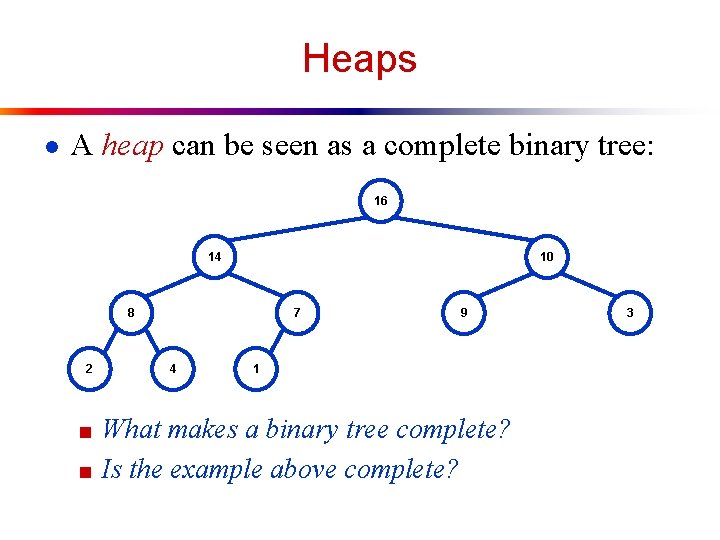
Heaps ● A heap can be seen as a complete binary tree: 16 14 10 8 2 7 4 9 1 ■ What makes a binary tree complete? ■ Is the example above complete? 3
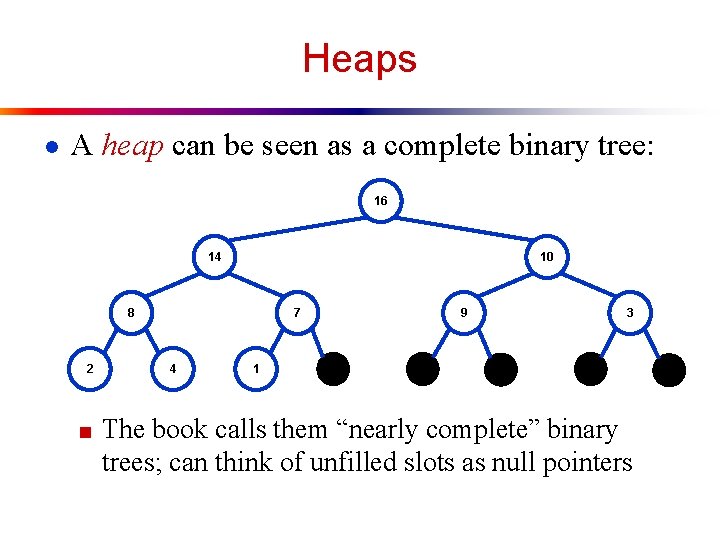
Heaps ● A heap can be seen as a complete binary tree: 16 14 10 8 2 7 4 1 9 1 1 3 1 1 ■ The book calls them “nearly complete” binary trees; can think of unfilled slots as null pointers 1
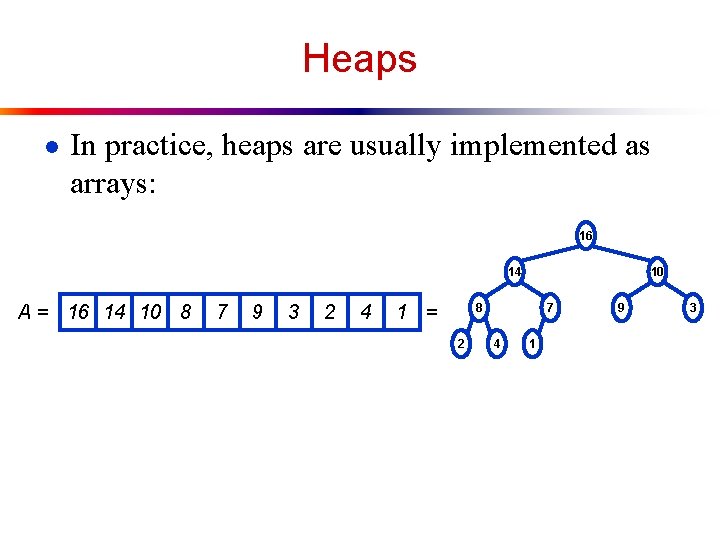
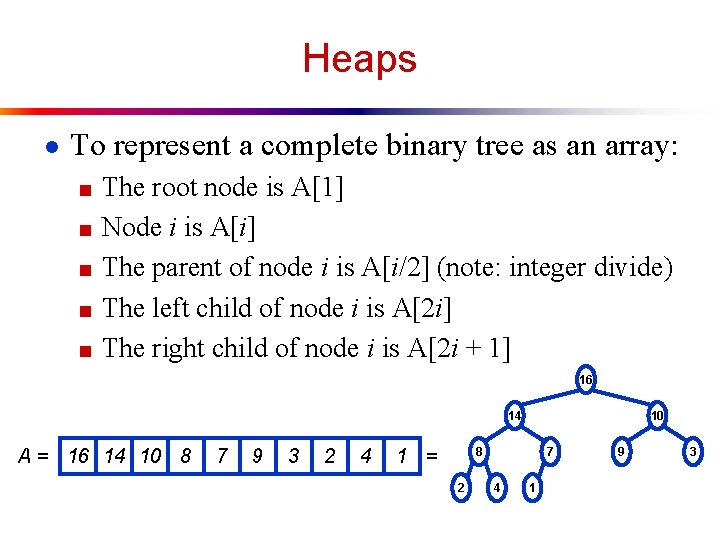
Heaps ● In practice, heaps are usually implemented as arrays: 16 14 A = 16 14 10 8 7 9 3 2 4 10 8 1 = 2 7 4 1 9 3
Heaps ● To represent a complete binary tree as an array: ■ The root node is A[1] ■ Node i is A[i] ■ The parent of node i is A[i/2] (note: integer divide) ■ The left child of node i is A[2 i] ■ The right child of node i is A[2 i + 1] 16 14 A = 16 14 10 8 7 9 3 2 4 10 8 1 = 2 7 4 1 9 3
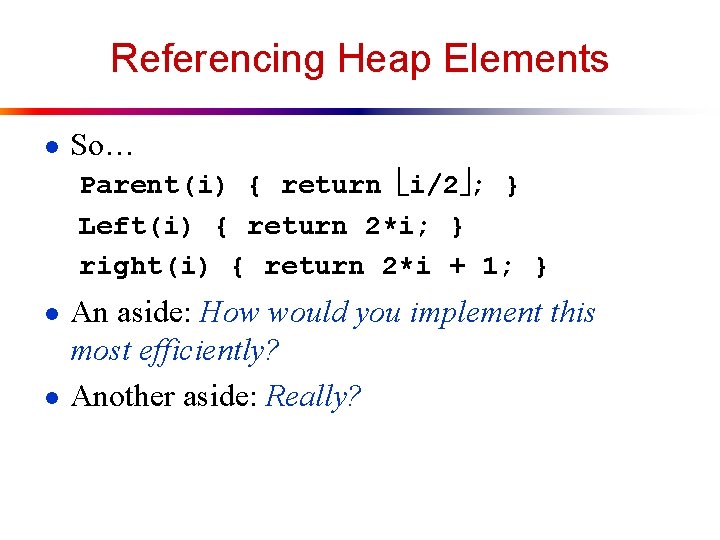
Referencing Heap Elements ● So… Parent(i) { return i/2 ; } Left(i) { return 2*i; } right(i) { return 2*i + 1; } ● An aside: How would you implement this most efficiently? ● Another aside: Really?
The Heap Property ● Heaps also satisfy the heap property: A[Parent(i)] A[i] for all nodes i > 1 ■ In other words, the value of a node is at most the value of its parent ■ Where is the largest element in a heap stored? ● Definitions: ■ The height of a node in the tree = the number of edges on the longest downward path to a leaf ■ The height of a tree = the height of its root
Heap Height ● What is the height of an n-element heap? Why? ● This is nice: basic heap operations take at most time proportional to the height of the heap
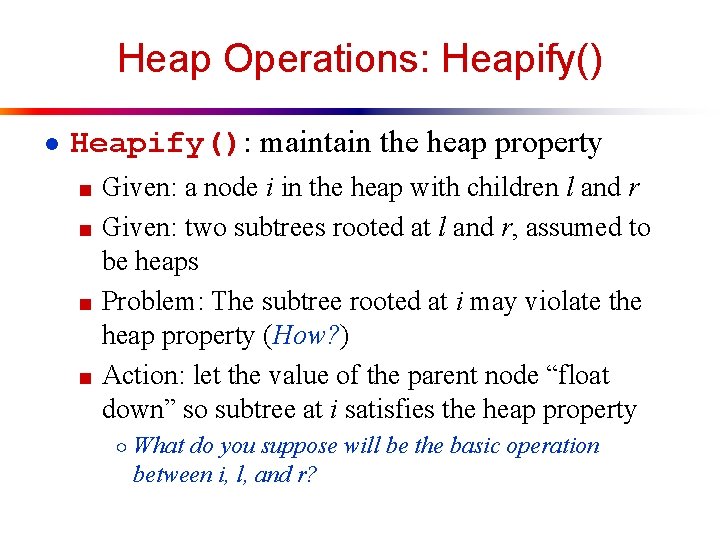
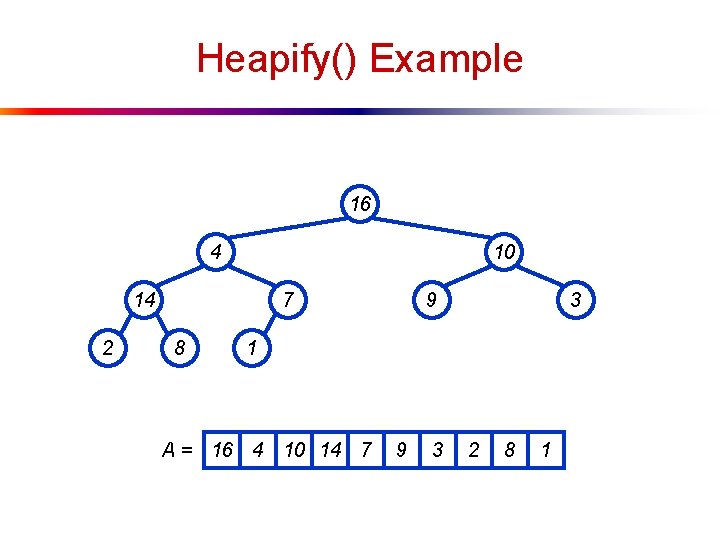
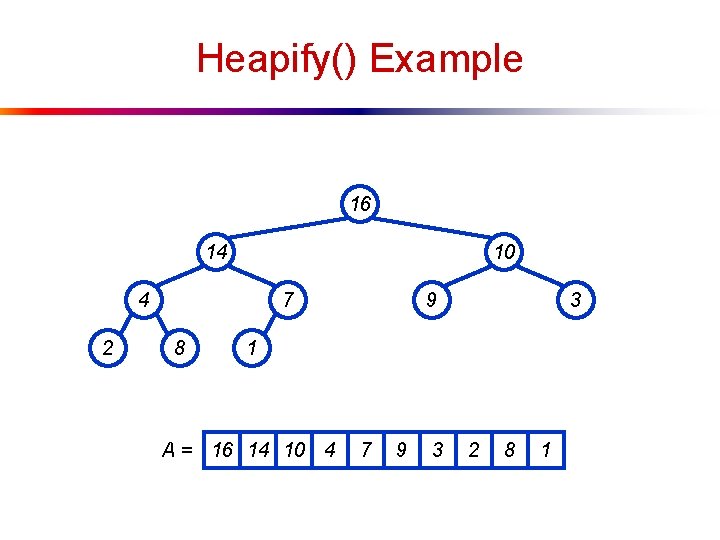
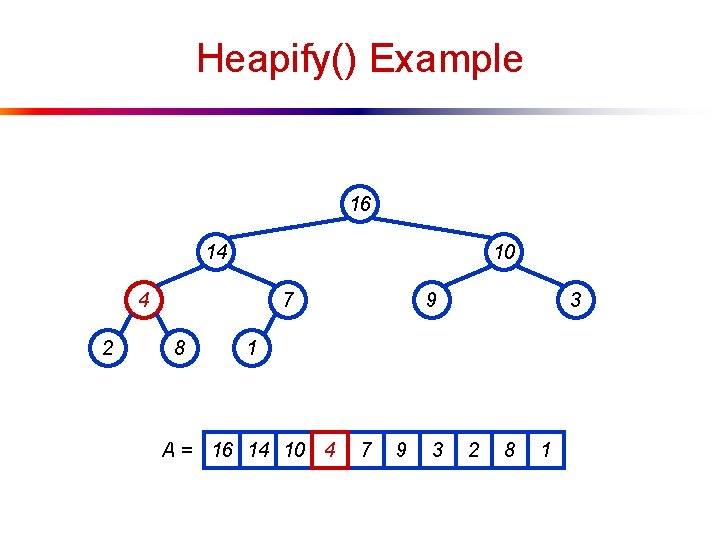
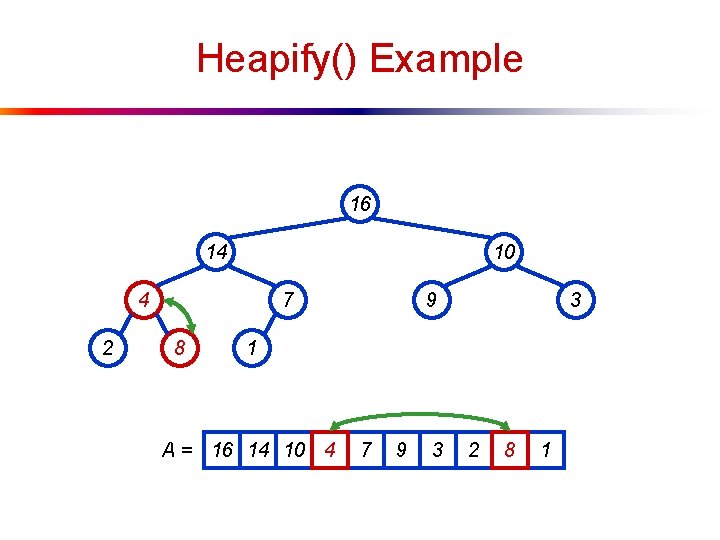
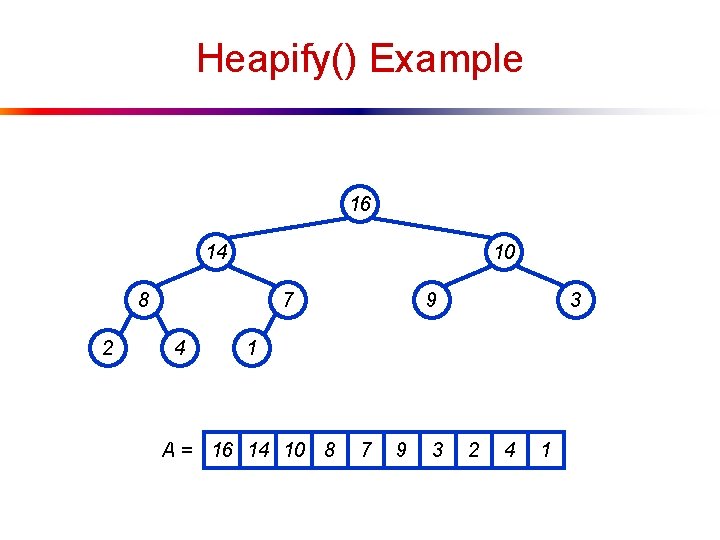
Heap Operations: Heapify() ● Heapify(): maintain the heap property ■ Given: a node i in the heap with children l and r ■ Given: two subtrees rooted at l and r, assumed to be heaps ■ Problem: The subtree rooted at i may violate the heap property (How? ) ■ Action: let the value of the parent node “float down” so subtree at i satisfies the heap property ○ What do you suppose will be the basic operation between i, l, and r?
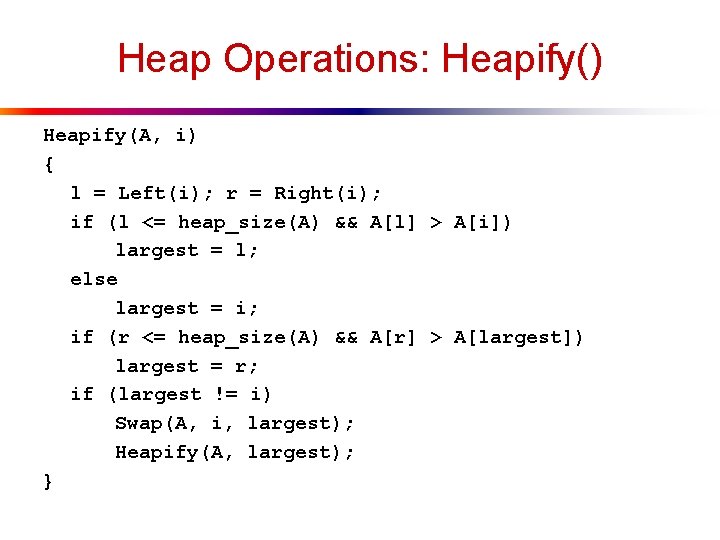
Heap Operations: Heapify() Heapify(A, i) { l = Left(i); r = Right(i); if (l <= heap_size(A) && A[l] > A[i]) largest = l; else largest = i; if (r <= heap_size(A) && A[r] > A[largest]) largest = r; if (largest != i) Swap(A, i, largest); Heapify(A, largest); }
Heapify() Example 16 4 10 14 2 7 8 9 3 1 A = 16 4 10 14 7 9 3 2 8 1
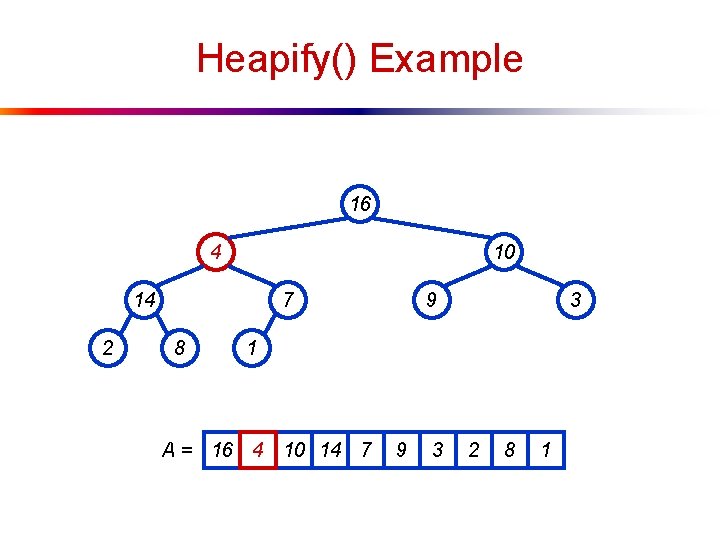
Heapify() Example 16 4 10 14 2 7 8 9 3 1 A = 16 4 10 14 7 9 3 2 8 1
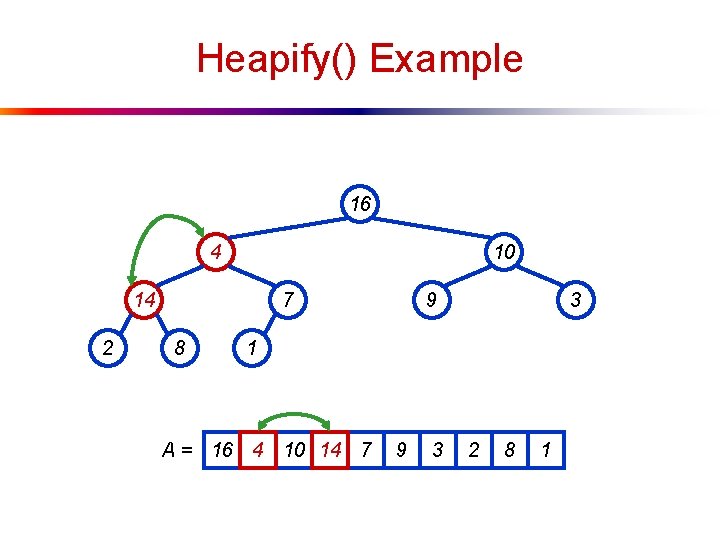
Heapify() Example 16 4 10 14 2 7 8 9 3 1 A = 16 4 10 14 7 9 3 2 8 1
Heapify() Example 16 14 10 4 2 7 8 9 3 1 A = 16 14 10 4 7 9 3 2 8 1
Heapify() Example 16 14 10 4 2 7 8 9 3 1 A = 16 14 10 4 7 9 3 2 8 1
Heapify() Example 16 14 10 4 2 7 8 9 3 1 A = 16 14 10 4 7 9 3 2 8 1
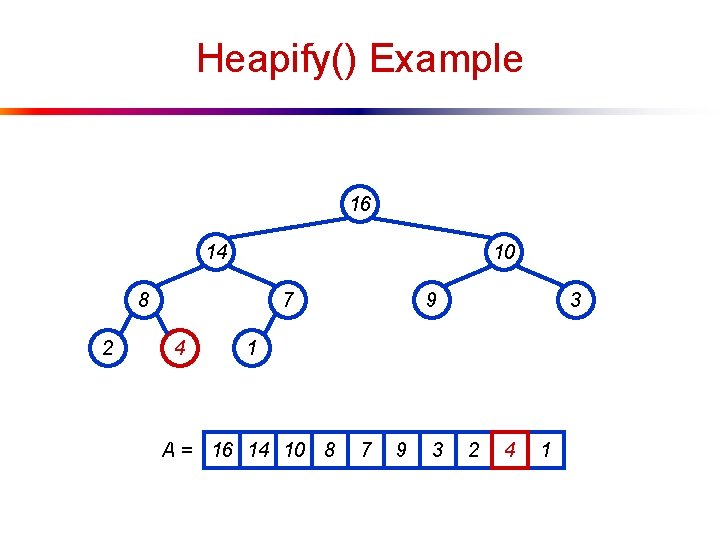
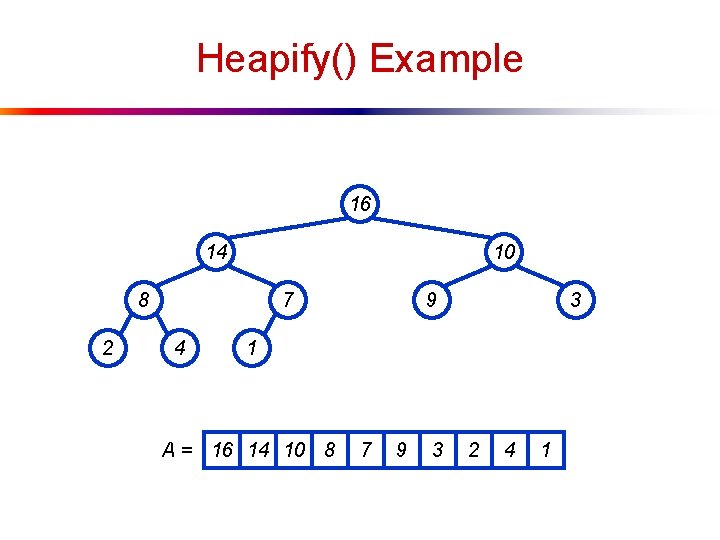
Heapify() Example 16 14 10 8 2 7 4 9 3 1 A = 16 14 10 8 7 9 3 2 4 1
Heapify() Example 16 14 10 8 2 7 4 9 3 1 A = 16 14 10 8 7 9 3 2 4 1
Heapify() Example 16 14 10 8 2 7 4 9 3 1 A = 16 14 10 8 7 9 3 2 4 1
Analyzing Heapify(): Informal ● Aside from the recursive call, what is the running time of Heapify()? ● How many times can Heapify() recursively call itself? ● What is the worst-case running time of Heapify() on a heap of size n?
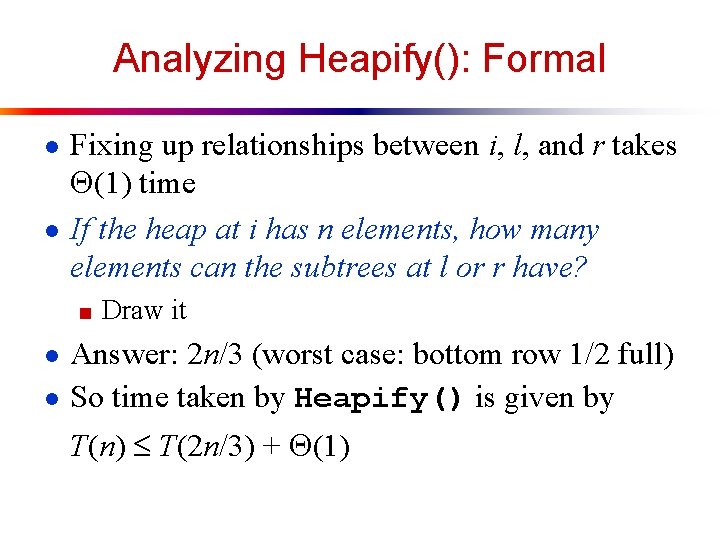
Analyzing Heapify(): Formal ● Fixing up relationships between i, l, and r takes (1) time ● If the heap at i has n elements, how many elements can the subtrees at l or r have? ■ Draw it ● Answer: 2 n/3 (worst case: bottom row 1/2 full) ● So time taken by Heapify() is given by T(n) T(2 n/3) + (1)
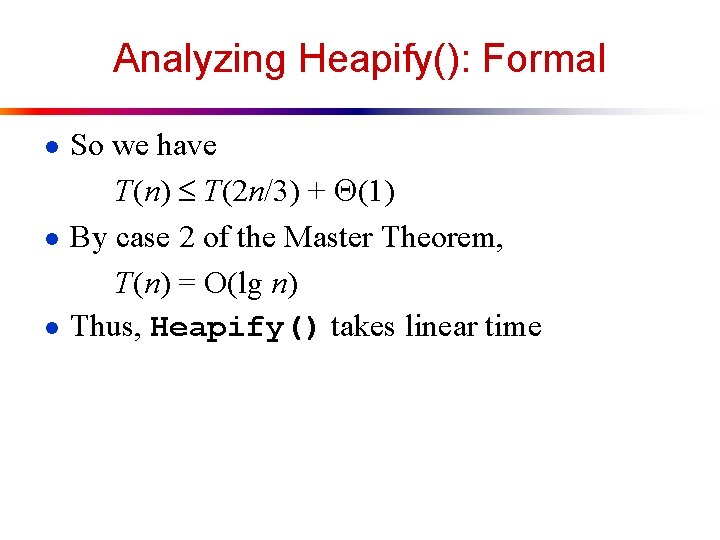
Analyzing Heapify(): Formal ● So we have T(n) T(2 n/3) + (1) ● By case 2 of the Master Theorem, T(n) = O(lg n) ● Thus, Heapify() takes linear time
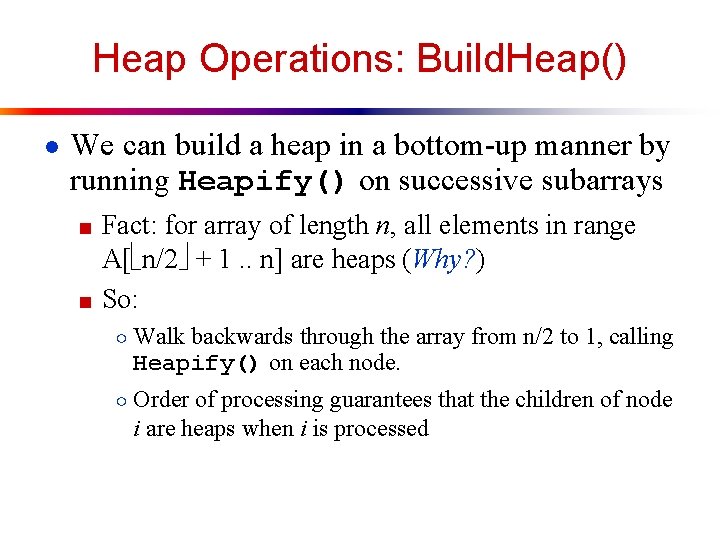
Heap Operations: Build. Heap() ● We can build a heap in a bottom-up manner by running Heapify() on successive subarrays ■ Fact: for array of length n, all elements in range A[ n/2 + 1. . n] are heaps (Why? ) ■ So: ○ Walk backwards through the array from n/2 to 1, calling Heapify() on each node. ○ Order of processing guarantees that the children of node i are heaps when i is processed
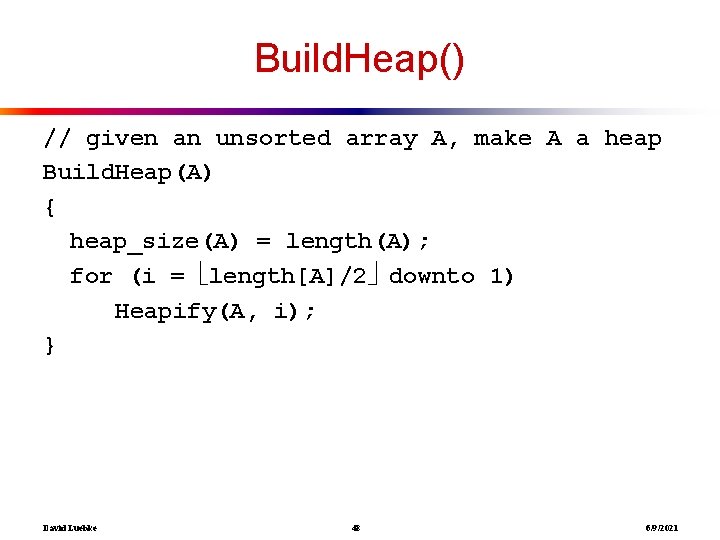
Build. Heap() // given an unsorted array A, make A a heap Build. Heap(A) { heap_size(A) = length(A); for (i = length[A]/2 downto 1) Heapify(A, i); } David Luebke 48 6/9/2021
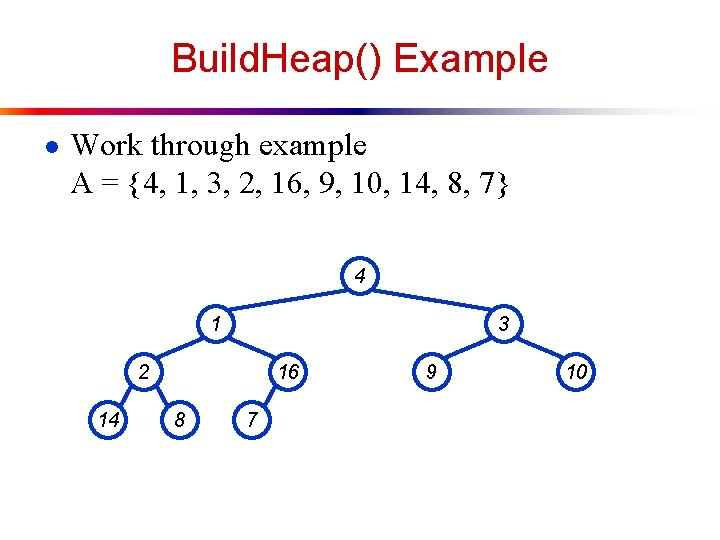
Build. Heap() Example ● Work through example A = {4, 1, 3, 2, 16, 9, 10, 14, 8, 7} 4 1 3 2 14 16 8 7 9 10
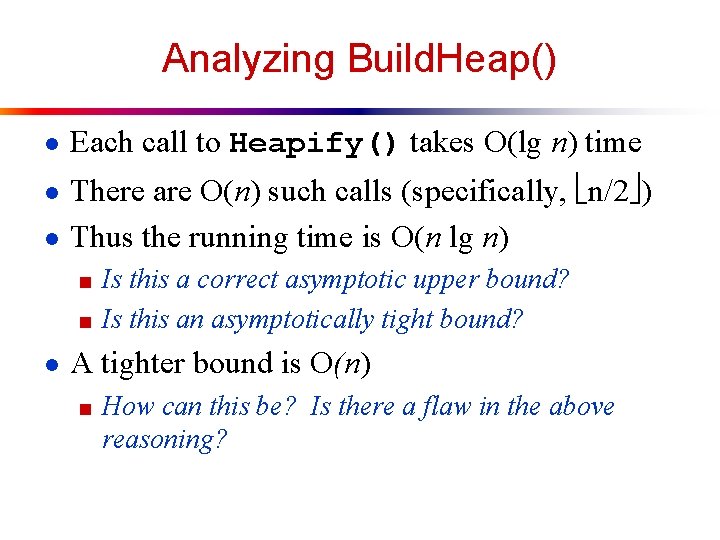
Analyzing Build. Heap() ● Each call to Heapify() takes O(lg n) time ● There are O(n) such calls (specifically, n/2 ) ● Thus the running time is O(n lg n) ■ Is this a correct asymptotic upper bound? ■ Is this an asymptotically tight bound? ● A tighter bound is O(n) ■ How can this be? Is there a flaw in the above reasoning?
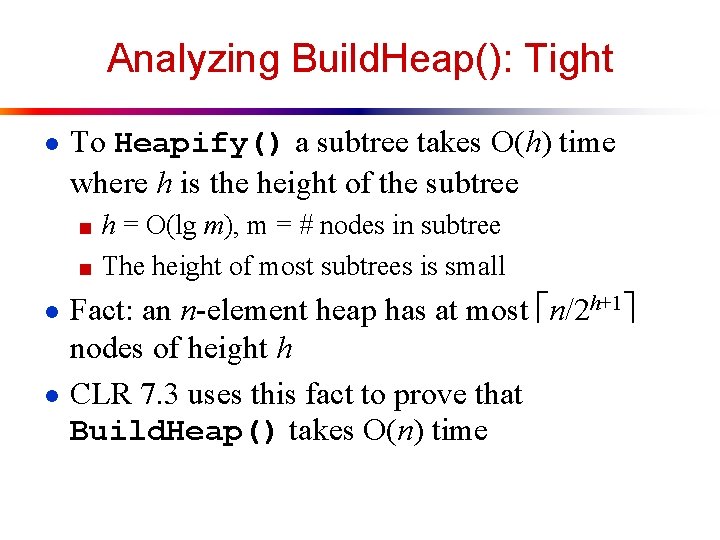
Analyzing Build. Heap(): Tight ● To Heapify() a subtree takes O(h) time where h is the height of the subtree ■ h = O(lg m), m = # nodes in subtree ■ The height of most subtrees is small ● Fact: an n-element heap has at most n/2 h+1 nodes of height h ● CLR 7. 3 uses this fact to prove that Build. Heap() takes O(n) time
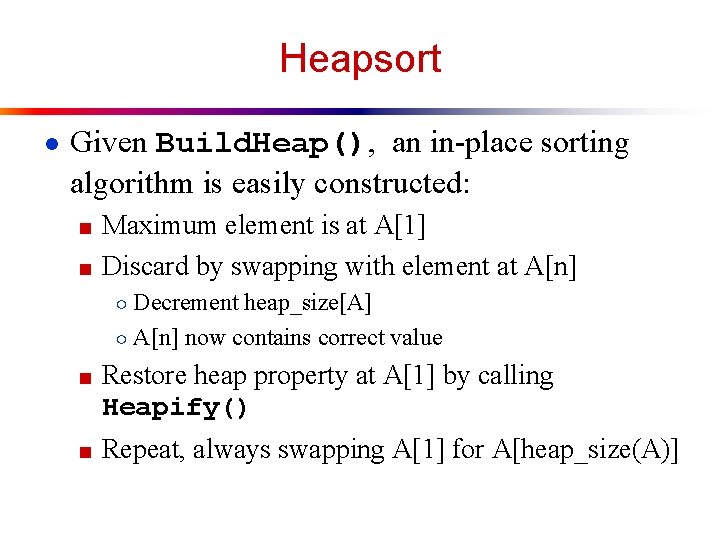
Heapsort ● Given Build. Heap(), an in-place sorting algorithm is easily constructed: ■ Maximum element is at A[1] ■ Discard by swapping with element at A[n] ○ Decrement heap_size[A] ○ A[n] now contains correct value ■ Restore heap property at A[1] by calling Heapify() ■ Repeat, always swapping A[1] for A[heap_size(A)]
Heapsort(A) { Build. Heap(A); for (i = length(A) downto 2) { Swap(A[1], A[i]); heap_size(A) -= 1; Heapify(A, 1); } }
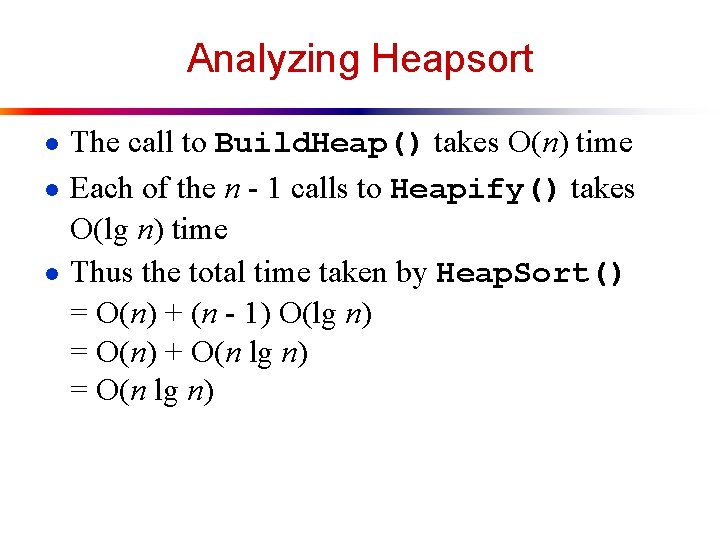
Analyzing Heapsort ● The call to Build. Heap() takes O(n) time ● Each of the n - 1 calls to Heapify() takes O(lg n) time ● Thus the total time taken by Heap. Sort() = O(n) + (n - 1) O(lg n) = O(n) + O(n lg n) = O(n lg n)
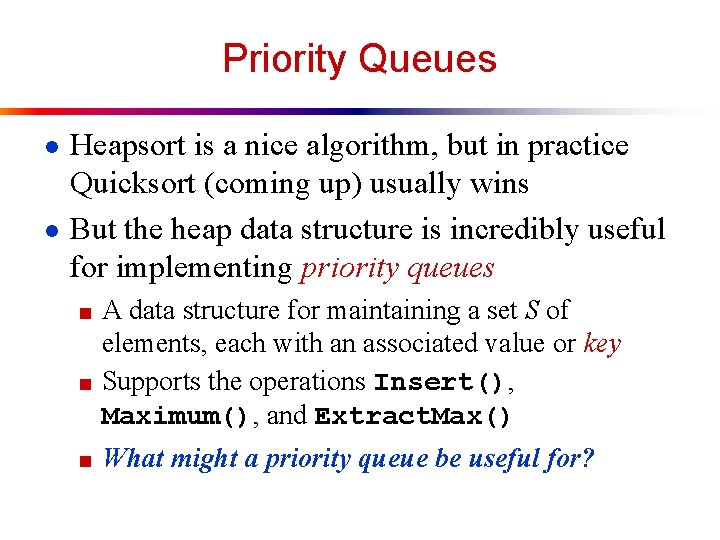
Priority Queues ● Heapsort is a nice algorithm, but in practice Quicksort (coming up) usually wins ● But the heap data structure is incredibly useful for implementing priority queues ■ A data structure for maintaining a set S of elements, each with an associated value or key ■ Supports the operations Insert(), Maximum(), and Extract. Max() ■ What might a priority queue be useful for?
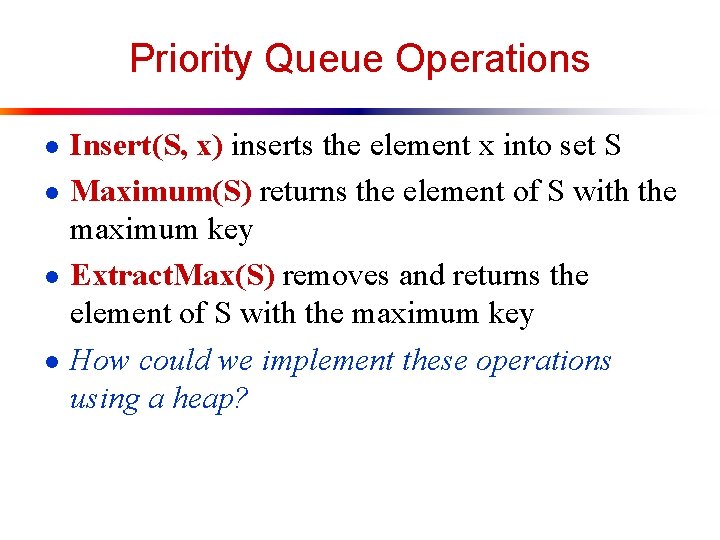
Priority Queue Operations ● Insert(S, x) inserts the element x into set S ● Maximum(S) returns the element of S with the maximum key ● Extract. Max(S) removes and returns the element of S with the maximum key ● How could we implement these operations using a heap?