
Analysis of Algorithms Initially prepared by Dr lyas
Analysis of Algorithms Initially prepared by Dr. İlyas Çiçekli; improved by various Bilkent CS 202 instructors. CS 202 - Fundamentals of Computer Science II 1
Algorithm • An algorithm is a set of instructions to be followed to solve a problem. – There can be more than one solution (more than one algorithm) to solve a given problem. – An algorithm can be implemented using different prog. languages on different platforms. • Once we have a correct algorithm for the problem, we have to determine the efficiency of that algorithm. – How much time that algorithm requires. – How much space that algorithm requires. • We will focus on – How to estimate the time required for an algorithm – How to reduce the time required CS 202 - Fundamentals of Computer Science II 2
Analysis of Algorithms • How do we compare the time efficiency of two algorithms that solve the same problem? • We should employ mathematical techniques that analyze algorithms independently of specific implementations, computers, or data. • To analyze algorithms: – First, we start counting the number of significant operations in a particular solution to assess its efficiency. – Then, we will express the efficiency of algorithms using growth functions. CS 202 - Fundamentals of Computer Science II 3
Analysis of Algorithms • Simple instructions (+, -, *, /, =, if, call) take 1 step • Loops and subroutine calls are not simple operations – They depend on size of data and the subroutine – “sort” is not a single step operation – Complex Operations (matrix addition, array resizing) are not single step • We assume infinite memory • We do not include the time required to read the input CS 202 - Fundamentals of Computer Science II 4

The Execution Time of Algorithms Consecutive statements Times count = count + 1; sum = sum + count; 1 1 Total cost = 1 + 1 The time required for this algorithm is constant Don’t forget: We assume that each simple operation takes one unit of time CS 202 - Fundamentals of Computer Science II 5
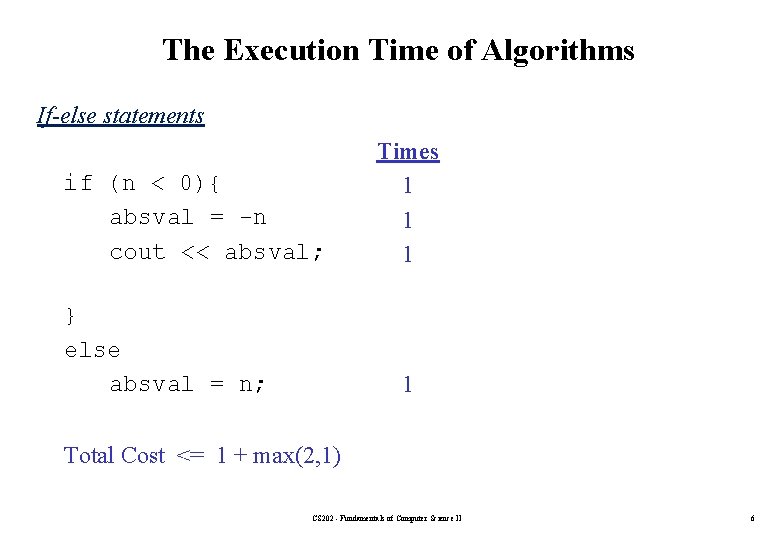
The Execution Time of Algorithms If-else statements if (n < 0){ absval = -n cout << absval; } else absval = n; Times 1 1 Total Cost <= 1 + max(2, 1) CS 202 - Fundamentals of Computer Science II 6
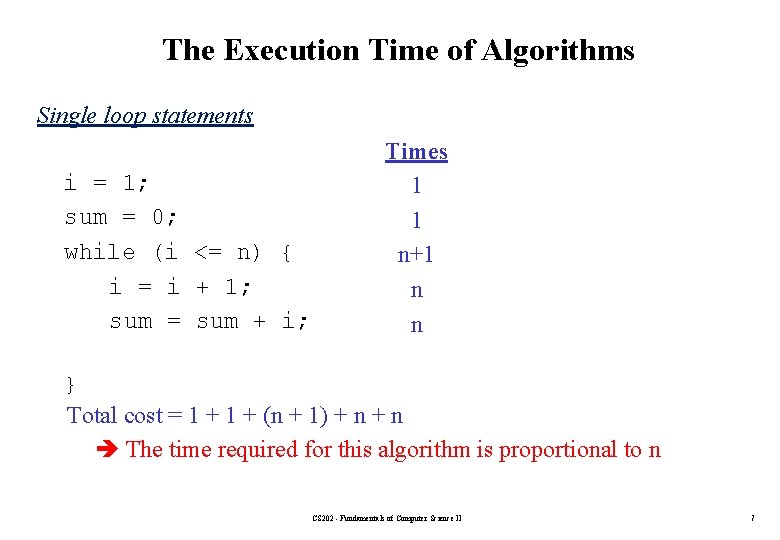
The Execution Time of Algorithms Single loop statements i = 1; sum = 0; while (i <= n) { i = i + 1; sum = sum + i; Times 1 1 n+1 n n } Total cost = 1 + (n + 1) + n The time required for this algorithm is proportional to n CS 202 - Fundamentals of Computer Science II 7
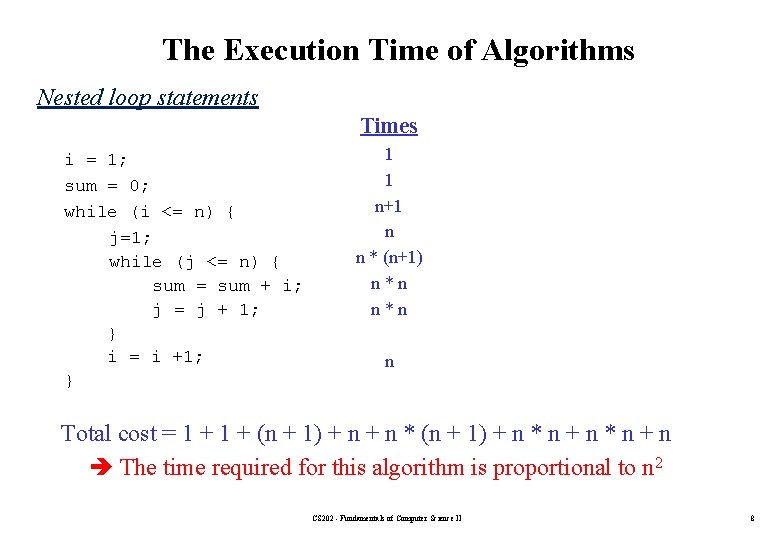
The Execution Time of Algorithms Nested loop statements Times i = 1; sum = 0; while (i <= n) { j=1; while (j <= n) { sum = sum + i; j = j + 1; } i = i +1; } 1 1 n+1 n n * (n+1) n*n n Total cost = 1 + (n + 1) + n * n + n The time required for this algorithm is proportional to n 2 CS 202 - Fundamentals of Computer Science II 8
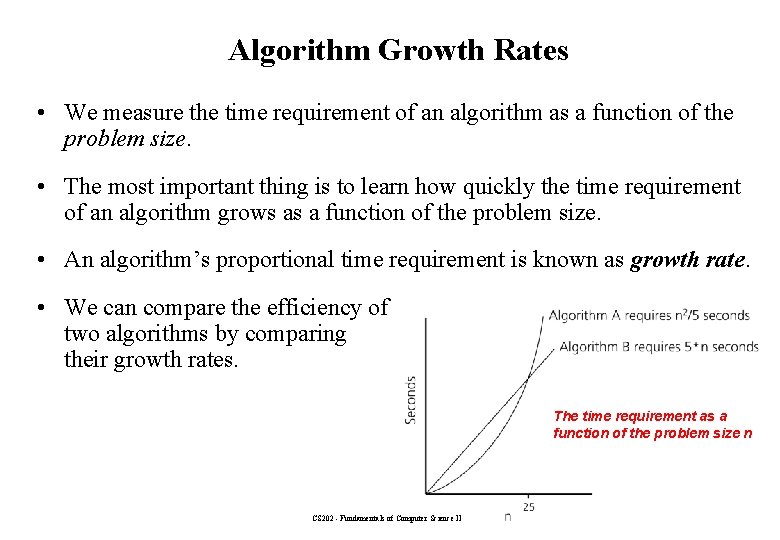
Algorithm Growth Rates • We measure the time requirement of an algorithm as a function of the problem size. • The most important thing is to learn how quickly the time requirement of an algorithm grows as a function of the problem size. • An algorithm’s proportional time requirement is known as growth rate. • We can compare the efficiency of two algorithms by comparing their growth rates. The time requirement as a function of the problem size n CS 202 - Fundamentals of Computer Science II 9
Order-of-Magnitude Analysis and Big-O Notation • If Algorithm A requires time at most proportional to f(n), it is said to be order f(n), and it is denoted as O(f(n)) • f(n) is called the algorithm’s growth-rate function • Since the capital O is used in the notation, this notation is called the Big-O notation CS 202 - Fundamentals of Computer Science II 10
Big-O Notation Definition: • Algorithm A is order of if it requires no more than time units to solve a problem of size – There may exist many values of c and n 0 • More informally, is an upper bound on CS 202 - Fundamentals of Computer Science II 11
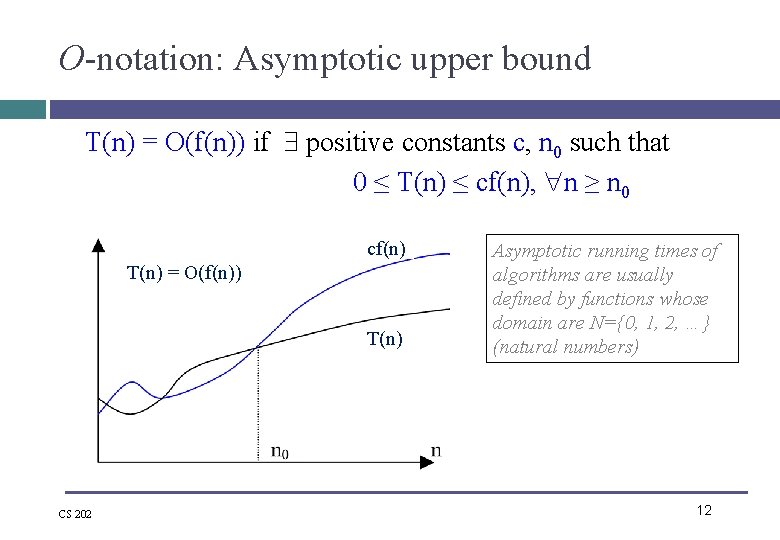
O-notation: Asymptotic upper bound T(n) = O(f(n)) if positive constants c, n 0 such that 0 ≤ T(n) ≤ cf(n), n ≥ n 0 cf(n) T(n) = O(f(n)) T(n) CS 202 Asymptotic running times of algorithms are usually defined by functions whose domain are N={0, 1, 2, …} (natural numbers) 12
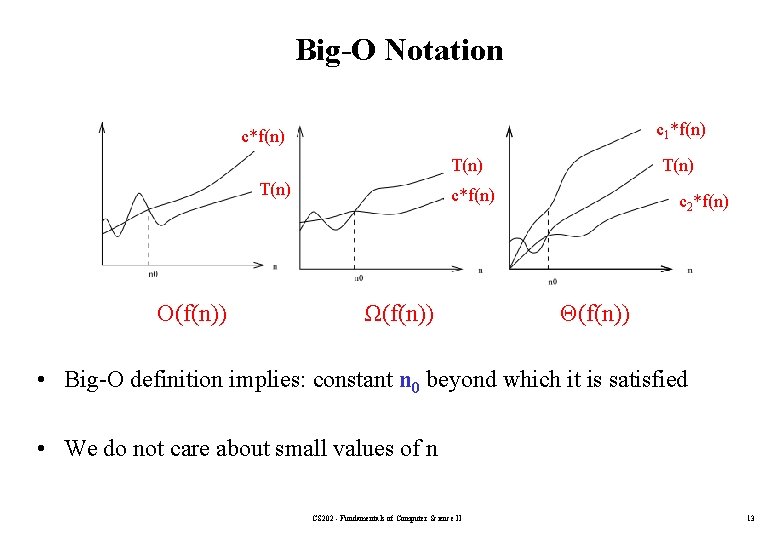
Big-O Notation c 1*f(n) c*f(n) T(n) O(f(n)) T(n) c*f(n) Ω(f(n)) c 2*f(n) Θ(f(n)) • Big-O definition implies: constant n 0 beyond which it is satisfied • We do not care about small values of n CS 202 - Fundamentals of Computer Science II 13
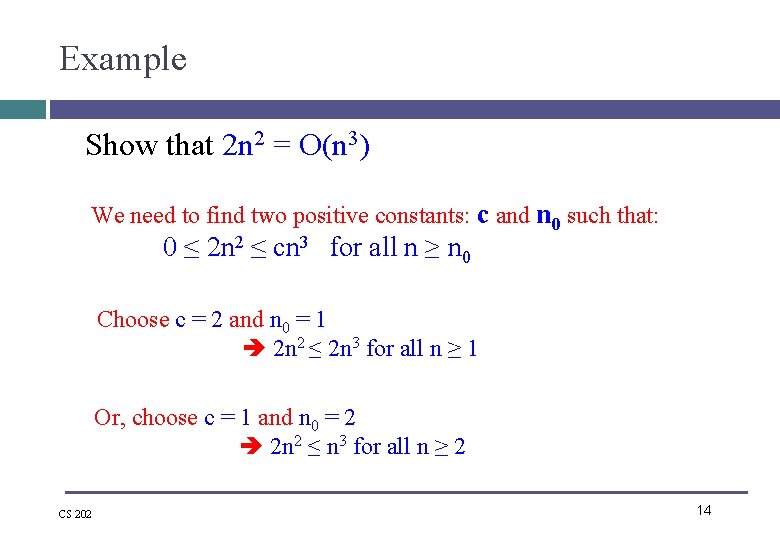
Example Show that 2 n 2 = O(n 3) We need to find two positive constants: c and n 0 such that: 0 ≤ 2 n 2 ≤ cn 3 for all n ≥ n 0 Choose c = 2 and n 0 = 1 2 n 2 ≤ 2 n 3 for all n ≥ 1 Or, choose c = 1 and n 0 = 2 2 n 2 ≤ n 3 for all n ≥ 2 CS 202 14
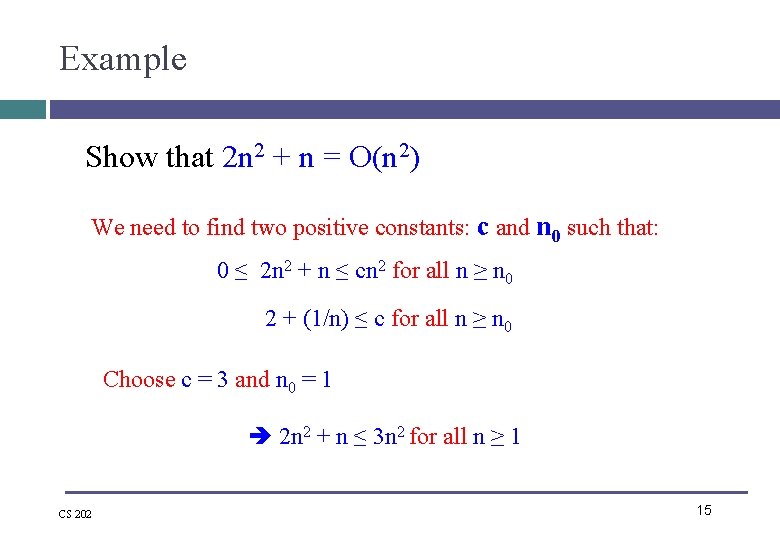
Example Show that 2 n 2 + n = O(n 2) We need to find two positive constants: c and n 0 such that: 0 ≤ 2 n 2 + n ≤ cn 2 for all n ≥ n 0 2 + (1/n) ≤ c for all n ≥ n 0 Choose c = 3 and n 0 = 1 2 n 2 + n ≤ 3 n 2 for all n ≥ 1 CS 202 15
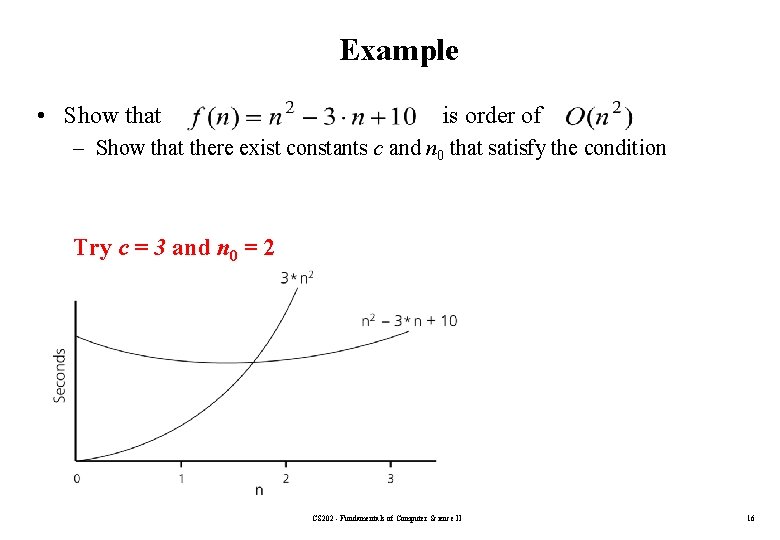
Example • Show that is order of – Show that there exist constants c and n 0 that satisfy the condition Try c = 3 and n 0 = 2 CS 202 - Fundamentals of Computer Science II 16
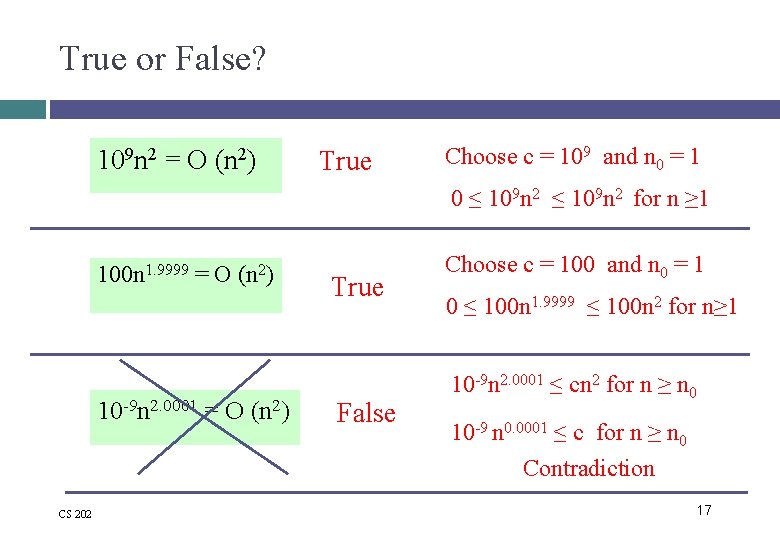
True or False? 109 n 2 = O (n 2) True Choose c = 109 and n 0 = 1 0 ≤ 109 n 2 for n ≥ 1 100 n 1. 9999 = O (n 2) 10 -9 n 2. 0001 = O (n 2) CS 202 True False Choose c = 100 and n 0 = 1 0 ≤ 100 n 1. 9999 ≤ 100 n 2 for n≥ 1 10 -9 n 2. 0001 ≤ cn 2 for n ≥ n 0 10 -9 n 0. 0001 ≤ c for n ≥ n 0 Contradiction 17
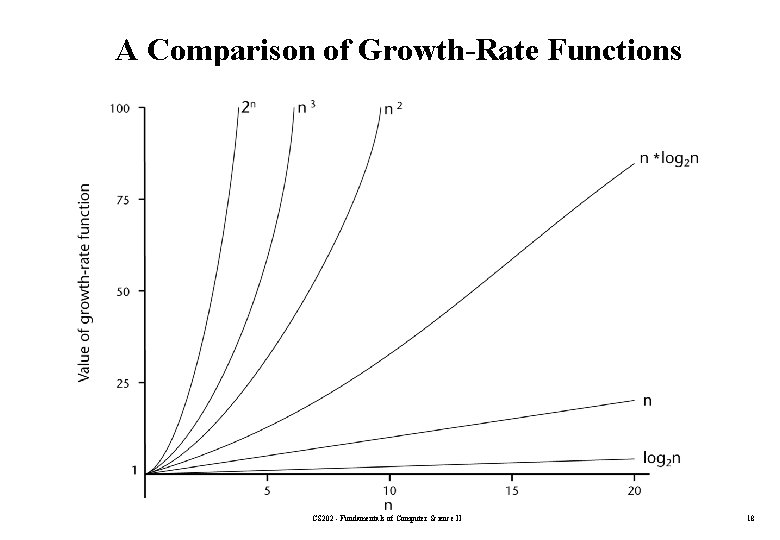
A Comparison of Growth-Rate Functions CS 202 - Fundamentals of Computer Science II 18
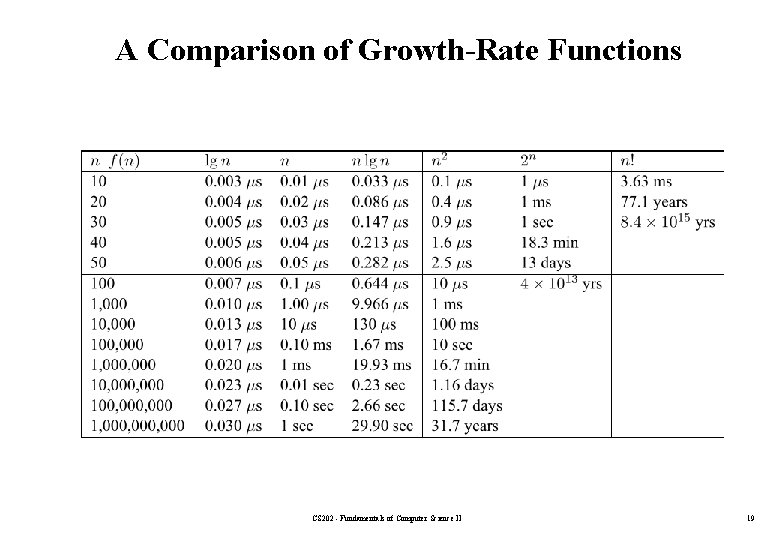
A Comparison of Growth-Rate Functions CS 202 - Fundamentals of Computer Science II 19
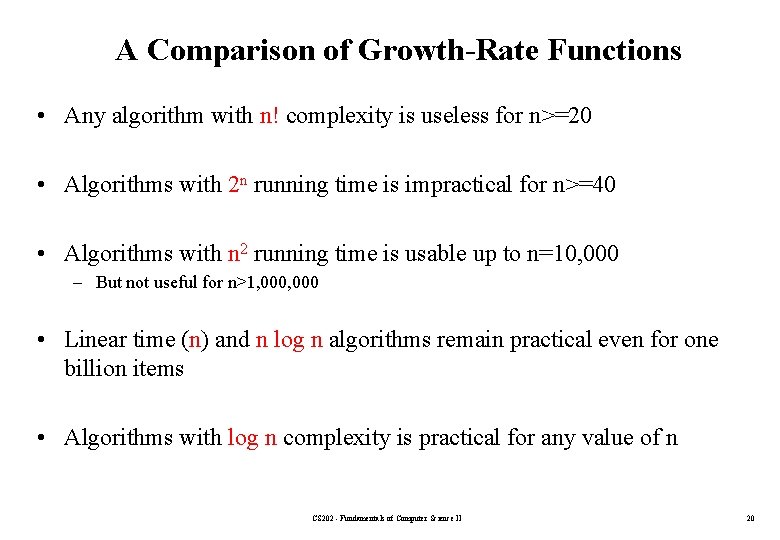
A Comparison of Growth-Rate Functions • Any algorithm with n! complexity is useless for n>=20 • Algorithms with 2 n running time is impractical for n>=40 • Algorithms with n 2 running time is usable up to n=10, 000 – But not useful for n>1, 000 • Linear time (n) and n log n algorithms remain practical even for one billion items • Algorithms with log n complexity is practical for any value of n CS 202 - Fundamentals of Computer Science II 20
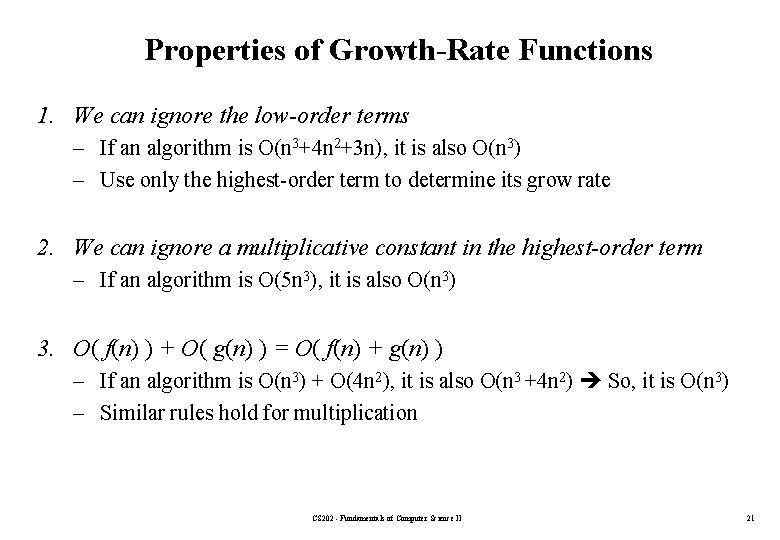
Properties of Growth-Rate Functions 1. We can ignore the low-order terms – If an algorithm is O(n 3+4 n 2+3 n), it is also O(n 3) – Use only the highest-order term to determine its grow rate 2. We can ignore a multiplicative constant in the highest-order term – If an algorithm is O(5 n 3), it is also O(n 3) 3. O( f(n) ) + O( g(n) ) = O( f(n) + g(n) ) – If an algorithm is O(n 3) + O(4 n 2), it is also O(n 3 +4 n 2) So, it is O(n 3) – Similar rules hold for multiplication CS 202 - Fundamentals of Computer Science II 21
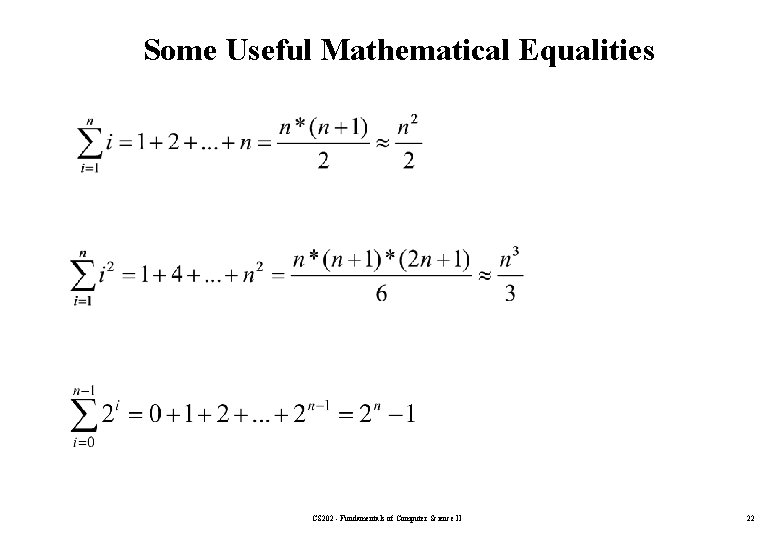
Some Useful Mathematical Equalities CS 202 - Fundamentals of Computer Science II 22
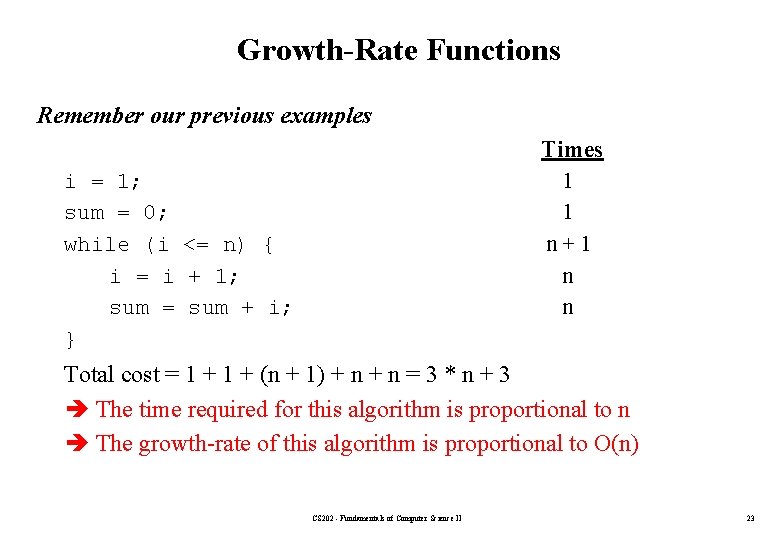
Growth-Rate Functions Remember our previous examples Times 1 1 n+1 n n i = 1; sum = 0; while (i <= n) { i = i + 1; sum = sum + i; } Total cost = 1 + (n + 1) + n = 3 * n + 3 The time required for this algorithm is proportional to n The growth-rate of this algorithm is proportional to O(n) CS 202 - Fundamentals of Computer Science II 23
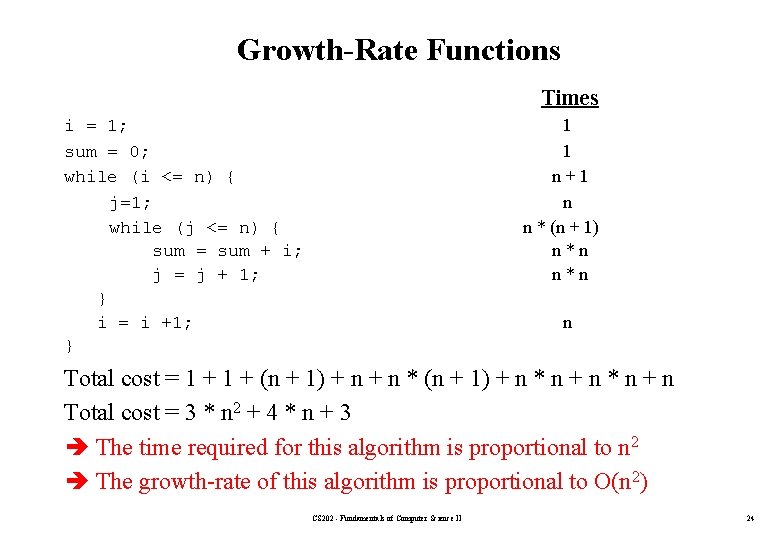
Growth-Rate Functions Times 1 1 n+1 n n * (n + 1) n*n i = 1; sum = 0; while (i <= n) { j=1; while (j <= n) { sum = sum + i; j = j + 1; } i = i +1; } n Total cost = 1 + (n + 1) + n * n + n Total cost = 3 * n 2 + 4 * n + 3 The time required for this algorithm is proportional to n 2 The growth-rate of this algorithm is proportional to O(n 2) CS 202 - Fundamentals of Computer Science II 24
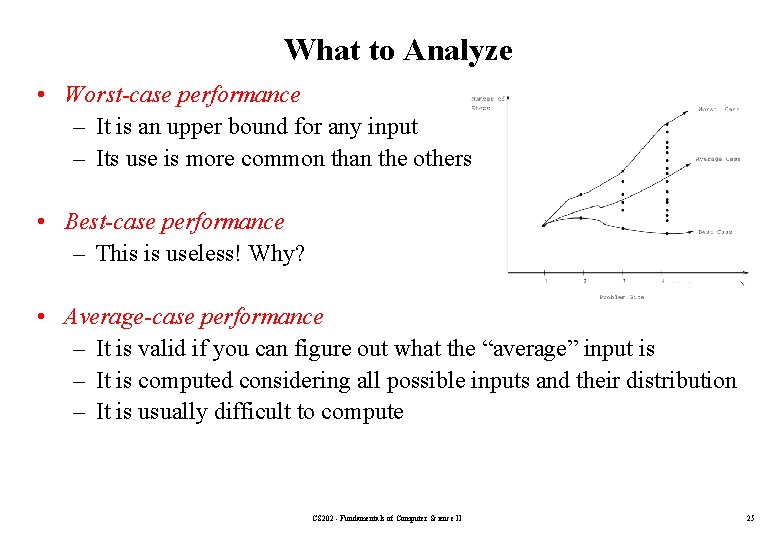
What to Analyze • Worst-case performance – It is an upper bound for any input – Its use is more common than the others • Best-case performance – This is useless! Why? • Average-case performance – It is valid if you can figure out what the “average” input is – It is computed considering all possible inputs and their distribution – It is usually difficult to compute CS 202 - Fundamentals of Computer Science II 25
![Consider the sequential search algorithm int sequential. Search(const int a[], int item, int n){](http://slidetodoc.com/presentation_image_h2/1a2c4857d38fb2be447b708db6b8bf86/image-26.jpg "Consider the sequential search algorithm int sequential. Search(const int a[], int item, int n){")
Consider the sequential search algorithm int sequential. Search(const int a[], int item, int n){ for (int i = 0; i < n; i++) if (a[i] == item) return i; return -1; } Worst-case: – If the item is in the last location of the array or – If it is not found in the array Best-case: – If the item is in the first location of the array Average-case: – How can we compute it? CS 202 - Fundamentals of Computer Science II 26
How to find the growth-rate of C++ codes? CS 202 - Fundamentals of Computer Science II 27
Some Examples Solved on the Board. CS 202 - Fundamentals of Computer Science II 28

What about recursive functions? CS 202 - Fundamentals of Computer Science II 29
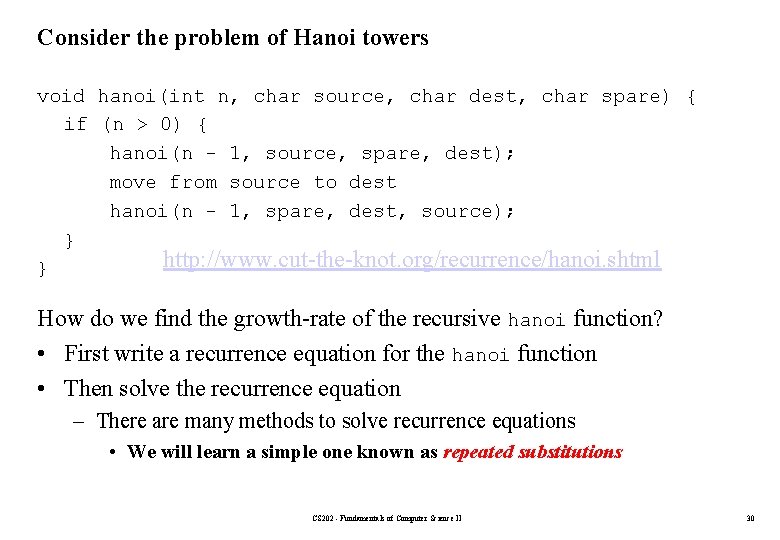
Consider the problem of Hanoi towers void hanoi(int n, char source, char dest, char spare) { if (n > 0) { hanoi(n - 1, source, spare, dest); move from source to dest hanoi(n - 1, spare, dest, source); } http: //www. cut-the-knot. org/recurrence/hanoi. shtml } How do we find the growth-rate of the recursive hanoi function? • First write a recurrence equation for the hanoi function • Then solve the recurrence equation – There are many methods to solve recurrence equations • We will learn a simple one known as repeated substitutions CS 202 - Fundamentals of Computer Science II 30
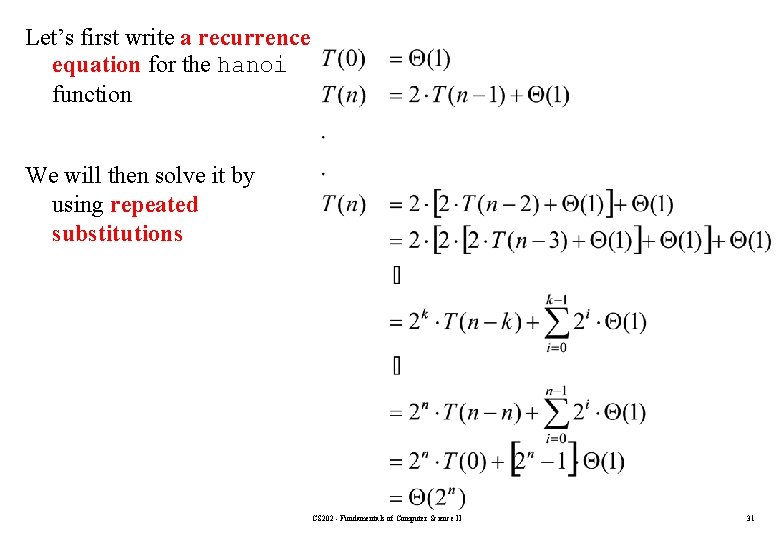
Let’s first write a recurrence equation for the hanoi function We will then solve it by using repeated substitutions CS 202 - Fundamentals of Computer Science II 31
More examples • Factorial function • Binary search • Merge sort – later CS 202 - Fundamentals of Computer Science II 32
- Slides: 32