
Analysis of Algorithms CS 477677 Instructor Monica Nicolescu
- Slides: 17
Analysis of Algorithms CS 477/677 Instructor: Monica Nicolescu Lecture 2
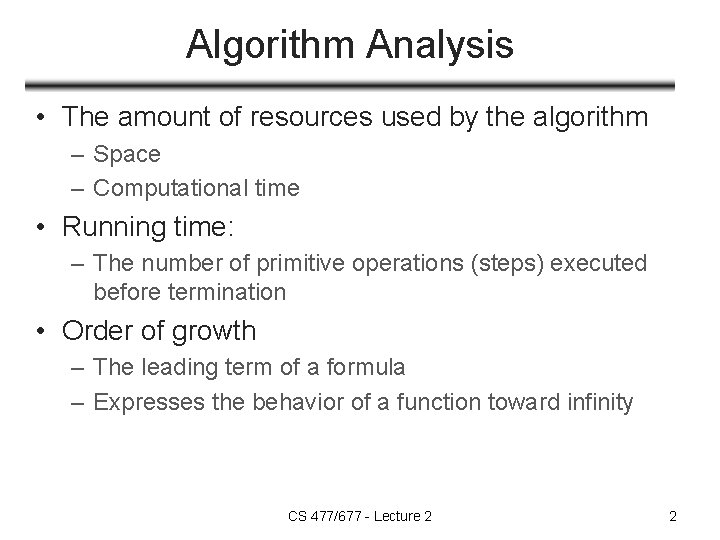
Algorithm Analysis • The amount of resources used by the algorithm – Space – Computational time • Running time: – The number of primitive operations (steps) executed before termination • Order of growth – The leading term of a formula – Expresses the behavior of a function toward infinity CS 477/677 - Lecture 2 2
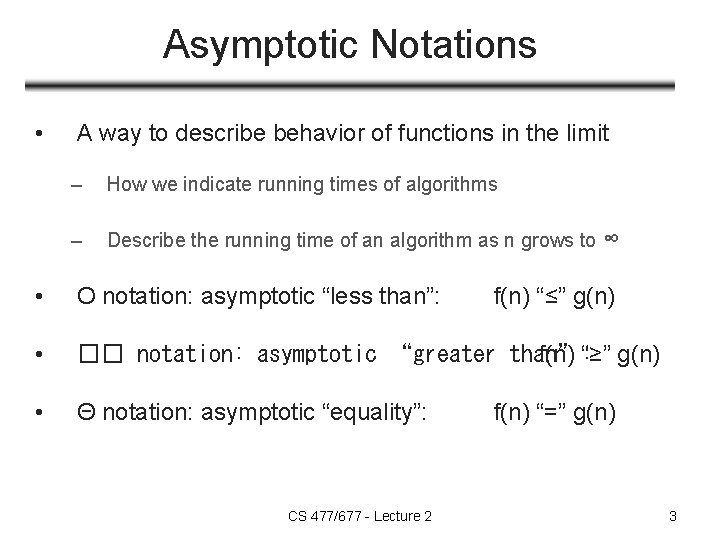
Asymptotic Notations • A way to describe behavior of functions in the limit – How we indicate running times of algorithms – Describe the running time of an algorithm as n grows to ∞ • O notation: asymptotic “less than”: • �� notation: asymptotic “greater than”: f(n) “≥” g(n) • Θ notation: asymptotic “equality”: CS 477/677 - Lecture 2 f(n) “≤” g(n) f(n) “=” g(n) 3
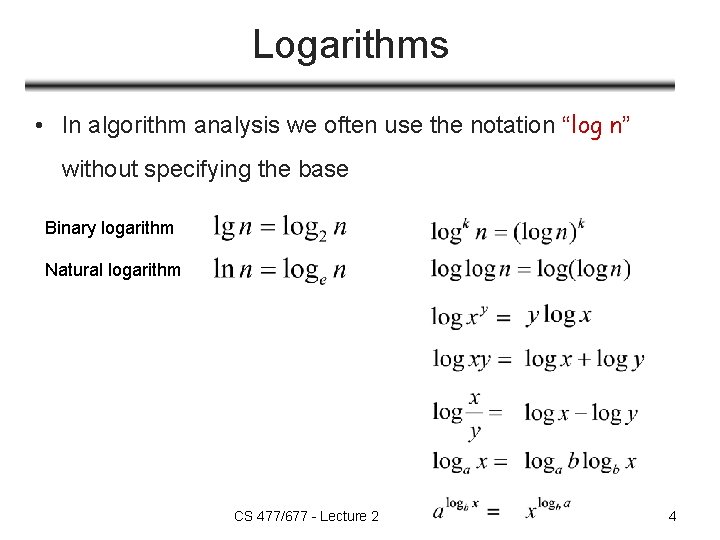
Logarithms • In algorithm analysis we often use the notation “log n” without specifying the base Binary logarithm Natural logarithm CS 477/677 - Lecture 2 4
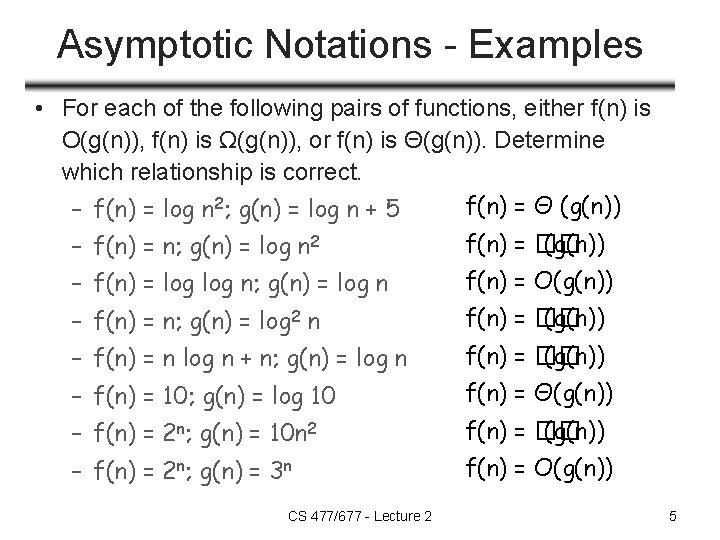
Asymptotic Notations - Examples • For each of the following pairs of functions, either f(n) is O(g(n)), f(n) is Ω(g(n)), or f(n) is Θ(g(n)). Determine which relationship is correct. f(n) = Θ (g(n)) – f(n) = log n 2; g(n) = log n + 5 – f(n) = n; g(n) = log n 2 f(n) = �� (g(n)) – f(n) = log n; g(n) = log n f(n) = O(g(n)) – f(n) = n; g(n) = log 2 n f(n) = �� (g(n)) – f(n) = n log n + n; g(n) = log n f(n) = �� (g(n)) – f(n) = 10; g(n) = log 10 f(n) = Θ(g(n)) – f(n) = 2 n; g(n) = 10 n 2 f(n) = �� (g(n)) – f(n) = 2 n; g(n) = 3 n f(n) = O(g(n)) CS 477/677 - Lecture 2 5
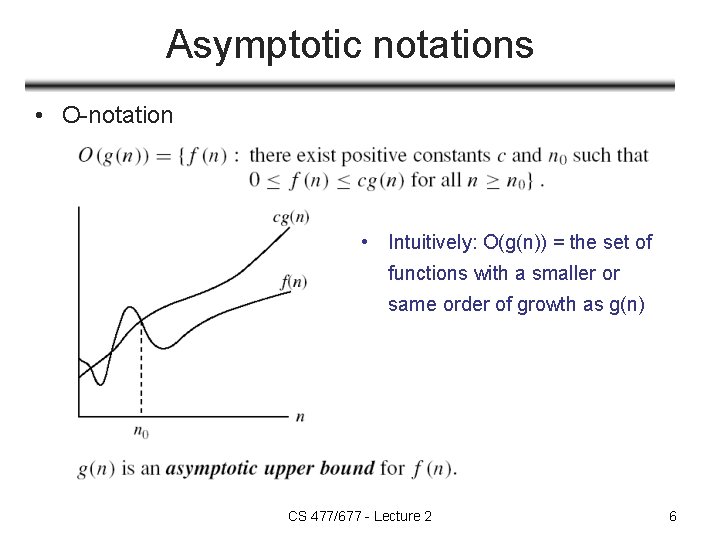
Asymptotic notations • O-notation • Intuitively: O(g(n)) = the set of functions with a smaller or same order of growth as g(n) CS 477/677 - Lecture 2 6
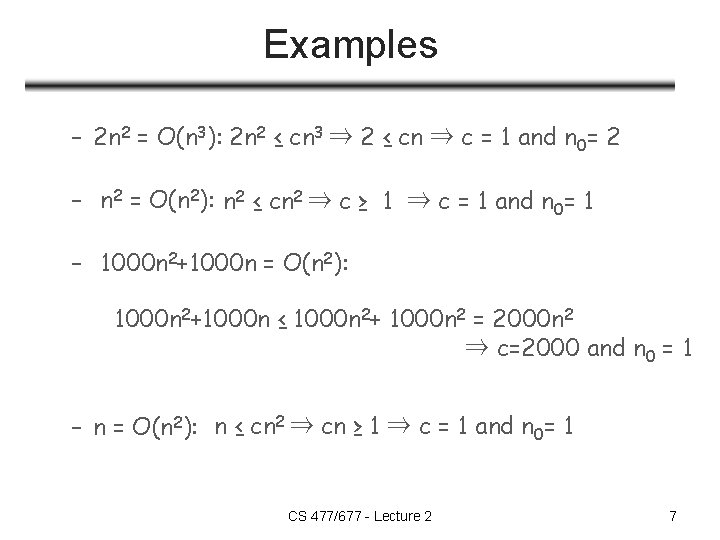
Examples – 2 n 2 = O(n 3): 2 n 2 ≤ cn 3 ⇒ 2 ≤ cn ⇒ c = 1 and n 0= 2 – n 2 = O(n 2): n 2 ≤ cn 2 ⇒ c ≥ 1 ⇒ c = 1 and n 0= 1 – 1000 n 2+1000 n = O(n 2): 1000 n 2+1000 n ≤ 1000 n 2+ 1000 n 2 = 2000 n 2 ⇒ c=2000 and n 0 = 1 – n = O(n 2): n ≤ cn 2 ⇒ cn ≥ 1 ⇒ c = 1 and n 0= 1 CS 477/677 - Lecture 2 7
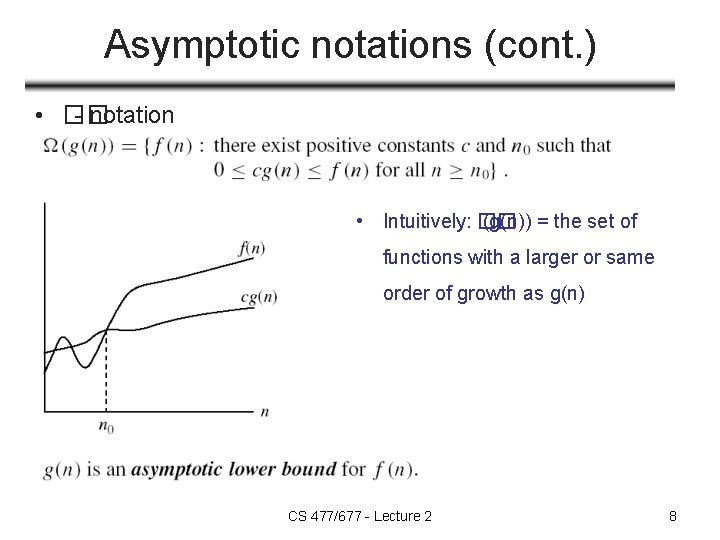
Asymptotic notations (cont. ) • �� - notation • Intuitively: �� (g(n)) = the set of functions with a larger or same order of growth as g(n) CS 477/677 - Lecture 2 8
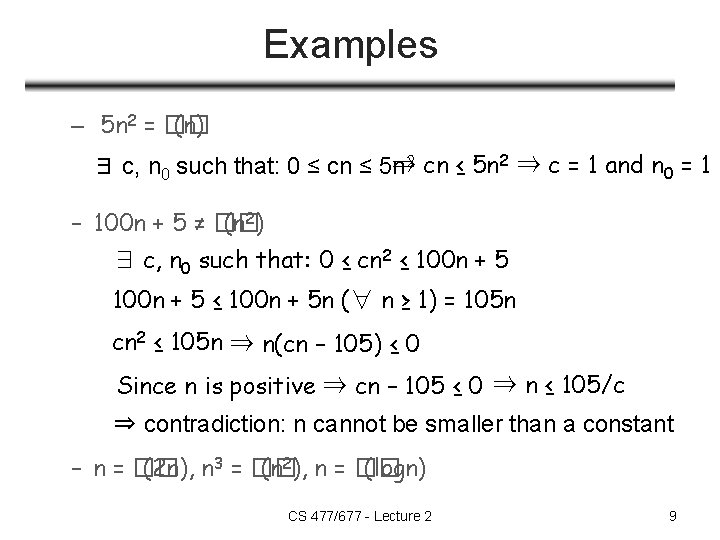
Examples – 5 n 2 = �� (n) ⇒ 2 cn ≤ 5 n 2 ⇒ c = 1 and n 0 = 1 ∃ c, n 0 such that: 0 ≤ cn ≤ 5 n – 100 n + 5 ≠ �� (n 2) ∃ c, n 0 such that: 0 ≤ cn 2 ≤ 100 n + 5 n (∀ n ≥ 1) = 105 n cn 2 ≤ 105 n ⇒ n(cn – 105) ≤ 0 Since n is positive ⇒ cn – 105 ≤ 0 ⇒ n ≤ 105/c ⇒ contradiction: n cannot be smaller than a constant – n = �� (2 n), n 3 = �� (n 2), n = �� (logn) CS 477/677 - Lecture 2 9
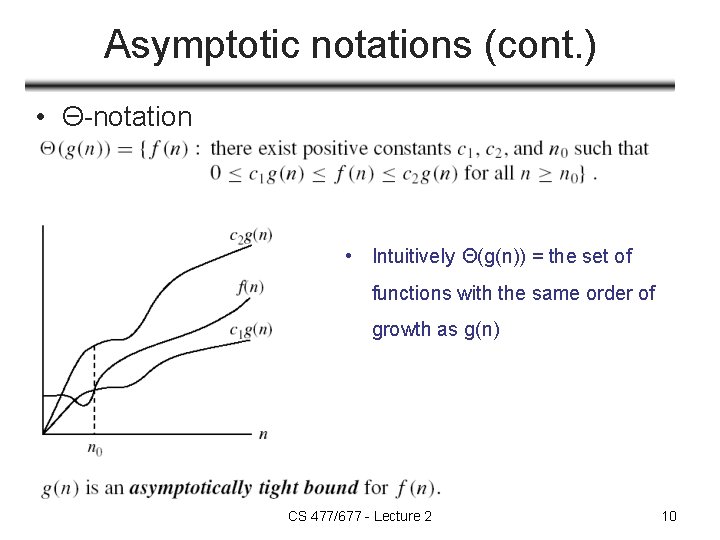
Asymptotic notations (cont. ) • Θ-notation • Intuitively Θ(g(n)) = the set of functions with the same order of growth as g(n) CS 477/677 - Lecture 2 10
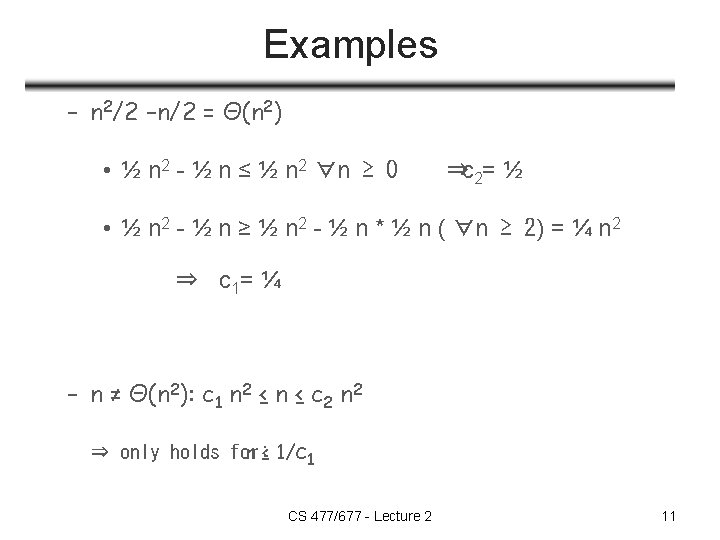
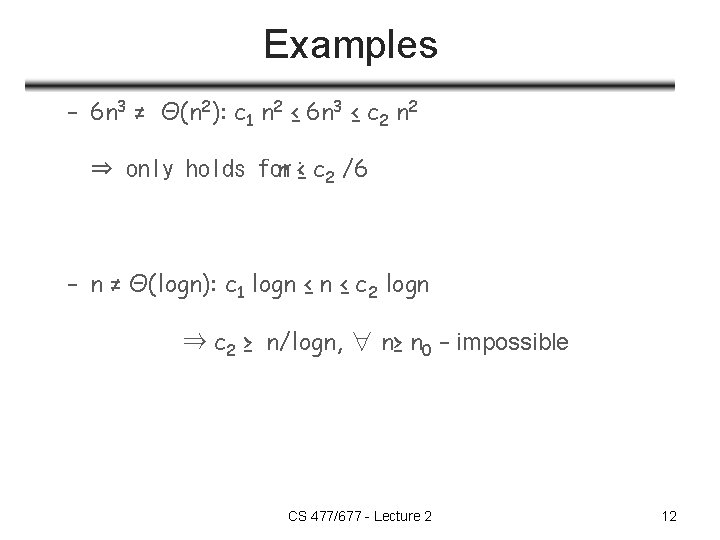
Examples – 6 n 3 ≠ Θ(n 2): c 1 n 2 ≤ 6 n 3 ≤ c 2 n 2 ⇒ only holds for: n ≤ c 2 /6 – n ≠ Θ(logn): c 1 logn ≤ c 2 logn ⇒ c 2 ≥ n/logn, ∀ n≥ n 0 – impossible CS 477/677 - Lecture 2 12
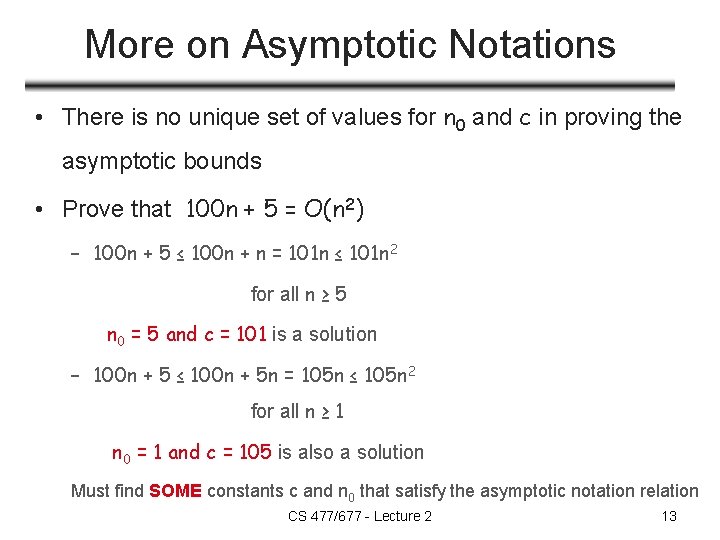
More on Asymptotic Notations • There is no unique set of values for n 0 and c in proving the asymptotic bounds • Prove that 100 n + 5 = O(n 2) – 100 n + 5 ≤ 100 n + n = 101 n ≤ 101 n 2 for all n ≥ 5 n 0 = 5 and c = 101 is a solution – 100 n + 5 ≤ 100 n + 5 n = 105 n ≤ 105 n 2 for all n ≥ 1 n 0 = 1 and c = 105 is also a solution Must find SOME constants c and n 0 that satisfy the asymptotic notation relation CS 477/677 - Lecture 2 13
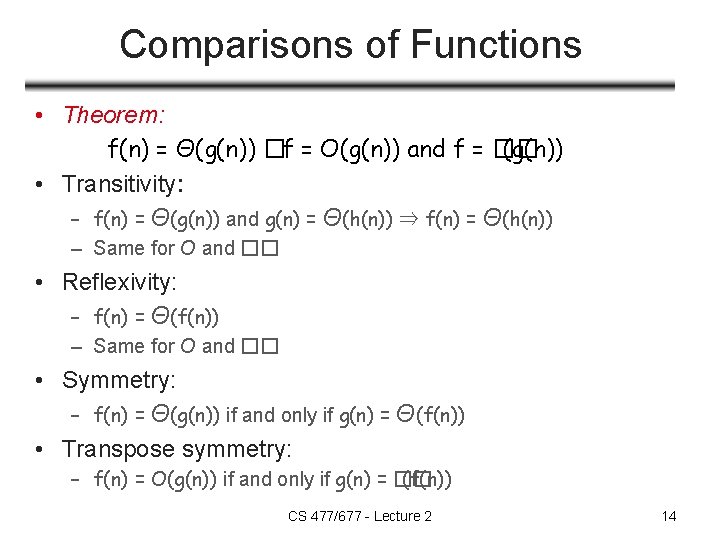
Comparisons of Functions • Theorem: f(n) = Θ(g(n)) �f = O(g(n)) and f = �� (g(n)) • Transitivity: – f(n) = Θ(g(n)) and g(n) = Θ(h(n)) ⇒ f(n) = Θ(h(n)) – Same for O and �� • Reflexivity: – f(n) = Θ(f(n)) – Same for O and �� • Symmetry: – f(n) = Θ(g(n)) if and only if g(n) = Θ(f(n)) • Transpose symmetry: – f(n) = O(g(n)) if and only if g(n) = �� (f(n)) CS 477/677 - Lecture 2 14
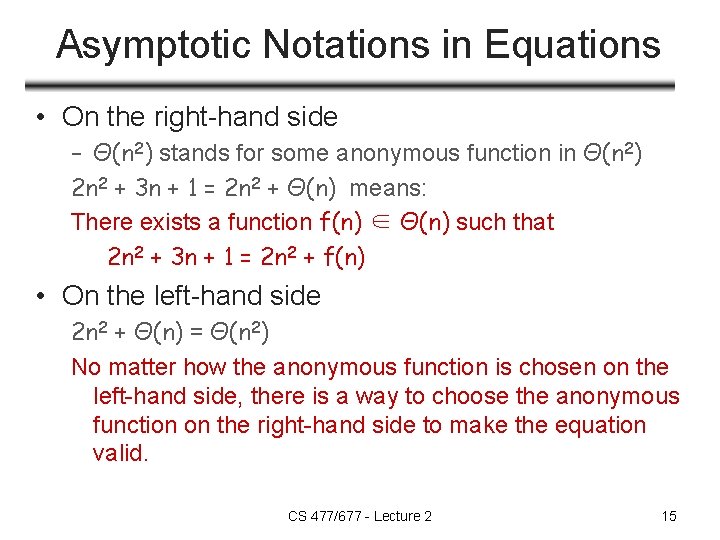
Asymptotic Notations in Equations • On the right-hand side – Θ(n 2) stands for some anonymous function in Θ(n 2) 2 n 2 + 3 n + 1 = 2 n 2 + Θ(n) means: There exists a function f(n) ∈ Θ(n) such that 2 n 2 + 3 n + 1 = 2 n 2 + f(n) • On the left-hand side 2 n 2 + Θ(n) = Θ(n 2) No matter how the anonymous function is chosen on the left-hand side, there is a way to choose the anonymous function on the right-hand side to make the equation valid. CS 477/677 - Lecture 2 15
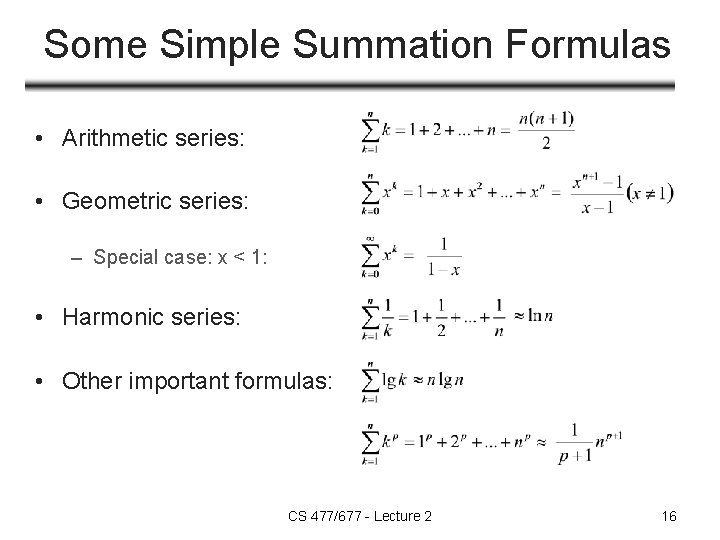
Some Simple Summation Formulas • Arithmetic series: • Geometric series: – Special case: x < 1: • Harmonic series: • Other important formulas: CS 477/677 - Lecture 2 16
Readings • Chapter 3 • Apendix A CS 477/677 - Lecture 2 17