
Analysis of Algorithm Lecture 1 Huma Ayub Assistant
Analysis of Algorithm Lecture 1 Huma Ayub (Assistant Professor) Department of Software Engineering huma. ayub@uettaxila. edu. pk

Acknowledgement v This lecture note has been summarized from lecture note on Data Structure and Algorithm, Design and Analysis of Computer Algorithm all over the world. I can’t remember where those slide come from. However, I’d like to thank all professors who create such a good work on those lecture notes. Without those lectures, this slide can’t be finished. Analysis of Algorithm Sunday, January 16, 2022 2
Course Information v Course webpage http: //web. uettaxila. edu. pk/uet/software/courses. htm v Office hours Wed, Thrus 9: 00 -12: 00 AM or make an appointment v Grading policy Assign. 20%, Midterm: 40%, Final: 40% Analysis of Algorithm Sunday, January 16, 2022 3

More Information v. Textbook Introduction to Algorithms 2 nd , Cormen, Leiserson, Rivest and Stein, The MIT Press, 2001. o Data Structures and Algorithm Analysis Clifford A. Shaffer, Edition 3. 2 (C++ Version), 2012. v. Others Introduction to Design & Analysis Computer Algorithm 3 rd, Sara Baase, Allen Van Gelder, Adison-Wesley, 2000. Algorithms, Richard Johnsonbaugh, Marcus Schaefer, Prentice Hall, 2004. Introduction to The Design and Analysis of Algorithms 2 nd Edition, Anany Levitin, Adison-Wesley, 2007. Analysis of Algorithm Sunday, January 16, 2022 4

Course Objectives v This course introduces students to the analysis and design of computer algorithms. Upon completion of this course, students will be able to do the following: Analyze the asymptotic performance of algorithms. Demonstrate a familiarity with major algorithms and data structures. Apply important algorithmic design paradigms and methods of analysis. Synthesize efficient algorithms in common engineering design situations. Analysis of Algorithm Sunday, January 16, 2022 5
Objective of course In this course we will cover the following topics: v Understand foundations of algorithms && design and analysis various variants algorithms Accuracy Efficiency Comparing efficiencies v Make use of skills to understand mathematical notations in algorithms and their simple mathematical proofs v Gain familiarity with a number of classical problems that occur frequently in real-world applications Sunday, January 16, 2022 Analysis of Algorithm 6
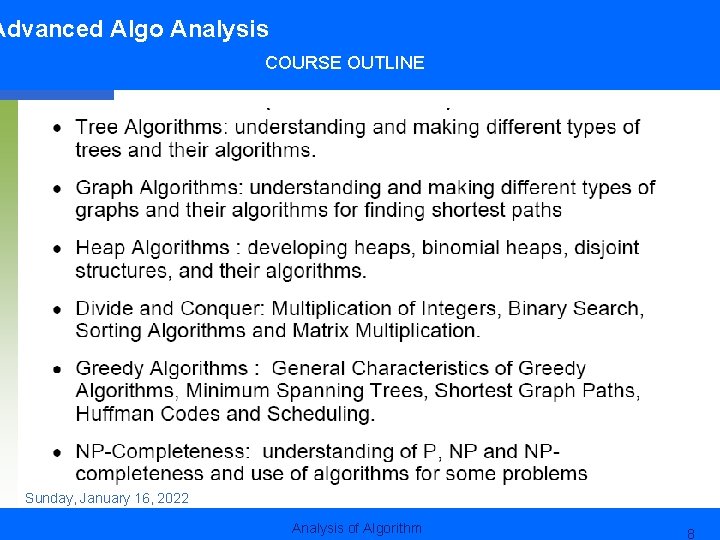
Advanced Algo Analysis COURSE OUTLINE v Preliminaries : different types of algorithms, analyzing methodologies, notations, proof techniques and limits. v Asymptotic Notation : different notations and their examples, standard notations and their common functions. v Analysis of Algorithms : analyzing control structures, using barometer instruction, amortization, and different examples for analysis and solving recurrences. v Structures: use of arrays, stacks, queues, records, pointers, lists, graphs, trees, hash tables, heaps and binomial heaps. v Searching/Sorting Algorithms : Various searching and sorting algorithms and their comparisons. Sunday, January 16, 2022 Analysis of Algorithm 7
Advanced Algo Analysis COURSE OUTLINE Sunday, January 16, 2022 Analysis of Algorithm 8
What is Algorithm? v. Algorithm is any well-defined computational procedure that takes some value, or set of values, as input and produces some value, or set of values, as output. is thus a sequence of computational steps that transform the input into the output. is a tool for solving a well - specified computational problem. Any special method of solving a certain kind of problem (Webster Dictionary( Analysis of Algorithm Sunday, January 16, 2022 9
ALGORITHMICS It is the science that lets designers study and evaluate the effect of algorithms based on various factors so that the best algorithm is selected to meet a particular task in given circumstances. It is also the science that tells how to design a new algorithm for a particular job. Sunday, January 16, 2022 Analysis of Algorithm 10
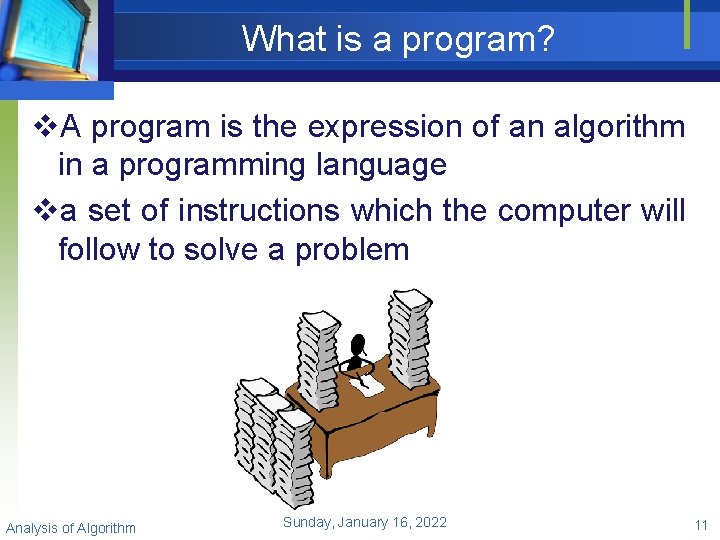
What is a program? v. A program is the expression of an algorithm in a programming language va set of instructions which the computer will follow to solve a problem Analysis of Algorithm Sunday, January 16, 2022 11
Introduction v. Why need algorithm analysis ? writing a working program is not good enough The program may be inefficient! If the program is run on a large data set, then the running time becomes an issue Analysis of Algorithm Sunday, January 16, 2022 12
Types of Algorithms Analysis of Algorithm Sunday, January 16, 2022 13
PROBABILISITIC ALGORITHM • In this algorithm, chosen values are used in such a way that the probability of chosen each value is known and controlled. e. g. Randomize Quick Sort Sunday, January 16, 2022 Analysis of Algorithm 14
HEURISTIC ALGORITHM v This type of algorithm is based largely on optimism and often with minimal theoretical support. Here error can not be controlled but may be estimated how large it is. Sunday, January 16, 2022 Analysis of Algorithm 15
APPROXIMATE ALGORITHM In this algorithm, answer is obtained that is as précised as required in decimal notation. In other words it specifies the error we are willing to accept. For example, two figures accuracy or 8 figures or whatever is required. Analysis of Algorithm Sunday, January 16, 2022 16
Where We're Going v Learn general approaches to algorithm design Divide and conquer Greedy method Dynamic Programming Basic Search and Traversal Technique Graph Theory Linear Programming Approximation Algorithm NP Problem Analysis of Algorithm Sunday, January 16, 2022 17
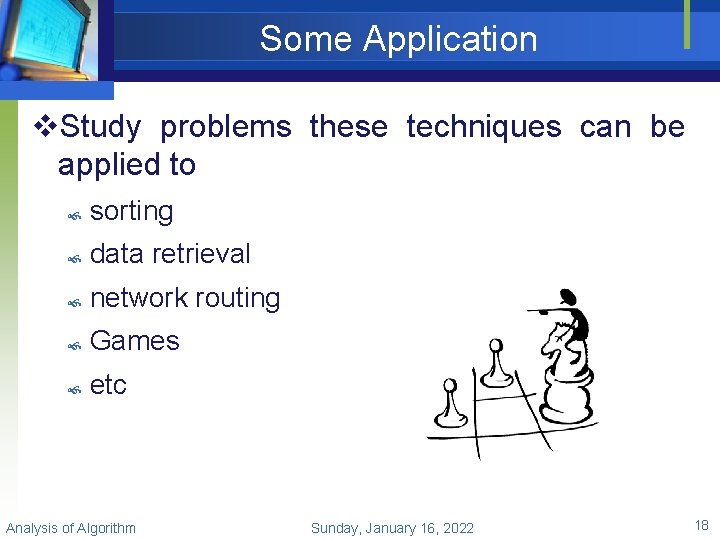
Some Application v. Study problems these techniques can be applied to sorting data retrieval network routing Games etc Analysis of Algorithm Sunday, January 16, 2022 18
What do we analyze about them ? v Correctness Does the input/output relation match algorithm requirement? v Amount of work done (aka complexity ( Basic operations to do task finite amount of time v Amount of space used Memory used Analysis of Algorithm Sunday, January 16, 2022 19
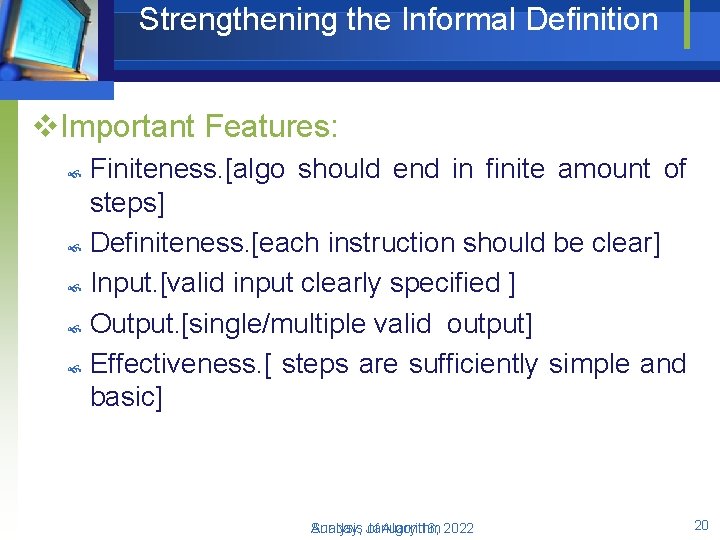
Strengthening the Informal Definition v. Important Features: Finiteness. [algo should end in finite amount of steps] Definiteness. [each instruction should be clear] Input. [valid input clearly specified ] Output. [single/multiple valid output] Effectiveness. [ steps are sufficiently simple and basic] Analysis January Sunday, of Algorithm 16, 2022 20
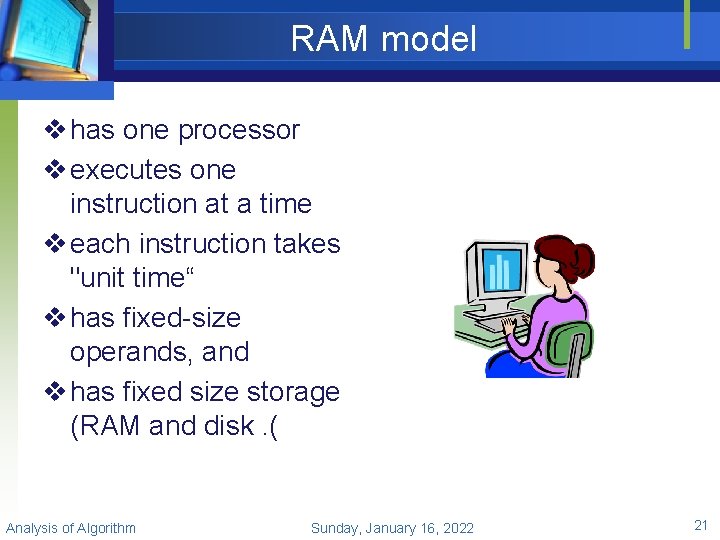
RAM model v has one processor v executes one instruction at a time v each instruction takes "unit time“ v has fixed-size operands, and v has fixed size storage (RAM and disk. ( Analysis of Algorithm Sunday, January 16, 2022 21
Example Of Algorithm
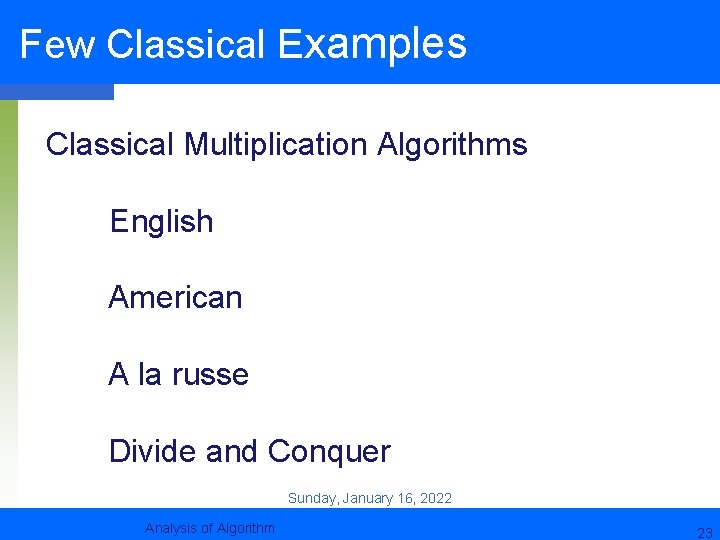
Few Classical Examples Classical Multiplication Algorithms English American A la russe Divide and Conquer Sunday, January 16, 2022 Analysis of Algorithm 23
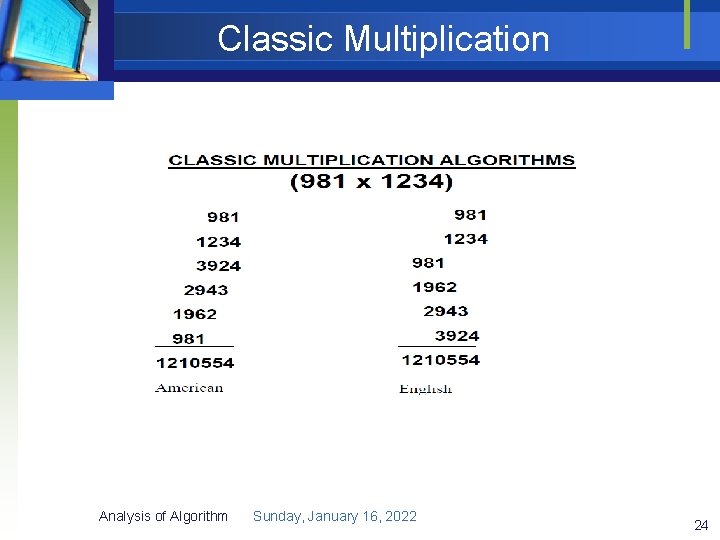
Classic Multiplication Analysis of Algorithm Sunday, January 16, 2022 24
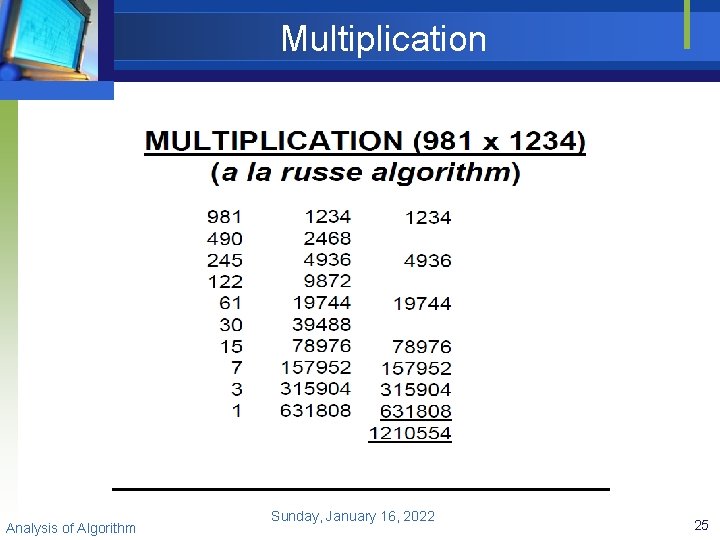
Multiplication Analysis of Algorithm Sunday, January 16, 2022 25
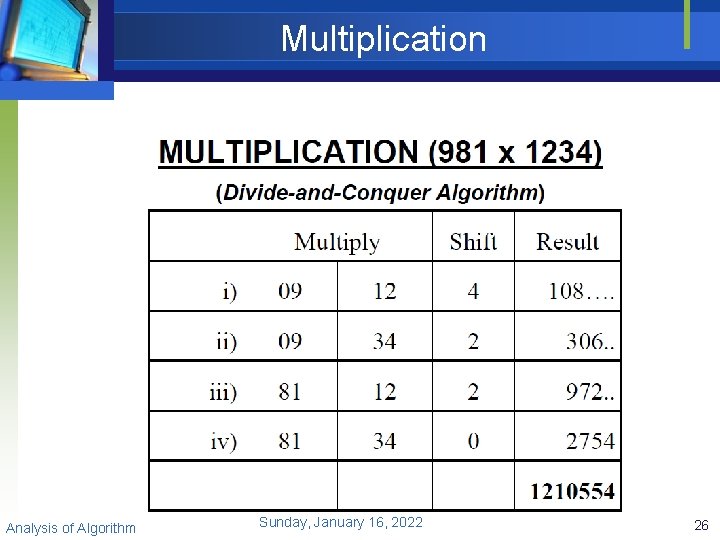
Multiplication Analysis of Algorithm Sunday, January 16, 2022 26
The Selection Problem Which algorithm is better? Sunday, January 16, 2022 Analysis of Algorithm 27
Which algorithm is better? The algorithms are correct, but which is the best? v Measure the running time (number of operations needed). v Measure the amount of memory used. v Note that the running time of the algorithms increase as the size of the input increases. Analysis of Algorithm Sunday, January 16, 2022 28
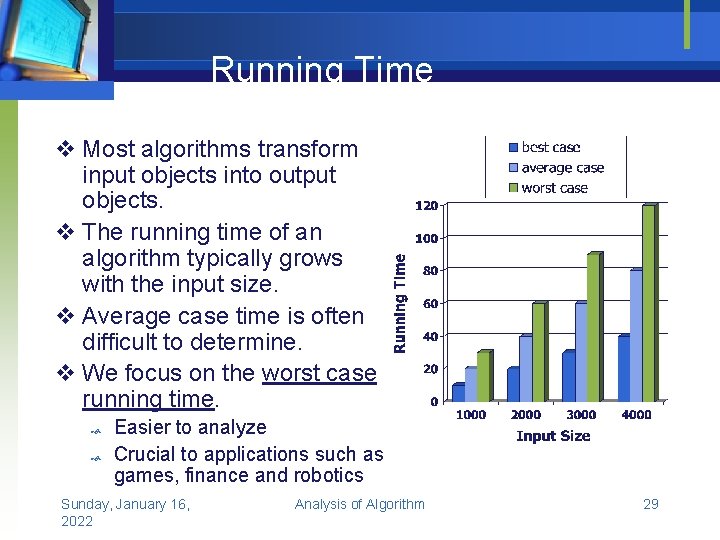
Running Time v Most algorithms transform input objects into output objects. v The running time of an algorithm typically grows with the input size. v Average case time is often difficult to determine. v We focus on the worst case running time. Easier to analyze Crucial to applications such as games, finance and robotics Sunday, January 16, 2022 Analysis of Algorithm 29
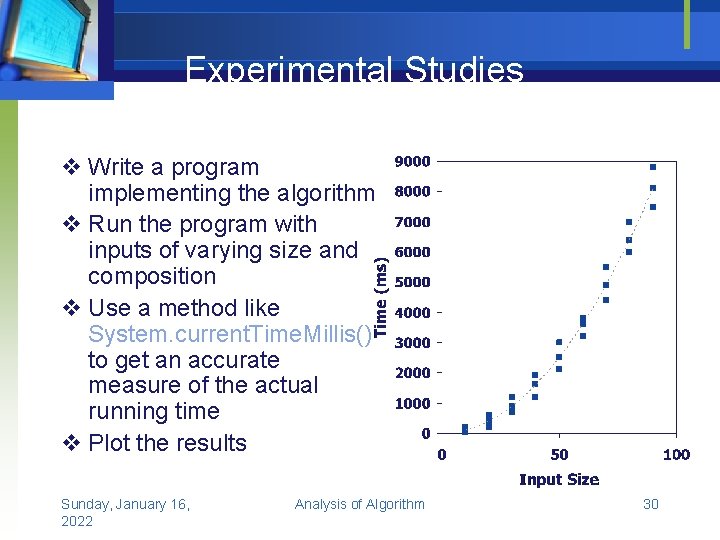
Experimental Studies v Write a program implementing the algorithm v Run the program with inputs of varying size and composition v Use a method like System. current. Time. Millis() to get an accurate measure of the actual running time v Plot the results Sunday, January 16, 2022 Analysis of Algorithm 30
Limitations of Experiments v. It is necessary to implement the algorithm, which may be difficult v. Results may not be indicative of the running time on other inputs not included in the experiment. v. In order to compare two algorithms, the same hardware and software environments must be used Analysis of Algorithm Sunday, January 16, 2022 31
Theoretical Analysis v. Uses a high-level description of the algorithm instead of an implementation v. Characterizes running time as a function of the input size, n. v. Takes into account all possible inputs v. Allows us to evaluate the speed of an algorithm independent of the hardware/software environment Sunday, January 16, 2022 Analysis of Algorithm 32
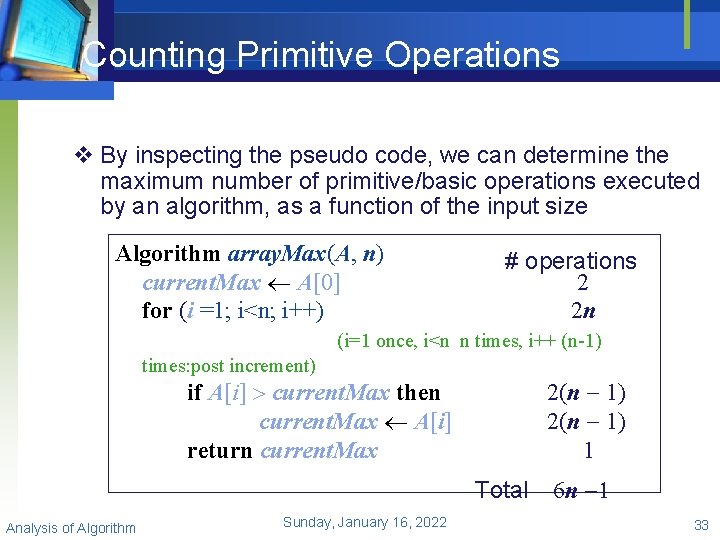
Counting Primitive Operations (§ 3. 4) v By inspecting the pseudo code, we can determine the maximum number of primitive/basic operations executed by an algorithm, as a function of the input size Algorithm array. Max(A, n) current. Max A[0] for (i =1; i<n; i++) # operations 2 2 n (i=1 once, i<n n times, i++ (n-1) times: post increment) if A[i] current. Max then current. Max A[i] return current. Max 2(n 1) 1 Total Analysis of Algorithm Sunday, January 16, 2022 6 n 1 33
Estimating Running Time v Algorithm array. Max executes 6 n 1 primitive operations in the worst case. Define: a = Time taken by the fastest primitive operation b = Time taken by the slowest primitive operation v Let T(n) be worst-case time of array. Max. Then a (6 n 1) T(n) b(6 n 1 ) v Hence, the running time T(n) is bounded by two linear functions Analysis of Algorithm Sunday, January 16, 2022 34
Growth Rate of Running Time v. Changing the environment hardware/ software Affects T(n) by a constant factor, but Does not alter the growth rate of T(n) v. The linear growth rate of the running time T(n) is an intrinsic/basic property of algorithm array. Max Sunday, January 16, 2022 Analysis of Algorithm 35
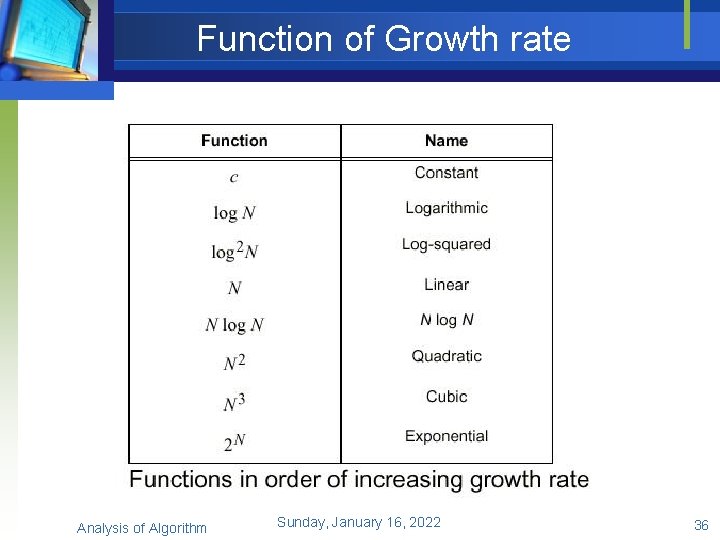
Function of Growth rate Analysis of Algorithm Sunday, January 16, 2022 36
Big-Oh Notation v. To simplify the running time estimation, for a function f(n), we ignore the constants and lower order terms. Example: 10 n 3+4 n 2 -4 n+5 is O(n 3). Sunday, January 16, 2022 Analysis of Algorithm 37
v FURTHER DISCUSSION NEXT WEEK ……………. Sunday, January 16, 2022 Analysis of Algorithm 38
- Slides: 38