
Analysis of acoustictoarticulatory speech inversion across different accents
![References • S. H. Weinberger, “speech accent archive. ” [Online]. Available: http: //accent. gmu.](https://slidetodoc.com/presentation_image_h/1cefdba2dd97a5a89656d7ea84d38ed2/image-15.jpg "References • S. H. Weinberger, “speech accent archive. ” [Online]. Available: http: //accent. gmu.")

- Slides: 16
Analysis of acoustic-to-articulatory speech inversion across different accents and languages Ganesh Sivaraman 1, Carol Espy-Wilson 1, Martijn Wieling 2 1 University of Maryland College Park, MD, USA 2 Faculty of Computational Linguistics, Rijksuniversiteit Groningen, Netherlands 3/1/2021 1
Overview • Acoustic to articulatory speech inversion • Articulatory dataset • Converting EMA sensor data to Tract Variables • Speech inversion system • Leave one speaker out experiments • Cross accent and cross language experiments • Example plot of a Dutch utterance • Example plot of an English utterance • Conclusion • • • Contents of the dataset Results of leave one speaker out tests Results of cross experiments 3/1/2021 2
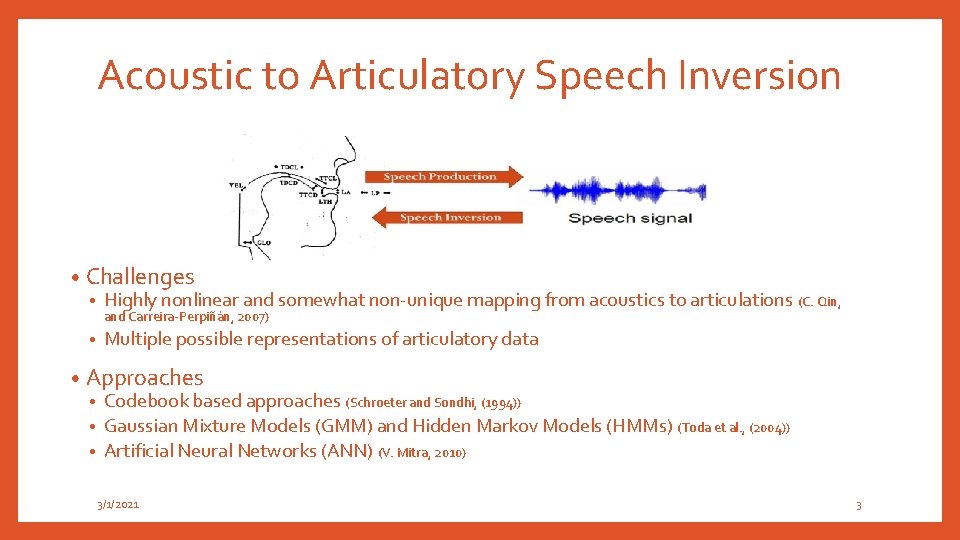
Acoustic to Articulatory Speech Inversion • Challenges • Highly nonlinear and somewhat non-unique mapping from acoustics to articulations (C. Qin, and Carreira-Perpiñán, 2007) • Multiple possible representations of articulatory data • Approaches • Codebook based approaches (Schroeter and Sondhi, (1994)) • Gaussian Mixture Models (GMM) and Hidden Markov Models (HMMs) (Toda et al. , (2004)) • Artificial Neural Networks (ANN) (V. Mitra, 2010) 3/1/2021 3
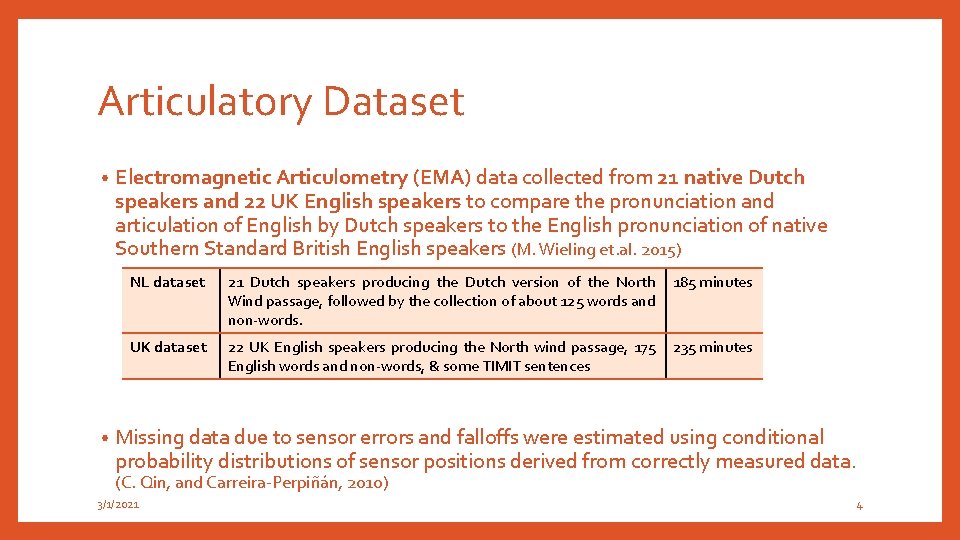
Articulatory Dataset • • Electromagnetic Articulometry (EMA) data collected from 21 native Dutch speakers and 22 UK English speakers to compare the pronunciation and articulation of English by Dutch speakers to the English pronunciation of native Southern Standard British English speakers (M. Wieling et. al. 2015) NL dataset 21 Dutch speakers producing the Dutch version of the North Wind passage, followed by the collection of about 125 words and non-words. 185 minutes UK dataset 22 UK English speakers producing the North wind passage, 175 English words and non-words, & some TIMIT sentences 235 minutes Missing data due to sensor errors and falloffs were estimated using conditional probability distributions of sensor positions derived from correctly measured data. (C. Qin, and Carreira-Perpiñán, 2010) 3/1/2021 4
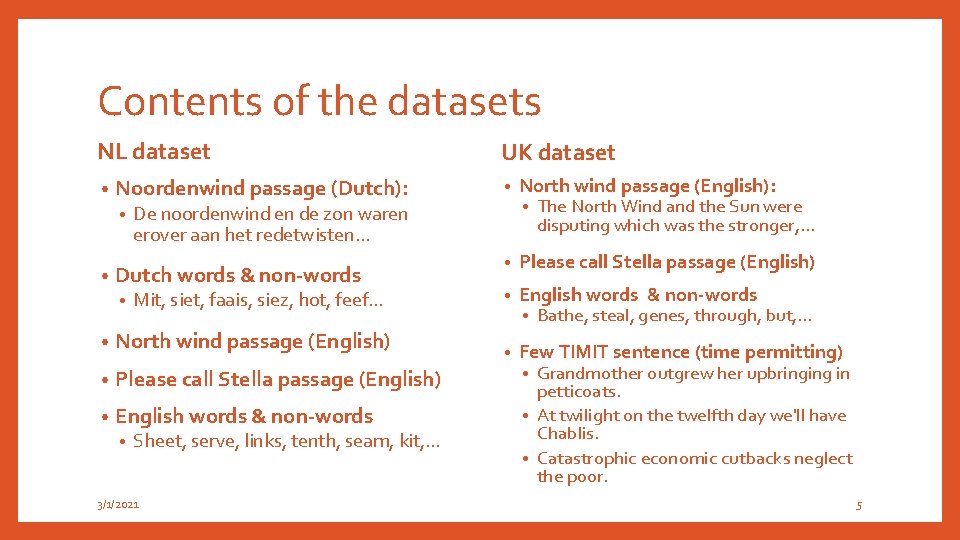
Contents of the datasets NL dataset • Noordenwind passage (Dutch): • • Mit, siet, faais, siez, hot, feef. . . • North wind passage (English) • Please call Stella passage (English) • English words & non-words • • Sheet, serve, links, tenth, seam, kit, … 3/1/2021 North wind passage (English): • De noordenwind en de zon waren erover aan het redetwisten. . . Dutch words & non-words • UK dataset The North Wind and the Sun were disputing which was the stronger, … • Please call Stella passage (English) • English words & non-words • • Bathe, steal, genes, through, but, … Few TIMIT sentence (time permitting) Grandmother outgrew her upbringing in petticoats. • At twilight on the twelfth day we'll have Chablis. • Catastrophic economic cutbacks neglect the poor. • 5
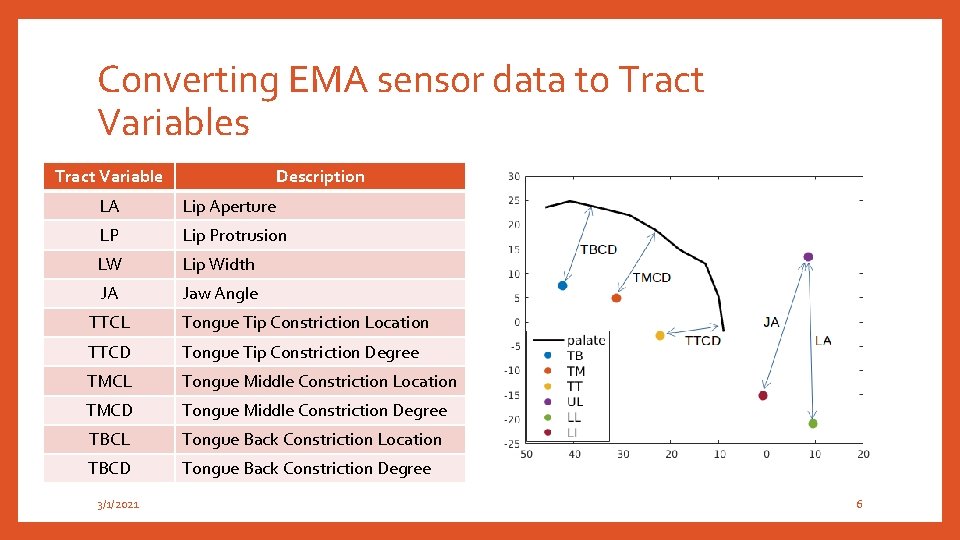
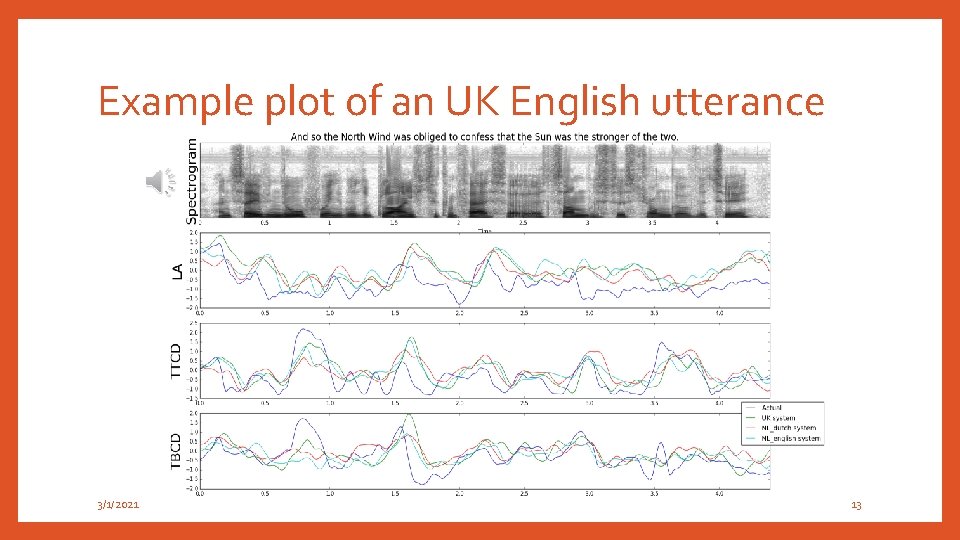
Converting EMA sensor data to Tract Variables Tract Variable Description LA Lip Aperture LP Lip Protrusion LW Lip Width JA Jaw Angle TTCL Tongue Tip Constriction Location TTCD Tongue Tip Constriction Degree TMCL Tongue Middle Constriction Location TMCD Tongue Middle Constriction Degree TBCL Tongue Back Constriction Location TBCD Tongue Back Constriction Degree 3/1/2021 6
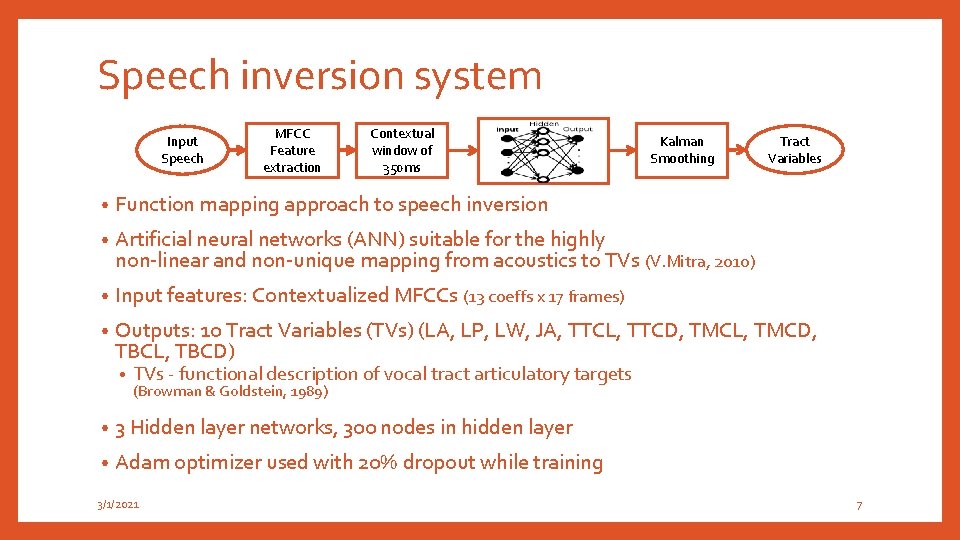
Speech inversion system Input Speech MFCC Feature extraction Contextual window of 350 ms Kalman Smoothing Tract Variables • Function mapping approach to speech inversion • Artificial neural networks (ANN) suitable for the highly non-linear and non-unique mapping from acoustics to TVs (V. Mitra, 2010) • Input features: Contextualized MFCCs (13 coeffs x 17 frames) • Outputs: 10 Tract Variables (TVs) (LA, LP, LW, JA, TTCL, TTCD, TMCL, TMCD, TBCL, TBCD) • TVs - functional description of vocal tract articulatory targets (Browman & Goldstein, 1989) • 3 Hidden layer networks, 300 nodes in hidden layer • Adam optimizer used with 20% dropout while training 3/1/2021 7
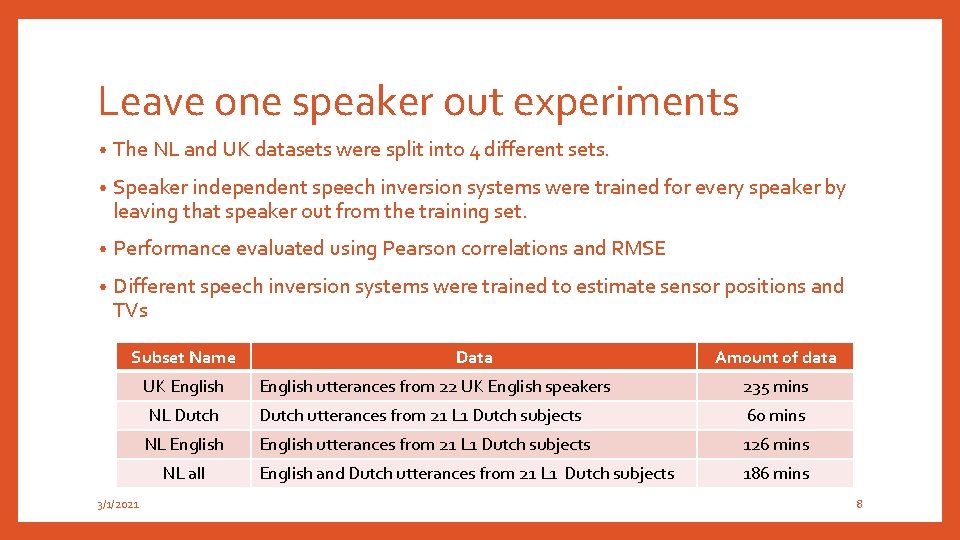
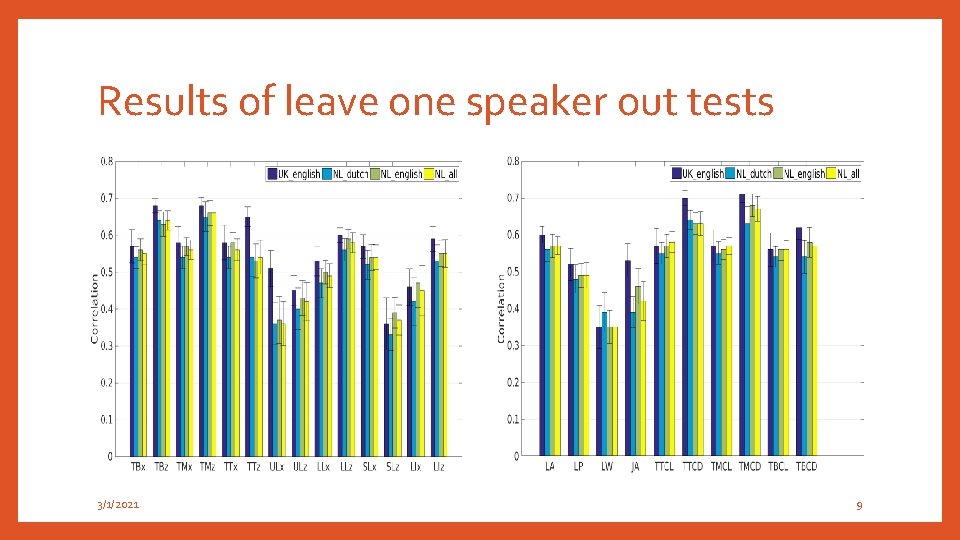
Leave one speaker out experiments • The NL and UK datasets were split into 4 different sets. • Speaker independent speech inversion systems were trained for every speaker by leaving that speaker out from the training set. • Performance evaluated using Pearson correlations and RMSE • Different speech inversion systems were trained to estimate sensor positions and TVs Subset Name Amount of data UK English utterances from 22 UK English speakers 235 mins NL Dutch utterances from 21 L 1 Dutch subjects 60 mins NL English utterances from 21 L 1 Dutch subjects 126 mins English and Dutch utterances from 21 L 1 Dutch subjects 186 mins NL all 3/1/2021 Data 8
Results of leave one speaker out tests 3/1/2021 9
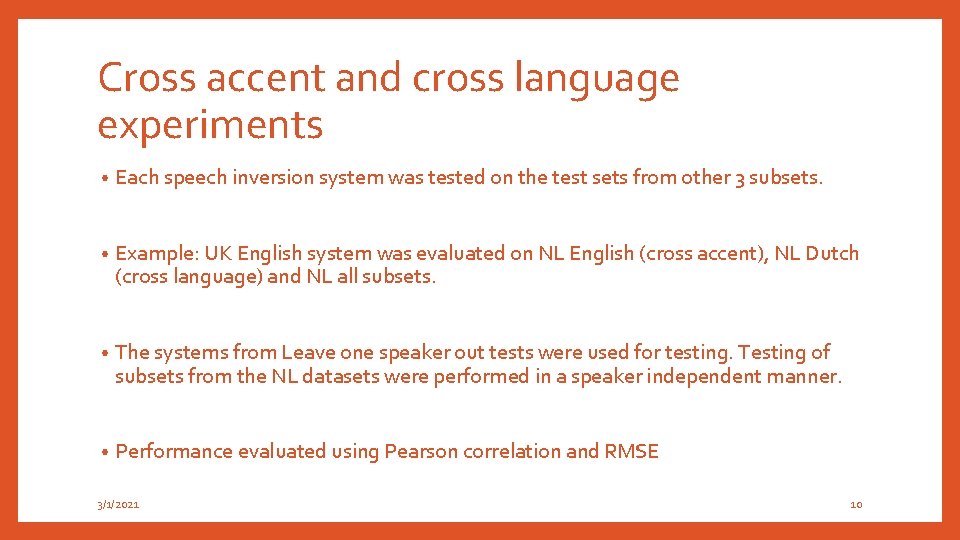
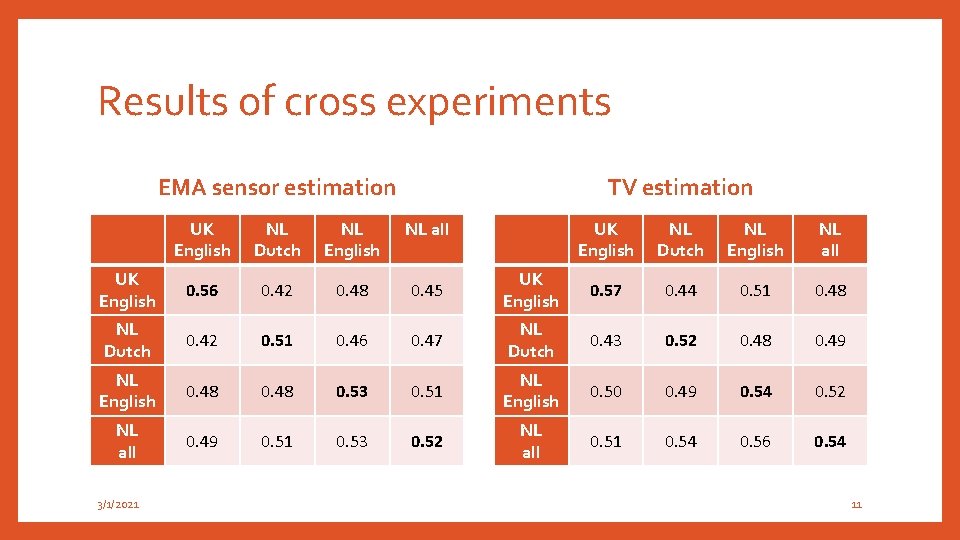
Cross accent and cross language experiments • Each speech inversion system was tested on the test sets from other 3 subsets. • Example: UK English system was evaluated on NL English (cross accent), NL Dutch (cross language) and NL all subsets. • The systems from Leave one speaker out tests were used for testing. Testing of subsets from the NL datasets were performed in a speaker independent manner. • Performance evaluated using Pearson correlation and RMSE 3/1/2021 10
Results of cross experiments TV estimation EMA sensor estimation UK English NL Dutch NL English NL all UK English 0. 57 0. 44 0. 51 0. 48 0. 47 NL Dutch 0. 43 0. 52 0. 48 0. 49 0. 53 0. 51 NL English 0. 50 0. 49 0. 54 0. 52 0. 53 0. 52 NL all 0. 51 0. 54 0. 56 0. 54 UK English NL Dutch NL English NL all UK English 0. 56 0. 42 0. 48 0. 45 NL Dutch 0. 42 0. 51 0. 46 NL English 0. 48 NL all 0. 49 0. 51 3/1/2021 11
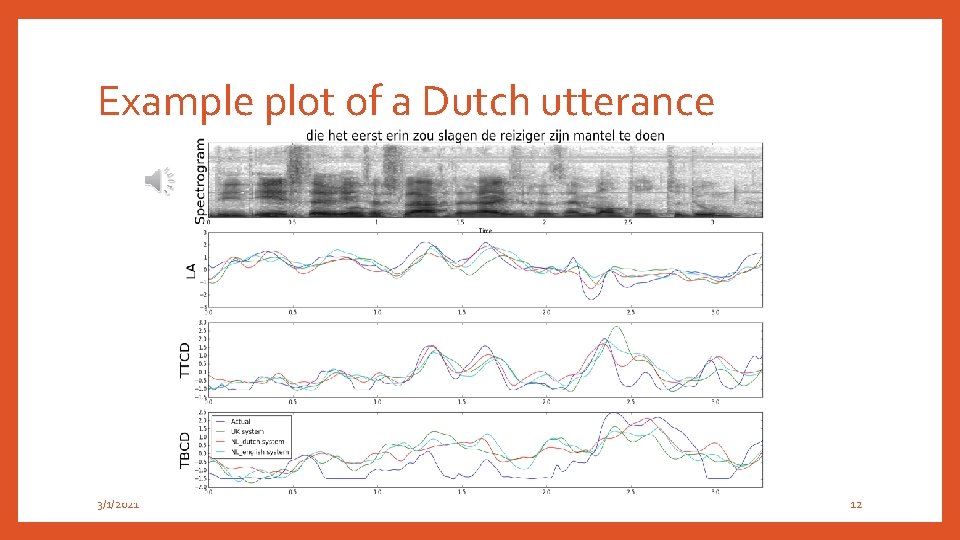
Example plot of a Dutch utterance 3/1/2021 12
Example plot of an UK English utterance 3/1/2021 13
Conclusions • The experiments highlight the effects of the amount of training data, the different types of data (i. e. collected in different environments), and different accents and languages on the performance of speech inversion systems. • Speaker independent systems work well with appropriate normalizations of the acoustic features and articulatory trajectories • Matched condition test performance correlation of about 0. 53 • For mismatched data, the performance drops to about 0. 43. • Future work: Speaker normalization techniques to further improve the performance. 3/1/2021 14
References • S. H. Weinberger, “speech accent archive. ” [Online]. Available: http: //accent. gmu. edu/about. php • M. Wieling, P. Veenstra, P. Adank, A. Weber, and M. Tiede, “Comparing L 1 and L 2 speakers using articulography, ” in Proceedings of ICPh. S 2015, 2015. • Browman, Catherine P. and Louis Goldstein 1989 Articulatory gestures as phonological units. Phonology 6: 151 - 206 • V. Mitra, “Articulatory Information For Robust Speech Recognition. ” Ph. D. dissertation, University of Maryland, College Park, 2010. • C. Qin and M. Carreira-Perpin a n, “An empirical investigation of the non-uniqueness in the acoustic-to-articulatory mapping. ” INTERSPEECH, 2007. • C. Qin and M. Carreira-Perpin a n, “Estimating missing data sequences in x-ray microbeam recordings, ” in INTERSPEECH, 2010. • Schroeter, J. , Sondhi, M. M. , 1994. Techniques for estimating vocal tract shapes from the speech signal. IEEE Trans. Speech Signal Process. vol, 2 no 1 pp 133– 150. • Toda, T. , Black, A. , Tokuda, K. , 2004. Acoustic-to-articulatory inversion mapping with gaussian mixture model, in: ICSLP. Jeju Island, Korea, pp. 1129– 1132. 3/1/2021 15
Questions? Comments? Acknowledgements We would like to thank the University of Maryland Graduate School and the University of Groningen for awarding the International Graduate Research Fellowship to fund this research. This work was made possible by a hardware grant from NVIDIA and a Veni grant for the project “Improving speech learning models and English pronunciation with articulography” awarded to Martijn Wieling by the Netherlands Organisation for Scientific Research (NWO). 3/1/2021 16