
Analysis and Synthesis of the Distribution of Consonants
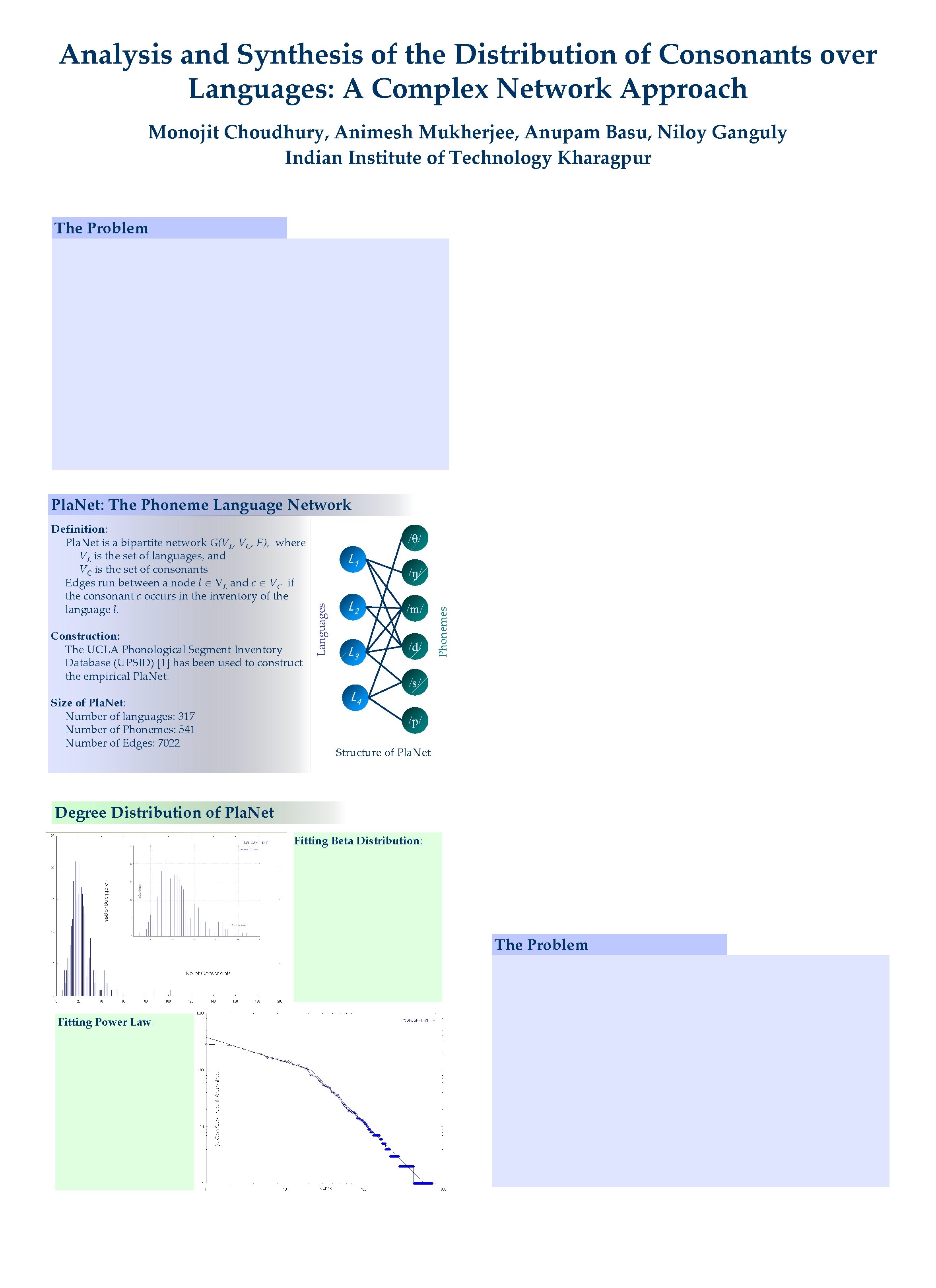
Analysis and Synthesis of the Distribution of Consonants over Languages: A Complex Network Approach Monojit Choudhury, Animesh Mukherjee, Anupam Basu, Niloy Ganguly Indian Institute of Technology Kharagpur The Problem Pla. Net: The Phoneme Language Network Size of Pla. Net: Number of languages: 317 Number of Phonemes: 541 Number of Edges: 7022 L 1 /ŋ/ L 2 /m/ L 3 /d/ L 4 Phonemes Construction: The UCLA Phonological Segment Inventory Database (UPSID) [1] has been used to construct the empirical Pla. Net. /θ/ Languages Definition: Pla. Net is a bipartite network G(VL, VC, E), where VL is the set of languages, and VC is the set of consonants Edges run between a node l VL and c VC if the consonant c occurs in the inventory of the language l. /s/ /p/ Structure of Pla. Net Degree Distribution of Pla. Net Fitting Beta Distribution: The Problem Fitting Power Law:
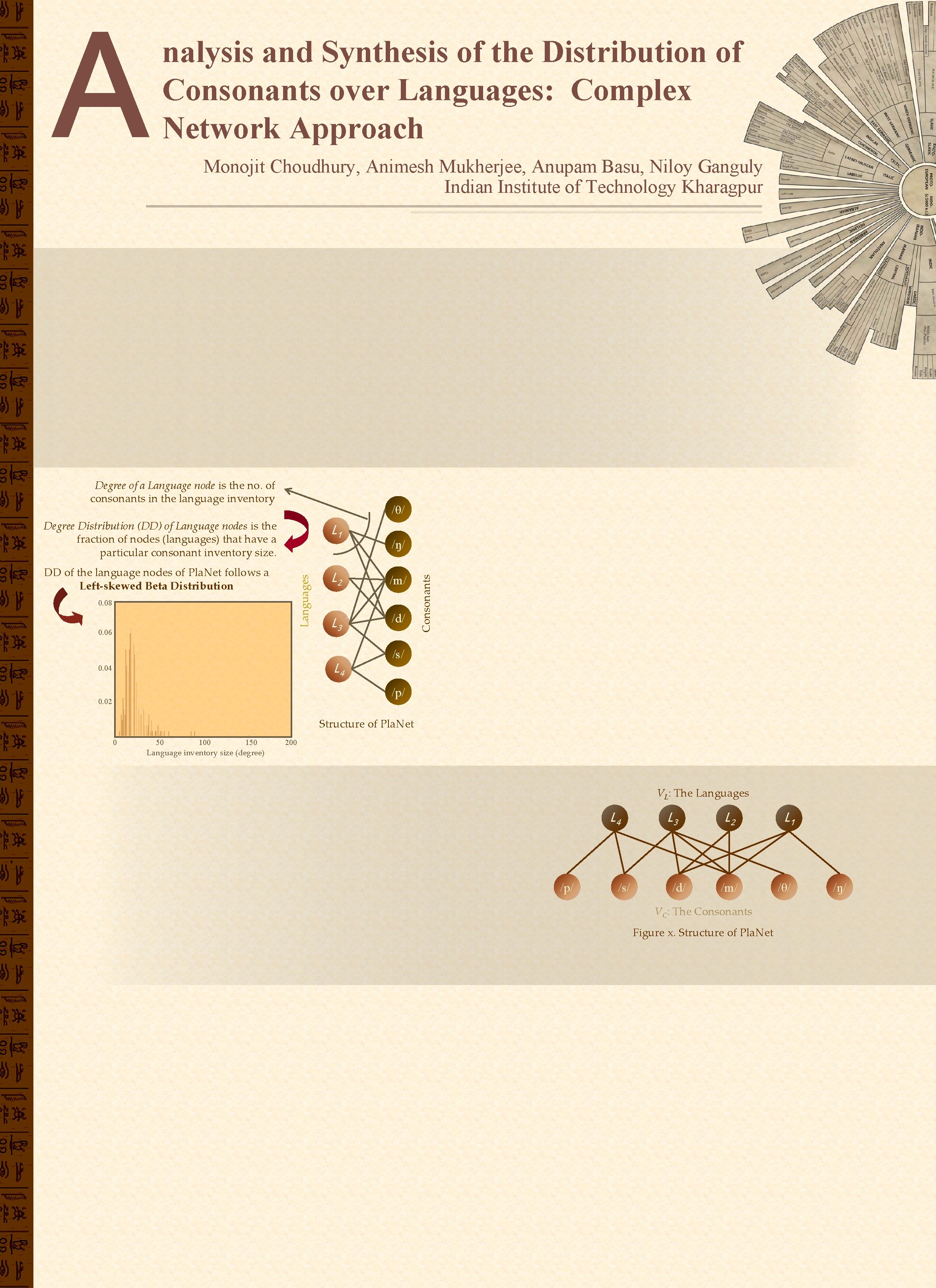
Monojit Choudhury, Animesh Mukherjee, Anupam Basu, Niloy Ganguly Indian Institute of Technology Kharagpur Degree of a Language node is the no. of consonants in the language inventory /θ/ L 1 DD of the language nodes of Pla. Net follows a Left-skewed Beta Distribution L 2 /m/ L 3 /d/ 0. 08 0. 06 Languages Degree Distribution (DD) of Language nodes is the fraction of nodes (languages) that have a particular consonant inventory size. L 4 0. 04 /ŋ/ Consonants A nalysis and Synthesis of the Distribution of Consonants over Languages: Complex Network Approach /s/ /p/ 0. 02 Structure of Pla. Net 0 50 100 150 Language inventory size (degree) 200 VL: The Languages L 4 /p/ /s/ L 3 /d/ L 2 L 1 /m/ /θ/ VC: The Consonants Figure x. Structure of Pla. Net /ŋ/
- Slides: 2