
Analysis and Design with UML Agenda Benefits of
Analysis and Design with UML
Agenda • • Benefits of Visual Modeling History of the UML Visual Modeling with UML The Rational Iterative Development Process
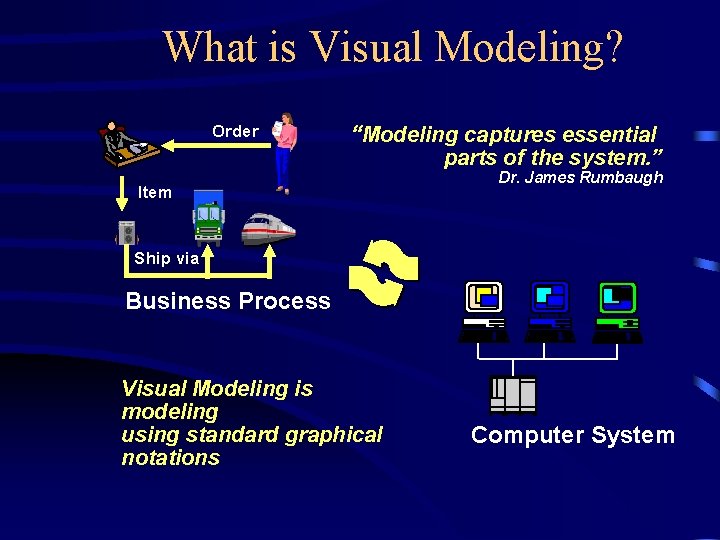
What is Visual Modeling? Order “Modeling captures essential parts of the system. ” Item Dr. James Rumbaugh Ship via Business Process Visual Modeling is modeling using standard graphical notations Computer System
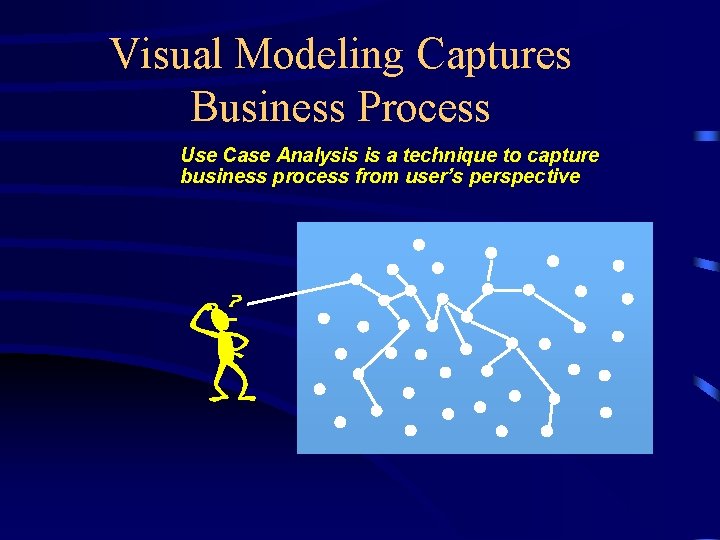
Visual Modeling Captures Business Process Use Case Analysis is a technique to capture business process from user’s perspective
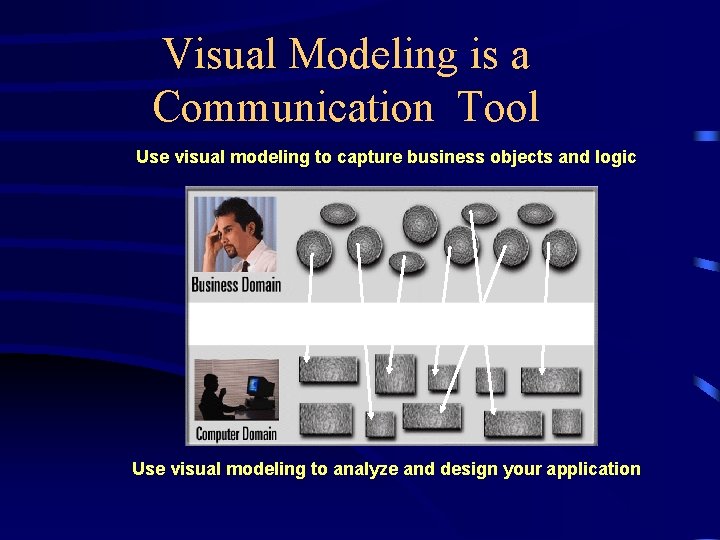
Visual Modeling is a Communication Tool Use visual modeling to capture business objects and logic Use visual modeling to analyze and design your application

Visual Modeling Manages Complexity
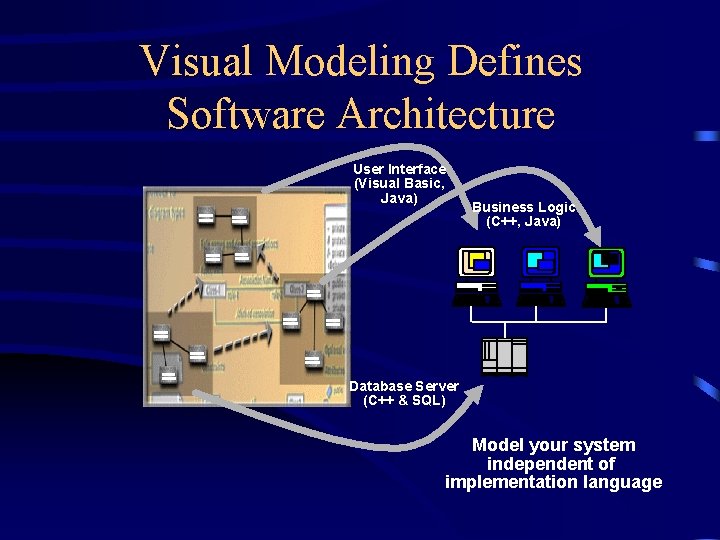
Visual Modeling Defines Software Architecture User Interface (Visual Basic, Java) Business Logic (C++, Java) Database Server (C++ & SQL) Model your system independent of implementation language
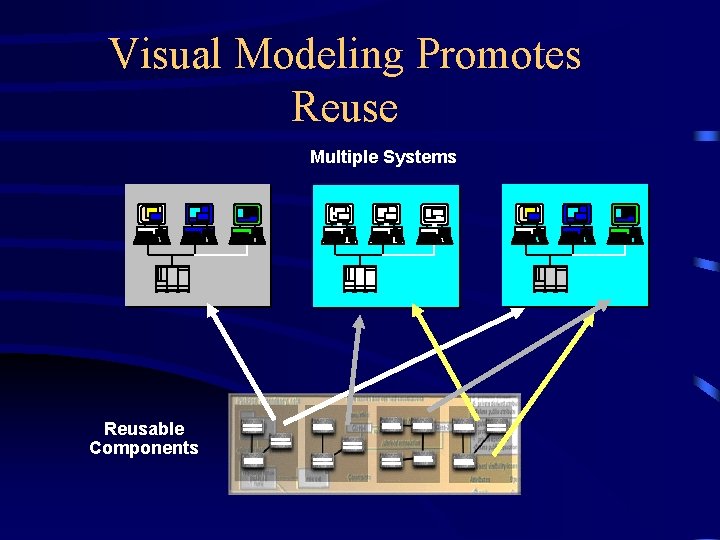
Visual Modeling Promotes Reuse Multiple Systems Reusable Components
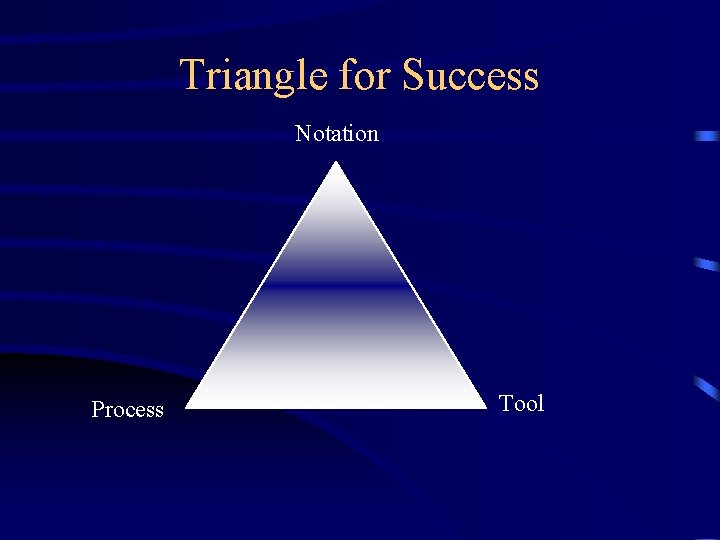
Triangle for Success Notation Process Tool
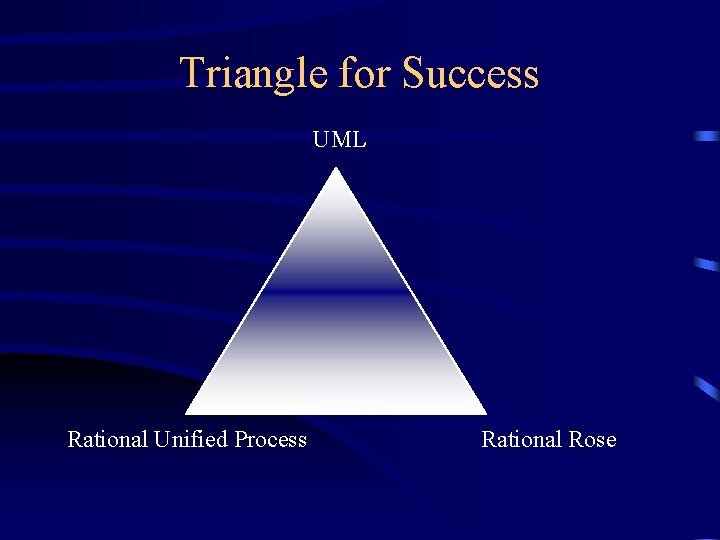
Triangle for Success UML Rational Unified Process Rational Rose
Unified Modeling Language A Notation
Notation • Notation serves as the language for communicating decisions that are not obvious • Notation provides semantics for capturing strategic and tactical decisions • UML is a notation that grows from analysis to design
What is the UML? • UML stands for Unified Modeling Language • The UML combines the best of the best from – Data Modeling concepts (Entity Relationship Diagrams) – Business Modeling (work flow) – Object Modeling – Component Modeling
UML …. • The UML is the standard language for visualizing, specifying, constructing, and documenting the artifacts of a softwareintensive system • It can be used with all processes, throughout the development life cycle, and across different implementation technologies
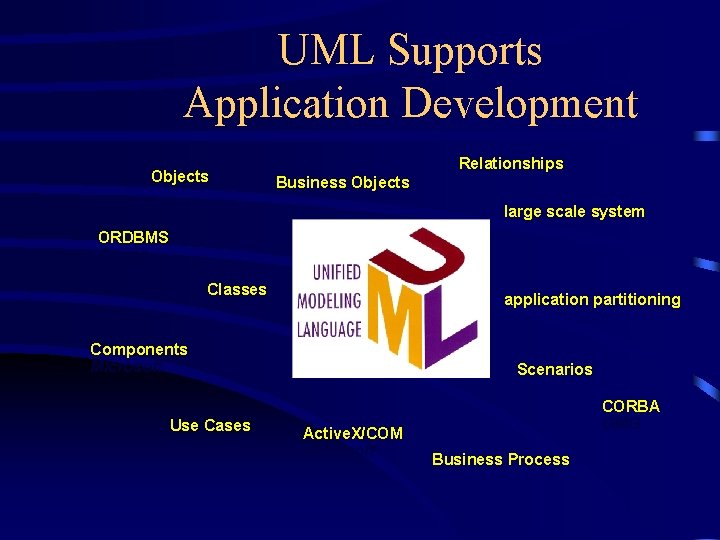
UML Supports Application Development Objects Relationships Business Objects large scale system ORDBMS Oracle Classes application partitioning Components Microsoft Use Cases Scenarios Active. X/COM Microsoft CORBA OMG Business Process
UML Concepts • The UML may be used to: – Display the boundary of a system & its major functions using use cases and actors – Illustrate use case realizations with interaction diagrams – Represent a static structure of a system using class diagrams – Reveal the physical implementation architecture with component & deployment diagrams – Extend your functionality with stereotypes
Putting UML to Work • The ESU University wants to computerize their registration system – The Registrar sets up the curriculum for a semester • One course may have multiple course offerings – Students select 4 primary courses and 2 alternate courses – Once a student registers for a semester, the billing system is notified so the student may be billed for the semester
Putting UML to Work. . . – Students may use the system to add/drop courses for a period of time after registration – Professors use the system to receive their course offering rosters – Users of the registration system are assigned passwords which are used at logon validation
Actors • An actor is someone or some thing that must interact with the system under development • An actor defines a coherent set of roles that users of an entity can play when interacting with the entity. • An actor may have generalization relationship
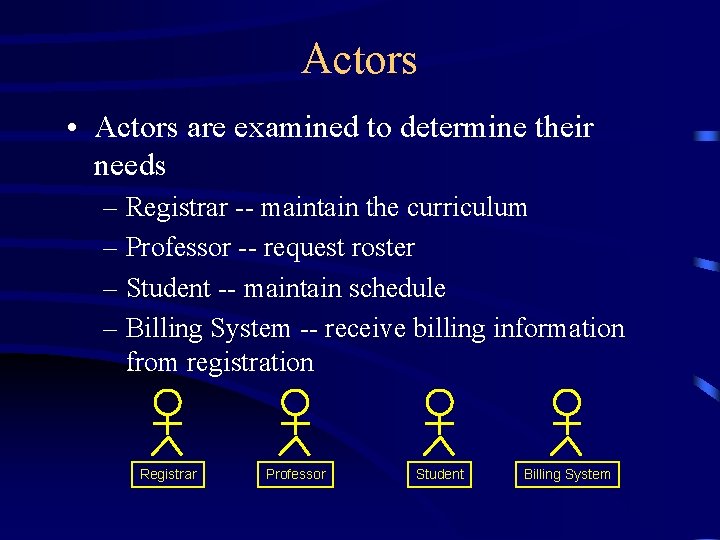
Actors • Actors are examined to determine their needs – Registrar -- maintain the curriculum – Professor -- request roster – Student -- maintain schedule – Billing System -- receive billing information from registration Registrar Professor Student Billing System
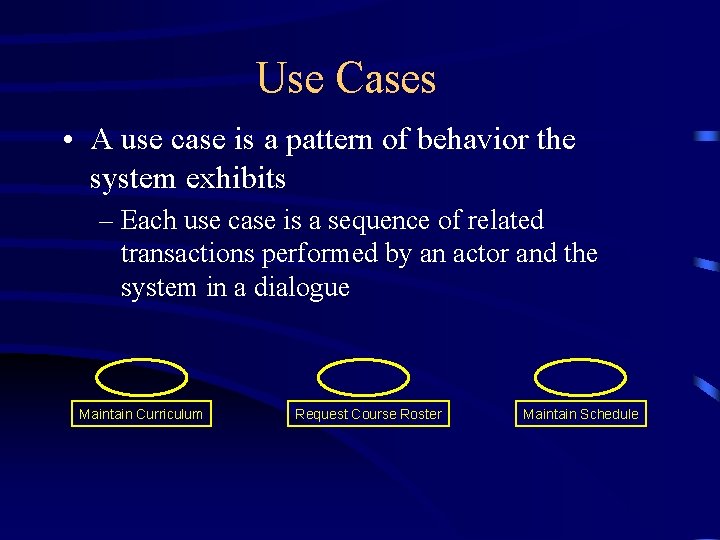
Use Cases • A use case is a pattern of behavior the system exhibits – Each use case is a sequence of related transactions performed by an actor and the system in a dialogue Maintain Curriculum Request Course Roster Maintain Schedule
Use Case Relationships • An extend relationship defines that instances of a use case may be augmented with some additional behavior defined in an extending use case.
Documenting Use Cases • A flow of events document is created for each use cases – Written from an actor point of view • Details what the system must provide to the actor when the use cases is executed • Typical contents – How the use case starts and ends – Normal flow of events – Alternate flow of events – Exceptional flow of events
Maintain Flow of Events • This use case begins when the Registrar logs onto the Registration System and enters his/her password. The system verifies that the password is valid (E-1) and prompts the Registrar to select the current semester or a future semester (E-2). The Registrar enters the desired semester. The system prompts the professor to select the desired activity: ADD, DELETE, REVIEW, or QUIT. • If the activity selected is ADD, the S-1: Add a Course subflow is performed.
• If the activity selected is DELETE, the S-2: Delete a Course subflow is performed. • If the activity selected is REVIEW, the S-3: Review Curriculum subflow is performed. • If the activity selected is QUIT, the use case ends.
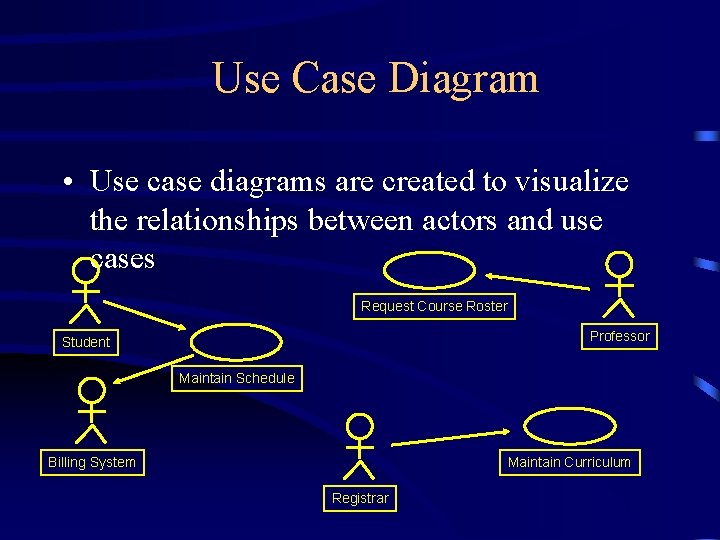
Use Case Diagram • Use case diagrams are created to visualize the relationships between actors and use cases Request Course Roster Professor Student Maintain Schedule Billing System Maintain Curriculum Registrar
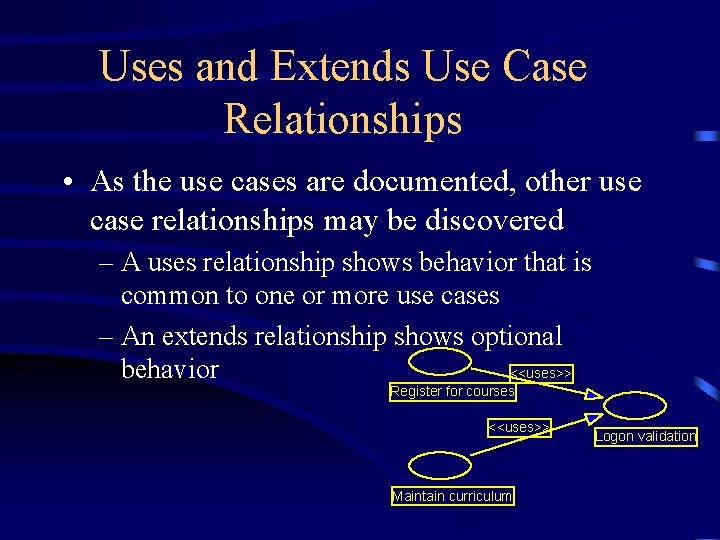
Uses and Extends Use Case Relationships • As the use cases are documented, other use case relationships may be discovered – A uses relationship shows behavior that is common to one or more use cases – An extends relationship shows optional behavior <<uses>> Register for courses <<uses>> Maintain curriculum Logon validation
Use Case Realizations • The use case diagram presents an outside view of the system • Interaction diagrams describe how use cases are realized as interactions among societies of objects • Two types of interaction diagrams – Sequence diagrams – Collaboration diagrams
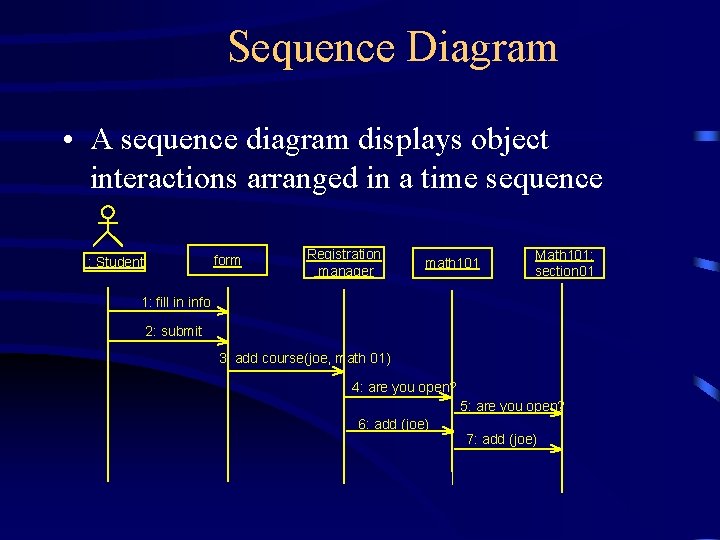
Sequence Diagram • A sequence diagram displays object interactions arranged in a time sequence form : Student Registration manager math 101 Math 101: section 01 1: fill in info 2: submit 3: add course(joe, math 01) 4: are you open? 5: are you open? 6: add (joe) 7: add (joe)
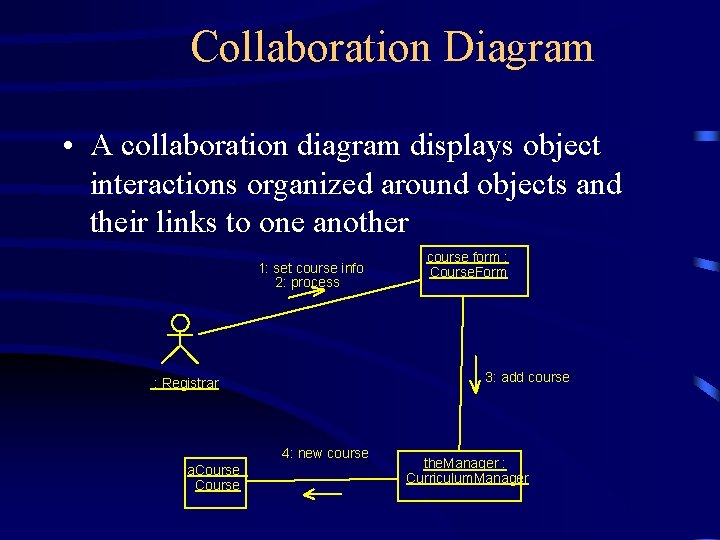
Collaboration Diagram • A collaboration diagram displays object interactions organized around objects and their links to one another 1: set course info 2: process 3: add course : Registrar 4: new course a. Course : Course course form : Course. Form the. Manager : Curriculum. Manager
Class Diagrams • A class diagram shows the existence of classes and their relationships in the logical view of a system • UML modeling elements in class diagrams – Classes and their structure and behavior – Association, aggregation, dependency, and inheritance relationships – Multiplicity and navigation indicators – Role names
Classes • Classes are found by examining the objects in sequence and collaboration diagram • A class is drawn as a rectangle with three compartments • Classes should be named using the vocabulary of the domain – Naming standards should be created – e. g. , all classes are singular nouns starting with a capital letter
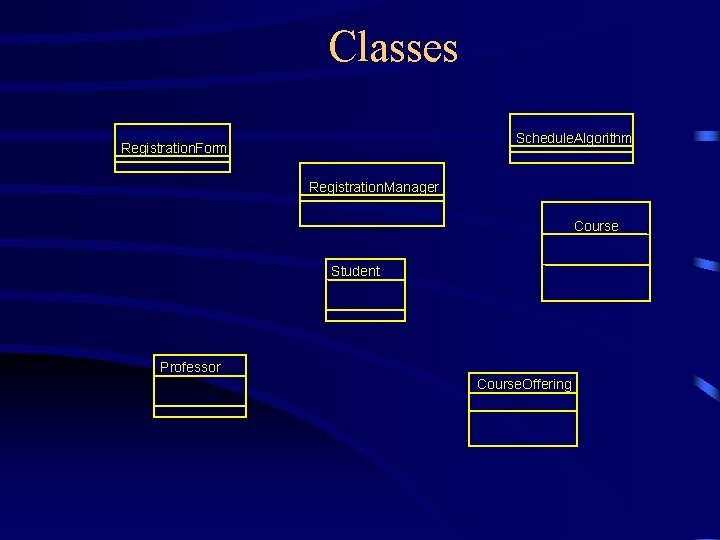
Classes Schedule. Algorithm Registration. Form Registration. Manager Course Student Professor Course. Offering
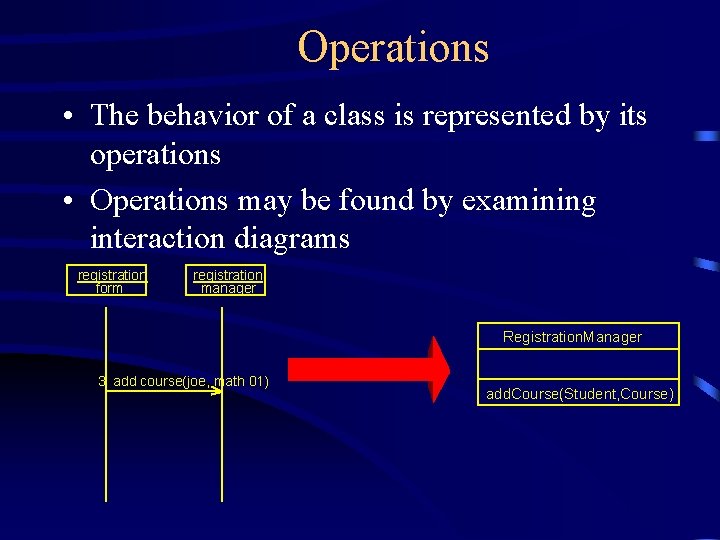
Operations • The behavior of a class is represented by its operations • Operations may be found by examining interaction diagrams registration form registration manager Registration. Manager 3: add course(joe, math 01) add. Course(Student, Course)
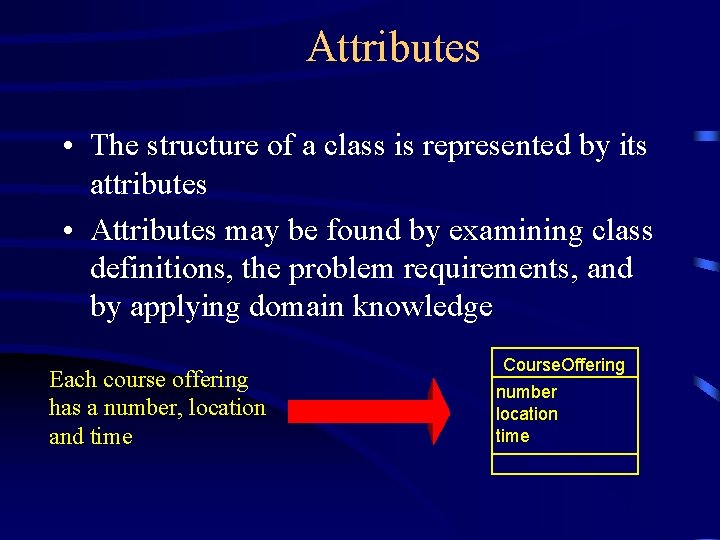
Attributes • The structure of a class is represented by its attributes • Attributes may be found by examining class definitions, the problem requirements, and by applying domain knowledge Each course offering has a number, location and time Course. Offering number location time
Relationships • Relationships provide a pathway for communication between objects • Sequence and/or collaboration diagrams are examined to determine what links between objects need to exist to accomplish the behavior -- if two objects need to “talk” there must be a link between them • Three types of relationships are: – Association – Aggregation – Dependency
Relationships • An association is a bi-directional connection between classes • An aggregation is a stronger form of relationship where the relationship is between a whole and its parts • A dependency relationship is a weaker form of relationship showing a relationship between a client and a supplier where the client does not have semantic knowledge of the supplier
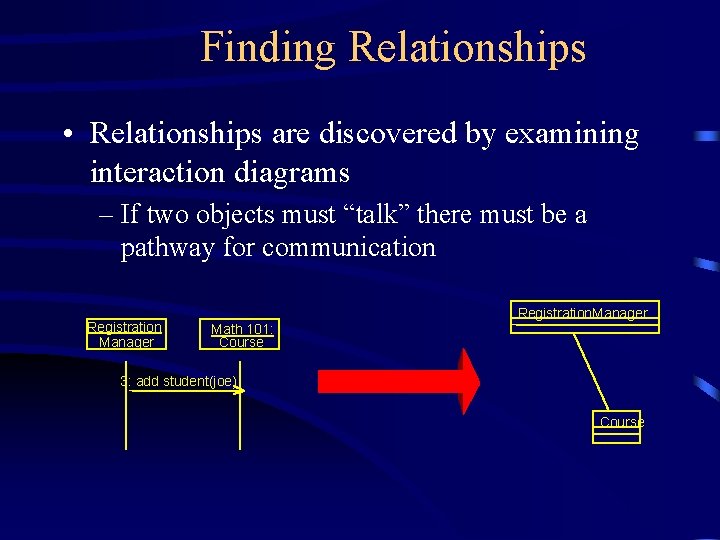
Finding Relationships • Relationships are discovered by examining interaction diagrams – If two objects must “talk” there must be a pathway for communication Registration Manager Registration. Manager Math 101: Course 3: add student(joe) Course
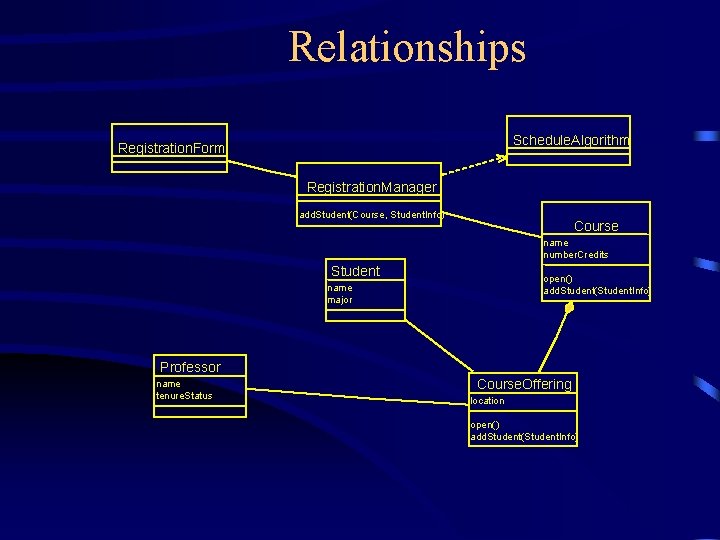
Relationships Schedule. Algorithm Registration. Form Registration. Manager add. Student(Course, Student. Info) Course name number. Credits Student open() add. Student(Student. Info) name major Professor name tenure. Status Course. Offering location open() add. Student(Student. Info)
Multiplicity and Navigation • Multiplicity defines how many objects participate in a relationships – Multiplicity is the number of instances of one class related to ONE instance of the other class – For each association and aggregation, there are two multiplicity decisions to make: one for each end of the relationship
Multiplicity and Navigation • Although associations and aggregations are bi-directional by default, it is often desirable to restrict navigation to one direction • If navigation is restricted, an arrowhead is added to indicate the direction of the navigation
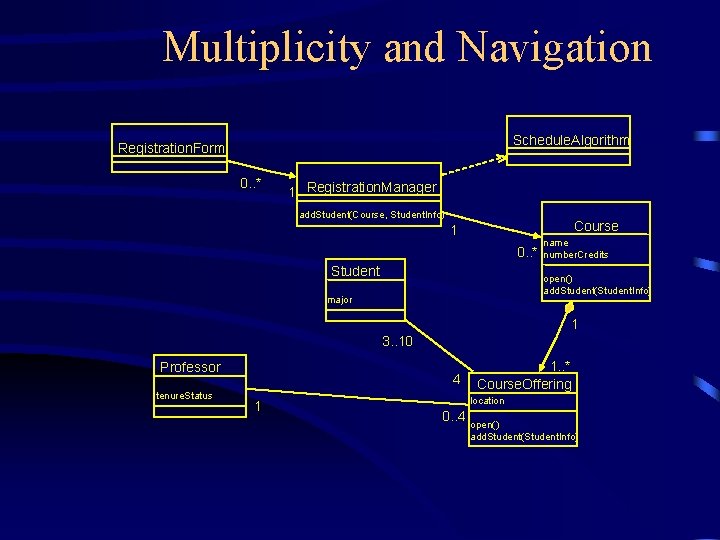
Multiplicity and Navigation Schedule. Algorithm Registration. Form 0. . * 1 Registration. Manager add. Student(Course, Student. Info) Course 1 0. . * Student name number. Credits open() add. Student(Student. Info) major 1 3. . 10 Professor tenure. Status 4 1 1. . * Course. Offering location 0. . 4 open() add. Student(Student. Info)
Inheritance • Inheritance is a relationships between a superclass and its subclasses • There are two ways to find inheritance: – Generalization – Specialization • Common attributes, operations, and/or relationships are shown at the highest applicable level in the hierarchy
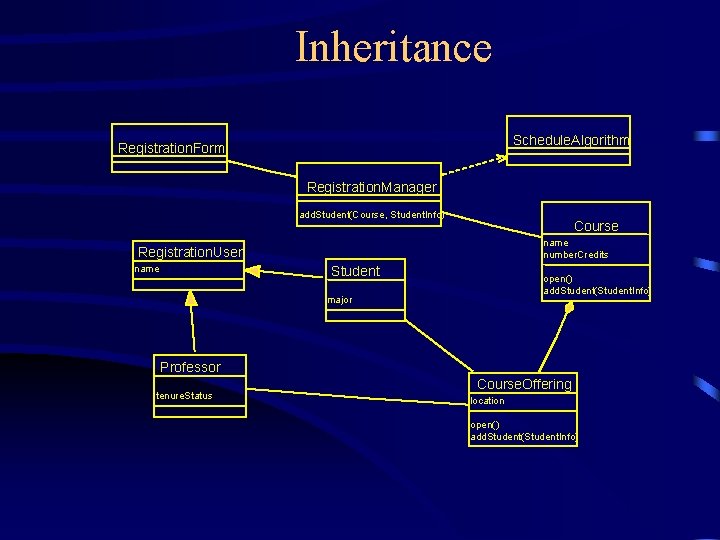
Inheritance Schedule. Algorithm Registration. Form Registration. Manager add. Student(Course, Student. Info) Course name number. Credits Registration. User name Student open() add. Student(Student. Info) major Professor tenure. Status Course. Offering location open() add. Student(Student. Info)
The State of an Object • A state transition diagram shows – The life history of a given class – The events that cause a transition from one state to another – The actions that result from a state change • State transition diagrams are created for objects with significant dynamic behavior
![State Transition Diagram Add student[ count < 10 ] Initialization Add Student / Set](http://slidetodoc.com/presentation_image_h2/743a221aad928d6bac328b5c883d47dd/image-46.jpg "State Transition Diagram Add student[ count < 10 ] Initialization Add Student / Set")
State Transition Diagram Add student[ count < 10 ] Initialization Add Student / Set count = 0 do: Initialize course Open entry: Register student exit: Increment count Cancel [ count = 10 ] Canceled do: Notify registered students Cancel Closed do: Finalize course
The Physical World • Component diagrams illustrate the organizations and dependencies among software components • A component may be – A source code component – A run time components or – An executable component
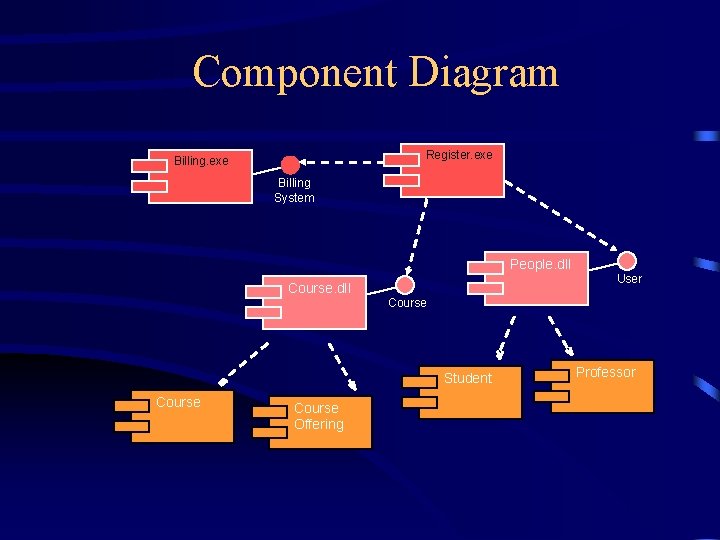
Component Diagram Register. exe Billing System People. dll User Course. dll Course Student Course Offering Professor
Deploying the System • The deployment diagram shows the configuration of run-time processing elements and the software processes living on them • The deployment diagram visualizes the distribution of components across the enterprise.
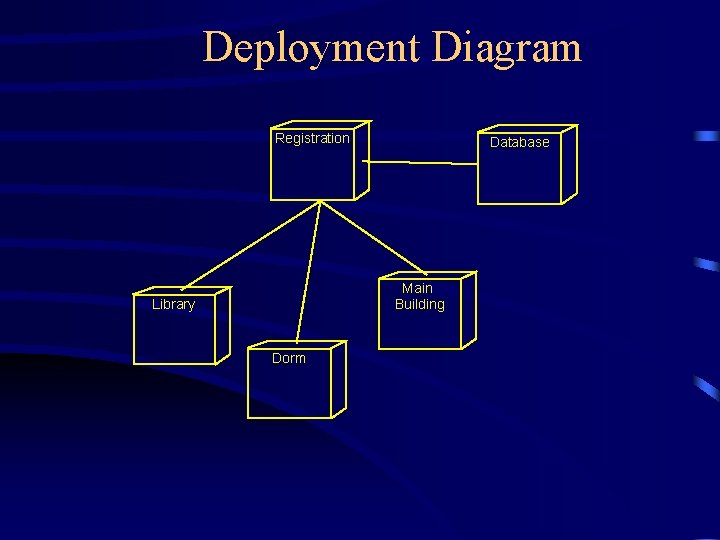
Deployment Diagram Registration Database Main Building Library Dorm
Extending the UML • Stereotypes can be used to extend the UML notational elements • Stereotypes may be used to classify and extend associations, inheritance relationships, classes, and components • Examples: – Class stereotypes: boundary, control, entity, utility, exception – Inheritance stereotypes: uses and extends – Component stereotypes: subsystem
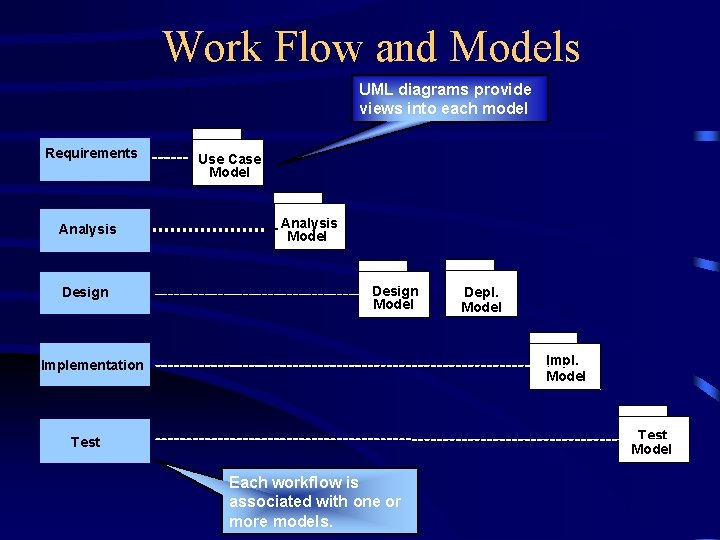
Work Flow and Models UML diagrams provide views into each model Requirements Analysis Design Use Case Model Analysis Model Design Model Depl. Model Implementation Test Model Test Each workflow is associated with one or more models.
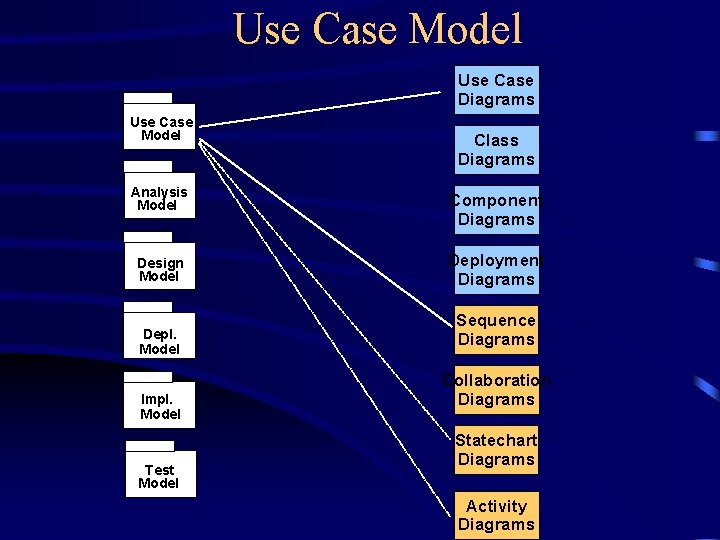
Use Case Model Use Case Diagrams Use Case Model Class Diagrams Analysis Model Component Diagrams Design Model Deployment Diagrams Depl. Model Impl. Model Test Model Sequence Diagrams Collaboration Diagrams Statechart Diagrams Activity Diagrams
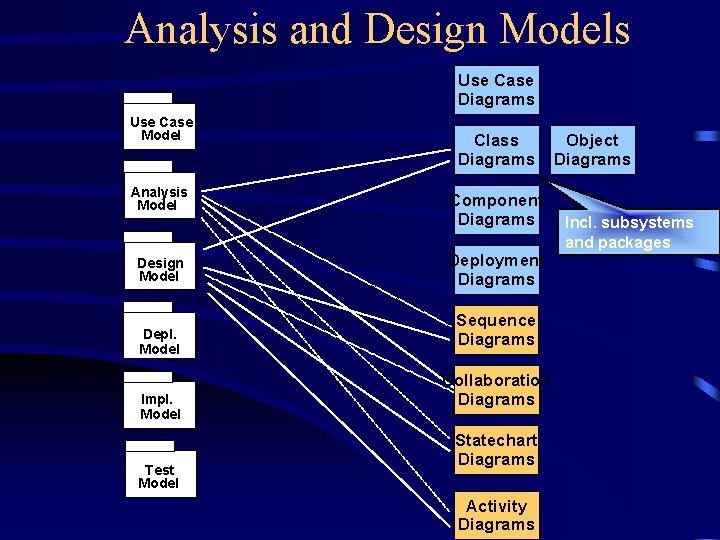
Analysis and Design Models Use Case Diagrams Use Case Model Analysis Model Design Model Depl. Model Impl. Model Test Model Class Diagrams Component Diagrams Deployment Diagrams Sequence Diagrams Collaboration Diagrams Statechart Diagrams Activity Diagrams Object Diagrams Incl. subsystems and packages
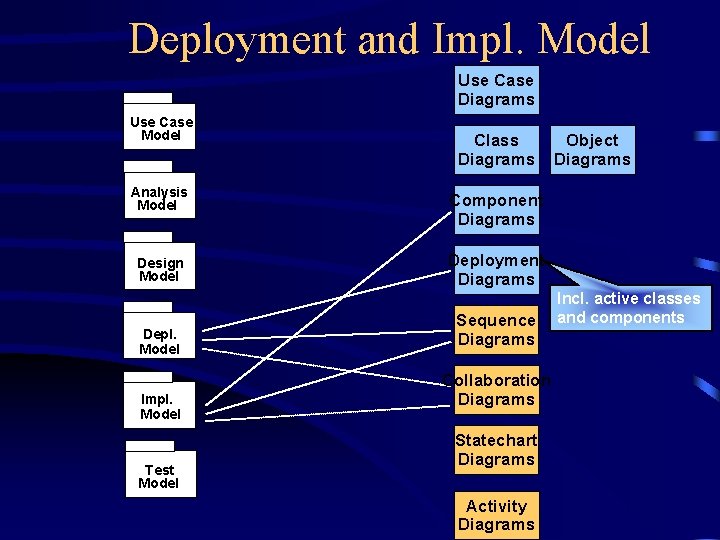
Deployment and Impl. Model Use Case Diagrams Use Case Model Class Diagrams Analysis Model Component Diagrams Design Model Deployment Diagrams Depl. Model Impl. Model Test Model Sequence Diagrams Collaboration Diagrams Statechart Diagrams Activity Diagrams Object Diagrams Incl. active classes and components
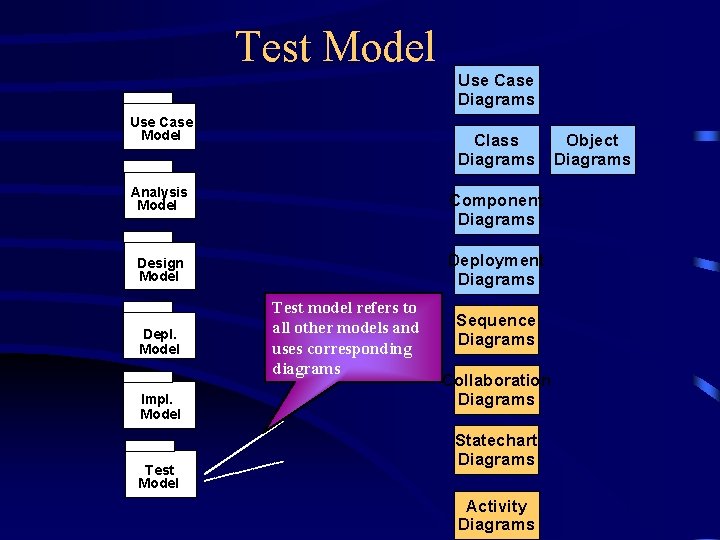
Test Model Use Case Diagrams Use Case Model Class Diagrams Analysis Model Component Diagrams Design Model Deployment Diagrams Depl. Model Impl. Model Test model refers to all other models and uses corresponding diagrams Sequence Diagrams Collaboration Diagrams Statechart Diagrams Activity Diagrams Object Diagrams
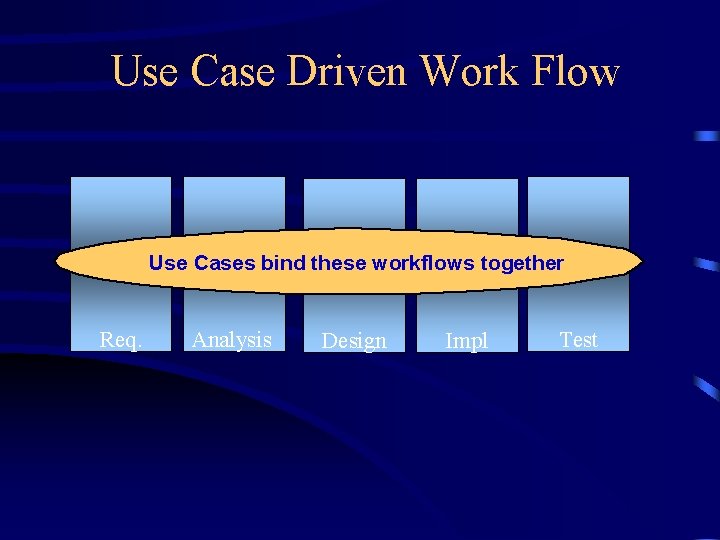
Use Case Driven Work Flow Use Cases bind these workflows together Req. Analysis Design Impl Test
UML is BIG. . • UML Notation is too big, but is flexible enough to accommodate the needs of wide range of projects • To use UML properly, we should streamline it • UML is just a notation, we also need a wellmanaged and well-defined modeling process
A Modeling Process A Process • provides guidance as to the order of a team’s activities, • specifies what artifacts should be developed, • directs the tasks of individual developers and the team as a whole, and • offers criteria for monitoring and measuring a project’s products and activities.
Points for defining Modeling Process • Legacy methods are important • Keep the process simple or else modeling will act as a burden • Write User manual before you design the classes • Organize use cases into Packages • Use stereotypes
Points for defining Modeling Process. . . • Two important questions to answer – What are the objects in the System? – How is the system behavior distributed among these objects? • Drive the static model from the dynamic models • Defer assigning operations from analysis to design stage • Remember it is a iterative and incremental approach
The Rational Iterative Process A Modeling process
• • What the Iterative Life Cycle Is Not It is not hacking It is not a playpen for developers It is not unpredictable It is not redesigning the same thing over and over until it is perfect • It is not an excuse for not planning and managing a project • It is not something that affects only the developers on a project
What the Iterative Life Cycle Is • It is planned and managed • It accommodates changes to requirements with less disruption • It is based on evolving executable prototypes, not documentation • It involves the user/customer throughout the process • It is risk driven
Three Important Features of the Iterative Approach • Continuous integration – Not done in one lump near the delivery date • Frequent, executable releases – Some internal; some delivered • Attack risks through demonstrable progress – Progress measured in products, not documentation or engineering estimates
Resulting Benefits • Releases are a forcing function that drives the development team to closure at regular intervals – Cannot have the “ 90% done with 90% remaining” phenomenon • Can incorporate problems/issues/changes into future iterations rather than disrupting ongoing production • The project’s supporting elements (testers, writers, toolsmiths, CM, QA, etc. ) can better schedule their work
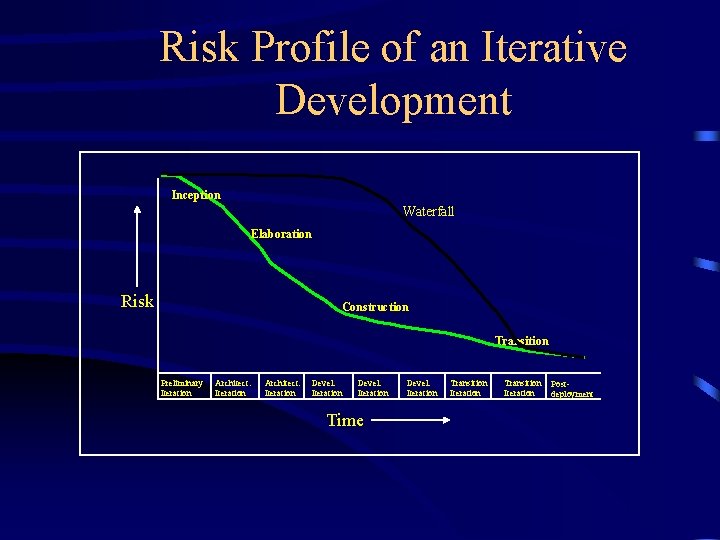
Risk Profile of an Iterative Development Inception Waterfall Elaboration Risk Construction Transition Preliminary Iteration Architect. Iteration Devel. Iteration Time Devel. Iteration Transition Iteration Postdeployment
Risk Management Phase-by -Phase • Inception – Bracket the project’s risks by building a proof of concept • Elaboration – Develop a common understanding of the system’s scope and desired behavior by exploring scenarios with end users and domain experts – Establish the system’s architecture – Design common mechanisms to address system-wide issues
Risk Management Phase-by -Phase • Construction – Refine the architecture – Risk-driven iterations – Continuous integration • Transition – Facilitate user acceptance – Measure user satisfaction • Post-deployment cycles – Continue evolutionary approach – Preserve architectural integrity
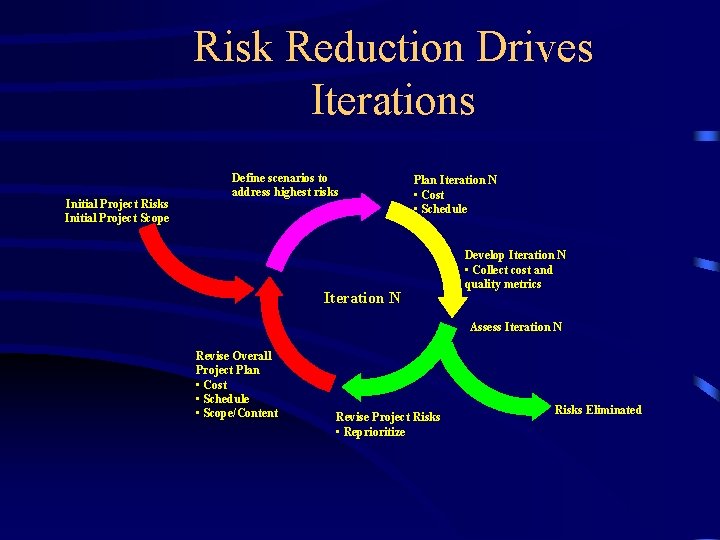
Risk Reduction Drives Iterations Initial Project Risks Initial Project Scope Define scenarios to address highest risks Plan Iteration N • Cost • Schedule Iteration N Develop Iteration N • Collect cost and quality metrics Assess Iteration N Revise Overall Project Plan • Cost • Schedule • Scope/Content Revise Project Risks • Reprioritize Risks Eliminated
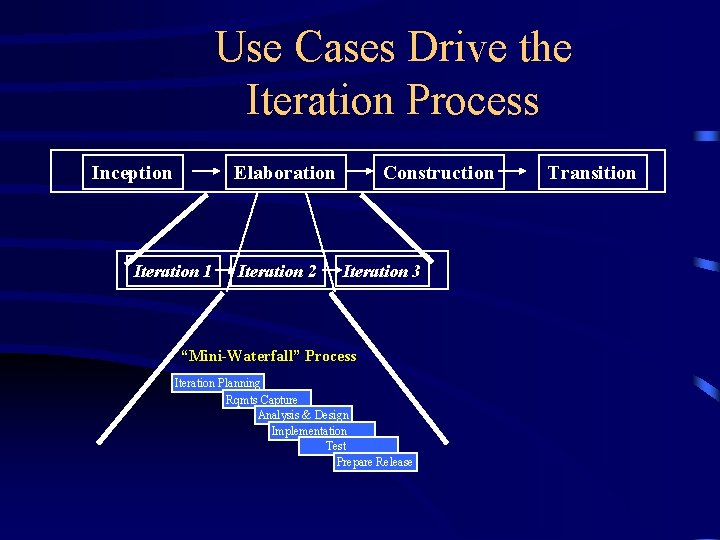
Use Cases Drive the Iteration Process Inception Elaboration Iteration 1 Iteration 2 Construction Iteration 3 “Mini-Waterfall” Process Iteration Planning Rqmts Capture Analysis & Design Implementation Test Prepare Release Transition
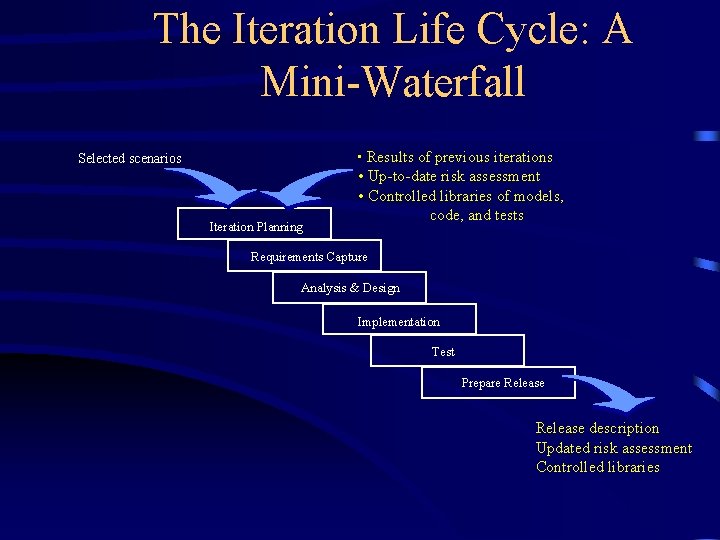
The Iteration Life Cycle: A Mini-Waterfall • Results of previous iterations Selected scenarios Iteration Planning • Up-to-date risk assessment • Controlled libraries of models, code, and tests Requirements Capture Analysis & Design Implementation Test Prepare Release description Updated risk assessment Controlled libraries
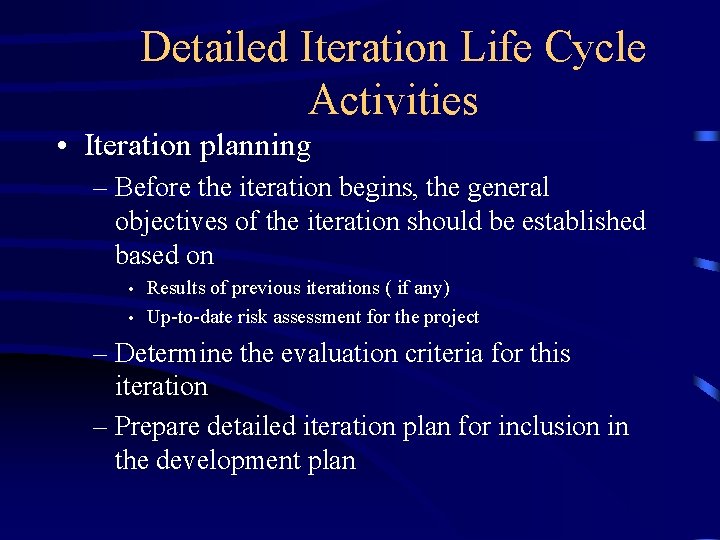
Detailed Iteration Life Cycle Activities • Iteration planning – Before the iteration begins, the general objectives of the iteration should be established based on • • Results of previous iterations ( if any) Up-to-date risk assessment for the project – Determine the evaluation criteria for this iteration – Prepare detailed iteration plan for inclusion in the development plan
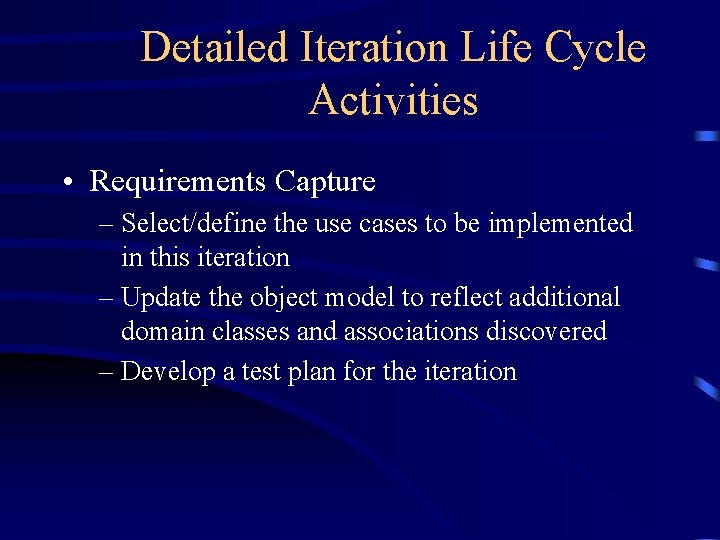
Detailed Iteration Life Cycle Activities • Requirements Capture – Select/define the use cases to be implemented in this iteration – Update the object model to reflect additional domain classes and associations discovered – Develop a test plan for the iteration
Detailed Iteration Life Cycle Activities • Analysis & Design – Determine the classes to be developed or updated in this iteration – Update the object model to reflect additional design classes and associations discovered – Update the architecture document if needed – Begin development of test procedures
Detailed Iteration Life Cycle Activities • Implementation – Automatically generate code from the design model – Manually generate code for operations – Complete test procedures – Conduct unit and integration tests
Detailed Iteration Life Cycle Activities • Test – Integrate and test the developed code with the rest of the system (previous releases) – Capture and review test results – Evaluate test results relative to the evaluation criteria – Conduct an iteration assessment
Detailed Iteration Life Cycle Activities • Prepare the release description – Synchronize code and design models – Place products of the iteration in controlled libraries
Work Allocation Within an Iteration • Work to be accomplished within an iteration is determined by – The (new) use cases to be implemented – The rework to be done • Packages make convenient work packages for developers – High-level packages can be assigned to teams – Lower-level packages can be assigned to individual developers
Work Allocation Within an Iteration • Use Cases make convenient work packages for test and assessment teams • Packages are also useful in determining the granularity at which configuration management will be applied – For example, check-in and check-out of individual packages
Selecting Iterations • How many iterations do I need? – On projects taking 18 months or less, 3 to 6 iterations are typical • Are all iterations on a project the same length? – Usually – Iteration length may vary by phase. For example, elaboration iterations may be shorter than construction iterations
The First Iteration • The first iteration is usually the hardest – Requires the entire development environment and most of the development team to be in place – Many tool integration issues, team-building issues, staffing issues, etc. must be resolved • Teams new to an iterative approach are usually overly-optimistic
There Is No Silver Bullet • Remember the main reason for using the iterative life cycle: • You must expect that – Some risks will not be eliminated as planned – You will discover new risks along the way – Some rework will be required; some lines of code developed for an iteration will be thrown away – Requirements will change along the way

- Slides: 84