
Analysing Argument The Complex Interplay of Persuasion Whats
- Slides: 17
Analysing Argument
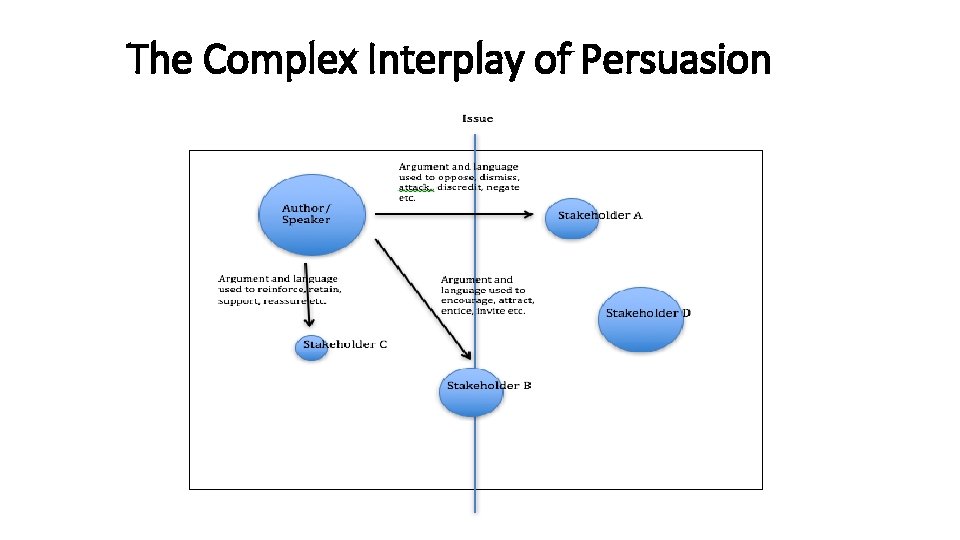
The Complex Interplay of Persuasion
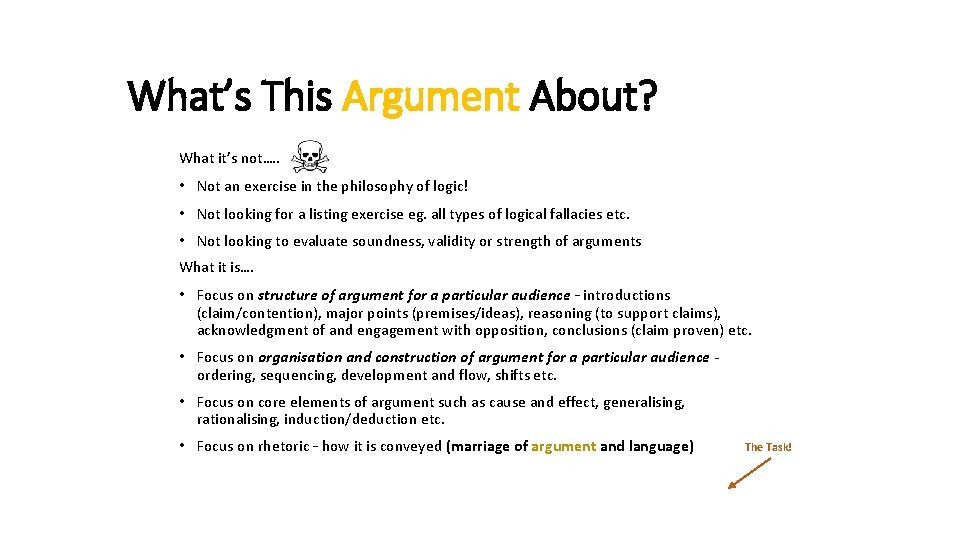
What’s This Argument About? What it’s not…. . • Not an exercise in the philosophy of logic! • Not looking for a listing exercise eg. all types of logical fallacies etc. • Not looking to evaluate soundness, validity or strength of arguments What it is…. • Focus on structure of argument for a particular audience – introductions (claim/contention), major points (premises/ideas), reasoning (to support claims), acknowledgment of and engagement with opposition, conclusions (claim proven) etc. • Focus on organisation and construction of argument for a particular audience - ordering, sequencing, development and flow, shifts etc. • Focus on core elements of argument such as cause and effect, generalising, rationalising, induction/deduction etc. • Focus on rhetoric – how it is conveyed (marriage of argument and language) The Task!
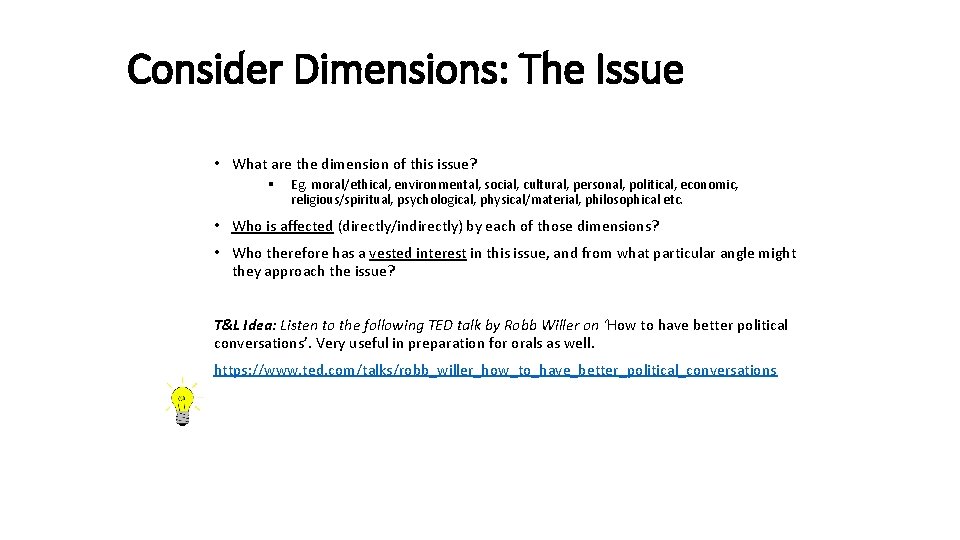
Consider Dimensions: The Issue • What are the dimension of this issue? § Eg. moral/ethical, environmental, social, cultural, personal, political, economic, religious/spiritual, psychological, physical/material, philosophical etc. • Who is affected (directly/indirectly) by each of those dimensions? • Who therefore has a vested interest in this issue, and from what particular angle might they approach the issue? T&L Idea: Listen to the following TED talk by Robb Willer on ‘How to have better political conversations’. Very useful in preparation for orals as well. https: //www. ted. com/talks/robb_willer_how_to_have_better_political_conversations
Consider Appeals • How does this issue affect (the rights, responsibilities, autonomy, sovereignty, wellbeing etc. ) of: § the individual (me) – and by extension, those with whom I would immediately identify § the local community / wider society / the nation / the global community (networks/relationships/peoples/partnerships) § future generations (intergenerational responsibilities) / past generations (history) § people, places, other living entities, nature – and dreams, ideals, possibilities (the concrete world vs the abstract world) • What are the tensions that may exist/arise between these different identities and loyalties? T&L Idea: Solarium Ban: A Victory For Good Sense is a useful article to help students consider how argument is constructed with different stakeholders in mind – logical development of range of points from various angles, engaging with opposition, endorsing solution that has been advanced etc. (will be uploaded as part of resources)
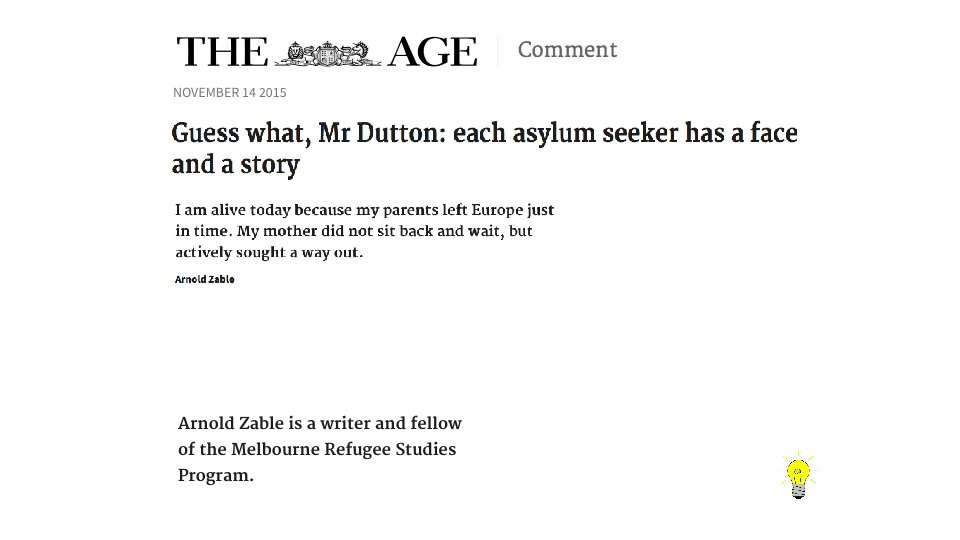
Consider Audience (Stakeholders) • Along what lines are they comprised? § Eg. gender/sexuality, religious, human vs non-human, special interest groups, age, ethnicity / nationality, minority groups, political, cultural, class, professional/career / industry [NB. AVOID THE ARBITRARY AGE BRACKET!] • What are the values that distinguish each of these groups? • How do they talk about those within the same group /outside the group? § Consider inclusion, exclusion, fear, categorisation, stereotyping, latent assumptions, support, rejection etc. T&L Idea: Arnold Zable’s opinion piece “Each asylum seeker has a face and a story” (The Age, 14/11/15) is an instructive text to use with students.
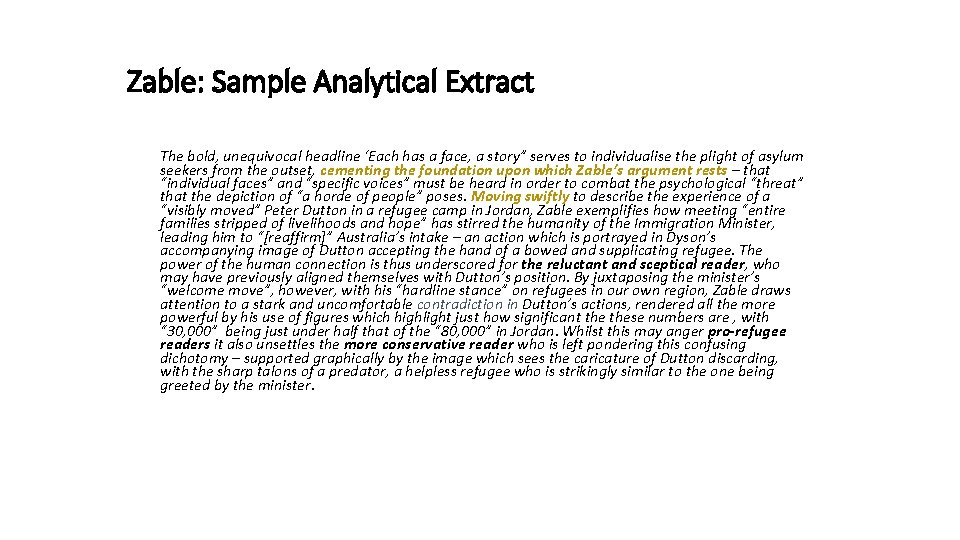
Zable: Sample Analytical Extract The bold, unequivocal headline ‘Each has a face, a story” serves to individualise the plight of asylum seekers from the outset, cementing the foundation upon which Zable’s argument rests – that “individual faces” and “specific voices” must be heard in order to combat the psychological “threat” that the depiction of “a horde of people” poses. Moving swiftly to describe the experience of a “visibly moved” Peter Dutton in a refugee camp in Jordan, Zable exemplifies how meeting “entire families stripped of livelihoods and hope” has stirred the humanity of the Immigration Minister, leading him to “[reaffirm]” Australia’s intake – an action which is portrayed in Dyson’s accompanying image of Dutton accepting the hand of a bowed and supplicating refugee. The power of the human connection is thus underscored for the reluctant and sceptical reader, who may have previously aligned themselves with Dutton’s position. By juxtaposing the minister’s “welcome move”, however, with his “hardline stance” on refugees in our own region, Zable draws attention to a stark and uncomfortable contradiction in Dutton’s actions, rendered all the more powerful by his use of figures which highlight just how significant these numbers are , with “ 30, 000” being just under half that of the “ 80, 000” in Jordan. Whilst this may anger pro-refugee readers it also unsettles the more conservative reader who is left pondering this confusing dichotomy – supported graphically by the image which sees the caricature of Dutton discarding, with the sharp talons of a predator, a helpless refugee who is strikingly similar to the one being greeted by the minister.
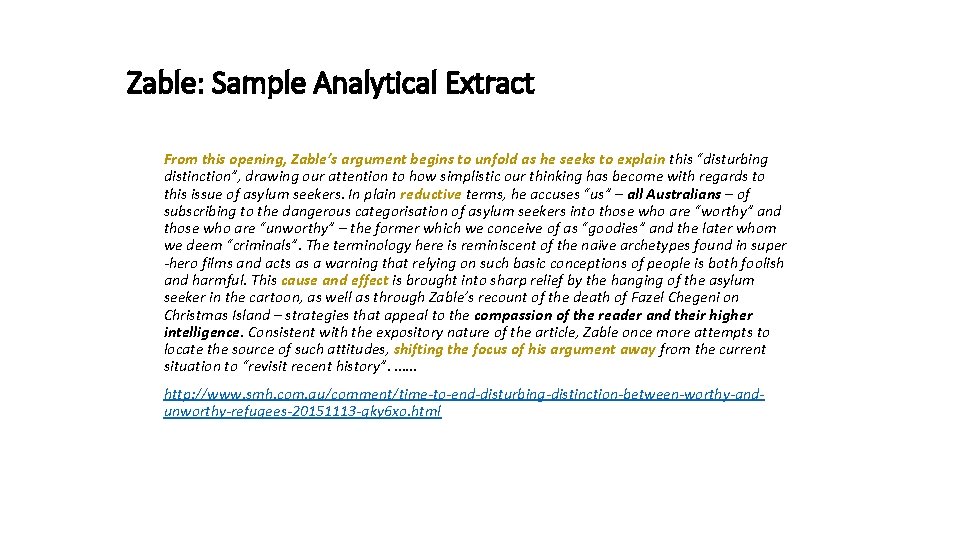
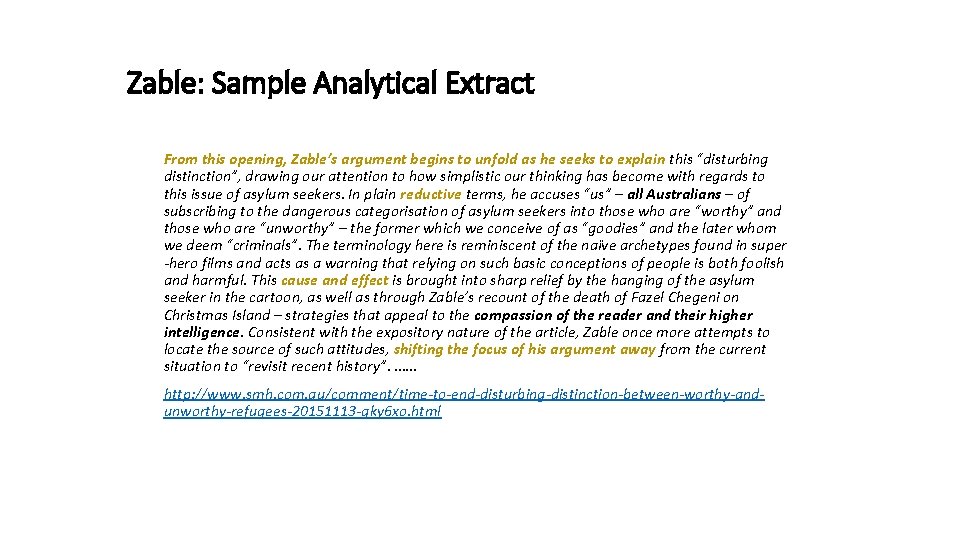
Zable: Sample Analytical Extract From this opening, Zable’s argument begins to unfold as he seeks to explain this “disturbing distinction”, drawing our attention to how simplistic our thinking has become with regards to this issue of asylum seekers. In plain reductive terms, he accuses “us” – all Australians – of subscribing to the dangerous categorisation of asylum seekers into those who are “worthy” and those who are “unworthy” – the former which we conceive of as “goodies” and the later whom we deem “criminals”. The terminology here is reminiscent of the naïve archetypes found in super -hero films and acts as a warning that relying on such basic conceptions of people is both foolish and harmful. This cause and effect is brought into sharp relief by the hanging of the asylum seeker in the cartoon, as well as through Zable’s recount of the death of Fazel Chegeni on Christmas Island – strategies that appeal to the compassion of the reader and their higher intelligence. Consistent with the expository nature of the article, Zable once more attempts to locate the source of such attitudes, shifting the focus of his argument away from the current situation to “revisit recent history”. …… http: //www. smh. com. au/comment/time-to-end-disturbing-distinction-between-worthy-andunworthy-refugees-20151113 -gky 6 xo. html
Zable: Sample Analytical Extract From this opening, Zable’s argument begins to unfold as he seeks to explain this “disturbing distinction”, drawing our attention to how simplistic our thinking has become with regards to this issue of asylum seekers. In plain reductive terms, he accuses “us” – all Australians – of subscribing to the dangerous categorisation of asylum seekers into those who are “worthy” and those who are “unworthy” – the former which we conceive of as “goodies” and the later whom we deem “criminals”. The terminology here is reminiscent of the naïve archetypes found in super -hero films and acts as a warning that relying on such basic conceptions of people is both foolish and harmful. This cause and effect is brought into sharp relief by the hanging of the asylum seeker in the cartoon, as well as through Zable’s recount of the death of Fazel Chegeni on Christmas Island – strategies that appeal to the compassion of the reader and their higher intelligence. Consistent with the expository nature of the article, Zable once more attempts to locate the source of such attitudes, shifting the focus of his argument away from the current situation to “revisit recent history”. …… http: //www. smh. com. au/comment/time-to-end-disturbing-distinction-between-worthy-andunworthy-refugees-20151113 -gky 6 xo. html
Consider Publication/Source • Who reads/watches/accesses what? Why? What are they looking for? § Consider: The Age, Herald Sun, The Australian, The Guardian, The Conversation, The Project, Fox News special interest (e)magazines, mummy blogs, social media sites eg. Facebook etc. • Who/ What are different publications/sources biased towards?
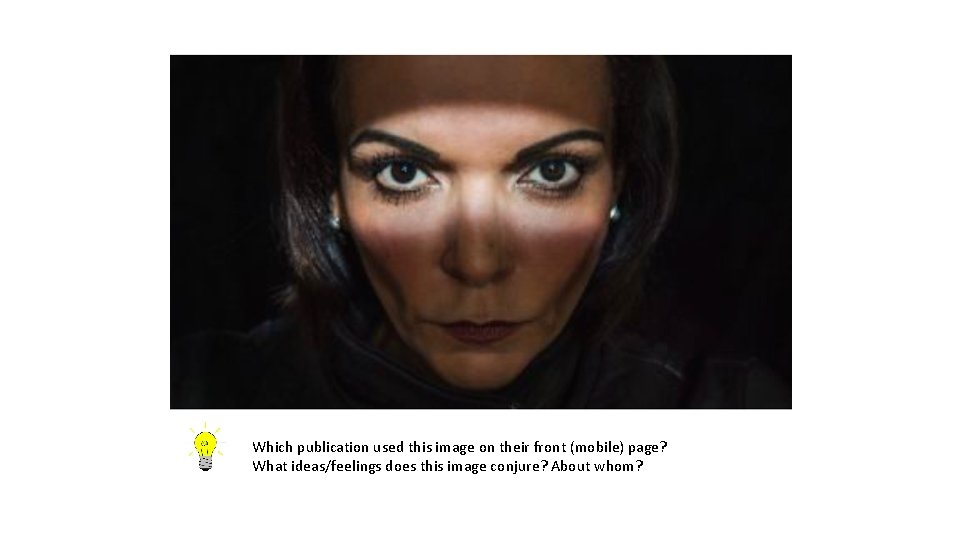
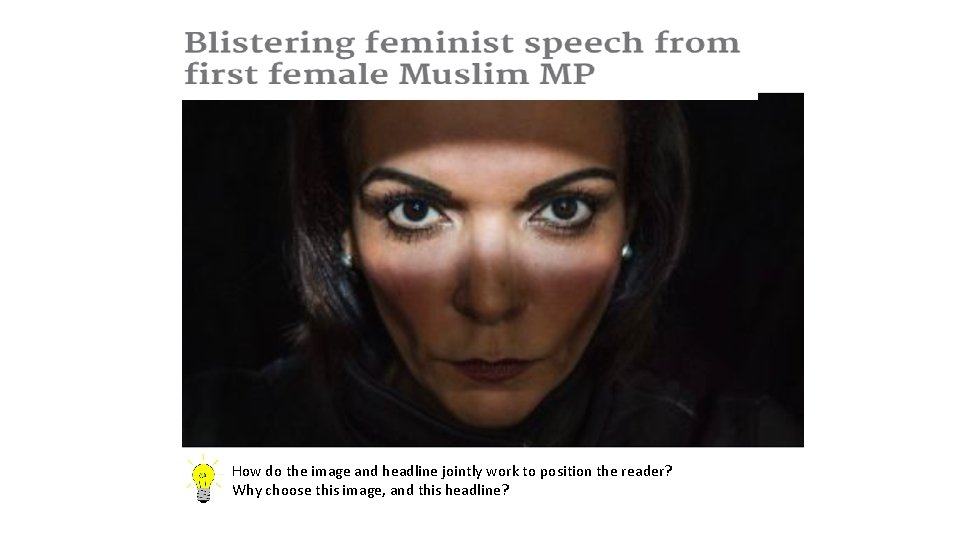
Which publication used this image on their front (mobile) page? What ideas/feelings does this image conjure? About whom?
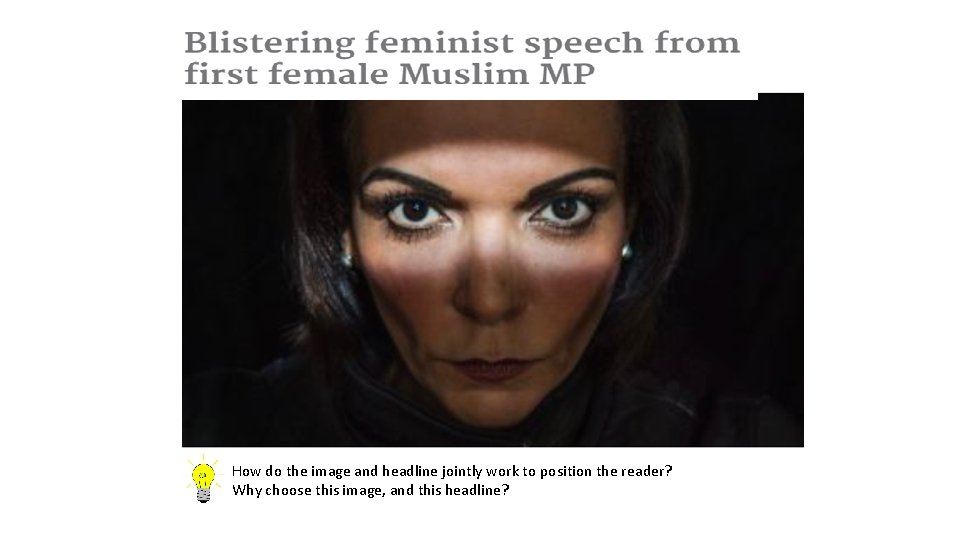
How do the image and headline jointly work to position the reader? Why choose this image, and this headline?
How do the image and headline jointly work to position the reader? Why choose this image, and this headline?
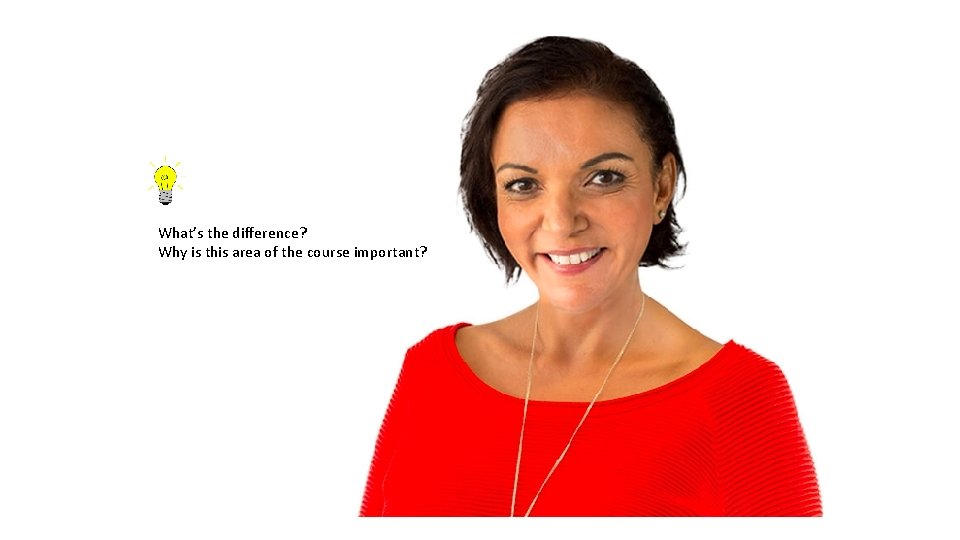
What’s the difference? Why is this area of the course important?
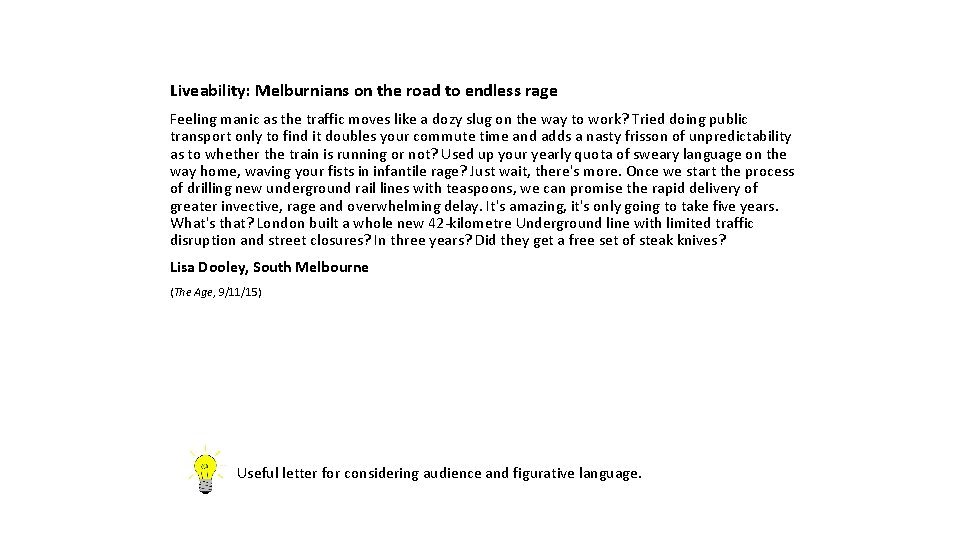
Liveability: Melburnians on the road to endless rage Feeling manic as the traffic moves like a dozy slug on the way to work? Tried doing public transport only to find it doubles your commute time and adds a nasty frisson of unpredictability as to whether the train is running or not? Used up your yearly quota of sweary language on the way home, waving your fists in infantile rage? Just wait, there's more. Once we start the process of drilling new underground rail lines with teaspoons, we can promise the rapid delivery of greater invective, rage and overwhelming delay. It's amazing, it's only going to take five years. What's that? London built a whole new 42 -kilometre Underground line with limited traffic disruption and street closures? In three years? Did they get a free set of steak knives? Lisa Dooley, South Melbourne (The Age, 9/11/15) Useful letter for considering audience and figurative language.
Sample Analytical Extract Initially, Dooley highlights the slowness of the traffic with a simile of “a dozy slug”, setting up a tone of annoyance that depicts how long the state government has taken to fix traffic congestion on our roads. Coupled with the “nasty frisson of unpredictability” that characterises the situation, Dooley underscores the uncertainty and inefficiency of the government, ridiculing their competency. The imagery of “infantile rage” evokes familiar scenes of tantrums and humorously engages fellow commuters in their own hysterical antics, thus portraying through cause and effect the chaos that has ensued through the ineptitude of the state government. Dooley shifts her focus to the irrational decision made by the government to create underground rail lines, utilising the metaphor of “drilling…with teaspoons” to convey the futility of this approach, and inviting the commuter to share her contempt with her sarcastic remark, “it’s amazing, it’s only going to take five years” ……… This Power. Point has been shared by Marjan Mossamaparast