
ANALYSING AND DESCRIBING JOBS AND ROLES Y D
ANALYSING AND DESCRIBING JOBS AND ROLES Y. D. PANDAY

ANALYSIS OF JOBS AND ROLES It provides the information required to produce job descriptions, role profiles and personal and learning/ training specifications. It is of fundamental importance in organisation and job design, recruitment and selection, performance management, training, management development, career management, job evaluation and the design of pay structures. (Most of the key processes in HRM)
JOBS AND ROLES Jobs A job consists of a related set of tasks that are carried out by a person to fulfill a purpose. Routine or machine controlled jobs do indeed exist in most organisation but increasingly the work carried out by people is not mechanistic. The rigidity inherent in the notion of a job is not in accord with the realities of the organisational life for many people. A flexible approach is often required to use and develop their skills in order to respond swiftly to the new demands they face every day.

JOBS AND ROLES Roles The concept of role conveys the notion of skills better than ‘job’. Essentially, a role is the part people play in carrying out their work. Individual role is carried out by the person. Generic role is carried out by a number of people. A role can be described in behaviour terms – given certain expectations this is how the person needs to behave to meet them. A role profile will not spell out the tasks to be carried out but will instead indicate expectations in the form of outputs and outcomes and competency requirements in the shape of inputs of skill and behaviours required to fulfill these expectations. In the definition of role: (a)People will be given scope to use their skills in accordance with their interpretation of the situation (b) Encouragement will be given for them both to grow in their roles and to grow their roles by developing their competencies and by extending the range of their responsibilities so that their contributions exceed their expectations © The need for flexibility is recognised. Roles are more about people than jobs. There are considerations which may apply to look into ways through which satisfaction at work is increased and growth is encouraged. Focus is on how roles can be developed rather than designed in today’s flexible organisations on the basis of an understanding of what role holders are expected to achieve.

RECAP OF DISCUSSION Job Analysis Job Description Job Evaluation Recruiting Selection Performance Appraisal Training Career Planning Compensation

QUESTIONS SET WHEN LOOKING JOB DESIGN IN ORGANISATIONS. The management of people in organisations constantly raises questions such as ‘who does what? ’ ‘How should activities be grouped together? ’ ‘What lines and means of communication that need to be established? ’ ‘How should people be helped to understand their roles in relation to the objectives of the organisation and the roles of their colleagues? ’ ‘Are we doing everything that we ought to be doing and nothing that we ought not to be doing? ’ ‘How we got too many unnecessary layers of management in the organisation? ’
FACTORS AFFECTING JOB DESIGN Purpose of the organisation The demands of the job The structure of the organisation The processes and the activities carried out in the organisation. The technology of the organisation Changes in the external environment. Other factors will also include: The intrinsic motivation The characteristics of task structure The motivating characteristics of the job Job characteristic model Providing intrinsic motivation.
JOB DESIGN Davies (1996): ‘ The specifications of the contents, methods and relationships of jobs in order to satisfy technological and organisational requirements as well as social and personal requirement of the job holder. ’ Aims of job design: � Satisfy the requirement of the organisation for productivity, operational efficiency and quality of product service � Satisfy the need of the individual for interest, challenge and accomplishment thus providing for job engagement. � Consideration has to be given for the organisation to fulfil the social responsibilities of the orgnisation to the people who work in it by improving the quality of working life.

PRINCIPLES OF JOB DESIGN Robertson and Smith (1985) suggests the following 5 principles: � To influence the skill variety, provide opportunities for people to do several tasks and combine tasks. � To influence task identity, combine tasks and form natural work units � To influence task significance, form natural work units and inform people of the importance of their work � To influence anatomy, give people responsibility for determining their own working systems � To influence feedback, establish good relationship and open feedback channels.

PRINCIPLES OF JOB DESIGN An integrated view suggest that the following motivating characteristics are of prime importance in job design. � Anatomy, discretion, self control and responsibility � Variety � Use of abilities � Feedback � Belief that the task is significant.
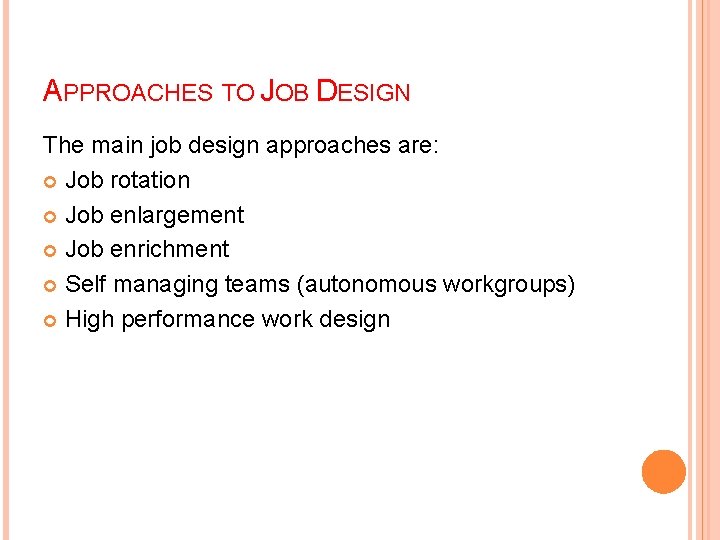
APPROACHES TO JOB DESIGN The main job design approaches are: Job rotation Job enlargement Job enrichment Self managing teams (autonomous workgroups) High performance work design

ROLE DEVELOPMENT It is continuous process which take place in the context of day to day work. It involves agreeing definitions of accountabilities, objectives and competence requirements as they evolve. It is desirable to achieve mutual understanding of the new expectations.
- Slides: 12