
Analyses of Bolted Joint for Bolt Preload and
Analyses of Bolted Joint for Bolt Preload and Shear Load Two surface interface conditions: 1. 2. 1) Bonded contact surfaces between shim plate and flanges 2) Frictionless contact surface between shim plate and flanges Two load cases: 1. Case 1: Shear load of 15 kip 2. Case 2: Combination of 60 kip bolt preload and 15 kip shear load.
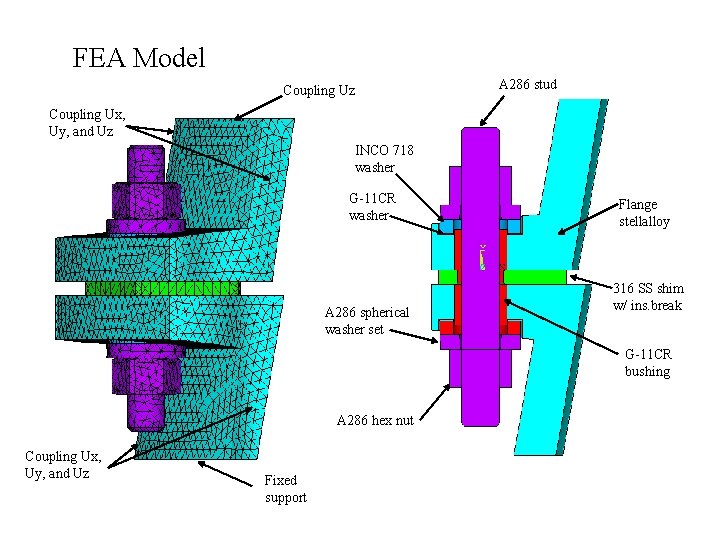
FEA Model A 286 stud Coupling Uz Coupling Ux, Uy, and Uz INCO 718 washer G-11 CR washer A 286 spherical washer set Flange stellalloy 316 SS shim w/ ins. break G-11 CR bushing A 286 hex nut Coupling Ux, Uy, and Uz Fixed support
Assumptions: • Except frictionless shim-flange contact surface, all compressive interfaces under preload are “glued” instead of bonded contacts in order to avoid the contact penetrations that affect the joint stiffness. • For stability, the G-11 bushings were glued to the flange stellalloy but have frictionless contact with the A 286 stud. • The hex nuts are glued to the stud without any tolerance. • The spherical washer sets were modeled by equivalent short cylinders. • The thickness of shim was formed by 1/7 of G-11 CR insulation and 6/7 of 316 SS. The equivalent smear material property was assumed. • The lower flange stellalloy was fixed at the bottom surface. The upper flange stellalloy was coupled in the vertical direction on the top surface nodal points. • Couples are applied at two side faces of the stellalloy to form a cyclically symmetric model. • The 60 kip pretension was applied about the mid-height of the stud and the 15 kip shear load was applied normal to the side face of upper flange, • All analyses used the room temperature material propertied as shown on next slide.

Material Properties
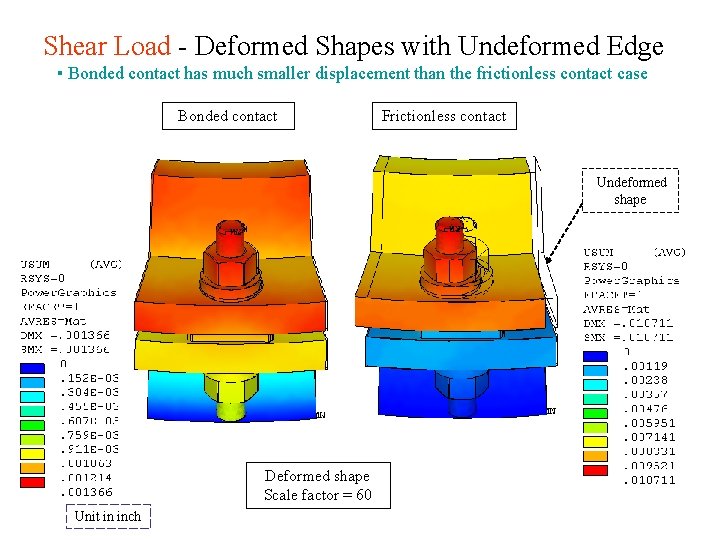
Shear Load - Deformed Shapes with Undeformed Edge ▪ Bonded contact has much smaller displacement than the frictionless contact case Bonded contact Frictionless contact Undeformed shape Deformed shape Scale factor = 60 Unit in inch
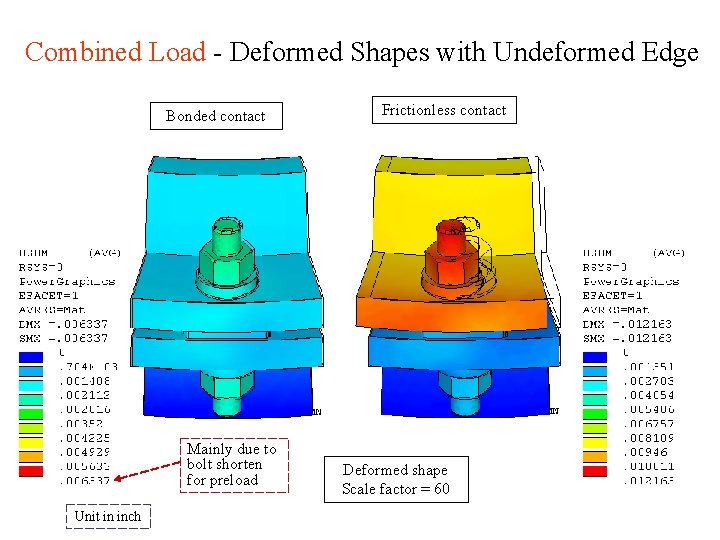
Combined Load - Deformed Shapes with Undeformed Edge Bonded contact Mainly due to bolt shorten for preload Unit in inch Frictionless contact Deformed shape Scale factor = 60
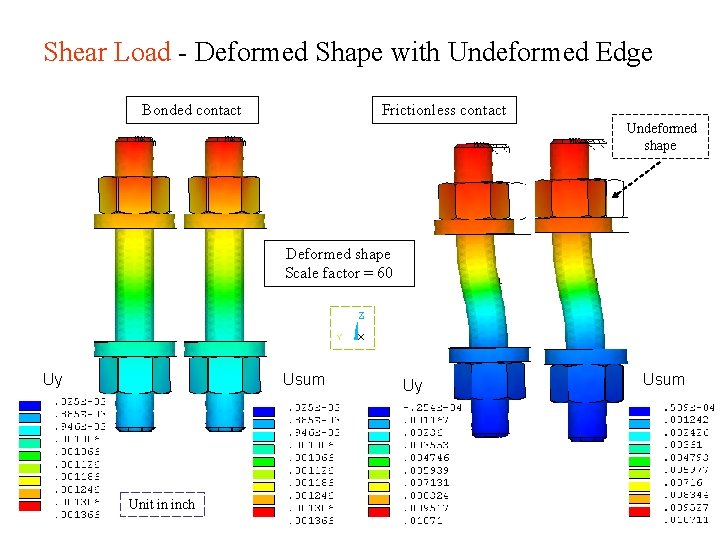
Shear Load - Deformed Shape with Undeformed Edge Bonded contact Frictionless contact Undeformed shape Deformed shape Scale factor = 60 Uy Usum Unit in inch Uy Usum
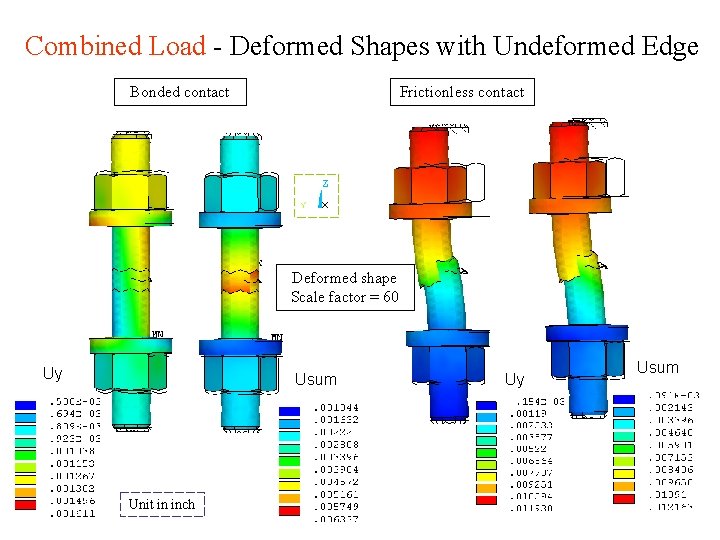
Combined Load - Deformed Shapes with Undeformed Edge Bonded contact Frictionless contact Deformed shape Scale factor = 60 Uy Usum Unit in inch Uy Usum
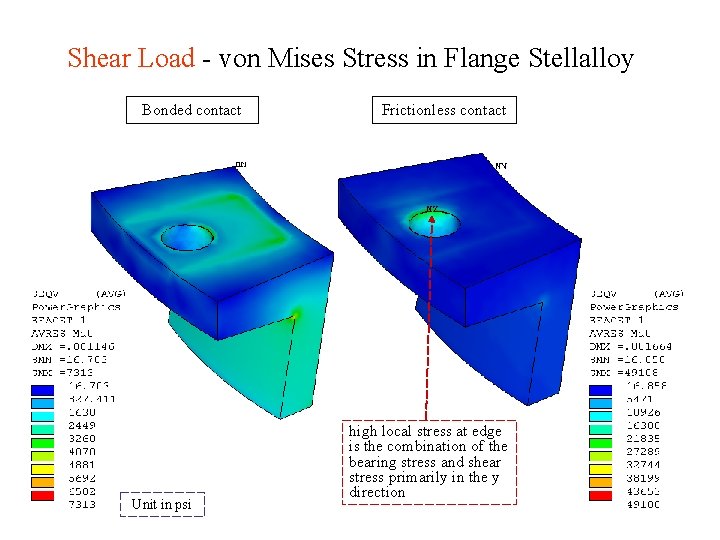
Shear Load - von Mises Stress in Flange Stellalloy Bonded contact Unit in psi Frictionless contact high local stress at edge is the combination of the bearing stress and shear stress primarily in the y direction
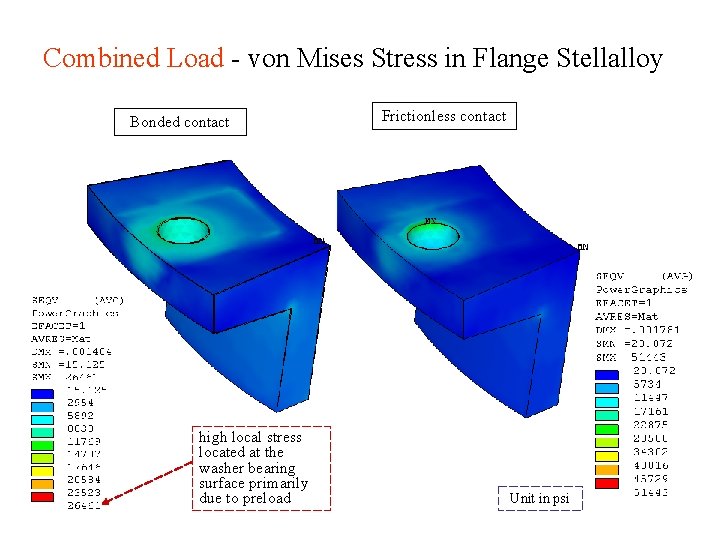
Combined Load - von Mises Stress in Flange Stellalloy Bonded contact high local stress located at the washer bearing surface primarily due to preload Frictionless contact Unit in psi
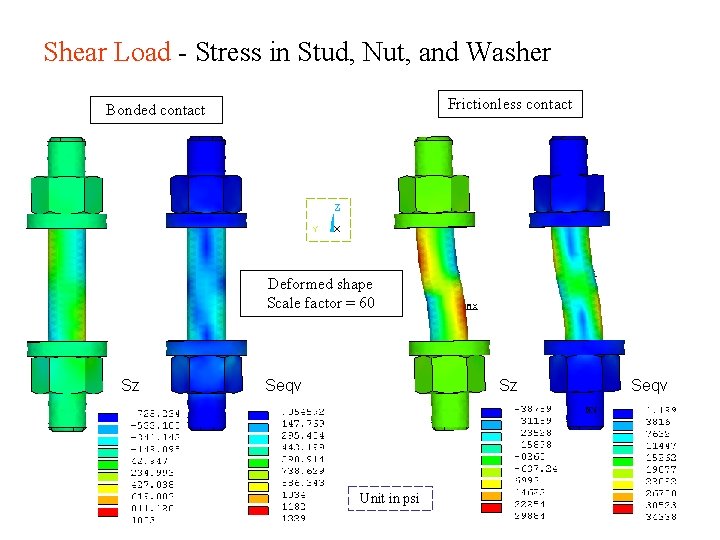
Shear Load - Stress in Stud, Nut, and Washer Frictionless contact Bonded contact Deformed shape Scale factor = 60 Sz Seqv Sz Unit in psi Seqv
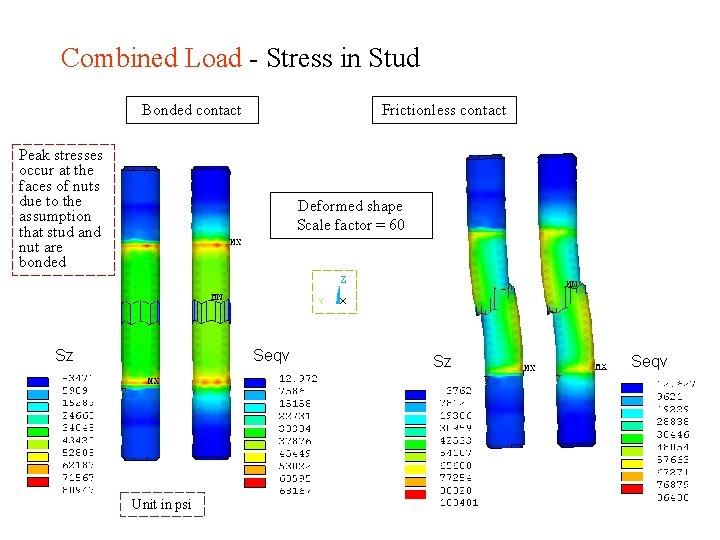
Combined Load - Stress in Stud Bonded contact Frictionless contact Peak stresses occur at the faces of nuts due to the assumption that stud and nut are bonded Deformed shape Scale factor = 60 Sz Seqv Unit in psi Sz Seqv
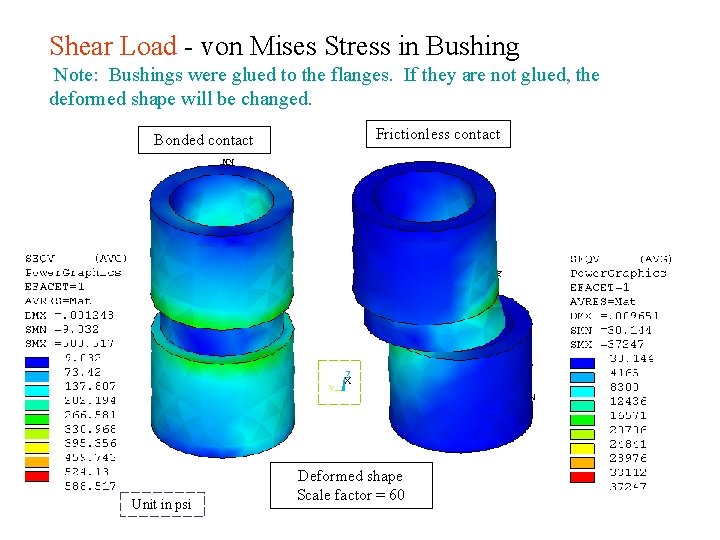
Shear Load - von Mises Stress in Bushing Note: Bushings were glued to the flanges. If they are not glued, the deformed shape will be changed. Bonded contact Unit in psi Frictionless contact Deformed shape Scale factor = 60
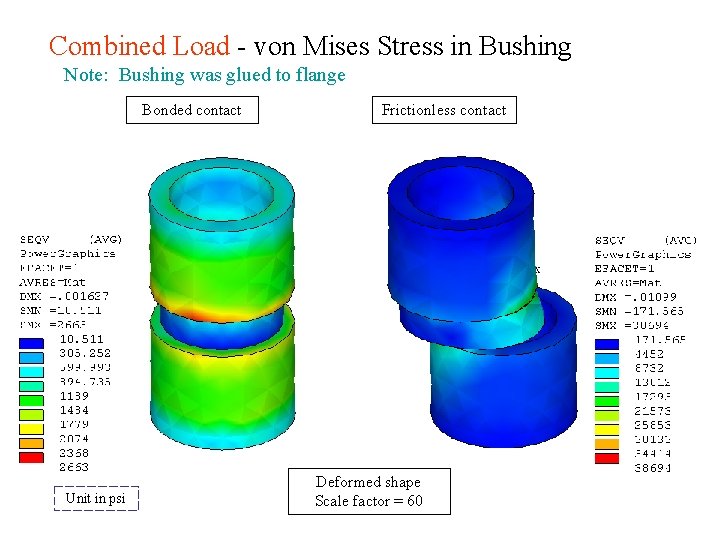
Combined Load - von Mises Stress in Bushing Note: Bushing was glued to flange Bonded contact Unit in psi Frictionless contact Deformed shape Scale factor = 60
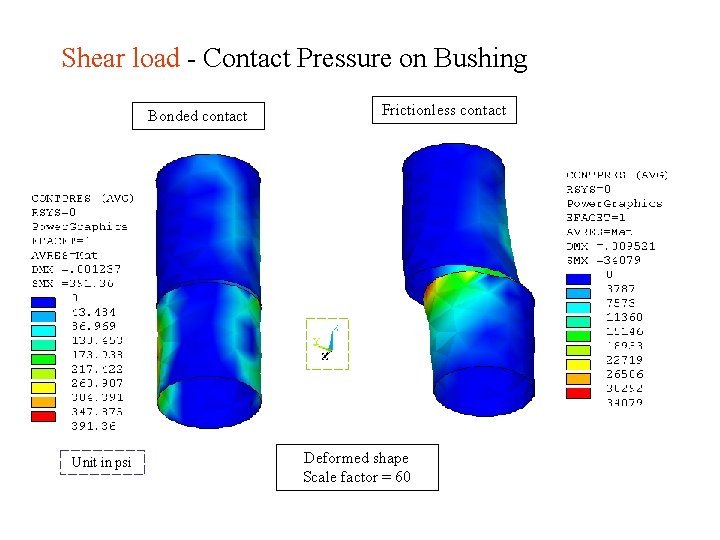
Shear load - Contact Pressure on Bushing Bonded contact Unit in psi Frictionless contact Deformed shape Scale factor = 60
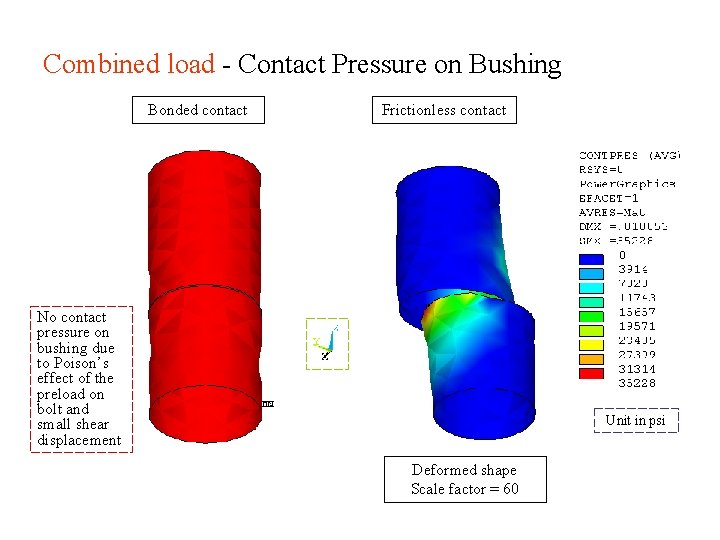
Combined load - Contact Pressure on Bushing Bonded contact Frictionless contact No contact pressure on bushing due to Poison’s effect of the preload on bolt and small shear displacement Unit in psi Deformed shape Scale factor = 60
Discussions: 1. The analyses intend to observe the structural behaviors of bolt joint subjected to preload and shear force under the two extreme conditions of the friction between the shim plate and the flange stellalloy. 2. The bonded case has much smaller lateral displacement than the frictionless case. 3. With frictionless case, the lateral displacement is mostly contributed by the shear load. The lateral stiffness of the joint is dominated by the bending and shearing stiffness of the bolt as well as the contact pressure on the bushing. 4. In the bonded case, the majority of shear force transporting between flanges depend on the shear stiffness of shim plate while in frictionless case, they are transferred through bearing on the bushing and bolt hole. This shows the high friction coefficient and larger shim plate improve the joint rigidity. 5. Bonded case produced much smaller stress on all parts of the joint than the frictionless case, that means a much better joint design. 6. The bending stress on the bolt is about 2. 0 ksi for 1. 0 kip of shear force. Tight fit of the bolt will reduce the bending stress on the bolt. 7. Bearing stresses on the bushing are due to the bolt bending and the gap tolerance. The maximum bearing stress do not occurs at ends of bushings because the bolt bending was restrained by the nuts and washers.
- Slides: 17