
Analogies Relationships Between Two Things That Are Different
Analogies Relationships Between Two Things That Are Different
What Are They? • Two sets of words that you read as if they are a sentence • The relationship between the parts is alike Why Solve Analogies? • Improvement for a learner’s comprehension & long-term memory • Useful skill to identify relationships • Connections to concrete from abstract • Critical thinking

Word Analogies • Use analogies to develop logic. • Analyze two words and identify the relationship between them. • Find another pair of words that has the same relationship.
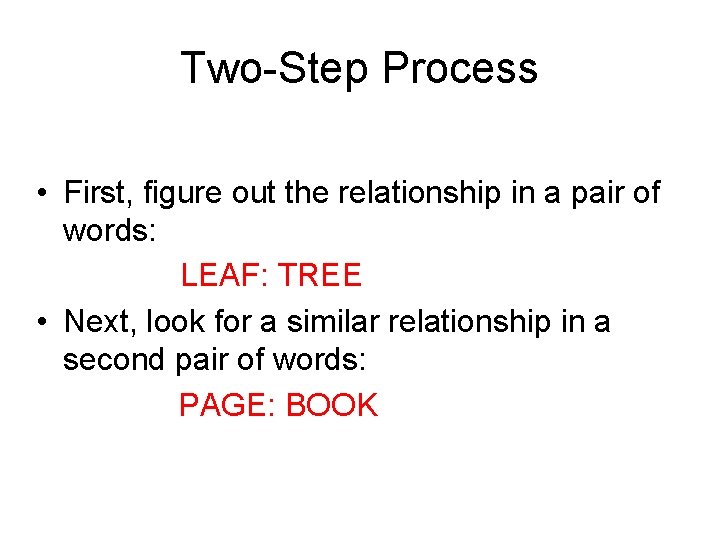
Two-Step Process • First, figure out the relationship in a pair of words: LEAF: TREE • Next, look for a similar relationship in a second pair of words: PAGE: BOOK
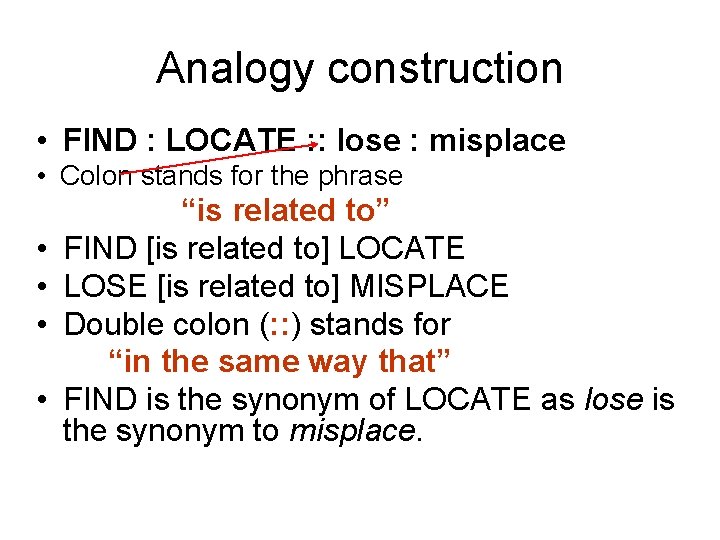
Analogy construction • FIND : LOCATE : : lose : misplace • Colon stands for the phrase • • “is related to” FIND [is related to] LOCATE LOSE [is related to] MISPLACE Double colon (: : ) stands for “in the same way that” FIND is the synonym of LOCATE as lose is the synonym to misplace.
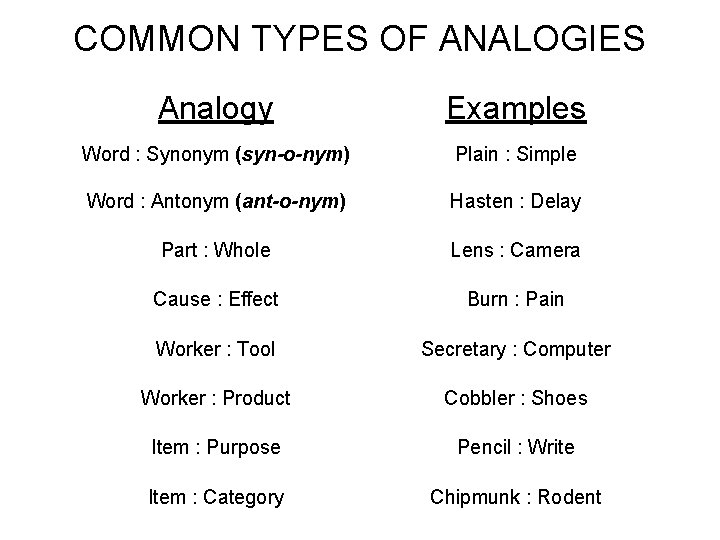
COMMON TYPES OF ANALOGIES Analogy Examples Word : Synonym (syn-o-nym) Plain : Simple Word : Antonym (ant-o-nym) Hasten : Delay Part : Whole Lens : Camera Cause : Effect Burn : Pain Worker : Tool Secretary : Computer Worker : Product Cobbler : Shoes Item : Purpose Pencil : Write Item : Category Chipmunk : Rodent
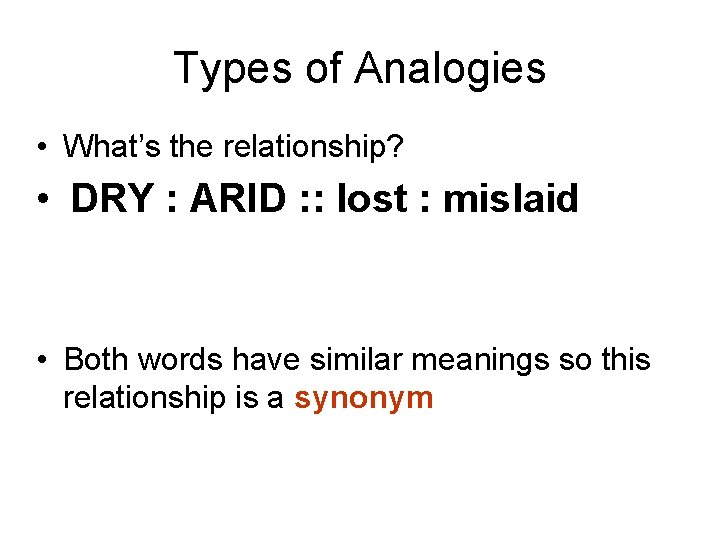
Types of Analogies • What’s the relationship? • DRY : ARID : : lost : mislaid • Both words have similar meanings so this relationship is a synonym

Types of Analogies • What’s the relationship? • KIND : CRUEL : : happy : sad • Both words have opposite meanings, so their relationship is an antonym.
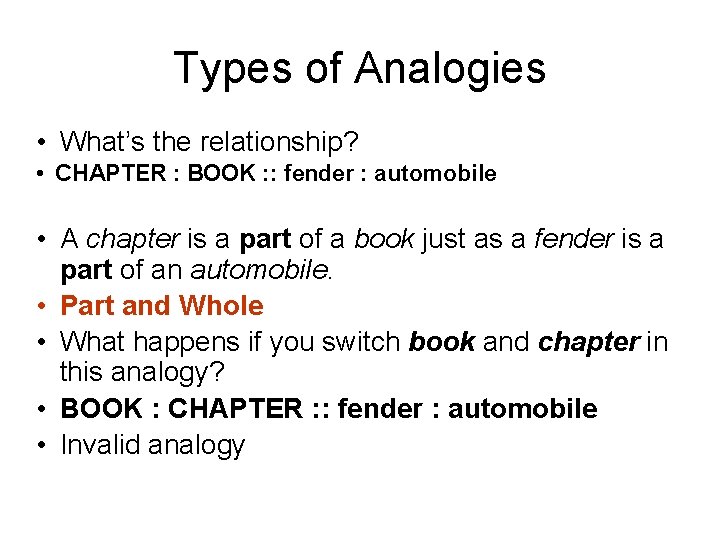
Types of Analogies • What’s the relationship? • CHAPTER : BOOK : : fender : automobile • A chapter is a part of a book just as a fender is a part of an automobile. • Part and Whole • What happens if you switch book and chapter in this analogy? • BOOK : CHAPTER : : fender : automobile • Invalid analogy
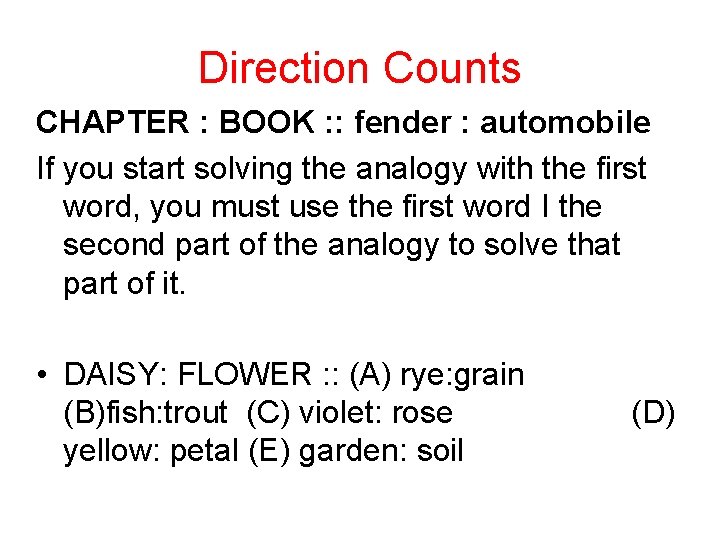
Direction Counts CHAPTER : BOOK : : fender : automobile If you start solving the analogy with the first word, you must use the first word I the second part of the analogy to solve that part of it. • DAISY: FLOWER : : (A) rye: grain (B)fish: trout (C) violet: rose yellow: petal (E) garden: soil (D)
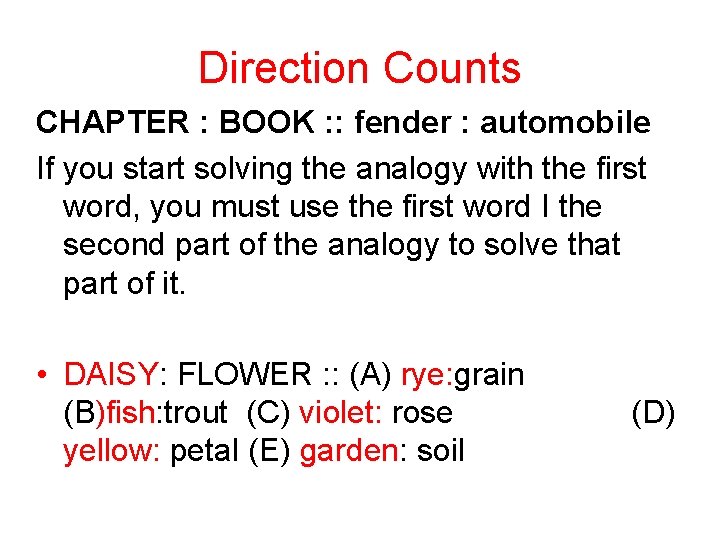
Direction Counts CHAPTER : BOOK : : fender : automobile If you start solving the analogy with the first word, you must use the first word I the second part of the analogy to solve that part of it. • DAISY: FLOWER : : (A) rye: grain (B)fish: trout (C) violet: rose yellow: petal (E) garden: soil (D)
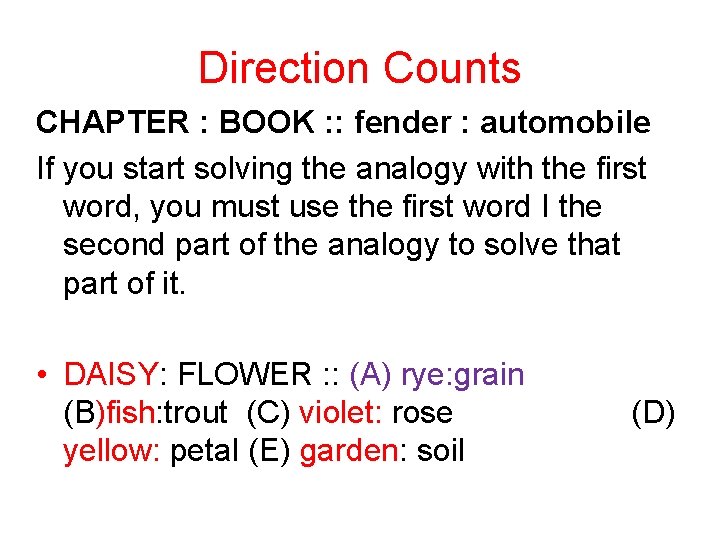
Direction Counts CHAPTER : BOOK : : fender : automobile If you start solving the analogy with the first word, you must use the first word I the second part of the analogy to solve that part of it. • DAISY: FLOWER : : (A) rye: grain (B)fish: trout (C) violet: rose yellow: petal (E) garden: soil (D)
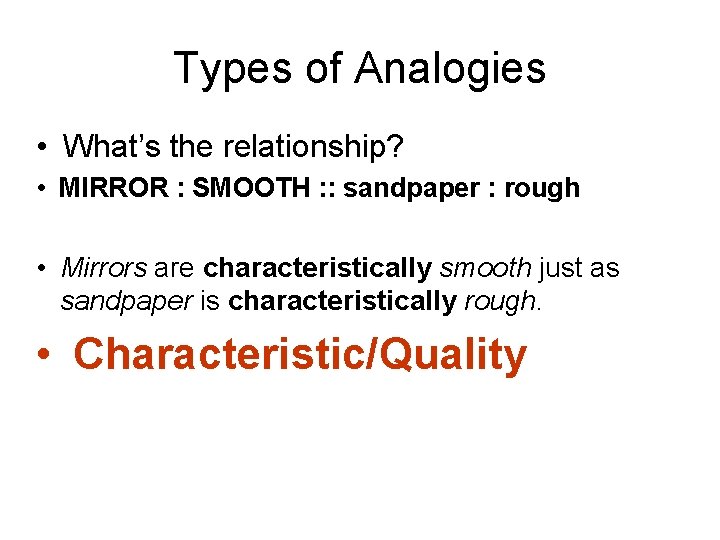
Types of Analogies • What’s the relationship? • MIRROR : SMOOTH : : sandpaper : rough • Mirrors are characteristically smooth just as sandpaper is characteristically rough. • Characteristic/Quality
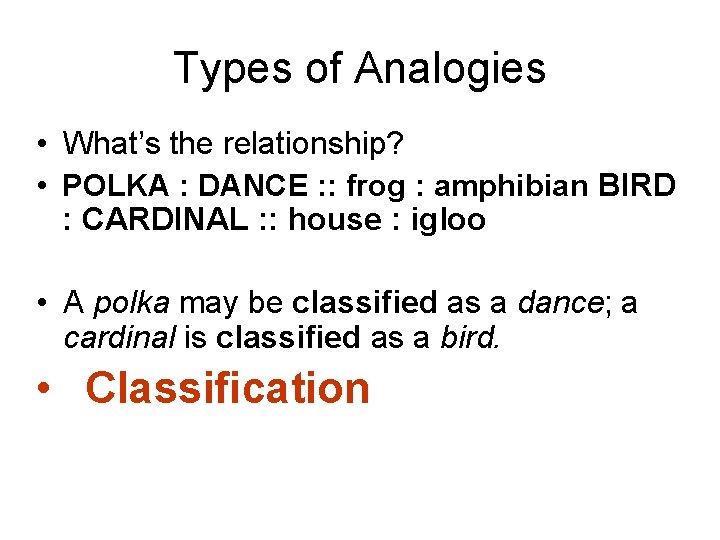
Types of Analogies • What’s the relationship? • POLKA : DANCE : : frog : amphibian BIRD : CARDINAL : : house : igloo • A polka may be classified as a dance; a cardinal is classified as a bird. • Classification
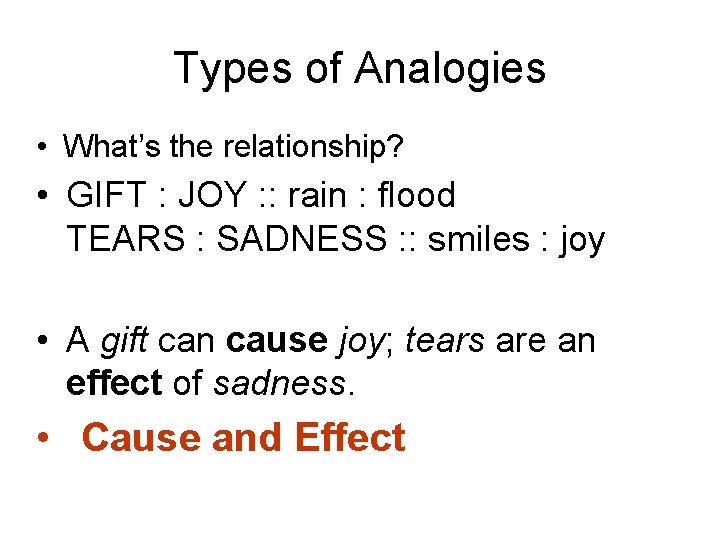
Types of Analogies • What’s the relationship? • GIFT : JOY : : rain : flood TEARS : SADNESS : : smiles : joy • A gift can cause joy; tears are an effect of sadness. • Cause and Effect
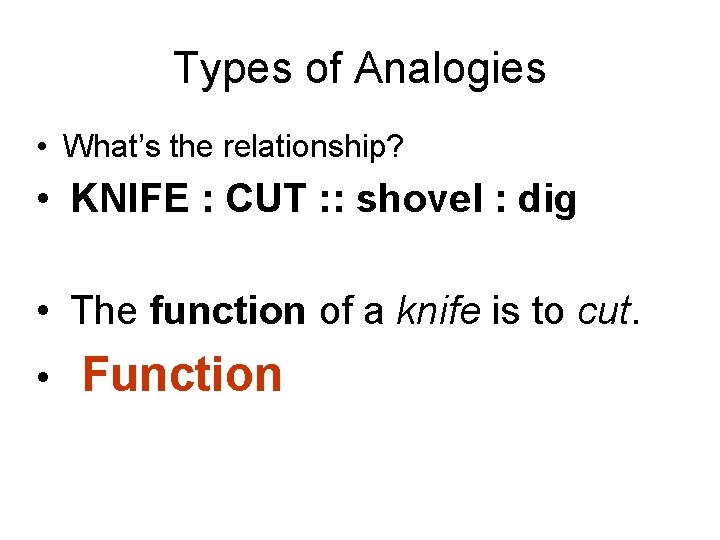
Types of Analogies • What’s the relationship? • KNIFE : CUT : : shovel : dig • The function of a knife is to cut. • Function
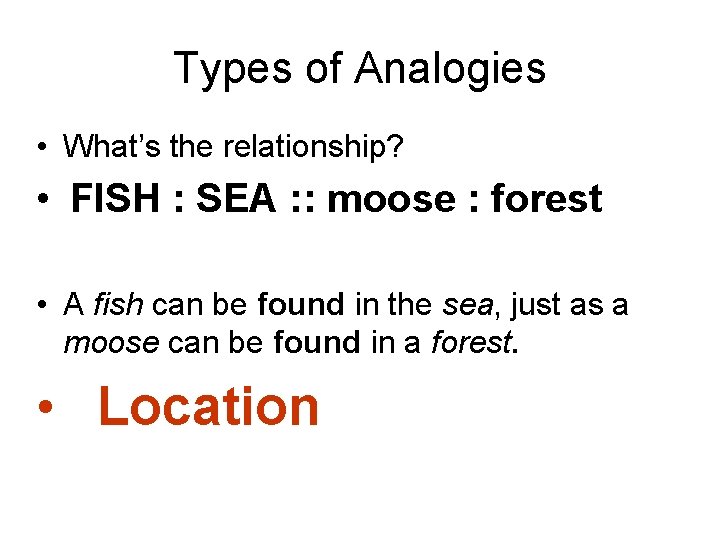
Types of Analogies • What’s the relationship? • FISH : SEA : : moose : forest • A fish can be found in the sea, just as a moose can be found in a forest. • Location

Types of Analogies • What’s the relationship? • CHUCKLE : LAUGH : : whimper : cry • These words differ in degree. One is more intense than the other. • Degree
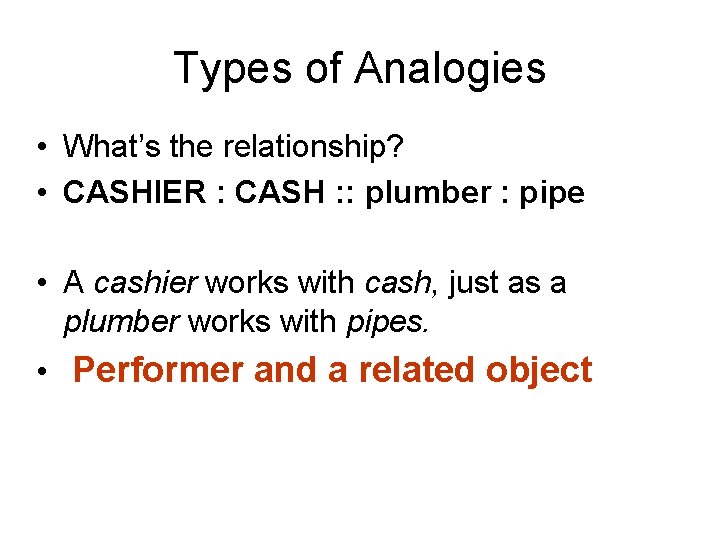
Types of Analogies • What’s the relationship? • CASHIER : CASH : : plumber : pipe • A cashier works with cash, just as a plumber works with pipes. • Performer and a related object
Types of Analogies • What’s the relationship? • AUTHOR : WRITE : : chef : cook • You expect an author to write, just as you expect a chef to cook. • Performer and a related action
Types of Analogies • What’s the relationship? • BOIL : EGG : : throw : ball • You boil an egg, just as you throw a ball. (In these items, the object always receives the action. ) • Action and a related object

RECOGNIZING ANALOGIES 1. Dentist : Drill : : (A) Calendar : Date (B) Sculptor : Chisel (C) Lumberjack : Forest (D) Eyeglasses : Sight Click to Begin (E) Hammer: Carpenter 2. Horse : Mammal : : (A) Insect : Beetle (C) Snake : Reptile (B) Beaver : Fish (D) Trout : Halibut (E) Animal : Tiger 3. Hasten : Hurry : : (A) Laugh : Talk (B) Trust : Doubt (C) Stammer : Whisper (D) Attempt : Try (E) Explain : Understand 4. Ranch : Cattle : : (A) People : City (B) Chickens : Coop (C) Garden : Vegetables (D) Automobile : Garage (E) Clowns : Circus

RECOGNIZING ANALOGIES Click to Continue 5. Calm : Restless : : (A) Vague : Indefinite (B) Tiny : Small (C) Colorless : Transparent (D) Loud : Noisy (E) Gloomy : Brilliant 6. Daisy : Flower : : (A) Rye : Grain (B) Fish : Trout (C) Violet : Rose (D) Yellow : Petal (E) Garden : Soil 7. Foundation : Base : : (A) Handle : Door (B) Shoes : Belt (C) Ruler : Inch (D) Guest : Visitor (E) Top : Bottom 8. Director : Movie : : (A) Doctor : Patient (B) Cook : Diet (C) Conductor : Symphony (D) Teacher : School (E) Building : Architect
Analogies in Social Studies Thomas Jefferson: Declaration of Independence: : James Madison: Constitution Thomas Jefferson was an author of the Declaration of Independence, just as James Madison was an author of the Constitution
Analogies in Science tadpole: frog: : caterpillar: butterfly (moth) The relationship sentence would be A tadpole develops into a frog, just as a caterpillar develops into a butterfly (moth)
"MTV is to music as KFC is to chicken. " (Lewis Black)
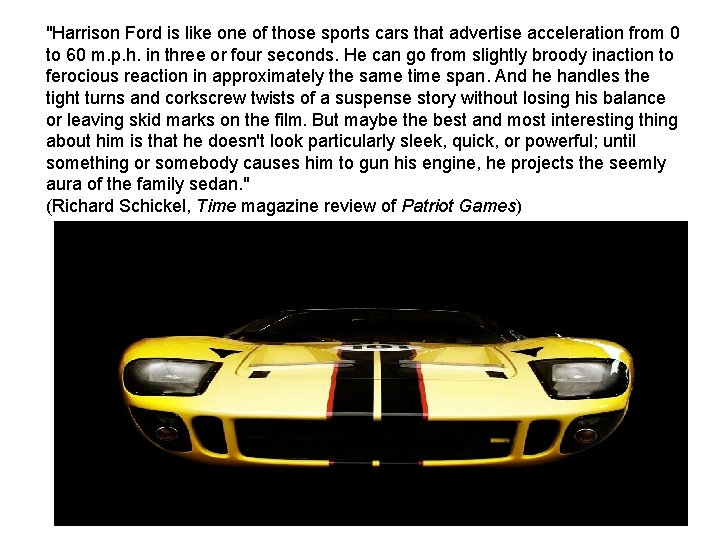
"Harrison Ford is like one of those sports cars that advertise acceleration from 0 to 60 m. p. h. in three or four seconds. He can go from slightly broody inaction to ferocious reaction in approximately the same time span. And he handles the tight turns and corkscrew twists of a suspense story without losing his balance or leaving skid marks on the film. But maybe the best and most interesting thing about him is that he doesn't look particularly sleek, quick, or powerful; until something or somebody causes him to gun his engine, he projects the seemly aura of the family sedan. " (Richard Schickel, Time magazine review of Patriot Games)
Memory is to love what the saucer is to the cup. " " (Elizabeth Bowen, The House in Paris, 1949)
Analogies http: //www. sadlier-oxford. com/phonics/analogiesx. htm http: //www. quia. com/cb/7146. html http: //a 4 esl. org/q/f/z/zz 67 fck. htm
That’s All!
- Slides: 30