
Analog Electronics Ch 3 Bipolar Junction Transistors 3
Analog Electronics Ch 3 Bipolar Junction Transistors 3. 1 Introduction of BJT 3. 2 Single-Stage BJT Amplifiers 3. 3 Frequency Response 3. 4 Power Amplifiers References: References Floyd-Ch-3, 5, 6; Gao-Ch 7;
Ch 3 Bipolar Junction Transistor 3. 1 Introductions of BJT This lecture will spend some time on understanding how the bipolar junction transistor (BJT) works based on what we have known about PN junctions. One way to look at a BJT transistor is two back-to-back diodes, but it has very different characteristics. Once we understand how the BJT device operates, we will take a look at the different circuits (amplifiers) which we can build.

Ch 3 Bipolar Junction Transistor 3. 1 Introduction of BJT
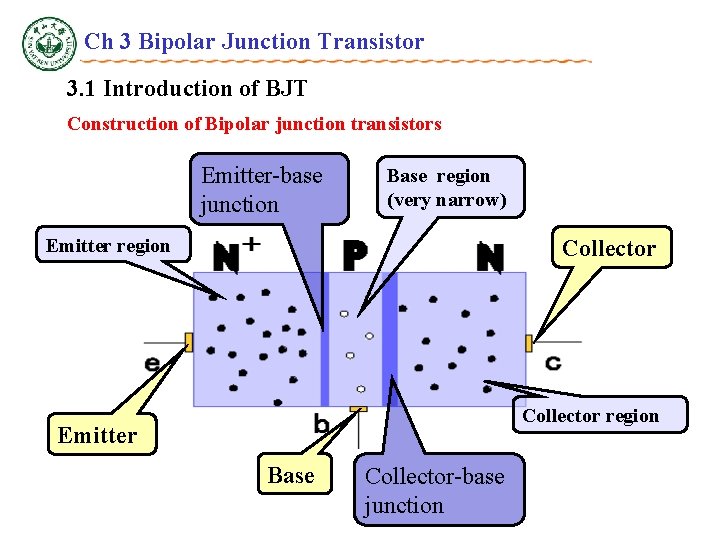
Ch 3 Bipolar Junction Transistor 3. 1 Introduction of BJT Construction of Bipolar junction transistors Emitter-base junction Base region (very narrow) Emitter region Collector region Emitter Base Collector-base junction
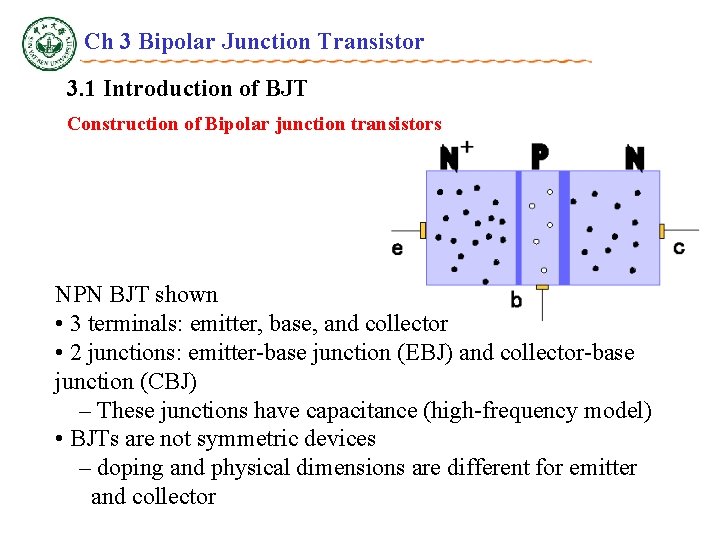
Ch 3 Bipolar Junction Transistor 3. 1 Introduction of BJT Construction of Bipolar junction transistors NPN BJT shown • 3 terminals: emitter, base, and collector • 2 junctions: emitter-base junction (EBJ) and collector-base junction (CBJ) – These junctions have capacitance (high-frequency model) • BJTs are not symmetric devices – doping and physical dimensions are different for emitter and collector
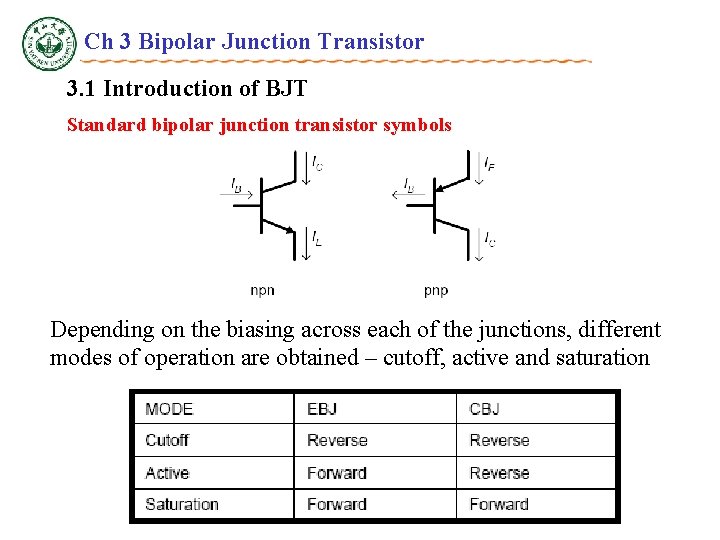
Ch 3 Bipolar Junction Transistor 3. 1 Introduction of BJT Standard bipolar junction transistor symbols Depending on the biasing across each of the junctions, different modes of operation are obtained – cutoff, active and saturation
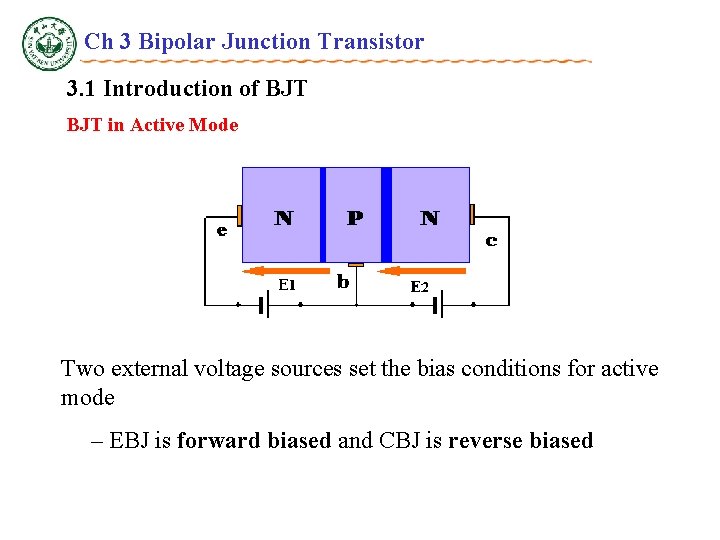
Ch 3 Bipolar Junction Transistor 3. 1 Introduction of BJT in Active Mode Two external voltage sources set the bias conditions for active mode – EBJ is forward biased and CBJ is reverse biased
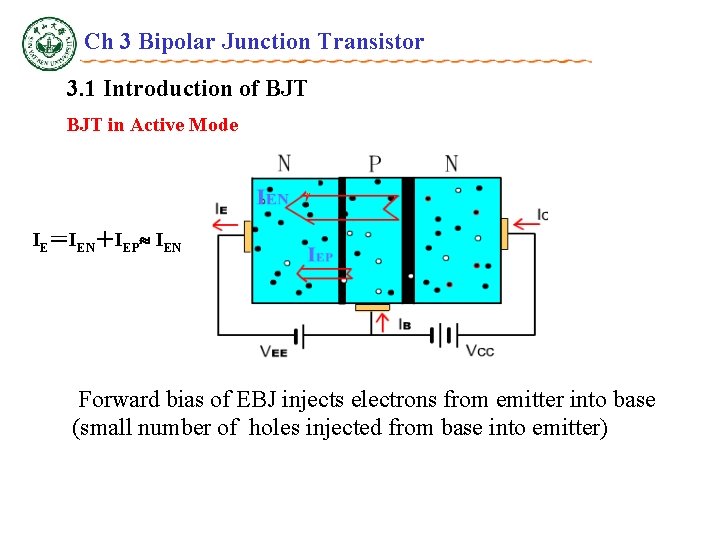
Ch 3 Bipolar Junction Transistor 3. 1 Introduction of BJT in Active Mode IE=IEN+IEP IEN Forward bias of EBJ injects electrons from emitter into base (small number of holes injected from base into emitter)
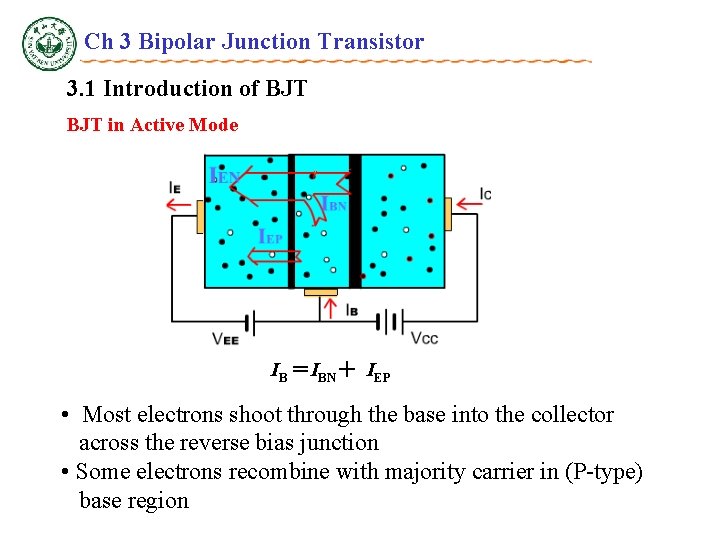
Ch 3 Bipolar Junction Transistor 3. 1 Introduction of BJT in Active Mode IB =IBN+ IEP • Most electrons shoot through the base into the collector across the reverse bias junction • Some electrons recombine with majority carrier in (P-type) base region
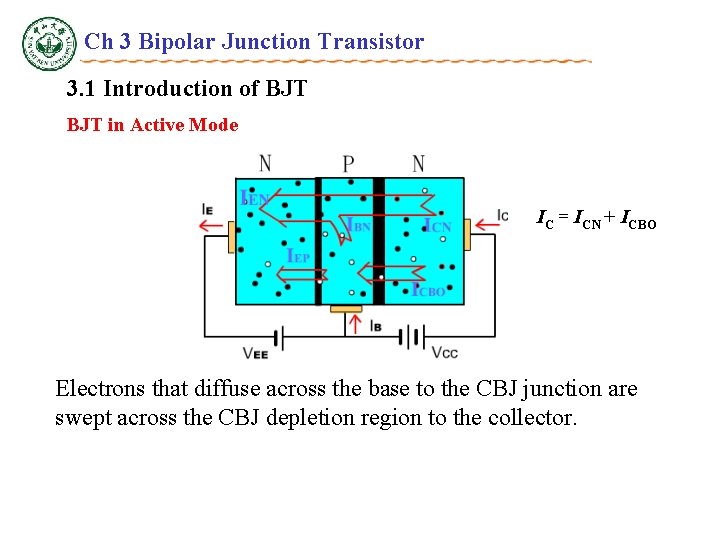
Ch 3 Bipolar Junction Transistor 3. 1 Introduction of BJT in Active Mode IC = ICN + ICBO Electrons that diffuse across the base to the CBJ junction are swept across the CBJ depletion region to the collector.
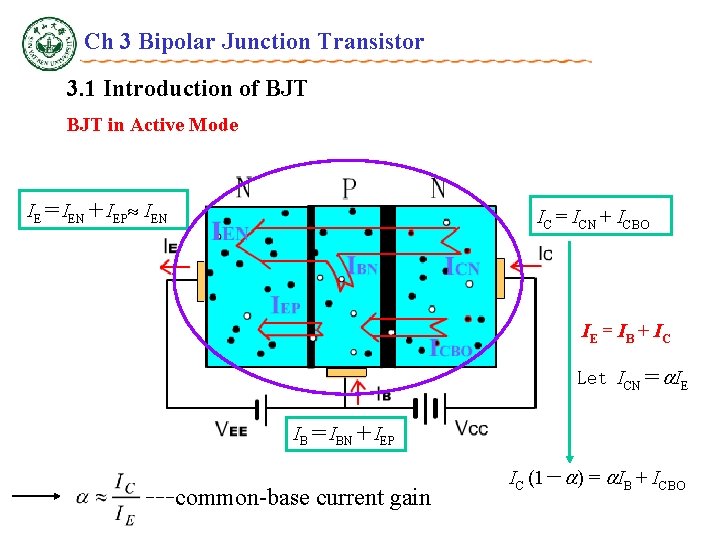
Ch 3 Bipolar Junction Transistor 3. 1 Introduction of BJT in Active Mode IE=IEN+IEP IEN IC = ICN + ICBO IE = IB + IC Let ICN= IE IB=IBN+IEP ---common-base current gain IC (1- ) = IB + ICBO
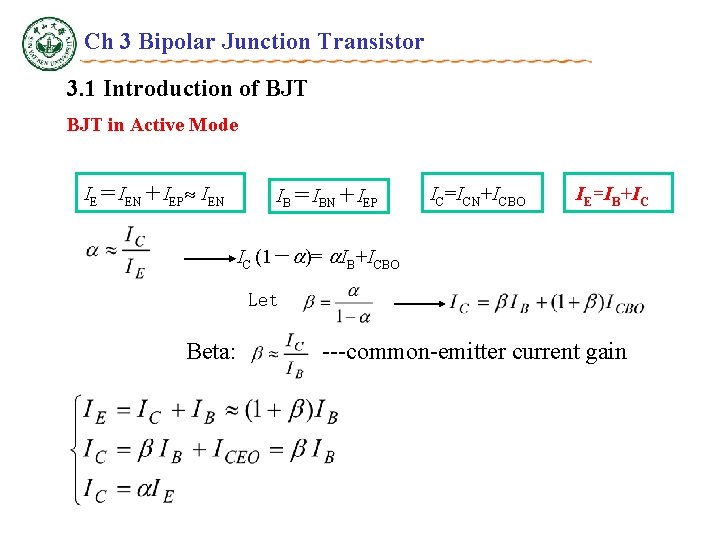
Ch 3 Bipolar Junction Transistor 3. 1 Introduction of BJT in Active Mode IE=IEN+IEP IEN IB=IBN+IEP IC=ICN+ICBO IE=IB+IC IC (1- )= IB+ICBO Let Beta: ---common-emitter current gain
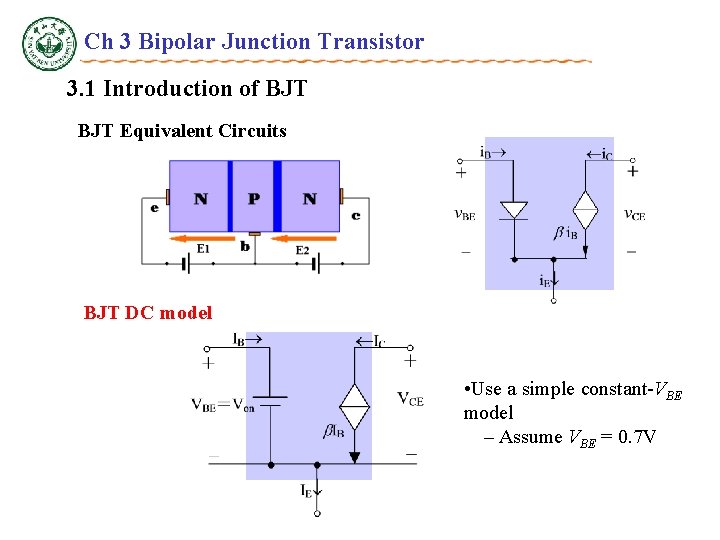
Ch 3 Bipolar Junction Transistor 3. 1 Introduction of BJT Equivalent Circuits BJT DC model • Use a simple constant-VBE model – Assume VBE = 0. 7 V
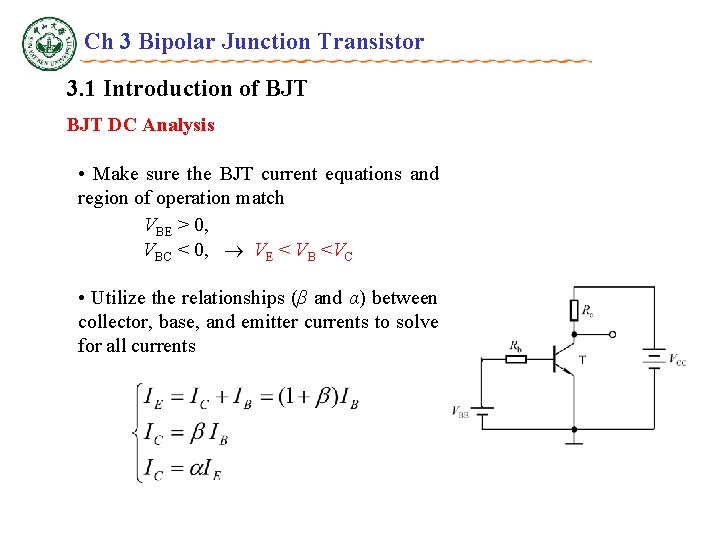
Ch 3 Bipolar Junction Transistor 3. 1 Introduction of BJT DC Analysis • Make sure the BJT current equations and region of operation match VBE > 0, VBC < 0, VE < VB <VC • Utilize the relationships (β and α) between collector, base, and emitter currents to solve for all currents
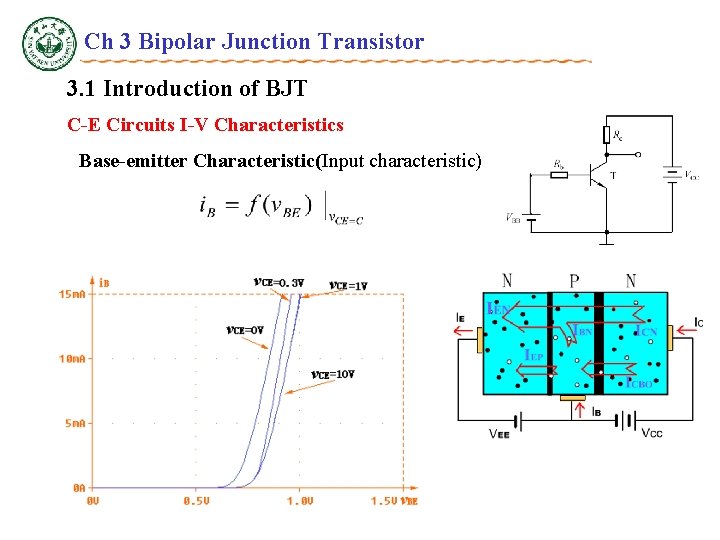
Ch 3 Bipolar Junction Transistor 3. 1 Introduction of BJT C-E Circuits I-V Characteristics Base-emitter Characteristic(Input characteristic)
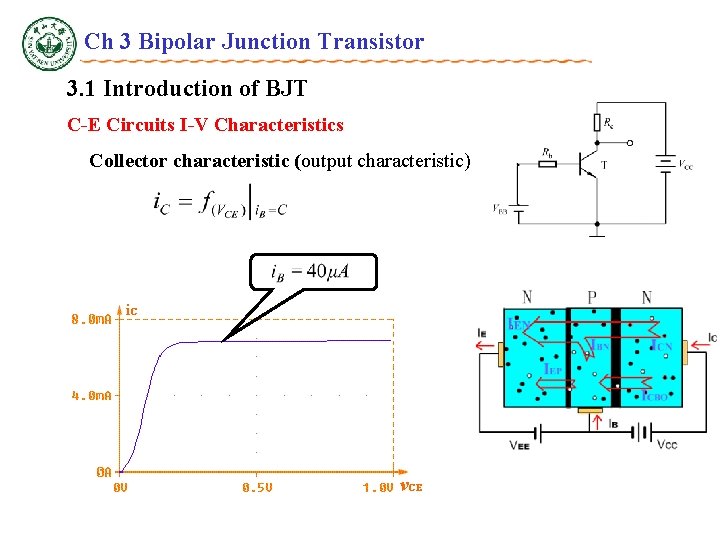
Ch 3 Bipolar Junction Transistor 3. 1 Introduction of BJT C-E Circuits I-V Characteristics Collector characteristic (output characteristic)
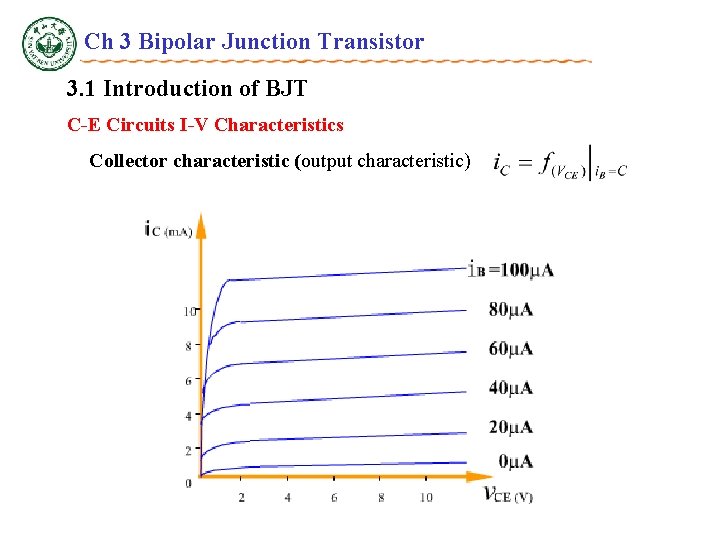
Ch 3 Bipolar Junction Transistor 3. 1 Introduction of BJT C-E Circuits I-V Characteristics Collector characteristic (output characteristic)
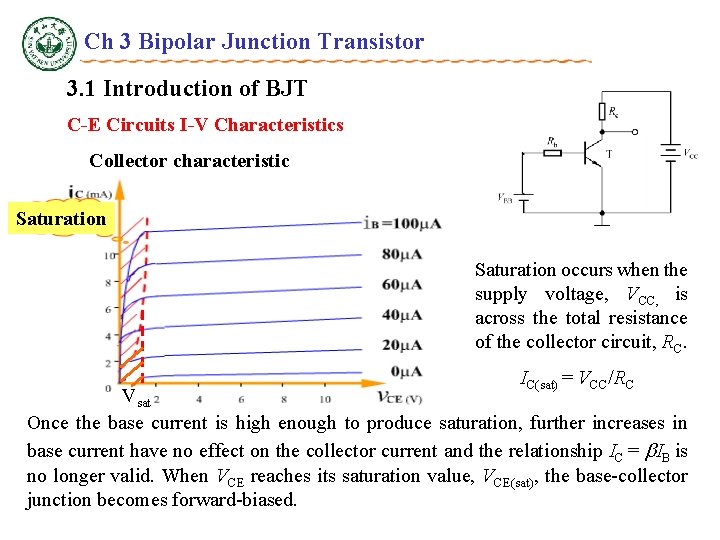
Ch 3 Bipolar Junction Transistor 3. 1 Introduction of BJT C-E Circuits I-V Characteristics Collector characteristic Saturation occurs when the supply voltage, VCC, is across the total resistance of the collector circuit, RC. IC(sat) = VCC/RC Vsat Once the base current is high enough to produce saturation, further increases in base current have no effect on the collector current and the relationship IC = IB is no longer valid. When VCE reaches its saturation value, VCE(sat), the base-collector junction becomes forward-biased.
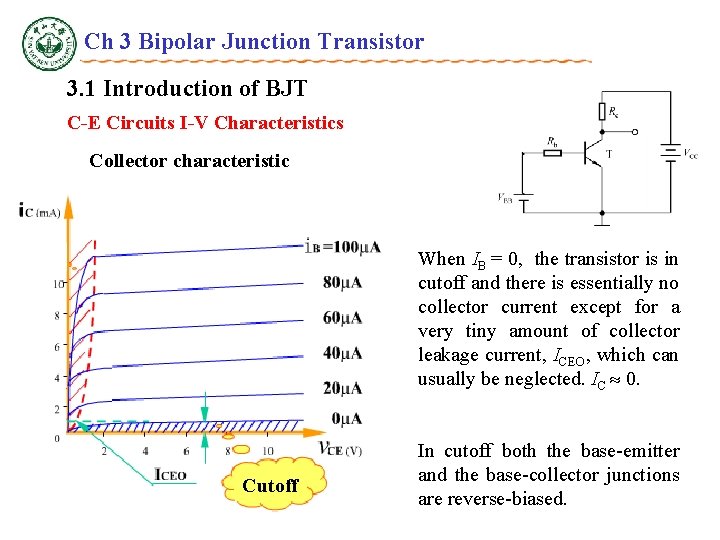
Ch 3 Bipolar Junction Transistor 3. 1 Introduction of BJT C-E Circuits I-V Characteristics Collector characteristic When IB = 0, the transistor is in cutoff and there is essentially no collector current except for a very tiny amount of collector leakage current, ICEO, which can usually be neglected. IC 0. Cutoff In cutoff both the base-emitter and the base-collector junctions are reverse-biased.
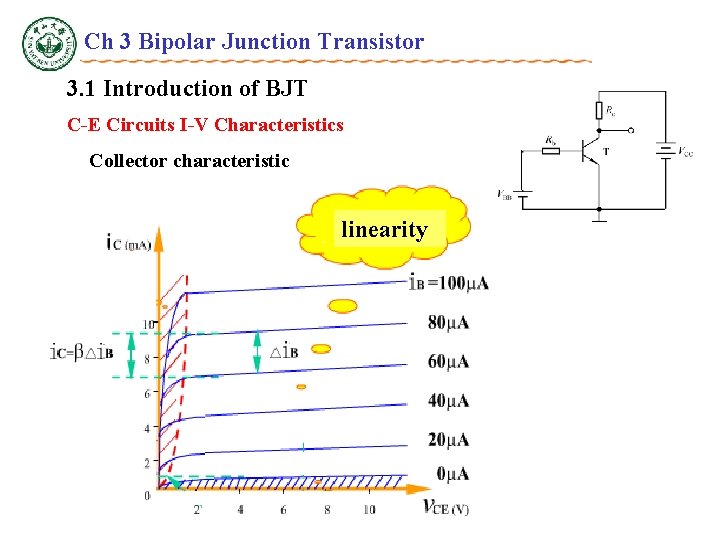
Ch 3 Bipolar Junction Transistor 3. 1 Introduction of BJT C-E Circuits I-V Characteristics Collector characteristic linearity
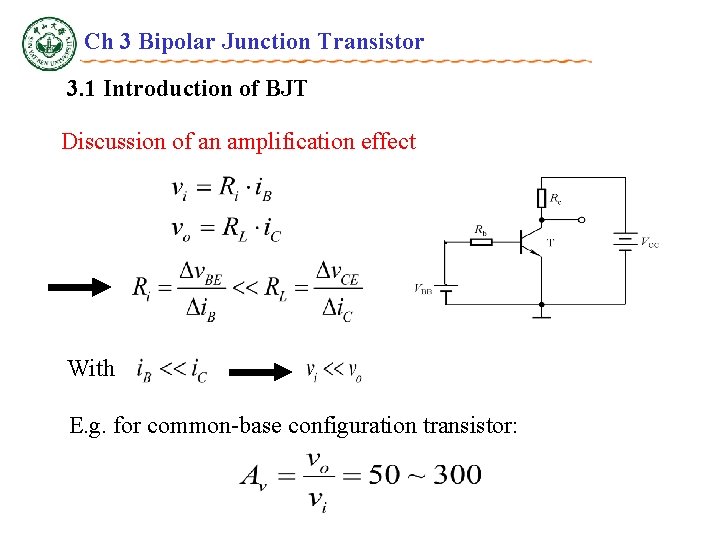
Ch 3 Bipolar Junction Transistor 3. 1 Introduction of BJT Discussion of an amplification effect With E. g. for common-base configuration transistor:
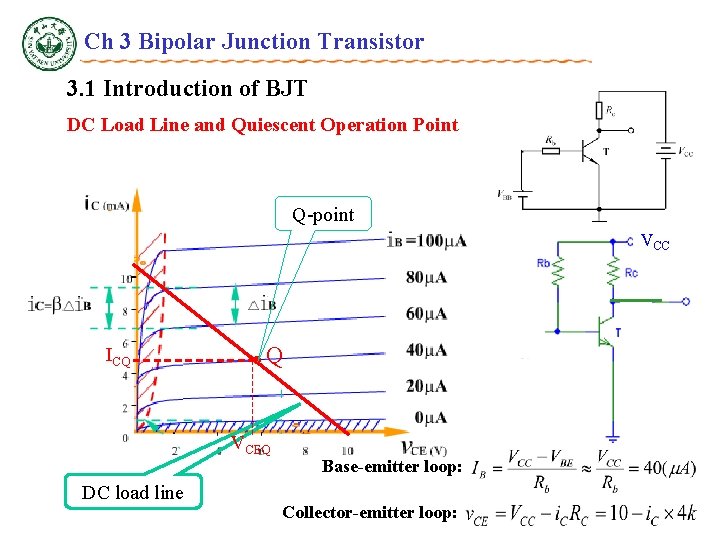
Ch 3 Bipolar Junction Transistor 3. 1 Introduction of BJT DC Load Line and Quiescent Operation Point Q-point VCC ICQ . Q VCEQ DC load line Base-emitter loop: Collector-emitter loop:
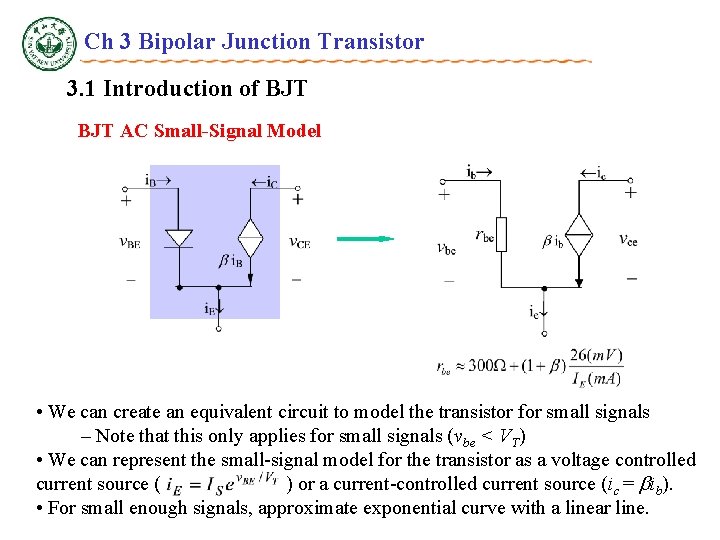
Ch 3 Bipolar Junction Transistor 3. 1 Introduction of BJT AC Small-Signal Model • We can create an equivalent circuit to model the transistor for small signals – Note that this only applies for small signals (vbe < VT) • We can represent the small-signal model for the transistor as a voltage controlled current source ( ) or a current-controlled current source (ic = ib). • For small enough signals, approximate exponential curve with a linear line.
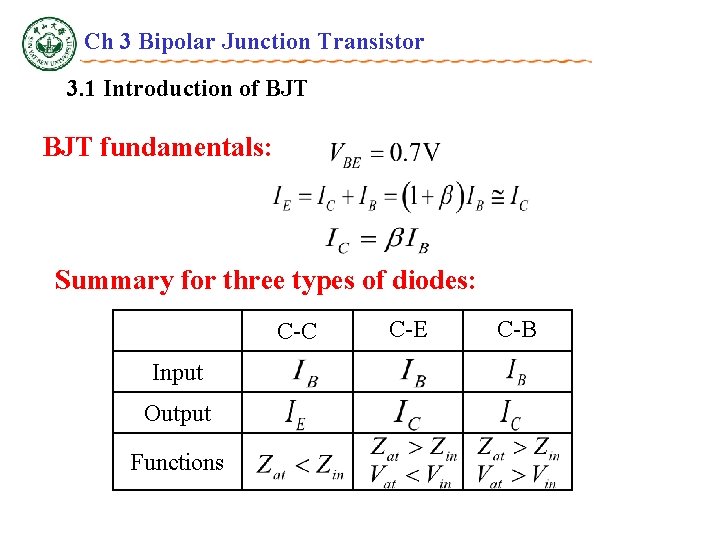
Ch 3 Bipolar Junction Transistor 3. 1 Introduction of BJT fundamentals: Summary for three types of diodes: C-C Input Output Functions C-E C-B
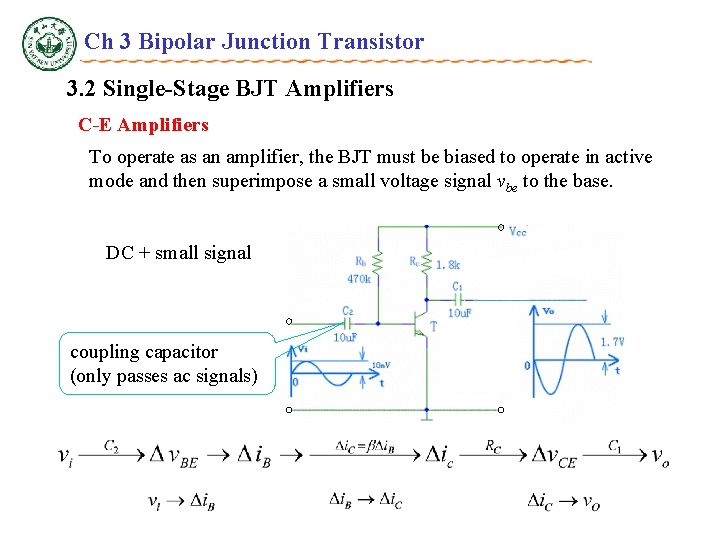
Ch 3 Bipolar Junction Transistor 3. 2 Single-Stage BJT Amplifiers C-E Amplifiers To operate as an amplifier, the BJT must be biased to operate in active mode and then superimpose a small voltage signal vbe to the base. DC + small signal coupling capacitor (only passes ac signals)
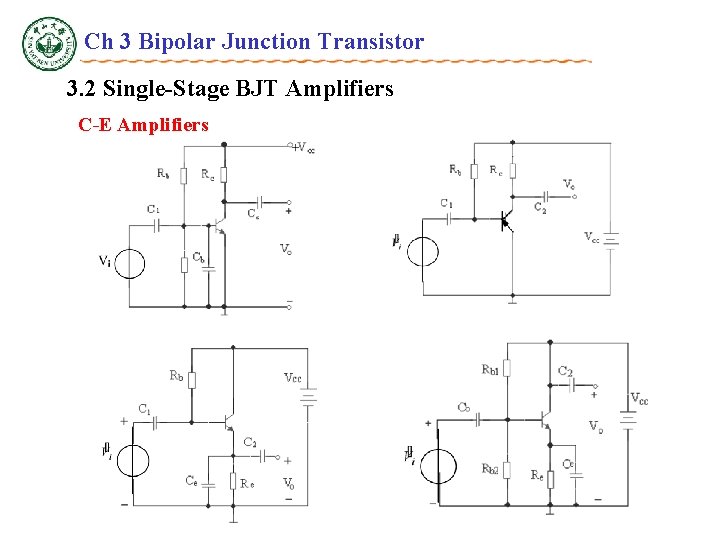
Ch 3 Bipolar Junction Transistor 3. 2 Single-Stage BJT Amplifiers C-E Amplifiers
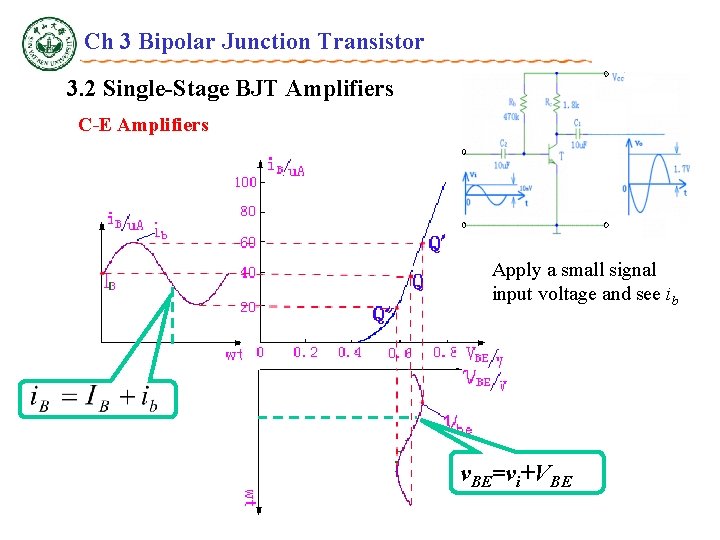
Ch 3 Bipolar Junction Transistor 3. 2 Single-Stage BJT Amplifiers C-E Amplifiers Apply a small signal input voltage and see ib v. BE=vi+VBE
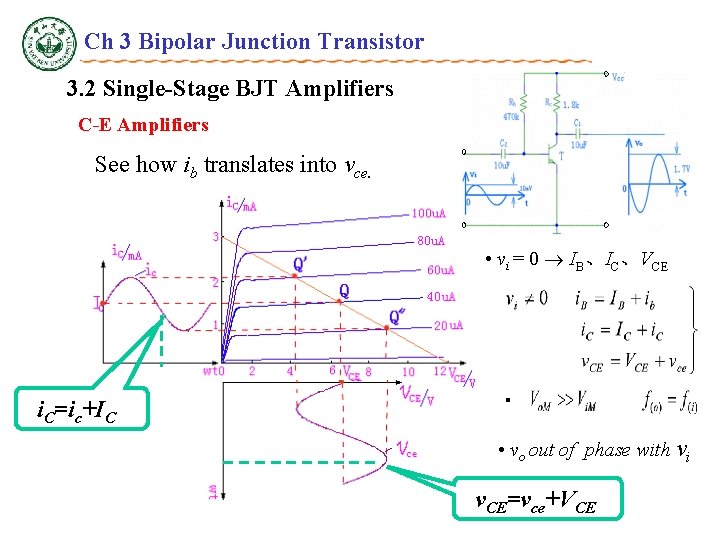
Ch 3 Bipolar Junction Transistor 3. 2 Single-Stage BJT Amplifiers C-E Amplifiers See how ib translates into vce. • vi = 0 IB、IC、VCE i. C=ic+IC • • vo out of phase with vi v. CE=vce+VCE
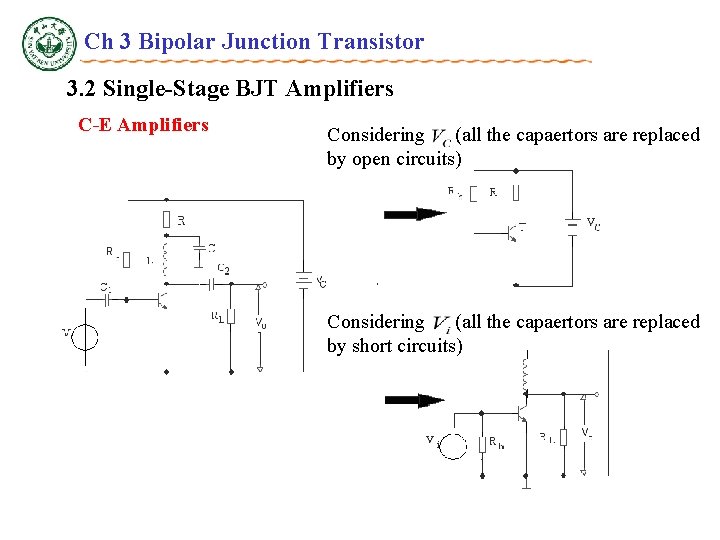
Ch 3 Bipolar Junction Transistor 3. 2 Single-Stage BJT Amplifiers C-E Amplifiers Considering (all the capaertors are replaced by open circuits) Considering (all the capaertors are replaced by short circuits)
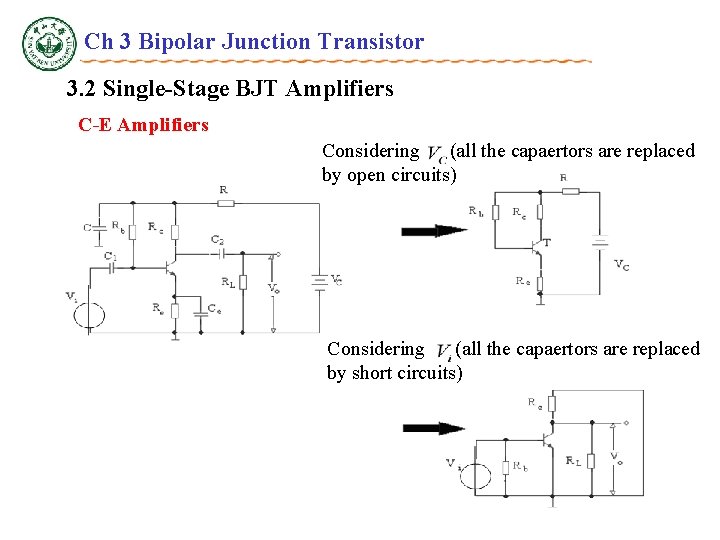
Ch 3 Bipolar Junction Transistor 3. 2 Single-Stage BJT Amplifiers C-E Amplifiers Considering (all the capaertors are replaced by open circuits) Considering (all the capaertors are replaced by short circuits)
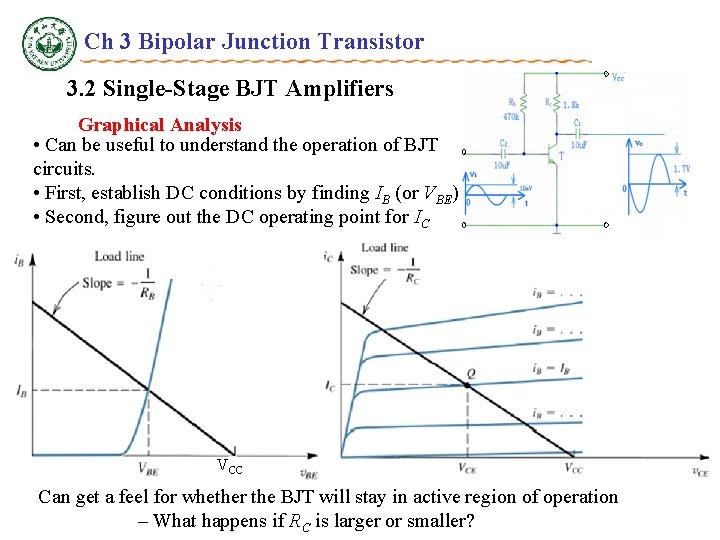
Ch 3 Bipolar Junction Transistor 3. 2 Single-Stage BJT Amplifiers Graphical Analysis • Can be useful to understand the operation of BJT circuits. • First, establish DC conditions by finding IB (or VBE) • Second, figure out the DC operating point for IC VCC Can get a feel for whether the BJT will stay in active region of operation – What happens if RC is larger or smaller?
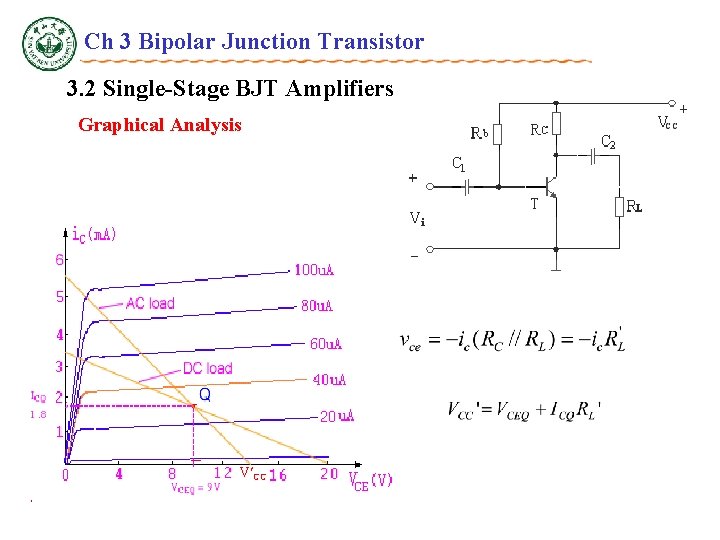
Ch 3 Bipolar Junction Transistor 3. 2 Single-Stage BJT Amplifiers Graphical Analysis V CC
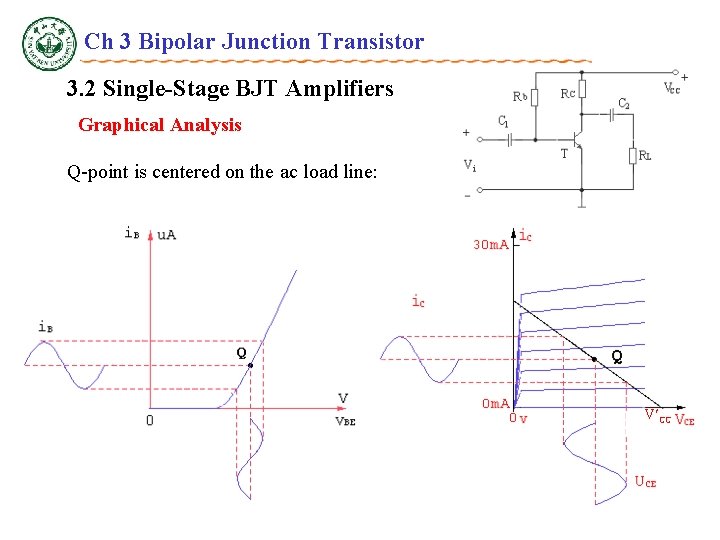
Ch 3 Bipolar Junction Transistor 3. 2 Single-Stage BJT Amplifiers Graphical Analysis Q-point is centered on the ac load line: V CC
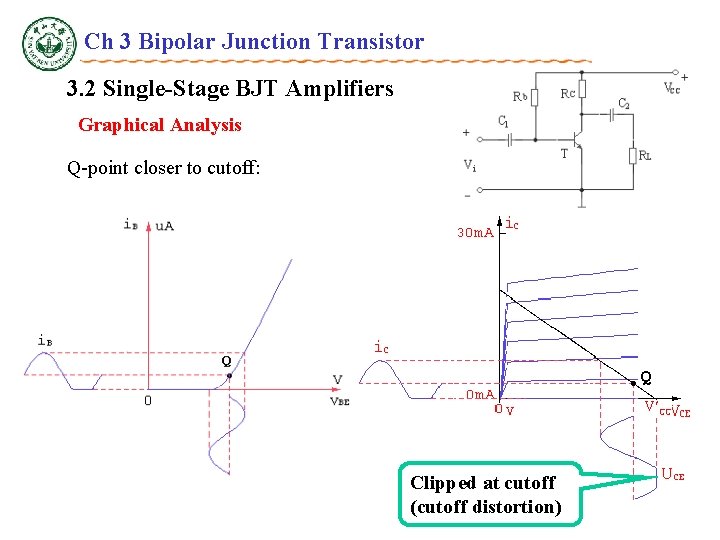
Ch 3 Bipolar Junction Transistor 3. 2 Single-Stage BJT Amplifiers Graphical Analysis Q-point closer to cutoff: V CC Clipped at cutoff (cutoff distortion)
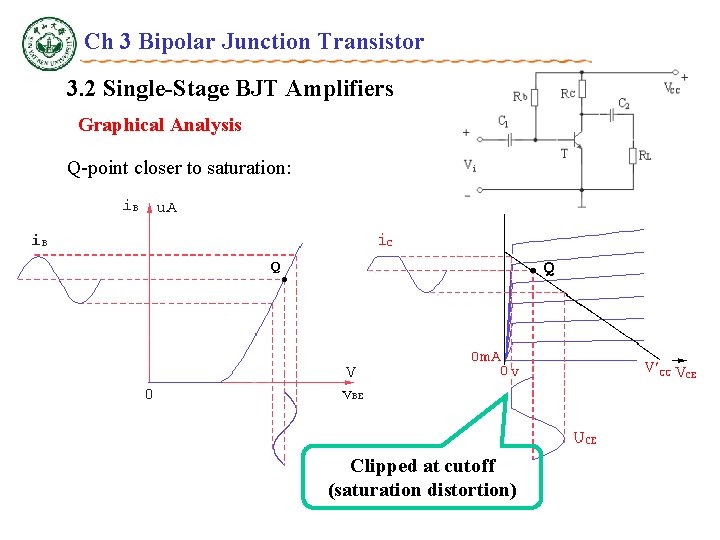
Ch 3 Bipolar Junction Transistor 3. 2 Single-Stage BJT Amplifiers Graphical Analysis Q-point closer to saturation: V CC Clipped at cutoff (saturation distortion)
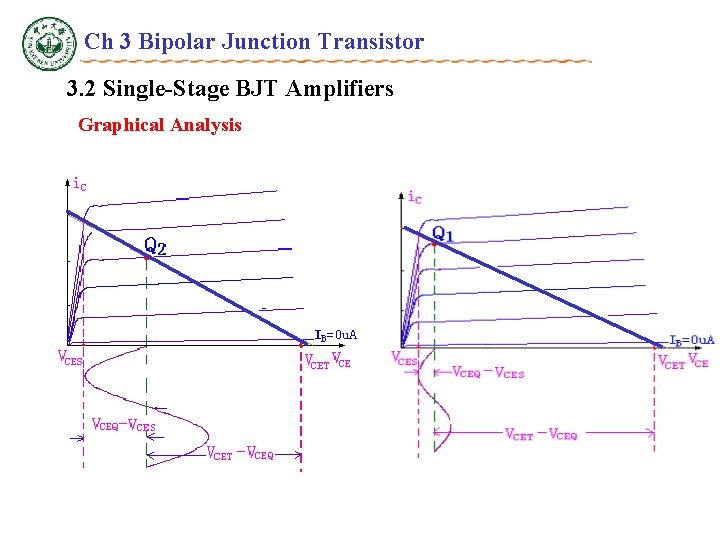
Ch 3 Bipolar Junction Transistor 3. 2 Single-Stage BJT Amplifiers Graphical Analysis
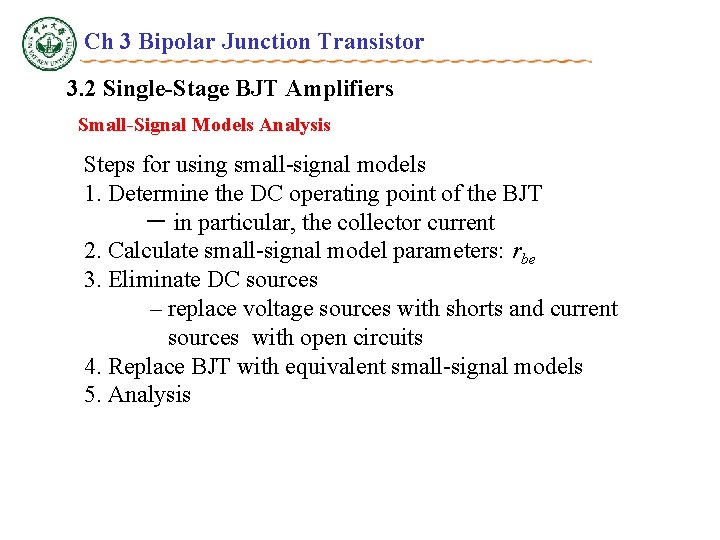
Ch 3 Bipolar Junction Transistor 3. 2 Single-Stage BJT Amplifiers Small-Signal Models Analysis Steps for using small-signal models 1. Determine the DC operating point of the BJT - in particular, the collector current 2. Calculate small-signal model parameters: rbe 3. Eliminate DC sources – replace voltage sources with shorts and current sources with open circuits 4. Replace BJT with equivalent small-signal models 5. Analysis
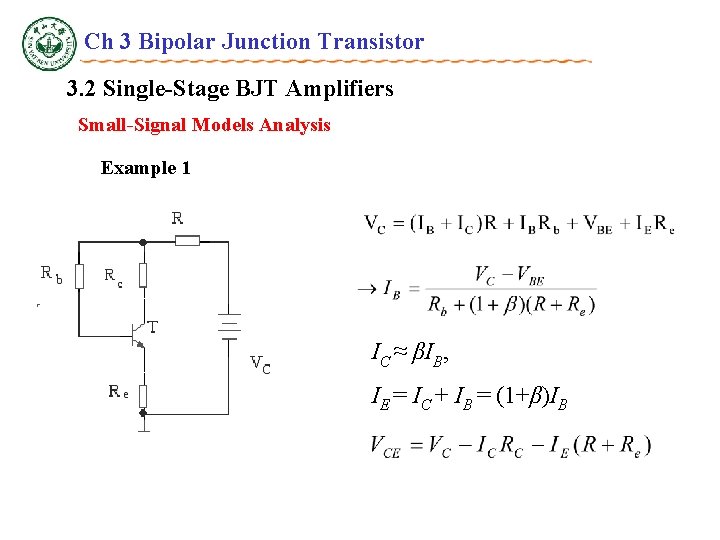
Ch 3 Bipolar Junction Transistor 3. 2 Single-Stage BJT Amplifiers Small-Signal Models Analysis Example 1 IC ≈ βIB, IE = IC + IB = (1+β)IB
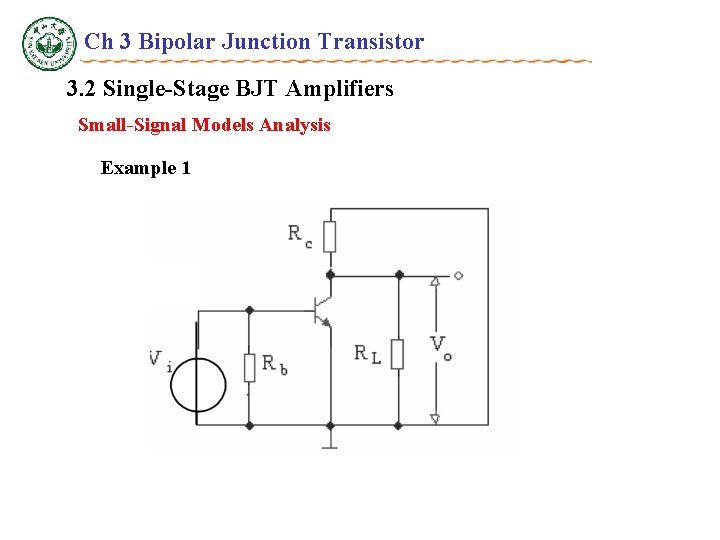
Ch 3 Bipolar Junction Transistor 3. 2 Single-Stage BJT Amplifiers Small-Signal Models Analysis Example 1
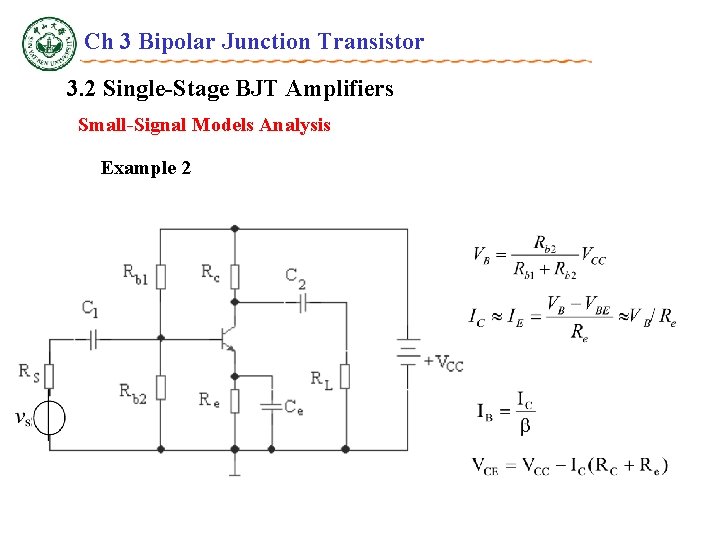
Ch 3 Bipolar Junction Transistor 3. 2 Single-Stage BJT Amplifiers Small-Signal Models Analysis Example 2
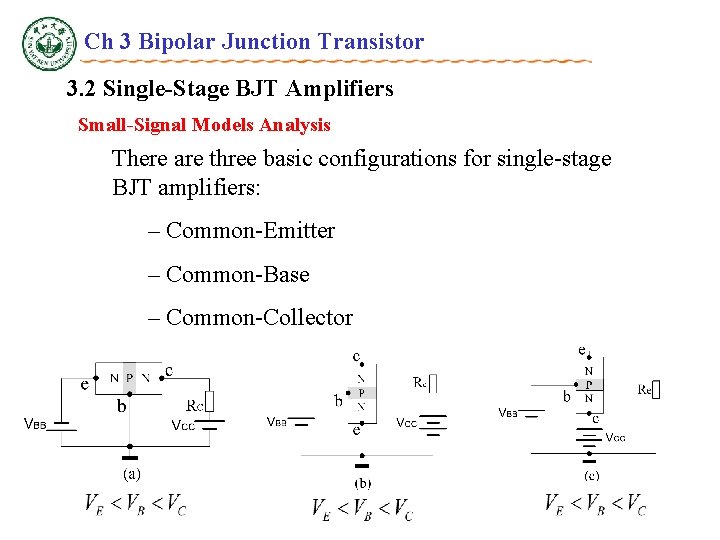
Ch 3 Bipolar Junction Transistor 3. 2 Single-Stage BJT Amplifiers Small-Signal Models Analysis There are three basic configurations for single-stage BJT amplifiers: – Common-Emitter – Common-Base – Common-Collector
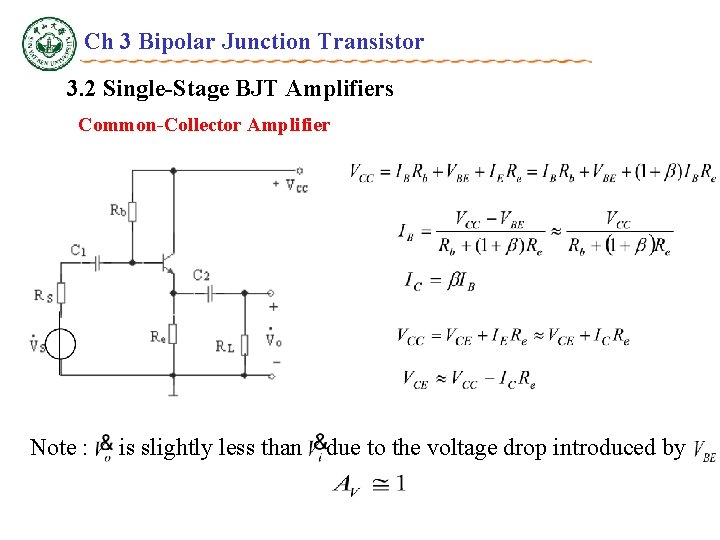
Ch 3 Bipolar Junction Transistor 3. 2 Single-Stage BJT Amplifiers Common-Collector Amplifier Note : is slightly less than due to the voltage drop introduced by
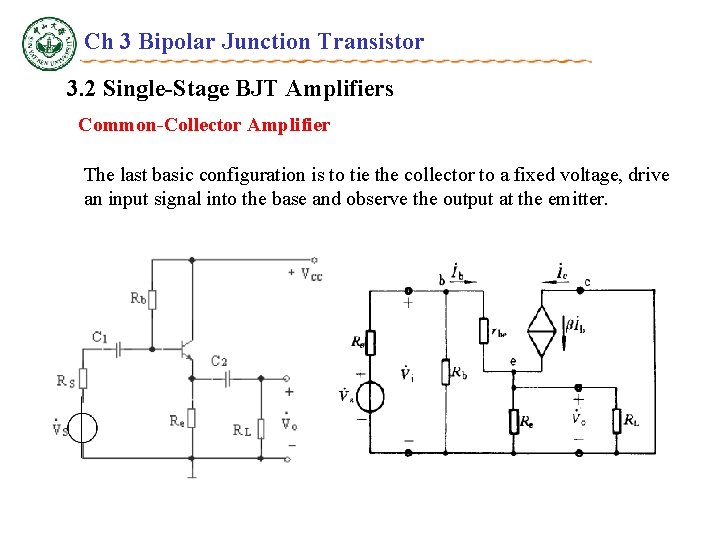
Ch 3 Bipolar Junction Transistor 3. 2 Single-Stage BJT Amplifiers Common-Collector Amplifier The last basic configuration is to tie the collector to a fixed voltage, drive an input signal into the base and observe the output at the emitter.
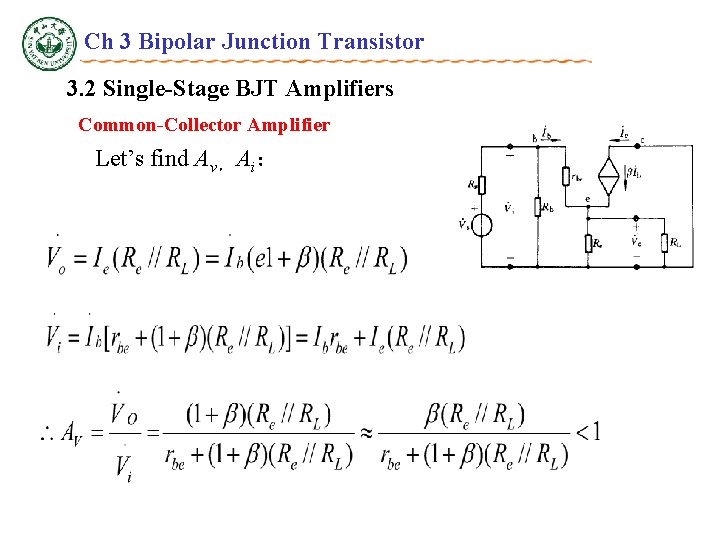
Ch 3 Bipolar Junction Transistor 3. 2 Single-Stage BJT Amplifiers Common-Collector Amplifier Let’s find Av, Ai:
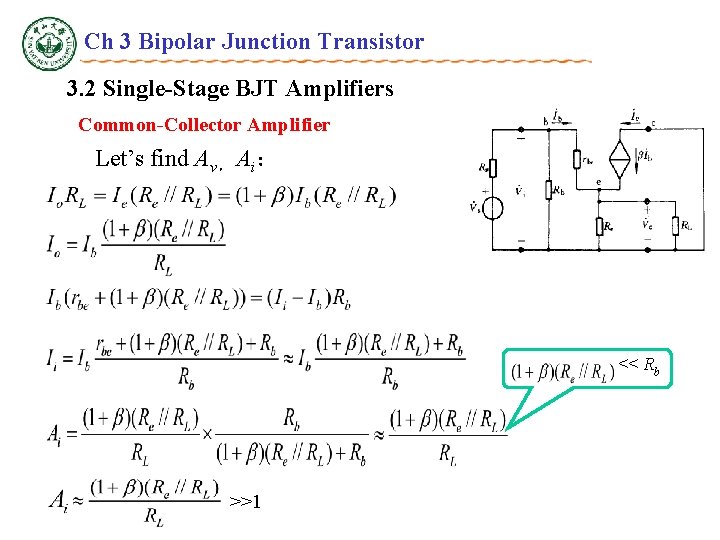
Ch 3 Bipolar Junction Transistor 3. 2 Single-Stage BJT Amplifiers Common-Collector Amplifier Let’s find Av, Ai: << Rb >>1
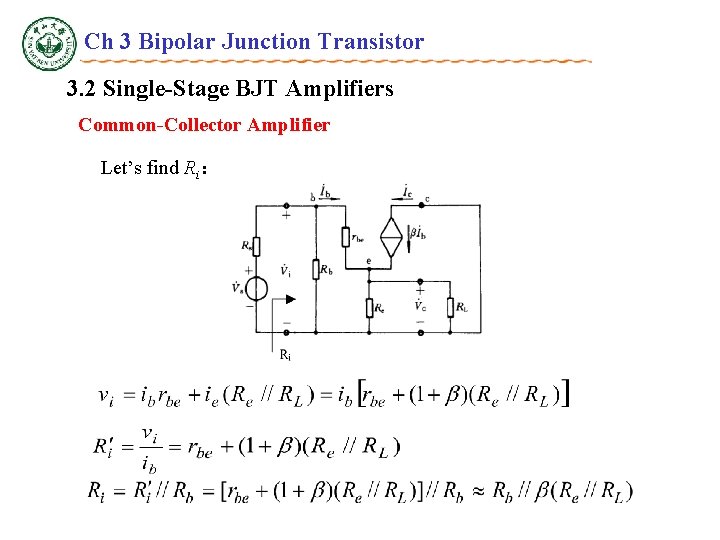
Ch 3 Bipolar Junction Transistor 3. 2 Single-Stage BJT Amplifiers Common-Collector Amplifier Let’s find Ri:
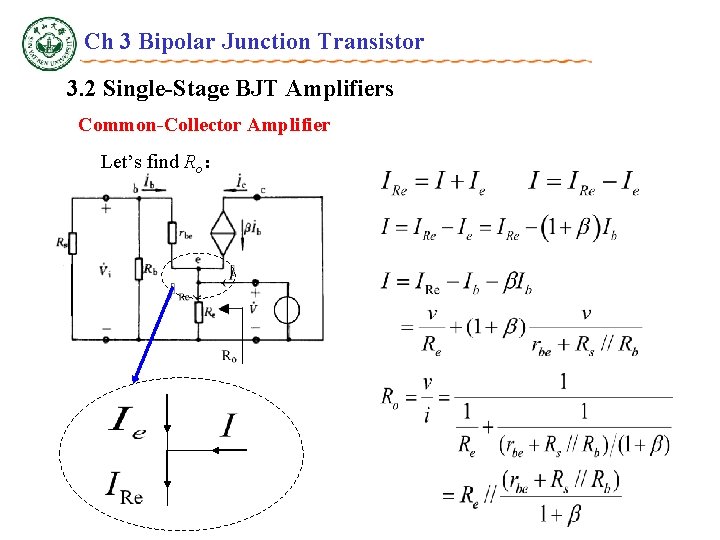
Ch 3 Bipolar Junction Transistor 3. 2 Single-Stage BJT Amplifiers Common-Collector Amplifier Let’s find Ro:
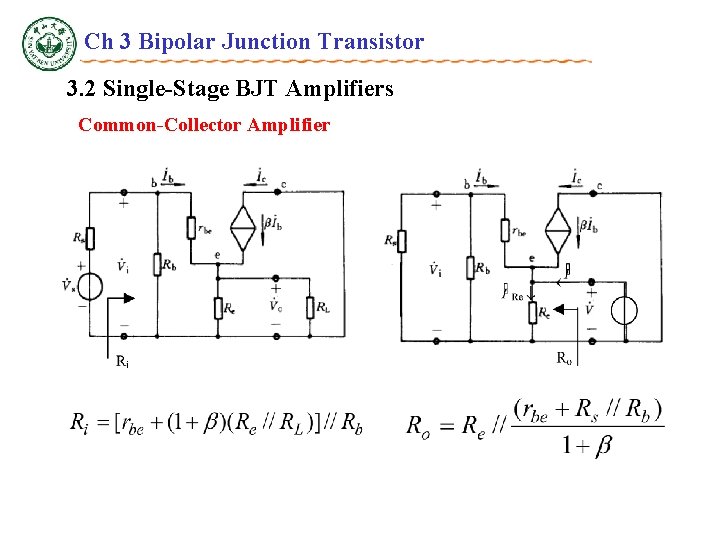
Ch 3 Bipolar Junction Transistor 3. 2 Single-Stage BJT Amplifiers Common-Collector Amplifier
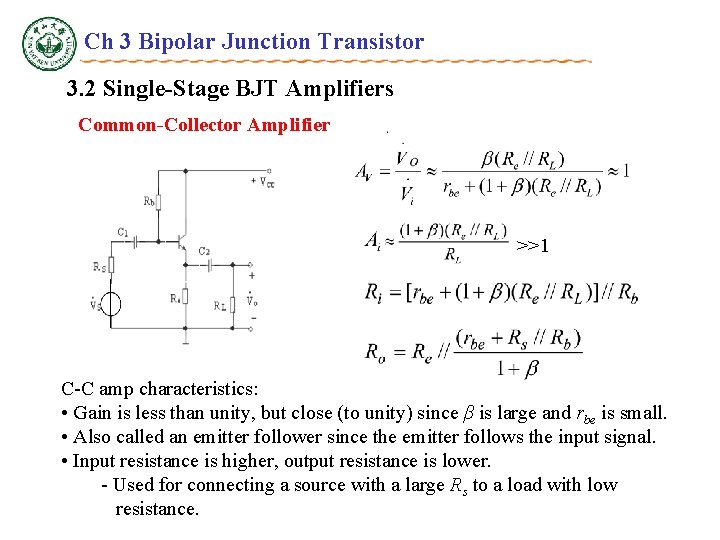
Ch 3 Bipolar Junction Transistor 3. 2 Single-Stage BJT Amplifiers Common-Collector Amplifier >>1 C-C amp characteristics: • Gain is less than unity, but close (to unity) since β is large and rbe is small. • Also called an emitter follower since the emitter follows the input signal. • Input resistance is higher, output resistance is lower. - Used for connecting a source with a large Rs to a load with low resistance.
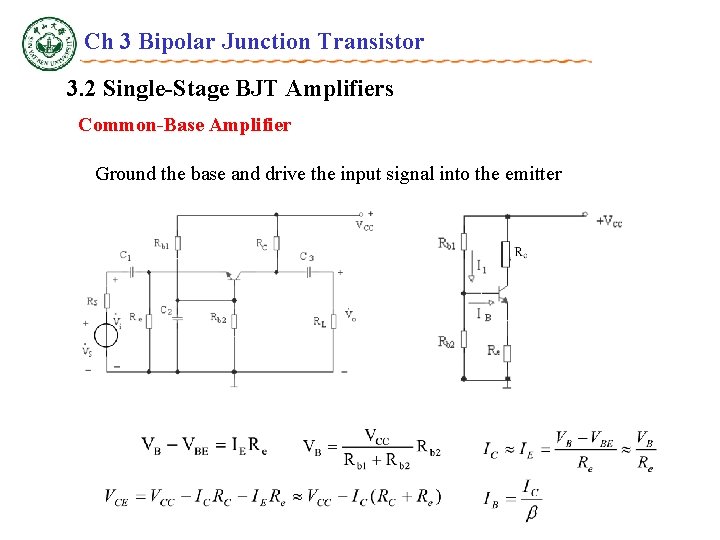
Ch 3 Bipolar Junction Transistor 3. 2 Single-Stage BJT Amplifiers Common-Base Amplifier Ground the base and drive the input signal into the emitter
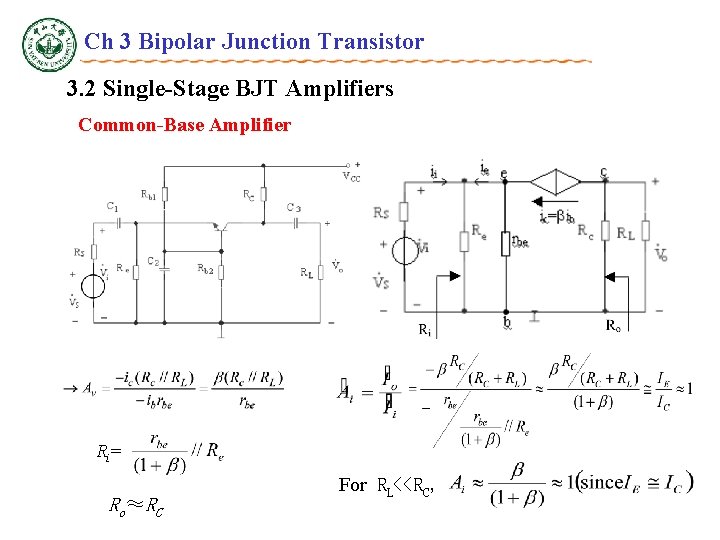
Ch 3 Bipolar Junction Transistor 3. 2 Single-Stage BJT Amplifiers Common-Base Amplifier Ri= Ro≈RC For RL<<RC,
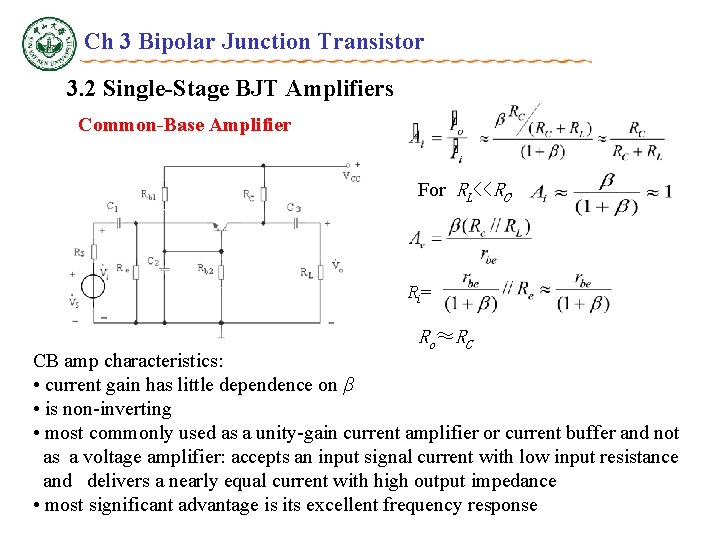
Ch 3 Bipolar Junction Transistor 3. 2 Single-Stage BJT Amplifiers Common-Base Amplifier For RL<<RC, Ri= Ro≈RC CB amp characteristics: • current gain has little dependence on β • is non-inverting • most commonly used as a unity-gain current amplifier or current buffer and not as a voltage amplifier: accepts an input signal current with low input resistance and delivers a nearly equal current with high output impedance • most significant advantage is its excellent frequency response
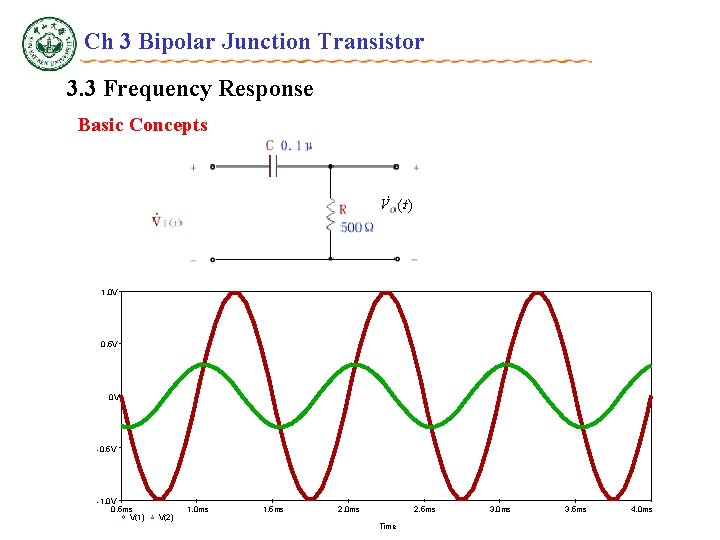
Ch 3 Bipolar Junction Transistor 3. 3 Frequency Response Basic Concepts 1. 0 V 0. 5 V 0 V -0. 5 V -1. 0 V 0. 5 ms V(1) V(2) 1. 0 ms 1. 5 ms 2. 0 ms 2. 5 ms Time 3. 0 ms 3. 5 ms 4. 0 ms
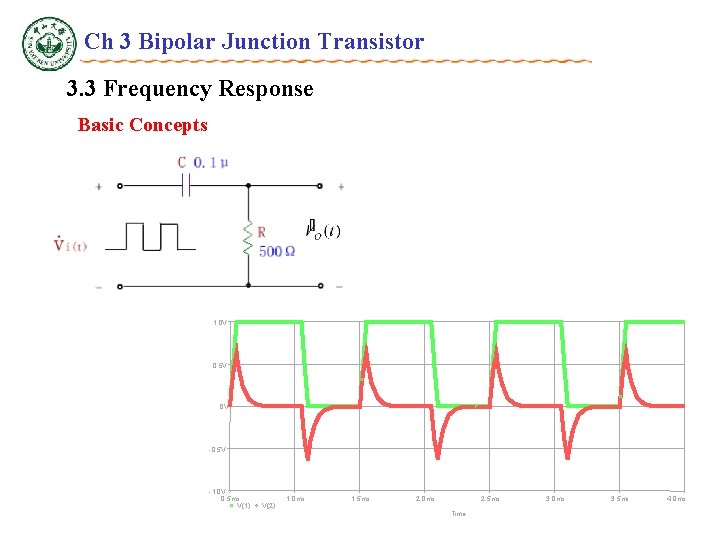
Ch 3 Bipolar Junction Transistor 3. 3 Frequency Response Basic Concepts 1. 0 V 0. 5 V 0 V -0. 5 V -1. 0 V 0. 5 ms V(1) V(2) 1. 0 ms 1. 5 ms 2. 0 ms 2. 5 ms Time 3. 0 ms 3. 5 ms 4. 0 ms
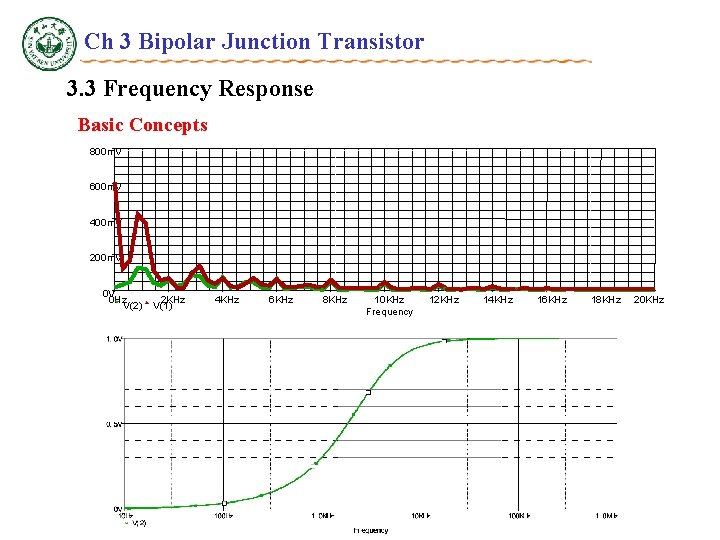
Ch 3 Bipolar Junction Transistor 3. 3 Frequency Response Basic Concepts 800 m. V 600 m. V 400 m. V 200 m. V 0 V 0 Hz V(2) 2 KHz V(1) 4 KHz 6 KHz 8 KHz 10 KHz Frequency 12 KHz 14 KHz 16 KHz 18 KHz 20 KHz
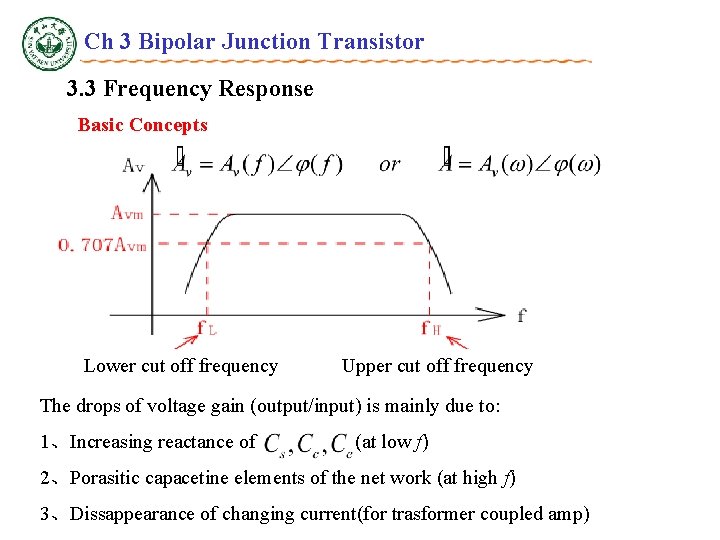
Ch 3 Bipolar Junction Transistor 3. 3 Frequency Response Basic Concepts Lower cut off frequency Upper cut off frequency The drops of voltage gain (output/input) is mainly due to: 1、Increasing reactance of (at low f) 2、Porasitic capacetine elements of the net work (at high f) 3、Dissappearance of changing current(for trasformer coupled amp)
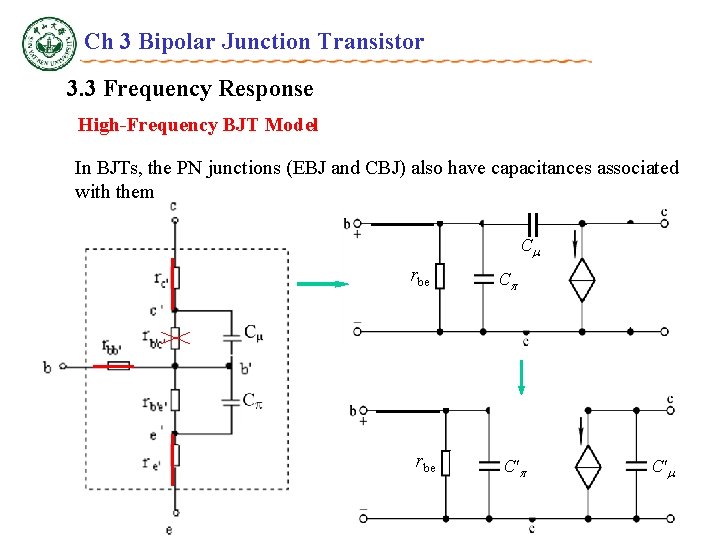
Ch 3 Bipolar Junction Transistor 3. 3 Frequency Response High-Frequency BJT Model In BJTs, the PN junctions (EBJ and CBJ) also have capacitances associated with them C rbe C C'
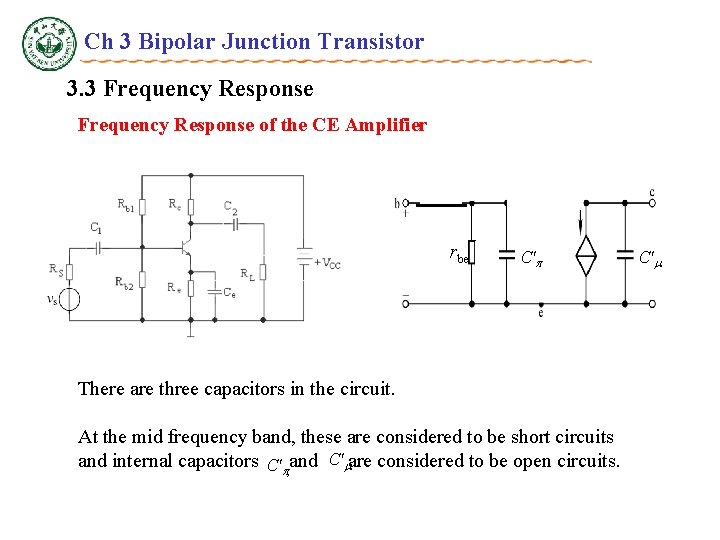
Ch 3 Bipolar Junction Transistor 3. 3 Frequency Response of the CE Amplifier rbe C' There are three capacitors in the circuit. At the mid frequency band, these are considered to be short circuits and internal capacitors C' , and C' are considered to be open circuits. C'
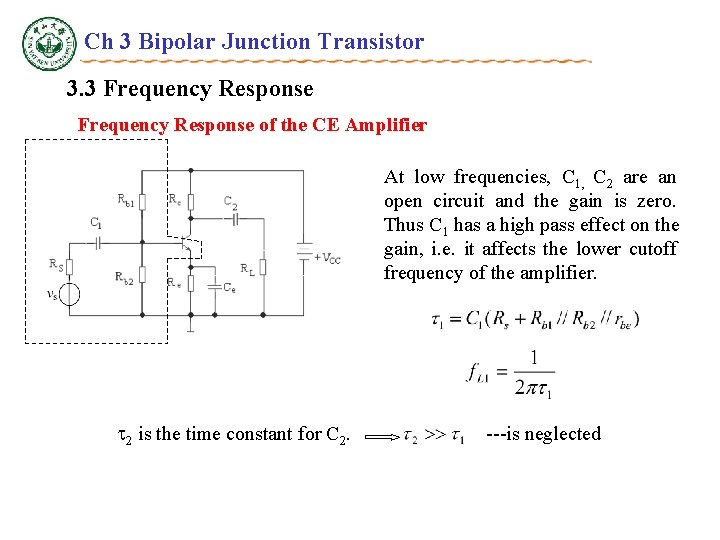
Ch 3 Bipolar Junction Transistor 3. 3 Frequency Response of the CE Amplifier At low frequencies, C 1, C 2 are an open circuit and the gain is zero. Thus C 1 has a high pass effect on the gain, i. e. it affects the lower cutoff frequency of the amplifier. 2 is the time constant for C 2. ---is neglected
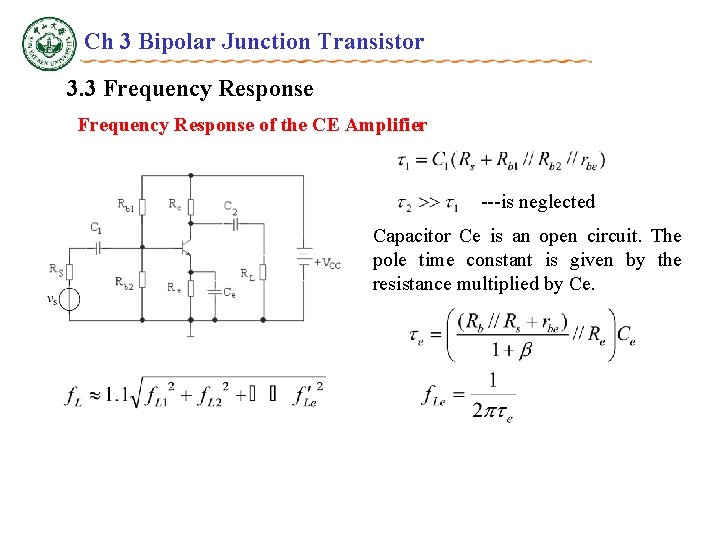
Ch 3 Bipolar Junction Transistor 3. 3 Frequency Response of the CE Amplifier ---is neglected Capacitor Ce is an open circuit. The pole time constant is given by the resistance multiplied by Ce.
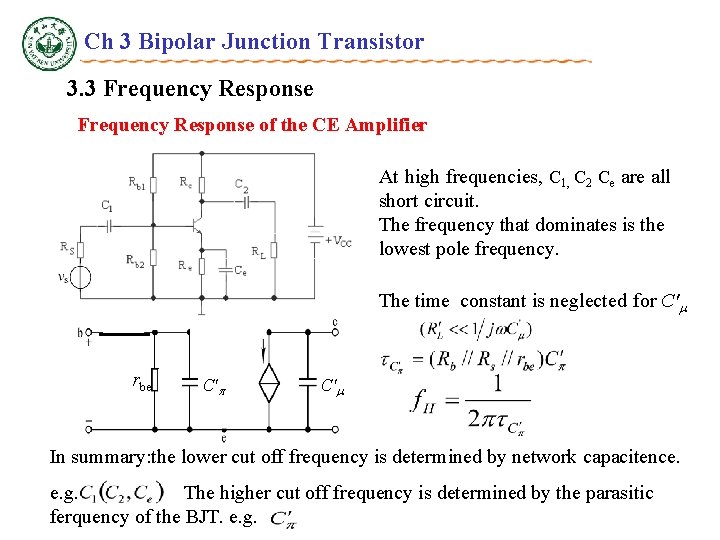
Ch 3 Bipolar Junction Transistor 3. 3 Frequency Response of the CE Amplifier At high frequencies, C 1, C 2 Ce are all short circuit. The frequency that dominates is the lowest pole frequency. The time constant is neglected for C' rbe C' In summary: the lower cut off frequency is determined by network capacitence. e. g. The higher cut off frequency is determined by the parasitic ferquency of the BJT. e. g.
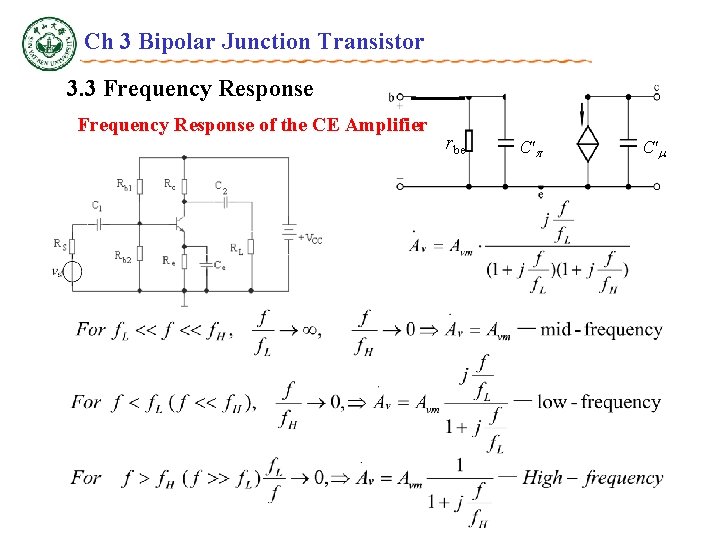
Ch 3 Bipolar Junction Transistor 3. 3 Frequency Response of the CE Amplifier rbe C'
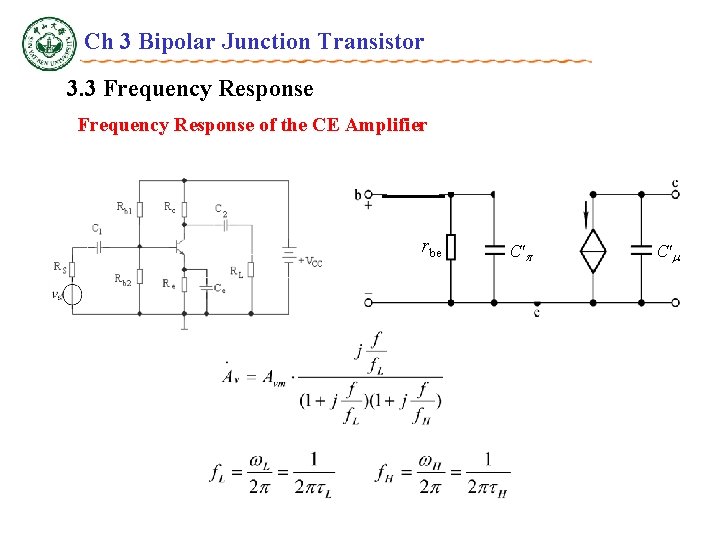
Ch 3 Bipolar Junction Transistor 3. 3 Frequency Response of the CE Amplifier rbe C'
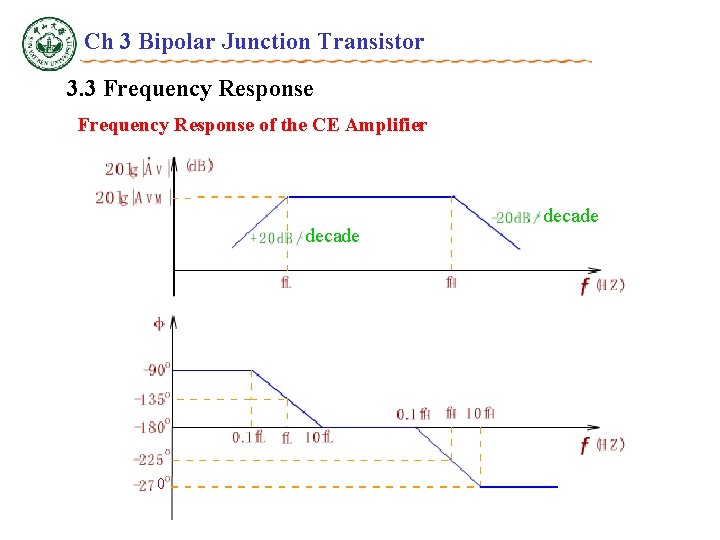
Ch 3 Bipolar Junction Transistor 3. 3 Frequency Response of the CE Amplifier decade 0 decade
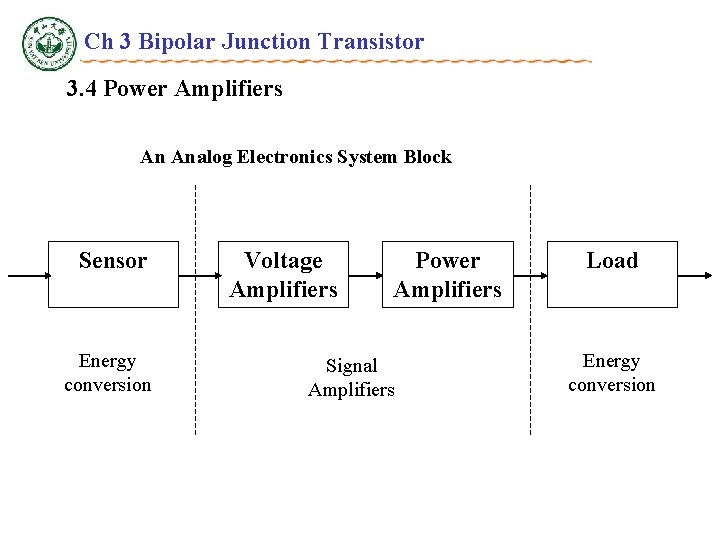
Ch 3 Bipolar Junction Transistor 3. 4 Power Amplifiers An Analog Electronics System Block Sensor Energy conversion Voltage Amplifiers Power Amplifiers Signal Amplifiers Load Energy conversion
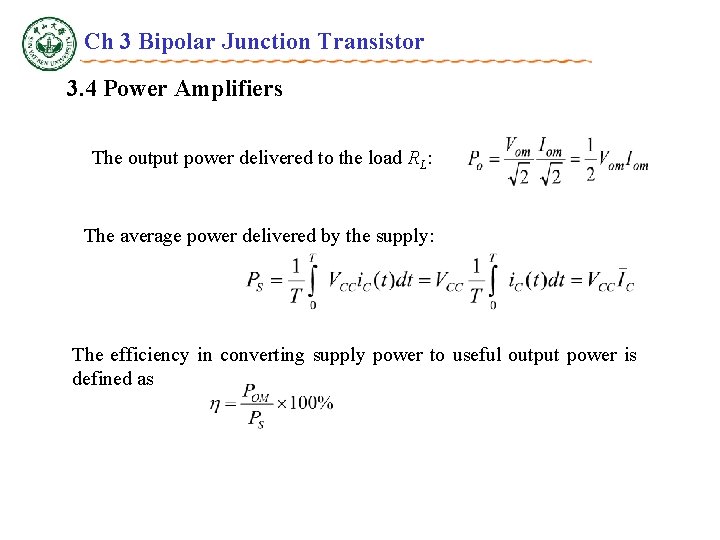
Ch 3 Bipolar Junction Transistor 3. 4 Power Amplifiers The output power delivered to the load RL: The average power delivered by the supply: The efficiency in converting supply power to useful output power is defined as
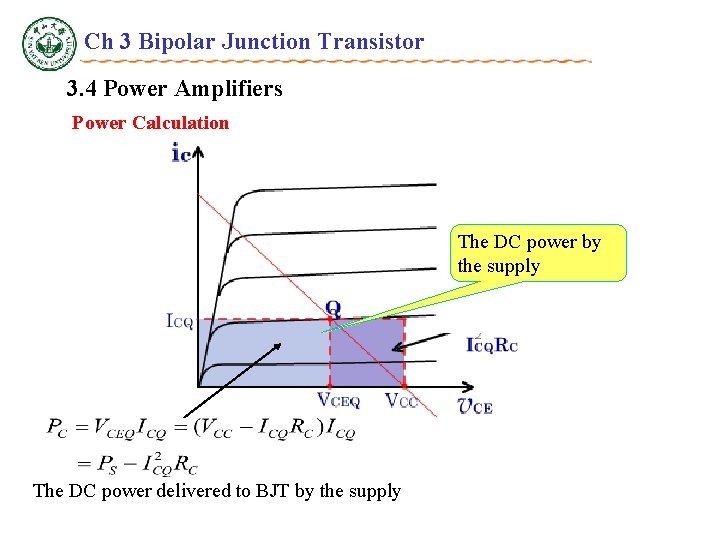
Ch 3 Bipolar Junction Transistor 3. 4 Power Amplifiers Power Calculation The DC power by the supply The DC power delivered to BJT by the supply
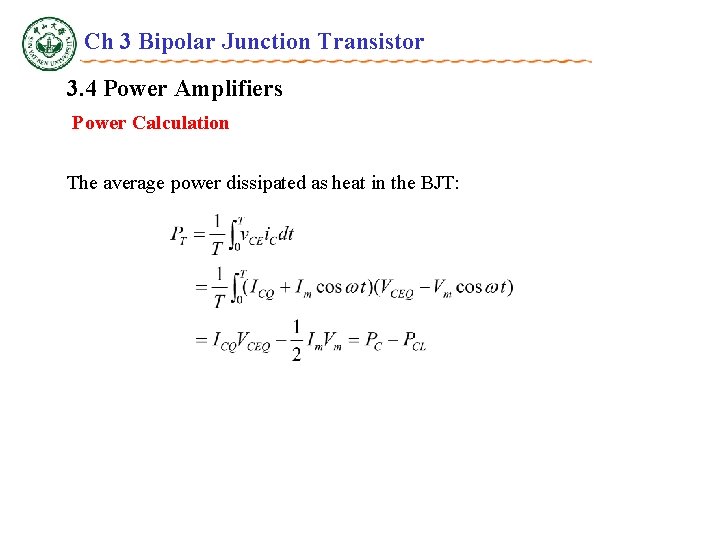
Ch 3 Bipolar Junction Transistor 3. 4 Power Amplifiers Power Calculation The average power dissipated as heat in the BJT:
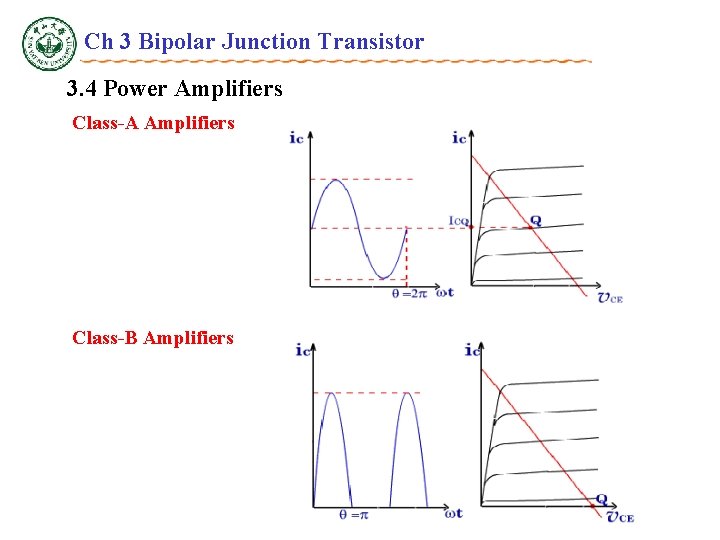
Ch 3 Bipolar Junction Transistor 3. 4 Power Amplifiers Class-A Amplifiers Class-B Amplifiers
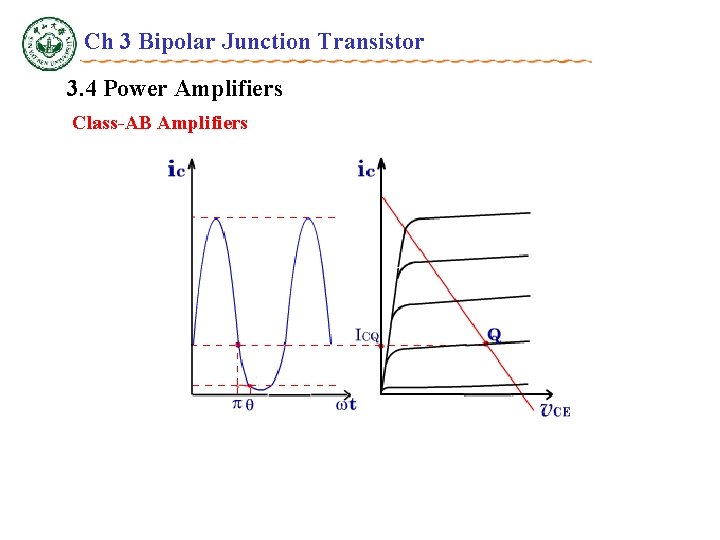
Ch 3 Bipolar Junction Transistor 3. 4 Power Amplifiers Class-AB Amplifiers
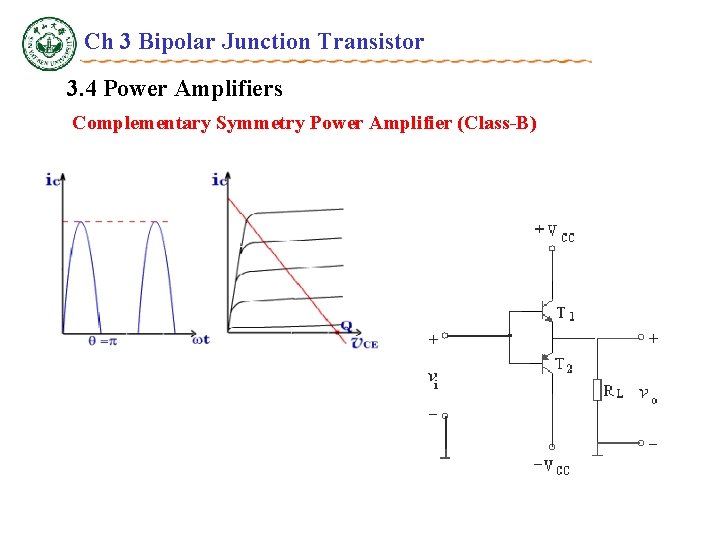
Ch 3 Bipolar Junction Transistor 3. 4 Power Amplifiers Complementary Symmetry Power Amplifier (Class-B)
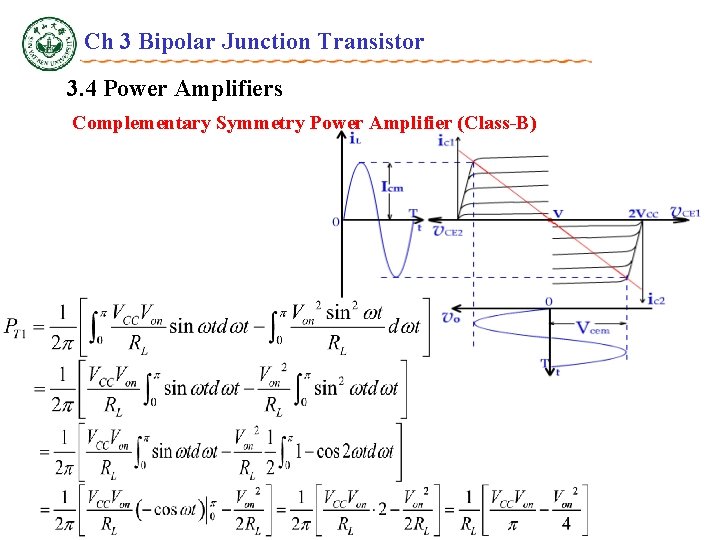
Ch 3 Bipolar Junction Transistor 3. 4 Power Amplifiers Complementary Symmetry Power Amplifier (Class-B)
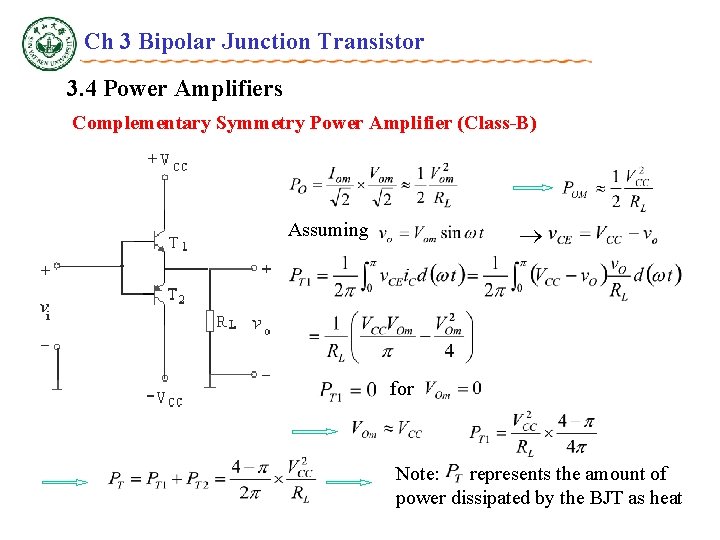
Ch 3 Bipolar Junction Transistor 3. 4 Power Amplifiers Complementary Symmetry Power Amplifier (Class-B) Assuming for Note: represents the amount of power dissipated by the BJT as heat
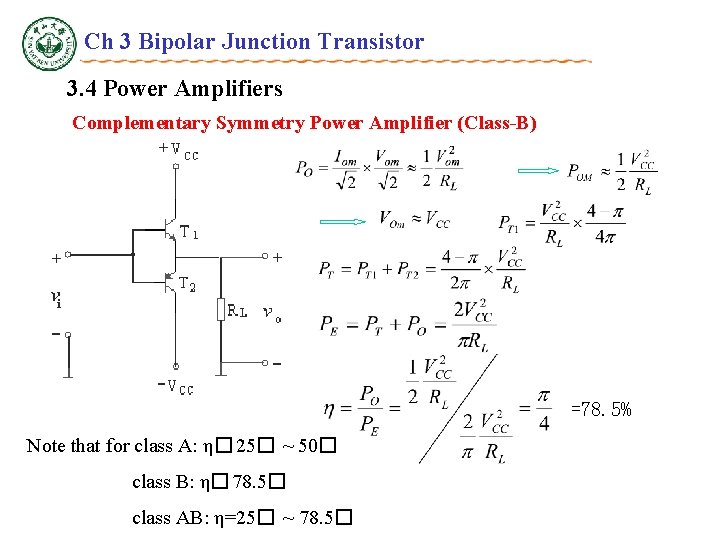
Ch 3 Bipolar Junction Transistor 3. 4 Power Amplifiers Complementary Symmetry Power Amplifier (Class-B) =78. 5% Note that for class A: η� 25� ~ 50� class B: η� 78. 5� class AB: η=25� ~ 78. 5�
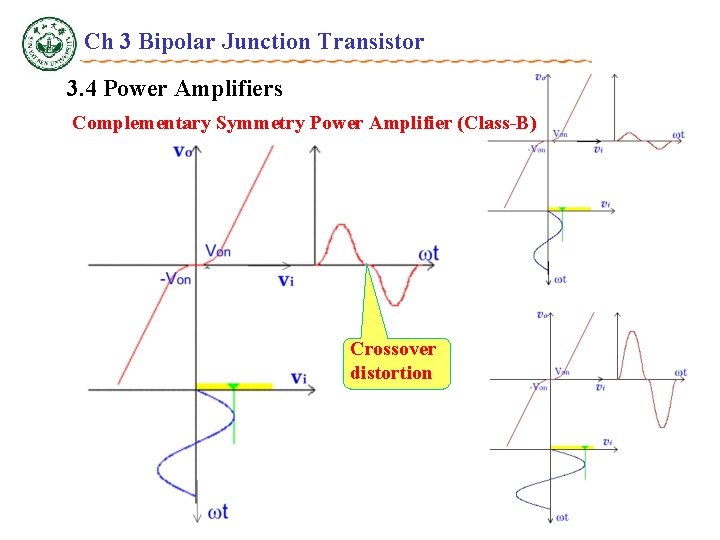
Ch 3 Bipolar Junction Transistor 3. 4 Power Amplifiers Complementary Symmetry Power Amplifier (Class-B) Crossover distortion

Ch 3 Bipolar Junction Transistor 3. 4 Power Amplifiers Biasing the Push-Pull Amplifier (Class-AB) (OCL) To overcome crossover distortion, the biasing is adjusted to just overcome the VBE of the transistors; this results in a modified form of operation called class AB. In class AB operation, the push-pull stages are biased into slight conduction, even when no input signal is present. }VCC Power Calculation is the same as class-B
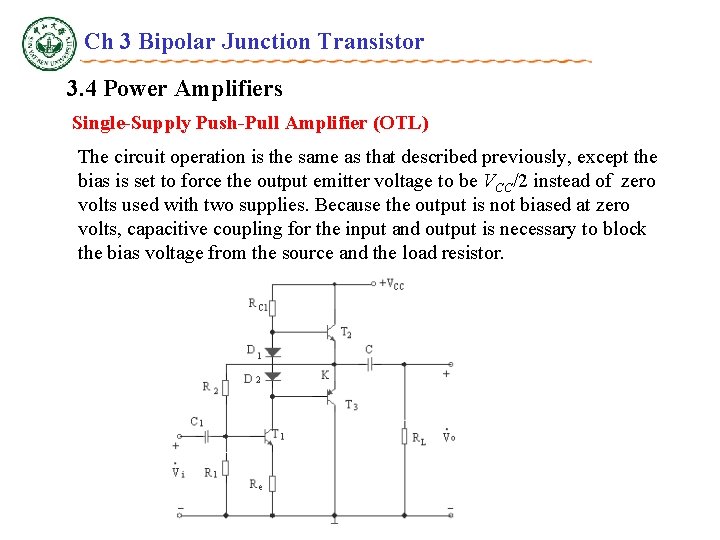
Ch 3 Bipolar Junction Transistor 3. 4 Power Amplifiers Single-Supply Push-Pull Amplifier (OTL) The circuit operation is the same as that described previously, except the bias is set to force the output emitter voltage to be VCC/2 instead of zero volts used with two supplies. Because the output is not biased at zero volts, capacitive coupling for the input and output is necessary to block the bias voltage from the source and the load resistor.
- Slides: 77