
ANALOG ELECTRONIC CIRCUITS 1 EKT 204 Basic BJT
ANALOG ELECTRONIC CIRCUITS 1 EKT 204 Basic BJT Amplifiers (Part 2) 1
Basic Common-Emitter Amplifier l The basic common-emitter circuit used in previous analysis causes a serious defect : l l If BJT with VBE=0. 7 V is used, IB=9. 5 μA & IC=0. 95 m. A But, if new BJT with VBE=0. 6 V is used, IB=26 μA & BJT goes into saturation; which is not acceptable Previous circuit is not practical So, the emitter resistor is included: Q-point is stabilized against variations in β, as will the voltage gain, AV Assumptions l l CC acts as a short circuit Early voltage = ∞ ==> ro neglected due to open circuit 2
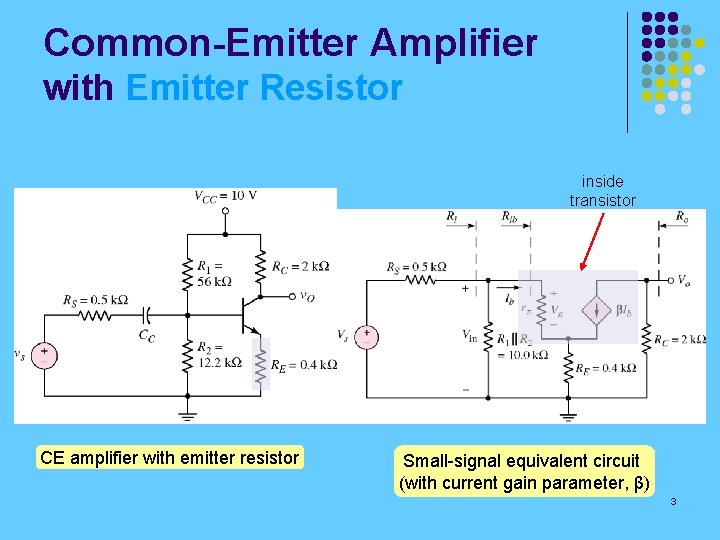
Common-Emitter Amplifier with Emitter Resistor inside transistor CE amplifier with emitter resistor Small-signal equivalent circuit (with current gain parameter, β) 3
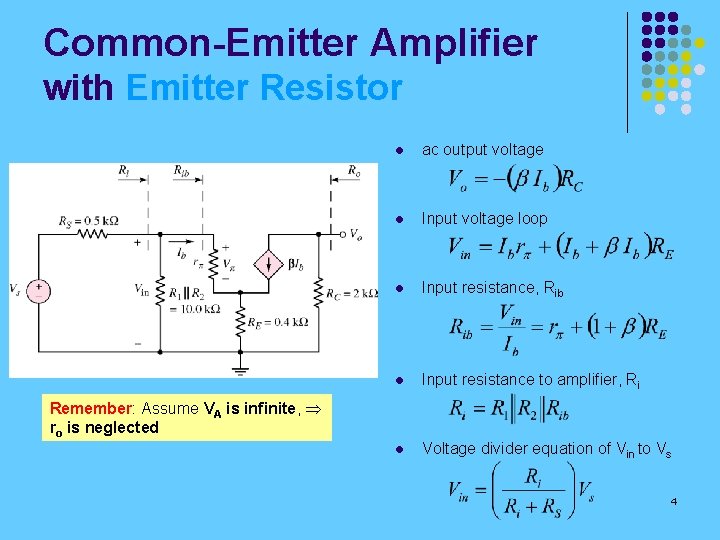
Common-Emitter Amplifier with Emitter Resistor l ac output voltage l Input voltage loop l Input resistance, Rib l Input resistance to amplifier, Ri l Voltage divider equation of Vin to Vs Remember: Assume VA is infinite, ro is neglected 4
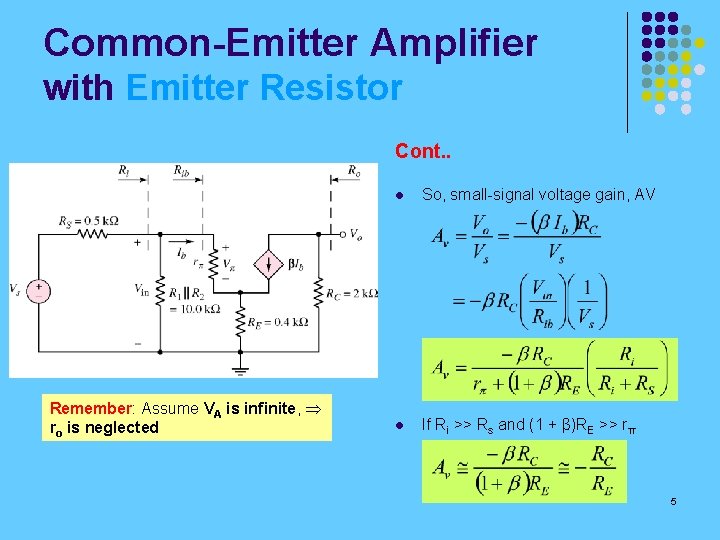
Common-Emitter Amplifier with Emitter Resistor Cont. . Remember: Assume VA is infinite, ro is neglected l So, small-signal voltage gain, AV l If Ri >> Rs and (1 + β)RE >> rπ 5
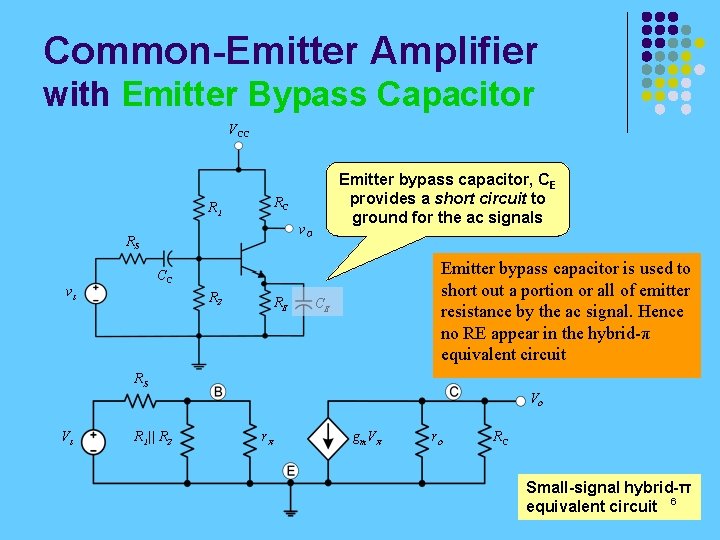
Common-Emitter Amplifier with Emitter Bypass Capacitor VCC Emitter bypass capacitor, CE provides a short circuit to ground for the ac signals RC R 1 v. O RS Emitter bypass capacitor is used to short out a portion or all of emitter resistance by the ac signal. Hence no RE appear in the hybrid-π equivalent circuit CC vs R 2 RE CE RS Vo Vs R 1|| R 2 r gm. V ro RC Small-signal hybrid-π equivalent circuit 6
DC & AC LOAD LINE ANALYSIS l DC load line l l Visualized the relationship between Q-point & transistor characteristics AC load line l l Visualized the relationship between small-signal response & transistor characteristics Occurs when capacitors added in transistor circuit 7
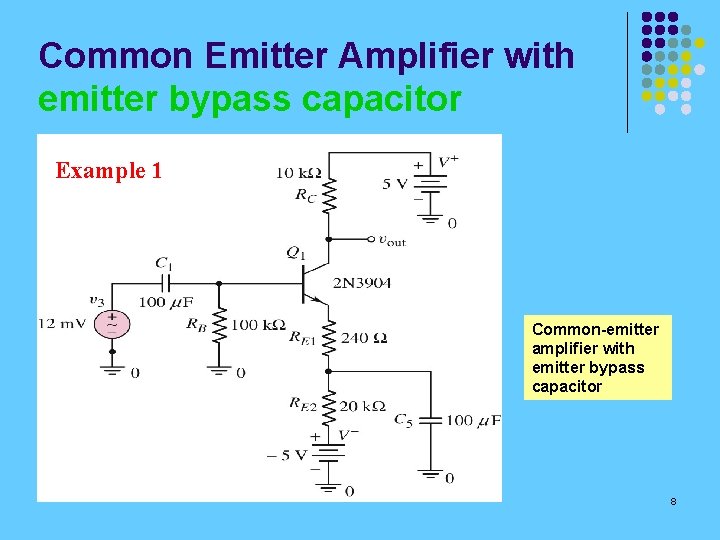
Common Emitter Amplifier with emitter bypass capacitor Example 1 Common-emitter amplifier with emitter bypass capacitor 8
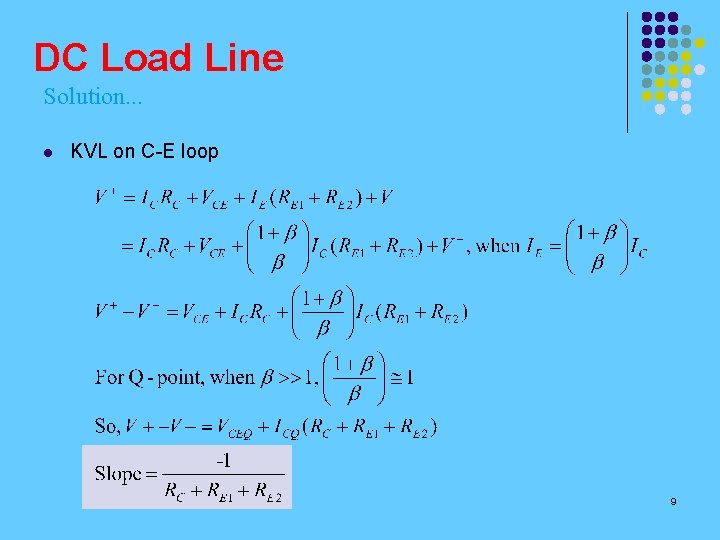
DC Load Line Solution. . . l KVL on C-E loop 9
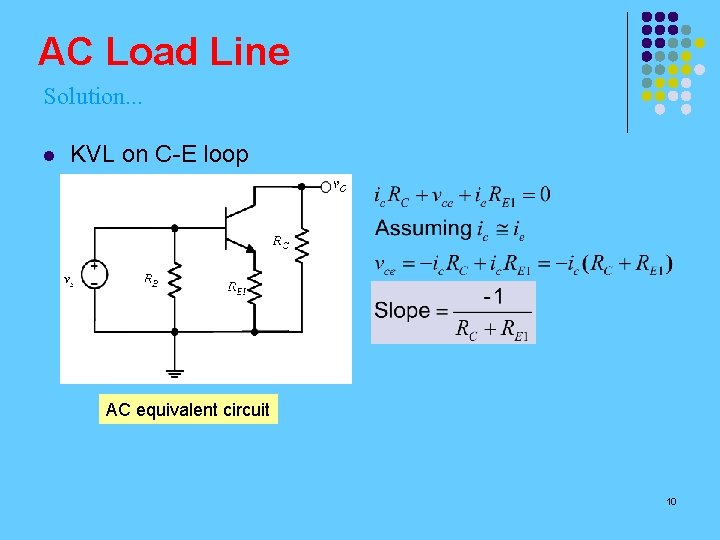
AC Load Line Solution. . . l KVL on C-E loop AC equivalent circuit 10
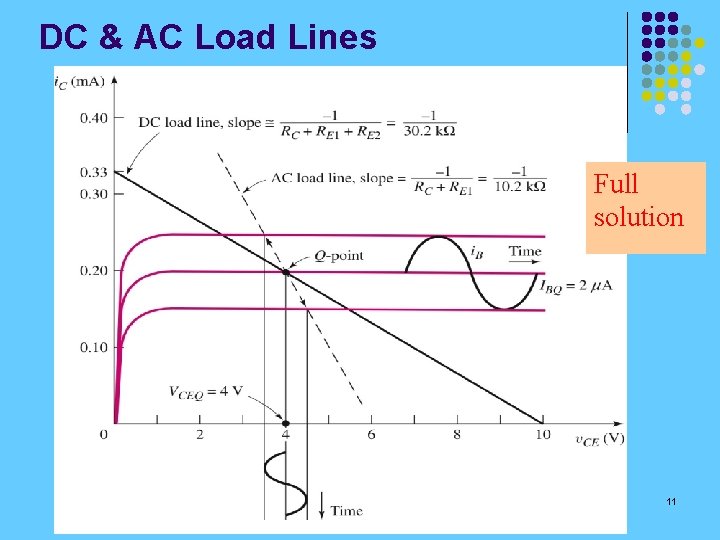
DC & AC Load Lines Full solution 11
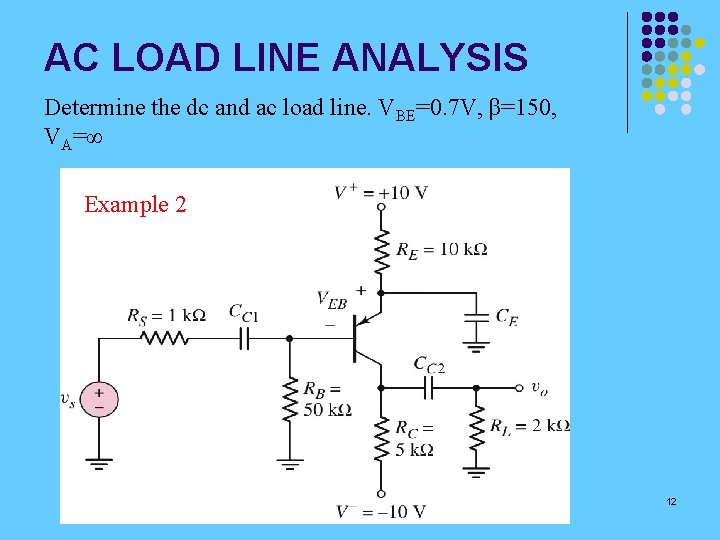
AC LOAD LINE ANALYSIS Determine the dc and ac load line. VBE=0. 7 V, β=150, VA=∞ Example 2 12
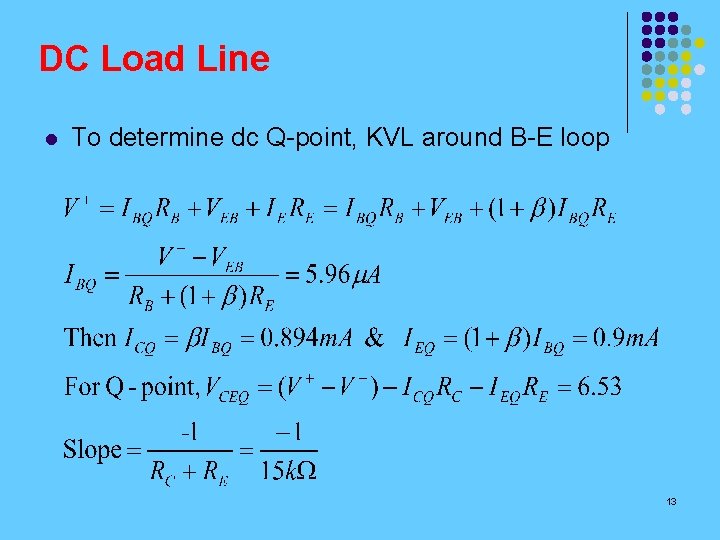
DC Load Line l To determine dc Q-point, KVL around B-E loop 13
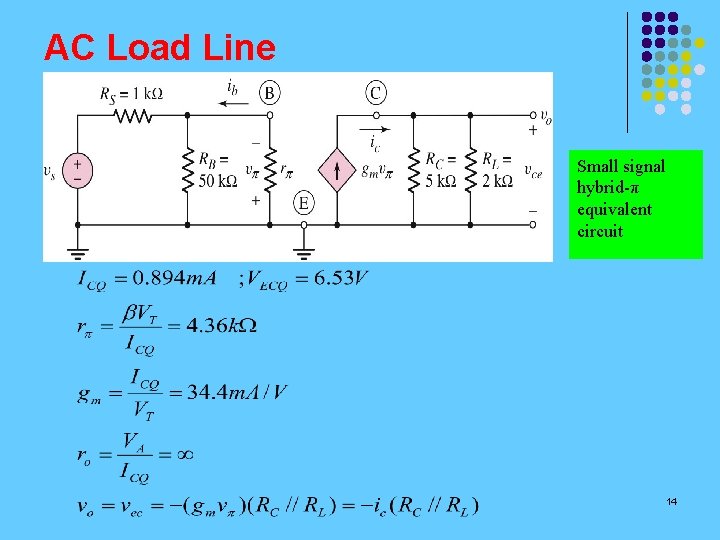
AC Load Line Small signal hybrid-π equivalent circuit 14
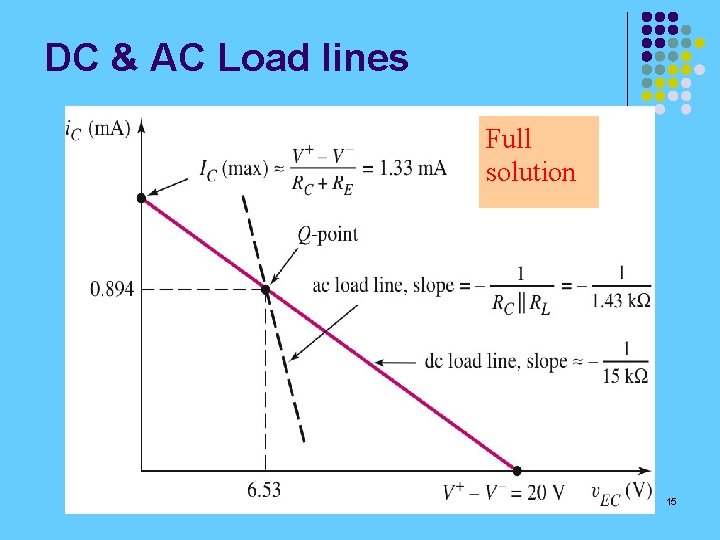
DC & AC Load lines Full solution 15
Maximum Symmetrical Swing l When symmetrical sinusoidal signal applied to the input of an amplifier, the output generated is also a symmetrical sinusoidal signal l AC load line is used to determine maximum output symmetrical swing l If output is out of limit, portion of the output signal will be clipped & signal distortion will occur 16
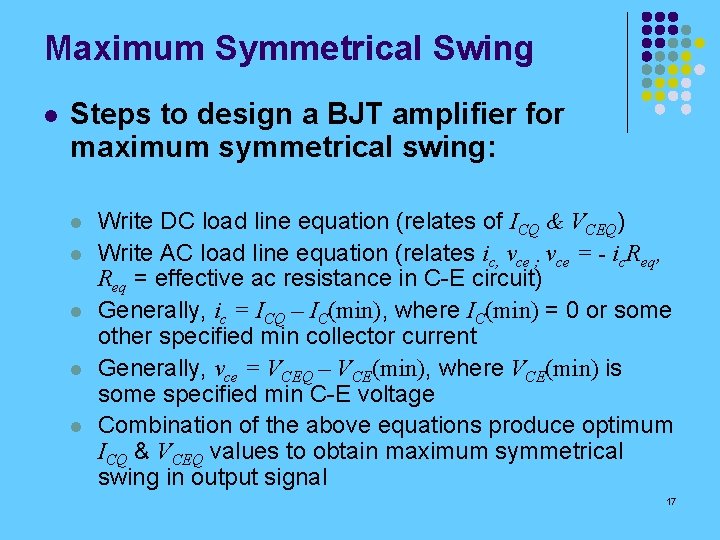
Maximum Symmetrical Swing l Steps to design a BJT amplifier for maximum symmetrical swing: l l l Write DC load line equation (relates of ICQ & VCEQ) Write AC load line equation (relates ic, vce ; vce = - ic. Req, Req = effective ac resistance in C-E circuit) Generally, ic = ICQ – IC(min), where IC(min) = 0 or some other specified min collector current Generally, vce = VCEQ – VCE(min), where VCE(min) is some specified min C-E voltage Combination of the above equations produce optimum ICQ & VCEQ values to obtain maximum symmetrical swing in output signal 17
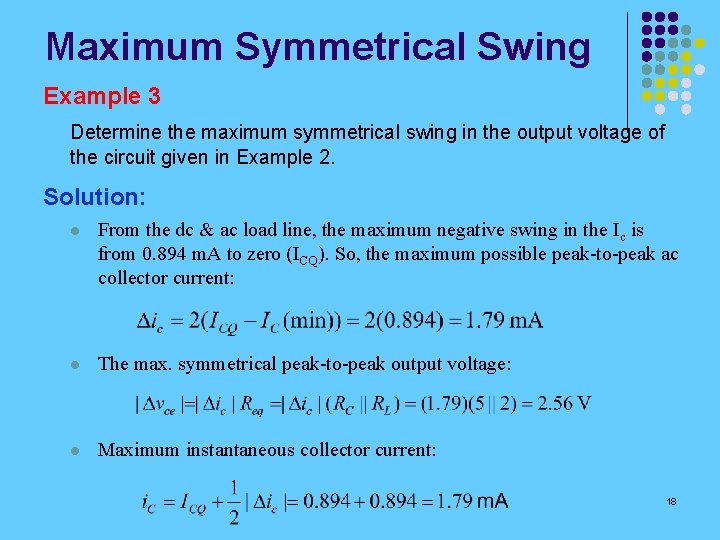
Maximum Symmetrical Swing Example 3 Determine the maximum symmetrical swing in the output voltage of the circuit given in Example 2. Solution: l From the dc & ac load line, the maximum negative swing in the Ic is from 0. 894 m. A to zero (ICQ). So, the maximum possible peak-to-peak ac collector current: l The max. symmetrical peak-to-peak output voltage: l Maximum instantaneous collector current: 18
Self-Reading Textbook: Donald A. Neamen, ‘MICROELECTRONICS Circuit Analysis & Design’, 3 rd Edition’, Mc. Graw Hill International Edition, 2007 q Chapter 6: Basic BJT Amplifiers q Page: 397 -413, 415 -424. q 19
Exercise Textbook: Donald A. Neamen, ‘MICROELECTRONICS Circuit Analysis & Design’, 3 rd Edition’, Mc. Graw Hill International Edition, 2007 q Exercise 6. 5, 6. 6, 6. 7, 6. 9 q Exercise 6. 10 , 6. 11 q 20
- Slides: 20