
Analisis Resiko Sistem Informasi Qualitative Risk Analysis Pertemuan
- Slides: 30
Analisis Resiko Sistem Informasi Qualitative Risk Analysis Pertemuan Dosen Pengampu: Alivia Yulfitri (2017) Prodi Sistem Informasi - Fakultas Ilmu Komputer
Qualitative Risk Analysis Outline for this unit 1: Qualitative Risk Analysis 2: Determine Assets and Vulnerabilities (Matrix Based Approach) 2
1 Risk Analysis: Qualitative Risk Analysis
Risk Analysis Outline • What are the difficulties with risk analysis? • What are the two different approaches? • What is the methodology for qualitative risk analysis? 4
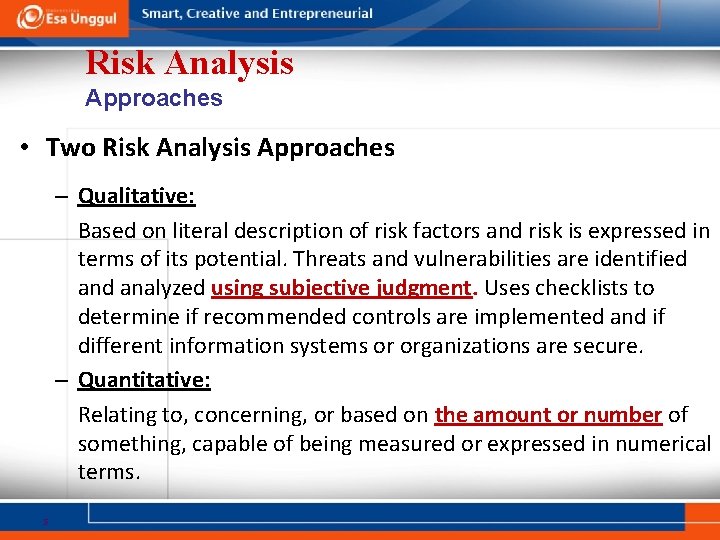
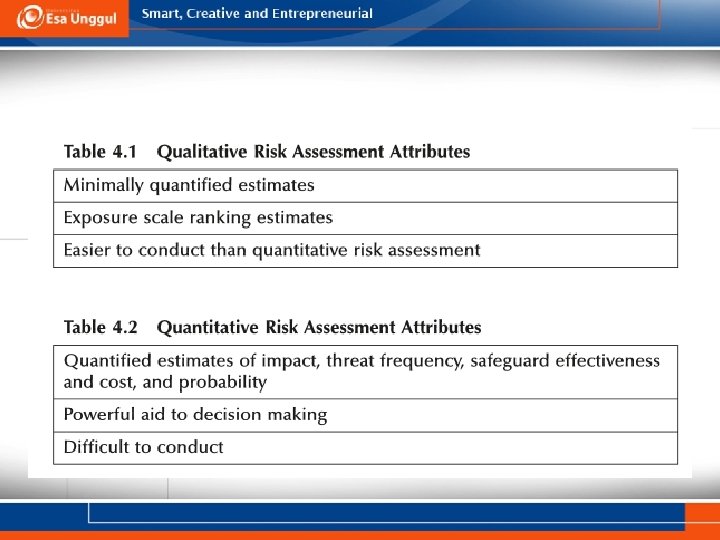
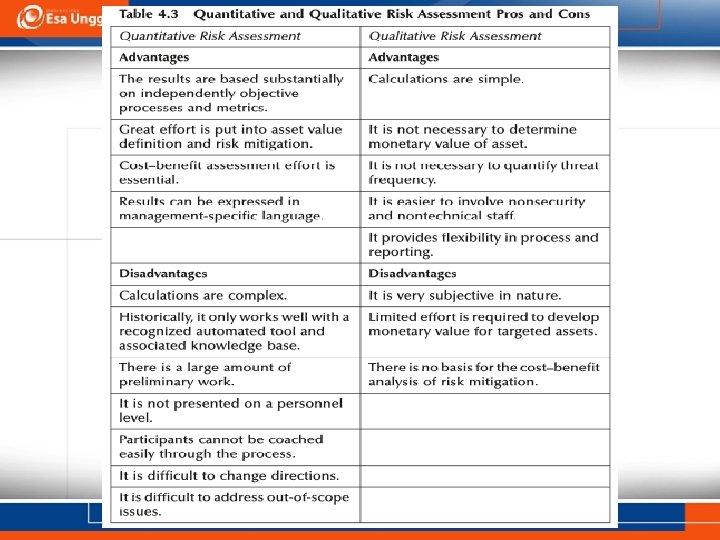
Risk Analysis Approaches • Two Risk Analysis Approaches – Qualitative: Based on literal description of risk factors and risk is expressed in terms of its potential. Threats and vulnerabilities are identified analyzed using subjective judgment. Uses checklists to determine if recommended controls are implemented and if different information systems or organizations are secure. – Quantitative: Relating to, concerning, or based on the amount or number of something, capable of being measured or expressed in numerical terms. 5
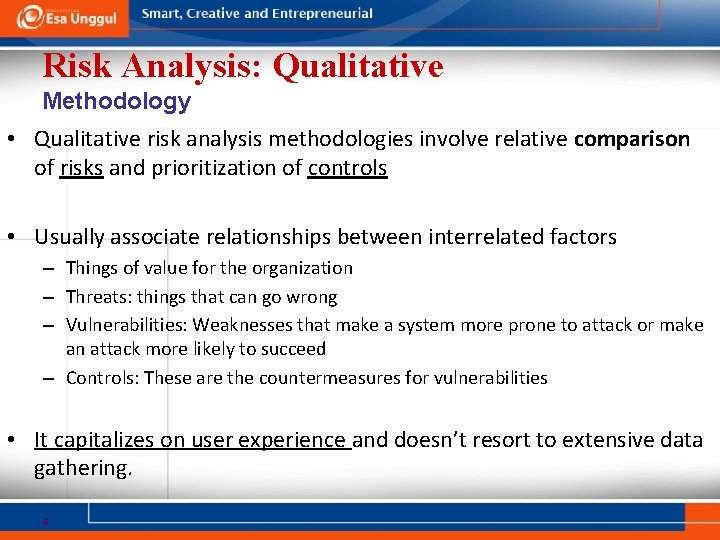
Risk Analysis: Qualitative Methodology • Qualitative risk analysis methodologies involve relative comparison of risks and prioritization of controls • Usually associate relationships between interrelated factors – Things of value for the organization – Threats: things that can go wrong – Vulnerabilities: Weaknesses that make a system more prone to attack or make an attack more likely to succeed – Controls: These are the countermeasures for vulnerabilities • It capitalizes on user experience and doesn’t resort to extensive data gathering. 6
Qualitative Risk Analysis (QRA) • Generally used in Information Security – Hard to make meaningful valuations and meaningful probabilities – Relative ordering is faster and more important • Many approaches to performing qualitative risk analysis • Same basic steps as quantitative analysis – Still identifying asserts, threats, vulnerabilities, and controls – Just evaluating importance differently Slide #9
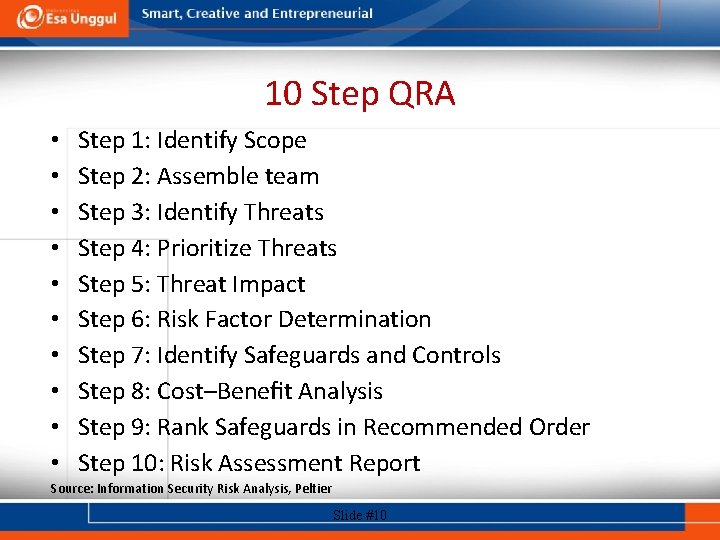
10 Step QRA • • • Step 1: Identify Scope Step 2: Assemble team Step 3: Identify Threats Step 4: Prioritize Threats Step 5: Threat Impact Step 6: Risk Factor Determination Step 7: Identify Safeguards and Controls Step 8: Cost–Benefit Analysis Step 9: Rank Safeguards in Recommended Order Step 10: Risk Assessment Report Source: Information Security Risk Analysis, Peltier Slide #10
10 Step QRA • Step 1: Identify Scope – Bound the problem • Step 2: Assemble team – Include subject matter experts, management in charge of implementing, users • Step 3: Identify Threats – Pick from lists of known threats – Brainstorm new threats – Mixing threats and vulnerabilities here. . . Slide #11
Step 4: Prioritize Threats • Prioritize threats for each assert – Likelihood of occurrence • Define a fixed threat rating – E. g. , Low(1) … High(5) • Associate a rating with each threat • Approximation to the risk probability in quantitative approach Slide #12
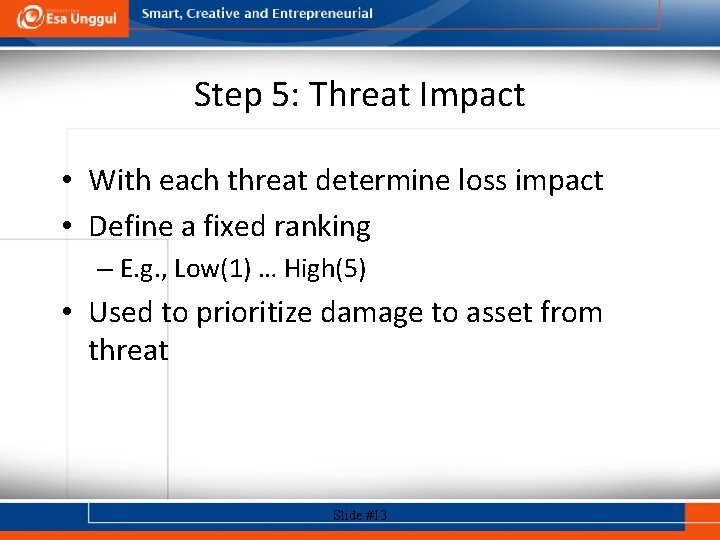
Step 5: Threat Impact • With each threat determine loss impact • Define a fixed ranking – E. g. , Low(1) … High(5) • Used to prioritize damage to asset from threat Slide #13
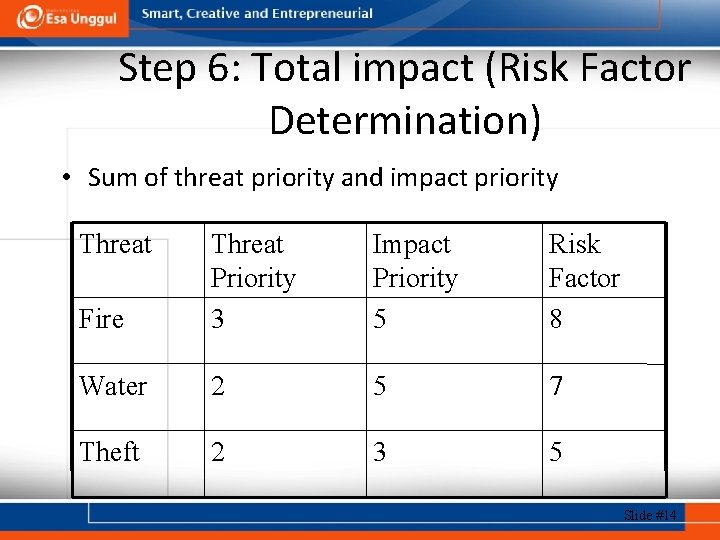
Step 6: Total impact (Risk Factor Determination) • Sum of threat priority and impact priority Threat Fire Threat Priority 3 Impact Priority 5 Risk Factor 8 Water 2 5 7 Theft 2 3 5 Slide #14
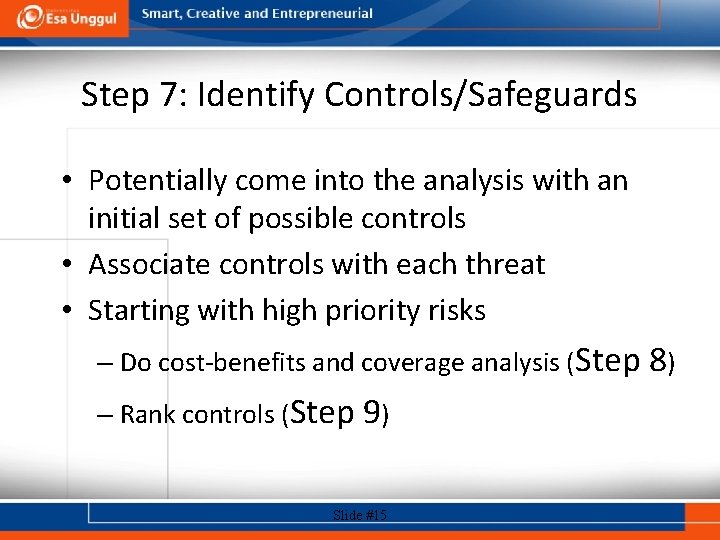
Step 7: Identify Controls/Safeguards • Potentially come into the analysis with an initial set of possible controls • Associate controls with each threat • Starting with high priority risks – Do cost-benefits and coverage analysis (Step 8) – Rank controls (Step 9) Slide #15
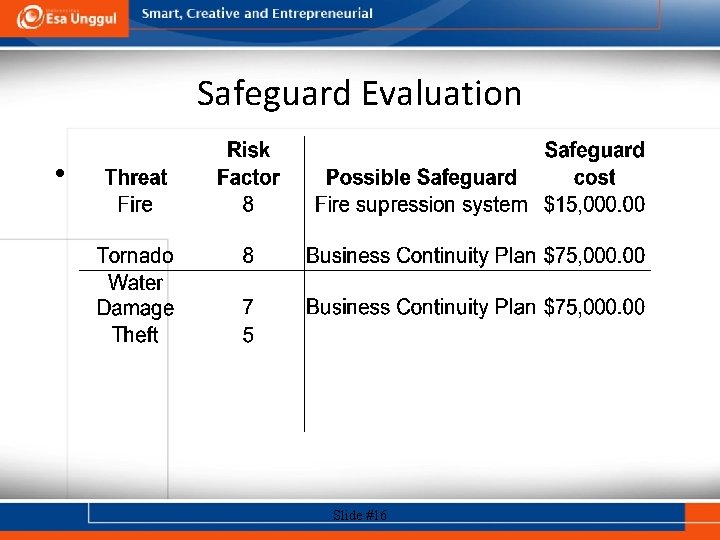
Safeguard Evaluation • Slide #16
Step 10: Risk Assessment Report/ Communicate Result • Most risk analysis projects result in a written report – Generally not read – Make a good executive summary – Beneficial to track decisions. • Real communication done in meetings an presentations Slide #17
2 Matrix Based Approach
Matrix Based Approach Outline • What are the steps involved? • How do you fill in the matrices? – Asset/Vulnerability Matrix – Vulnerability/Threat Matrix – Threat/Control Matrix 19
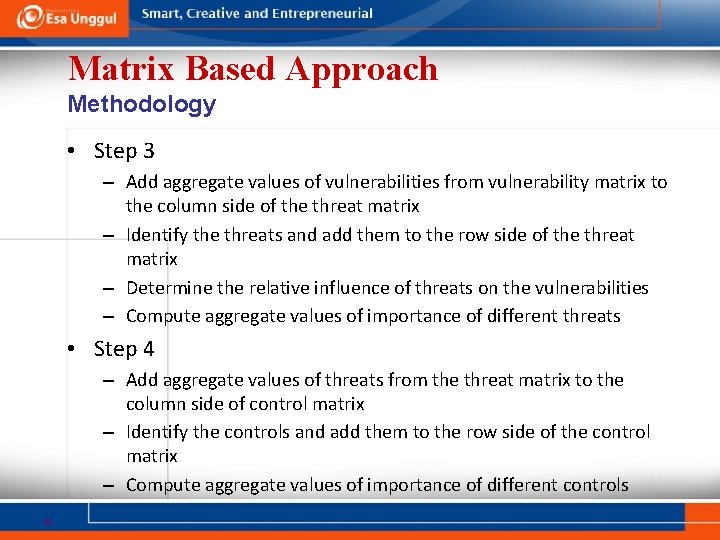
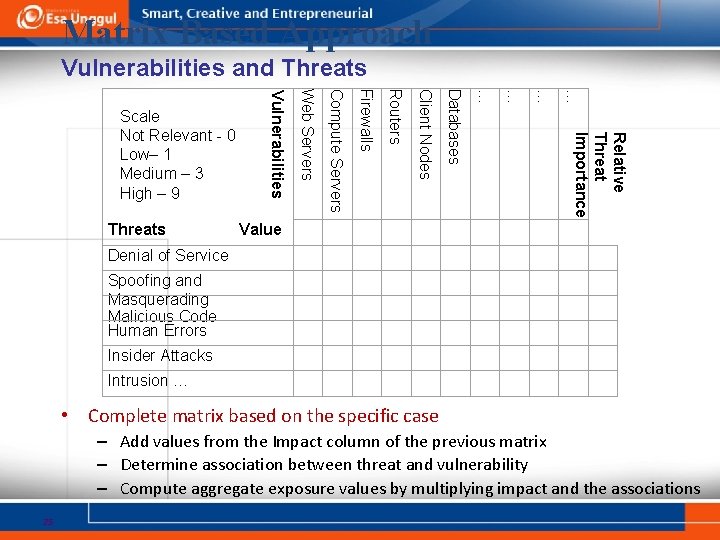
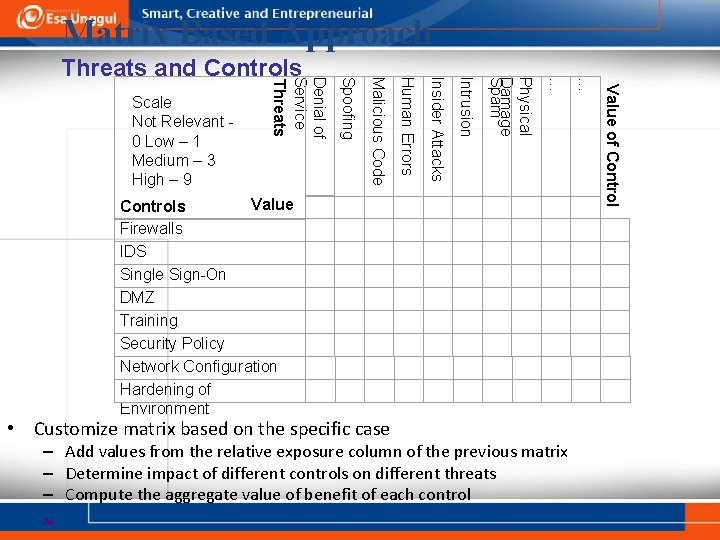
Matrix Based Approach Methodology • Consists of three matrices – Vulnerability Matrix: Links assets to vulnerabilities – Threat Matrix: Links vulnerabilities to threats – Control Matrix: Links threats to the controls • Step 1 – Identify the assets & compute the relative importance of assets • Step 2 – – – 20 List assets in the columns of the matrix. List vulnerabilities in the rows within the matrix. The value row should contain asset values. Rank the assets based on the impact to the organization. Compute the aggregate value of relative importance of different vulnerabilities
Matrix Based Approach Methodology • Step 3 – Add aggregate values of vulnerabilities from vulnerability matrix to the column side of the threat matrix – Identify the threats and add them to the row side of the threat matrix – Determine the relative influence of threats on the vulnerabilities – Compute aggregate values of importance of different threats • Step 4 – Add aggregate values of threats from the threat matrix to the column side of control matrix – Identify the controls and add them to the row side of the control matrix – Compute aggregate values of importance of different controls 21
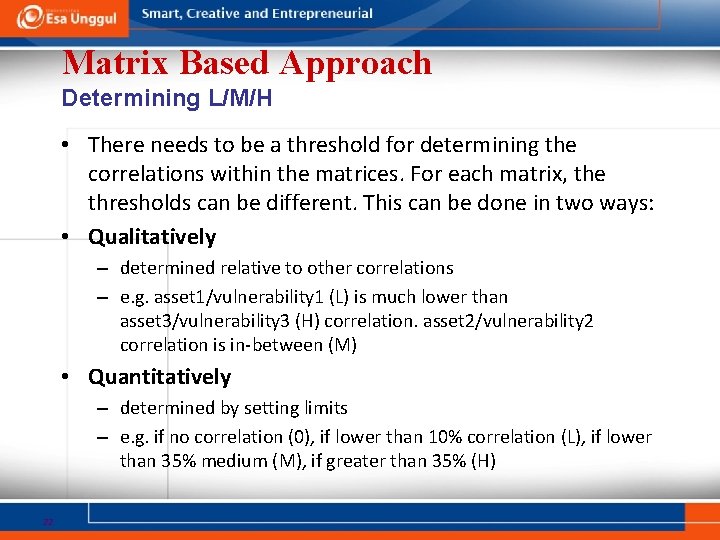
Matrix Based Approach Determining L/M/H • There needs to be a threshold for determining the correlations within the matrices. For each matrix, the thresholds can be different. This can be done in two ways: • Qualitatively – determined relative to other correlations – e. g. asset 1/vulnerability 1 (L) is much lower than asset 3/vulnerability 3 (H) correlation. asset 2/vulnerability 2 correlation is in-between (M) • Quantitatively – determined by setting limits – e. g. if no correlation (0), if lower than 10% correlation (L), if lower than 35% medium (M), if greater than 35% (H) 22
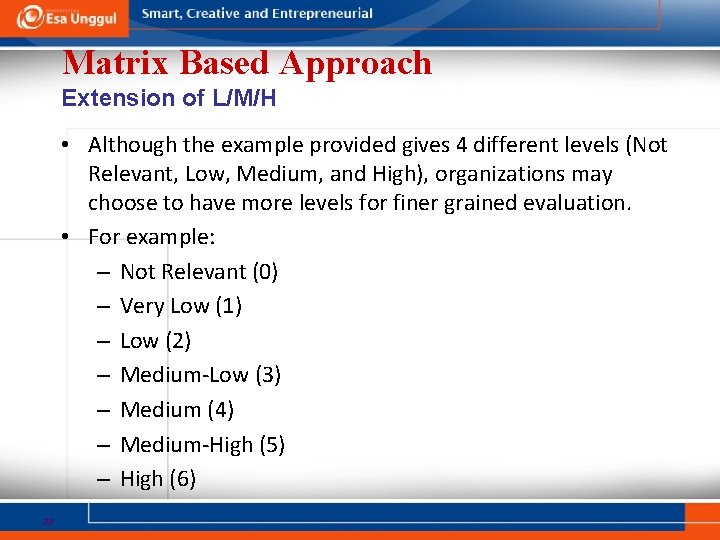
Matrix Based Approach Extension of L/M/H • Although the example provided gives 4 different levels (Not Relevant, Low, Medium, and High), organizations may choose to have more levels for finer grained evaluation. • For example: – Not Relevant (0) – Very Low (1) – Low (2) – Medium-Low (3) – Medium (4) – Medium-High (5) – High (6) 23
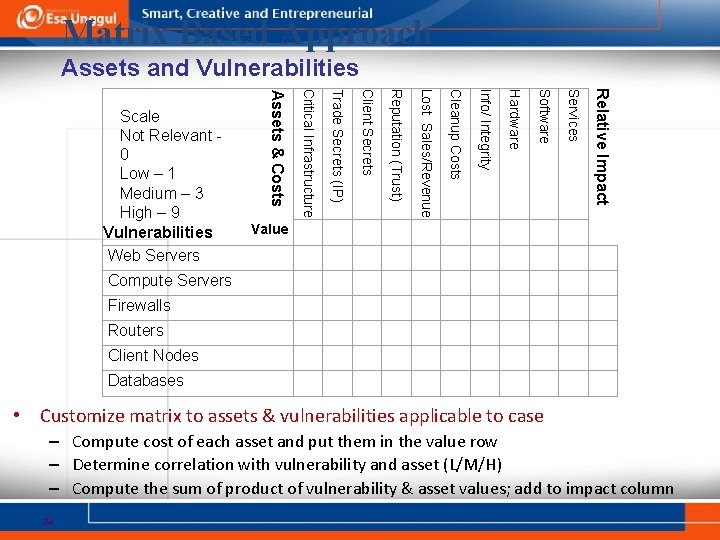
Matrix Based Approach Assets and Vulnerabilities Relative Impact Services Software Hardware Info/ Integrity Cleanup Costs Lost Sales/Revenue Reputation (Trust) Client Secrets Trade Secrets (IP) Critical Infrastructure Assets & Costs Scale Not Relevant 0 Low – 1 Medium – 3 High – 9 Vulnerabilities Web Servers Value Compute Servers Firewalls Routers Client Nodes Databases • Customize matrix to assets & vulnerabilities applicable to case – Compute cost of each asset and put them in the value row – Determine correlation with vulnerability and asset (L/M/H) – Compute the sum of product of vulnerability & asset values; add to impact column 24
Matrix Based Approach Vulnerabilities and Threats … … Relative Threat Importance Databases Client Nodes Routers Firewalls Compute Servers Web Servers Threats Vulnerabilities Scale Not Relevant - 0 Low– 1 Medium – 3 High – 9 Value Denial of Service Spoofing and Masquerading Malicious Code Human Errors Insider Attacks Intrusion … • Complete matrix based on the specific case – Add values from the Impact column of the previous matrix – Determine association between threat and vulnerability – Compute aggregate exposure values by multiplying impact and the associations 25
Matrix Based Approach • Customize matrix based on the specific case – Add values from the relative exposure column of the previous matrix – Determine impact of different controls on different threats – Compute the aggregate value of benefit of each control 26 Value of Control Value Controls Firewalls IDS Single Sign-On DMZ Training Security Policy Network Configuration Hardening of Environment … … Physical Damage Spam Intrusion Insider Attacks Human Errors Malicious Code Spoofing Scale Not Relevant 0 Low – 1 Medium – 3 High – 9 Denial of Service Threats and Controls
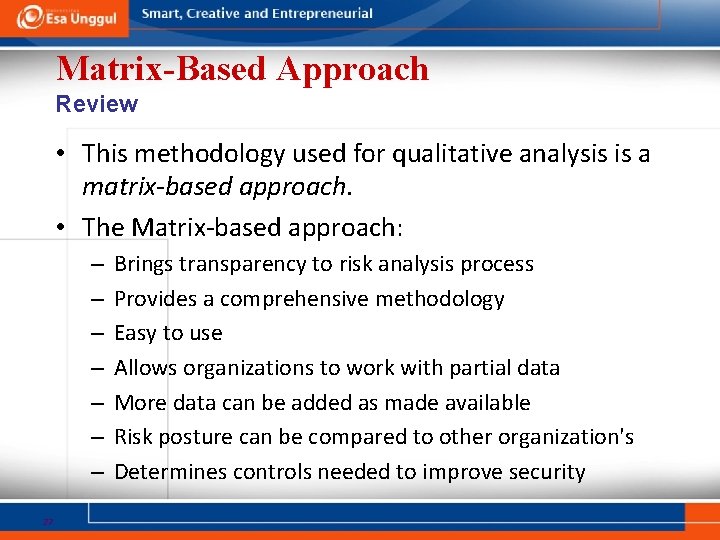
Matrix-Based Approach Review • This methodology used for qualitative analysis is a matrix-based approach. • The Matrix-based approach: – – – – 27 Brings transparency to risk analysis process Provides a comprehensive methodology Easy to use Allows organizations to work with partial data More data can be added as made available Risk posture can be compared to other organization's Determines controls needed to improve security
Matrix Based Approach Assignment • 28 Go through the next modules in the unit to appropriately fill in the matrices presented in this module.
Qualitative Risk Analysis Summary • Qualitative risk analysis involves using relative values of assets, threats, vulnerabilities to: – Determine the relative exposure of different assets of the organization – Determine the relative effectiveness of different controls • The methodology developed here uses a series of matrices to collect the data on assets, vulnerabilities, threats and controls • Data from the matrices is integrated to determine the relative importance of controls • This approach is suitable when precise data for different elements is unavailable • Most organizations start with a qualitative analysis and gradually migrate to a quantitative analysis 29
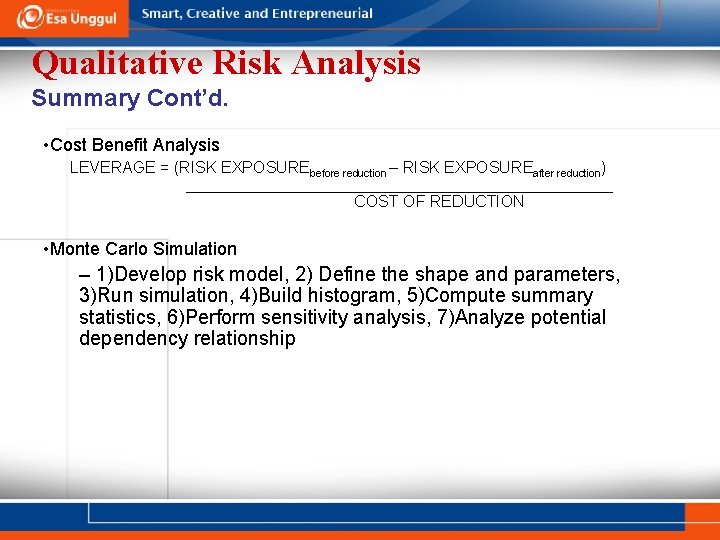
Qualitative Risk Analysis Summary Cont’d. • Cost Benefit Analysis LEVERAGE = (RISK EXPOSUREbefore reduction – RISK EXPOSUREafter reduction) ________________________ COST OF REDUCTION • Monte Carlo Simulation – 1)Develop risk model, 2) Define the shape and parameters, 3)Run simulation, 4)Build histogram, 5)Compute summary statistics, 6)Perform sensitivity analysis, 7)Analyze potential dependency relationship