
ANAESTHETICS What are Anaesthetics l Anaesthetics are drugs
- Slides: 41
ANAESTHETICS
What are Anaesthetics? l Anaesthetics are drugs that causes reversible loss of sensation with or without reversible loss of consciousness
Classification a) General Anaesthetics These are drugs that causes reversible loss of sensation, along with reversible loss of consciousness, affecting the whole body b) Local Anaesthetics These are drugs that causes reversible loss of sensation, without loss of consciousness, affecting a localized area
Classification of General Anaesthetics I) Inhalational General Anaesthetics l Volatile Liquids: Chloroform, Diethyl ether, Ethyl chloride, Trichloroethylene, halothane, Enflurane, Isoflurane l Gases: Cyclopropane, Nitrous oxide
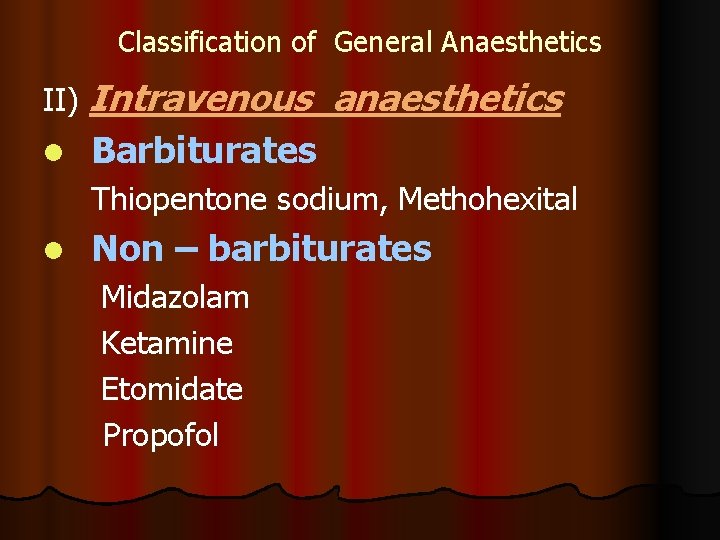
Classification of General Anaesthetics II) Intravenous anaesthetics l Barbiturates Thiopentone sodium, Methohexital l Non – barbiturates Midazolam Ketamine Etomidate Propofol
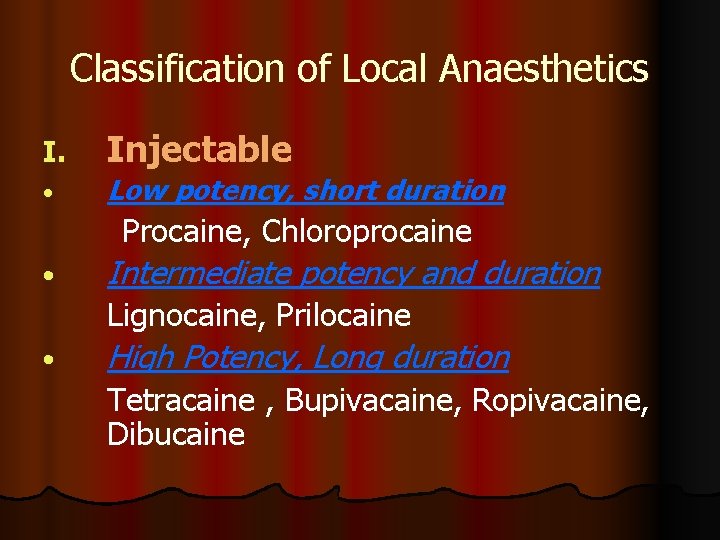
Classification of Local Anaesthetics I. • Injectable Low potency, short duration Procaine, Chloroprocaine • Intermediate potency and duration Lignocaine, Prilocaine • High Potency, Long duration Tetracaine , Bupivacaine, Ropivacaine, Dibucaine
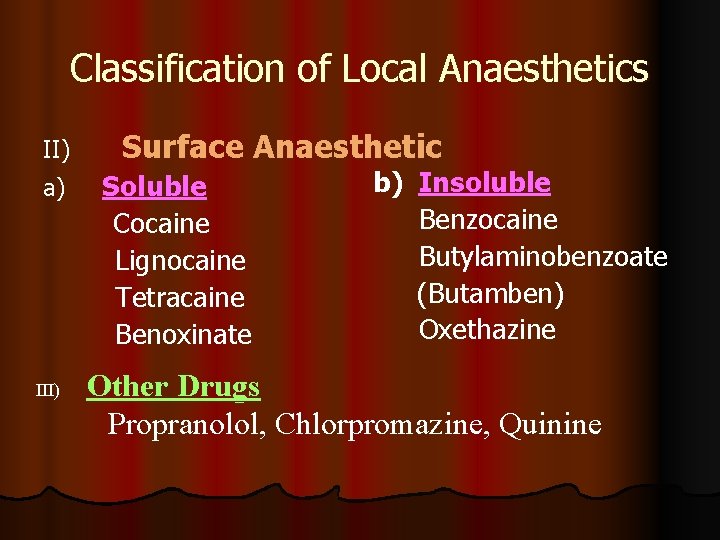
Classification of Local Anaesthetics II) a) III) Surface Anaesthetic Soluble Cocaine Lignocaine Tetracaine Benoxinate b) Insoluble Benzocaine Butylaminobenzoate (Butamben) Oxethazine Other Drugs Propranolol, Chlorpromazine, Quinine
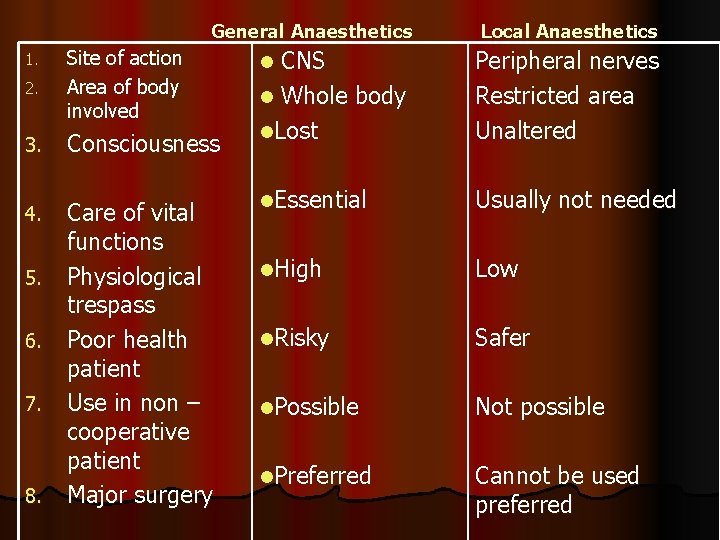
General Anaesthetics 2. Site of action Area of body involved 3. Consciousness 1. 4. 5. 6. 7. 8. Care of vital functions Physiological trespass Poor health patient Use in non – cooperative patient Major surgery Local Anaesthetics l CNS l Whole body l. Lost Peripheral nerves Restricted area Unaltered l. Essential Usually not needed l. High Low l. Risky Safer l. Possible Not possible l. Preferred Cannot be used preferred
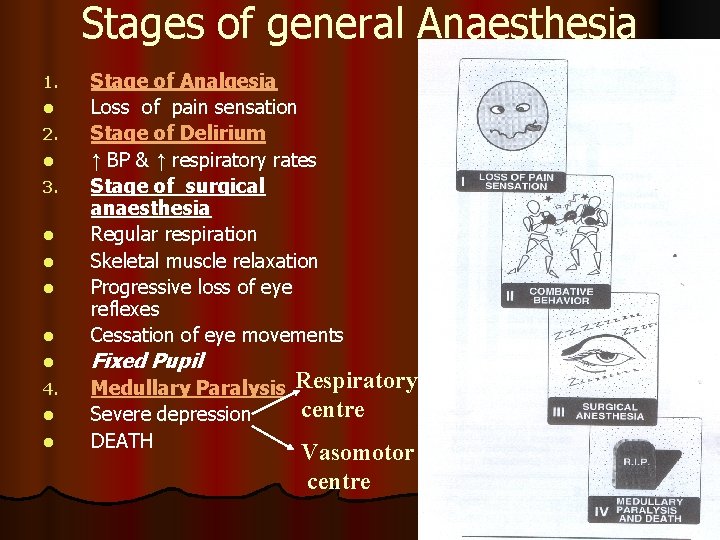
Stages of general Anaesthesia l Stage of Analgesia Loss of pain sensation Stage of Delirium ↑ BP & ↑ respiratory rates Stage of surgical anaesthesia Regular respiration Skeletal muscle relaxation Progressive loss of eye reflexes Cessation of eye movements l Fixed Pupil 4. Medullary Paralysis Severe depression DEATH 1. l 2. l 3. l l l Respiratory centre Vasomotor centre
Properties of an Ideal Anaesthetic Pleasant Non – irritating Non – inflammable Good anaesthetic, analgesic, skeletal muscle relaxant No action on heart, BP, respiration Smooth induction No post anaesthetic nausea and vomiting Cheap
Nitrous Oxide Colorless , Non-irritating gas Odourless, Non – inflammable Low potency anaesthetic Good analgesic Poor skeletal muscle relaxant Low blood solubility, Quick onset Rapid recovery No effect on other organs Shows second gas effect & Diffusion hypoxia Used as an adjuvant/carrier ALONE in dental and Obstetric analgesia Cheap , very commonly used
Second Gas Effect l When certain anaesthetics like N 2 O are administered in high concentrations, the other anaesthetic which is given along with N 2 O , is also pullen & its alveolar tension rises more rapidly than when it (second anaesthetic) is given alone. This is known as second gas effect l ↓ concentration of second anaesthetic l ↓ adverse effects
Diffusion hypoxia l When anaesthetics like N 2 O is discontinued after prolonged use- N 2 O having low blood solubility , rapidly back diffuses into alveoli & dilutes alveolar air (↓ oxygen content) hypoxia
Ether Colorless , volatile liquid Pungent odour Highly irritant & Inflammable Potent anaesthetic Good analgesic & skeletal muscle relaxant action ↑ respiratory rate BP & heart rate are well maintained No interference with uterine contractility Cheap Shouldn’t be given in Alcoholics
Halothane Fluorinated volatile liquid Structurally similar to chloroform Sweet fruity odour Non – irritant & Non – inflammable Potent anaesthetic Poor analgesic & muscle relaxant ↓ solubility in blood Smooth induction Rapid recovery
Halothane Depresses myocardial contractility ↓ BP & heart rate Arrhythmia Respiratory depression ↓ urine formation HEPATITIS Malignant hyperthermia Most popular anaesthetic
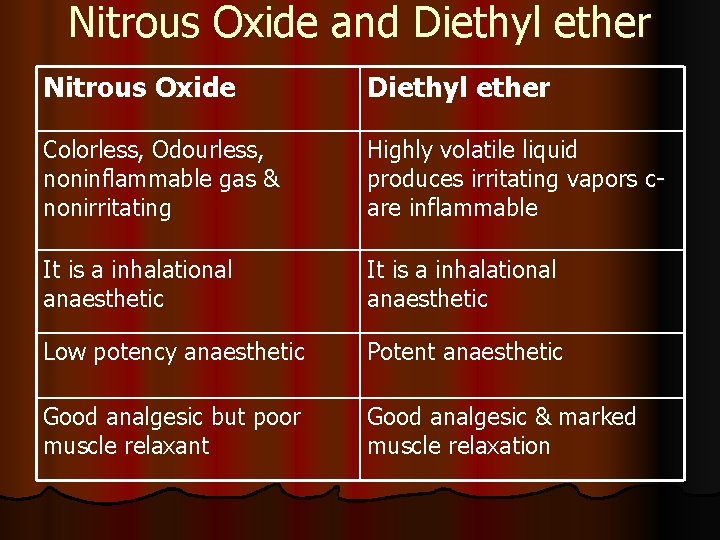
Nitrous Oxide and Diethyl ether Nitrous Oxide Diethyl ether Colorless, Odourless, noninflammable gas & nonirritating Highly volatile liquid produces irritating vapors care inflammable It is a inhalational anaesthetic Low potency anaesthetic Potent anaesthetic Good analgesic but poor muscle relaxant Good analgesic & marked muscle relaxation
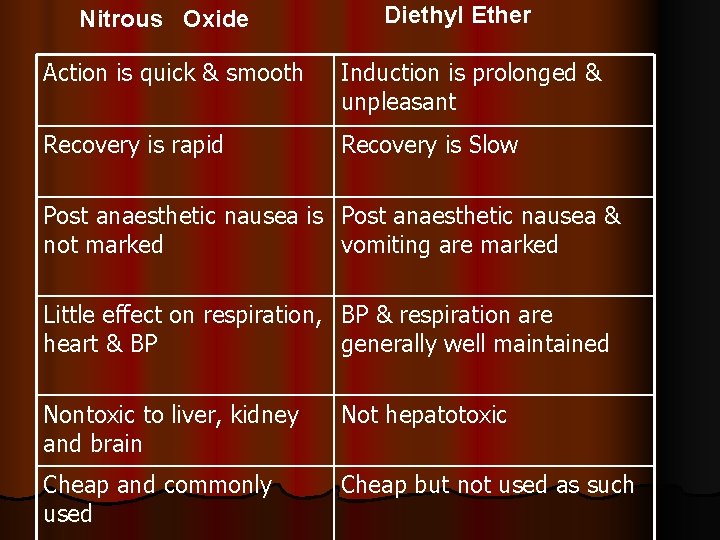
Nitrous Oxide Diethyl Ether Action is quick & smooth Induction is prolonged & unpleasant Recovery is rapid Recovery is Slow Post anaesthetic nausea is Post anaesthetic nausea & not marked vomiting are marked Little effect on respiration, BP & respiration are heart & BP generally well maintained Nontoxic to liver, kidney and brain Not hepatotoxic Cheap and commonly used Cheap but not used as such
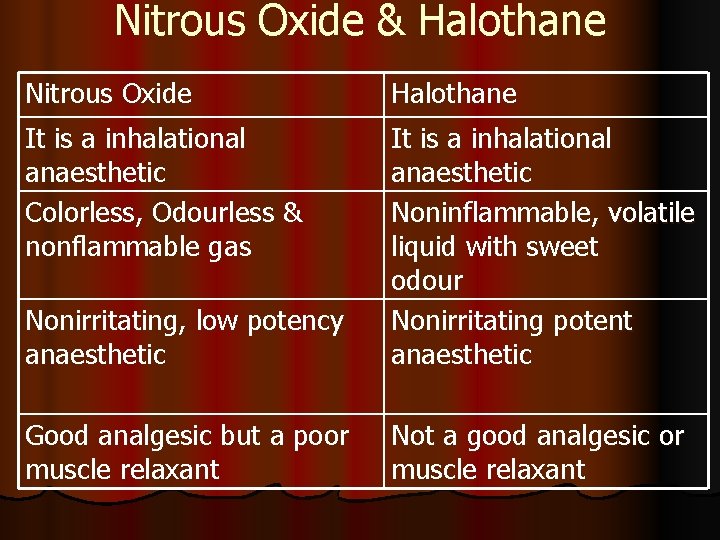
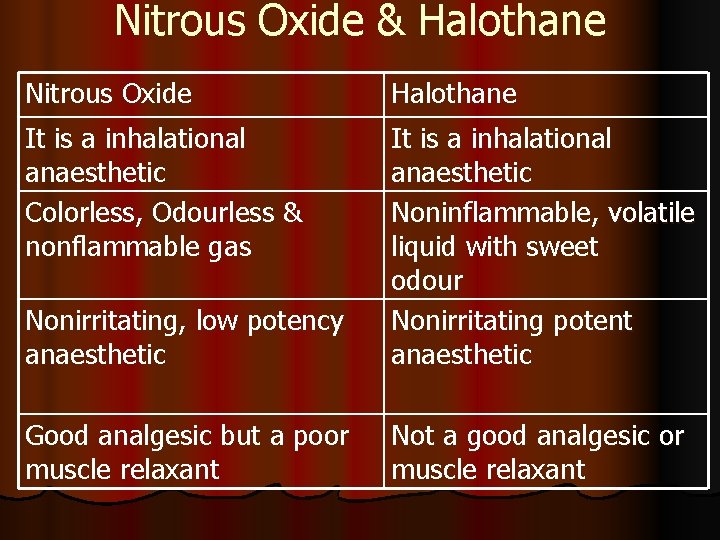
Nitrous Oxide & Halothane Nitrous Oxide Halothane It is a inhalational anaesthetic Colorless, Odourless & nonflammable gas Nonirritating, low potency anaesthetic It is a inhalational anaesthetic Noninflammable, volatile liquid with sweet odour Nonirritating potent anaesthetic Good analgesic but a poor muscle relaxant Not a good analgesic or muscle relaxant
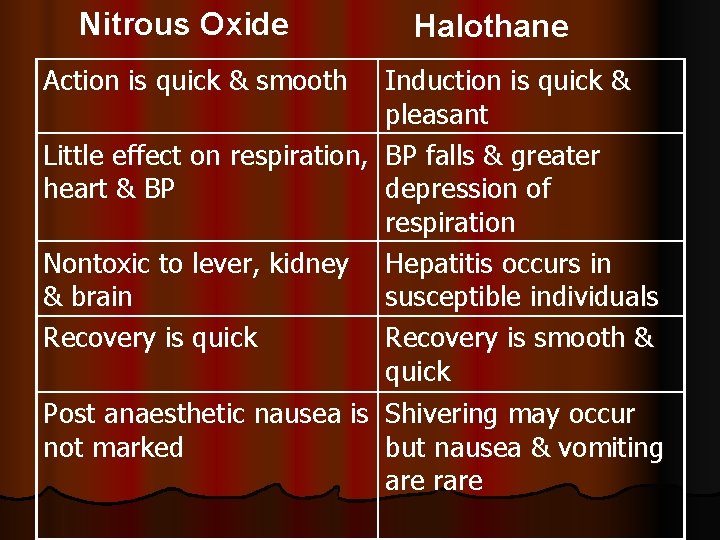
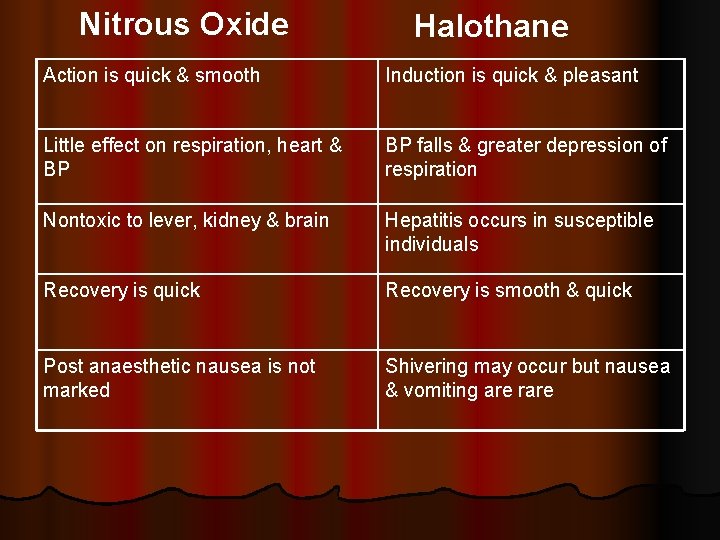
Nitrous Oxide Action is quick & smooth Halothane Induction is quick & pleasant Little effect on respiration, BP falls & greater heart & BP depression of respiration Nontoxic to lever, kidney Hepatitis occurs in & brain susceptible individuals Recovery is quick Recovery is smooth & quick Post anaesthetic nausea is Shivering may occur not marked but nausea & vomiting are rare
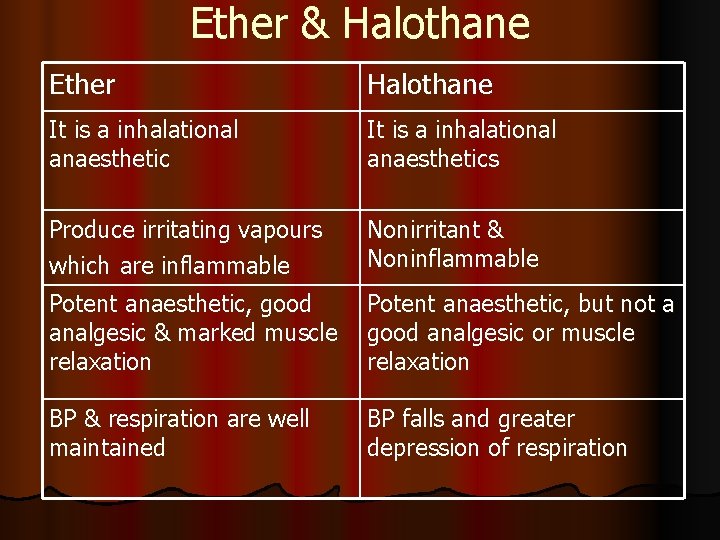
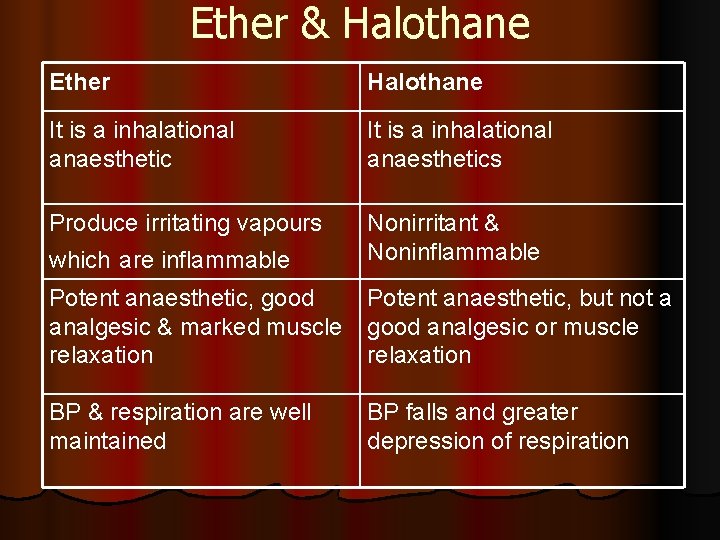
Ether & Halothane Ether Halothane It is a inhalational anaesthetics Produce irritating vapours which are inflammable Nonirritant & Noninflammable Potent anaesthetic, good analgesic & marked muscle relaxation Potent anaesthetic, but not a good analgesic or muscle relaxation BP & respiration are well maintained BP falls and greater depression of respiration
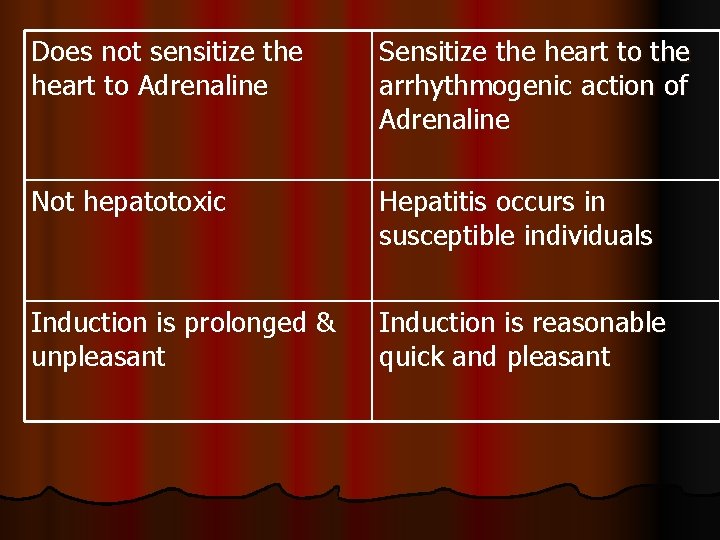
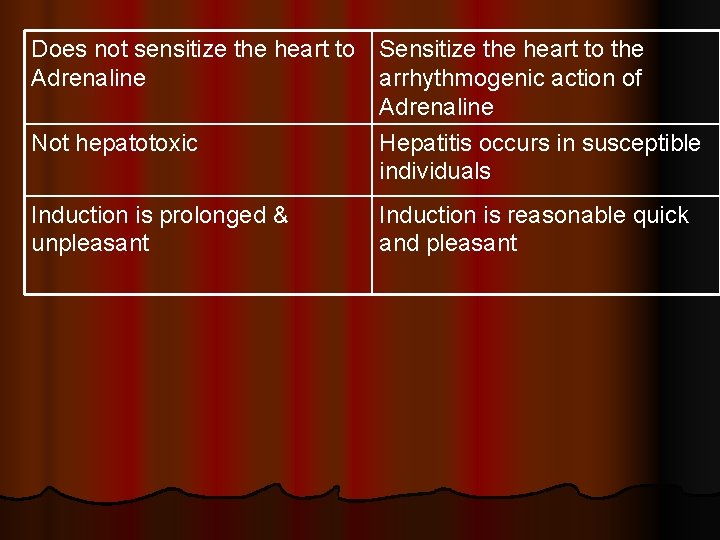
Does not sensitize the heart to Adrenaline Sensitize the heart to the arrhythmogenic action of Adrenaline Not hepatotoxic Hepatitis occurs in susceptible individuals Induction is prolonged & unpleasant Induction is reasonable quick and pleasant
Nitrous Oxide & Halothane Nitrous Oxide Halothane It is a inhalational anaesthetic Colorless, Odourless & nonflammable gas Nonirritating, low potency anaesthetic It is a inhalational anaesthetic Noninflammable, volatile liquid with sweet odour Nonirritating potent anaesthetic Good analgesic but a poor muscle relaxant Not a good analgesic or muscle relaxant
Nitrous Oxide Halothane Action is quick & smooth Induction is quick & pleasant Little effect on respiration, heart & BP BP falls & greater depression of respiration Nontoxic to lever, kidney & brain Hepatitis occurs in susceptible individuals Recovery is quick Recovery is smooth & quick Post anaesthetic nausea is not marked Shivering may occur but nausea & vomiting are rare
Ether & Halothane Ether Halothane It is a inhalational anaesthetics Produce irritating vapours which are inflammable Nonirritant & Noninflammable Potent anaesthetic, good analgesic & marked muscle relaxation Potent anaesthetic, but not a good analgesic or muscle relaxation BP & respiration are well maintained BP falls and greater depression of respiration
Does not sensitize the heart to Adrenaline Not hepatotoxic Induction is prolonged & unpleasant Sensitize the heart to the arrhythmogenic action of Adrenaline Hepatitis occurs in susceptible individuals Induction is reasonable quick and pleasant
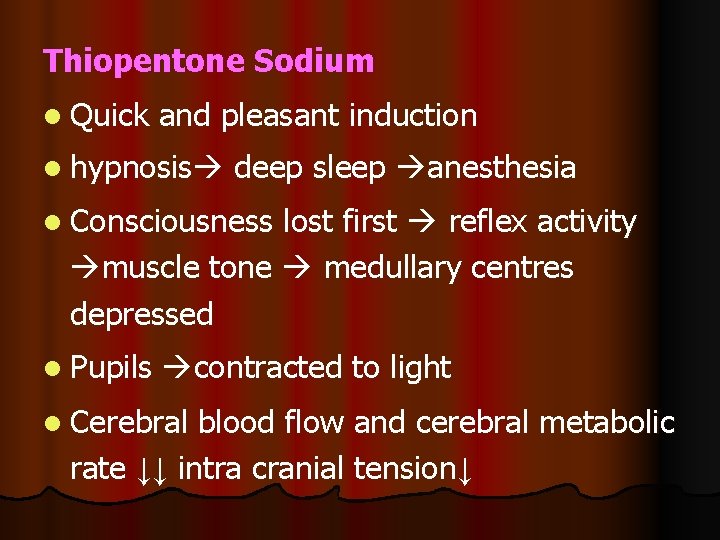
Thiopentone Sodium l Quick and pleasant induction l hypnosis deep sleep anesthesia l Consciousness lost first reflex activity muscle tone medullary centres depressed l Pupils contracted to light l Cerebral blood flow and cerebral metabolic rate ↓↓ intra cranial tension↓
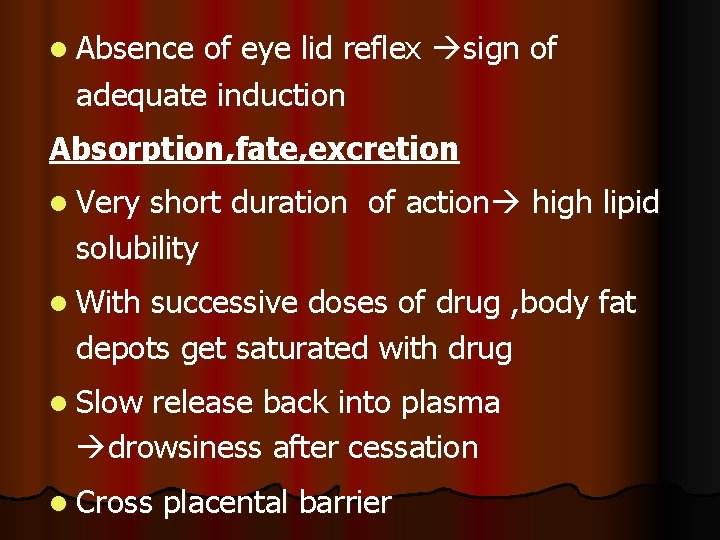
l Absence of eye lid reflex sign of adequate induction Absorption, fate, excretion l Very short duration of action high lipid solubility l With successive doses of drug , body fat depots get saturated with drug l Slow release back into plasma drowsiness after cessation l Cross placental barrier
Therapeutic uses ü For Induction ü As anesthetic agent, for operations of short duration ü As an anesthetic, in patients with malignant hyperthermia ü As an Anticonvulsant
Advantages l Quiet respiration , non-explosive Disadvantages l Pharyngeal, laryngeal reflexes persist coughing , laryngospasm l Depression of respiratory centre
KETAMINE l Pharmacologically related to hallucinogen phencyclidine l Anesthesia induced by im(5 -10 mg/kg) or iv (1 -2 mg/kg) l Site of action: cerebral cortex, limbic system l Analgesic in sub narcotic doses, immobility, amnesia with light sleep
l Given iv quick acting , following single dose dissociative anesthesia complete analgesia & amnesia l Analgesia 40 minutes; anesthesia 15 minutes l No CVS & respiratory depression l Bronchodilator l BP , HR, CO noradrenaline l Used in shock
Disadvantages of Ketamine l Involuntary movements , hypertonus l Delirium , hallucinations during induction and recovery ; avoided by diazepam l Poor muscle relaxation , intra ocular pressures & intra cranial pressures
PROPOFOL l Rapid induction & recovery, small hangover effect l Used for induction & maintenance of GA l Dose dependent cortical depression, anticonvulsant l Metabolized by liver 88% l Adv: antiemetic action, daycare surgery, safe during pregnancy
NEUROLEPTANALGESIA l Method of IV anesthesia combining neuroleptics & opioids. l Conscious & cooperative during anesthesia l Droperidol + Fentanyl
Fentanyl l Opioid supplementary analgesic in inducing GA l 100 times more potent than morphine l Droperidol 2. 5 mg & fentanyl citrate 50 mcg in 1 ml Advantage l Smooth onset and rapid post operative recovery
l Less danger of hypotension , suppression of coughing , vomiting l Continued l Patient’s l Useful analgesia in post operative period co-operation in old people
Adverse reactions l Extra pyramidal disturbances , respiratory depression l Fentanyl has shorter duration of analgesic action; supplementary doses of fentanyl has to be given
PREANAESTHETIC MEDICATION Defined as “preanaesthetic medication", drugs with specific pharmacological actions administered preoperatively with specific goals to achieve.
GOALS OR OBJECTIVES OF PREMEDICATION 1. 2. 3. 4. 5. 6. 7. RELIEF OF APPREHENSION OR ANXIETY SEDATION ANALGESIA ANTISIALOGOGUE EFFECT REDUCTION OF GASTRIC ACIDITY & VOLUME PREVENTION OF NAUSEA & VOMITING FACILITATION OF ANESTHETIC INDUCTION
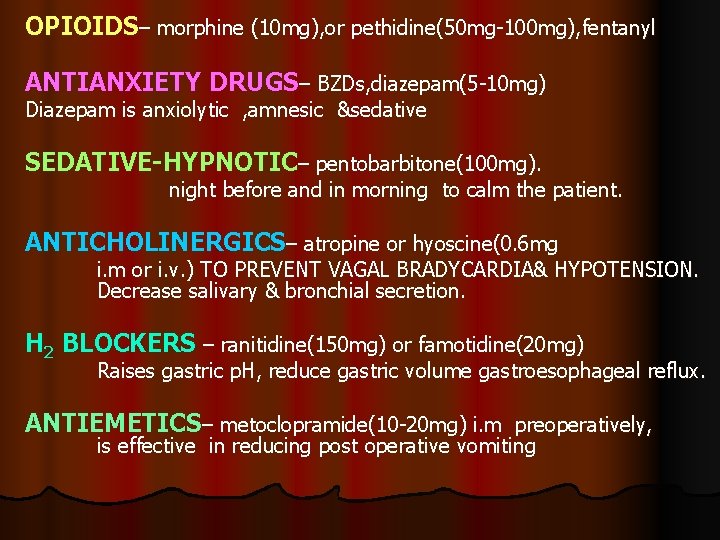
OPIOIDS– morphine (10 mg), or pethidine(50 mg-100 mg), fentanyl ANTIANXIETY DRUGS– BZDs, diazepam(5 -10 mg) Diazepam is anxiolytic , amnesic &sedative SEDATIVE-HYPNOTIC– pentobarbitone(100 mg). night before and in morning to calm the patient. ANTICHOLINERGICS– atropine or hyoscine(0. 6 mg i. m or i. v. ) TO PREVENT VAGAL BRADYCARDIA& HYPOTENSION. Decrease salivary & bronchial secretion. H 2 BLOCKERS – ranitidine(150 mg) or famotidine(20 mg) Raises gastric p. H, reduce gastric volume gastroesophageal reflux. ANTIEMETICS– metoclopramide(10 -20 mg) i. m preoperatively, is effective in reducing post operative vomiting