
Anaesthesia for healthy patient Group C Case scenario
- Slides: 20
Anaesthesia for healthy patient Group C
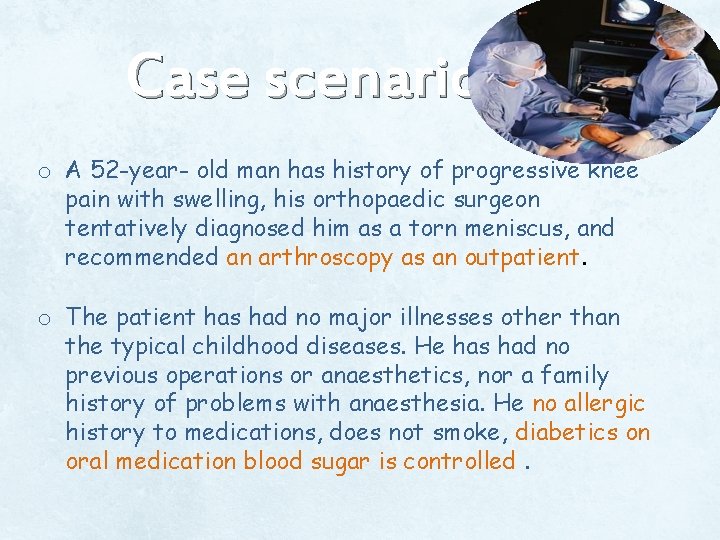
Case scenario o A 52 -year- old man has history of progressive knee pain with swelling, his orthopaedic surgeon tentatively diagnosed him as a torn meniscus, and recommended an arthroscopy as an outpatient. o The patient has had no major illnesses other than the typical childhood diseases. He has had no previous operations or anaesthetics, nor a family history of problems with anaesthesia. He no allergic history to medications, does not smoke, diabetics on oral medication blood sugar is controlled.
Cont. scenario o His laboratory results and physical examination by an internist were all normal. He has had nothing to eat or drink since he went to bed last night. o On examination, the patient weight was 75 Kg and height 182 Cm. His neck appears to be flexible and mobile. He opens his mouth without difficulty, and with his head extended and tongue protruding, his uvula is completely visible.
Q 1. What is the patient’s general medical condition and ASA standard classifications?
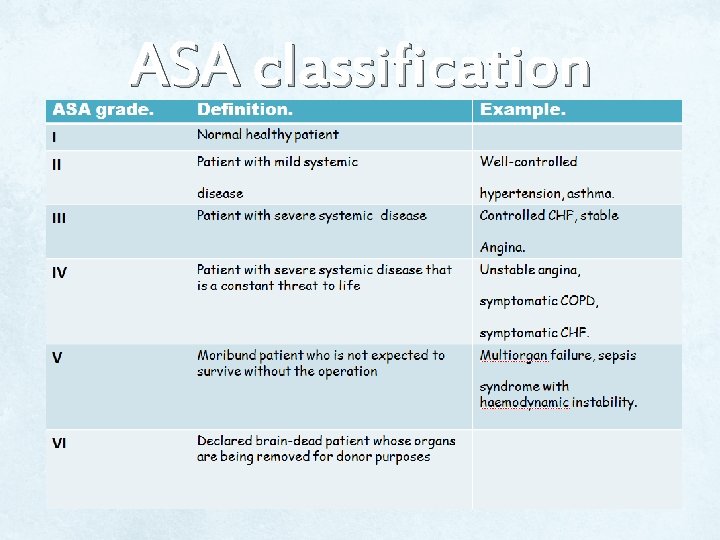
• This patient has a mild systemic disease (well controlled diabetes), for that his ASA standard classifications is ASA grade II.
ASA classification
Q 2. Discuss the airway assessment for this patient?
• The majority of assessments relate to the ease or difficulty of this process. • Assess by history and physical examination (LEMON approach)
Ask about: History • Past anaesthetic history – see old notes, Medic Alert bracelet; • Surgery/radiotherapy to head and neck; • Obstructive sleep apnoea (OSA). • Conditions affecting: ü Tongue size (e. g. acromegaly, infections, tumors); ü Neck mobility (e. g. ankylosing spondylitis, infections, tumors); ü Mouth opening (e. g. temporamandibular joint dysfunction).
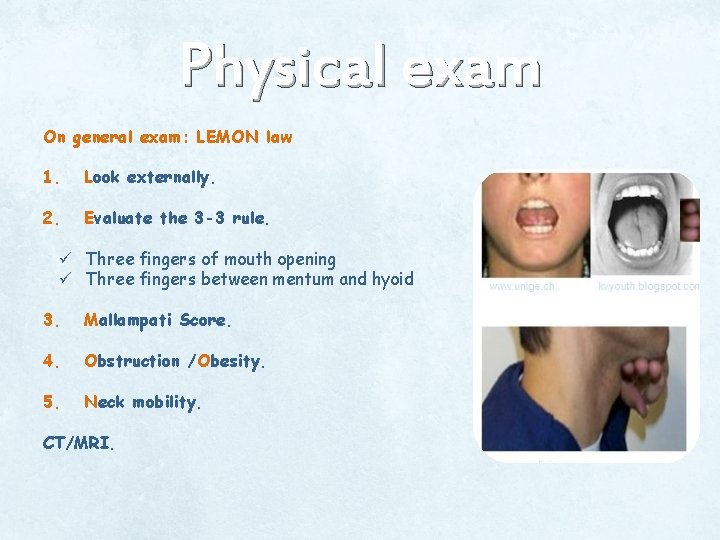
Physical exam On general exam: LEMON law 1. Look externally. 2. Evaluate the 3 -3 rule. ü Three fingers of mouth opening ü Three fingers between mentum and hyoid 3. Mallampati Score. 4. Obstruction /Obesity. 5. Neck mobility. CT/MRI.
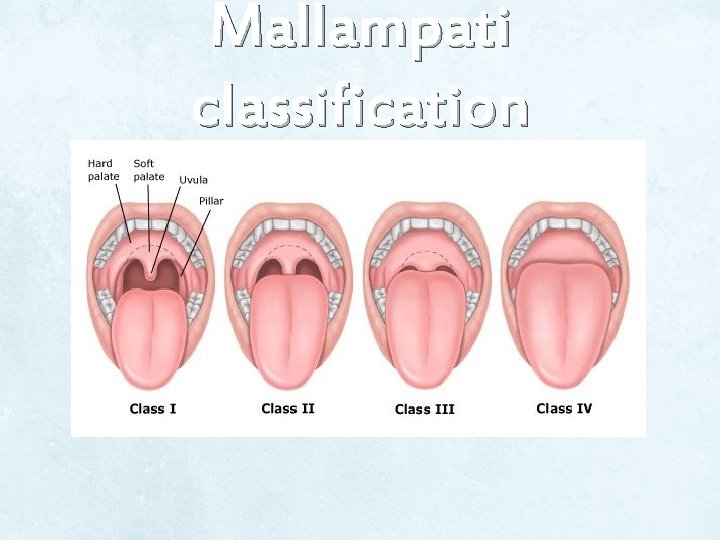
Mallampati classification
Airway assessment for this patient Hx • No previous surgeries, or anesthetics. • No family history of anesthetic problems. • No allergies. • No major illnesses. • Diabetic controlled by oral medication. • NOT smoking. • LAST MEAL was last night. Examination • Normal weight 75 kg and 182 cm (BMI of 22. 64). • Neck is flexible and mobile. • Opens his mouth without difficulty. • He had mallampati grade of 1 ( with his head is extended and protruding his tongue, his uvula is completely visible).
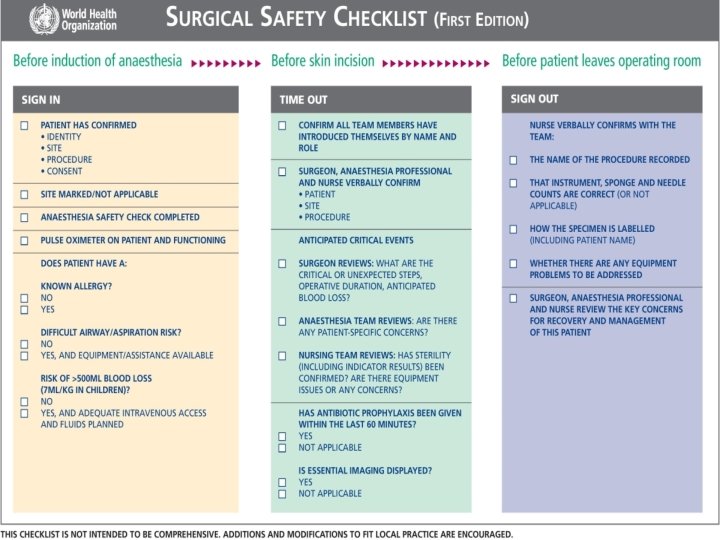
Q 3. What is the check list for sign in in operating theatre and for time out?
Q 4. Discuss anaesthesia plan for this patient
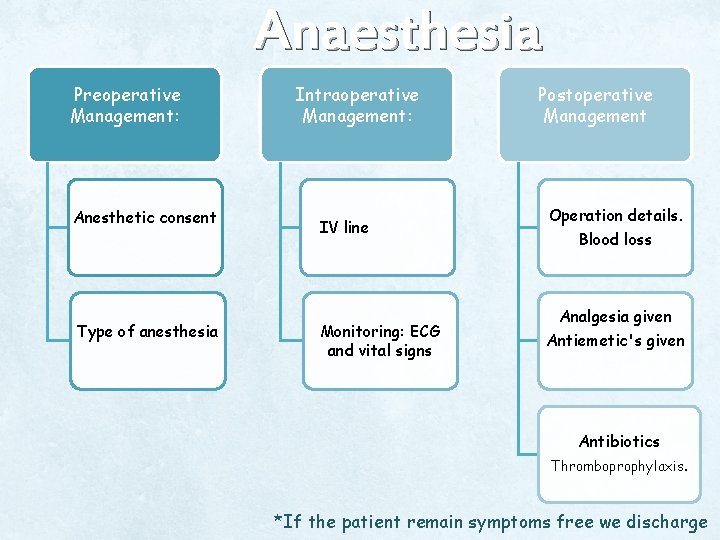
Preoperative Management: Anesthetic consent Type of anesthesia Anaesthesia plan Intraoperative Management: IV line Monitoring: ECG and vital signs Postoperative Management Operation details. Blood loss Analgesia given Antiemetic's given Antibiotics Thromboprophylaxis. *If the patient remain symptoms free we discharge
Q 6. Discuss the safety features of anaesthesia machine before starting anaesthesia
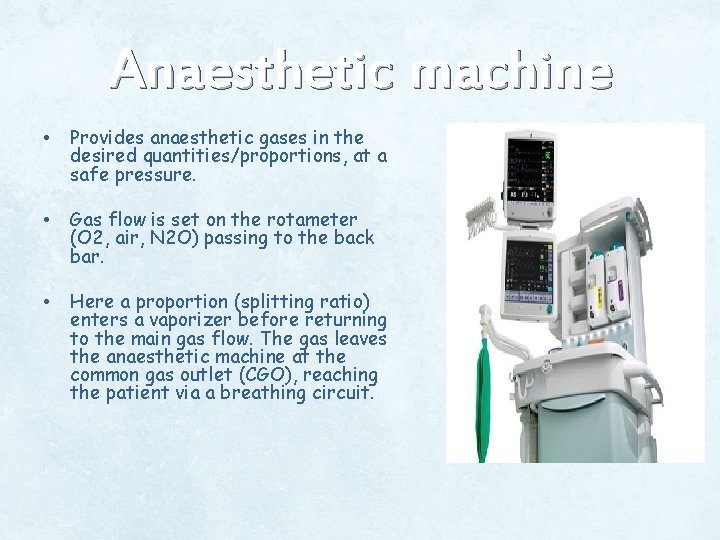
Anaesthetic machine • Provides anaesthetic gases in the desired quantities/proportions, at a safe pressure. • Gas flow is set on the rotameter (O 2, air, N 2 O) passing to the back bar. • Here a proportion (splitting ratio) enters a vaporizer before returning to the main gas flow. The gas leaves the anaesthetic machine at the common gas outlet (CGO), reaching the patient via a breathing circuit.
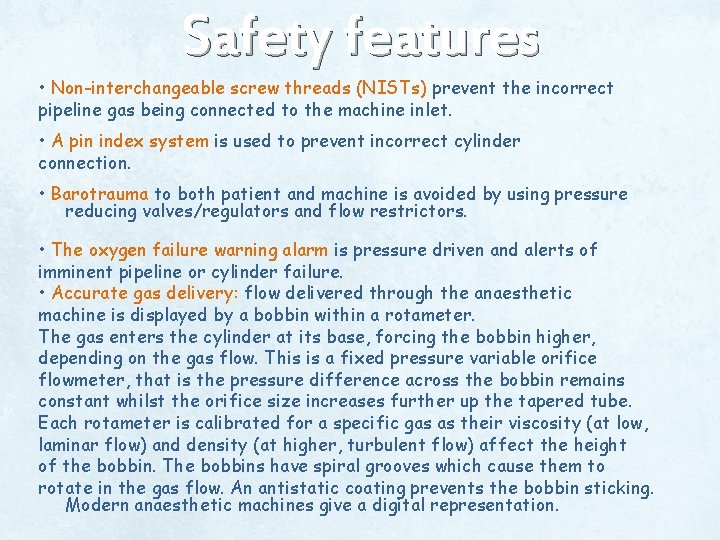
Safety features • Non-interchangeable screw threads (NISTs) prevent the incorrect pipeline gas being connected to the machine inlet. • A pin index system is used to prevent incorrect cylinder connection. • Barotrauma to both patient and machine is avoided by using pressure reducing valves/regulators and flow restrictors. • The oxygen failure warning alarm is pressure driven and alerts of imminent pipeline or cylinder failure. • Accurate gas delivery: flow delivered through the anaesthetic machine is displayed by a bobbin within a rotameter. The gas enters the cylinder at its base, forcing the bobbin higher, depending on the gas flow. This is a fixed pressure variable orifice flowmeter, that is the pressure difference across the bobbin remains constant whilst the orifice size increases further up the tapered tube. Each rotameter is calibrated for a specific gas as their viscosity (at low, laminar flow) and density (at higher, turbulent flow) affect the height of the bobbin. The bobbins have spiral grooves which cause them to rotate in the gas flow. An antistatic coating prevents the bobbin sticking. Modern anaesthetic machines give a digital representation.
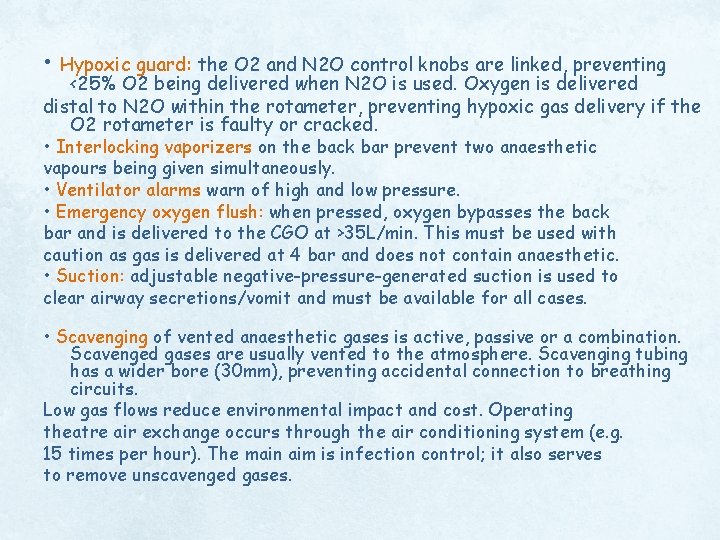
• Hypoxic guard: the O 2 and N 2 O control knobs are linked, preventing <25% O 2 being delivered when N 2 O is used. Oxygen is delivered distal to N 2 O within the rotameter, preventing hypoxic gas delivery if the O 2 rotameter is faulty or cracked. • Interlocking vaporizers on the back bar prevent two anaesthetic vapours being given simultaneously. • Ventilator alarms warn of high and low pressure. • Emergency oxygen flush: when pressed, oxygen bypasses the back bar and is delivered to the CGO at >35 L/min. This must be used with caution as gas is delivered at 4 bar and does not contain anaesthetic. • Suction: adjustable negative-pressure-generated suction is used to clear airway secretions/vomit and must be available for all cases. • Scavenging of vented anaesthetic gases is active, passive or a combination. Scavenged gases are usually vented to the atmosphere. Scavenging tubing has a wider bore (30 mm), preventing accidental connection to breathing circuits. Low gas flows reduce environmental impact and cost. Operating theatre air exchange occurs through the air conditioning system (e. g. 15 times per hour). The main aim is infection control; it also serves to remove unscavenged gases.