
Anaesthesia for Cardiac Catherisation UCSF Mission Bay Cath
Anaesthesia for Cardiac Catherisation UCSF Mission Bay Cath Lab Education William C. K. Ng UCSF, Division of Congenital Cardiac Anesthesia 2017
… this should only take 30 minutes… Outline § Stages of Anesthesia § Negative pressure ventilation § Positive pressure ventilation § Supraglottic devices § Adverse events with ketamine, dexmedetomidine and propofol § QI and upcoming projects 2 Anaesthesia for Cardiac Catherisation – William C. K. Ng 9/24/2020
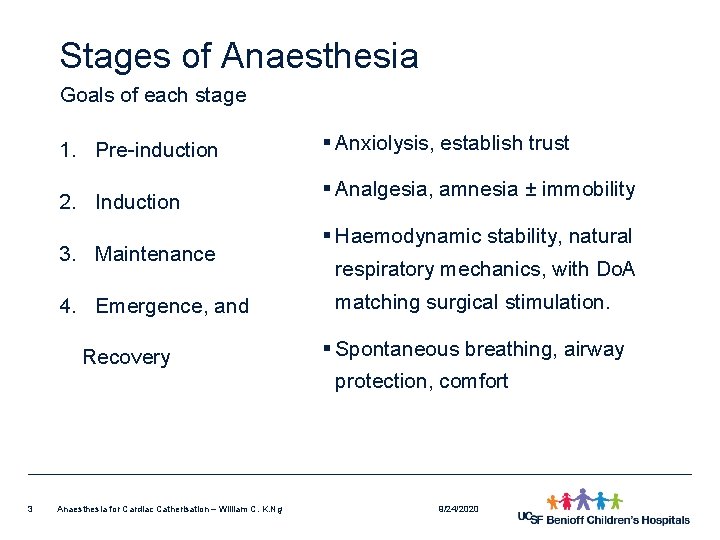
Stages of Anaesthesia Goals of each stage 1. Pre-induction 2. Induction 3. Maintenance 4. Emergence, and Recovery § Anxiolysis, establish trust § Analgesia, amnesia ± immobility § Haemodynamic stability, natural respiratory mechanics, with Do. A matching surgical stimulation. § Spontaneous breathing, airway protection, comfort 3 Anaesthesia for Cardiac Catherisation – William C. K. Ng 9/24/2020
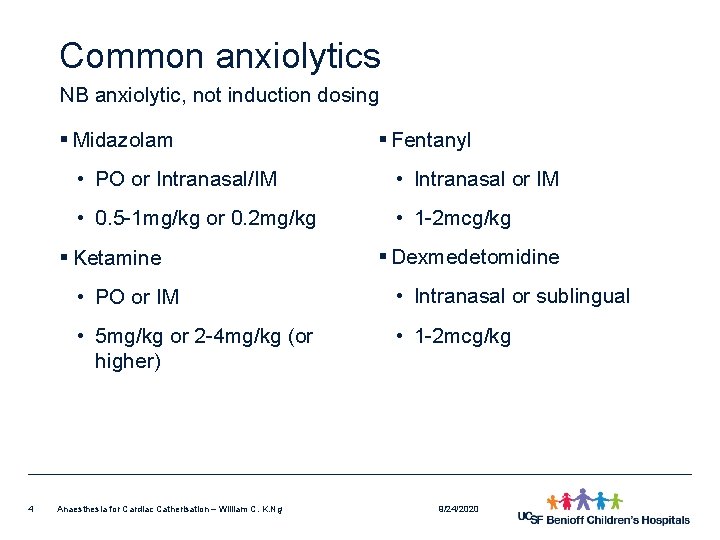
Common anxiolytics NB anxiolytic, not induction dosing § Midazolam • PO or Intranasal/IM • Intranasal or IM • 0. 5 -1 mg/kg or 0. 2 mg/kg • 1 -2 mcg/kg § Ketamine 4 § Fentanyl § Dexmedetomidine • PO or IM • Intranasal or sublingual • 5 mg/kg or 2 -4 mg/kg (or higher) • 1 -2 mcg/kg Anaesthesia for Cardiac Catherisation – William C. K. Ng 9/24/2020

Why inhalational induction? Pros and Cons 5 § Avoids IV § Slow c. c. IV (min vs. sec) § Slow loss of airway reflex § Guedel Stage II: excitation § Maintains upper oesophageal tone § Mask-phobia § Stable HDS § Aspiration risk in certain contexts § Maintains spontaneous breathing § Irritation, pollutant and occupational exposure § Quick reversal/washout § Sevoflurane and newborn bradycardia Anaesthesia for Cardiac Catherisation – William C. K. Ng 9/24/2020
Maintenance Phase Matching depth of anaesthesia and surgical stimulation § Stimulation § Too Light • IV, Airway Manipulation • Breath-hold • Incision, Arterial Puncture, Dilation • PVR • Venous Angioplasty • Arterial (Aortic) Angioplasty § Immobility • Valve placement • Device deployment • Bradyarrhythmia • Pain -> Nausea -> Regurgitation § Too Deep § Communication and Audio. Visual Cues • Stent 6 Anaesthesia for Cardiac Catherisation – William C. K. Ng 9/24/2020
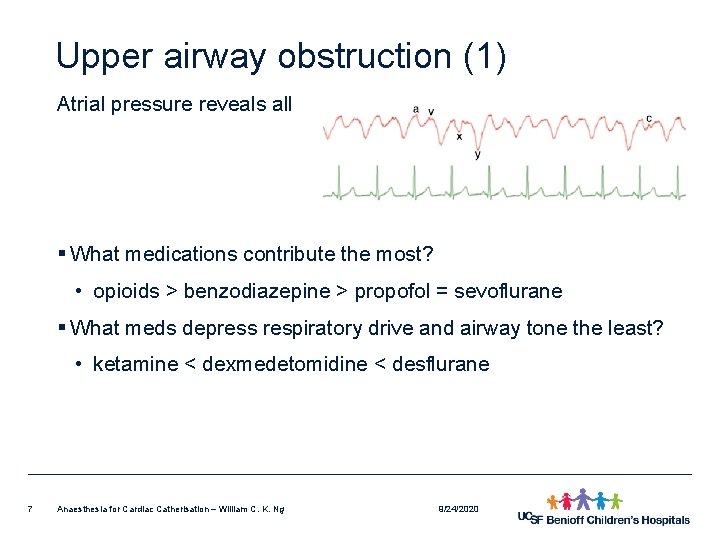
Upper airway obstruction (1) Atrial pressure reveals all § What medications contribute the most? • opioids > benzodiazepine > propofol = sevoflurane § What meds depress respiratory drive and airway tone the least? • ketamine < dexmedetomidine < desflurane 7 Anaesthesia for Cardiac Catherisation – William C. K. Ng 9/24/2020
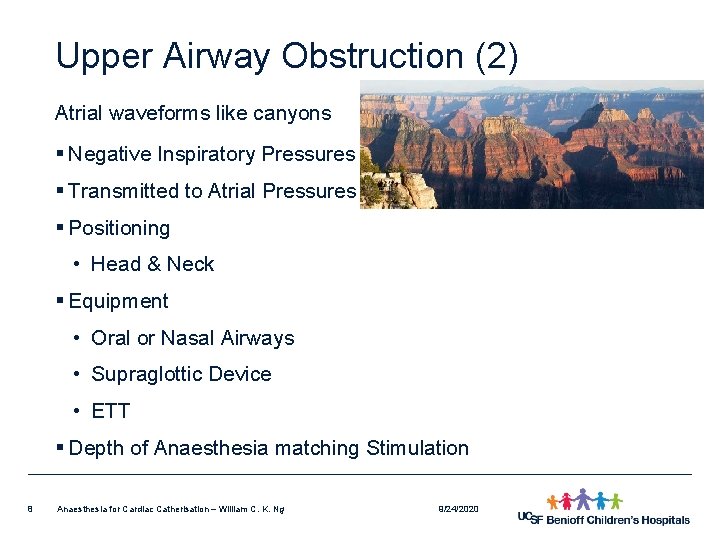
Upper Airway Obstruction (2) Atrial waveforms like canyons § Negative Inspiratory Pressures § Transmitted to Atrial Pressures § Positioning • Head & Neck § Equipment • Oral or Nasal Airways • Supraglottic Device • ETT § Depth of Anaesthesia matching Stimulation 8 Anaesthesia for Cardiac Catherisation – William C. K. Ng 9/24/2020
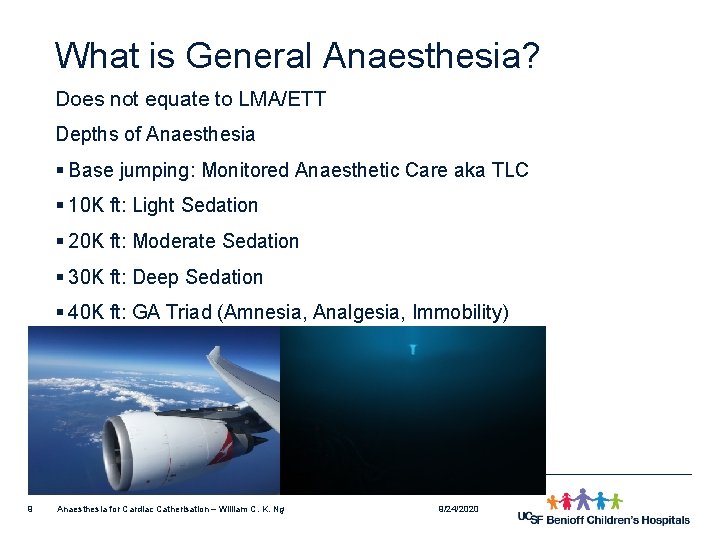
What is General Anaesthesia? Does not equate to LMA/ETT Depths of Anaesthesia § Base jumping: Monitored Anaesthetic Care aka TLC § 10 K ft: Light Sedation § 20 K ft: Moderate Sedation § 30 K ft: Deep Sedation § 40 K ft: GA Triad (Amnesia, Analgesia, Immobility) 9 Anaesthesia for Cardiac Catherisation – William C. K. Ng 9/24/2020
LMA as supraglottic device Think OSA § Insertion of LMA may require Depth of GA § Tolerating an LMA in-situ only requires moderate to deep sedation • Negative pressure ventilation ≈ • Spontaneous ventilation without support with LMA ≈ • Spontaneous breathing patient without upper airway obstruction ≈ • Natural airway § For certain patient groups (OSA) § Even an endotracheal tube may be seen as such a device 10 Anaesthesia for Cardiac Catherisation – William C. K. Ng 9/24/2020
Spectrum of Practice Across the East and West… § Heavy premed, GETA, paralysis, positive pressure ventilation, reversal of paralysis, awake extubation § Light premed, natural airway, spontaneous (negative pressure) ventilation, PRN recovery sedation § How does this affect haemodynamic measurements? § Smooth and gradual emergence is desirable. 11 Anaesthesia for Cardiac Catherisation – William C. K. Ng 9/24/2020
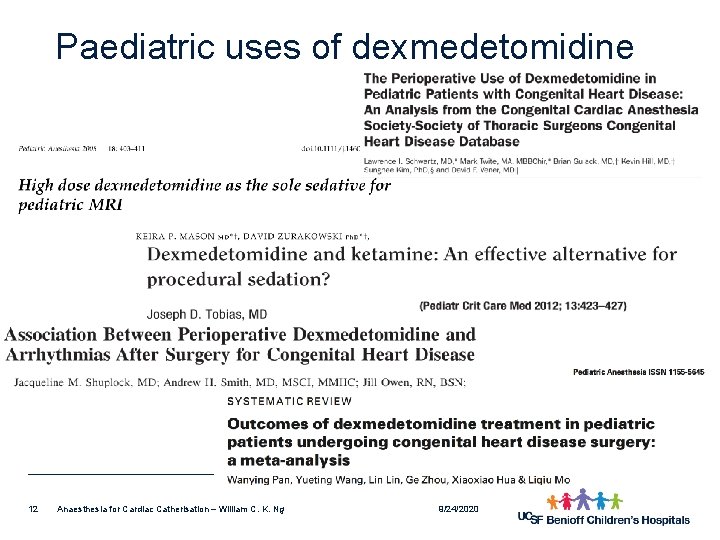
Paediatric uses of dexmedetomidine 12 Anaesthesia for Cardiac Catherisation – William C. K. Ng 9/24/2020
Dexmedetomidine not a panacea § Sinus node function § Interaction with anticholinergics (atropine, glycopyrrolate) § In adults, case reports of prolonged bradycardia § Not potent as sole anaesthetic § Ideal agent • Deep sedation • Analgesic effect • Retained respiratory drive • Maintained upper airway tone • Minimal cardiodepressant • Minimal vasodilation • Quick onset/offset • Smooth emergence 13 Anaesthesia for Cardiac Catherisation – William C. K. Ng 9/24/2020
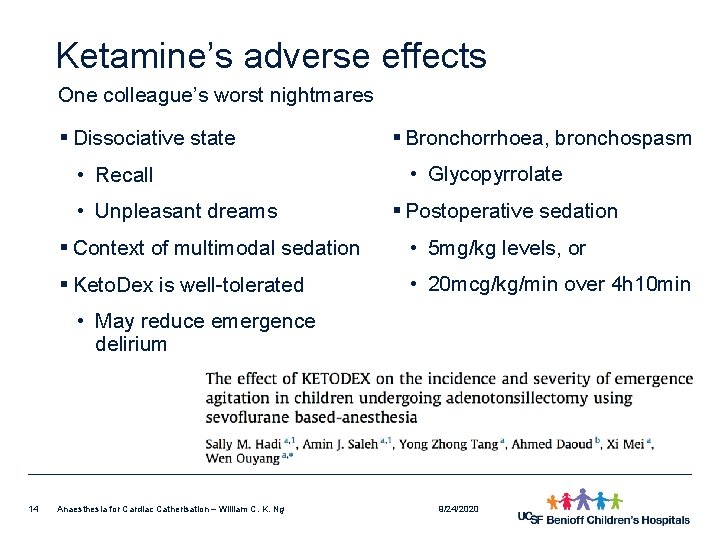
Ketamine’s adverse effects One colleague’s worst nightmares § Dissociative state • Recall • Unpleasant dreams § Bronchorrhoea, bronchospasm • Glycopyrrolate § Postoperative sedation § Context of multimodal sedation • 5 mg/kg levels, or § Keto. Dex is well-tolerated • 20 mcg/kg/min over 4 h 10 min • May reduce emergence delirium 14 Anaesthesia for Cardiac Catherisation – William C. K. Ng 9/24/2020
Upcoming projects How we spend non-clinical time § Retrospective review of (Keto)Dex • 2013 -2016, >1000 patients, <18 yo • Primary outcome: natural airway • Secondary outcomes: airway adjunct, alternative airway, CVS instability, airway-related major events § Pulmonary Hypertension paediatric patients with above technique for Cardiac Catheterisation § LMA/ETT spontaneous ventilating without respiratory support under IV sedation in select patient groups and its effect on atrial pressure tracing. 15 Anaesthesia for Cardiac Catherisation – William C. K. Ng 9/24/2020
Summary § Stages of Anesthesia § Negative pressure ventilation § Supraglottic devices § Medications § Adverse events with ketamine, dexmedetomidine and propofol § QI and upcoming projects 16 Anaesthesia for Cardiac Catherisation – William C. K. Ng 9/24/2020
17 Anaesthesia for Cardiac Catherisation – William C. K. Ng 9/24/2020
18 Anaesthesia for Cardiac Catherisation – William C. K. Ng 9/24/2020
References Selected reviews Mowatt C. Fundamentals of Anaesthesia. 4 th ed. Lin T, Smith T, Pinnock C, editors. Cambridge: Cambridge University Press; 2016. Tobias JD. Dexmedetomidine and ketamine: an effective alternative for procedural sedation? Pediatr Crit Care Med. 2012; 13(4): 423– 7. Available from: http: //www. ncbi. nlm. nih. gov/pubmed/22067985 Mason KP, Lerman J. Review article: Dexmedetomidine in children: current knowledge and future applications. Anesth Analg. 2011; 113(5): 1129– 42. Available from: http: //www. ncbi. nlm. nih. gov/pubmed/21821507 Peng K, Wu S, Ji F, Li J. Premedication with dexmedetomidine in pediatric patients: a systematic review and meta-analysis. Clinics (Sao Paulo). 2014 Nov; 69(11): 777– 86. Available from: http: //www. ncbi. nlm. nih. gov/pubmed/25518037 19 Anaesthesia for Cardiac Catherisation – William C. K. Ng 2017
- Slides: 19