
Anaerobic respiration Do now activity 1 How does
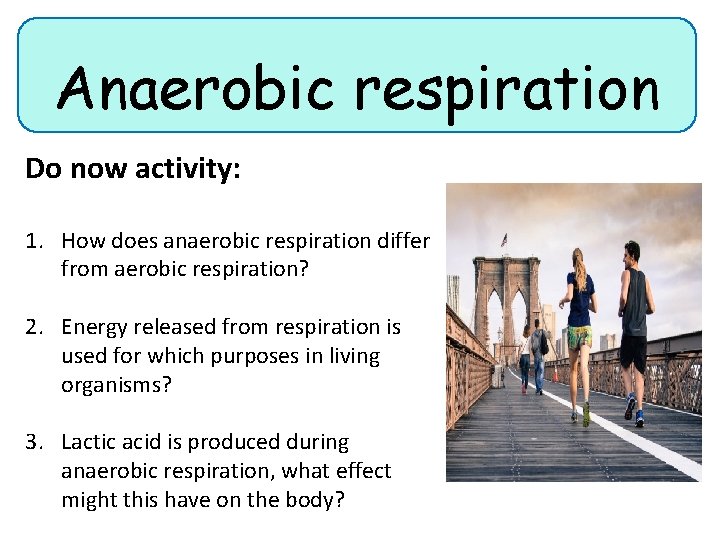
Anaerobic respiration Do now activity: 1. How does anaerobic respiration differ from aerobic respiration? 2. Energy released from respiration is used for which purposes in living organisms? 3. Lactic acid is produced during anaerobic respiration, what effect might this have on the body?
Progress indicators GOOD PROGRESS: State the simple word equation for anaerobic respiration OUTSTANDING PROGRESS: Describe the process of anaerobic respiration in other organisms, such as plants and fungi
Think > Pair > Share Why can’t muscle cells continuously carry out aerobic respiration? Why do they revert to anaerobic respiration? When you exercise quite hard your heart may not be able to pump oxygenated blood to your respiring cells quickly enough to carry out aerobic respiration. In the mean time, to still supply your body with energy your cells can revert to anaerobic respiration, where glucose is broken down in the absence of oxygen.
Why can’t muscle cells continuously carry out aerobic respiration? Why do they revert to anaerobic respiration? Muscle heart oxygen blood breathing energy When you exercise hard, your muscle cells become short of ____. Although your _____ rate and _______ rate may increase, sometimes the ______ cannot supply oxygen fast enough. When this happens ______ from the breakdown of glucose can still be transferred to _______ cells. This is anaerobic respiration.
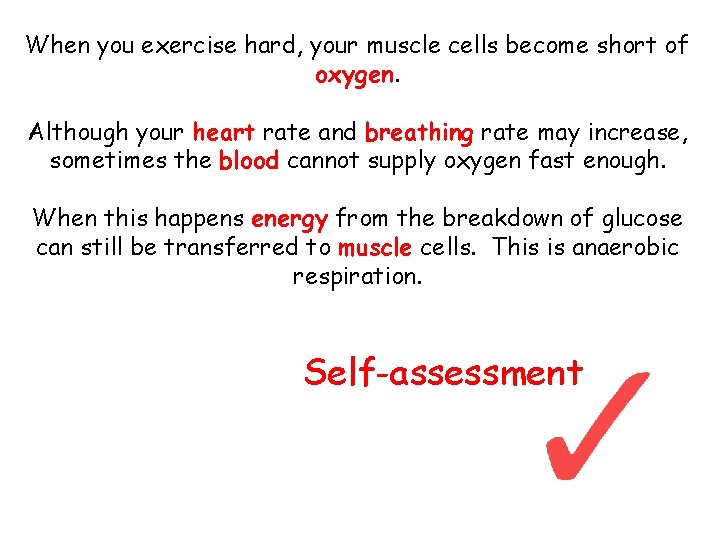
When you exercise hard, your muscle cells become short of oxygen. Although your heart rate and breathing rate may increase, sometimes the blood cannot supply oxygen fast enough. When this happens energy from the breakdown of glucose can still be transferred to muscle cells. This is anaerobic respiration. Self-assessment
Task: Watch the video and answer the following questions on your worksheet: 1. During which type of exercise do animals usually start to carry out anaerobic respiration? 2. What is the generalised equation for anaerobic respiration? 3. Is more or less energy released during anaerobic respiration? 4. What effect does lactic acid build up have on the muscles? 5. How can lactic acid be cleared from the muscle? 6. What is the word equation for anaerobic respiration in plants? 7. What is the process called? Why is it a useful process? https: //www. youtube. com/watch? v=HZt. XLhm 7 ISA
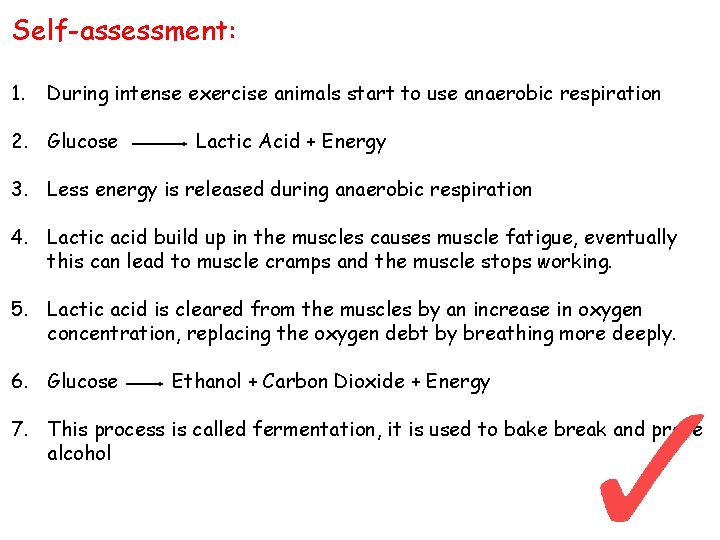
Self-assessment: 1. During intense exercise animals start to use anaerobic respiration 2. Glucose Lactic Acid + Energy 3. Less energy is released during anaerobic respiration 4. Lactic acid build up in the muscles causes muscle fatigue, eventually this can lead to muscle cramps and the muscle stops working. 5. Lactic acid is cleared from the muscles by an increase in oxygen concentration, replacing the oxygen debt by breathing more deeply. 6. Glucose Ethanol + Carbon Dioxide + Energy 7. This process is called fermentation, it is used to bake break and prove alcohol
Oxygen debt Task: Read the information on oxygen debt and answer the following questions: 1. Why do you carry on breathing heavily and deeply when you have stopped using your muscles? 2. What is oxygen debt? 3. What is the word equation with demonstrates how oxygen repayment occurs? 4. Use figure 2 to explain the difference between the breathing rate of a fit person and an unfit person: a) During exercise b) After exercise
1. You need to carry on breathing heavily and deeply in order to repay the oxygen debt to your body. If you have been exercising an aerobically you will need to also use this oxygen to break down the lactic acid to avoid muscle cramps. 2. Oxygen debt is the amount of oxygen needed to break down lactic acid into carbon dioxide and water 3. Lactic acid + oxygen carbon dioxide + water 4. The differences between the breathing rate of a fit person and an unfit person: a) During exercise – breathing rate of an unfit person increases more quickly than that of an fit person, at the point in which the exercise stops the difference between the fit and unfit person is at least 10 breaths per minute. b) After exercise – the breathing rate of the fit person decreases and is restored back to their normal breathing rate quite rapidly. Whereas the breathing rate of the unfit person remains quite initially and takes a little longer to be restored to their resting breathing rate. Self-assessment
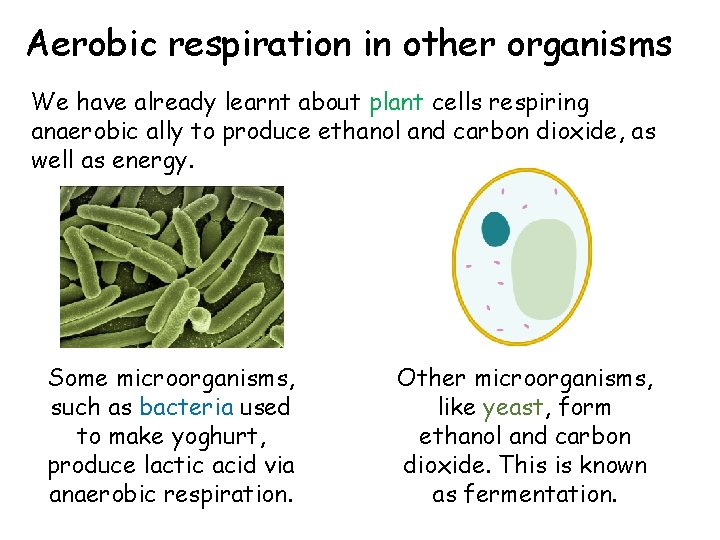
Aerobic respiration in other organisms We have already learnt about plant cells respiring anaerobic ally to produce ethanol and carbon dioxide, as well as energy. Some microorganisms, such as bacteria used to make yoghurt, produce lactic acid via anaerobic respiration. Other microorganisms, like yeast, form ethanol and carbon dioxide. This is known as fermentation.
Exam-style questions: 1. Anaerobic respiration occurs in muscle cells and yeast cells. This equation demonstrates what happens in yeast cells: a) How can you tell from this equation that the process is anaerobic? (1 mark) b) Exercise cannot be sustained when anaerobic respiration takes place in muscle cells. Explain why. (2 marks) c) Compare anaerobic respiration in a yeast cell with anaerobic respiration in an animal cell (3 marks)
Self-assessment: a) No oxygen (is used) b) Muscles become fatigued / stop contracting because not enough energy is transferred c) Yeast produces ethanol but muscles produce lactic acid yeast produces carbon dioxide but muscles do not both release small amounts of energy
Plenary: Write a twitter message about the differences between aerobic and anaerobic respiration! #keywords
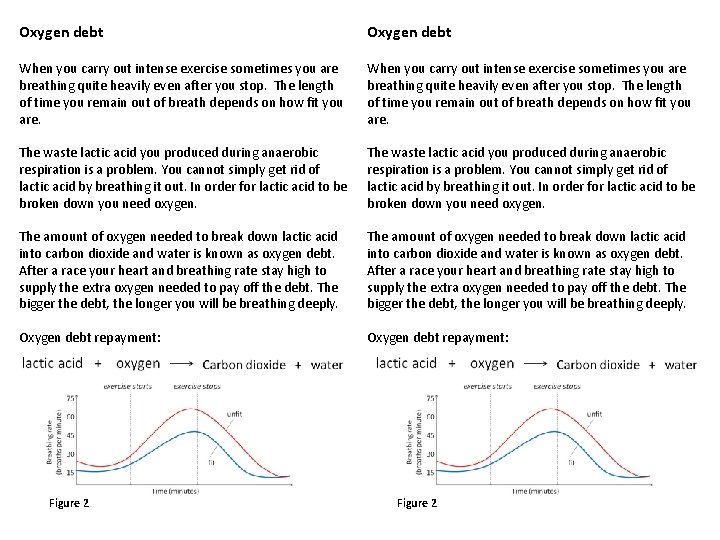
Oxygen debt When you carry out intense exercise sometimes you are breathing quite heavily even after you stop. The length of time you remain out of breath depends on how fit you are. The waste lactic acid you produced during anaerobic respiration is a problem. You cannot simply get rid of lactic acid by breathing it out. In order for lactic acid to be broken down you need oxygen. The amount of oxygen needed to break down lactic acid into carbon dioxide and water is known as oxygen debt. After a race your heart and breathing rate stay high to supply the extra oxygen needed to pay off the debt. The bigger the debt, the longer you will be breathing deeply. Oxygen debt repayment: Figure 2
- Slides: 14