
ANAEROBIC DIGESTION OF FISH SLUDGE FOR BIOGAS PRODUCTION
ANAEROBIC DIGESTION OF FISH SLUDGE FOR BIOGAS PRODUCTION BY NETSHIVHUMBE RUDZANI Supervisor : Dr N. J Goosen Co-supervisor : Prof J Gorgens Prof N. S Mamphweli Dr F. D Faloye Fakulteit Ingenieurswese Faculty of Engineering
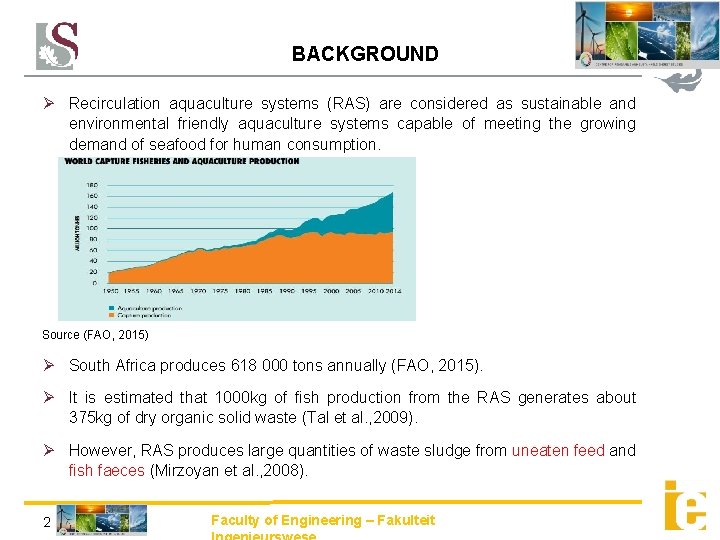
BACKGROUND Recirculation aquaculture systems (RAS) are considered as sustainable and environmental friendly aquaculture systems capable of meeting the growing demand of seafood for human consumption. Source (FAO, 2015) South Africa produces 618 000 tons annually (FAO, 2015). It is estimated that 1000 kg of fish production from the RAS generates about 375 kg of dry organic solid waste (Tal et al. , 2009). However, RAS produces large quantities of waste sludge from uneaten feed and fish faeces (Mirzoyan et al. , 2008). 2 Faculty of Engineering – Fakulteit

BACKGROUND Fish production tank oxygenation Nitrification ilt iof er B Biogas Mechanical filtration Backwash Sedimentation solid separation Sludge Disposal unit (AD) Scheme of a Recirculating Aquaculture System (adapted from Mirzoyan et al. , 2008) proper management in order to prevent environmental impacts such water pollution and eutrophication, emission of unpleasant odours, high content of salinity, leachate with a high polluting potential Due to high content of salinity of sludge from saline aquaculture limit sludge management options of landfill, as discharge it into the environments it can lead to salinization of soils. 3 Faculty of Engineering – Fakulteit
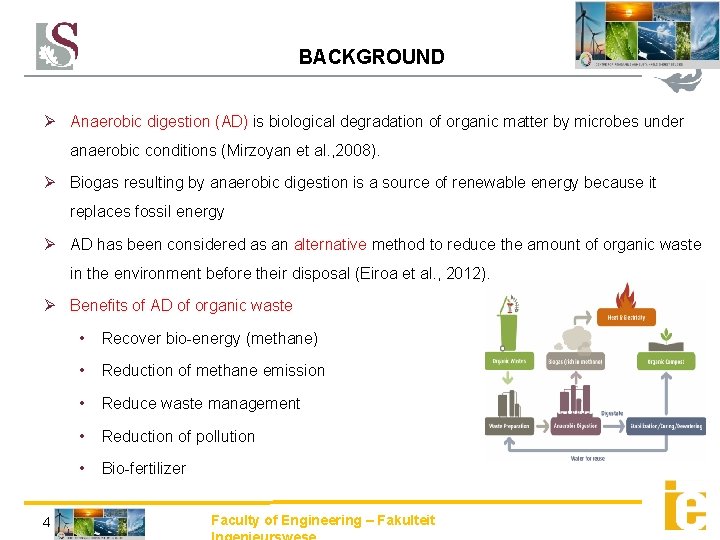
BACKGROUND Anaerobic digestion (AD) is biological degradation of organic matter by microbes under anaerobic conditions (Mirzoyan et al. , 2008). Biogas resulting by anaerobic digestion is a source of renewable energy because it replaces fossil energy AD has been considered as an alternative method to reduce the amount of organic waste in the environment before their disposal (Eiroa et al. , 2012). Benefits of AD of organic waste 4 • Recover bio-energy (methane) • Reduction of methane emission • Reduce waste management • Reduction of pollution • Bio-fertilizer Faculty of Engineering – Fakulteit
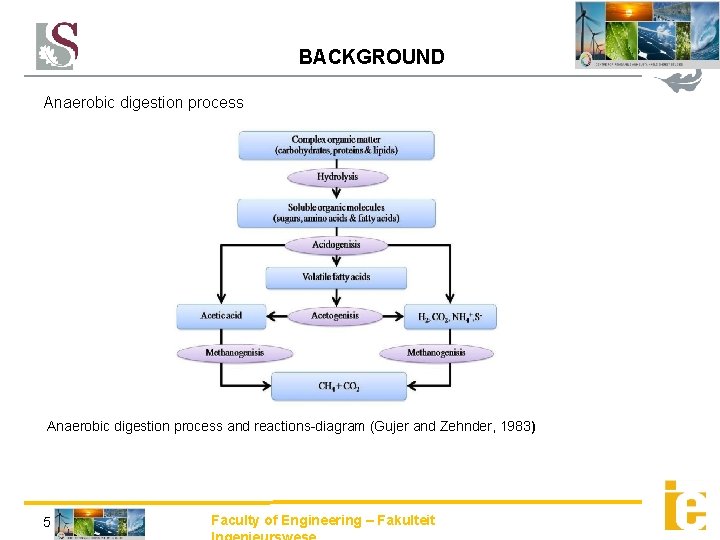
BACKGROUND Anaerobic digestion process and reactions-diagram (Gujer and Zehnder, 1983) 5 Faculty of Engineering – Fakulteit
BACKGROUND Factors affecting the anaerobic digestion process: • Temperature : Mesophilic (35 -37°C) Thermophilic (45 -55°C) 6 • p. H and alkalinity: optimal between 6. 8 to 7. 2 (Mc. Carty, 1964) • C/N ratio : optimum (20 -30) • Substrate loading (TS 6 -10%) • Mixing : prevents sedimentation and foaming of dead zones in the reactor. Faculty of Engineering – Fakulteit
RESEARCH RATIONALE Composition of fish sludge Fish sludge waste from aquaculture is rich in organic matter such as nitrogen (Mirzoyan et al. , 2008). • Biodegradable • High volatile solids (60 -90%) (Mirzoyan et al. , 2008). • High moisture content Potential problems of fish sludge as a substrate for biogas production • Low C/N ratios of the sludge • Total solids content (low) Low methane yield • High concentration of metals • High salinity of the sludge Therefore, in order to overcome these limitation, it important to have a carbonrich co-substrates that will balance the nutrients. 7 Faculty of Engineering – Fakulteit
RESEARCH RATIONALE Anaerobic Co-digestion is the digestion of two or more substrates simultaneously in the same digester to make a process more stable (Mshandete et al. , 2014). Advantages of co-digestion (Mata-Alvarez. , 2014) • Improved nutrient balance for an optimal digestion • Dilution of inhibitory substance • Enhance biogas production • Improve the process stabilization However, the ratio of fish sludge with other co-substrates must be balanced in order to achieve an optimum biogas yields. 8 Faculty of Engineering – Fakulteit
CURRENT RESEARCH Aim The current study aim to optimise the biomethane production from fish sludge originating from RAS using anaerobic digestion. Research objectives To determine the chemical compositions of fish sludge from a RAS and it’s suitability for anaerobic digestion. To optimise operating parameters to maximize the methane in the biogas. To identify and evaluate suitable substrates for anaerobic co-digestion, in order to increase biomethane yield. 9 Faculty of Engineering – Fakulteit
MATERIALS AND METHODS Samples Collection Inoculum The inoculum samples will be obtained from an active digester running in Stellenbosch University lab. Substrates Fish sludge will be collected from the RAS at the experimental farm at Stellenbosch University. 10 Faculty of Engineering – Fakulteit

METHODOLOGY Fish sludge Analysis Collection Fish sludge and inoculum Characterisation (TS, VS, C/N, p. H) BMP testing (AMPTS II) Analytical methods Elemental analyser C, H, N, S, O content Colorimetric analysis Chemical oxygen demand (COD) Alkalinity tritation method Alkalinity and p. H Proximate analysis Moisture content, TS, VS. Anaerobic co-digestion trial (Mixture design) 11 Faculty of Engineering – Fakulteit
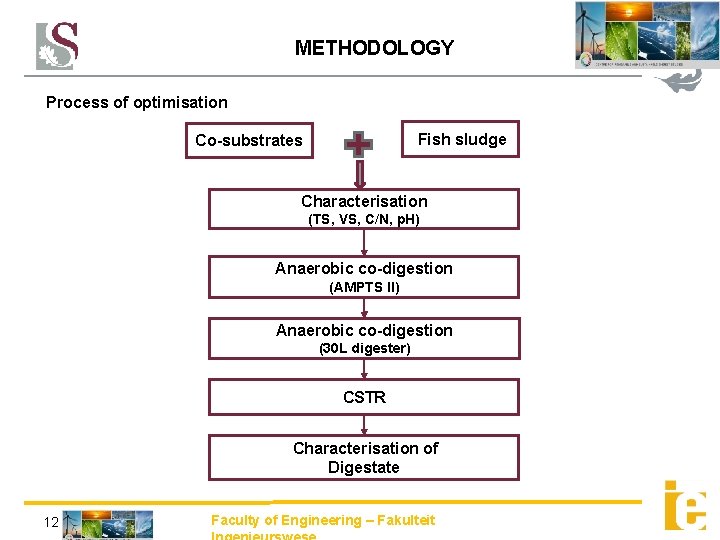
METHODOLOGY Process of optimisation Fish sludge Co-substrates Characterisation (TS, VS, C/N, p. H) Anaerobic co-digestion (AMPTS II) Anaerobic co-digestion (30 L digester) CSTR Characterisation of Digestate 12 Faculty of Engineering – Fakulteit
EXPECTED OUTCOMES Suitable co-substrate of anaerobic digestion of fish sludge Generate optimal biomethane yield Possibility of integration of large-scale anaerobic digestion bioreactor in the RAS. Provide information on quality of digestate 13 Faculty of Engineering – Fakulteit
REFERENCES Mirzoyan, N. , Parnes, S. , Singer, A. , Tal, Y. , Sowers, K. , Gross, A. , 2008. Quality of brackish aquaculture sludge and its suitability for anaerobic digestion and methane production in an upflow anaerobic sludge blanket (UASB) reactor. Aquaculture 279, 35– 41. Eiroa, M. , Costa, J. C. , Alves, M. M. , Kennes, M. C. 2012. Evaluation of the biomethane potential of solid fish waste. Waste Management 32 , 1347– 1352 Gujer, W. , and Zehnder, A. J. B. (1983). Conversion processes in anaerobic digestion. Water Science and Technology 15, 127 -167. Mshandete, A, Kivaisi, A, Rubindamayugi, M and Mattiasson, B. (2004). Anaerobic batch co-digestion of sisal pulp and fish wastes. Bioresource Technology 95(1): 19 -24. Mata-Alvarez, J. Mace, S. , Llabres, P. (2000). Anaerobic digestion of organic solid wastes. An overview of research achievements and perspectives. Bioresource Technology 74: 3 -16. Mc. Carty, P. L. , (1964). Anaerobic waste treatment fundamentals, part III: Toxic materials and their control. Public Works 95 (11), 91– 94 FAO 2015. The state of world fisheries and aquaculture. Rome: Food and Agriculture Organization of the United Nations. Fisheries Department 14 Faculty of Engineering – Fakulteit
ACKNOWLEDGMENT This study funded by the Centre for Renewable and Sustainable Energy studies 15 Faculty of Engineering – Fakulteit
Thank you 16 Faculty of Engineering – Fakulteit
- Slides: 16