
ANAEROBIC DIGESTION AND DIGESTERS What is a Digester
ANAEROBIC DIGESTION AND DIGESTERS
What is a Digester? l l l Digester is a vessel or container where the biogas process takes place. Bacteria breaks down manure or other waste products to create biogas. Products may be fed into the chamber such as manure or the container could be used to cover a place that is already giving off biogas such as a swamp or a landfill.
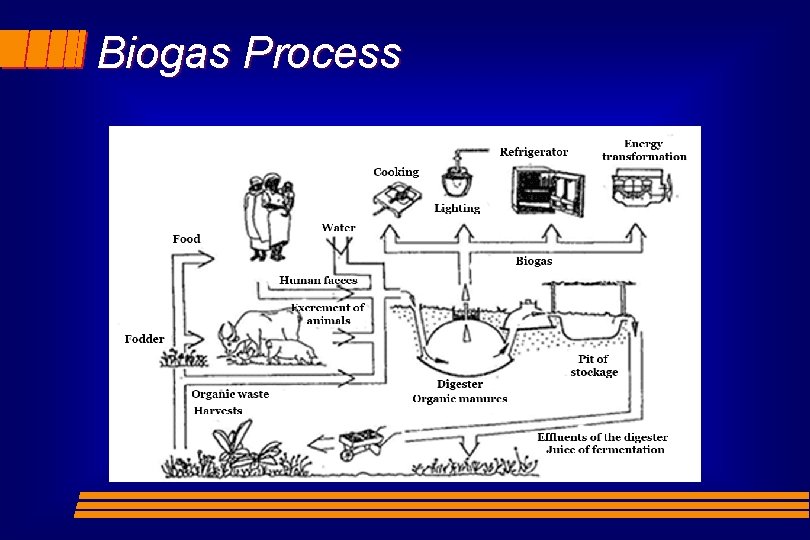
Biogas Process
How Digester Works l l Temperature must be kept between 65 degrees and 150 degrees 4 Types of bacteria breakdown the waste – Hydrolytic breaks organic material to simple sugar and amino acids – Fermentative then converts to organic acids – Acidogenic convert to carbon dioxide, acetate, and hydrogen – Methanogenic produces biogas
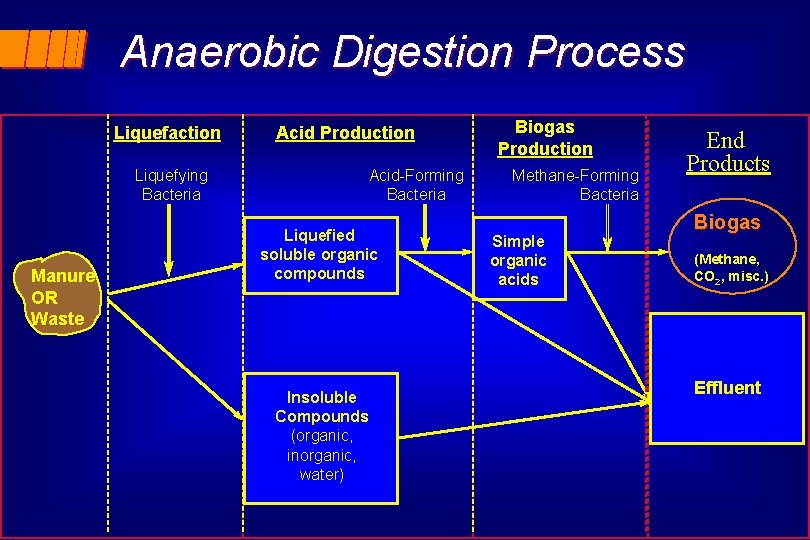
Anaerobic Digestion Process Liquefaction Liquefying Bacteria Manure OR Waste Acid Production Acid-Forming Bacteria Liquefied soluble organic compounds Insoluble Compounds (organic, inorganic, water) Biogas Production Methane-Forming Bacteria Simple organic acids End Products Biogas (Methane, CO 2, misc. ) Effluent 5
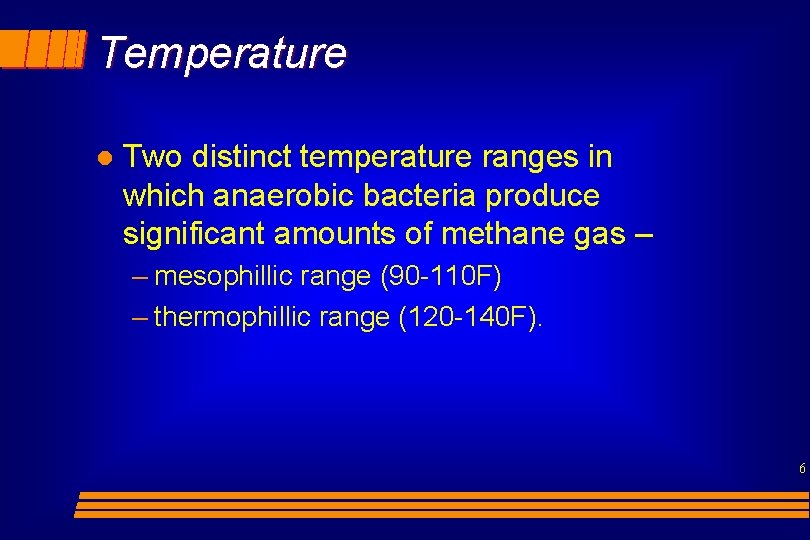
Temperature l Two distinct temperature ranges in which anaerobic bacteria produce significant amounts of methane gas – – mesophillic range (90 -110 F) – thermophillic range (120 -140 F). 6
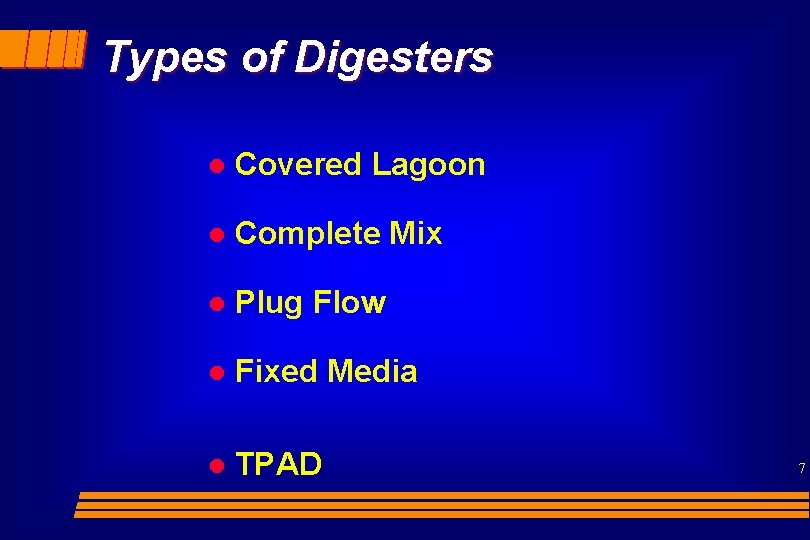
Types of Digesters l Covered Lagoon l Complete Mix l Plug Flow l Fixed Media l TPAD 7
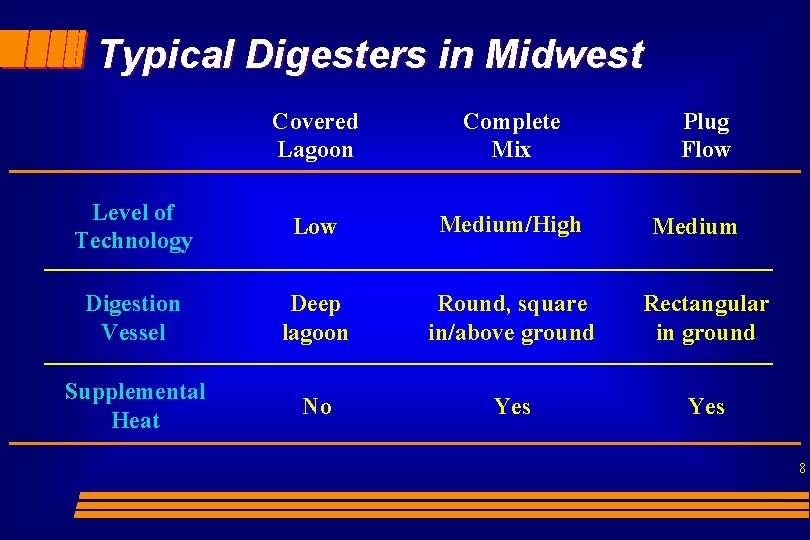
Typical Digesters in Midwest Covered Lagoon Complete Mix Plug Flow Level of Technology Low Medium/High Digestion Vessel Deep lagoon Round, square in/above ground Rectangular in ground Supplemental Heat No Yes Medium 8
Covered lagoon digester l “an anaerobic lagoon is commonly used when manure has less than 2 percent solids. Decomposition of the manure occurs, methane is produced and effluent odor is reduced. The lagoon is covered with a gas-tight cover to capture the biogas. ”
Covered lagoon The digester consists of two cells. l The first cell is covered and second is uncovered. l Both cells are needed for system to operate efficiently. l 10
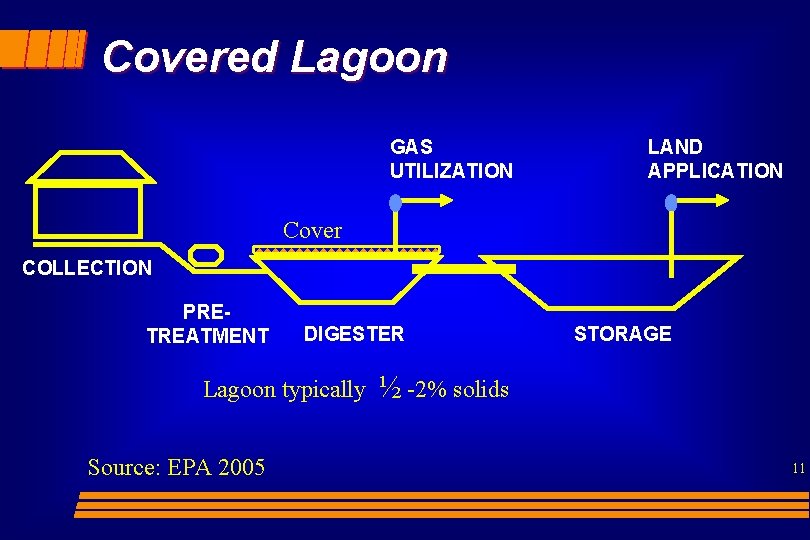
Covered Lagoon GAS UTILIZATION LAND APPLICATION Cover COLLECTION PRETREATMENT DIGESTER Lagoon typically Source: EPA 2005 STORAGE ½ -2% solids 11
Covered Lagoon l Advantages: · Relatively inexpensive to build · Long retention · Construction and management is simple · Limitations: · Limited to warm weather areas since digestion depends on temperature · Manure not completely digested, so odor released when land applied. cover maintainance Source: ·David Downing, Iowa Department of Natural Resources, 2002 12
Complete Mix Digester Are larger vessels that can either be above or below ground. They are used for larger amounts of manure l Consist of large tank where fresh material is mixed with partially digested material. l These wastes are deposited in a heated tank and periodically mixed l
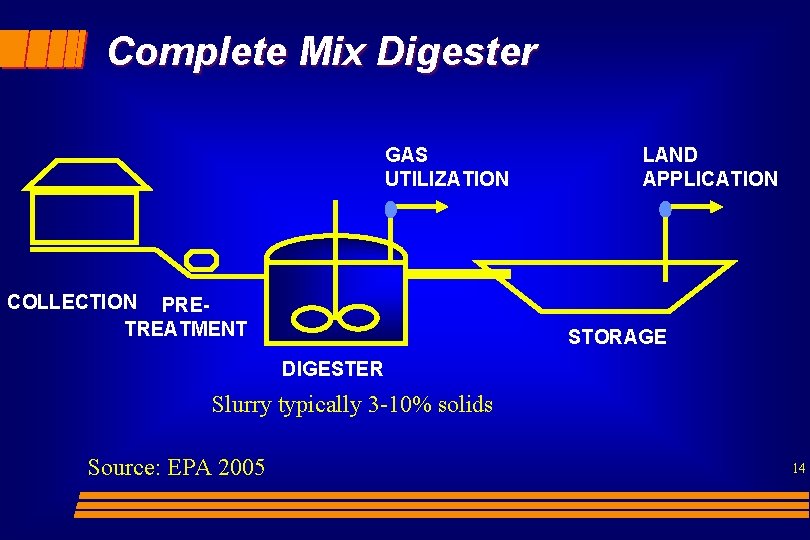
Complete Mix Digester GAS UTILIZATION COLLECTION PRETREATMENT LAND APPLICATION STORAGE DIGESTER Slurry typically 3 -10% solids Source: EPA 2005 14
Complete Mix System l Advantages: § Mechanical mixers prevents crust and keeps solids from collecting on the bottom of the digester tank, delaying cleaning l Limitations: § Requires more maintenance Source: David Downing, Iowa Department of Natural Resources, 2002 15
Plug Flow Digester Is used for ruminant animal manure and requires little maintenance. Better for smaller operations l It handle more amount of solid than both covered lagoon and complete mix digester. l Waste are deposited in a long, heated tank that is typically situated below. l
Plug flow digester Plug flow systems are subject to stratification; heavier material settle to the bottom while the lighter materials float to the surface. l A very little mixing occurs, so manure moves through the digester as a plug, hence the name “plug flow” l No mechanical mixing is requires. l 17
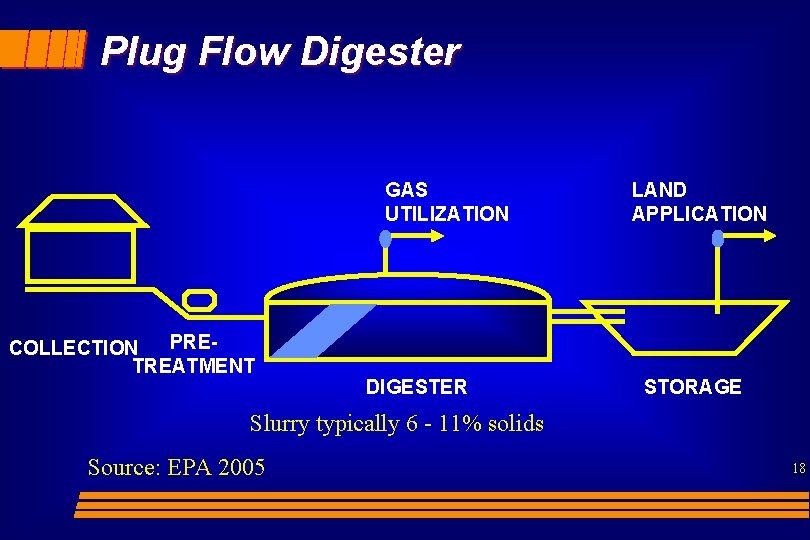
Plug Flow Digester GAS UTILIZATION PRECOLLECTION TREATMENT DIGESTER LAND APPLICATION STORAGE Slurry typically 6 - 11% solids Source: EPA 2005 18
Plug Flow Digester l Advantages: § Medium cost range § Simpler design § Less labor/management intensive to operate l Limitations: § Most compatible with daily scrape dairy systems § Requires pre-mix tank. § Requires high solid feedstocks. Source: David Downing, Iowa Department of Natural Resources, 2002 19
Fixed film digester l l l “a tank designed as part of a manure management system to handle manure up to 3 percent solids. The digester is temperature controlled and a media is placed inside the digester. This design allows the microbial populations to attach to the media and grow as a biofilm (fixed film), thus preventing the microbes from being removed with the effluent”
Fixed-film Anaerobic Filter Up flow digester with porous media l Bacteria grows on media and feeds on organics passing by l Wastewater passes thru in 4 -6 days but slowgrowing bacteria remain in digester. l A fixed film digester is essentially column packed with media such as wood chips or small plastic rings. l 21
Fixed film digester These units contain a plastic packing that serves as a structure on which bacteria attach, grow and create a biofilm hence named fixed film digester. l As the wastewater passes through the media-filled reactor, the attached and suspended anaerobic biomass converts both and particulate organic matter in the wastewater to biogas. l 22
Temperature-phased anaerobic digester (TPAD) “Two tanks designed as part of a manure management system. l The digesters are heated, the first digester in thermophilic temperature range. l The second digester in the mesophilic temperature range. l This will maximize biological activity for the destruction of volatile solids, methane production and odor reduction. ” l
UASB digester UASB Upflow Anaerobic Sludge Blanket l The whole waste is passed through the anaerobic reactor in an up flow mode. l Waste water entering from the bottom of the reactor passes through a sludge bed and sludge blanket where organic material are anaerobically decomposed. l No prior sedimentation is required. l 25
UASB The anaerobic unit does not need to be filled with stones or any other media; the upflowing sewage itself forms million of small granules or particles of sludge which are held in suspension and provide large surface area on which organic matter can attach and undergo biodegradation. l Gas produced is then separate by a gas -solid separator. l 26
UASB l Excess sludge is removed from time to time through a separate pipe and sent to simple sand bed for drying. 27
Benefits of Anaerobic Digestion l Odor reduction (digestion stabilizes degradable organic matter) l Digested manure retains most of its nutrient/fertilizer value l Digestion minimizes release of methane to atmosphere during later storage 28
Environmental Benefits l Reduces odor from land application l Protects water resources l Reduces pathogens l Weed seed reduction l Fly control after digestion l Greenhouse gas reduction 29
- Slides: 28