
An Updated Interest Based Account Monotropism theory A
An Updated Interest Based Account (Monotropism theory): A Developmental Model and Demand Avoidance Phenomena. Richard Woods. 01 st November 2019. Monotropism & DAP. 1
PERSPECTIVE. About me. 1) Diagnosed autistic in 2012. 2) Demand Avoidance Phenomena (DAP). 3) Meets DAP proposed profile, but that does not mean much. 4) Independent Scholar. 5) Lateral thinker, not longitudinal. 6) Portfolio. Monotropism & DAP. 2
CHEAP PLUG. Autism Policy & Practice. 1) Open Access autistic‐led good practice journal. 2) Access via link below: https: //www. openaccessautism. org/index. ph p/app/about Monotropism & DAP. 3
CHEAP PLUG & SOCKET. DAP Expert. 1) Written articles, book chapters. 2) Delivered conference talks, topics such as scientific issues around DAP & neutral ethical position. 3) Trained Postgrad students at Anna Freud Centre. 4) Seeking to do a DAP Ph. D at LSBU under Eddie Chaplin and Damian Milton, aiming for September 2020 start. 5) Covering Monotropism autism theory. Monotropism & DAP. 4
BE SPECIFIC. A content analysis. 1) Nick Chown analysed BAP and autistic traits tools for specificity (2019). 2) Suggests these 2 terms are result of word games as they these constructs lack specificity. 3) DAP is argued to fall under BAP (Eaton 2018 a). 4) Currently replicating Chown (2019) study with DAP tools. Monotropism & DAP. 5
BE SPECIFIC. A content analysis. 1) DAP has no specificity (Attwood 2018; Christie et al 2012; Christie & Fidler 2015; Garralda 2003; Malik and Baird 2018; PDA Society 2019; Wing 2002). 2) Signs of DAP seen in Asperger’s case studies (Falk 2019; Philip & Contejean 2018; Sanchez 2018). 3) My hypothesis: DAP has no specificity. 4) Analysis should be completed by mid‐ November 2019. Monotropism & DAP. 6
WHAT IS IN A NAME? Preferred name. 1) Demand to change its name (Eaton 2018; Gillberg 2014; Milton 2017 a; Newson et al 2003; PDA Society 2019; Reilly et al 2014; Sanchez 2018; Woods 2019 b). 2) Lack of compelling evidence to say exactly what DAP is (Green et al 2018 a; Milton 2017 a; Woods forthcoming). 3) Ethically, a balanced perspective should be presented (Brooks et al 2014; Dawson 2004; Rutter & Pickles 2016; Waltz 2007). 4) Demand Avoidance Phenomena, DAP. Monotropism & DAP. 7
WHAT IS IN A NAME? Preferred name. 1) “Professionals and teams working with children need to become aware of the ways in which girls can mask their difficulties, and need to move away from using the DSM as a “bible”. Stating that someone does not fulfil criteria, when these criteria are based on upon a “male” presentation of a disorder, is short sighted in the extreme” (Eaton 2018, p 176). 2) Applicable to those dogmatically favouring DAP as a form of autism. Monotropism & DAP. 8
WHAT IS IN A NAME? Preferred name. 1) “One of the strengths of the current study was that the data used were collected in 2010 or earlier: for the most part prior to the large peak in interest in PDA … As such, it is likely that clinicians were not particularly ‘on the lookout’ for PDA features in their cases… was possible to get an honest and unbiased picture of the features of PDA in this sample” (O’Nions et al 2016 a, p 418). 2) Campaigning for DAP as form of autism probably creates source of confirmation bias. Monotropism & DAP. 9
AN INTEREST BASED ACOUNT. Monotropism 101. 1) Attention is a scarce resource, there is competition for its use by myriad interests. 2) An interest is anything that gains your attention; from sensory stimuli, thoughts to emotions. 3) Each person can only process a certain amount of attention resource at any moment. 4) Continuum of perceiving attention; One end is Monotropism and the other Polytropism. 5) Autistic persons tend to be monotropic. 6) Non‐autistic persons tend to be polytropic. Monotropism & DAP. 10
AN INTEREST BASED ACOUNT. Monotropism 101. 1) Attention tunnels are made from attention resource. 2) Monotropism is with a single attention tunnel when entire attention resource is used. 3) Polytropism is with many attention tunnels that have similarly distributed attention resources. Monotropism & DAP. 11
AN INTEREST BASED ACOUNT. Single attention tunnel leads to: 1) Interests are processed sequentially in order of importance. 2) Experiencing intense sensations. 3) Binaric black and white thinking. 4) External information being occluded from awareness. 5) Intensity of our thoughts leave stronger impression on subconscious. 6) More difficult to restart attention tunnels. Monotropism & DAP. 12
AN EVIDENCE BASED ACOUNT. The evidence base: 1) Theoretically is the strongest autism theory (Woods & Waltz 2019). 2) The theory lacks direct empirical research. 3) Emerging qualitative evidence (Bertilsdotter‐ Rosqvist 2019; Leatherland 2018; Wood 2019). 4) Stuart et al (2019) results, support theory I am presenting. 5) Wenn Lawson is a leading monotropism expert (Lawson 2011; Murray 2011). Monotropism & DAP. 13
CONFLICTING INTERESTS. An Interest Based Account Reading. 1) For further reading see (Murray et al 2005): https: //www. researchgate. net/publication/7 879954_Attention_monotropism_and_the_diag nostic_criteria_for_autism 2) The Passionate Mind (Lawson 2011). 3) Monotropism – An Interest Based Account of Autism (Murray 2018). 4) Me and Monotropism: A unified theory of autism (Murray 2019): https: //thepsychologist. bps. org. uk/me‐and‐ monotropism‐unified‐theory‐autism Monotropism & DAP. 14
OF KEEN INTEREST. Different states of attention tunnels. 1) Flow states. 2) Clumping. 3) Biolooping. Monotropism & DAP. 15
GOING WITH THE FLOW. Flow States. 1) An optimal experience that is beneficial to our wellbeing and happiness. 2) Experienced when a person is deeply involved in an activity and nothing else seems to matter. 3) Flow states can happen in social interaction. 4) Provide stability, e. g. an escape from anxiety. 5) Such activities that engage with flow states can become a compulsion and addictive. 6) Aversive to chaotic life outside of the person. 7) (Mc. Donnell & Milton 2014). Monotropism & DAP. 16
CLUMPING TOGETHER. Clumping Attention Resource. 1) Where the flow of attention resource is halted due to sticking together. 2) Can form blockages to prevent attention resource bringing certain information into person’s awareness. 3) (Mc. Donnell & Milton 2014). Monotropism & DAP. 17
IN THE LOOP. Biolooping. 1) How a person’s mental state affects their physical state. 2) Also vice versa. 3) A person thinking they are ill, can make themselves ill. 4) Again, vice versa. 5) Yoga. 6) (Hacking 1999). Monotropism & DAP. 18
DEVELOPMENTAL TRAJECTORY. Developing Monotropism. 1) N = Attention Resource (Murray 2018). 2) A = Anxiety. 3) F = Flow states. Duration and intensity of a flow state. 4) R = Stored N. Depleted by persons using N Monotropism & DAP. 19
DEVELOPMENTAL TRAJECTORY. Developing Monotropism. 1) C = Capacity: N that is available for use after automatic cognitive processing; forming the perception based on sensory inputs and any intrusive thoughts that consume R before it can be used for day‐to‐day tasks (Murray et al 2005). 2) Higher F = Higher N and Lower A. 3) Higher F → Higher C. 4) Higher F → Higher R. Monotropism & DAP. 20
THE FOUR CASE. Fidler & Christie, Matching The Dials. 1) Person has a threshold capacity to demands, determined by their anxiety levels. 2) There are 2 dials. 3) First for a person’s tolerances to demands. 4) Second for person’s levels of experienced demands. 5) If first dial is high, demand expectations can be raised. 6) If first dial is low, demand expectations should be lowered. 7) Synchronise dials as much as possible. 8) (Fidler and Christie 2019, pp. 26‐ 27). Monotropism & DAP. 21
AN ANXIOUS MOMENT. Monotropism and anxiety. 1) All humans (and animals) need stability. 2) Points of interest can be stability points. 3) Black/ white thinking style. Either have certainty/ uncertainty on a subject. 4) Obscure other thoughts that are linked to the subject of interest; obscure & reduce anxiety. 5) Therefore these flow states form fixed points of stability for autistic persons. Monotropism & DAP. 22
AN ANXIOUS MOMENT. Monotropism and anxiety. 1) Autistic persons engage with subjects that interest them. 2) Requires significant N to engage with uninteresting matters. 3) Explains autistic social communication issues. 4) When a person has no N and an attention tunnel is violently disrupted, an autistic person can lose control; go into meltdown/ shutdown/ panic attacks. 5) Autistic persons will tend to have higher anxiety levels due to black and white thinking. Monotropism & DAP. 23
REMEMBER, JUST BREATHE. Monotropism and anxiety. 1) Autistic persons being 1‐ 2% of population and not interested in non‐autistic social norms; they have different sources of stability. 2) Polytropism easily engages in social interactions; thus forming flow states from it. 3) Non‐autistic benefiting from lower anxiety and increased R. 4) Non‐autistic stability also comes from understanding non‐autistic social interaction and being able to rely on this consistently. Monotropism & DAP. 24
AN ANXIOUS MOMENT. Flow state Example & Implications. 1) Autistic person’s breakfast routine, allows person to function for rest of the day. 2) Autistic person is in a flow state from that routine. 3) Benefiting from reduced anxiety and increased N. If it is a flow state present from the routine, it would be a fixed point as explained by Monotropism. 4) Regular low levels of R and C over extended time periods can lead to trauma and anxiety. Monotropism & DAP. 25
REMEMBER, JUST BREATHE. Polytropism & Anxiety. 1) Non‐autistic persons can experience inconsistent social interaction. 2) “Some staff also find it anxiety provoking to spend extended periods of time with another person who is anxious and has mood swings. This group of pupils can be very intense to work with, which is tiring” (Fidler and Christie 2019, p. 140). 3) Anxiety here can also be explained by masking (Goffman 1963). Monotropism & DAP. 26
REMEMBER, JUST BREATHE. Polytropism & Anxiety. 1) DAP parents often have higher anxiety levels than either autism parents & CD parents (Durà ‐Vilà & Levi 2019). 2) Correlation between parents with high anxiety & children with high anxiety (Howard 2017). Monotropism & DAP. 27
TAKES TWO TO TANGO. Steph’s Two Girls Example. 1) “For years now, Sasha has controlled the music in the car, and we have one CD on repeat for weeks or months at a time. From any one CD, there is usually only a handful of songs at most which can be selected; I think I've become immune to the repetition but am sure others would find it unbearable if they joined us regularly on our journey. It's become apparent in the last few days that Sasha now needs to listen to certain songs at a certain time in the journey” (Curtis 2018). Monotropism & DAP. 28
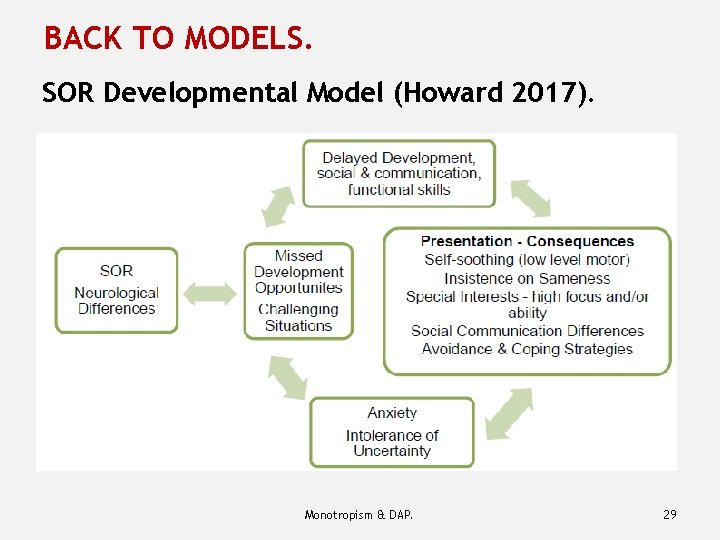
BACK TO MODELS. SOR Developmental Model (Howard 2017). Monotropism & DAP. 29
SINGLE FOCUS. Monotropism DAP Model. 1) Howard Model can be adapted for Sensory Under Responsivity & Monotropism. 2) Howard Model is applicable for trauma‐based developmental delays. 3) Neurological differences can be from in‐utero trauma. Monotropism & DAP. 30
SINGLE FOCUS. Monotropism DAP Model. 1) Monotropism uses an embodied mind/ environment feedback (Murray 2019). 2) Crucially, from birth. 3) Mechanisms for biolooping & looping effects (Hacking 1999; Heasman & Gillespie 2018; Loomes 2019). Monotropism & DAP. 31
A SNUG FIT. Monotropism DAP Model. 1) Autism + Environment = Outcome (Beardon 2017, p 11). 2) Environment component uses DEP & “Goodness of fit” (Green et al 2016; Milton 2018). 3) Thus, is transactional. 4) Matching environment to individuals needs (Green et al 2016). 5) Preschool Autism Communication Trial; PACT intervention. 6) Sustained reduction in “severity” of autism “symptoms” (Pickles et al 2016). Monotropism & DAP. 32
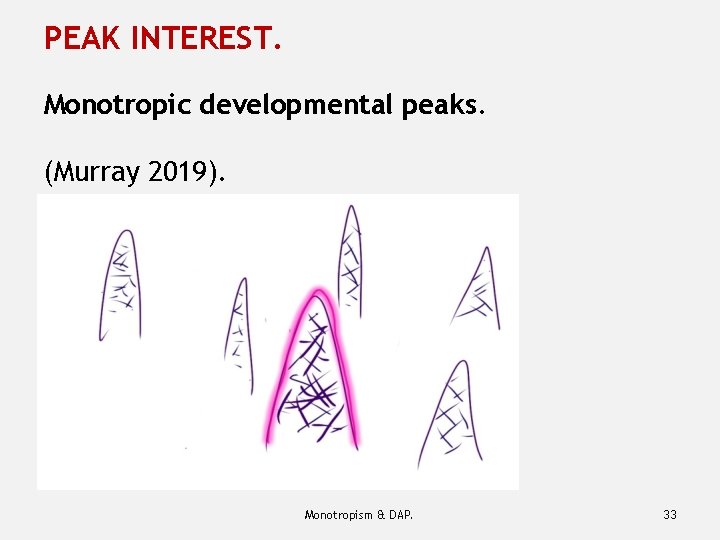
PEAK INTEREST. Monotropic developmental peaks. (Murray 2019). Monotropism & DAP. 33
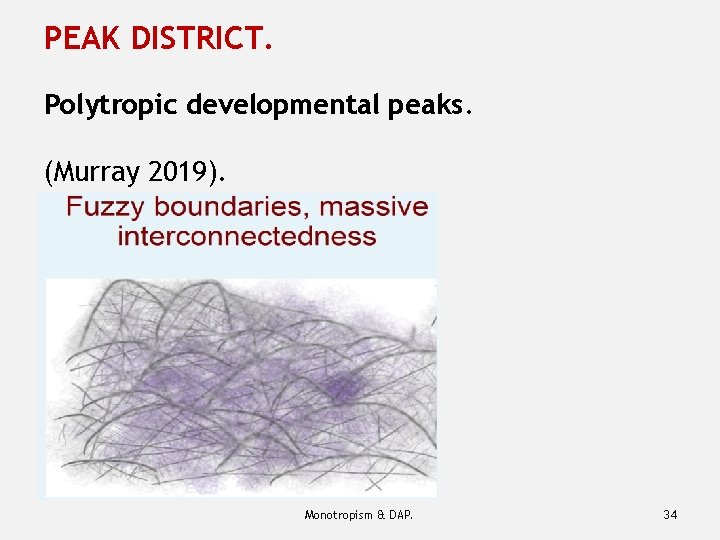
PEAK DISTRICT. Polytropic developmental peaks. (Murray 2019). Monotropism & DAP. 34
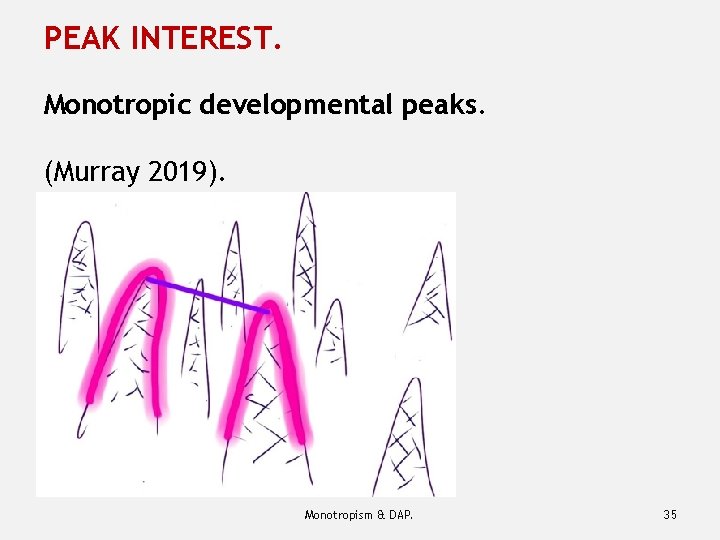
PEAK INTEREST. Monotropic developmental peaks. (Murray 2019). Monotropism & DAP. 35
MATCHING SALIENCES. Environmental Impact on development. 1) More synchronised environment to autistic’s interests, the more opportunities to enter flow states. 2) Thus, autistic person will have more fixed points. 3) Likewise, higher Global Stability levels. 4) Activities that are fixed points are over time internalise to be part of autistic’s identity. 5) E. g. . Harry Thompson responding to dares (2019). 6) Or my bad jokes. Monotropism & DAP. 36
MIS/ MATCHING SALIENCES. Environmental Impact on development. 1) More an autistic’s external environment is matched to their interests. 2) The more densely connected their peaks. 3) Likewise, more external connections between their peaks. 4) Autistic persons can loose sense of self from trauma (Milton 2017 b). 5) Due to connections between peaks severing & possibly the shattering of peaks. Monotropism & DAP. 37
MISMATCHING SALIENCES. Impact of trauma on development. 1) Process can be exacerbated by experiencing distressing situations. 2) Can internalise distressing response. 3) Creating a destructive feedback loop. 4) Traumatic experiences can shatter autistic persons fixed points. 5) This forces individuals to search for different activities they can enter flow states with. Monotropism & DAP. 38
MISMATCHING SALIENCES. Impact of trauma on development. 1) If an autistic person is repeatedly traumatised, they can gradually shift from automatically responding to dares to controlling their food intake. E. g. . Thompson (2019). 2) Or retreat to other “extreme” activities as sources of fixed points, increasingly entering fantasy worlds. Monotropism & DAP. 39
MISMATCHING SALIENCES. Impact of trauma on development. 1) This matters, as over time from repeatedly entering a flow state by rituals controlling food intake, these become fixed points. 2) Then internalised to become part of the person in a form of an eating disorder. 3) Applicable to other “extreme” fixed points. 4) Autistic persons need environments we can easily enter flow states with many different sources. 5) Give us control of our routines; Structure part of SPELL Framework (Milton 2017). Monotropism & DAP. 40
THREE’S A CROWD. Judy Eaton’s Controlling Food Intake. 1) Often go into meltdowns etc. when pushed to follow another’s direction. 2) These persons are externalisers. 3) Punished for displaying clear emotions/ making mistakes. 4) Internalise their anger & frustration. 5) Thus to prevent further social isolation, person control their food intake (behaviour) instead of other persons to manage their anxiety. 6) (Eaton 2018, pp. 146‐ 147). Monotropism & DAP. 41
MISMATCHING SALIENCES. Easier said than done. 1) Autistic infants can be startled by “trivial” interactions with carers. 2) With monotropic processing, infant may not recognise they are in a safe situation when being hugged; thus is shocked. 3) Can occur repeatedly. 4) Often not carer’s fault. Monotropism & DAP. 42
A STARTLING REVELATION. Easier said than done. 1) Startled infants could become hyper aware and sensitive to their sensory environment. 2) Rises intolerance uncertainty & thus anxiety. 3) Carers told to follow standard parenting advise raises mismatch between environment & infant. 4) Generates cycle that deteriorate infants & carers wellbeing. 5) Often not carer’s fault. 6) Can explain DAP behaviour in infants. 7) Needs strategies that works with the child. Monotropism & DAP. 43
AVOIDANCE OF DOUBT. Modelling DAP. 1) DAP fixed points tend to be fantasy, role play & “challenging” behaviour. E. g. . automatically responding to dares (Thompson 2019). 2) Can be problematic leading by creating substantial mismatch between autistic & environment, leading to possible trauma. 3) Essentially views DAPers as traumatised autistics. Monotropism & DAP. 44
AVOIDANCE OF DOUBT. Seen in trauma/ attachment based literature. 1) Behaviourist strategies based on rewards & consequences do not work (Colley and Cooper 2017). 2) Building trusting relationships (Brooks 2020; Pearce 2017). 3) Chaotic worldviews and high anxiety (Brooks 2020; Colley and Cooper 2017; Pearce 2017). 4) Child taking rewards instead of completing request (Brooks 2020). 5) Desperate carers as traditional approaches do not work (Brooks 2020). Monotropism & DAP. 45
AVOIDANCE OF DOUBT. Seen in trauma/ attachment based literature. 1) Lack of pride and shame (Brooks 2020). 2) Need to reduce uncertainty (Brooks 2020; Colley & Cooper 2017; Pearce 2017). 3) Significant overlap with trauma based strategies, such as DBT and LA Approach (Woods forthcoming). 4) Use of a key worker (Brooks 2020). 5) Howard Model (2017) is applicable to trauma based developmental delay & can explain DAP. 6) Hypothesis: DAP is a trauma/ distress response not specific to autism. Monotropism & DAP. 46
ROUND TABLE. Summarising. 1) Monotropism can explain anxiety in autism. 2) Developmental model places importance on matching environment to child. 3) Autistic trauma is often not the carers fault. Monotropism & DAP. 47
POSITIVE FEEDBACK. Acknowledgements. 1) I thank the following for commentary on development of this talk: 2) Carl Cameron, Judy Eaton, Jonathan Green, Damian Milton, Dinah Murray & Harry Thompson. 3) Andy Mc. Donnell, Fergus Murray & Catriona Stewart for having faith in my theorising. 4) Luke Beardon for his Global Instability Theory that inspired my initial Monotropism work. Monotropism & DAP. 48
ANY QUESTIONS? The End Game. 1) Contact Details: richardwoodsautism@gmail. com 2) Twitter handle: @Richard_Autism 3) My researchgate: https: //www. researchgate. net/profile/Richar d_Woods 10 4) Bibliography can be found in Woods (2019 b). 5) Any questions? Monotropism & DAP. 49
SPANNISH INQUISITION. Further discussion. 1) DAP criteria. Monotropism & DAP. 50
READY PLAYER ONE? Autism + DAP Traits criteria. 1) Comfortable in role play and pretend. 2) Continues to resist and avoid ordinary demands of life. 3) Demand avoidance can use social strategies. 4) Lability of mood & impulsive. 5) Obsessive behaviour, often focused on other people. 6) Surface sociability, but apparent lack of sense of social identity, pride, or shame (Fidler 2019; Green et al 2018 a; Newson et al 2003). Monotropism & DAP. 51
READY PLAYER ONE? Optional Autism + DAP Traits criteria. 1) 2) 3) 4) Delayed Speech Development. Neurological Involvement. Passive early history (Newson et al 2003). Sensory differences (Eaton et al 2018). Monotropism & DAP. 52
NOT THE ONE BIBLE. Bibliography. 1) Attword, T. (2018). School Refusal by Professor Tony Attwood (Online blog). Retrieved from https: //attwoodandgarnettevents. com/2018/11/29/school‐refusal‐ by‐professor‐tony‐attwood/ (Accessed 27 March 2018) 2) Beardon, L. (2012). Coping Strategies (University Website). Retrieved from: https: //www. shu. ac. uk/~/media/home/about‐us/academic. . . /coping‐ strategies. doc? (Cached, access via a Google search) (Accessed 08 November 2018). 3) Beardon, L. (2017). Autism and Asperger Syndrome in Adults. London: Sheldon Press. 4) Bertilsdotter‐Rosqvist, H. (2019). Doing things together: Exploring meanings of different forms of sociality among autistic people in an autistic work space. European Journal of Disability Research, In Press. https: //www. sciencedirect. com/science/article/pii/S 1875067217300524? via%3 Dihu b 5) Brede, J. , Remington, A. , Kenny, L. , & Warren, K. (2017). Excluded from school: Autistic students’ experiences of school exclusion and subsequent re‐integration into school. Autism & Developmental Language Impairments, 2(1), 1‐ 20. 6) Brooks, R. (2020). The Trauma And Attachment Aware Classroom: A Practical Guide to Supporting Children Who Have Encountered Trauma and Adverse Childhood Experiences. London: Jessica Kingsley Publishers. 7) Brooks, R. , Te Riele, K. , & Maguire, M. (2014). Ethics and Education Research. London: Sage Publications Limited. Monotropism & DAP. 53
NOT THE SECOND BIBLE. Bibliography. 1) Cat, Sally. (2018). PDA by PDAers: From Anxiety to Avoidance and Masking to Meltdowns. London, UK: Jessica Kingsley Publishers. 2) Chaplin, E. (2017). Mental Health and Autism. In Milton, D, and Martin, N. (Eds. ), Autism and Intellectual Disability in Adults, Volume 2 (pp. 63‐ 67). Hove, UK: Pavilion Publishing and Media Limited. 3) Chown, N. (2019). Are the “Autistic Traits” and “Broader Autism Phenotype” Concepts Real or Mythical? Autism Policy and Practice, 2(1), 46‐ 63. https: //www. openaccessautism. org/index. php/app/article/view/19 4) Christie, P. (2007). The distinctive clinical and educational needs of children with pathological demand avoidance syndrome: guidelines for good practice. Good Autism Practice, 8(1), 3– 11. 5) Christie, P. (2018). Towards a better understanding of Pathological Demand Avoidance. In National Autistic Society (Ed), Pathological Demand Avoidance Conference. London: National Autistic Society. 6) Christie, P. , Duncan, M. , Fidler, R. & Healey, Z. (2012). Understanding Pathological Demand Avoidance Syndrome in Children: A Guide for Parents, Teachers and Other Professionals. London: Jessica Kingsley Publishers. 7) Christie, P. , & Fidler, R. (2015). Frequently Asked Questions. In: Sherwin, J. Pathological Demand Avoidance Syndrome, Daughter is Not Naughty (pp. 308‐ 319). London: Jessica Kingsley Publishers. Monotropism & DAP. 54
NOT THE THIRD BIBLE. Bibliography. 1) Colley, D. , & Cooper, P (2017). Attachment and Emotional Development in the Classroom: Theory and Practice. London: Jessica Kingsley Publishers. 2) Curtis, S. (2018). Autism with acute anxiety or Pathological Demand Avoidance? (Online Blog). Retrieved from: https: //www. stephstwogirls. co. uk/2018/10/autism‐ with‐acute‐anxiety‐or. html (Accessed 08 November 2018). 3) Dawson, M. (2004). The misbehaviour of behaviourists: ethical challenges to the autism-ABA industry (Online blog). Retrieved from: http: //www. sentex. net/~nexus 23/naa_aba. html (Accessed 29 January 2019). 4) Dinishak, J. , & Akhtar, J. (2013). A Critical Examination of Mindblindness as a Metaphor for Autism. Child Development Perspectives, 7(2), 110‐ 114. 5) Dore, P. (2016). Pathological Demand Avoidance: Does it exist, and if so what is it? (Online Blog). Retrieved from: https: //unsafespaces. com/2016/04/03/pathological ‐demand‐avoidance‐does‐it‐exist‐and‐if‐so‐what‐is‐it/ (Accessed 08 March 2019). 6) Durà‐Vilà, G. and Levi, T. (2019). Me and My PDA: A Guide to Pathological Demand Avoidance for Young People. London: Jessica Kingsley Publishers. 7) Eaton, J. (2018 a). A guide to mental health issues in girls and young women on the autism spectrum: diagnosis, intervention and family support. London: Jessica Kingsley Publishers. Monotropism & DAP. 55
NOT THE FOURTH BIBLE. Bibliography. 1) Eaton, J. (2018 b). PDA and differential diagnosis. In National Autistic Society (Ed), Pathological Demand Avoidance Conference. (Conference Paper). Retrieved from: https: //network. autism. org. uk/sites/default/files/ckfinder/files/Differential%20 di agnosis%20 between%20 PDA%20 and%20 attachment%20 disorder%20‐ %20 Dr%20 Judy%20 Eaton. pdf (Accessed 09 November 2019). 2) Eaton, J. , Duncan, K. , & Hesketh, E. (2018). Modification of the Coventry Grid Interview (Flackhill et al, 2017) to include the Pathological Demand Avoidant profile. Good Autism Practice, 19(2), 12‐ 24. 3) Egan, V. , Linenburg, O. , & O’Nions, L. (2019). The Measurement of Adult Pathological Demand Avoidance Traits. Journal of Autism and Developmental Disorders, 49(2), 481‐ 494. 4) Evans‐Williams, C. (2018). “They’re not speaking my language”, PARC Autistic Fringe Programme. 08 November 2018. Gallery 4, The Lighthouse, 11 Mitchell Lane, Glasgow G 1 3 NU. 5) Falk, D. (2019). Non‐complicit: Revisiting Hans Asperger’s Career in Nazi‐era Vienna. Journal of Autism and Developmental Disorders, (2019). https: //doi. org/10. 1007/s 10803‐ 019‐ 03981‐ 7 6) Fidler, R. (2019). Girls who “can’t help won’t”: Understanding the distinctive profile of Pathological Demand Avoidance (PDA) and developing approaches to support girls with PDA. In: Carpenter, B. , Happe, F. , & Egerton, J (Eds. ), Girls and Autism: Educational, Family and Personal Perspectives (pp. 93‐ 101). Abbingdon, Monotropism & DAP. 56 Routledge.
NOT THE FIFTH BIBLE. Bibliography. 1) Fidler, R and Christie, P. (2019). Collaborative Approaches to Learning for Pupils with PDA: Strategies for Education Professionals. London: Jessica Kingsley Publishers. 2) Fieldman, R. (2018). Reflections on the Psychopathology of Demand Rejection and Avoidance (Online Blog). Retrieved from: https: //libertyofthinking. wordpress. com/2018/10/29/reflections‐on‐the‐ psychopathology‐of‐demand‐rejection‐and‐avoidance/ (Accessed 08 March 2019). 3) Flackhill, C. , James, S. , Soppitt, R. , & Milton, K. (2017). The Coventry Grid Interview (CGI): exploring autism and attachment difficulties. Good Autism Practice, 18(1), 62‐ 80. 4) Garralda, E. (2003). Pathological demand avoidance syndrome or psychiatric disorder? Archives of Disease in Childhood (online only article). Retrieved from: https: //adc. bmj. com/content/88/7/595. responses#pathological‐demand‐ avoidance‐syndrome‐or‐psychiatric‐disorder (Accessed 11 November 2018). 5) Gillberg, C. (2014). Commentary: PDA – public display of affection or pathological demand avoidance? – reflections on O’Nions et al. (2014). Journal of Child Psychology and Psychiatry, 55: 769– 770. 6) Gillberg, C. , Thompson, Lucy. , Biskupsto, R. , & Billstedt, E. (2015). Extreme (“pathological”) demand avoidance in autism: a general population study in the Faroe Islands. European Child & Adolescent Psychiatry, 24(8), 979– 984. 7) Goffman, E. (1963). Stigma: Notes on the Management of Spoiled Identity. London: Monotropism & DAP. 57 Penguin Books.
NOT THE SIXTH BIBLE. Bibliography. 1) Goodley, D. , Lawthom, R. , Liddiard, K. , & Runswick‐Cole, K. (2019). Provocations for Critical Disability Studies. Disability & Society (2019). https: //www. tandfonline. com/doi/full/10. 1080/09687599. 2019. 1566889 2) Green, J. (2018). Video‐Feedback Intervention for Parents of Infants at High‐Risk of Developing Autism. In: Steele, H. , & Steele, M. (Eds. ), Handbook of Attachment. Based Interventions (pp. 273‐ 295). New York: The Guilford Press. 3) Green, J. , Absoud, M. , Grahame, V. , Malik, O. , Simonoff, E. , Le Couteur, A. , & Baird, G. (2018 a). Pathological Demand Avoidance: symptoms but not a syndrome. Lancet Child & Adolescent Health, 2(6), 455– 464. 4) Green, J. , Absoud, M. , Grahame, V. , Malik, O. , Simonoff, E. , Le Couteur, A. , & Baird, G. (2018 b). Demand avoidance is not necessarily defiance: Authors’ reply. Lancet Child & Adolescent Health, 2 (9), e 21. 5) Green, S. , Hernandez. L. , Bookheimer, S. , & Dapretto, M. (2016). Salience Network Connectivity in Autism Is Related to Brain and Behavioral Markers of Sensory Over‐ Responsivity. Journal of the American Academy of Child & Adolescent Psychiatry, 55(7), 618‐ 626. 6) Hacking, I. (1999). The Social Construction of What? London: Harvard University Press. 7) Hacking, I. (2010). Autism Fiction: A Mirror of an Internet Decade? University of Toronto Quarterly, 79 (2), 632‐ 655. Monotropism & DAP. 58
NOT THE SEVENTH BIBLE. Bibliography. 1) Happé, F. (2011). Criteria, Categories, and Continua: Autism and Related Disorders in DSM‐ 5. American Academy of Child and Adolescent Psychiatry, 50(6), 540‐ 542. 2) Haroon, M. (2019). ABC of Autism. London: Wiley‐Blackwell. 3) Hassiotis, A. , Poppe, M. , Strydom, A. , & Vickerstaff, V. (2018). Clinical outcomes of staff training in positive behaviour support to reduce challenging behaviour in adults with intellectual disability: cluster randomised controlled trial. The British Journal of Psychiatry, 212(3), 161‐ 168. 4) Heasman, B. , & Gillespie, A. (2018). Perspective‐taking is two‐sided: Misunderstandings between people with Asperger’s syndrome and their family members. Autism, 22(6), 740– 750. 5) Honeybourne, V. (2018). A Practical Guide To Happiness In Children And Teens On The Autism Spectrum: A Positive Psychology Approach. London: Jessica Kingsley Publishers. 6) Howard, R. (2017). Autism: The Case for a Family Intervention Employing Adapted Positive Psychology Approaches (Conference Paper). Pp 94‐ 115. Retrieved from: https: //pospsychbucks. files. wordpress. com/2019/02/app‐symposium‐proceedings‐ 2017‐final 2. pdf (Accessed 06 April 2019). 7) Kaushik, A. , Ozsivadjian, A. , Baird, G. , Kyriakopoulos, M. , and Absoud, M (2015, 09, 16). Extreme Demand Avoidance: towards a dimensional approach in children presenting with complex neurodevelopmental disorders and avoidance of demands. Paper presented at Royal College of Psychiatrists Faculty of Child and Adolescent Psychiatry Annual Conference. Brighton, United Kingdom. London: 59 Royal College of Psychiatrists. Monotropism & DAP.
NOT THE EIGHTH BIBLE. Bibliography. 1) Lai, M. , & Peter Szatmari, P. (2019). Resilience in autism: Research and practice prospects. Autism, 23(3), 539– 541. 2) Laurent, A. (2019). Letting Go of Control and Rethinking Support for Autistic Individuals (Online seminar). Retrieved from: https: //www. youtube. com/watch? time_continue=3&v=fx 3 cfzl. CG_Q (Accessed 31 March 2019). 3) Lawson, W. (2011). The Passionate Mind: How People with Autism Learn. London: Jessica Kingsley Publishers. 4) Leatherland, J. (2018). Understanding how autistic pupils experience secondary school: autism criteria, theory and FAMe™. Ph. D, Sheffield Hallam University. 5) Liss, M. , Saulnier, C. , Fein. D. , & Kinsbourne, M. (2006). Sensory and attention abnormalities in autistic spectrum disorders. Autism, 10(2), 155‐ 172. 6) Loomes, G. (2019). How to make your own way: Talking to autistic women and girls about adolescence and sexuality. In: Carpenter, B. , Happe, F. , & Egerton, J (Eds. ), Girls and Autism: Educational, Family and Personal Perspectives (pp. 136‐ 146). Abbingdon, Routledge. 7) Lord, C. , Elsabbagh, M. , Baird, G. , & Veenstra‐Vanderweele, J. (2018). Autism spectrum disorder. Lancet, 2018(392), 508‐ 520. 8) Lyle, C. , & Leatherland, H. (2018). Preventing school exclusion: a case study of a primary aged autistic child with ADHD and a PDA profile. Good Autism Practice, 19(2), 33‐ 42. Monotropism & DAP. 60
NOT THE NINTH BIBLE. Bibliography. 1) Malik, O, & Baird, G. (2018). Commentary: PDA ‐ what’s in a name? Dimensions of difficulty in children reported to have an ASD and features of extreme/pathological demand avoidance: a commentary on O’Nions et al. (2018). Child and Adolescent Mental Health, 23(4), 387– 388. 2) Martin, N. , Milton, D. , Krupa, J. , Brett, S. , Bulman, K. , Callow, D. , Copeland, F. , …Wilmot, S. (2019). The sensory school: working with teachers, parents and pupils to create good sensory conditions, Advances in Autism. DOI: https: //www. emeraldinsight. com/doi/abs/10. 1108/AIA‐ 09‐ 2018‐ 0034 3) Mc. Donnell, A. (2019). The reflective journey: A practitioner’s guide to the Low Arousal Approach. Alcester, UK: Studio 3. 4) Mc. Donnell, A, and Milton, D. (2014). Going with the flow: Reconsidering ‘repetitive behaviour’ through the concept of ‘flow states’. Good Autism Practice, Supplement (2014), 37‐ 46. 5) Mc. Donnell, A. , Mc. Creadie, M. , and Dickson, P. (In Press). Behaviour Supports and Issues. In: Jordan, R. (Ed. ), Handbook of Autism and Education. London: Sage. 6) Mc. Elroy, R. (2015). PDA – is there another explanation? (Online Magazine). Retrieved from: https: //thepsychologist. bps. org. uk/volume‐ 29/january‐ 2016/pda‐ there‐another‐explanation (Accessed 08 March 2019). 7) Milton, D. (2012 a). So what exactly is autism? (Online resource). Retrieved from: http: //www. aettraininghubs. org. uk/wp‐content/uploads/2012/08/1_So‐what‐ exactly‐is‐autism. pdf (Accessed 08 November 2018). Monotropism & DAP. 61
NOT THE TENTH BIBLE. Bibliography. 1) Milton, D. (2012 b). On the ontological status of autism: the ‘double empathy problem’. Disability & Society, 27(6), 883‐ 887, 2) Milton, D. (2017 a). A Mismatch of Salience: Explorations of the nature of autism from theory to practice. Hove, UK: Pavilion Publishing and Media Limited. 3) Milton, D. (2017 b). Challenging the ideology of idealised normalcy. In: Martin, N. , & Milton, D. (Eds. ), Autism and Intellectual Disability in Adults Volume 2 (pp. 7‐ 10). Hove, UK: Pavilion Publishing and Media Limited. 4) Milton, D. (2017 c). Autistic Development, Trauma and Personhood: Beyond the Frame of the Neoliberal Individual. In: Runswick‐Cole, K. , Curran, T. , and Liddiard, K. (Eds), The Palgrave Handbook of Disabled Children’s Childhood Studies (pp. 461 ‐ 476). Love: Palgrave Macmillan. 5) Milton, D. (2018 a). Pathological Demand Avoidance (PDA) and alternative explanations: a critical overview (Conference Paper). Retrieved from: https: //kar. kent. ac. uk/67064/1/PDA%20 and%20 alternative%20 explanations. pdf (Accessed 07 November 2018). 6) Milton, D. (2018 b). A critique of the use of Applied Behavioural Analysis (ABA): on behalf of the Neurodiversity Manifesto Steering Group (Internet article). Retrieved from: https: //kar. kent. ac. uk/69268/1/Applied%20 behaviour%20 analysis. pdf (Accessed 31 March 2019). 7) Milton, D. , Heasman, B. , & Sheppard, E. (2018). Double Empathy. In Volkmar, F. (Ed. ), Encyclopaedia of Autism Spectrum Disorders. New York: Springer Nature. Monotropism & DAP. 62
NOT THE ELEVENTH BIBLE. Bibliography. 1) Murray, D. (2016). How to be equals, as required by the Care Quality Commission. In: Milton, D and Martin, N (Eds. ), Autism and Intellectual Disability in Adults: Volume 1 (pp. 69‐ 74). Hove, Pavilion Publishing and Media Limited. 2) Murray, D. (2018). Monotropism – An Interest Based Account of Autism. In Volkmar, F. (Ed. ), Encyclopaedia of Autism Spectrum Disorders. New York: Springer Nature. 3) Murray, D. (2019). Interests: Atypical patterns of interest have been in every definitive account of autism since Kanner first described it. Friston Frissons: Monotropism, University College London, 12 March 2019. 4) Murray, D. , Lesser, M. , & Lawson, W. (2005). Attention, monotropism and the diagnostic criteria for autism. Autism, 9(2), 139– 156. 5) Murray, F. (2018). Me and Monotropism: A unified theory of autism (Online magazine article). Retrieved from: https: //thepsychologist. bps. org. uk/me‐and‐ monotropism‐unified‐theory‐autism (Accessed 09 April 2019). 6) Neil, L. , Olsson, N. , & Pellicano, E. (2016). The Relationship Between Intolerance of Uncertainty, Sensory Sensitivities, and Anxiety in Autistic and Typically Developing Children. Journal of Autism and Developmental Disorders, 46(6), 1962‐ 1973. 7) Newson, E. , Le Maréchal, K. , & David, C. (2003). Pathological demand avoidance syndrome: a necessary distinction within the pervasive developmental disorders. Archives of Disease in Childhood, 88(7), 595– 600. Monotropism & DAP. 63
NOT THE TWELFTH BIBLE. Bibliography. 1) O'Brien, J. (2018). How to be right… in a world gone wrong. London: Penguin Random House group. 2) O’Nions, E. , Christie, P. , Gould, J. , Viding, E. , Happe, F. (2014 a). Development of the ‘Extreme Demand Avoidance Questionnaire’ (EDA‐Q): preliminary observations on a trait measure for Pathological Demand Avoidance. Journal of Child Psychology and Psychiatry, 55(7), 758– 768. 3) O’Nions, E. , Viding, E. , Greven, C. , Ronald, A. , & Happe, F. , (2014 b). Pathological demand avoidance: Exploring the behavioural profile. Autism, 18(5), 538‐ 544. 4) O’Nions, E. , Gould, J. , Christie, P. , Gillberg, C. , Viding, E. , & Happe, F. (2016 a). Identifying features of ‘pathological demand avoidance’ using the Diagnostic Interview for Social and Communication Disorders (DISCO). European Child & Adolescent Psychiatry, 25(4), 407‐ 419. 5) O’Nions, E. , Happe, F. , & Viding, E. (2016 b). Extreme/’pathological’ demand avoidance. British Psychological Society DECP Debate, issue 160. 6) O’Nions, E. , Viding, E. , Floyd, C. , Quinlan, E. , Pidgeon, C. , Gould, J. , & Happe, F. (2018) Dimensions of difficulty in children reported to have an autism spectrum diagnosis and features of extreme/‘pathological’ demand avoidance. Child and Adolescent Mental Health, 23(3), 220‐ 227. 7) O’Nions, E. , & Neons, I. (2018). Commentary: Conceptualising demand avoidance in an ASD context – a response to Osman Malik & Gillian Baird (2018). Child and Adolescent Mental Health, 23(4), 389‐ 390. Monotropism & DAP. 64
NOT THE THIRTEENTH BIBLE. Bibliography. 1) PDA Society. (2019). Research Meeting: Record of meeting held 08 th of January 2019 (Online Report): https: //www. pdasociety. org. uk/blog/2019/04/research‐ meeting‐report (Accessed 05 April 2019). 2) Pearce, C. (2017). A short introduction to attachment and attachment disorder, Second Edition. London: Jessica Kingsley Publishers. 3) Pickles, A. , Harris, V. , Green, J. , Aldred, C. , Mc. Conachie, H. , Slonims, V. , Le Couteur, A. , Hudry, K. , … the PACT Consortium. (2016). Treatment mechanism in the MRC preschool autism communication trial: implications for study design and parent‐focussed therapy for children. The Journal of Child Psychology and Psychiatry, 56(2), 162‐ 170. 4) Pickles, A. , Le Couteur, A. , Leadbitter, K. , Salomone, K. , Cole‐Fletcher, R. , Tobin, H. , Isobel Gammer, I. , … Green, G. (2016). Parent‐mediated social communication therapy for young children with autism (PACT): long‐term follow‐up of a randomised controlled trial. Lancet; 388(2016), 2501– 09. 5) Philip, A. , & Contejean, Y. (2018). The syndrome of pathological avoidance of requests: autistic psychopathy? Asperger Syndrome ? Atypical autism? Or specific pervasive developmental disorder (PDD)? Pathological demand avoidance syndrome: Autistic psychopathy? Asperger syndrome? Atypical autism? Or specific pervasive developmental disorder (PDD)? Neuropsychiatry of Childhood and Adolescence, 66(2), 103‐ 108. 6) Rajendran, G. , & Mitchell, P. (2007). Cognitive theories of autism. Developmental Monotropism & DAP. 65 Review, 27 (2007), 224– 260.
NOT THE FOURTHEENTH BIBLE. Bibliography. 1) Reilly, C. , Atkinson, P. , Menlove, L. , Gillberg, C. , O’Nions, E. , Happe, F. , & Neville, B. (2014). Pathological Demand Avoidance in a population‐based cohort of children with epilepsy: Four case studies. Research in Developmental Disabilities, 35: 3236– 3244. 2) Runswick‐Cole, K. , Mallett, R. , and Timimi, S. (2016). Re-Thinking Autism: Diagnosis Identity and Equality. London: Jessica Kingsley Publishers. 3) Rutter, M. , & Pickles, A. (2016). Annual Research Review: Threats to the validity of child psychiatry and psychology. Journal of Child Psychology and Psychiatry, 57(3), 398– 416. 4) Sanchez, S. (2018). PDA & Parenting: A critical-insider perspective on PDA and parenting (Conference Paper). Retrieved from: https: //autisticmotherland. com/tag/pda/ (Accessed 24 November 2018). 5) Shephard, E. , Bedford, R. , Milosavljevic, B. , Gliga, T. , Jones. E. , Pickles. A. , Johnson. M. , … The BASIS Team. (2018). Early developmental pathways to childhood symptoms of attention‐deficit hyperactivity disorder, anxiety and autism spectrum disorder. The Journal of Child Psychology and Psychiatry, DOI: doi: 10. 1111/jcpp. 12947 6) Slaughter, A. , Hein, S. , Hong, J. , Mire, S. , & Grigorenko, E. (2019). Criminal Behavior and School Discipline in Juvenile Justice‐Involved Youth with Autism. Journal of Autism and Developmental Disorders, (2019). https: //doi. org/10. 1007/s 10803‐ 019‐ 03883‐ 8 Monotropism & DAP. 66
NOT THE FIFTHTEENTH BIBLE. Bibliography. 1) Stuart, L. , Grahame, V. , Honey, E. , and Freeston, M. (2019). Intolerance of uncertainty and anxiety as explanatory frameworks for extreme demand avoidance in children and adolescents. Child and Adolescent Mental Health, DOI: 10. 1111/camh. 12336 2) Summerhill, L. , & Collett, K. (2018). Developing a multi‐agency assessment pathway for children and young people thought to have a Pathological Demand Avoidance profile. Good Autism Practice, 19(2), 25‐ 32. 3) Tamimi, S. (2018). Rebuttal to Foreman’s article ‘Attention‐deficit hyperactivity disorder (ADHD): progress and controversy in diagnosis and treatment. Irish Journal of Psychological Medicine, 35(3), 262‐ 265. 4) Thompson, H. (2019). The PDA Paradox: The Highs and Lows of My Life on a Little. Known Part of the Autism Spectrum. London: Jessica Kingsley Publishers. 5) Trundle, G. , Leam. , C. , Stringer, I. (2017). Differentiating between pathological demand avoidance and antisocial personality disorder: a case study. Journal of Intellectual Disabilities and Offending Behaviour, 8(1), 13‐ 27. 6) Vassilev, I. , & Pilgrim, D. (2009). Risk, trust and the myth of mental health services. Journal of Mental Health, 16(3), 347‐ 357. 7) Verhoeff, B. (2012). What is thing called autism? A critical analysis of the tenacious search for autism's essence. Bio. Soties, 7(4), 410‐ 432. Monotropism & DAP. 67
NOT THE SIXTEENTH BIBLE. Bibliography. 1) Vermeulen, P. (2019). Are sensory issues in autism actually sensory (Conference paper). Retrieved from: https: //network. autism. org. uk/sites/default/files/ckfinder/files/Are%20 sensory%2 0 issues%20 in%20 autism%20 actually%20 sensory%20‐%20 Peter%20 Vermeulen. pdf (Accessed 08 April 2019). 2) Vivantia, G. , Hocking, D. , Fanning, P. , Uljarevic, M. , Postorinoe, V. , Mazzone, L. , & Dissanayake, C. (2018). Attention to novelty versus repetition: Contrasting habituation profiles in Autism and Williams syndrome. Developmental Cognitive Neuroscience, 29(2018), 54– 60 3) Walsh, P. (2018). Ethics. In Volkmar, F. (Ed. ), Encyclopaedia of Autism Spectrum Disorders. New York: Springer Nature. 4) Waltz, M. (2007). The relationship of ethics to quality: a particular case of research in autism. International Journal of Research & Method in Education, 30(3), 353‐ 361. 5) Watts, G. (2017). Adult autism advocacy in the UK: a policy review. Tizard Learning Disability Review, 22(4), 185‐ 192. 6) Wing, L. (2002). The Autistic Spectrum: A guide for parents and professionals. London: Constable & Robinson Limited. 7) Wing, L. , Gould, J. , & Gillberg, C. (2011). Autism spectrum disorders in the DSM‐V: Better or worse than the DSM‐IV? Research in Developmental Disabilities, 32(2011), 768‐ 773. Monotropism & DAP. 68
NOT THE SEVENTEENTH BIBLE. Bibliography. 1) Wood, R. (2019). Autism, intense interests and support in school: from wasted efforts to shared understandings. Educational Review. DOI: 10. 1080/00131911. 2019. 1566213 2) Woods, R. (2017). Pathological demand avoidance: my thoughts on looping effects and commodification of autism. Disability & Society, 34(5), 753– 758. 3) Woods, R. (2018 a). Critical Reflections on the Pathological Demand Avoidance debate: A response to The Practice MK blog and discussion. (Online blog). Retrieved from: https: //rationaldemandavoidance. com/2018/05/15/critical‐ reflections‐on‐the‐pathological‐demand‐avoidance‐debate‐a‐response‐to‐the‐ practice‐mk‐blog‐and‐discussion/ (Accessed 08 November 2018). 4) Woods, R. (2018 b). Rational (Pathological) Demand Avoidance: what it is not, what it could be & what it does (Conference Paper). Retrieved from: https: //www. researchgate. net/publication/325181432_Demand_Avoidance_what_i t_is_not_what_it_could_be_what_it_does (Accessed 07 November 2018). 5) Woods, R. (2018 c). An Interest Based Account (Monotropism theory) explanation of anxiety in Autism & a Demand Avoidance Phenomenon discussion. (Conference paper). Retrieved from: https: //www. researchgate. net/publication/329001126_An_Interest_Based_Accoun t_Monotropism_theory_explanation_of_anxiety_in_Autism_a_Demand_Avoidance_P henomenon_discussion (Accessed 22 March 2019). Monotropism & DAP. 69
ARE WE THERE YET? Bibliography. 1) Woods, R. (2019 a). Pathological Demand Avoidance (PDA). In Volkmar, F. (Ed. ), Encyclopaedia of Autism Spectrum Disorders. New York: Springer Nature. 2) Woods, R. (2019 b). Pathological Demand Avoidance: Is it time to move beyond the pathological need to not to develop more inclusive pedagogical practices? Autonomy, the Critical Journal of Interdisciplinary Autism Studies, 1(6). http: //www. larryarnold. net/Autonomy/index. php/autonomy/article/view/CO 3/ht ml 3) Woods, R. (Forthcoming). Demand Avoidance Phenomena: Circularity, integrity and validity: a commentary on the 2018 National Autistic Society PDA Conference. In Press. 4) Woods, R. , Milton, D. , Arnold, L. , & Graby. , S. (2018). Redefining Critical Autism Studies: a more inclusive interpretation. Disability & Society, 33(6), 974‐ 979. 5) Woods, R. & Waltz, M. (2019). The strength of autistic expertise and its implications for autism knowledge production: A response to Damian Milton. Autonomy, the Critical Journal of Interdisciplinary Autism Studies, 1(6). http: //www. larryarnold. net/Autonomy/index. php/autonomy/article/view/CO 2/ht ml Monotropism & DAP. 70
- Slides: 70