
An Update on MicroPenetrators for InSitu MSSL Scientific
- Slides: 1
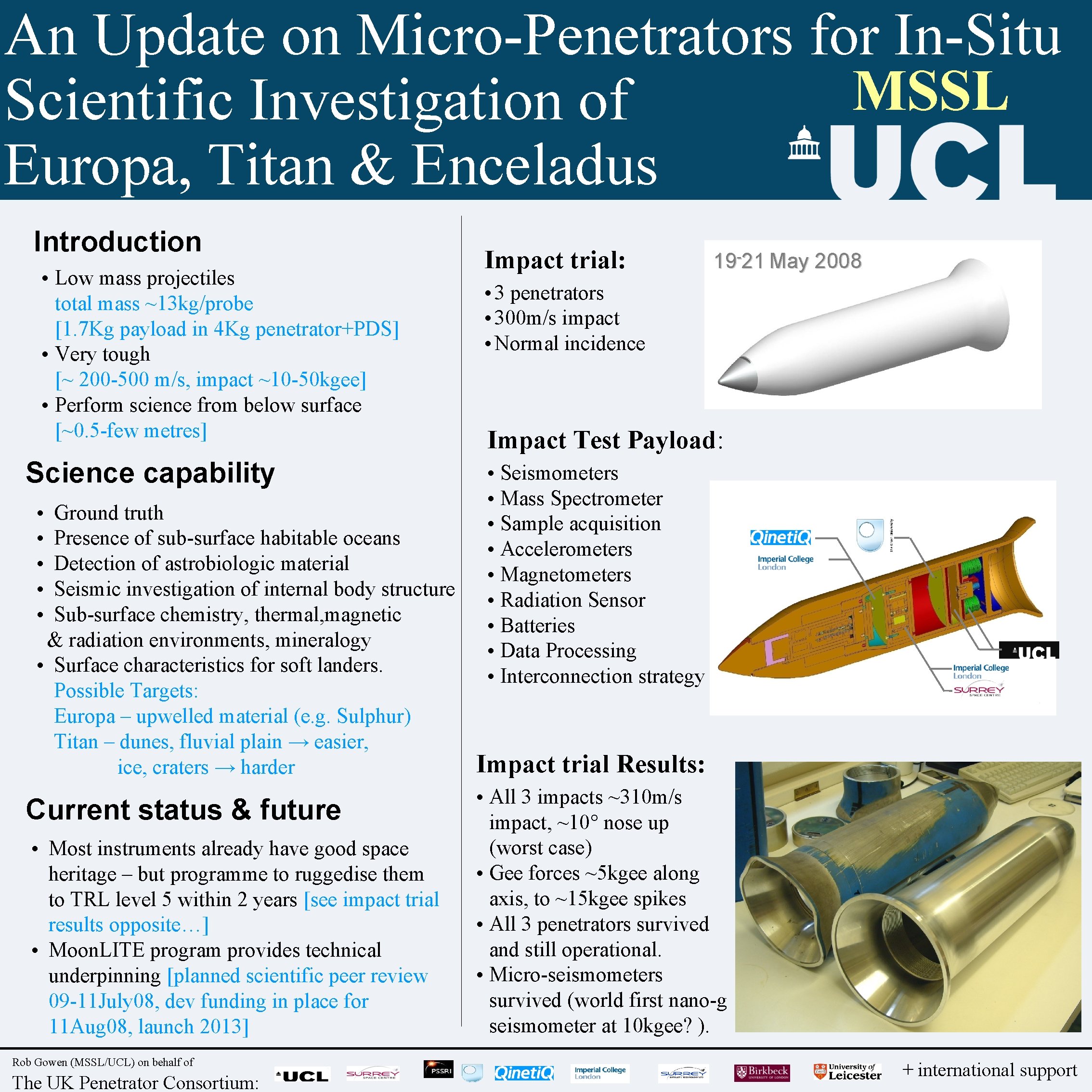
An Update on Micro-Penetrators for In-Situ MSSL Scientific Investigation of Europa, Titan & Enceladus Introduction • Low mass projectiles total mass ~13 kg/probe [1. 7 Kg payload in 4 Kg penetrator+PDS] • Very tough [~ 200 -500 m/s, impact ~10 -50 kgee] • Perform science from below surface [~0. 5 -few metres] Science capability • • • Ground truth Presence of sub-surface habitable oceans Detection of astrobiologic material Seismic investigation of internal body structure Sub-surface chemistry, thermal, magnetic & radiation environments, mineralogy • Surface characteristics for soft landers. Possible Targets: Europa – upwelled material (e. g. Sulphur) Titan – dunes, fluvial plain → easier, ice, craters → harder Current status & future • Most instruments already have good space heritage – but programme to ruggedise them to TRL level 5 within 2 years [see impact trial results opposite…] • Moon. LITE program provides technical underpinning [planned scientific peer review 09 -11 July 08, dev funding in place for 11 Aug 08, launch 2013] Rob Gowen (MSSL/UCL) on behalf of The UK Penetrator Consortium: Impact trial: 19 21 May 2008 • 3 penetrators • 300 m/s impact • Normal incidence Impact Test Payload: • Seismometers • Mass Spectrometer • Sample acquisition • Accelerometers • Magnetometers • Radiation Sensor • Batteries • Data Processing • Interconnection strategy Impact trial Results: • All 3 impacts ~310 m/s impact, ~10 nose up (worst case) • Gee forces ~5 kgee along axis, to ~15 kgee spikes • All 3 penetrators survived and still operational. • Micro-seismometers survived (world first nano-g seismometer at 10 kgee? ). + international support