
An Unstructured Grid Arctic Ocean Model FVCOMArctic Validations

- Slides: 20
An Unstructured Grid Arctic Ocean Model (FVCOM-Arctic): Validations via Observations and Needs for Horizontal Resolution Changsheng Chen 1, Guoping Gao 1, Andrey Proshuntinsky 2 and Robert C. Beardsley 2 1 Department of Fisheries Oceanography University of Massachusetts-Dartmouth (UMASSD), New Bedford, MA 02744 2 Department of Physical Oceanography Woods Hole Oceanographic Institution, Woods Hole, MA 02543 Website: http: //fvcom. smast. umassd. edu E-mail: c 1 chen@umassd. edu; ggao@umassd. edu; aproshuntinsky@whoi. edu; rbeardsley@whoi. edu
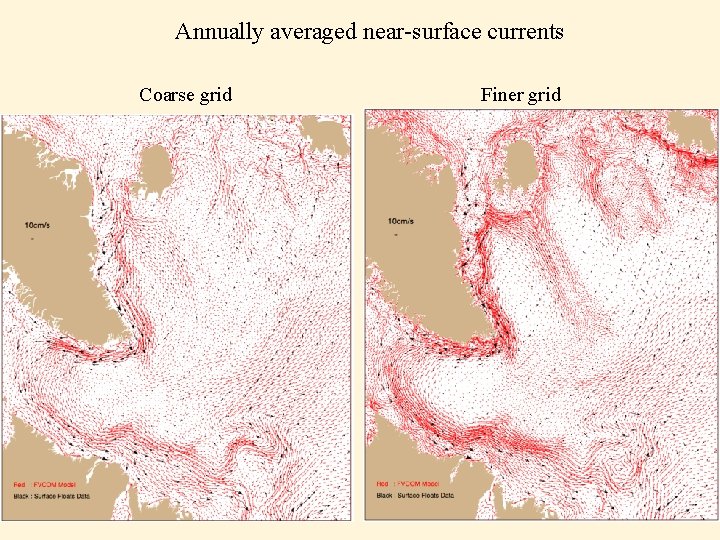
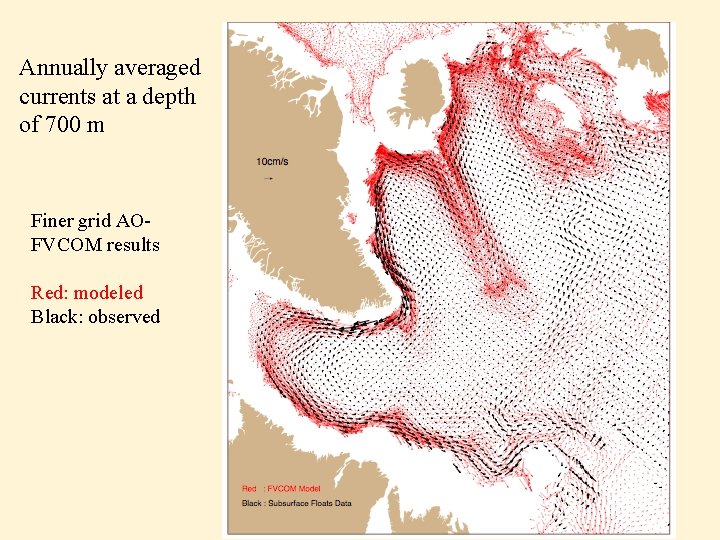
Outline • A brief description of the FVCOM-Arctic system; • Comparison between high- and coarse resolution FVCOMArctic results; • Comparison with the observations, with focus on water currents.
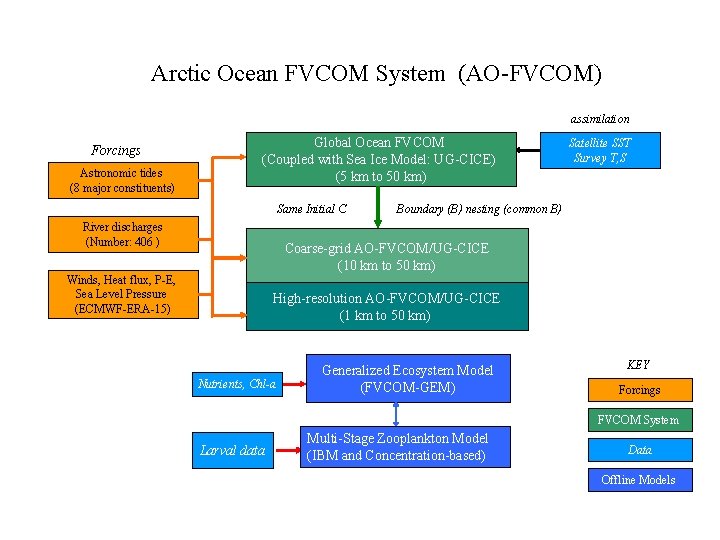
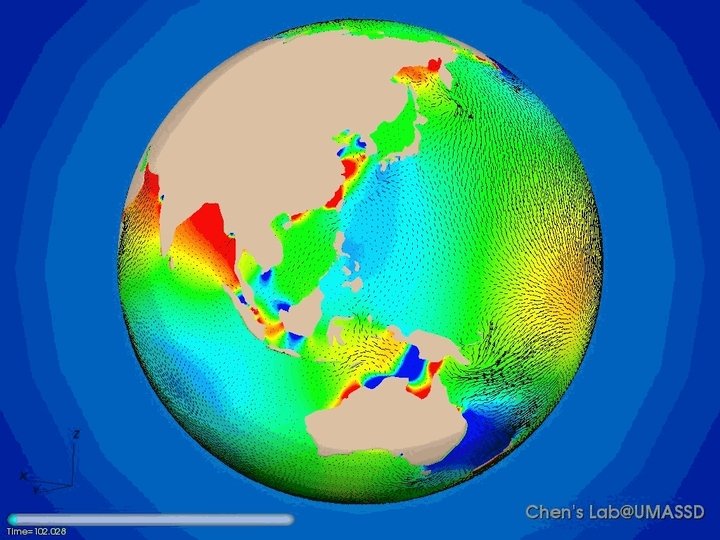
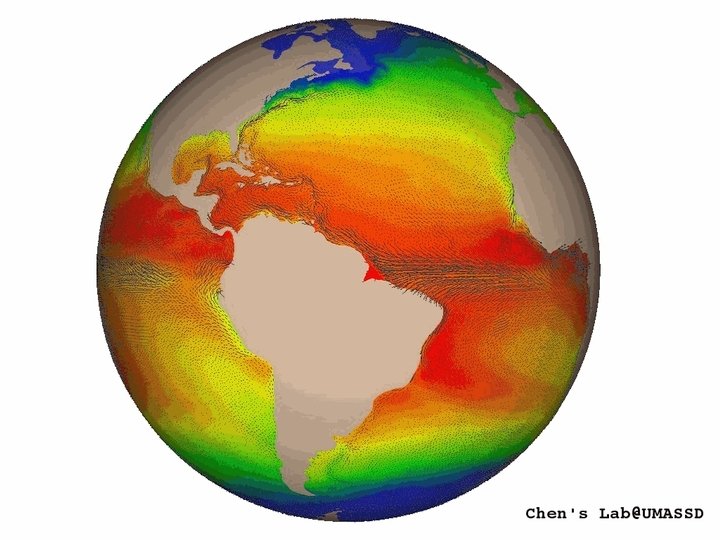
Arctic Ocean FVCOM System (AO-FVCOM) assimilation Forcings Astronomic tides (8 major constituents) Global Ocean FVCOM (Coupled with Sea Ice Model: UG-CICE) (5 km to 50 km) Same Initial C River discharges (Number: 406 ) Satellite SST Survey T, S Boundary (B) nesting (common B) Coarse-grid AO-FVCOM/UG-CICE (10 km to 50 km) Winds, Heat flux, P-E, Sea Level Pressure (ECMWF-ERA-15) High-resolution AO-FVCOM/UG-CICE (1 km to 50 km) Nutrients, Chl-a Generalized Ecosystem Model (FVCOM-GEM) KEY Forcings FVCOM System Larval data Multi-Stage Zooplankton Model (IBM and Concentration-based) Data Offline Models
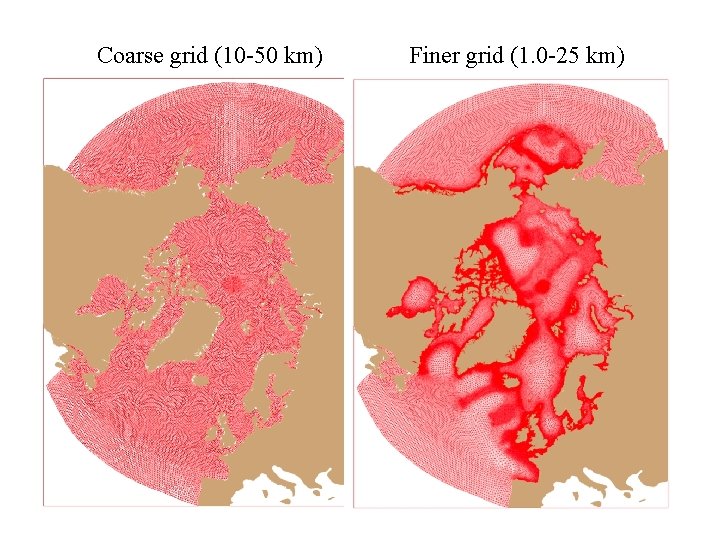
Coarse grid (10 -50 km) Finer grid (1. 0 -25 km)
Procedures used in the experiment Spin up the FVCOM-Global for 50 years with inclusion of the data assimilation of water temperature and salinity on a monthly base. Forcing: daily meteorological forcing (ECMWF-ERA-15), river discharges, and tides. Initialize AO-FVCOM with FVCOM-Global fields and run AO-FVCOM through a mass conservative nesting boundary provided by FVCOM-Global. This applies for both high-and coarse resolution cases.
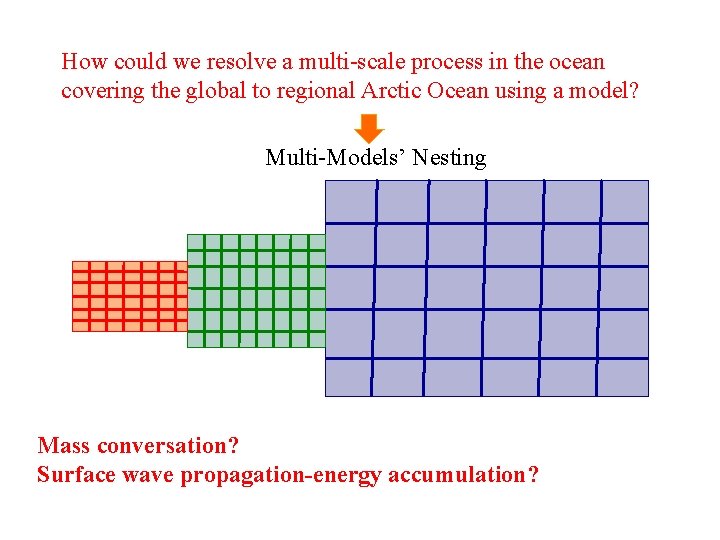
How could we resolve a multi-scale process in the ocean covering the global to regional Arctic Ocean using a model? Multi-Models’ Nesting Mass conversation? Surface wave propagation-energy accumulation?
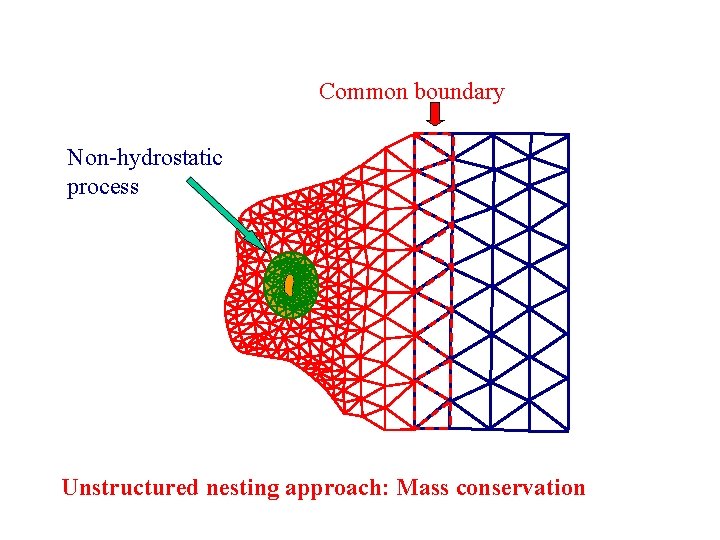
Common boundary Non-hydrostatic process Unstructured nesting approach: Mass conservation
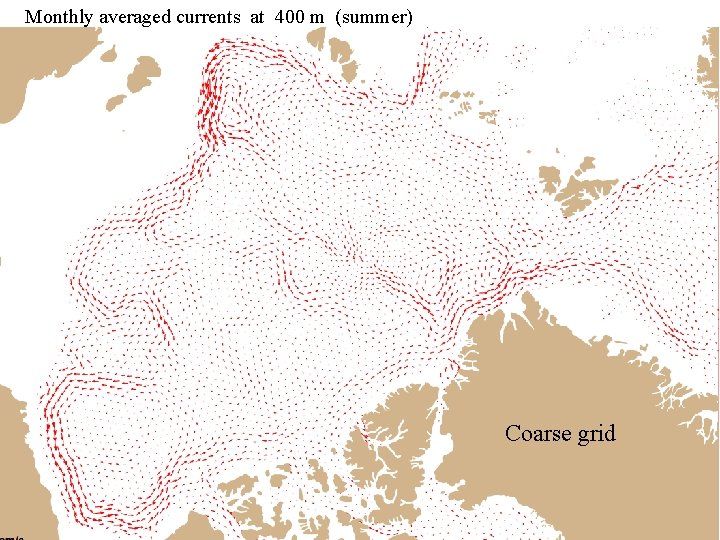
Monthly averaged currents at 400 m (summer) Coarse grid
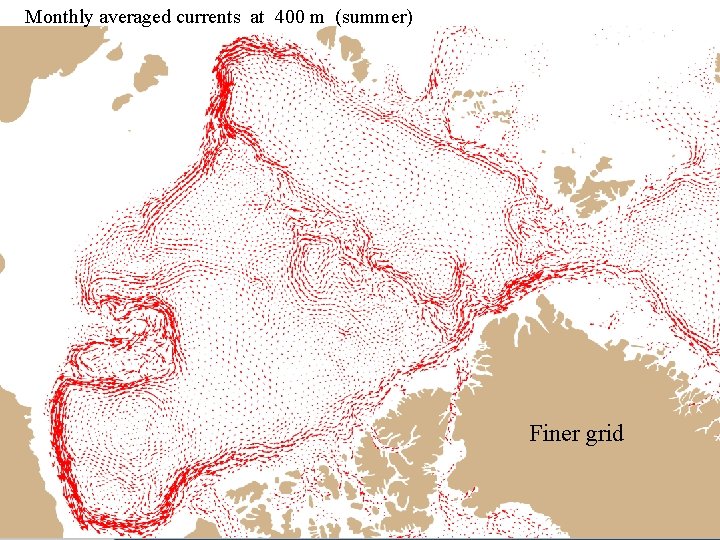
Monthly averaged currents at 400 m (summer) Finer grid
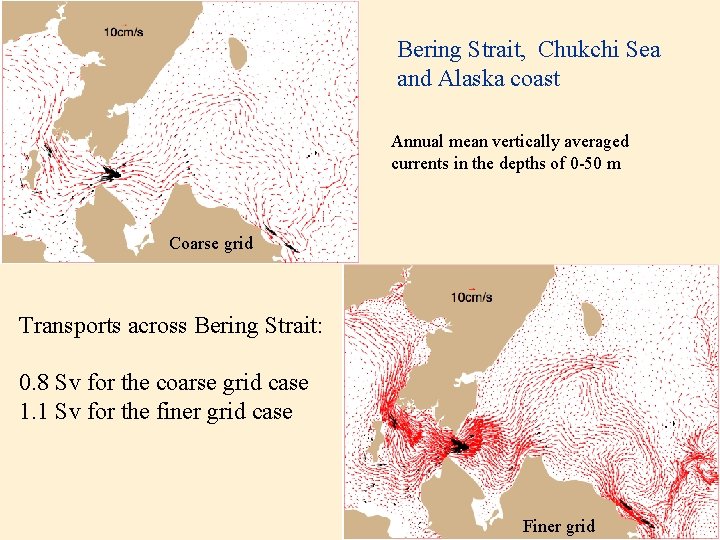
Bering Strait, Chukchi Sea and Alaska coast Annual mean vertically averaged currents in the depths of 0 -50 m Coarse grid Transports across Bering Strait: 0. 8 Sv for the coarse grid case 1. 1 Sv for the finer grid case Finer grid
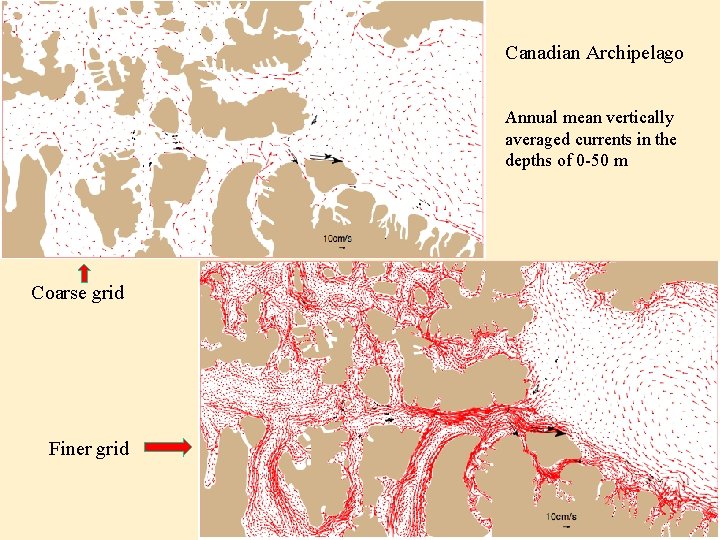
Canadian Archipelago Annual mean vertically averaged currents in the depths of 0 -50 m Coarse grid Finer grid
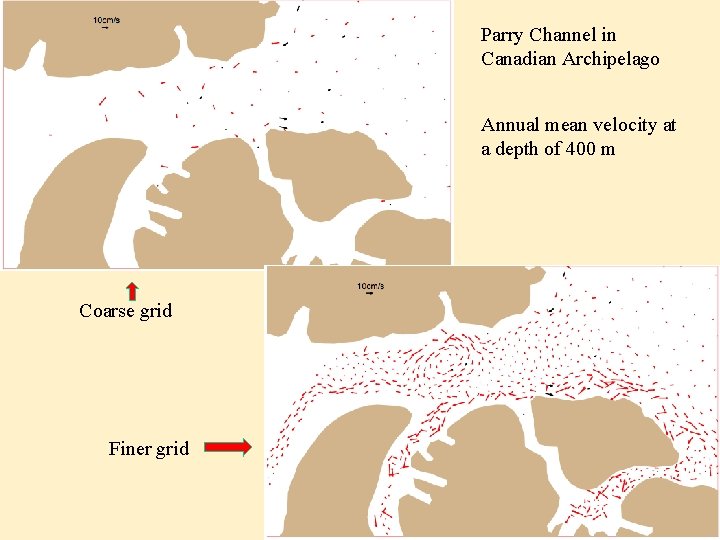
Parry Channel in Canadian Archipelago Annual mean velocity at a depth of 400 m Coarse grid Finer grid
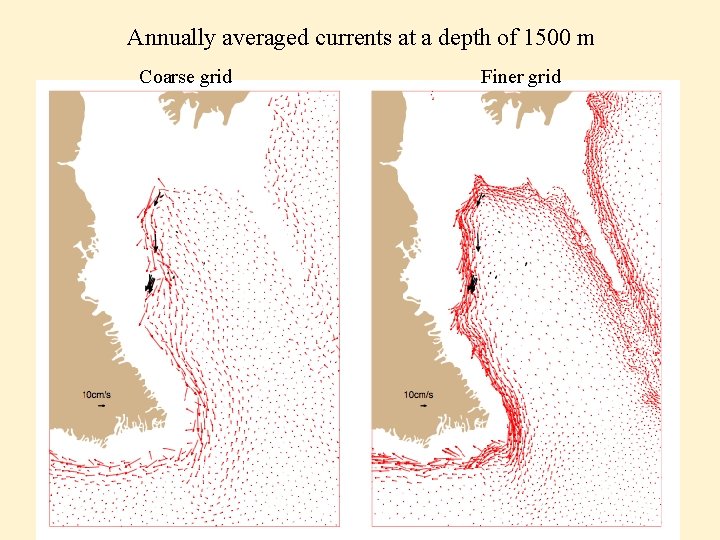
Annually averaged currents at a depth of 1500 m Coarse grid Finer grid
Annually averaged near-surface currents Coarse grid Finer grid
Annually averaged currents at a depth of 700 m Finer grid AOFVCOM results Red: modeled Black: observed
Summary AO-FVCOM provides a new model tool for the study of the Arctic Ocean. By resolving the complex coastal geometry and steep bottom topography, FVCOM is robust to capture the complex structures of water currents in the Arctic Ocean and adjacent regions An attention is needed for the horizontal resolution of the model in order to capture the cross-shelf scale and intensity of the currents over the slope and in the regions characterized with complex geometries.