
An uncertainty quantification and aggregation framework for system


- Slides: 22
An uncertainty quantification and aggregation framework for system performance assessment in industrial maintenance Presenting author: Alex Grenyer Email: a. h. grenyer@cranfield. ac. uk By Alex Grenyer, John Ahmet Erkoyuncu, Sri Addepalli and Yifan Zhao 03/11/2020 www. through-life-engineering-services. org
Overview • Introduction • Research background • Framework development • Framework implementation • Discussion & conclusions 2 © Cranfield University 2020
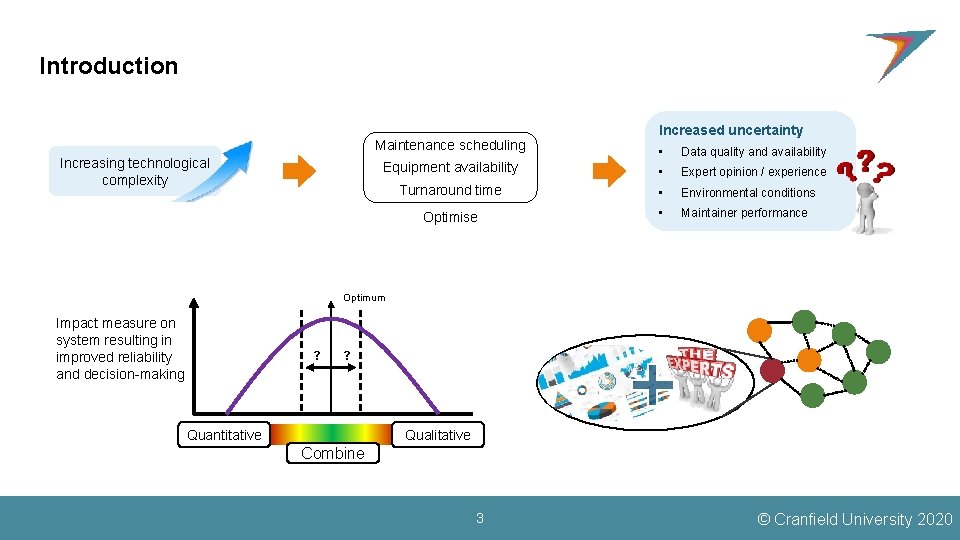
Introduction Maintenance scheduling Increasing technological complexity Increased uncertainty • Data quality and availability Equipment availability • Expert opinion / experience Turnaround time • Environmental conditions Optimise • Maintainer performance Optimum Impact measure on system resulting in improved reliability and decision-making ? ? Quantitative Qualitative Combine 3 © Cranfield University 2020
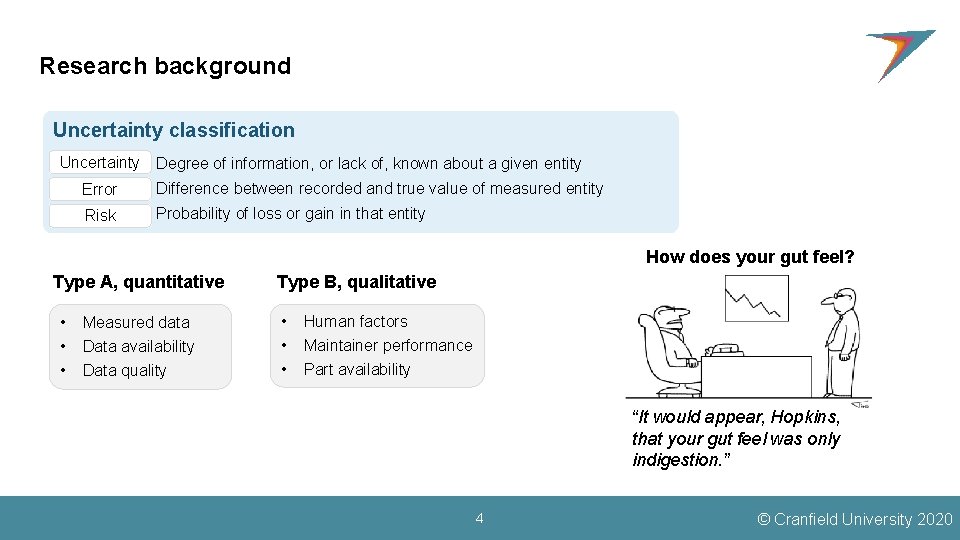
Research background Uncertainty classification Uncertainty Degree of information, or lack of, known about a given entity Error Difference between recorded and true value of measured entity Risk Probability of loss or gain in that entity How does your gut feel? Type A, quantitative • • • Measured data Data availability Data quality Type B, qualitative • • • Human factors Maintainer performance Part availability “It would appear, Hopkins, that your gut feel was only indigestion. ” 4 © Cranfield University 2020
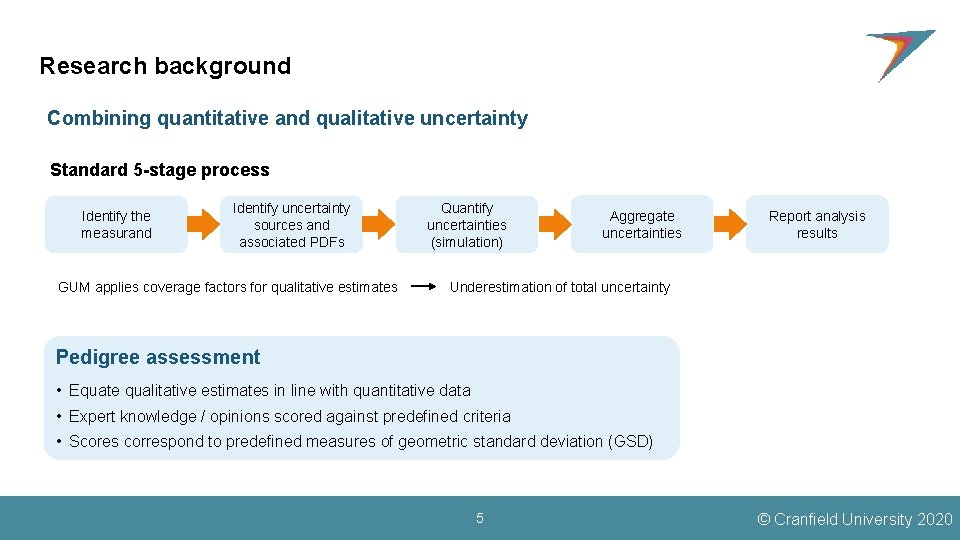
Research background Combining quantitative and qualitative uncertainty Standard 5 -stage process Identify the measurand Identify uncertainty sources and associated PDFs GUM applies coverage factors for qualitative estimates Quantify uncertainties (simulation) Aggregate uncertainties Report analysis results Underestimation of total uncertainty Pedigree assessment • Equate qualitative estimates in line with quantitative data • Expert knowledge / opinions scored against predefined criteria • Scores correspond to predefined measures of geometric standard deviation (GSD) 5 © Cranfield University 2020
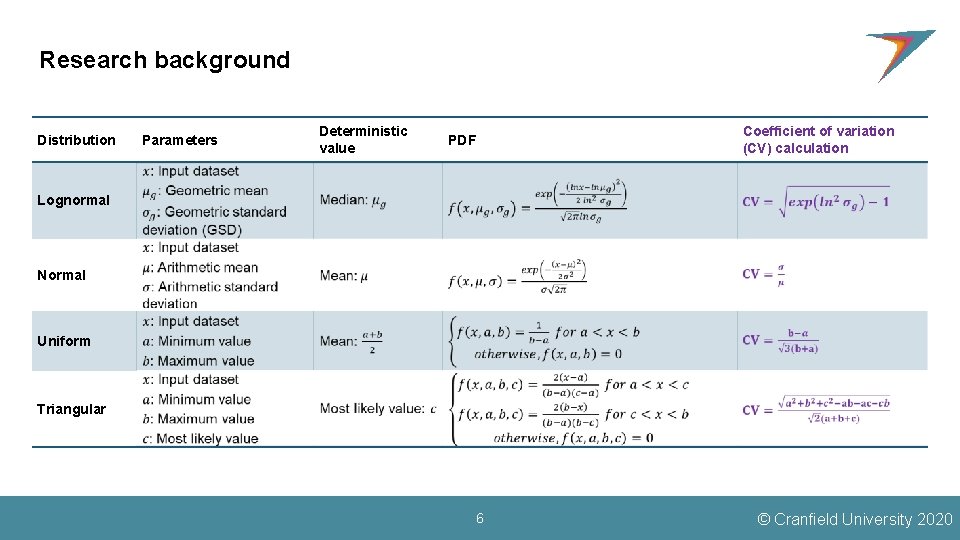
Research background Distribution Parameters Deterministic value Coefficient of variation (CV) calculation PDF Lognormal Normal Uniform Triangular 6 © Cranfield University 2020
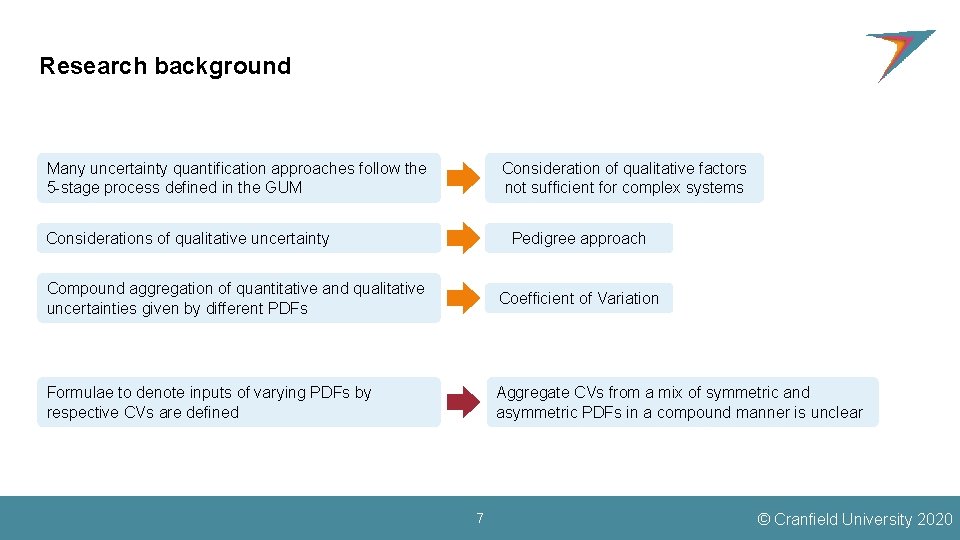
Research background Many uncertainty quantification approaches follow the 5 -stage process defined in the GUM Consideration of qualitative factors not sufficient for complex systems Considerations of qualitative uncertainty Pedigree approach Compound aggregation of quantitative and qualitative uncertainties given by different PDFs Coefficient of Variation Formulae to denote inputs of varying PDFs by respective CVs are defined Aggregate CVs from a mix of symmetric and asymmetric PDFs in a compound manner is unclear 7 © Cranfield University 2020
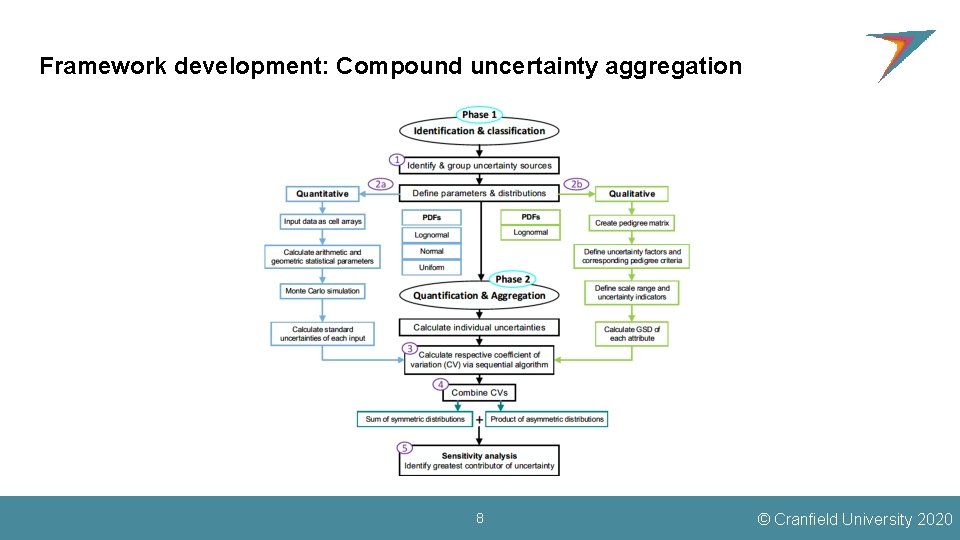
Framework development: Compound uncertainty aggregation 8 © Cranfield University 2020
Framework development: Compound uncertainty aggregation Step 1 2 2 a 9 © Cranfield University 2020
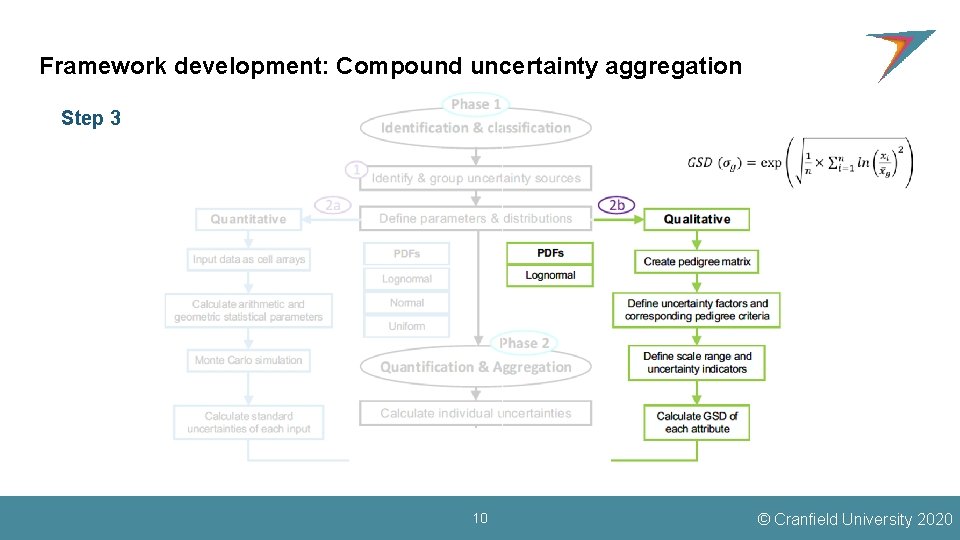
Framework development: Compound uncertainty aggregation Step 3 2 b 10 © Cranfield University 2020
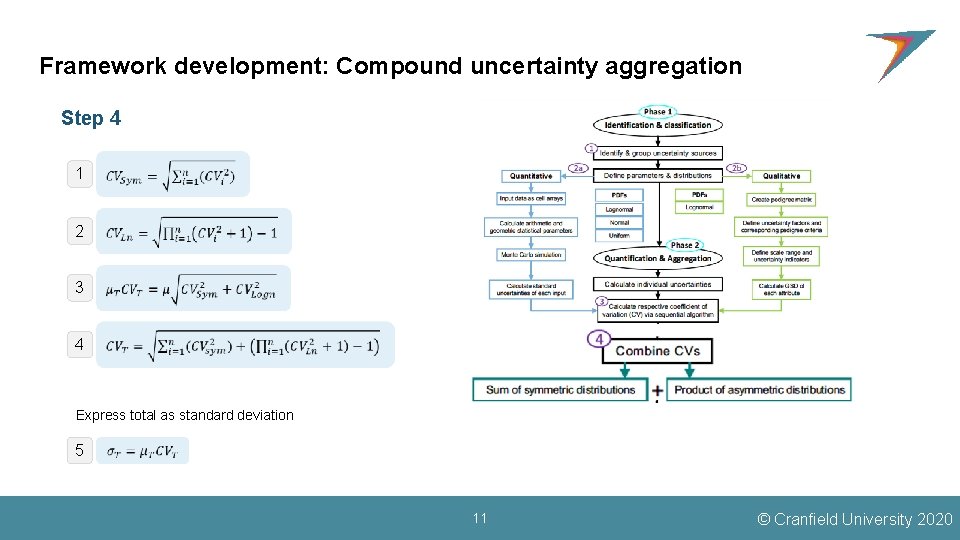
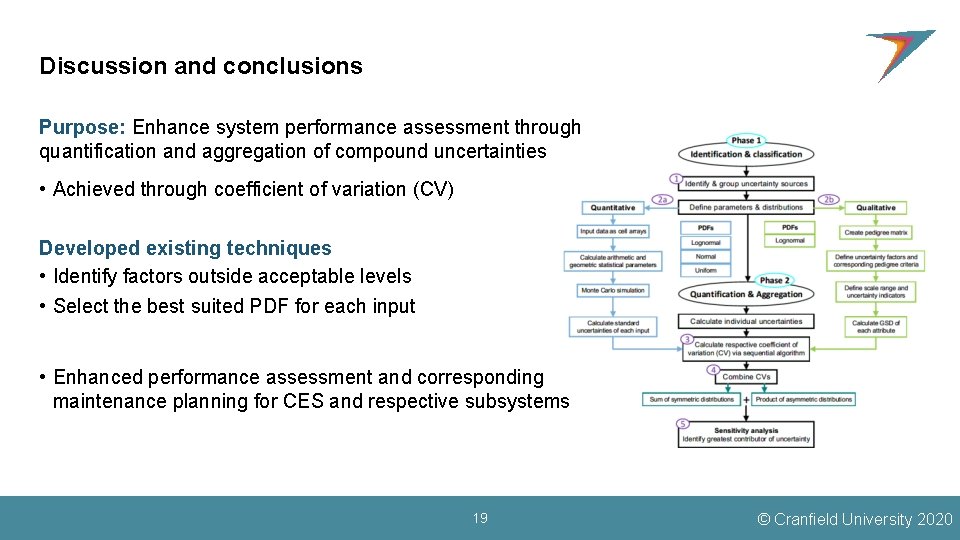
Framework development: Compound uncertainty aggregation Step 4 1 2 3 4 Express total as standard deviation 5 11 © Cranfield University 2020
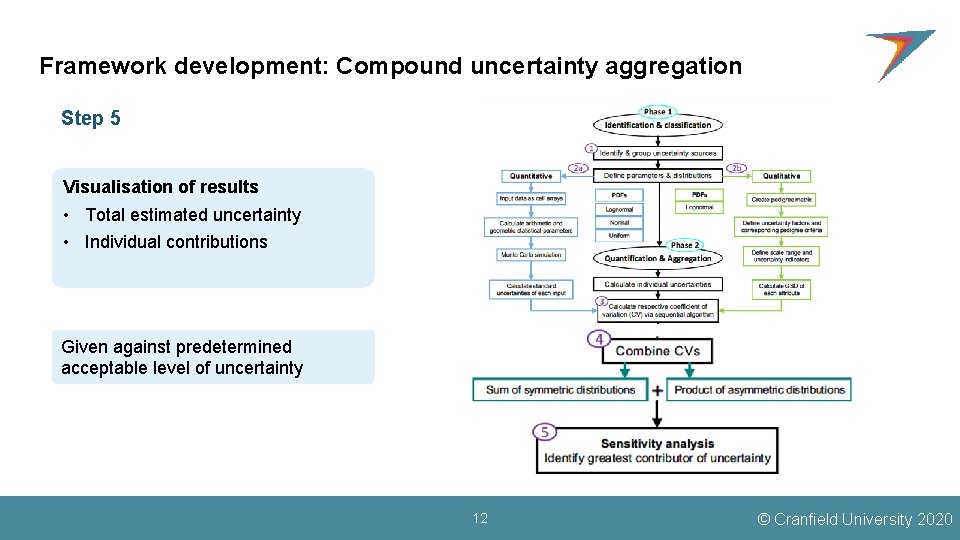
Framework development: Compound uncertainty aggregation Step 5 Visualisation of results • Total estimated uncertainty • Individual contributions Given against predetermined acceptable level of uncertainty 12 © Cranfield University 2020
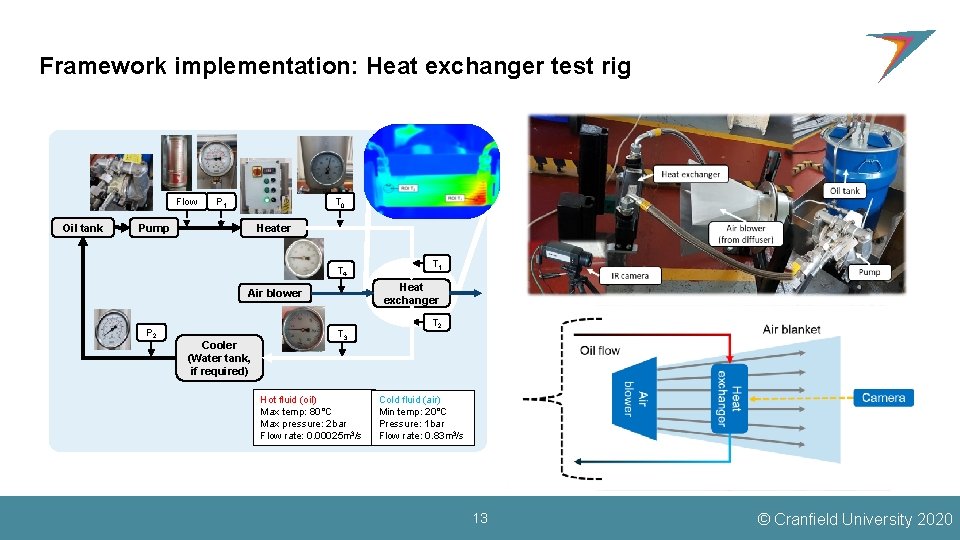
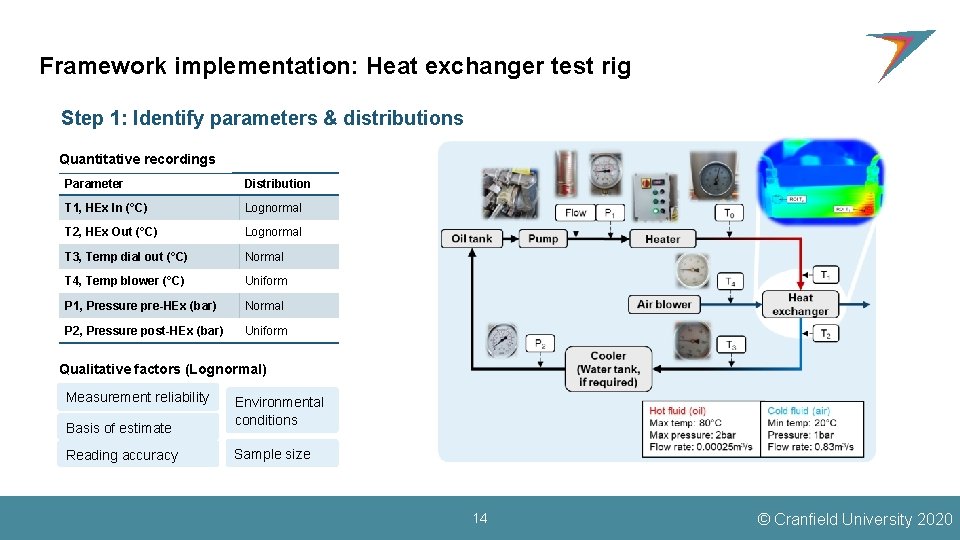
Framework implementation: Heat exchanger test rig Flow Oil tank P 1 T 0 Pump Heater T 4 Heat exchanger Air blower P 2 Cooler (Water tank, if required) T 1 T 3 Hot fluid (oil) Max temp: 80°C Max pressure: 2 bar Flow rate: 0. 00025 m 3/s T 2 Cold fluid (air) Min temp: 20°C Pressure: 1 bar Flow rate: 0. 83 m 3/s 13 © Cranfield University 2020
Framework implementation: Heat exchanger test rig Step 1: Identify parameters & distributions Quantitative recordings Parameter Distribution T 1, HEx In (°C) Lognormal T 2, HEx Out (°C) Lognormal T 3, Temp dial out (°C) Normal T 4, Temp blower (°C) Uniform P 1, Pressure pre-HEx (bar) Normal P 2, Pressure post-HEx (bar) Uniform Qualitative factors (Lognormal) Measurement reliability Basis of estimate Reading accuracy Environmental conditions Sample size 14 © Cranfield University 2020
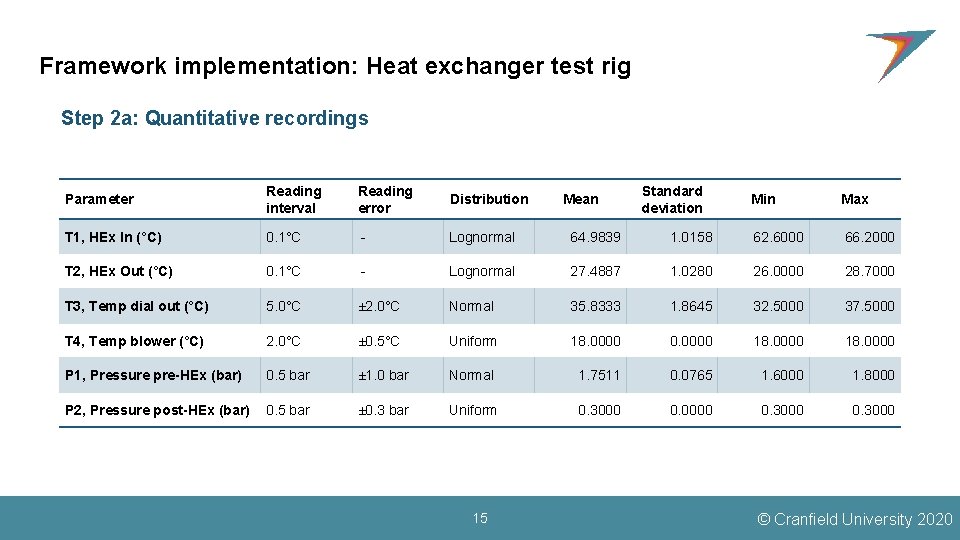
Framework implementation: Heat exchanger test rig Step 2 a: Quantitative recordings Parameter Reading interval Reading error Distribution T 1, HEx In (°C) 0. 1°C - Lognormal 64. 9839 T 2, HEx Out (°C) 0. 1°C - Lognormal T 3, Temp dial out (°C) 5. 0°C ± 2. 0°C T 4, Temp blower (°C) 2. 0°C P 1, Pressure pre-HEx (bar) P 2, Pressure post-HEx (bar) Standard deviation Min Max 1. 0158 62. 6000 66. 2000 27. 4887 1. 0280 26. 0000 28. 7000 Normal 35. 8333 1. 8645 32. 5000 37. 5000 ± 0. 5°C Uniform 18. 0000 0. 0000 18. 0000 0. 5 bar ± 1. 0 bar Normal 1. 7511 0. 0765 1. 6000 1. 8000 0. 5 bar ± 0. 3 bar Uniform 0. 3000 0. 0000 0. 3000 15 Mean © Cranfield University 2020
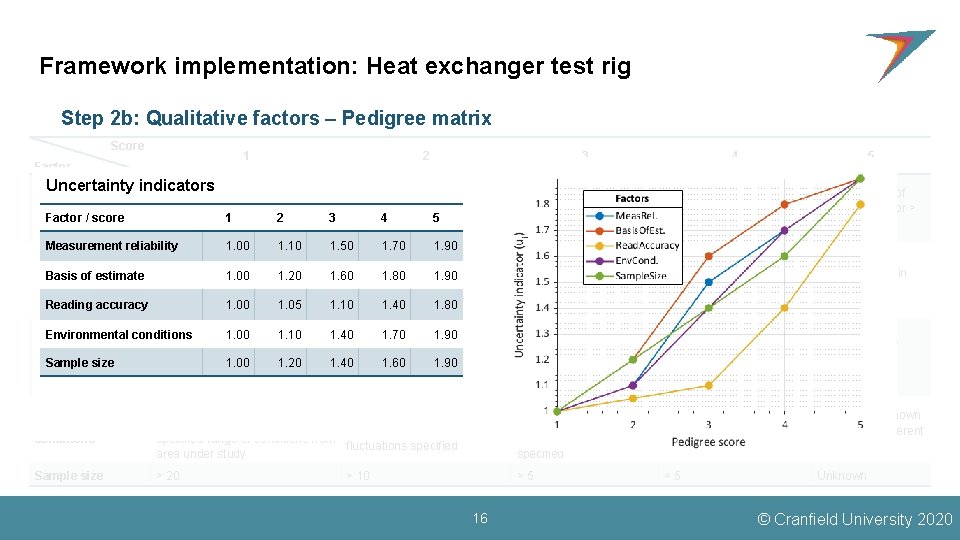
Framework implementation: Heat exchanger test rig Step 2 b: Qualitative factors – Pedigree matrix Score 1 Factor 2 3 Uncertainty indicators Data is < 2 months old and/or Data is < 6 months old and/or Measurement recorded by fully calibrated reliability sensor 4 or fully qualified Factor / score 5 sensor or fully 1 qualified 2 person 3 person Measurement reliability 1. 50 1. 70 1. 90 Best possible 1. 00 data, use 1. 10 of Smaller sample of historical field data, validated data, parametric estimates, Basis of estimate 1. 00 1. 20 1. 80 1. 90 Basis of estimate tools and independently verified 1. 60 internally verified data, some data, given by fully qualified experience area Reading accuracy 1. 00 1. 05 1. 10 1. 40 in the 1. 80 expert 4 5 Data is < 12 months old and/or recorded by fully qualified person Data is > 12 months old and/or recorded by fully qualified person Age or source of data unknown or > 12 months old Limited available data, unverified, inexperienced opinions Incomplete data, small sample, educated guesses, indirect approximate rule of thumb estimate No experience in the data Measurements taken using recently calibrated but less accurate equipment: >± 1. 0°C, >± 1. 0 bar Measurements taken using accurate equipment that may need recalibrating Measurements taken using uncalibrated and inaccurate equipment Environmental conditions Data recorded under specific Data recorded in generally consistent conditions or a consistent conditions with specified range of conditions from fluctuations specified area under study Data recorded in generally consistent conditions, changes not specified Data recorded in a range of unspecified conditions Data from unknown or distinctly different areas Sample size > 20 >5 <5 Unknown Environmental conditions 1. 00 1. 10 1. 40 1. 70 1. 90 using Measurements taken using fully recently calibrated but less Reading calibrated and 1. 00 accurate 1. 20 Sampleaccuracy size 1. 40 1. 60 1. 90 ± 0. 5°C, accurate equipment: ± 0. 1°C, ± 0. 1 bar ± 0. 5 bar > 10 16 © Cranfield University 2020
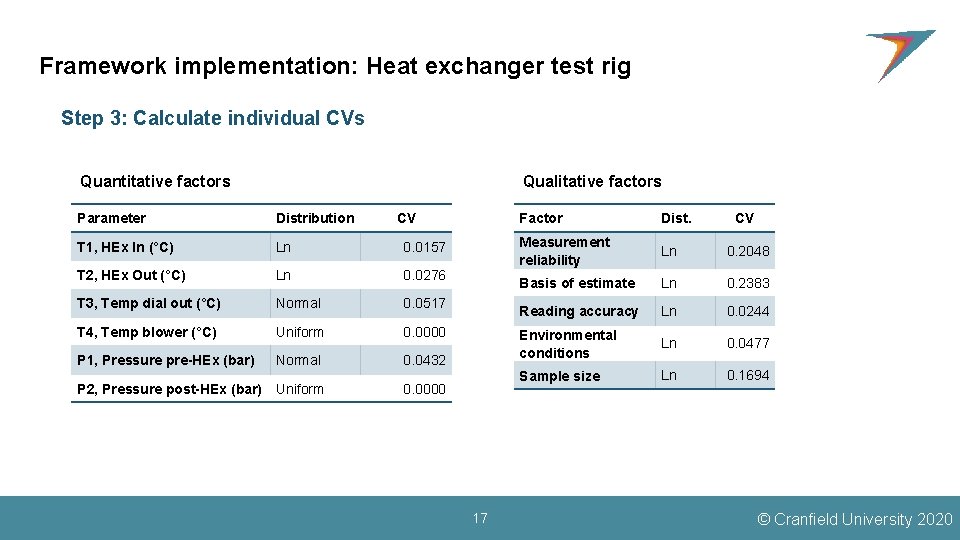
Framework implementation: Heat exchanger test rig Step 3: Calculate individual CVs Quantitative factors Qualitative factors Parameter Distribution CV T 1, HEx In (°C) Ln 0. 0157 T 2, HEx Out (°C) Ln 0. 0276 T 3, Temp dial out (°C) Normal 0. 0517 T 4, Temp blower (°C) Uniform 0. 0000 P 1, Pressure pre-HEx (bar) Normal 0. 0432 P 2, Pressure post-HEx (bar) Uniform 0. 0000 17 Factor Dist. CV Measurement reliability Ln 0. 2048 Basis of estimate Ln 0. 2383 Reading accuracy Ln 0. 0244 Environmental conditions Ln 0. 0477 Sample size Ln 0. 1694 © Cranfield University 2020
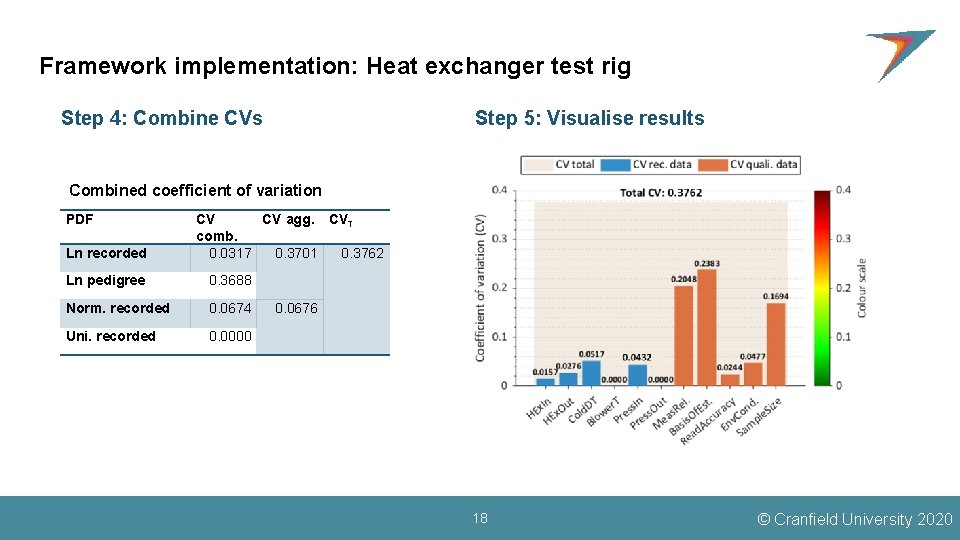
Framework implementation: Heat exchanger test rig Step 4: Combine CVs Step 5: Visualise results Combined coefficient of variation PDF Ln recorded CV CV agg. CVT comb. 0. 0317 0. 3701 0. 3762 Ln pedigree 0. 3688 Norm. recorded 0. 0674 Uni. recorded 0. 0000 0. 0676 18 © Cranfield University 2020
Discussion and conclusions Purpose: Enhance system performance assessment through quantification and aggregation of compound uncertainties • Achieved through coefficient of variation (CV) Developed existing techniques • Identify factors outside acceptable levels • Select the best suited PDF for each input • Enhanced performance assessment and corresponding maintenance planning for CES and respective subsystems 19 © Cranfield University 2020
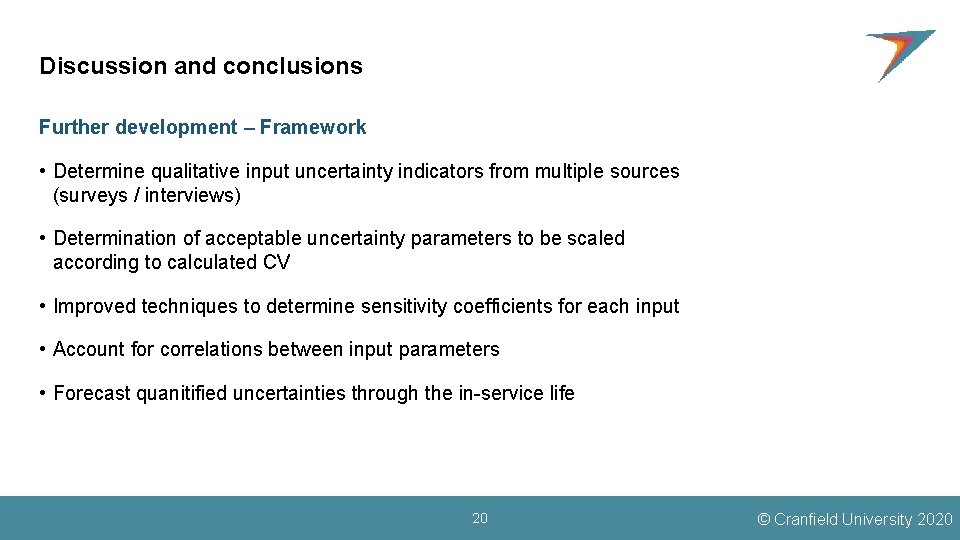
Discussion and conclusions Further development – Framework • Determine qualitative input uncertainty indicators from multiple sources (surveys / interviews) • Determination of acceptable uncertainty parameters to be scaled according to calculated CV • Improved techniques to determine sensitivity coefficients for each input • Account for correlations between input parameters • Forecast quanitified uncertainties through the in-service life 20 © Cranfield University 2020
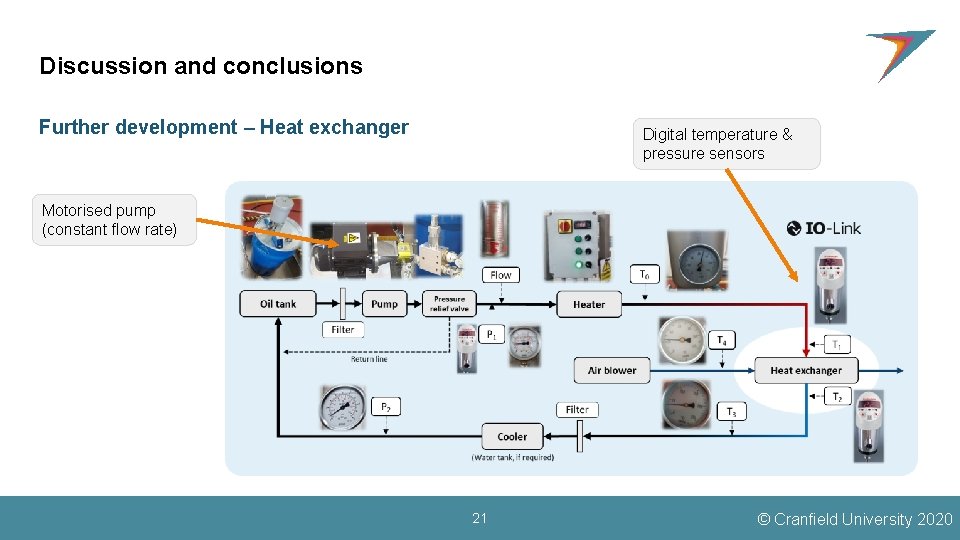
Discussion and conclusions Further development – Heat exchanger Digital temperature & pressure sensors Motorised pump (constant flow rate) 21 © Cranfield University 2020
Alex Grenyer Ph. D Researcher Cranfield University E: a. h. grenyer@cranfield. ac. uk www. through-life-engineering-services. org