
An overview Speculative fiction is the literature of

- Slides: 25
An overview Speculative fiction is the literature of change - It creates a world where anything can happen, limited only by the mind of the writer. It is a place both beyond and within reality, a place that could have been, or might be, if only the rules of the Universe were altered just a bit. Speculative fiction allows one to go beyond the mundane nature of the everyday world, into a realm of magic, fantasy, myth, or science – so could such a world still maintain notion of what is a ‘natural’ role and representation?
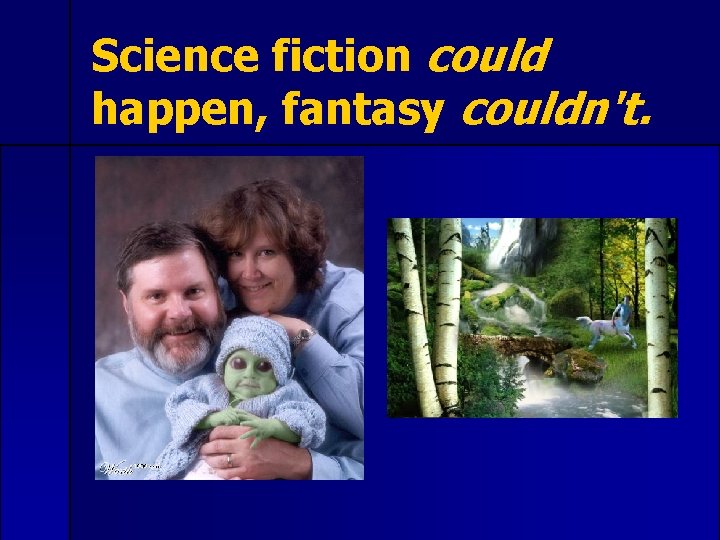
Science fiction could happen, fantasy couldn't.
A fantasy Recipe "Take a vaguely medieval world. Add a problem, sometimes more or less ecological Add a prophecy for solving it involving a quest. Introduce one powerful villain with no particular characteristics except a nearly all-powerful badness. Give him a convenient blind spot. Pour in enough mythological creatures and nonhuman races to fill out a number of secondary episodes: fighting a dragon, riding a winged horse, stopping overnight with the elves To the mixture, add one naive and ordinary hero who will prove to be the prophesized saviour; Give him a comic sidekick and a wise old advisor who can rescue him from time to time and explain the plot. Keep stirring until the whole thing congeals. "
Today, fantasy has evolved into a unique genre. The four main sources of fantasy today are as follows: n 1. The world's supply of myths, legends, and religions n 2. Folk stories and traditions in nineteenth century Europe n 3. The creation of "sword and sorcery" in the American graphic novels/comics n 4. The overwhelming success of J. R. R Tolkien's The Lord of the Rings (first published in 1945 -55 and dominated the genre from the 1960 s up to present. )
Evolution of fantasy n n Fantasy, in its archaic form, dealt with the fairy tale and the heroic epic - and the corresponding issues of education, personality, morality, duty and relationship that went along with such an exploration. Supernatural tales were a way of relating ordinary themes of everyday life in extraordinary ways, thus inspiring the reader not only to magical worlds of disbelief, but also, educating him on important issues which were universal in nature. Fantasy, contrary to its name, always carries an element of truth within it. n n Fantasy provides our modern, materialistic and so-called ‘enlightened’ culture with a sense of spirituality or a numinous mysticism. Fantasy has its roots in mythology, as do most religions, and is attempting to see beyond the mere physical reality of our world.
Definition of fantasy as 'imagination unrestricted by reality' n Fantasy is potent exactly because it is free and unrestrained, which also makes it dangerous and subversive n Fantasy is an elusive and protean element that breaks down traditions and boundaries, which is exactly what good literature should do.
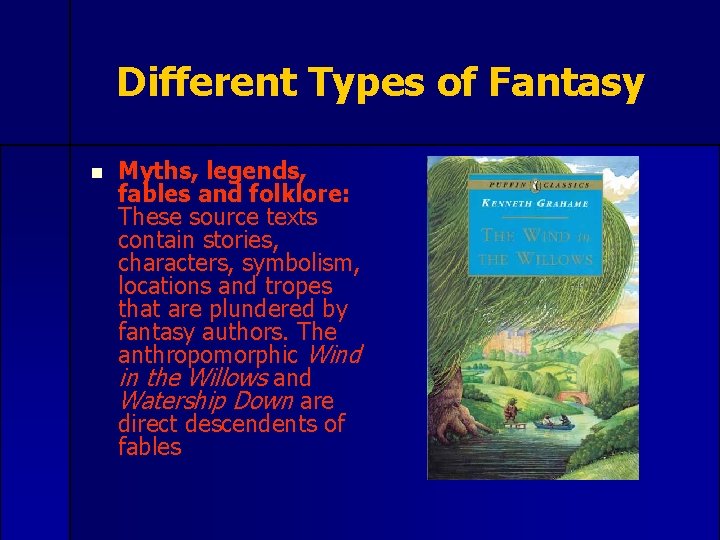
Different Types of Fantasy n Myths, legends, fables and folklore: These source texts contain stories, characters, symbolism, locations and tropes that are plundered by fantasy authors. The anthropomorphic Wind in the Willows and Watership Down are direct descendents of fables
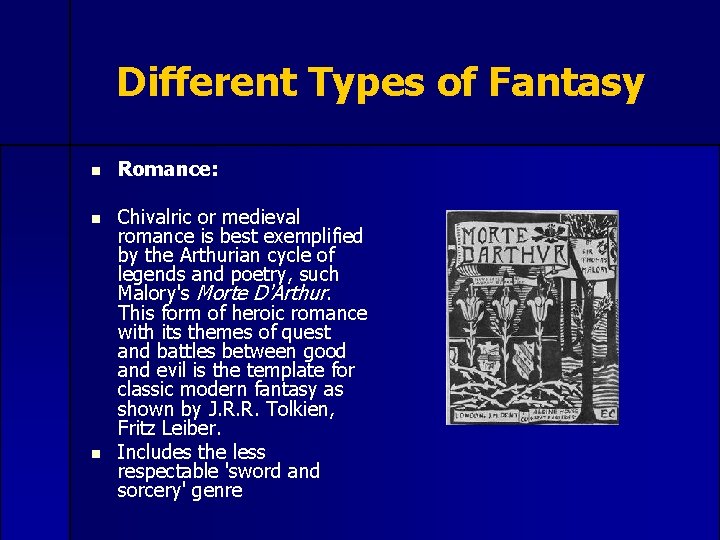
Different Types of Fantasy n Romance: n Chivalric or medieval romance is best exemplified by the Arthurian cycle of legends and poetry, such Malory's Morte D'Arthur. This form of heroic romance with its themes of quest and battles between good and evil is the template for classic modern fantasy as shown by J. R. R. Tolkien, Fritz Leiber. Includes the less respectable 'sword and sorcery' genre n
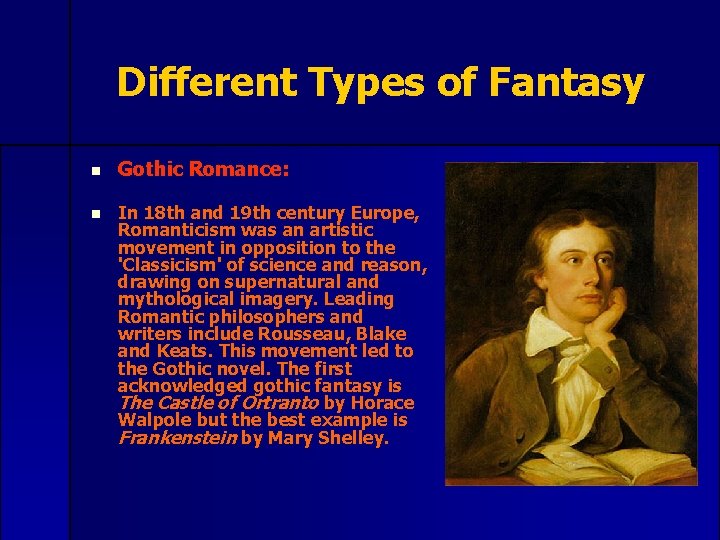
Different Types of Fantasy n n Gothic Romance: In 18 th and 19 th century Europe, Romanticism was an artistic movement in opposition to the 'Classicism' of science and reason, drawing on supernatural and mythological imagery. Leading Romantic philosophers and writers include Rousseau, Blake and Keats. This movement led to the Gothic novel. The first acknowledged gothic fantasy is The Castle of Ortranto by Horace Walpole but the best example is Frankenstein by Mary Shelley.
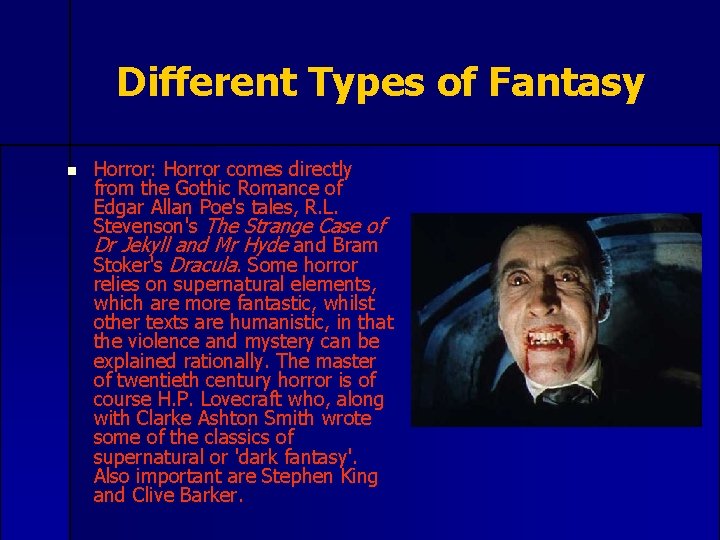
Different Types of Fantasy n Horror: Horror comes directly from the Gothic Romance of Edgar Allan Poe's tales, R. L. Stevenson's The Strange Case of Dr Jekyll and Mr Hyde and Bram Stoker's Dracula. Some horror relies on supernatural elements, which are more fantastic, whilst other texts are humanistic, in that the violence and mystery can be explained rationally. The master of twentieth century horror is of course H. P. Lovecraft who, along with Clarke Ashton Smith wrote some of the classics of supernatural or 'dark fantasy'. Also important are Stephen King and Clive Barker.
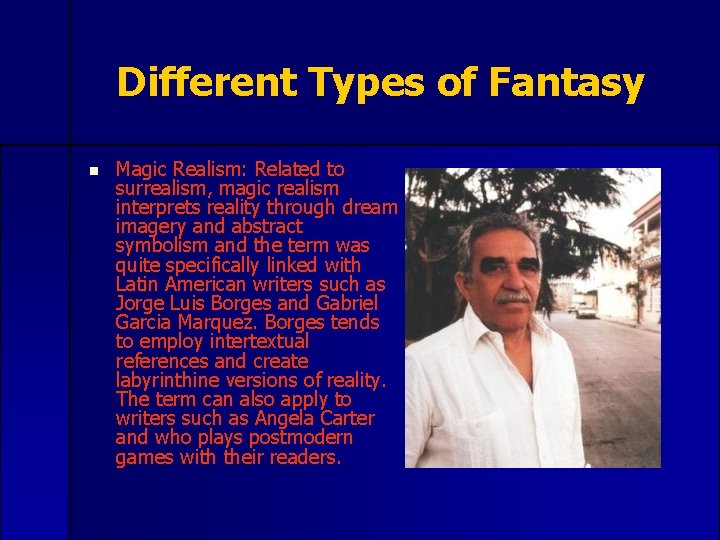
Different Types of Fantasy n Magic Realism: Related to surrealism, magic realism interprets reality through dream imagery and abstract symbolism and the term was quite specifically linked with Latin American writers such as Jorge Luis Borges and Gabriel Garcia Marquez. Borges tends to employ intertextual references and create labyrinthine versions of reality. The term can also apply to writers such as Angela Carter and who plays postmodern games with their readers.
Different Types of Fantasy n n Urban Fantasy: Some fantasy is set in a real city or one so realistic that reality and fantasy become blurred at the edges - thus fantastic realism. Slipstream: A term devised by Bruce Sterling to categorise postmodern writers who react against reality without their books being explicitly fantasy or sf, such as Peter Ackroyd and J. G. Ballard. n Fabulation: Writers of fabulation tend to break generic boundaries and their mainstream books use fantasy to subvert reality e. g. Anthony Burgess, William Burroughs, Italo Calvino, Umberto Eco, Franz Kafka and Michael Moorcock.
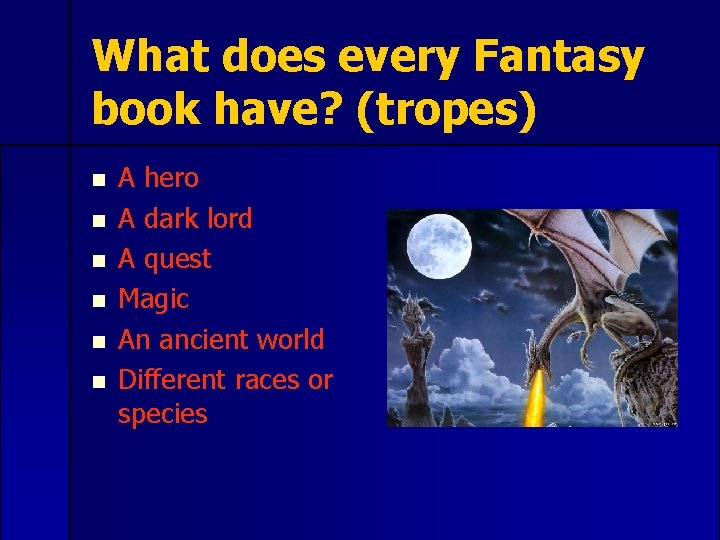
What does every Fantasy book have? (tropes) n n n A hero A dark lord A quest Magic An ancient world Different races or species
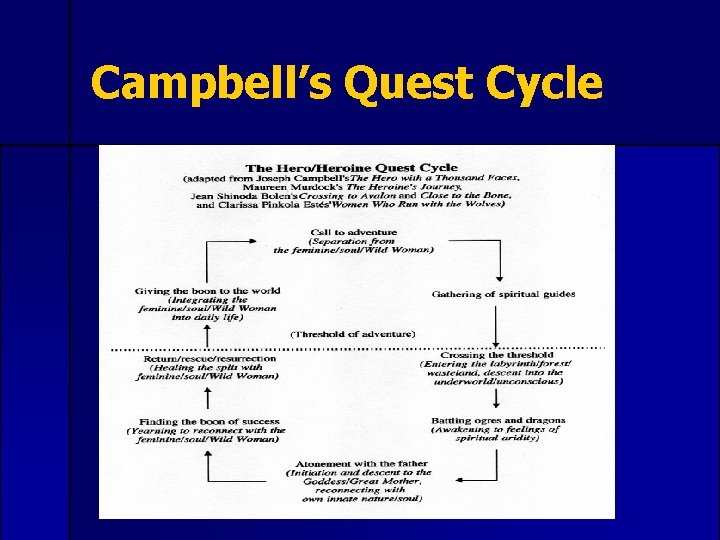
Campbell’s Quest Cycle
Your task Take a film, book or TV show n Think of the hero/main character n Use the diagram and fill in their Quest cycle n
Reflective writing n n What is it? What examples are most common? What examples might we see? How do we do it?
What is reflective writing? Essentially, thinking about what has happened and writing about it n People have been writing reflectively for as long as people have been writing n
Why reflect? Lets us record our reactions n Basis for discussion n Challenges us n Lets us share insight and deep thinking n Allows us to improve when sharing with others. n
Examples of reflective writing Journals n Autobiographies n Diaries n Songs n Poetry n Any you can think of? n
So how do we do it? n Your assessment will ask you to reflect on what you’ve read in The Hobbit n Each question will reflect where you should be up to in the book
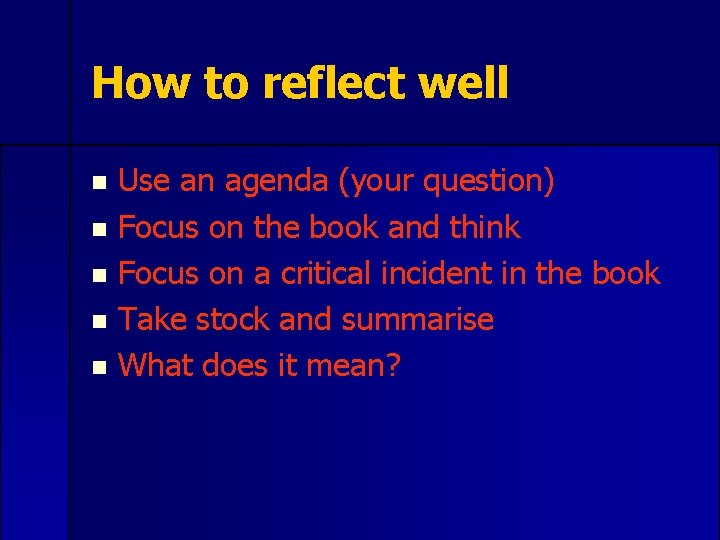
How to reflect well Use an agenda (your question) n Focus on the book and think n Focus on a critical incident in the book n Take stock and summarise n What does it mean? n
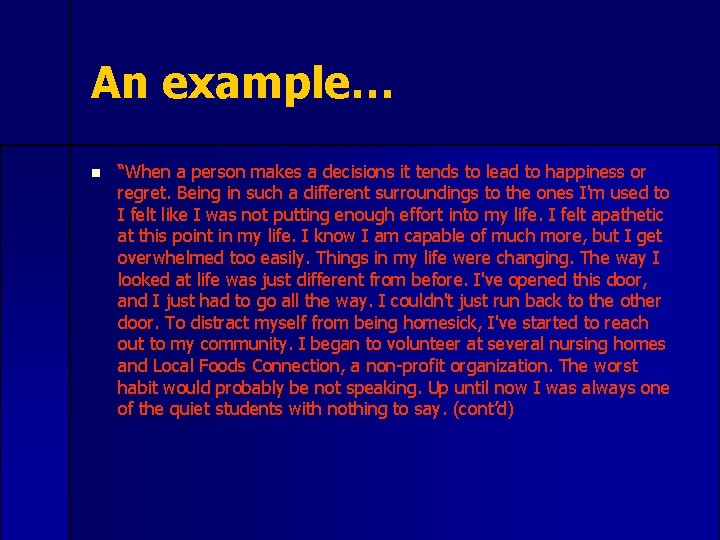
An example… n “When a person makes a decisions it tends to lead to happiness or regret. Being in such a different surroundings to the ones I'm used to I felt like I was not putting enough effort into my life. I felt apathetic at this point in my life. I know I am capable of much more, but I get overwhelmed too easily. Things in my life were changing. The way I looked at life was just different from before. I've opened this door, and I just had to go all the way. I couldn't just run back to the other door. To distract myself from being homesick, I've started to reach out to my community. I began to volunteer at several nursing homes and Local Foods Connection, a non-profit organization. The worst habit would probably be not speaking. Up until now I was always one of the quiet students with nothing to say. (cont’d)
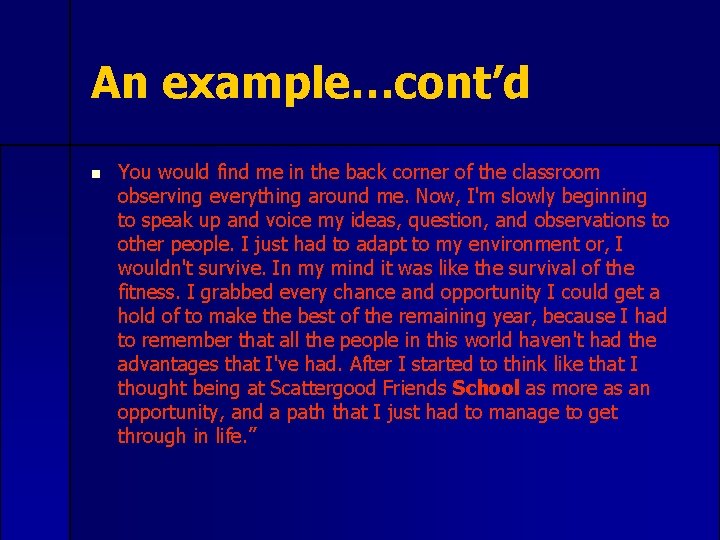
An example…cont’d n You would find me in the back corner of the classroom observing everything around me. Now, I'm slowly beginning to speak up and voice my ideas, question, and observations to other people. I just had to adapt to my environment or, I wouldn't survive. In my mind it was like the survival of the fitness. I grabbed every chance and opportunity I could get a hold of to make the best of the remaining year, because I had to remember that all the people in this world haven't had the advantages that I've had. After I started to think like that I thought being at Scattergood Friends School as more as an opportunity, and a path that I just had to manage to get through in life. ”
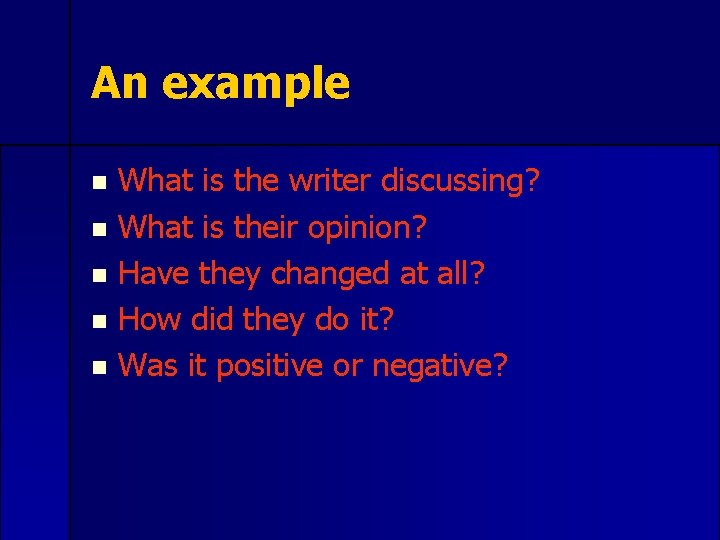
An example What is the writer discussing? n What is their opinion? n Have they changed at all? n How did they do it? n Was it positive or negative? n