
An Overview Presolar nebula Protoplanetary disk condensation and

An Overview • Pre-solar nebula • Protoplanetary disk: condensation and accretion • Solar wind (beginning of fusion) • Collisions continue • Planetary migration (orbits shifting) • Late Heavy Bombardment (Hadean Era) • Planetary Evolution
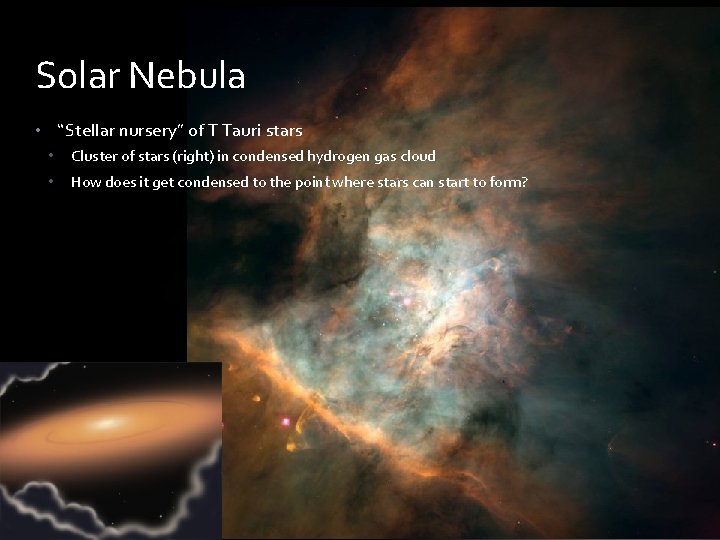
Solar Nebula • “Stellar nursery” of T Tauri stars • Cluster of stars (right) in condensed hydrogen gas cloud • How does it get condensed to the point where stars can start to form?
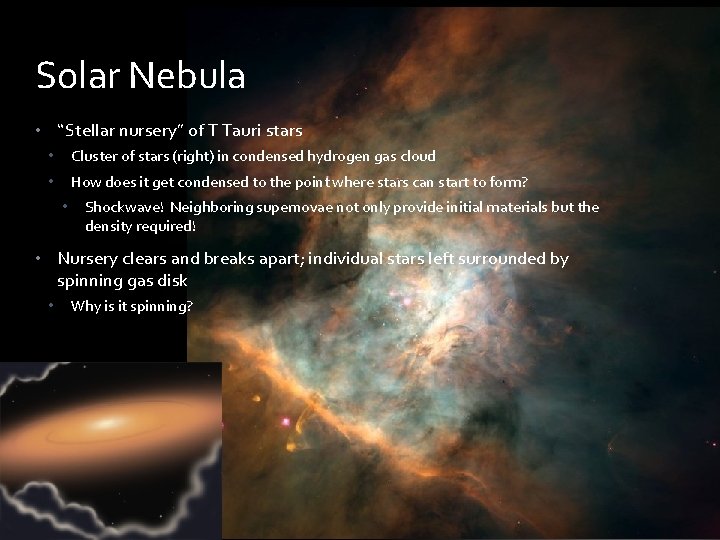
Solar Nebula • “Stellar nursery” of T Tauri stars • Cluster of stars (right) in condensed hydrogen gas cloud • How does it get condensed to the point where stars can start to form? • Shockwave! Neighboring supernovae not only provide initial materials but the density required! • Nursery clears and breaks apart; individual stars left surrounded by spinning gas disk • Why is it spinning?
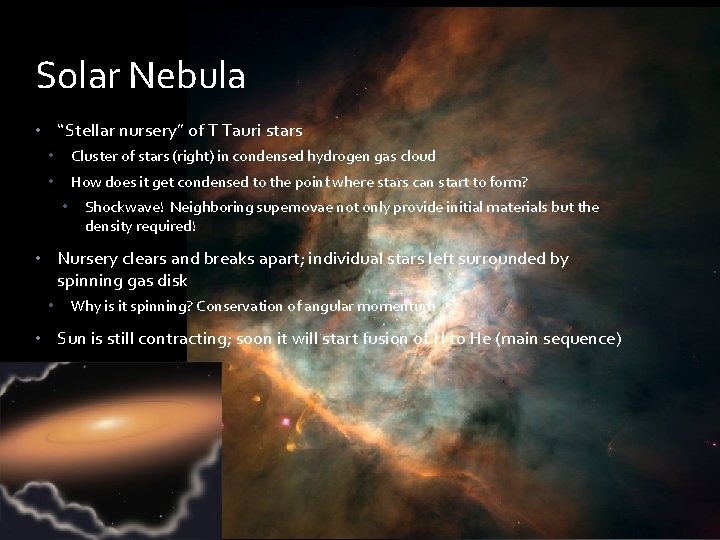
Solar Nebula • “Stellar nursery” of T Tauri stars • Cluster of stars (right) in condensed hydrogen gas cloud • How does it get condensed to the point where stars can start to form? • Shockwave! Neighboring supernovae not only provide initial materials but the density required! • Nursery clears and breaks apart; individual stars left surrounded by spinning gas disk • Why is it spinning? Conservation of angular momentum • Sun is still contracting; soon it will start fusion of H to He (main sequence)
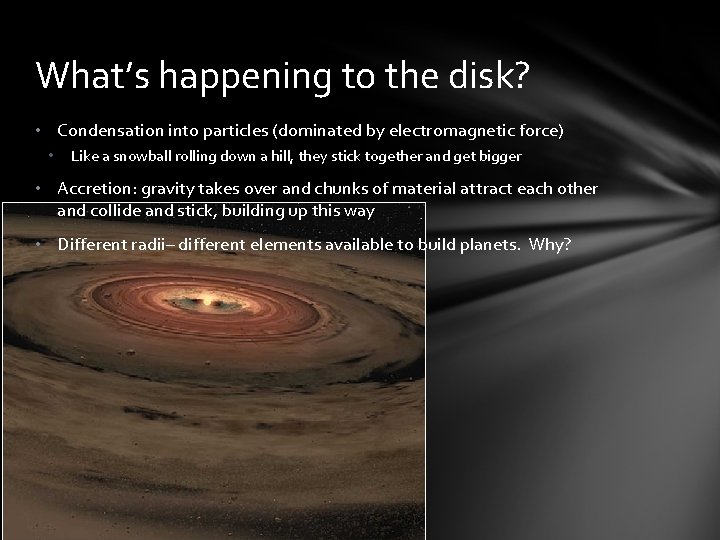
What’s happening to the disk? • Condensation into particles (dominated by electromagnetic force) • Like a snowball rolling down a hill, they stick together and get bigger • Accretion: gravity takes over and chunks of material attract each other and collide and stick, building up this way • Different radii– different elements available to build planets. Why?
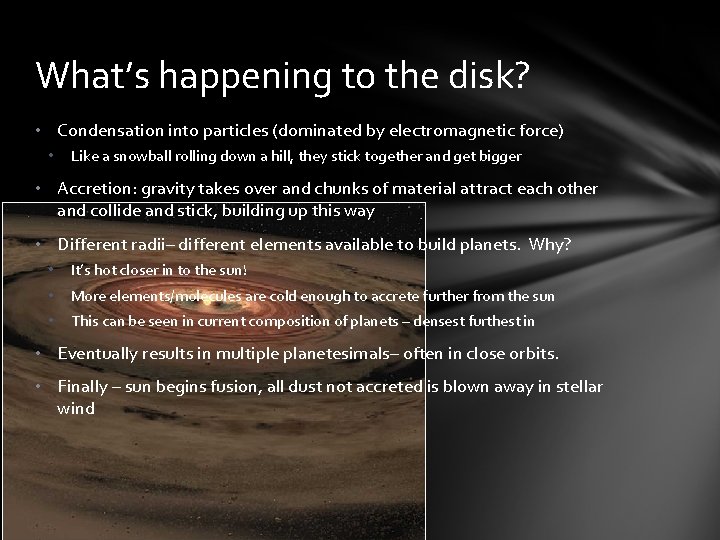
What’s happening to the disk? • Condensation into particles (dominated by electromagnetic force) • Like a snowball rolling down a hill, they stick together and get bigger • Accretion: gravity takes over and chunks of material attract each other and collide and stick, building up this way • Different radii– different elements available to build planets. Why? • It’s hot closer in to the sun! • More elements/molecules are cold enough to accrete further from the sun • This can be seen in current composition of planets – densest furthest in • Eventually results in multiple planetesimals– often in close orbits. • Finally – sun begins fusion, all dust not accreted is blown away in stellar wind
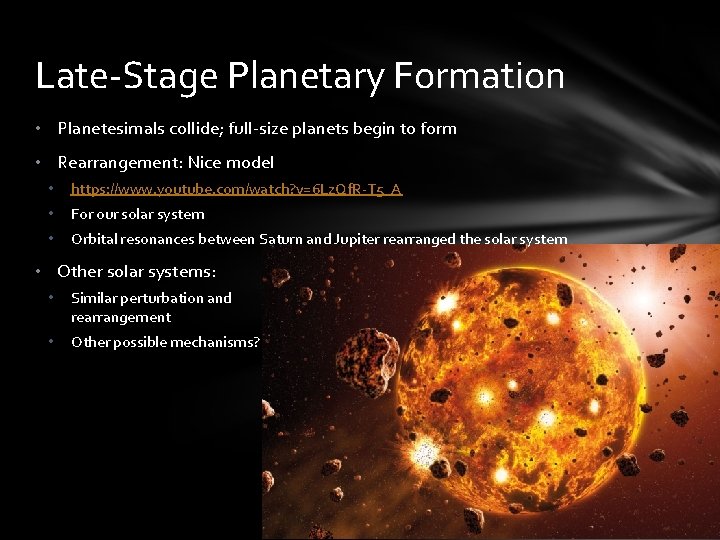
Late-Stage Planetary Formation • Planetesimals collide; full-size planets begin to form • Rearrangement: Nice model • https: //www. youtube. com/watch? v=6 Lz. Qf. R-T 5_A • For our solar system • Orbital resonances between Saturn and Jupiter rearranged the solar system • Other solar systems: • Similar perturbation and rearrangement • Other possible mechanisms?
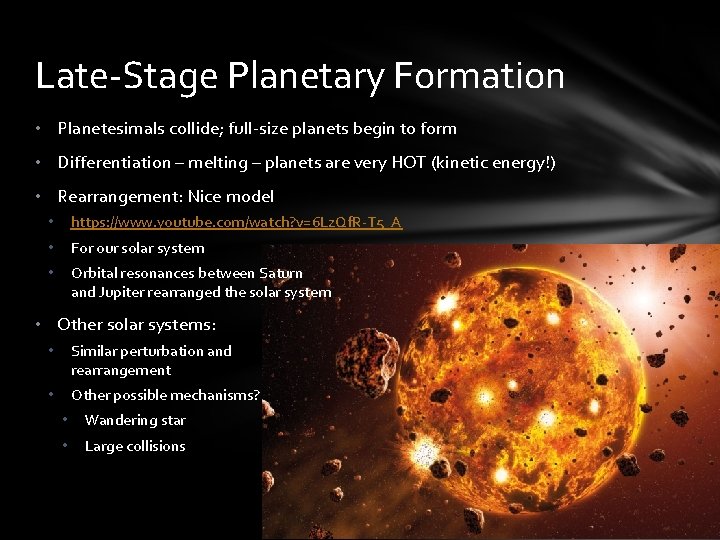
Late-Stage Planetary Formation • Planetesimals collide; full-size planets begin to form • Differentiation – melting – planets are very HOT (kinetic energy!) • Rearrangement: Nice model • https: //www. youtube. com/watch? v=6 Lz. Qf. R-T 5_A • For our solar system • Orbital resonances between Saturn and Jupiter rearranged the solar system • Other solar systems: • Similar perturbation and rearrangement • Other possible mechanisms? • Wandering star • Large collisions
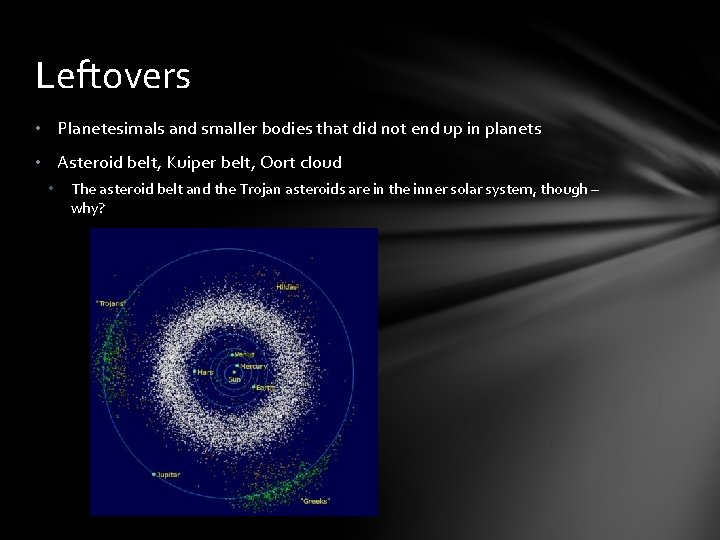
Leftovers • Planetesimals and smaller bodies that did not end up in planets • Asteroid belt, Kuiper belt, Oort cloud • The asteroid belt and the Trojan asteroids are in the inner solar system, though – why?
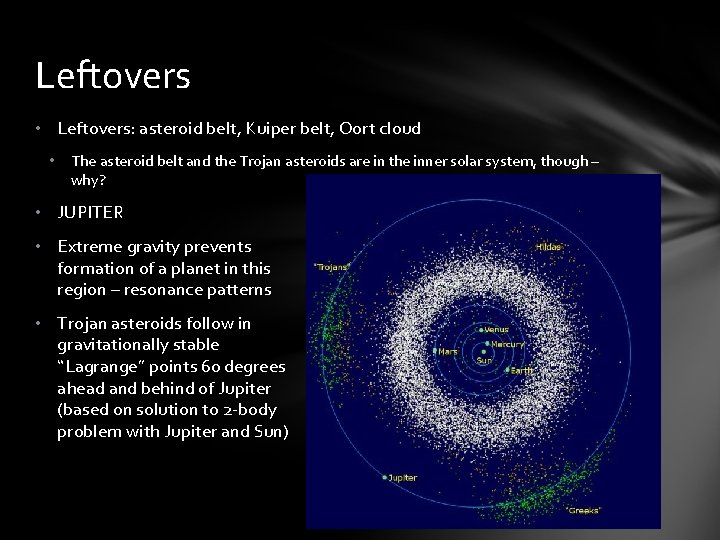
Leftovers • Leftovers: asteroid belt, Kuiper belt, Oort cloud • The asteroid belt and the Trojan asteroids are in the inner solar system, though – why? • JUPITER • Extreme gravity prevents formation of a planet in this region – resonance patterns • Trojan asteroids follow in gravitationally stable “Lagrange” points 60 degrees ahead and behind of Jupiter (based on solution to 2 -body problem with Jupiter and Sun)
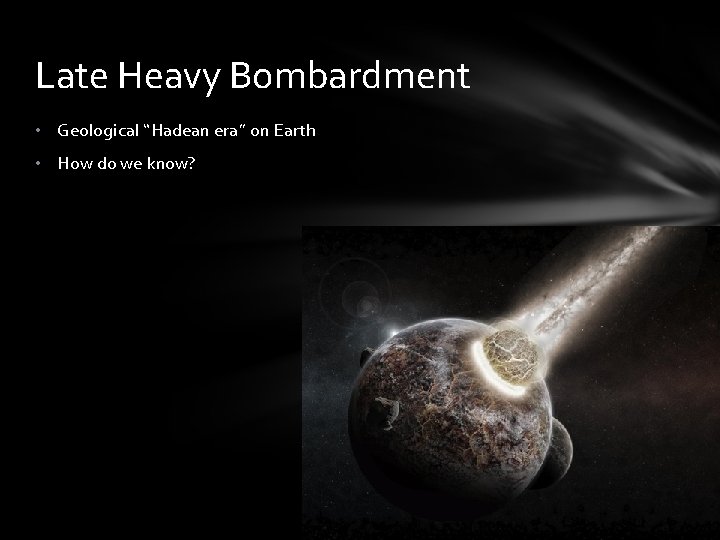
Late Heavy Bombardment • Geological “Hadean era” on Earth • How do we know?
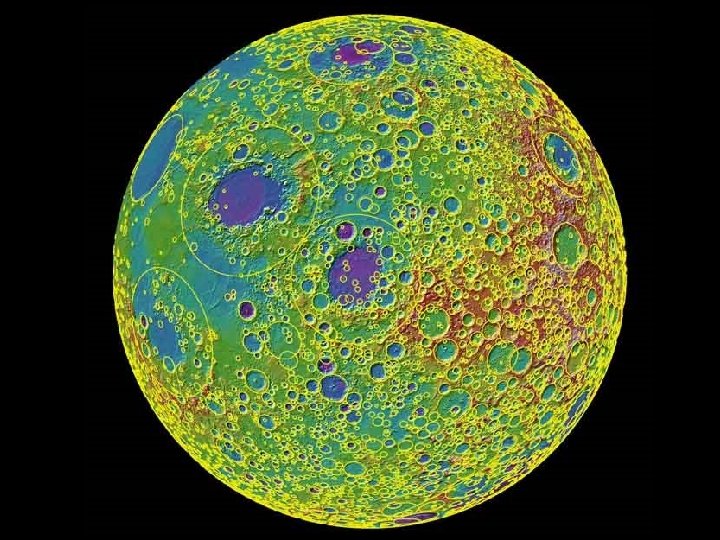
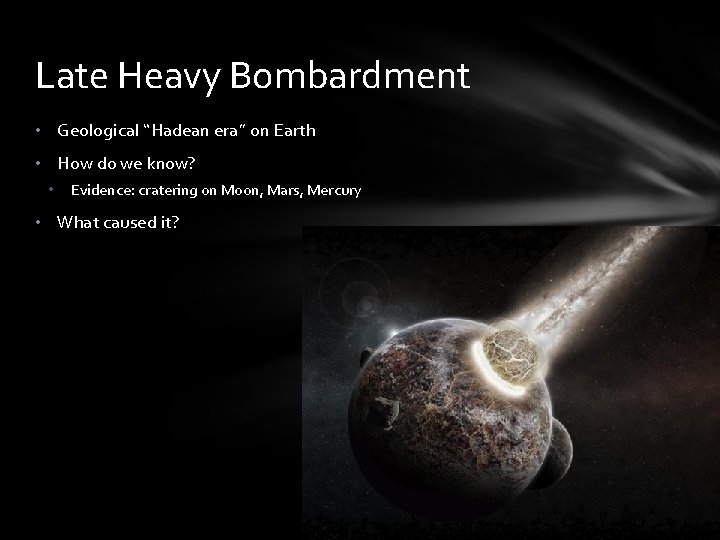
Late Heavy Bombardment • Geological “Hadean era” on Earth • How do we know? • Evidence: cratering on Moon, Mars, Mercury • What caused it?
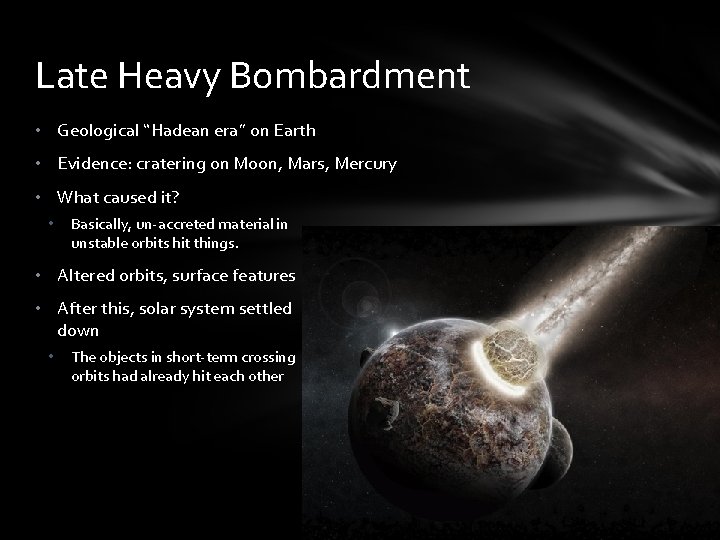
Late Heavy Bombardment • Geological “Hadean era” on Earth • Evidence: cratering on Moon, Mars, Mercury • What caused it? • Basically, un-accreted material in unstable orbits hit things. • Altered orbits, surface features • After this, solar system settled down • The objects in short-term crossing orbits had already hit each other
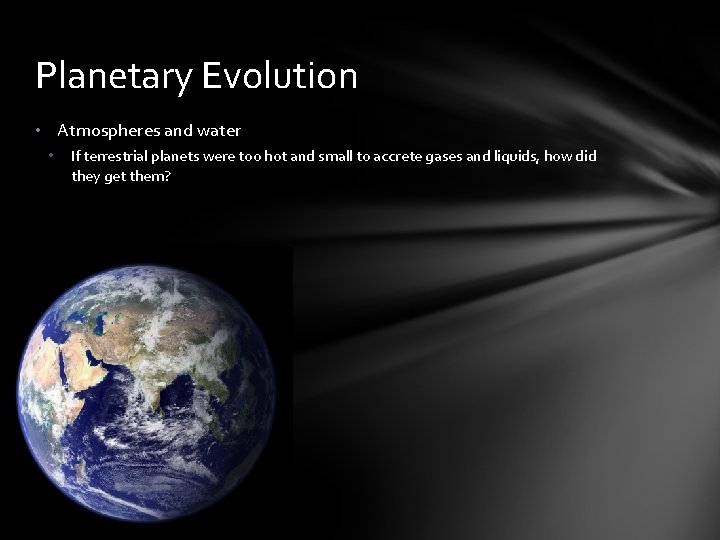
Planetary Evolution • Atmospheres and water • If terrestrial planets were too hot and small to accrete gases and liquids, how did they get them?
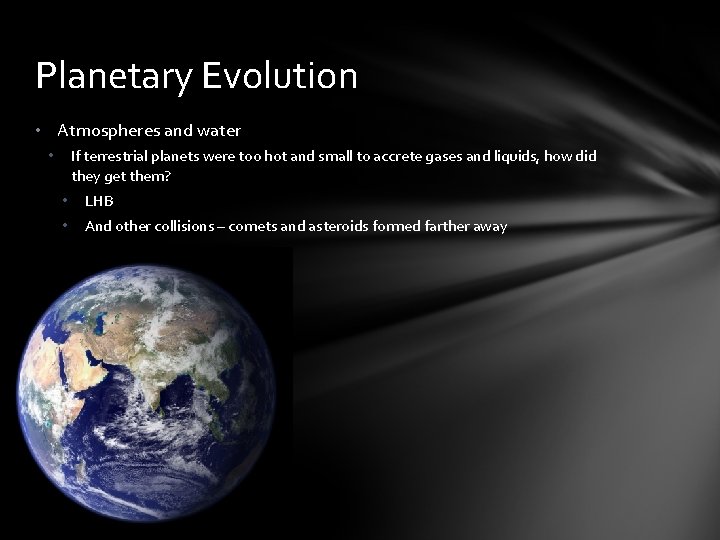
Planetary Evolution • Atmospheres and water If terrestrial planets were too hot and small to accrete gases and liquids, how did they get them? • • LHB • And other collisions – comets and asteroids formed farther away • Structure
Planetary Evolution • Moons and other satellites • How could a planet get moons?
Planetary Evolution • Moons and other satellites • • How could a planet get moons? Co-formation (planets had disks like suns do and satellites accreted) Capture Other processes: collision and subsequent accretion (Earth’s Moon) • https: //www. youtube. com/watch? v=HKk. XVny 7 Yd 8 • Surface Processes • • • Some internal heating > volcanism and plate tectonics Continued collisions Actions of atmosphere Cooling of the planet (Mercury’s scarps) Entropy, chemical and thermal reactions run down to stable states from initial conditions Next week: specific examples from the solar system we know the most about!
- Slides: 19