
An overview on Auditing Part 2 Department of

- Slides: 15
An overview on Auditing Part 2 Department of Pharmaceutical Sciences & Technology Birla Institute of Technology, Mesra Ranchi – 835 215 (Jharkhand) 2016
Learning outcome ❖ After watching this video lecture we are going to learn: ❖ what is recording of Deficiencies? ❖ what are the classification of deficiencies?
What is recording of deficiencies?
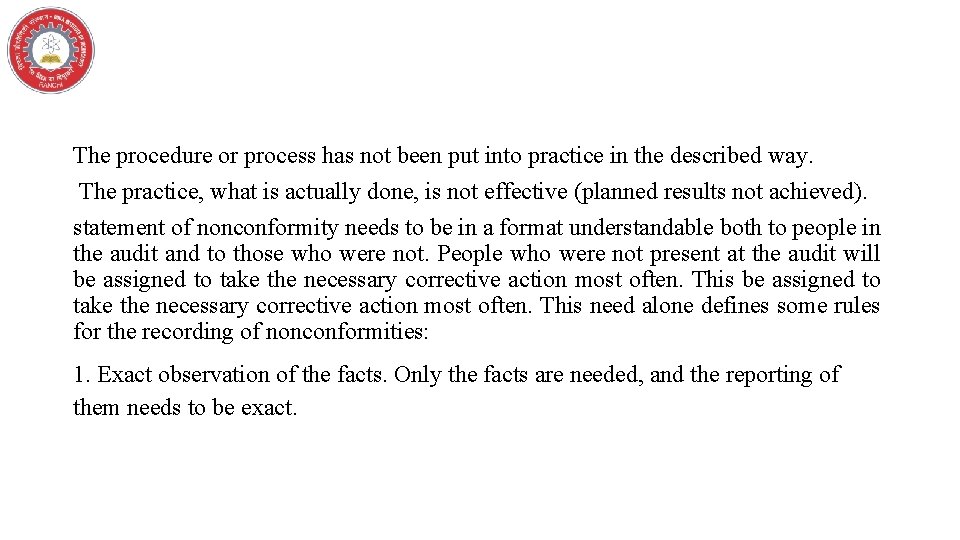
The procedure or process has not been put into practice in the described way. The practice, what is actually done, is not effective (planned results not achieved). statement of nonconformity needs to be in a format understandable both to people in the audit and to those who were not. People who were not present at the audit will be assigned to take the necessary corrective action most often. This need alone defines some rules for the recording of nonconformities: 1. Exact observation of the facts. Only the facts are needed, and the reporting of them needs to be exact.
2. Where was it found? The statement needs to identify exactly where it was found; otherwise, it may not be found again. 3. What was found? It needs to be clear so that people understand what aspect of the system is nonconforming. 4. Why is it nonconformity? The statement needs to make it clear what specified requirement has not been met. 5. What is the objective evidence of the nonconformity? What audit evidence do we have–records, documents, statements or observations for our nonconformity findings?
6. Who was involved? The statement often has no need to involve specific people, but where the objective evidence was based on a statement, and then the statement and the originator (s) need to be clear. Job titles rather than names should be used. 7. Use local terminology. Industry has its own names for certain activities, documents, etc. These unique terms should be used for clarity.
what are recording of deficiences? ❖ The audit proceeds, there might arise some situations where the facts indicate there is a failure, either partially or wholly, of the quality management system, such a situation is called Recording nonconformities or deficiencies nonconformity”. a ❖ What is non conformity? 1. a condition adverse to Quality. 2. The non-fulfillment of a requirement. There may be nonconformity for one of three reasons : . 1. The procedure or defined process does not conform to the regulatory requirements
classification of Deficiencies?
What is the classification of Deficiency Critical defects have a high probability of resulting in a product recall or in an adverse physiological response by the consumer. Critical deficiencies found in internal audits that usually produce significant effects on the strength, identity, safety, and purity of the product that will be considered during regulatory compliance. The possible source of a critical defect • Cross-contamination of materials of the product • Incorrect labeling • Active ingredients outside of specifications •
Major defects found during the internal audit can reduce the usability or stability of a product, but without causing harm to the consumer. The possible source of a major defect • Major equipment not calibrated or out of calibration • Inadequate segregation of quarantine components • Inadequate evaluation of production process outside of action levels • Process deviations not properly documented or investigated • Operator not trained in or familiar with the standard operating procedures. Minor defects have a low probability of affecting the quality or usability of the product which can help in regulatory compliance.
NOW take a pause for 2 minute to recapitulate the topics we have discussed and try following ques. ❖ what are recording of deficiencies? ❖ what are the classification of deficiency?
What is Information gathering?
What is information gathering? Information is simply the facts or knowledge provided or learned. It can be tacit, in people's heads, or explicit, in documents-electronic or hard copy During the audit, information relevant to the objectives, scope and criteria, including information on interfaces between functions, activities and processes, should be collected by appropriate sampling and should be verified. Only verifiable information can be audit evidence which must be recorded]Audit evidence is any information used by the auditor to determine if the audited information is in accordance with the established criteria and to arrive at the conclusions on which the audit opinion is based. Internal Audit Evidence includes any data, information, process flows, vouchers, bills, memos, contracts or transactions. The internal audit evidence collected would be dependent on
1) Audit procedures to use-specific procedures should be spelled out for instruction during the audit. 2) Sample size-how many items should be tested for each audit procedure. 3) Items to select-determine which items in the population should be selected. 4) TIMING: Timing-timing can vary from the beginning of the accounting period to the closure of it.
Prepared by: Ms monika mishra Mr Ankit Dr Manik Ghosh Dr kk pradhan Pharmaceutical quality assurance Depatment of pharmaceutical science and technology(B. I. T Mesra)