
An Overview of Workplacebased Assessment Cees van der
An Overview of Workplace-based Assessment Cees van der Vleuten Maastricht University, The Netherlands www. ceesvandervleuten. com UCSF, 3 April 2019
Outcome systems Can. Meds § § § § Medical expert Communicator Collaborator Manager Health advocate Scholar Professional ACGME n n n Medical knowledge Patient care Practice-based learning & improvement Interpersonal and communication skills Professionalism Systems-based practice GMC n n n Good clinical care Relationships with patients and families Working with colleagues Managing the workplace Social responsibility and accountability Professionalism

Typical for outcomes n n n Emphasis on competences Emphasis on behaviours/performance Emphasis on non-discipline specific competences
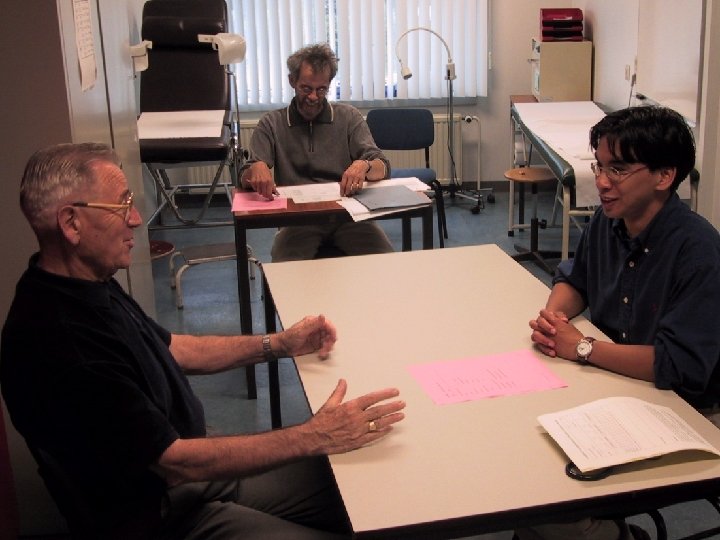
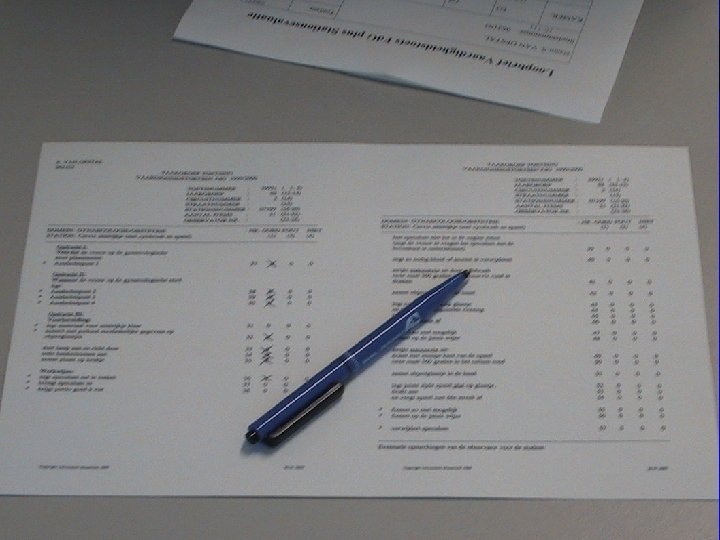
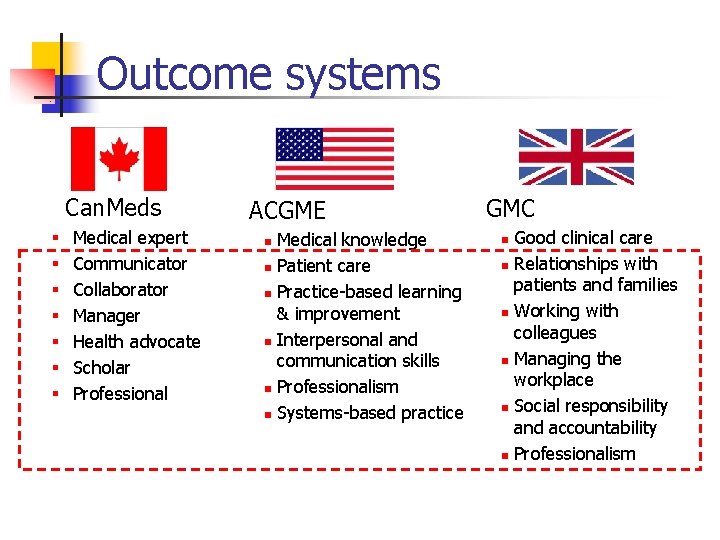
OSCE n n What are strengths? What are threats?
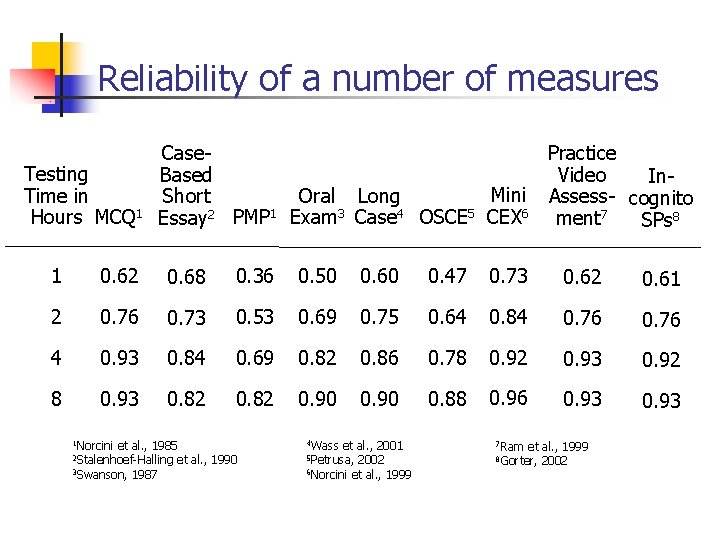
Reliability of a number of measures Testing Time in Hours MCQ 1 Case. Practice Based Video In. Mini Assess- cognito Oral Long Short Essay 2 PMP 1 Exam 3 Case 4 OSCE 5 CEX 6 ment 7 SPs 8 1 0. 62 0. 68 0. 36 0. 50 0. 60 0. 47 0. 73 0. 62 0. 61 2 0. 76 0. 73 0. 53 0. 69 0. 75 0. 64 0. 84 0. 76 4 0. 93 0. 84 0. 69 0. 82 0. 86 0. 78 0. 92 0. 93 0. 92 8 0. 93 0. 82 0. 90 0. 88 0. 96 0. 93 1 Norcini et al. , 1985 2 Stalenhoef-Halling et al. , 1990 3 Swanson, 1987 4 Wass et al. , 2001 5 Petrusa, 2002 6 Norcini et al. , 1999 7 Ram et al. , 1999 2002 8 Gorter,
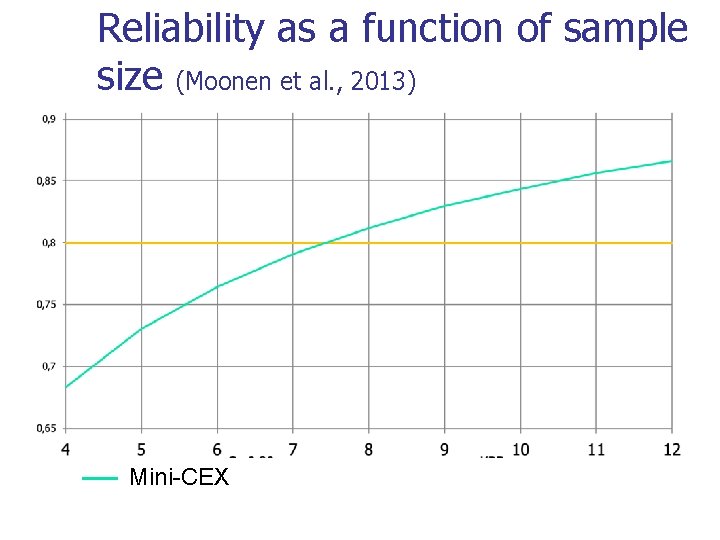
Reliability as a function of sample size (Moonen et al. , 2013) Mini-CEX
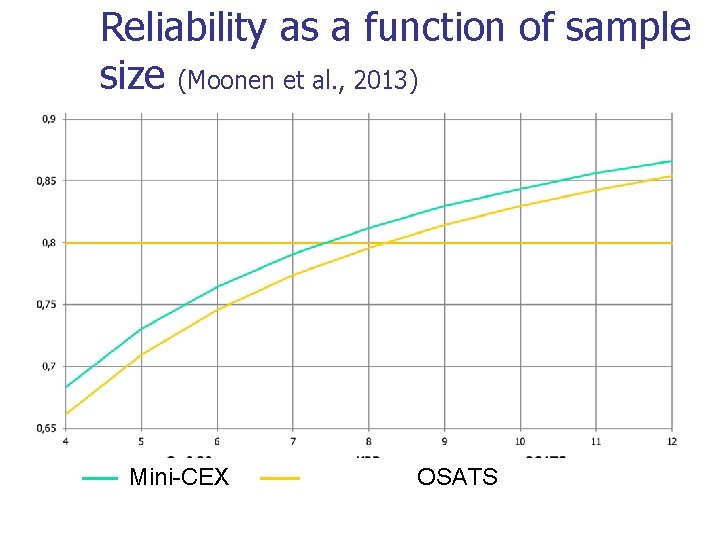
Reliability as a function of sample size (Moonen et al. , 2013) Mini-CEX OSATS

Reliability as a function of sample size (Moonen et al. , 2013) Mini-CEX OSATS MSF
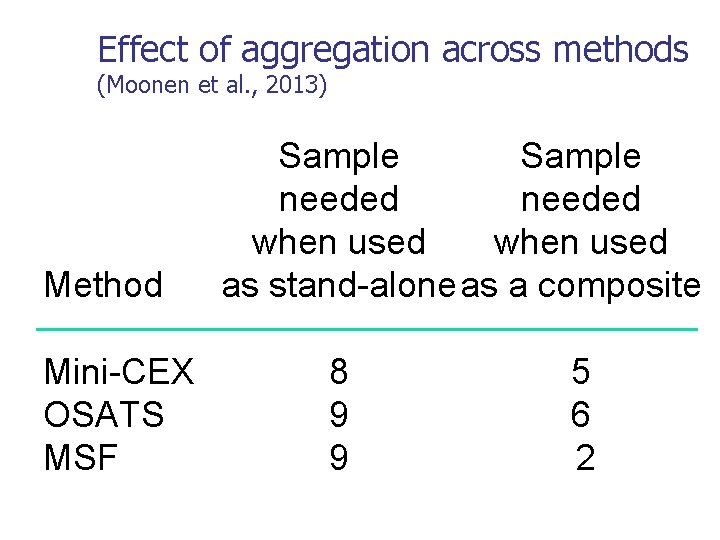
Effect of aggregation across methods (Moonen et al. , 2013) Method Mini-CEX OSATS MSF Sample needed when used as stand-alone as a composite 8 9 9 5 6 2
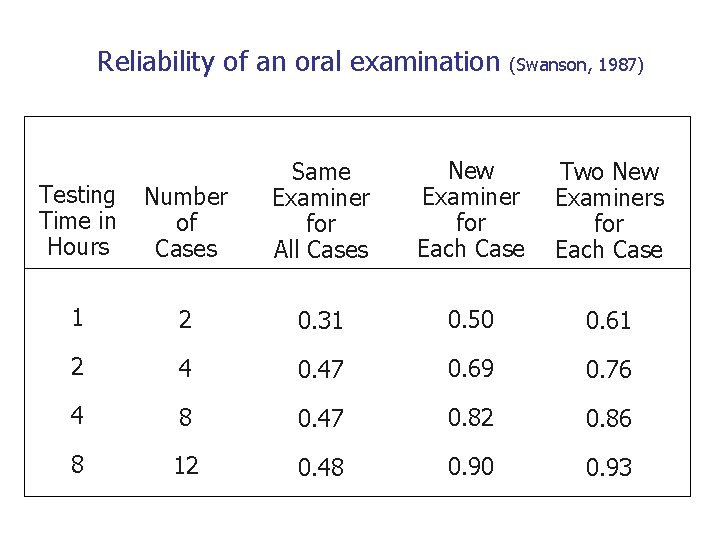
Reliability of an oral examination (Swanson, 1987) New Examiner for Each Case Two New Examiners for Each Case Testing Time in Hours Number of Cases Same Examiner for All Cases 1 2 0. 31 0. 50 0. 61 2 4 0. 47 0. 69 0. 76 4 8 0. 47 0. 82 0. 86 8 12 0. 48 0. 90 0. 93
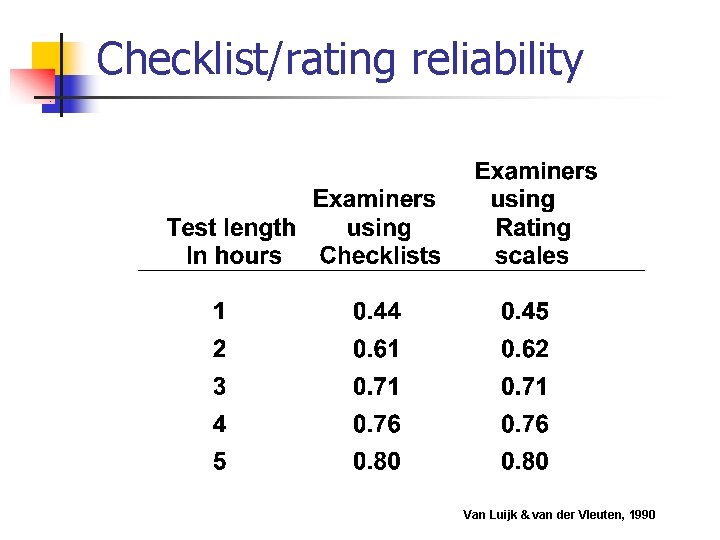
Checklist/rating reliability Van Luijk & van der Vleuten, 1990

Miller’s competency pyramid Outcomes Does Shows how OSCE Knows how Knows Miller GE. The assessment of clinical skills/competence/performance. Academic Medicine (Supplement) 1990; 65: S 63 -S 7.
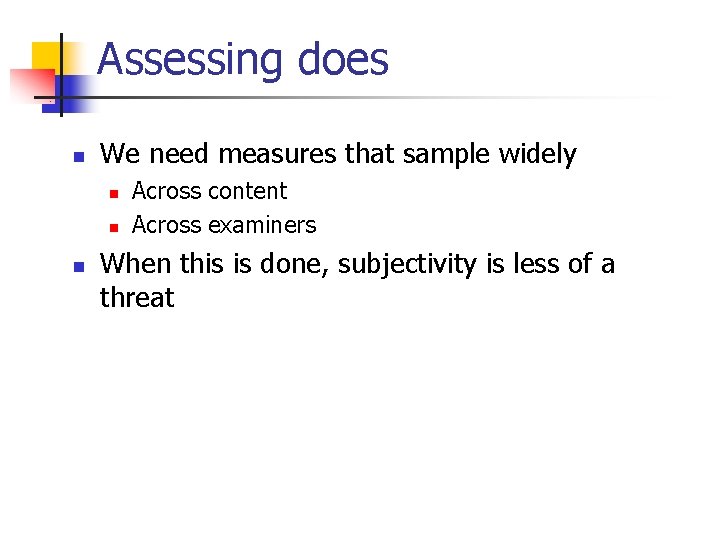
Assessing does n We need measures that sample widely n n n Across content Across examiners When this is done, subjectivity is less of a threat
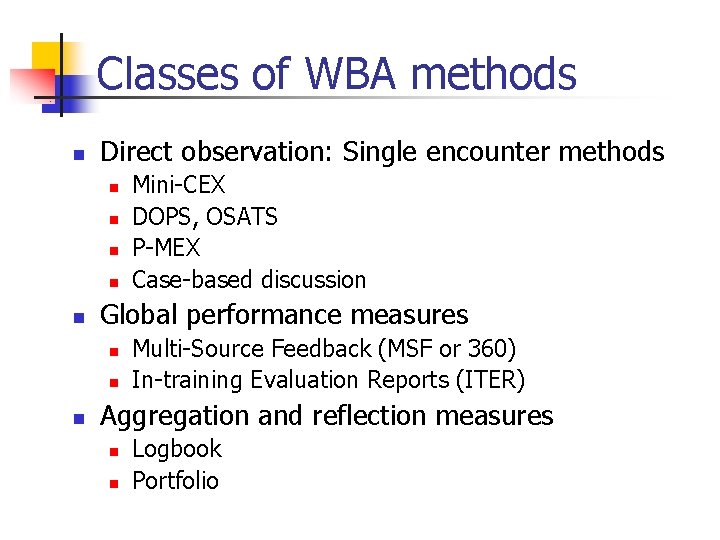
Classes of WBA methods n Direct observation: Single encounter methods n n n Global performance measures n n n Mini-CEX DOPS, OSATS P-MEX Case-based discussion Multi-Source Feedback (MSF or 360) In-training Evaluation Reports (ITER) Aggregation and reflection measures n n Logbook Portfolio
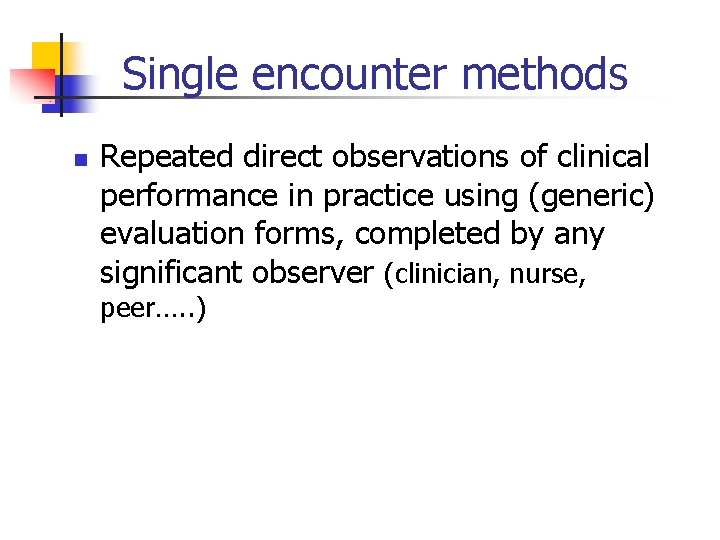
Single encounter methods n Repeated direct observations of clinical performance in practice using (generic) evaluation forms, completed by any significant observer (clinician, nurse, peer…. . )
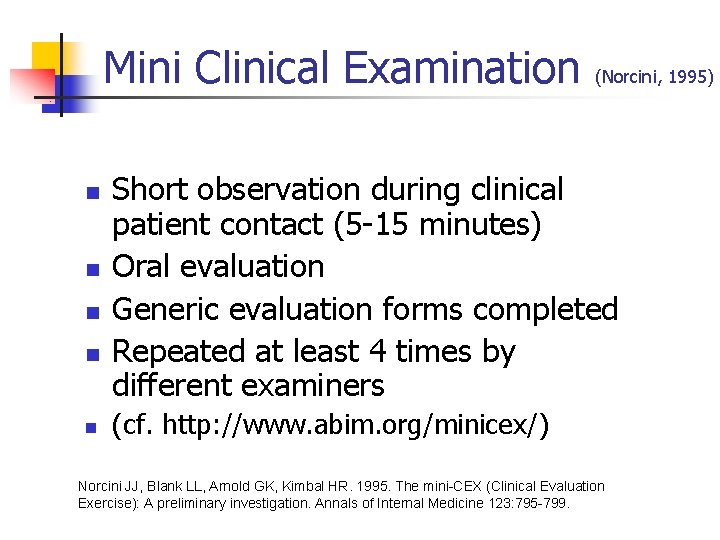
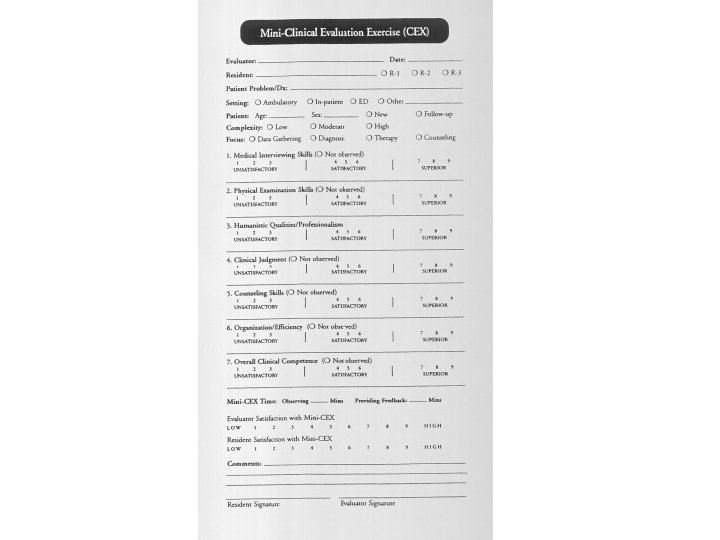
Mini Clinical Examination n n (Norcini, 1995) Short observation during clinical patient contact (5 -15 minutes) Oral evaluation Generic evaluation forms completed Repeated at least 4 times by different examiners (cf. http: //www. abim. org/minicex/) Norcini JJ, Blank LL, Arnold GK, Kimbal HR. 1995. The mini-CEX (Clinical Evaluation Exercise): A preliminary investigation. Annals of Internal Medicine 123: 795 -799.
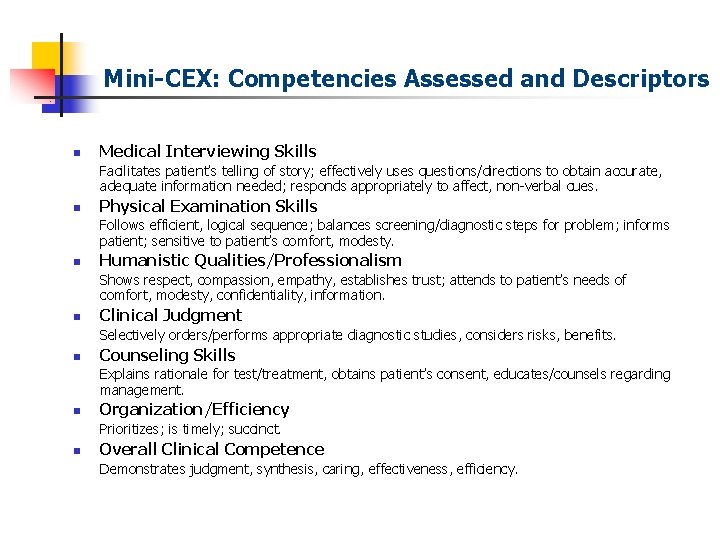
Mini-CEX: Competencies Assessed and Descriptors n Medical Interviewing Skills Facilitates patient’s telling of story; effectively uses questions/directions to obtain accurate, adequate information needed; responds appropriately to affect, non-verbal cues. n Physical Examination Skills Follows efficient, logical sequence; balances screening/diagnostic steps for problem; informs patient; sensitive to patient’s comfort, modesty. n Humanistic Qualities/Professionalism Shows respect, compassion, empathy, establishes trust; attends to patient’s needs of comfort, modesty, confidentiality, information. n Clinical Judgment Selectively orders/performs appropriate diagnostic studies, considers risks, benefits. n Counseling Skills Explains rationale for test/treatment, obtains patient’s consent, educates/counsels regarding management. n Organization/Efficiency Prioritizes; is timely; succinct. n Overall Clinical Competence Demonstrates judgment, synthesis, caring, effectiveness, efficiency.
Take home messages n n n People are more important than measurement instruments Reflective dialogues are essential Words are more important than scores Rely on your clinical skills to provide feedback Use your patient communication skills for communicating with a learner Sample across cases and assessors.
Mini-CEX Exercise Start exercise
Mini-CEX n n What are strengths? What are threats?

Multi-source feedback n n n Multiple raters (8 -10) Different rater groups, including selfrating Questionnaires n n Specifically on observable behaviour Impression over a longer period of time
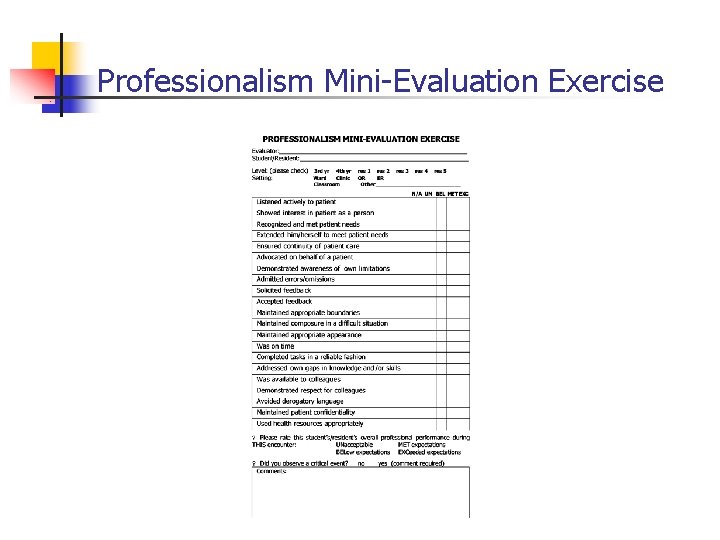
Professionalism Mini-Evaluation Exercise

Multi-source feedback Peers Patients Clinical supervisor(s) Nursing staff Self

Illustration MSF feedback SPRAT (Sheffield peer review assessment tool; Archer JC, Norcini J, Davies HA. 2005. Use of SPRAT for peer review of paediatricians in training. Bmj 330: 1251 -1253. )

Multi-source feedback procedure n Step 1: select raters n n Complete questionnaires n n Raters remain anonymous Assign responsibility to someone (i. e. secretary) Require qualitative feedback Discuss information n Proposal by assessee in conjunction with supervisor Mid-term review, end of rotation Plan of action, reflection Reporting n i. e. in portfolio
Multi-source feedback n n What are strengths? What are threats?

Multi-source feedback n Rich source of information on professional performance n n n On different competency domains Different groups of raters provide unique and different perspectives Self-assessment versus assessment by others stimulates self-awareness and reflection
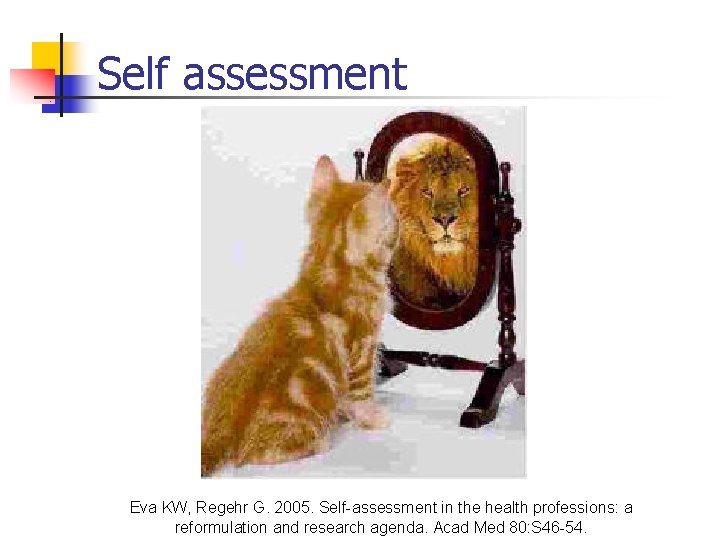
Self assessment Eva KW, Regehr G. 2005. Self-assessment in the health professions: a reformulation and research agenda. Acad Med 80: S 46 -54.
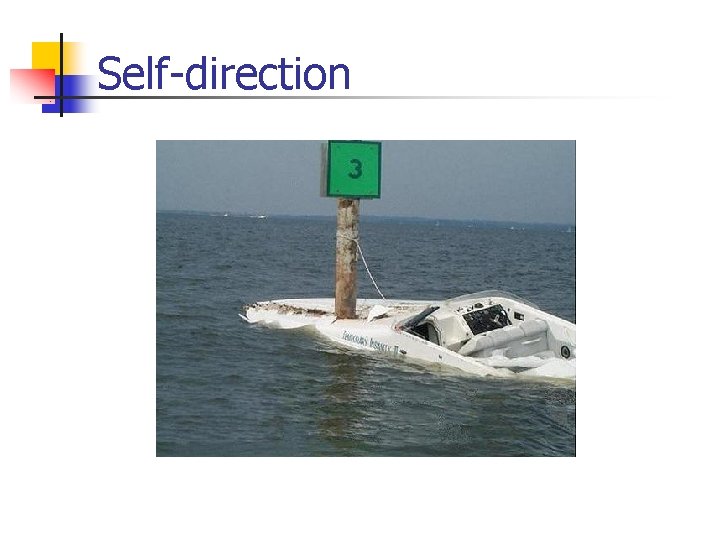
Self-direction
Multi-source feedback n n n Assessment and learning: concrete, descriptive, qualitative feedback is extremely useful Learning: feedback is central; Plan of action is part of feedback; follow-up! Assessment: proper documentation is essential for defensible decisions
Multi-source feedback n Dilemma’s: n n Dual role of supervisor (helper & judge) Anonymity of raters Discrepancies between rater groups Time pressured (absence of) rich feedback

Multisource-feedback “The most important goal of multirater feedback is to inform and motivate feedback recipients to engage in self directed action planning for improvement. It is the feedback process, not the measurement process that generates the real payoffs. ” (Fleenor and Prince, 1997)
Portfolio n n n A collection of results and/or evidence that demonstrates competence Usually paired with reflections, plans of actions, discussed with peers, mentors, coaches, supervisors Aggregation of information (very comparable to patient chart) Active role of the person assessed Reversal of the burden of evidence But it’s a container term
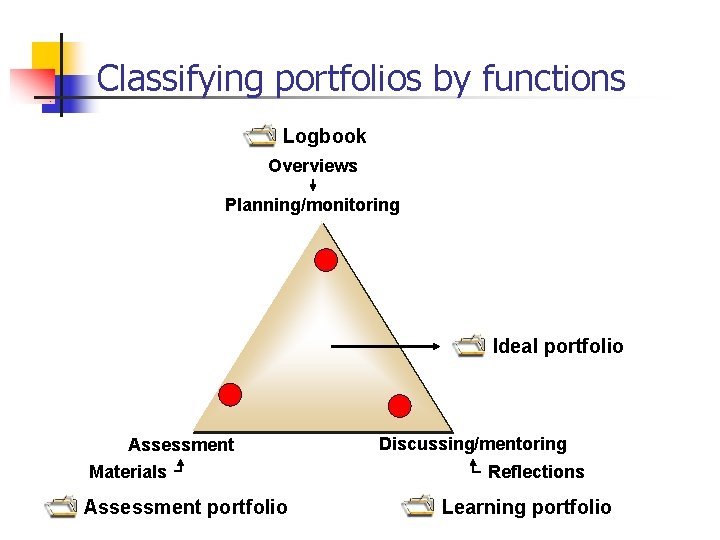
Classifying portfolios by functions Logbook Overviews Planning/monitoring Ideal portfolio Assessment Materials Assessment portfolio Discussing/mentoring Reflections Learning portfolio
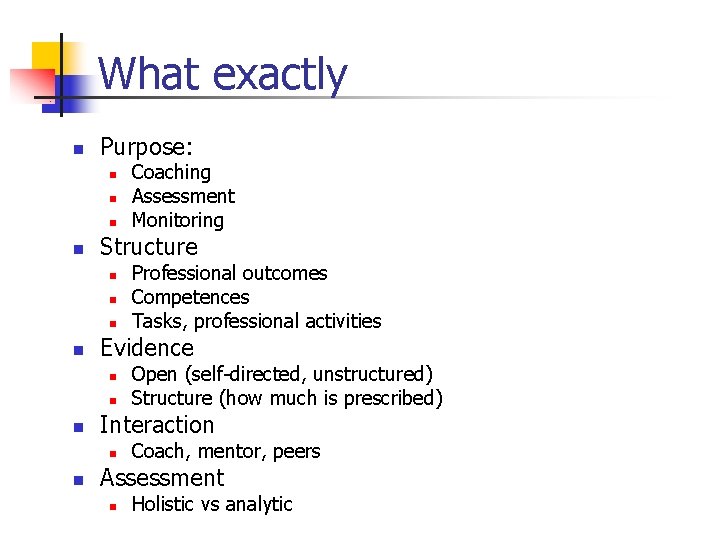
What exactly n Purpose: n n Structure n n n Open (self-directed, unstructured) Structure (how much is prescribed) Interaction n n Professional outcomes Competences Tasks, professional activities Evidence n n Coaching Assessment Monitoring Coach, mentor, peers Assessment n Holistic vs analytic
Portfolio
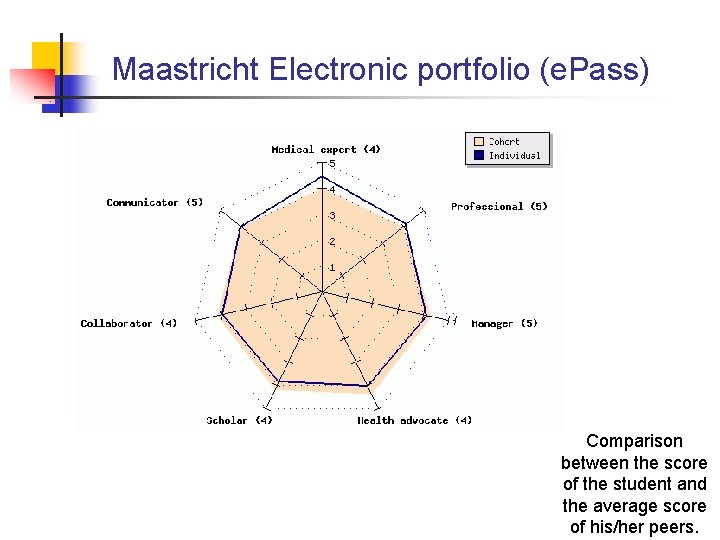
Maastricht Electronic portfolio (e. Pass) Comparison between the score of the student and the average score of his/her peers.
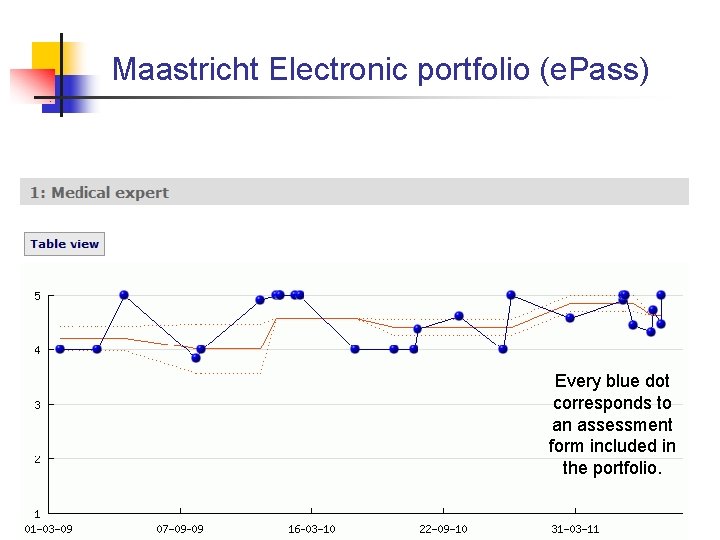
Maastricht Electronic portfolio (e. Pass) Every blue dot corresponds to an assessment form included in the portfolio.
What can go wrong? n n n n “Reflection sucks” Too much structure Too little structure Portfolio as a goal not as a means Ritualization Ignorance by portfolio stakeholders Paper tiger
Portfolio recommendations n Portfolio is not but an assessment method, rather it is an educational concept n n n Portfolio should have immediate learning value for the student/resident n n n Outcome-based education Framework of defined competences Professional tasks need to be translated in assessable moments or artefacts Self-direction is required (and made possible) Direct use for directing learning activities Be aware of too much reflection Portfolios need to be ‘lean and mean’ (Driessen, E. , Van Tartwijk, J. , Van der Vleuten, C. Wass, V. Portfolios in medical education: why do they meet with mixed success? A systematic review. Medical Education, 2007, 41, 1224 -1233. )
Portfolio recommendations n Social interaction around portfolios are imperative n n n Build a system of progress and review meeting around portfolios Peers may potentially be involved Purpose of the portfolio should be very clear Portfolio as an aggregation instrument is useful (compare with patient chart) Use holistic criteria for assessment; subjectivity can be dealt with (Driessen EW, Van der Vleuten CPM, Schuwirth LWT, Van Tartwijk J, Vermunt JD. 2005. The use of qualitative research criteria for portfolio assessment as an alternative to reliability evaluation: a case study. Medical Education 39: 214 -220. )
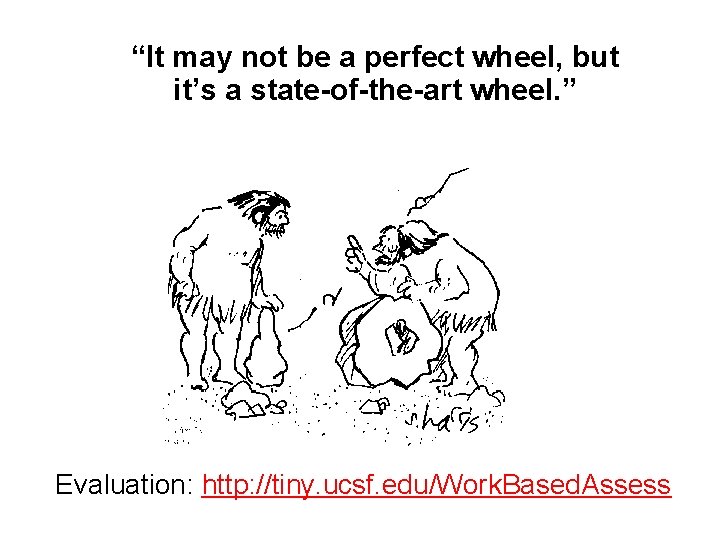
“It may not be a perfect wheel, but it’s a state-of-the-art wheel. ” Evaluation: http: //tiny. ucsf. edu/Work. Based. Assess
- Slides: 45