
An Overview of The Physical Processes Method and

- Slides: 15
An Overview of The Physical Processes Method and Model (#29021) ISRP Presentations Wenatchee, WA February 5, 2002 Keith Wolf & Bill Roberds Golder Associates Inc.
Why do we need the PPM? There is broad agreement among NPPC, BPA and others, that Subbasin planning is stranded at the point where analysis of habitat conditions and identification of treatment actions diverge. ® This project will develop a quantitative method that combines geomorphic principles, engineering approaches and land -forming processes to provide a link between analysis and action. ® Golder Associates Inc. 2
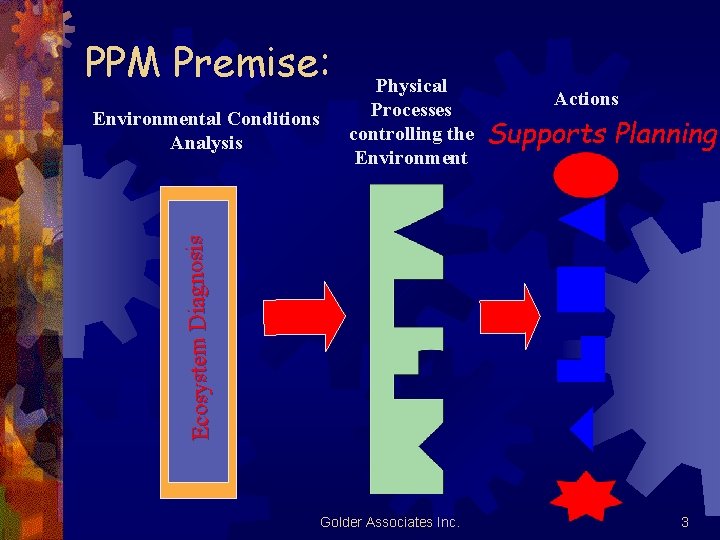
PPM Premise: Actions Supports Planning E cosystem D iagnosis Environmental Conditions Analysis Physical Processes controlling the Environment Golder Associates Inc. 3
Completing the Planning Process Subbasin Plan Subbasin Summaries Comparison of actions and alternatives –testable hypotheses Habitat Conditions Analysis -EDT Subbasin Planning Really good ideas based on analysis Good Ideas Better ideas Identify Controlling Mechanisms PPM Golder Associates Inc. 4
What will we get? Connections between 1. Cause and Effect, Analysis and Actions ® Thus, the PPM will allow us to directly treat the cause, not the symptoms ® Golder Associates Inc. 5
What will we get? 2. Identification of actual physical mechanisms that control or affect fish habitat – ® Thus, we can identify test-able treatment options ® Golder Associates Inc. 6
What will we get? 3. With Steps 1 & 2 complete we can do 1. cost: benefit, and 2. trade-off analyses ® Thus, we can compare options and produce/refine the Plan ® Golder Associates Inc. 7
What will we deliver We will deliver iterative products for immediate use by subbasin planners 2. We will develop the method and model in conjunction with ongoing or other EDT analyses and subbasin planning efforts 3. We will be consulting with basin experts, subbasin planning teams, the Upper Columbia Salmon Recovery Board and the Regional Technical Team 1. Golder Associates Inc. 8
In sum, the Physical Processes Model is a method to identify and link “Analysis with Action” 1. 2. 3. 4. 5. 6. 7. Supported by Clear Need Benefits directly support EDT etc. Products directly support Subbasin Planners Incorporates Geomorphology, engineering, geology, hydrology Integrates existing Physical process models and knowledge Accesses literature and science of physical processes Identifies Options 1. 2. 3. 4. 5. 6. 7. 8. Tell us “what” to do Categorizes Physical Processes Creates Linkage with Conditions Analysis Deals with Cause and Effect Relationships Produces Comparable Treatment Options Produces Comparable Action Strategies Allows Cost: Benefit analysis Allows Trade-Off Analysis Allows Plan Rigor to be Golder Associatestested Inc. 9. 9
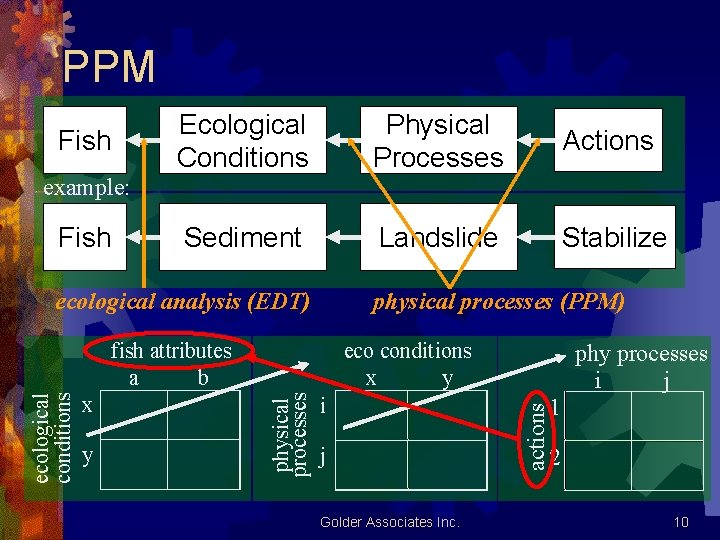
PPM Fish Ecological Conditions Physical Processes Actions Sediment Landslide Stabilize example: ecological analysis (EDT) physical processes (PPM) x y eco conditions x y physical processes ecological conditions fish attributes a b i j Golder Associates Inc. phy processes i j 1 actions Fish 2 10
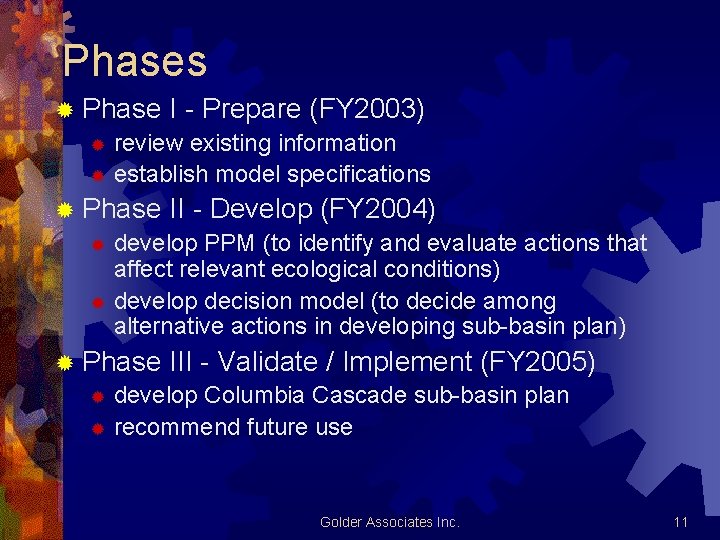
Phases ® Phase I - Prepare (FY 2003) ® review existing information ® establish model specifications ® Phase II - Develop (FY 2004) ® develop PPM (to identify and evaluate actions that affect relevant ecological conditions) ® develop decision model (to decide among alternative actions in developing sub-basin plan) ® Phase III - Validate / Implement (FY 2005) ® develop Columbia Cascade sub-basin plan ® recommend future use Golder Associates Inc. 11
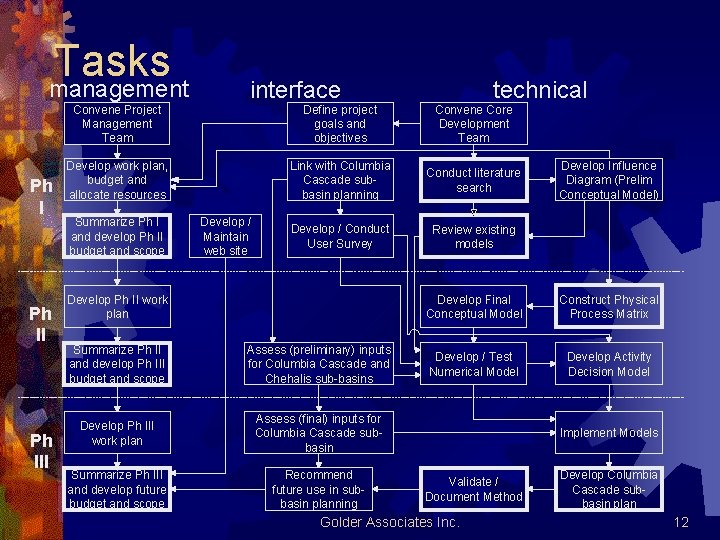
Tasks management Convene Project Management Team Ph III interface Develop work plan, budget and allocate resources Summarize Ph I and develop Ph II budget and scope Develop / Maintain web site technical Define project goals and objectives Convene Core Development Team Link with Columbia Cascade subbasin planning Conduct literature search Develop / Conduct User Survey Review existing models Develop Ph II work plan Summarize Ph II and develop Ph III budget and scope Assess (preliminary) inputs for Columbia Cascade and Chehalis sub-basins Develop Ph III work plan Assess (final) inputs for Columbia Cascade subbasin Summarize Ph III and develop future budget and scope Recommend future use in subbasin planning Develop Influence Diagram (Prelim Conceptual Model) Develop Final Conceptual Model Construct Physical Process Matrix Develop / Test Numerical Model Develop Activity Decision Model Implement Models Validate / Document Method Golder Associates Inc. Develop Columbia Cascade subbasin plan 12
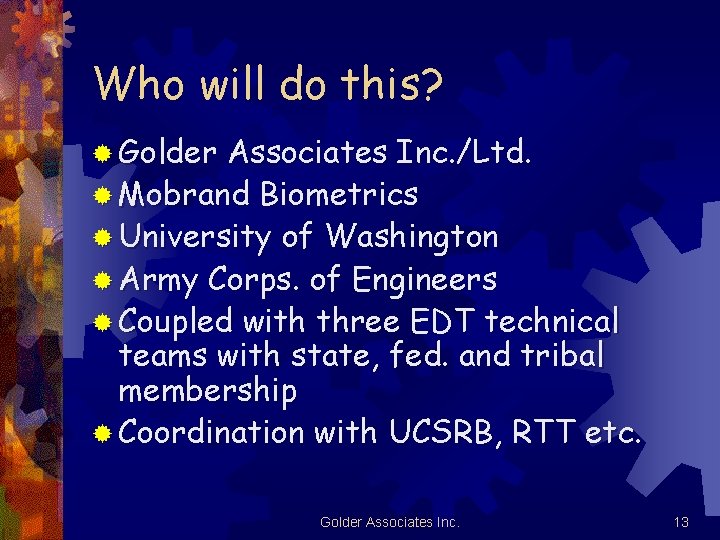
Who will do this? ® Golder Associates Inc. /Ltd. ® Mobrand Biometrics ® University of Washington ® Army Corps. of Engineers ® Coupled with three EDT technical teams with state, fed. and tribal membership ® Coordination with UCSRB, RTT etc. Golder Associates Inc. 13
Who will do this? ® Golder Associates Inc. /Ltd. - Full capability ® Geomorphologists ® Fisheries Biologists ® Civil and Geotechnical Engineers ® Systems and Decision Support Experts ® Proven record on large complex projects ® 30 years in Columbia Basin Fish and Wildlife ® Currently - Upper Col. Salmon Recovery and CCT, SRFB, CBFWA, NPPC etc. ® Gold. Sim and other tools ® Experience and relationship with Team ® Peer recognition Golder Associates Inc. 14
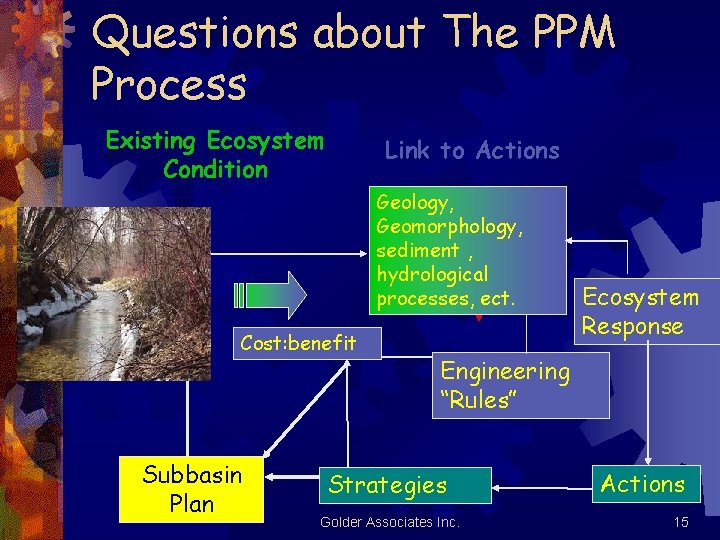
Questions about The PPM Process Existing Ecosystem Condition Link to Actions Geology, Geomorphology, sediment , hydrological processes, ect. Cost: benefit Subbasin Plan Ecosystem Response Engineering “Rules” Strategies Golder Associates Inc. Actions 15