
An Overview of the HST Treasury Program on
- Slides: 16
An Overview of the HST Treasury Program on the Orion Nebula Massimo Robberto Space Telescope Science Institute 12/28/2021 Washington DC 1
Co-Investigators Science team: D. Soderblom (STSc. I), C. R. O’Dell (Vanderbilt), L. A. Hillenbrand (Caltech), M. Simon (Stony Brook), E. D. Feigelson (Penn State), J. Najita (NOAO), K. G. Stassun (Vanderbilt), J. Stauffer (IPAC-Caltech), M. Meyer (Steward), J. Krist (JPL), N. Panagia (STSc. I), M. Romaniello (ESO), F. Palla (Arcetri), I. N. Reid (STSc. I), P. Mc. Cullough (STSc. I), R. Makidon (STSc. I) Home team: E. Bergeron (STSc. I), M. Mc. Master (STSc. I), V. Kozhurina-Platais (STSc. I), H. Mc. Laughlin (STSc. I), K. Smith (STSc. I), W. Sherry (NOAO) 12/28/2021 Washington DC 2
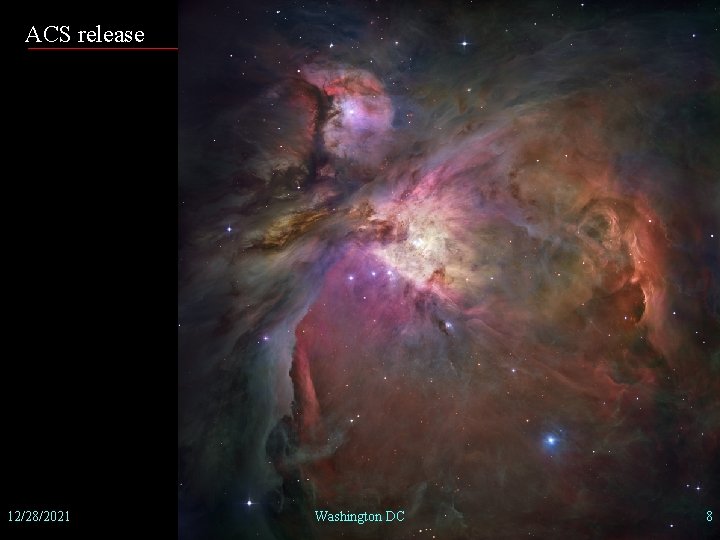
basic facts 1. Orion Nebula and its Cluster – The closest star forming region containing the entire spectrum of stellar masses. Cornerstone for understanding how stars form. 2. GO 10246: HST Treasury Project on Orion – 104 orbits. The largest Hubble program ever dedicated to star formation – All cameras onboard HST used in parallel (ACS, WFPC 2, NICMOS). 9 filters from ultraviole to infrared 3. ACS release image of the Orion Nebula – 33, 000 x 36, 000 pixels, 5 colors, the most detailed image of Orion ever made 12/28/2021 Washington DC 3
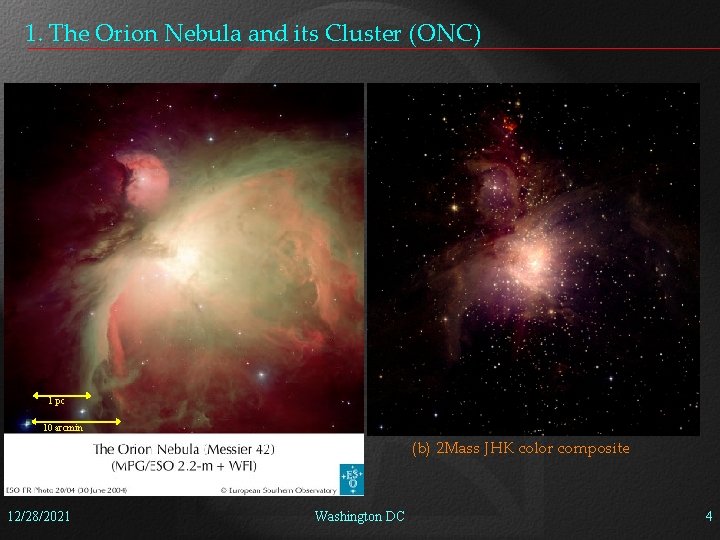
1. The Orion Nebula and its Cluster (ONC) 1 pc 10 arcmin (b) 2 Mass JHK color composite 12/28/2021 Washington DC 4
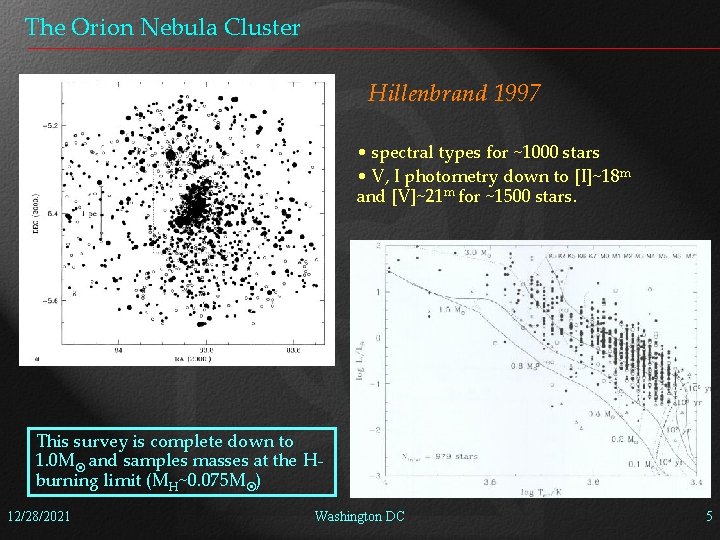
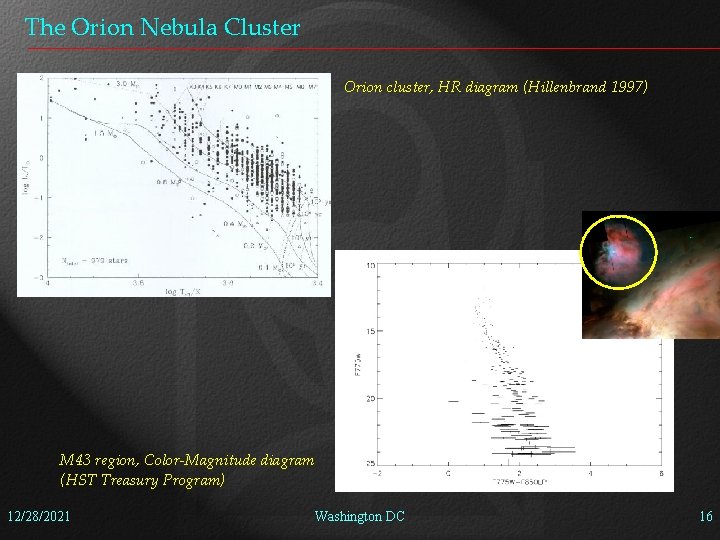
The Orion Nebula Cluster Hillenbrand 1997 • spectral types for ~1000 stars • V, I photometry down to [I]~18 m and [V]~21 m for ~1500 stars. This survey is complete down to 1. 0 M and samples masses at the Hburning limit (MH~0. 075 M ) 12/28/2021 Washington DC 5
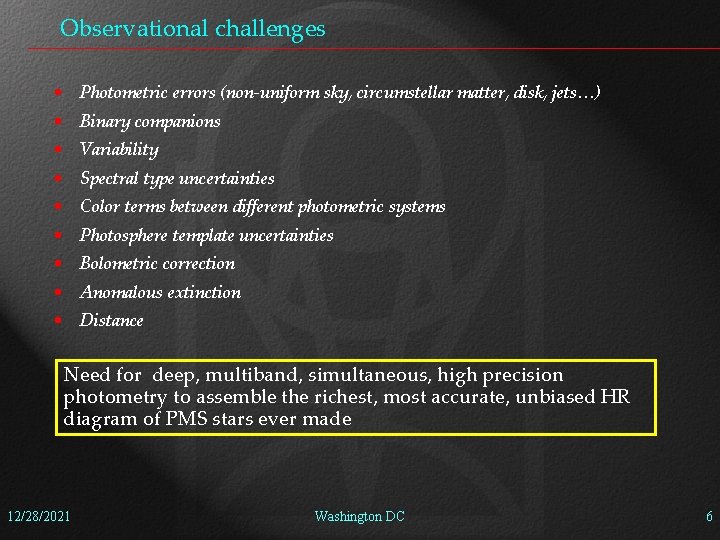
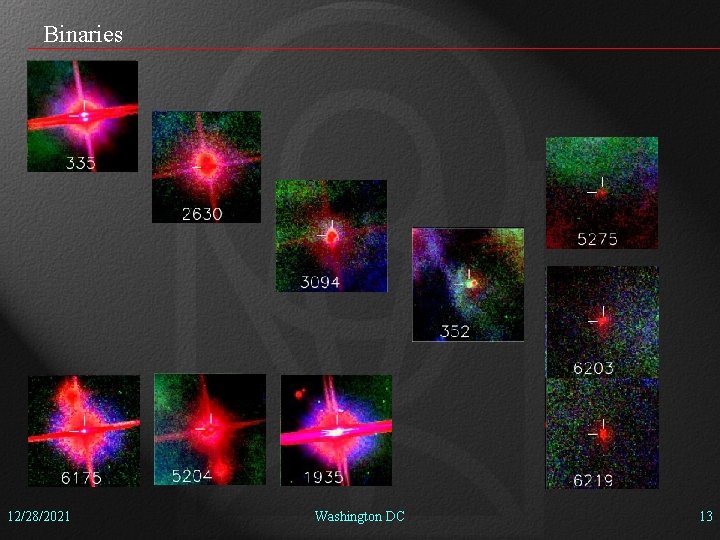
Observational challenges • Photometric errors (non-uniform sky, circumstellar matter, disk, jets…) • Binary companions • Variability • Spectral type uncertainties • Color terms between different photometric systems • Photosphere template uncertainties • Bolometric correction • Anomalous extinction • Distance Need for deep, multiband, simultaneous, high precision photometry to assemble the richest, most accurate, unbiased HR diagram of PMS stars ever made 12/28/2021 Washington DC 6
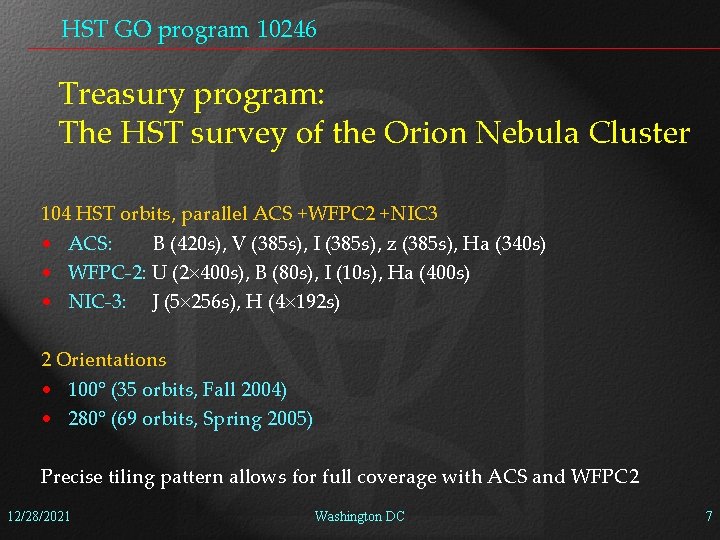
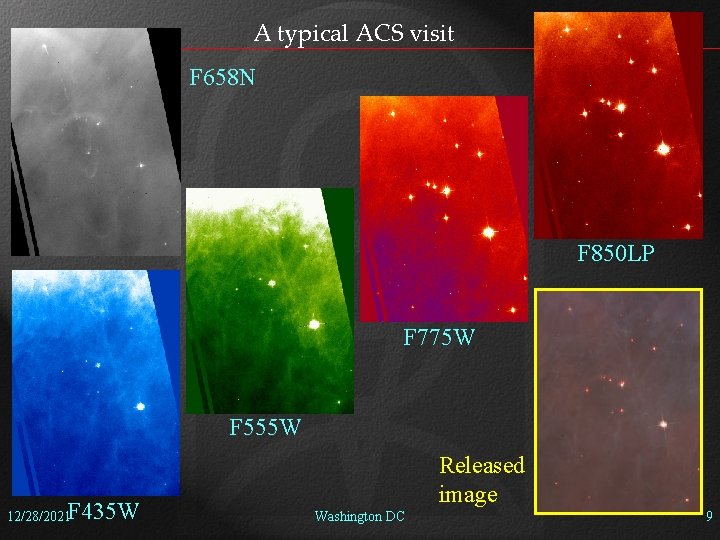
HST GO program 10246 Treasury program: The HST survey of the Orion Nebula Cluster 104 HST orbits, parallel ACS +WFPC 2 +NIC 3 • ACS: B (420 s), V (385 s), I (385 s), z (385 s), Ha (340 s) • WFPC-2: U (2 400 s), B (80 s), I (10 s), Ha (400 s) • NIC-3: J (5 256 s), H (4 192 s) 2 Orientations • 100° (35 orbits, Fall 2004) • 280° (69 orbits, Spring 2005) Precise tiling pattern allows for full coverage with ACS and WFPC 2 12/28/2021 Washington DC 7
ACS release 12/28/2021 Washington DC 8
A typical ACS visit F 658 N F 850 LP F 775 W F 555 W F 435 W 12/28/2021 Released image Washington DC 9
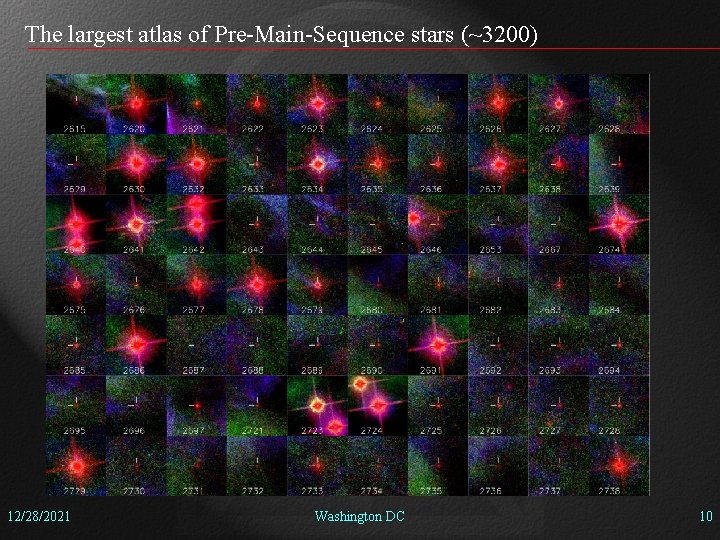
The largest atlas of Pre-Main-Sequence stars (~3200) 12/28/2021 Washington DC 10
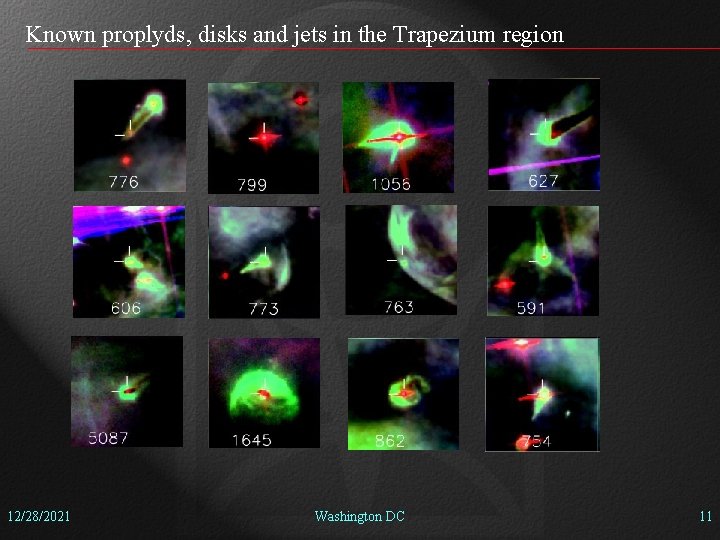
Known proplyds, disks and jets in the Trapezium region 12/28/2021 Washington DC 11
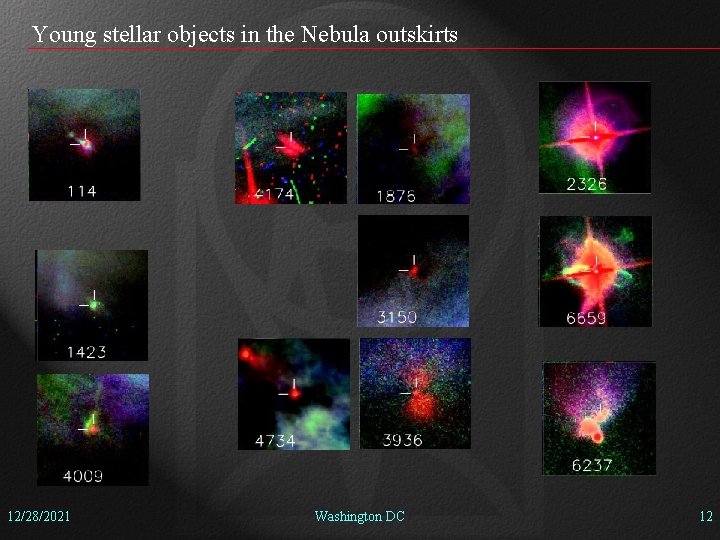
Young stellar objects in the Nebula outskirts 12/28/2021 Washington DC 12
Binaries 12/28/2021 Washington DC 13
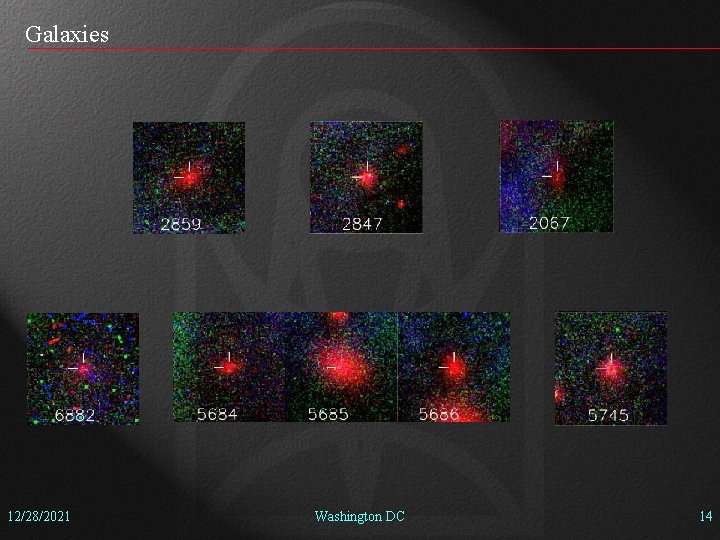
Galaxies 12/28/2021 Washington DC 14
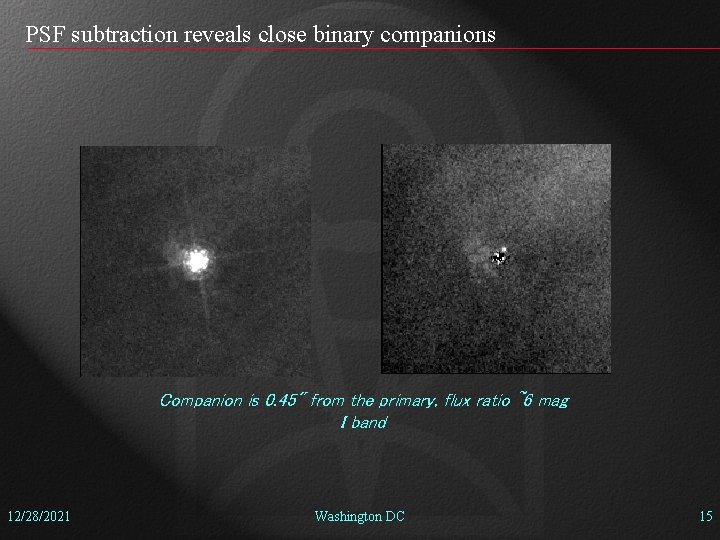
PSF subtraction reveals close binary companions Companion is 0. 45" from the primary, flux ratio ~6 mag I band 12/28/2021 Washington DC 15
The Orion Nebula Cluster Orion cluster, HR diagram (Hillenbrand 1997) M 43 region, Color-Magnitude diagram (HST Treasury Program) 12/28/2021 Washington DC 16