
AN OVERVIEW OF THE EARLY START DENVER MODEL




- Slides: 66
AN OVERVIEW OF THE EARLY START DENVER MODEL Cindy Dollman Le. Grand, M. A. , CCC-SLP/BCBA Karen Randolph, M. A. , CCC-SLP WEST VIRGINIA SPEECH-LANGUAGE HEARING ASSOCIATION CONFERENCE BRIDGEPORT WV APRIL 5, 2019
BRINGING ESDM TO WEST VIRGINIA BIRTH TO THREE Early Start Denver Model Introductory Workshop Fall 2016 (Karen and Cindy) Applications for WVBTT providers interested in participating in ESDM training Summer 2017 ESDM Cohort established Fall 2017 Intro class taken by 8 additional providers Winter 2017 Community of Practice established 2017 Advanced Training and continued Community of Practice August 2018 Future Plans
Prevalence of ASD affects up to 1 in 59 people. * 1 in 37 boys and 1 in 151 girls. Boys are four times more likely to be diagnosed with autism than girls. A new case of ASD is diagnosed nearly every 20 minutes. • Largest increases in Hispanic and African- American children. • Siblings of children with autism are at higher risk of developing autism Developmental regression, or loss of skills, such as language and social interests, affects around 1 in 5 children who will go on to be diagnosed with autism and typically occurs between ages 1 and 3. *Centers for Disease Control, 2018
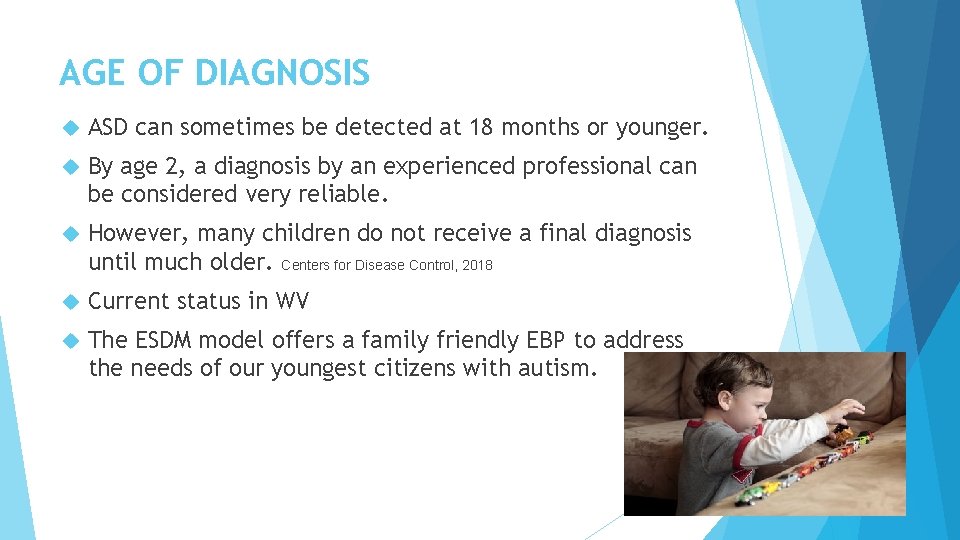
AGE OF DIAGNOSIS ASD can sometimes be detected at 18 months or younger. By age 2, a diagnosis by an experienced professional can be considered very reliable. However, many children do not receive a final diagnosis until much older. Centers for Disease Control, 2018 Current status in WV The ESDM model offers a family friendly EBP to address the needs of our youngest citizens with autism.
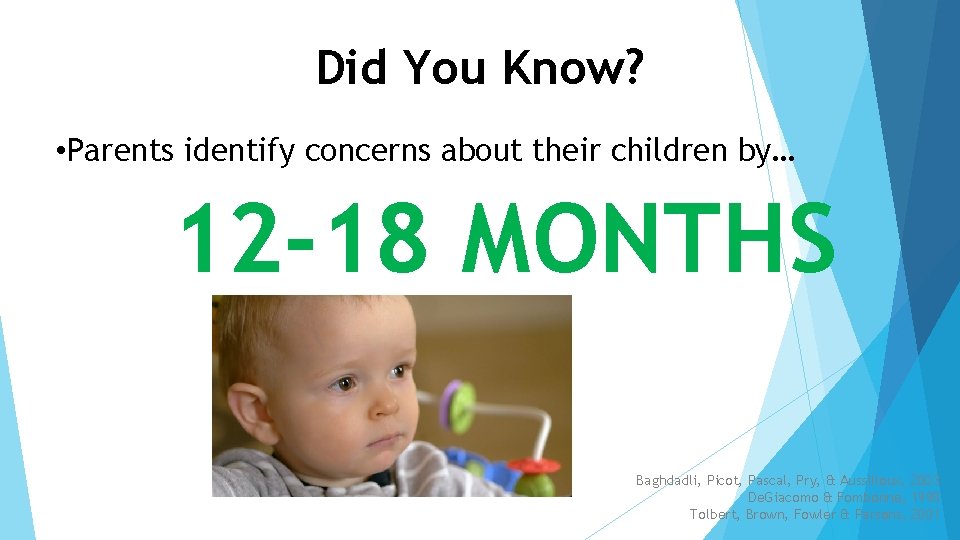
Did You Know? • Parents identify concerns about their children by… 12 -18 MONTHS Baghdadli, Picot, Pascal, Pry, & Aussilloux, 2003 De. Giacomo & Fombonne, 1998 Tolbert, Brown, Fowler & Parsons, 2001
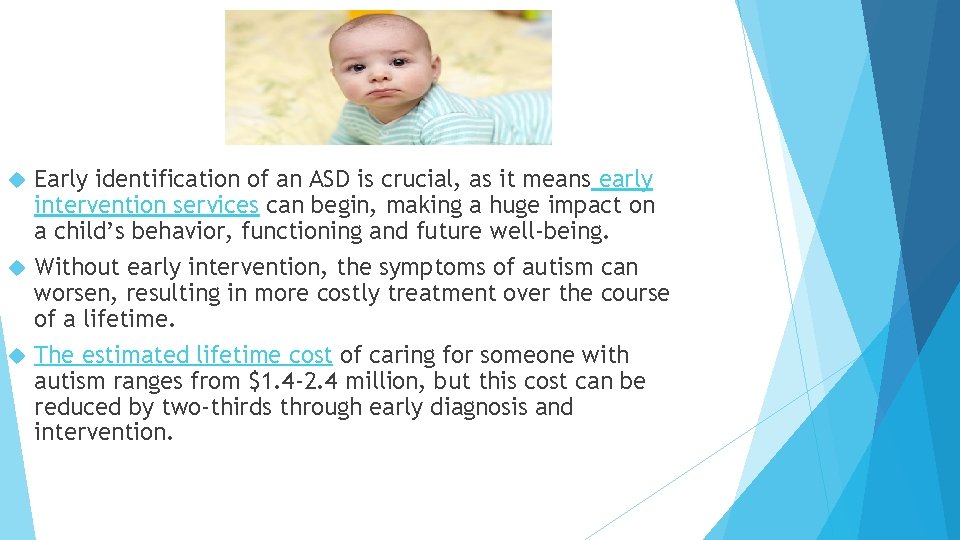
Early identification of an ASD is crucial, as it means early intervention services can begin, making a huge impact on a child’s behavior, functioning and future well-being. Without early intervention, the symptoms of autism can worsen, resulting in more costly treatment over the course of a lifetime. The estimated lifetime cost of caring for someone with autism ranges from $1. 4 -2. 4 million, but this cost can be reduced by two-thirds through early diagnosis and intervention.
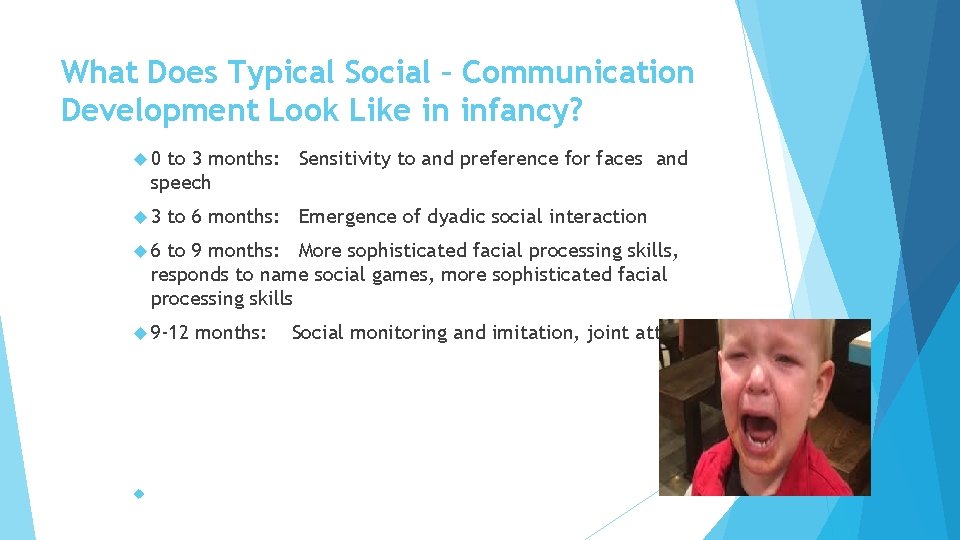
What Does Typical Social – Communication Development Look Like in infancy? 0 to 3 months: Sensitivity to and preference for faces and speech 3 to 6 months: Emergence of dyadic social interaction 6 to 9 months: More sophisticated facial processing skills, responds to name social games, more sophisticated facial processing skills 9 -12 months: Social monitoring and imitation, joint attention.
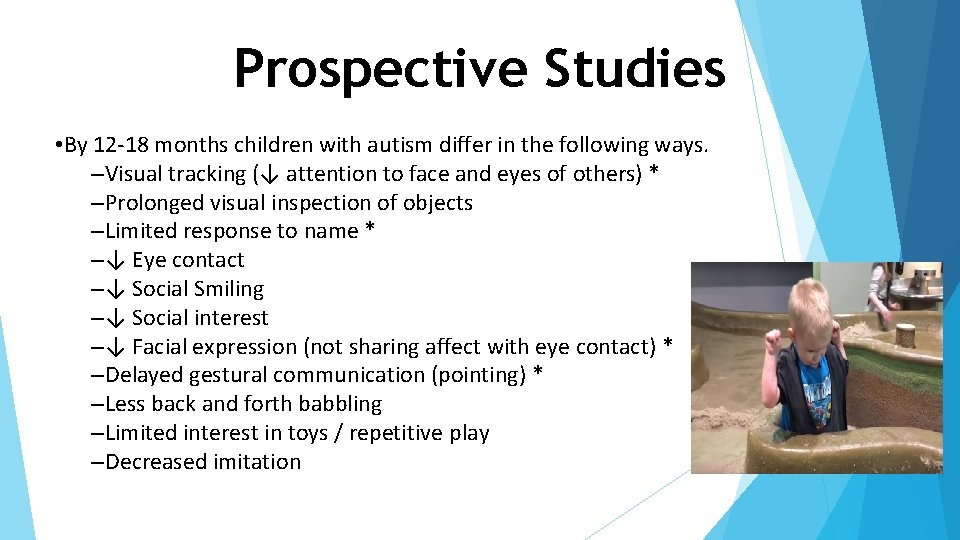
Prospective Studies • By 12 -18 months children with autism differ in the following ways. –Visual tracking (↓ attention to face and eyes of others) * –Prolonged visual inspection of objects –Limited response to name * –↓ Eye contact –↓ Social Smiling –↓ Social interest –↓ Facial expression (not sharing affect with eye contact) * –Delayed gestural communication (pointing) * –Less back and forth babbling –Limited interest in toys / repetitive play –Decreased imitation
“It’s easy to notice things babies do that are unusual. It’s harder to notice things that are missing. ” -Dr. Lauren Turner-Brown
What is ESDM? ESDM is a comprehensive early intervention for infants and toddlers between the ages of 12 -48 months It is a naturalistic developmental model of treatment that incorporates some teaching elements of ABA, and focuses on building strong, positive social relationships with caregivers ESDM aims to increase the rates of development across all domains and decrease the core symptoms of autism (Schriebman et al. , 2015, http: //www. ucdmc. ucdavis. edu/mindinstitute/research/esdm/)
HOW DOES IT WORK? Early interventions that enhance social attention may be critical in effecting change via brain plasticity At the heart of the ESDM is the empirical knowledge-base of infant-toddler learning and development and the effects of early autism. If we observe how typically developing infants do most of their early learning…observational learning and imitation The ESDM model draws on science of learning principles that cue the child’s attention to our faces, our voices and actions so we can provide very clear social communicative cues to elicit a response.
Theoretical Background Developed by Sally Rogers, Ph. D. and Geraldine Dawson, Ph. D. as an extension of the Denver Model, an intervention for children with autism between the ages of 24 -60 months The American Academy of Pediatrics recommends that children be screened for autism between 18 -24 months of age, so Rogers and Dawson wanted to target an intervention specifically towards that age group (Dawson et al. , 2012; Rogers & Dawson, 2010)
Theoretical Background con’t The aim of ESDM is to capitalize on high levels of brain plasticity during infancy and toddlerhood Not just to change behaviors associated with autism, but to actually change brain structure and function in order to promote future social development Children with autism are naturally less socially-oriented, so without intervention they have less opportunities to engage in activities that will build neural pathways in the same way as typically developing children (Dawson et al. , 2012; Rogers & Dawson, 2010)
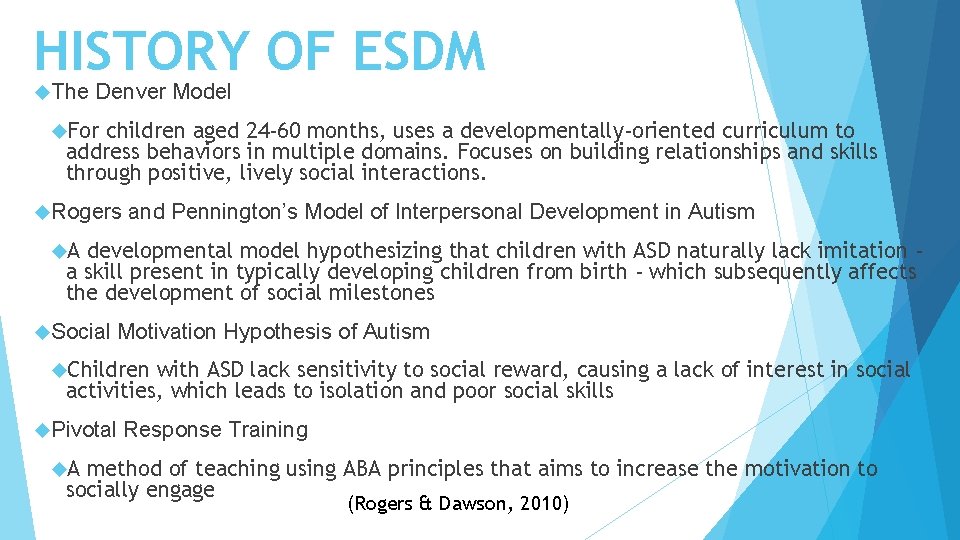
HISTORY OF ESDM The Denver Model For children aged 24 -60 months, uses a developmentally-oriented curriculum to address behaviors in multiple domains. Focuses on building relationships and skills through positive, lively social interactions. Rogers and Pennington’s Model of Interpersonal Development in Autism A developmental model hypothesizing that children with ASD naturally lack imitation a skill present in typically developing children from birth - which subsequently affects the development of social milestones Social Motivation Hypothesis of Autism Children with ASD lack sensitivity to social reward, causing a lack of interest in social activities, which leads to isolation and poor social skills Pivotal Response Training A method of teaching using ABA principles that aims to increase the motivation to socially engage (Rogers & Dawson, 2010)
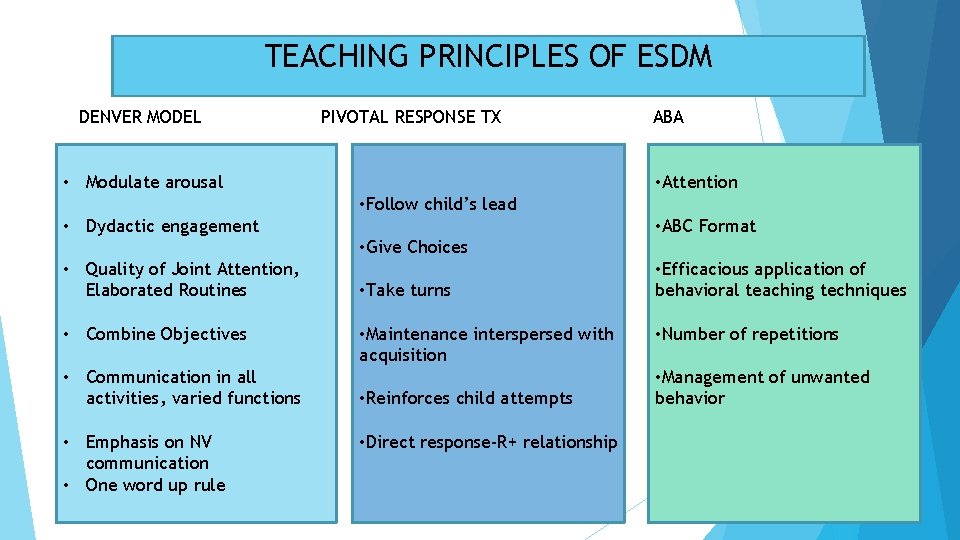
TEACHING PRINCIPLES OF ESDM DENVER MODEL PIVOTAL RESPONSE TX ABA • Attention • Modulate arousal • Follow child’s lead • ABC Format • Dydactic engagement • Give Choices • Quality of Joint Attention, Elaborated Routines • Combine Objectives • Communication in all activities, varied functions • Emphasis on NV communication • One word up rule • Take turns • Maintenance interspersed with acquisition • Reinforces child attempts • Direct response-R+ relationship • Efficacious application of behavioral teaching techniques • Number of repetitions • Management of unwanted behavior
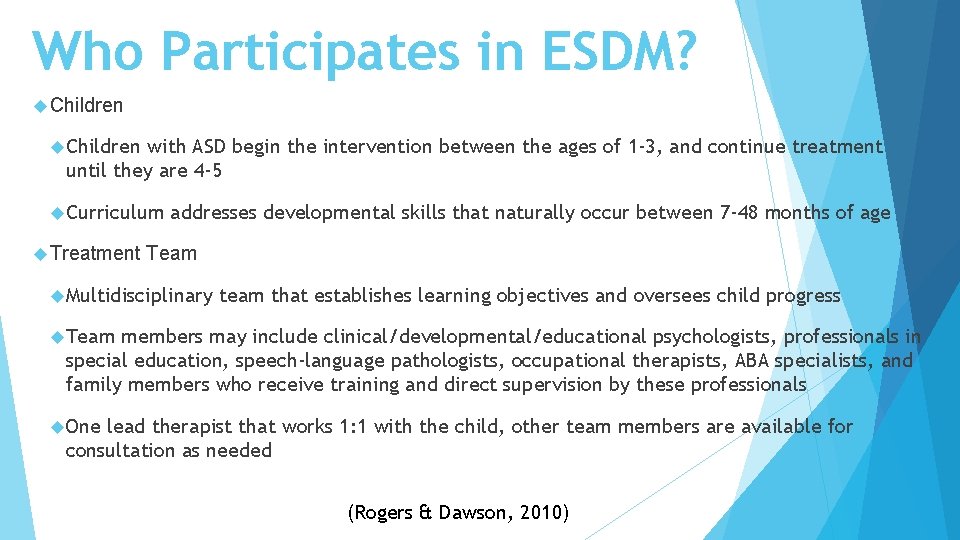
Who Participates in ESDM? Children with ASD begin the intervention between the ages of 1 -3, and continue treatment until they are 4 -5 Curriculum Treatment addresses developmental skills that naturally occur between 7 -48 months of age Team Multidisciplinary team that establishes learning objectives and oversees child progress Team members may include clinical/developmental/educational psychologists, professionals in special education, speech-language pathologists, occupational therapists, ABA specialists, and family members who receive training and direct supervision by these professionals One lead therapist that works 1: 1 with the child, other team members are available for consultation as needed (Rogers & Dawson, 2010)
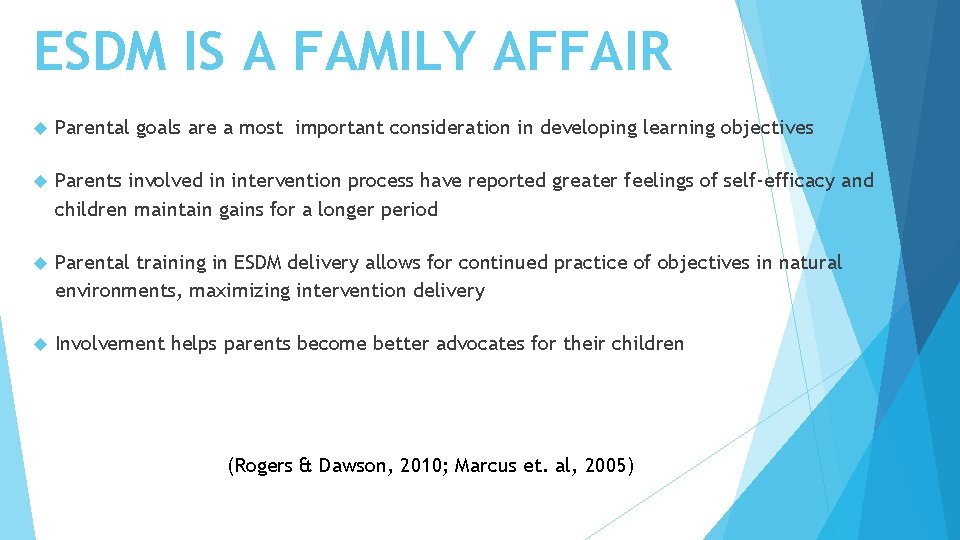
ESDM IS A FAMILY AFFAIR Parental goals are a most important consideration in developing learning objectives Parents involved in intervention process have reported greater feelings of self-efficacy and children maintain gains for a longer period Parental training in ESDM delivery allows for continued practice of objectives in natural environments, maximizing intervention delivery Involvement helps parents become better advocates for their children (Rogers & Dawson, 2010; Marcus et. al, 2005)
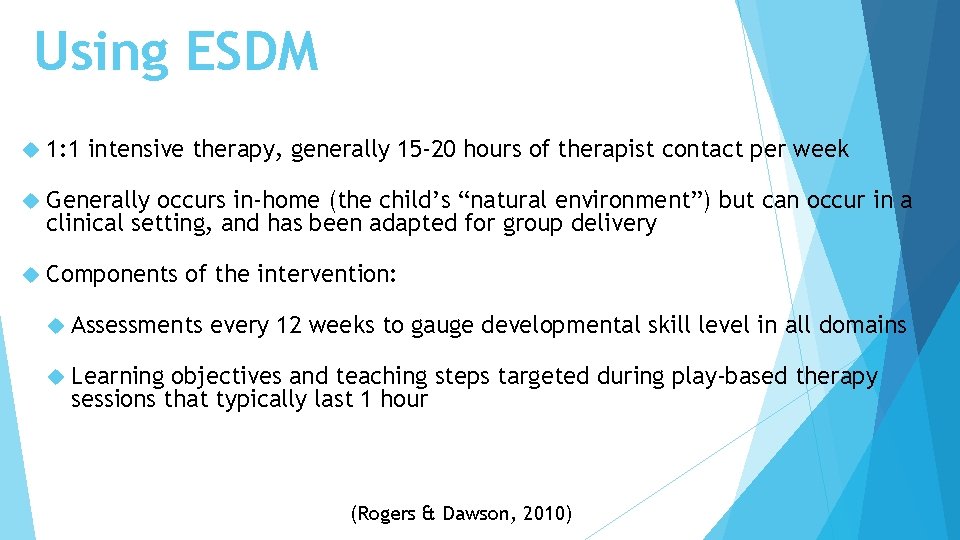
Using ESDM 1: 1 intensive therapy, generally 15 -20 hours of therapist contact per week Generally occurs in-home (the child’s “natural environment”) but can occur in a clinical setting, and has been adapted for group delivery Components of the intervention: Assessments every 12 weeks to gauge developmental skill level in all domains Learning objectives and teaching steps targeted during play-based therapy sessions that typically last 1 hour (Rogers & Dawson, 2010)
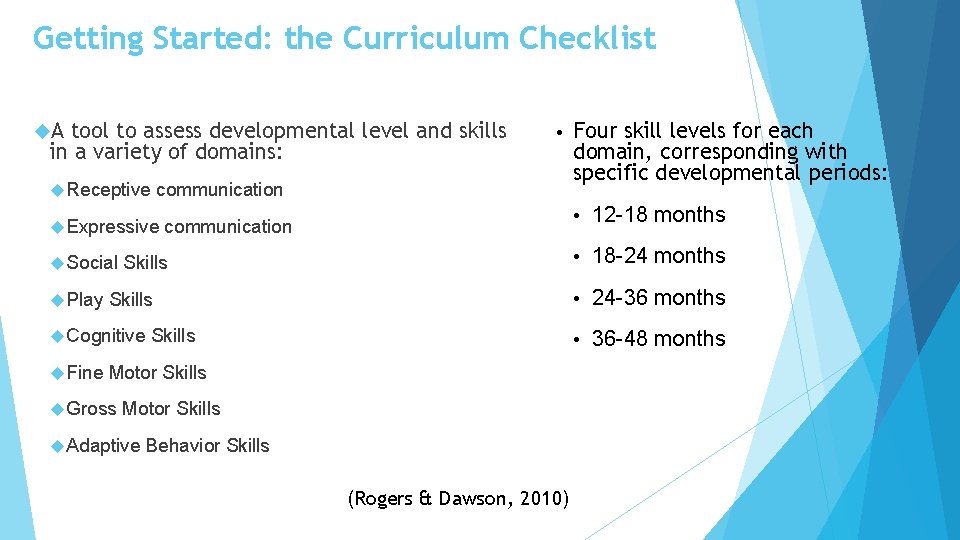
Getting Started: the Curriculum Checklist A tool to assess developmental level and skills in a variety of domains: Receptive communication Expressive Social Play • 18 -24 months • 24 -36 months Skills • 36 -48 months Motor Skills Gross Motor Skills Adaptive domain, corresponding with specific developmental periods: • 12 -18 months communication Skills Cognitive Fine • Four skill levels for each Behavior Skills (Rogers & Dawson, 2010)
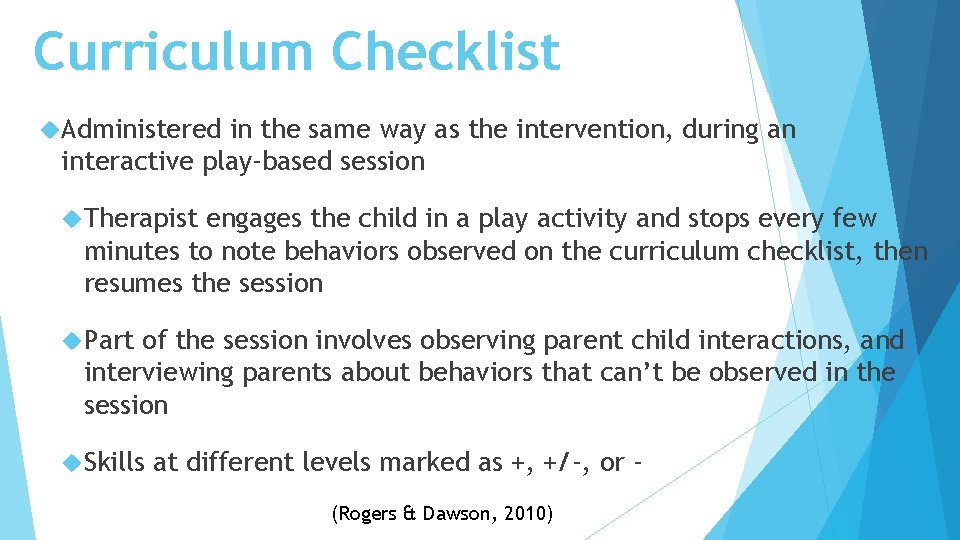
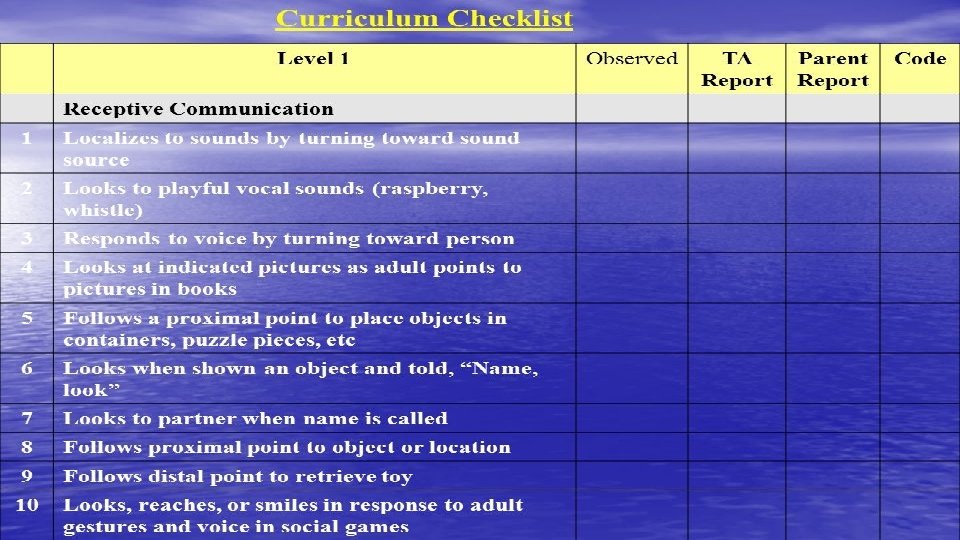
Curriculum Checklist Administered in the same way as the intervention, during an interactive play-based session Therapist engages the child in a play activity and stops every few minutes to note behaviors observed on the curriculum checklist, then resumes the session Part of the session involves observing parent child interactions, and interviewing parents about behaviors that can’t be observed in the session Skills at different levels marked as +, +/-, or (Rogers & Dawson, 2010)
(Rogers & Dawson, 2010)
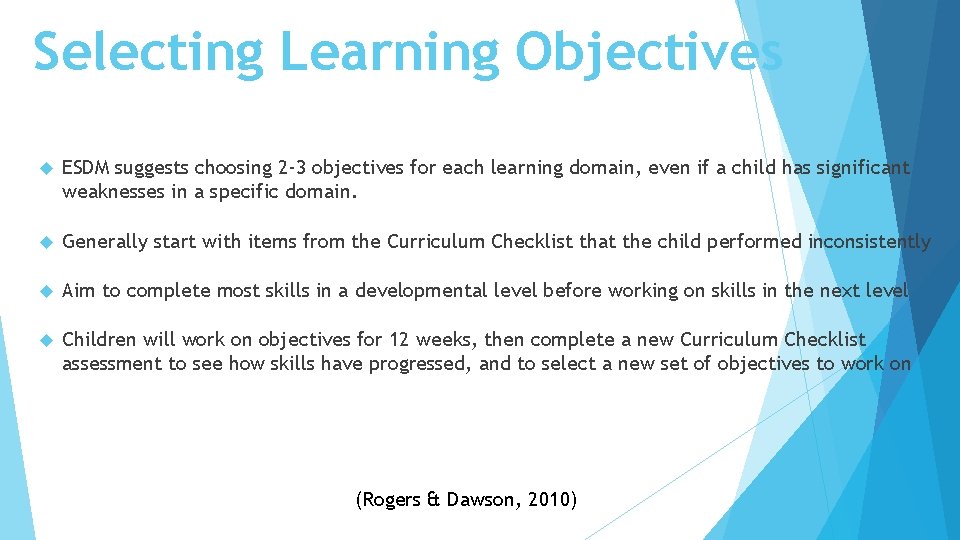
Selecting Learning Objectives ESDM suggests choosing 2 -3 objectives for each learning domain, even if a child has significant weaknesses in a specific domain. Generally start with items from the Curriculum Checklist that the child performed inconsistently Aim to complete most skills in a developmental level before working on skills in the next level Children will work on objectives for 12 weeks, then complete a new Curriculum Checklist assessment to see how skills have progressed, and to select a new set of objectives to work on (Rogers & Dawson, 2010)
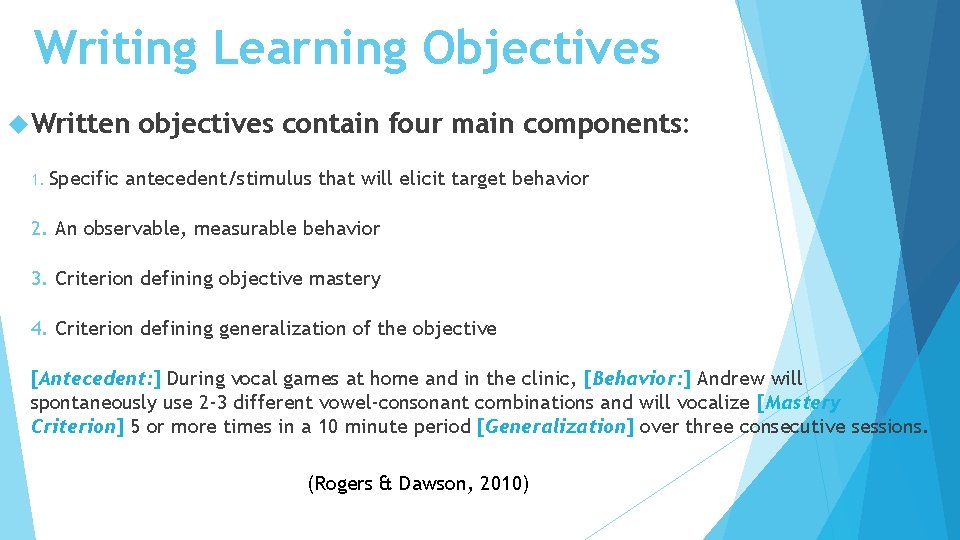
Writing Learning Objectives Written 1. Specific objectives contain four main components: antecedent/stimulus that will elicit target behavior 2. An observable, measurable behavior 3. Criterion defining objective mastery 4. Criterion defining generalization of the objective [Antecedent: ] During vocal games at home and in the clinic, [Behavior: ] Andrew will spontaneously use 2 -3 different vowel-consonant combinations and will vocalize [Mastery Criterion] 5 or more times in a 10 minute period [Generalization] over three consecutive sessions. (Rogers & Dawson, 2010)
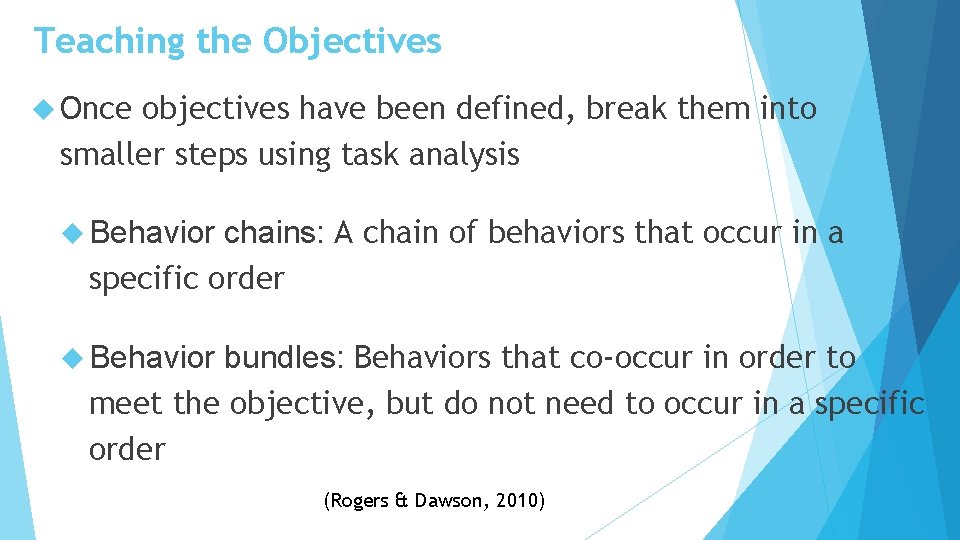
Teaching the Objectives Once objectives have been defined, break them into smaller steps using task analysis chains: A chain of behaviors that occur in a specific order Behavior bundles: Behaviors that co-occur in order to meet the objective, but do not need to occur in a specific order Behavior (Rogers & Dawson, 2010)
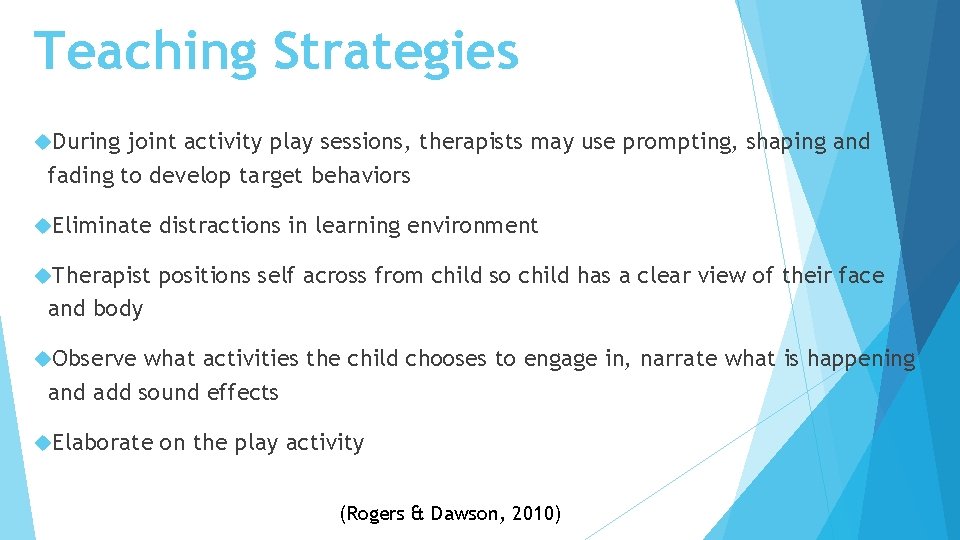
Teaching Strategies During joint activity play sessions, therapists may use prompting, shaping and fading to develop target behaviors Eliminate distractions in learning environment Therapist positions self across from child so child has a clear view of their face and body Observe what activities the child chooses to engage in, narrate what is happening and add sound effects Elaborate on the play activity (Rogers & Dawson, 2010)
Teaching Strategies con’t Imitate the child, and prompt the child to imitate you Be helpful - see what the child wants and help them obtain it. This establishes your presence as a natural reinforcer. Control the materials - require the child to gesture or vocalize to get them from you Take turns - when the child is engaged in a one-person activity observe, take materials and say “my turn!” then hand them back and say “your turn!” (Rogers & Dawson, 2010)
What Does a Session Look Like? Child interest cues an activity Adult follows the child’s lead, maintaining a positive affect and using language to describe what is happening Adult elaborates on the activity using skills such as turn taking, imitation, and variation on the play theme, while making sure the activity remains social and reciprocal Adult weaves in target vocabulary and frequently elicits verbal and nonverbal communication from the child It’s fun! (Rogers & Dawson, 2010)
Joint Activities An activity in which two partners are engaged with each other in the same cooperative activity, attending to the same objects Definition: During sessions, therapists alternate between object focused and sensory-social joint routines. Sessions begin and end with “hello” and “goodbye” routines, and generally include a snack. Each joint activity typically lasts for a few minutes. The goals of ESDM joint activities: Engage the child in activities that provide practice opportunities for target skills Develop a positive relationship with the child in which the adult makes activities more interesting and socially rewarding (Rogers & Dawson, 2010)
Tracking Progress: the Data Sheet For every objective, note the date started and the date the objective is passed During each session, therapists aim to probe acquisition skills and recently mastered skills Data marked the same way as on the Curriculum checklist (+, +/-, or -) During a one hour session, therapist pauses at 15 minute intervals to mark data sheet and review which teaching targets still need to be practiced (Rogers & Dawson, 2010)
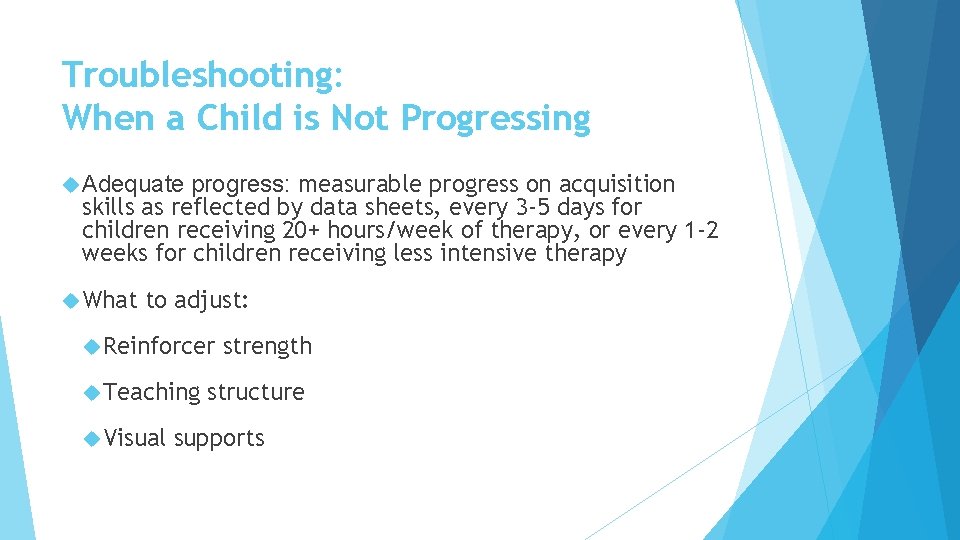
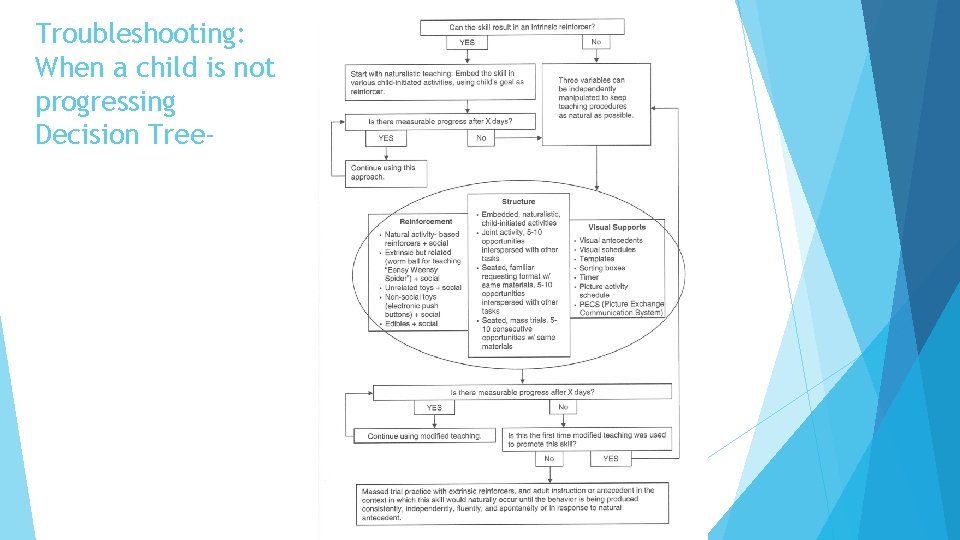
Troubleshooting: When a Child is Not Progressing progress: measurable progress on acquisition skills as reflected by data sheets, every 3 -5 days for children receiving 20+ hours/week of therapy, or every 1 -2 weeks for children receiving less intensive therapy Adequate What to adjust: Reinforcer Teaching Visual strength structure supports
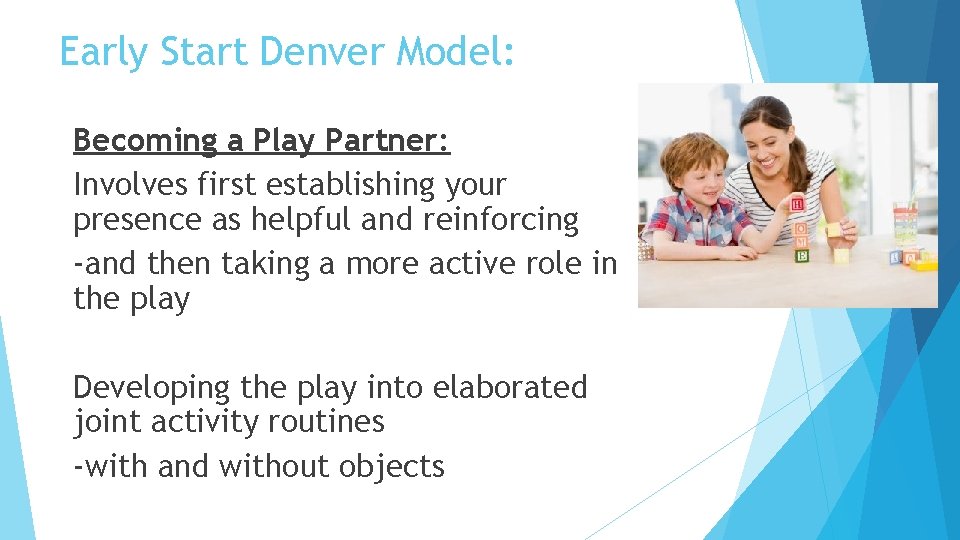
Early Start Denver Model: Becoming a Play Partner: Involves first establishing your presence as helpful and reinforcing -and then taking a more active role in the play Developing the play into elaborated joint activity routines -with and without objects
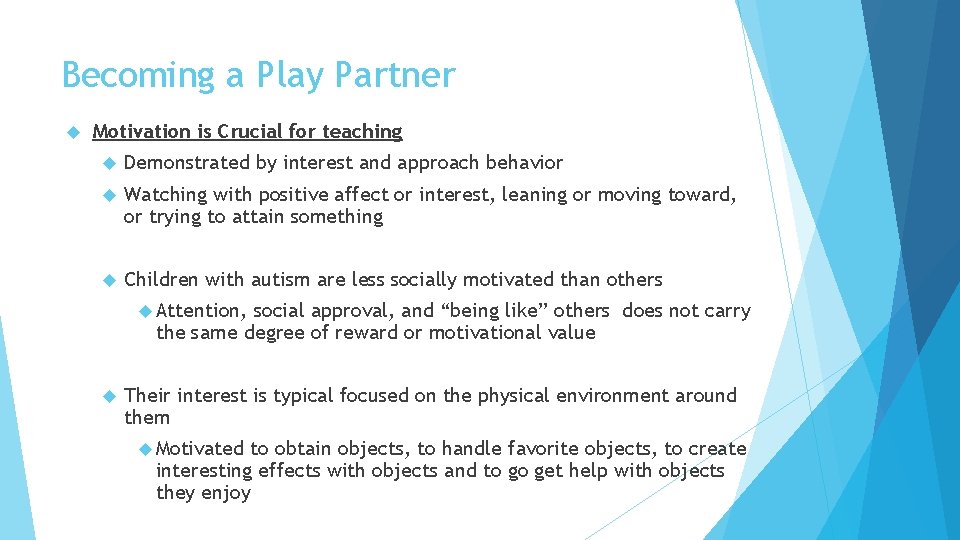
Becoming a Play Partner Motivation is Crucial for teaching Demonstrated by interest and approach behavior Watching with positive affect or interest, leaning or moving toward, or trying to attain something Children with autism are less socially motivated than others Attention, social approval, and “being like” others does not carry the same degree of reward or motivational value Their interest is typical focused on the physical environment around them Motivated to obtain objects, to handle favorite objects, to create interesting effects with objects and to go get help with objects they enjoy
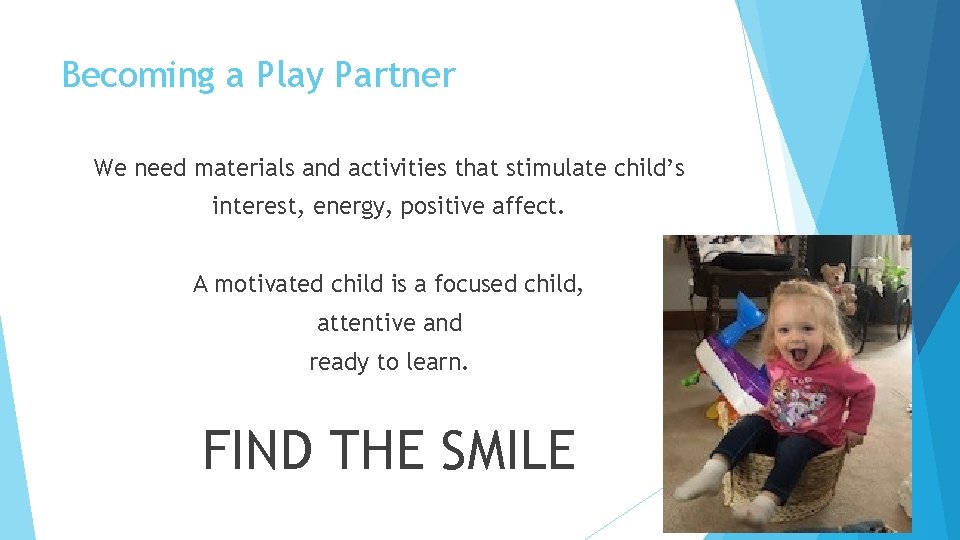
Becoming a Play Partner We need materials and activities that stimulate child’s interest, energy, positive affect. A motivated child is a focused child, attentive and ready to learn. FIND THE SMILE
Becoming a Play Partner Strong motivation supports active learners. Active learners show initiation and spontaneity. TWO CHARACTERITICS THAT WE WANT TO FOSTER IN CHILDREN WITH AUTISM
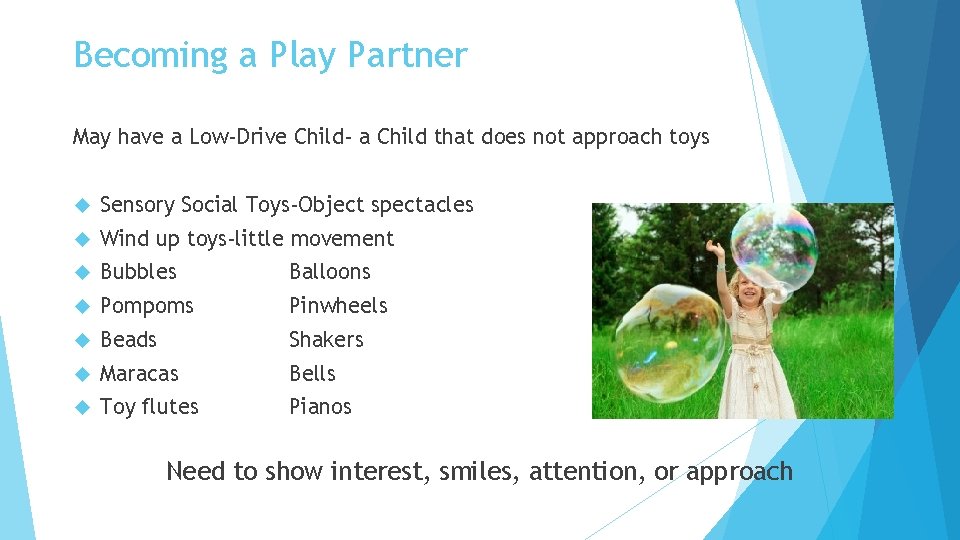
Becoming a Play Partner May have a Low-Drive Child- a Child that does not approach toys Sensory Social Toys-Object spectacles Wind up toys-little movement Bubbles Balloons Pompoms Pinwheels Beads Shakers Maracas Bells Toy flutes Pianos Need to show interest, smiles, attention, or approach
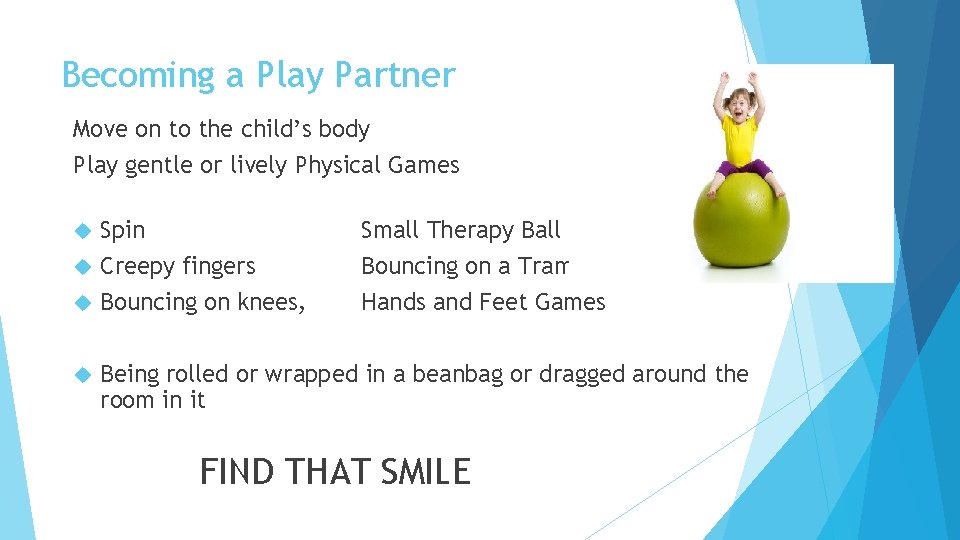
Becoming a Play Partner Move on to the child’s body Play gentle or lively Physical Games Spin Creepy fingers Bouncing on knees, Small Therapy Ball Bouncing on a Trampoline Hands and Feet Games Being rolled or wrapped in a beanbag or dragged around the room in it FIND THAT SMILE
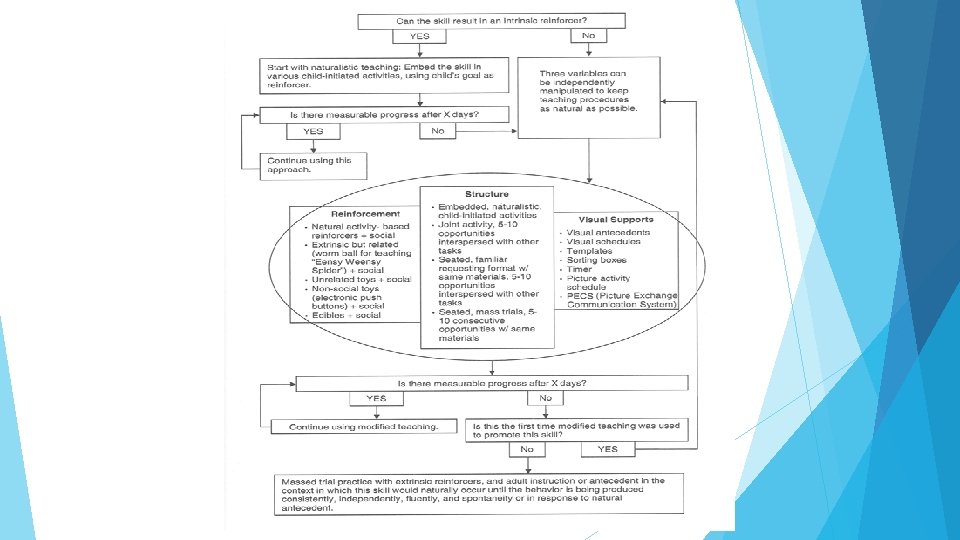
Becoming a Play Partner If Food is the only motivating object, then have a snack with the child and uses these physical games to have a drawn-out snack time. To be able to reach a child, you need to find reliable ways to turn on that “spotlight” of attention and the motivation behind it. There a few young children with autism who do not respond positively to any other stimuli They may do better with a more adult-direct and didactic, discrete trail teaching approach to build up their interest and reward the value of interacting with objects and people. Apply the decision tree.
Troubleshooting: When a child is not progressing Decision Tree-
Becoming a Play Partner In order to learn from people, a child’s attention has to be on people. We have to become the child’s focus of attention We have to step into that “SPOTLIGHT OF ATTENTION” Once we identify a child’s object or activity interest-- Draw the child’s attention to our eyes and faces Our body actions And our voices, sounds and words BE IN THAT SPOTLIGHT
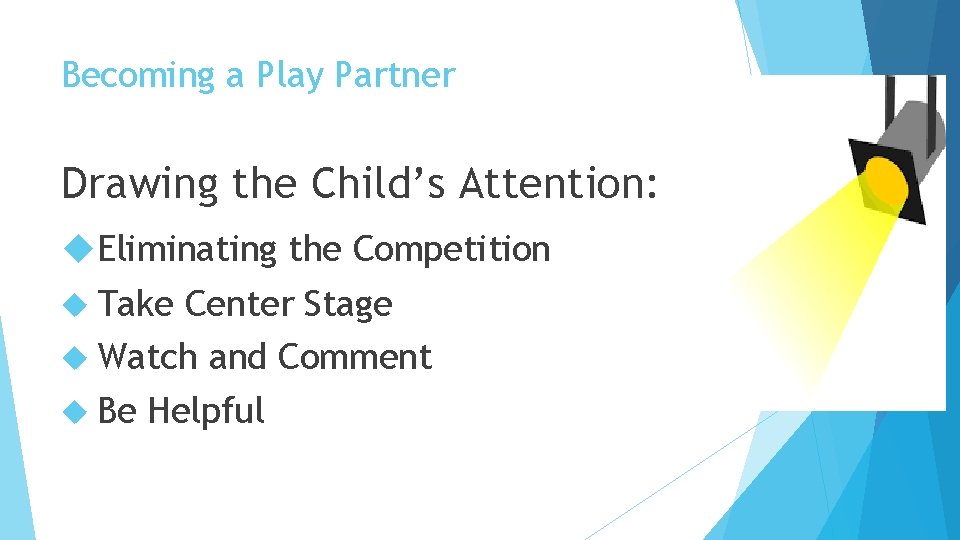
Becoming a Play Partner Drawing the Child’s Attention: Eliminating the Competition Take Center Stage Watch and Comment Be Helpful
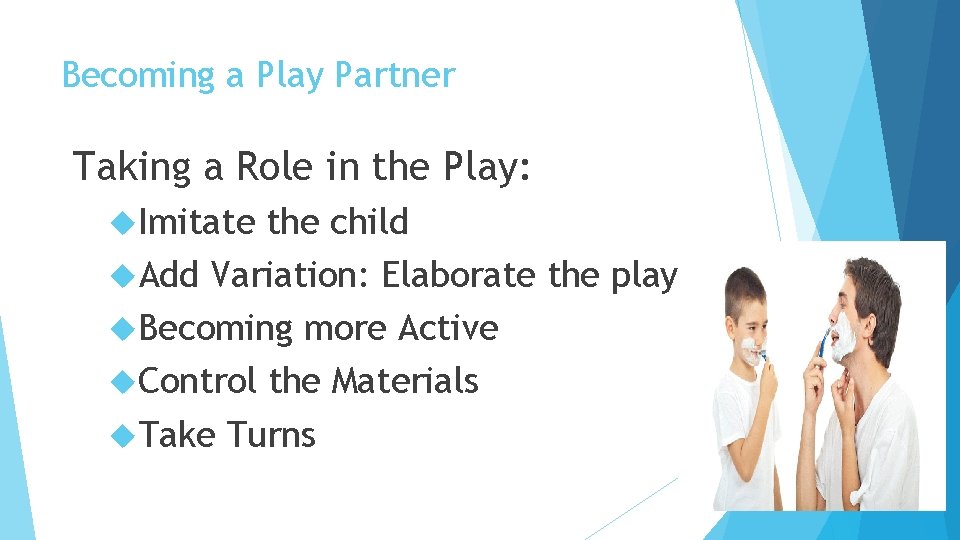
Becoming a Play Partner Taking a Role in the Play: Imitate the child Add Variation: Elaborate the play Becoming more Active Control the Materials Take Turns
Joint Attention Routines: Frames for Teaching Joint Attention An activity in which two partners are engaged with each other in the same cooperative activity, attending to the same object or playing or working together on a common activity Partners maybe imitating each others, constructing the activity together (Co-constriction)
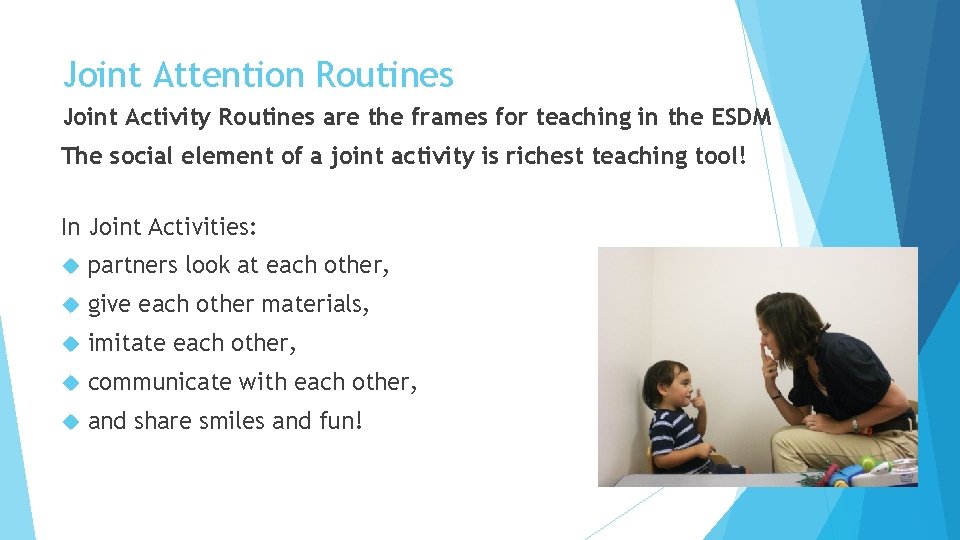
Joint Attention Routines Joint Activity Routines are the frames for teaching in the ESDM The social element of a joint activity is richest teaching tool! In Joint Activities: partners look at each other, give each other materials, imitate each other, communicate with each other, and share smiles and fun!
Phases of Joint Activity Routines The term Joint Activity Routines-discuss the entire scenario that surrounds the play acts with a social partner and provides for a whole teaching activity Several phases: The Opening or Set-Up Phase Theme The Elaboration Phase The Closing Involves a series of joint activities, beginning with a greeting activity, then moving through a series of different activities, some more active, some at the table, some more object focused and some more social, until the closing greeting routine ends the treatment session.
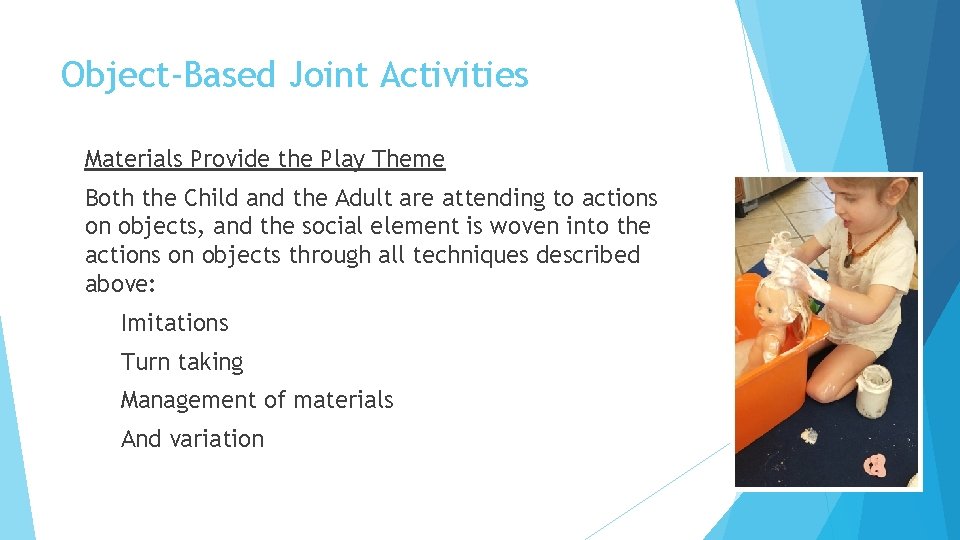
Object-Based Joint Activities Materials Provide the Play Theme Both the Child and the Adult are attending to actions on objects, and the social element is woven into the actions on objects through all techniques described above: Imitations Turn taking Management of materials And variation
How to Do Joint Activities with Objects Narrate the activity as you follow the child's lead by naming objects, actions, and relations in the simple language. Should occur frequently-several times a minute-This is the giving, the sharing, the showing, the pointing and the looking back and forth. As one theme or action becomes “played out” Move to the elaboration phase Model new action occasionally When the interest fades Move New through clean-up phase material and another joint attention routine
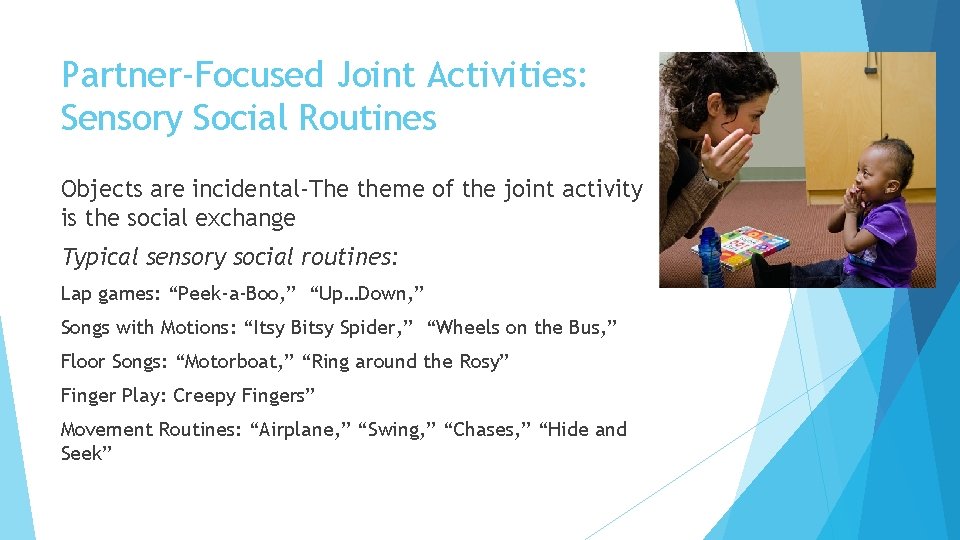
Partner-Focused Joint Activities: Sensory Social Routines The term sensory social routines refer to joint activity routines in which each partner's attention is focused on the other person, rather than the object where there is mutual pleasure and engagement dominate the play.
Partner-Focused Joint Activities: Sensory Social Routines Sensory Social Routine is a Dyadic Activity: Two persons are engaged in the same activity in a reciprocal way Turn Taking Imitating Each Other Communication Gestures Facial Expressions Building on Each Others Activity
Partner-Focused Joint Activities: Sensory Social Routines Objects are incidental-The theme of the joint activity is the social exchange Typical sensory social routines: Lap games: “Peek-a-Boo, ” “Up…Down, ” Songs with Motions: “Itsy Bitsy Spider, ” “Wheels on the Bus, ” Floor Songs: “Motorboat, ” “Ring around the Rosy” Finger Play: Creepy Fingers” Movement Routines: “Airplane, ” “Swing, ” “Chases, ” “Hide and Seek”
Four Main Goals that Sensory Social Routines accomplish: 1. Drawing the child’s attention to other people’s social communicative cues- especially eye contact and the face physical gestures, postures, anticipatory movements, and facial expressions. 2. Developing the child’s awareness of facial expression and their ability to share emotional expression face to face with another. 3. Increasing the child’s communication to initiate, respond to, and continue social interaction through their eye contact, facial expression, gestures, sounds, and words. 4. Optimizing the child’s arousal, state, and attention.
Sensory Social Routines-Foster Social Orienting and Communication Sensory Social Routines teach children to communicate intentionally to initiate, maintain, and end social interactions. Adult sets up interesting activities until the child is engaged, and then pause and wait for the child to signal them to continue. Very subtle at first: involving looking, reaching, vocalizing, making eye contact, or making some other gestures. This signal marks the child’s “Turn” and the adult then responds by continuing the activity.
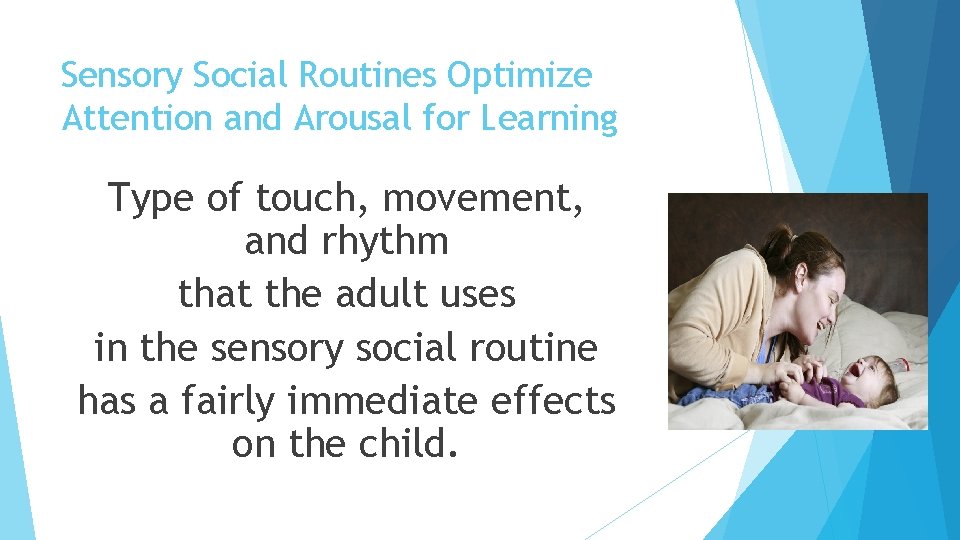
Sensory Social Routines Optimize Attention and Arousal for Learning Type of touch, movement, and rhythm that the adult uses in the sensory social routine has a fairly immediate effects on the child.
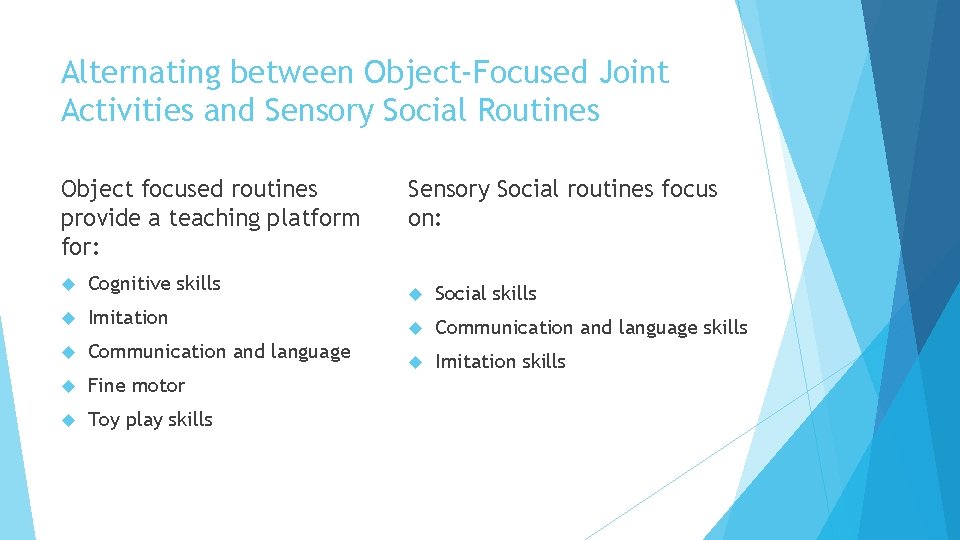
Alternating between Object-Focused Joint Activities and Sensory Social Routines Object focused routines provide a teaching platform for: Cognitive skills Imitation Communication and language Fine motor Toy play skills Sensory Social routines focus on: Social skills Communication and language skills Imitation skills
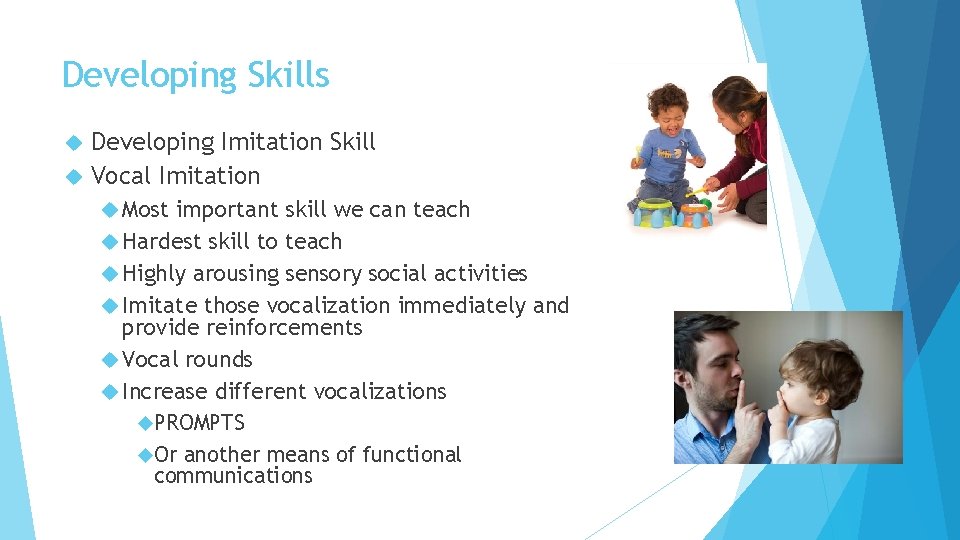
Developing Skills Developing Imitation Skill Vocal Imitation Most important skill we can teach Hardest skill to teach Highly arousing sensory social activities Imitate those vocalization immediately and provide reinforcements Vocal rounds Increase different vocalizations PROMPTS Or another means of functional communications
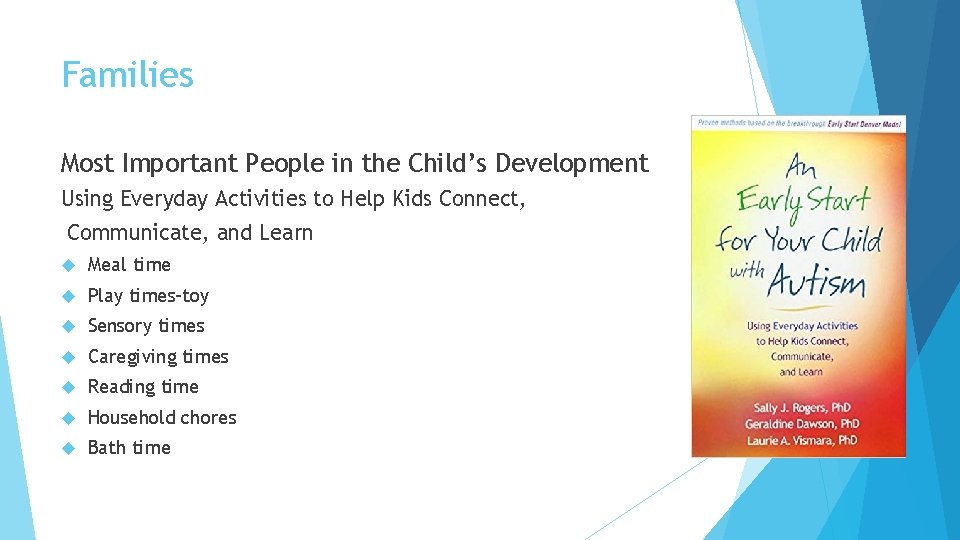
Families Most Important People in the Child’s Development Using Everyday Activities to Help Kids Connect, Communicate, and Learn Meal time Play times-toy Sensory times Caregiving times Reading time Household chores Bath time
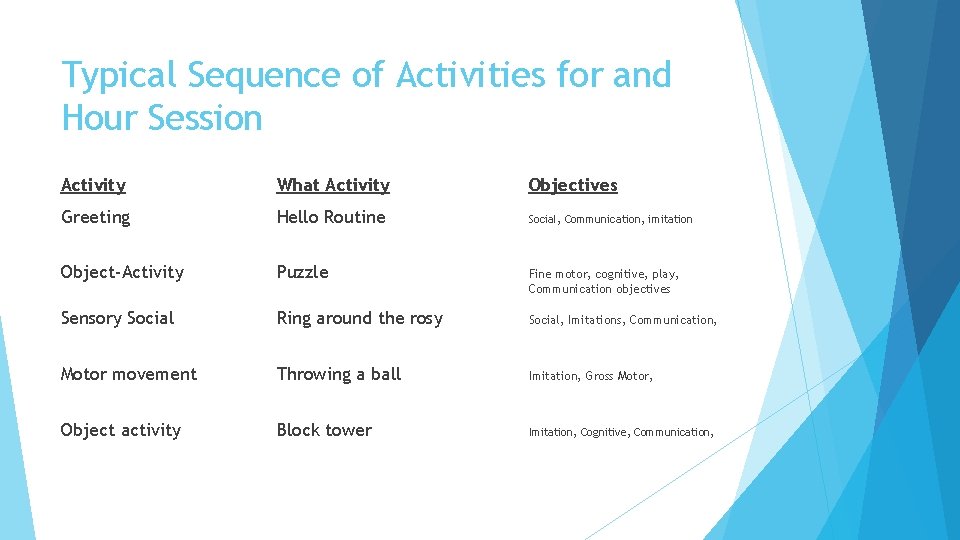
Typical Sequence of Activities for and Hour Session Activity What Activity Objectives Greeting Hello Routine Social, Communication, imitation Object-Activity Puzzle Fine motor, cognitive, play, Communication objectives Sensory Social Ring around the rosy Social, Imitations, Communication, Motor movement Throwing a ball Imitation, Gross Motor, Object activity Block tower Imitation, Cognitive, Communication,
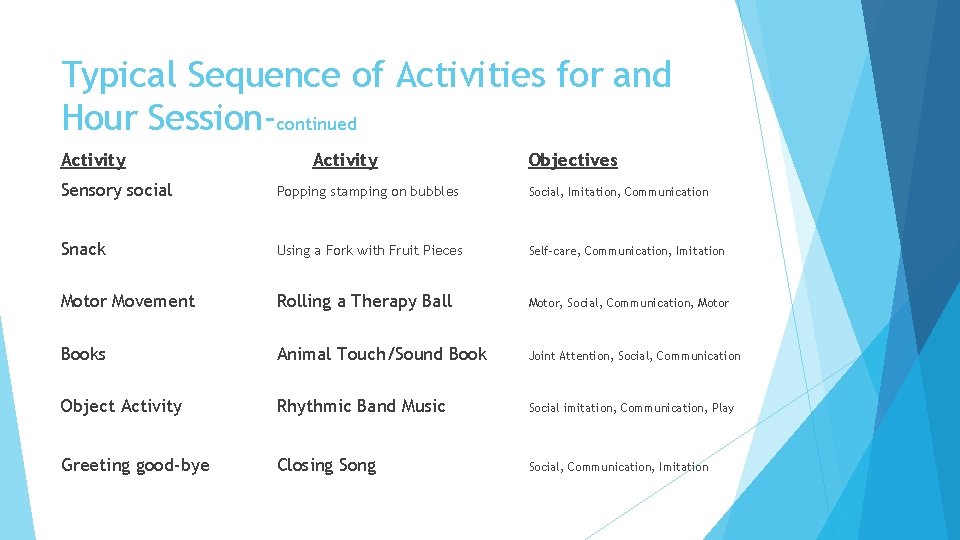
Typical Sequence of Activities for and Hour Session-continued Activity Objectives Sensory social Popping stamping on bubbles Social, Imitation, Communication Snack Using a Fork with Fruit Pieces Self-care, Communication, Imitation Motor Movement Rolling a Therapy Ball Motor, Social, Communication, Motor Books Animal Touch/Sound Book Joint Attention, Social, Communication Object Activity Rhythmic Band Music Social imitation, Communication, Play Greeting good-bye Closing Social, Communication, Imitation
QUESTIONS?
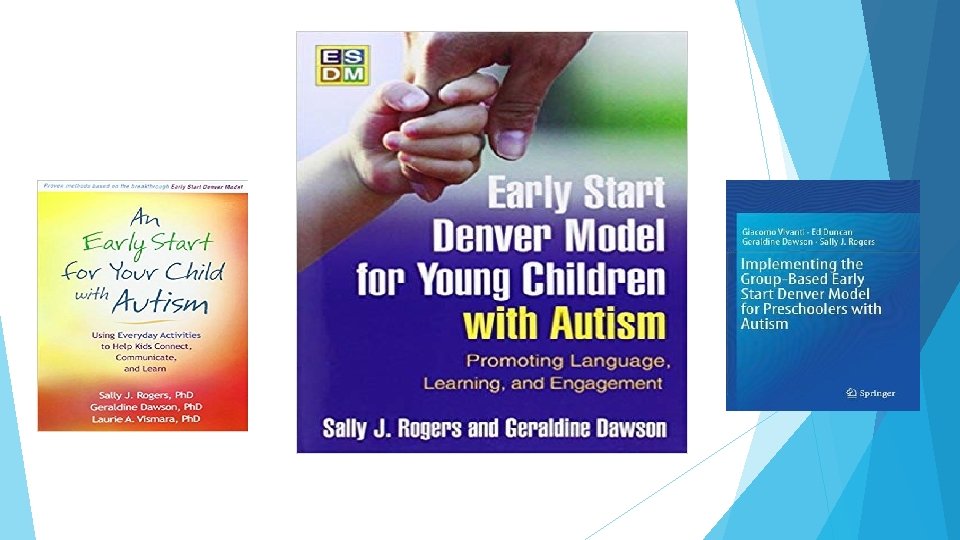
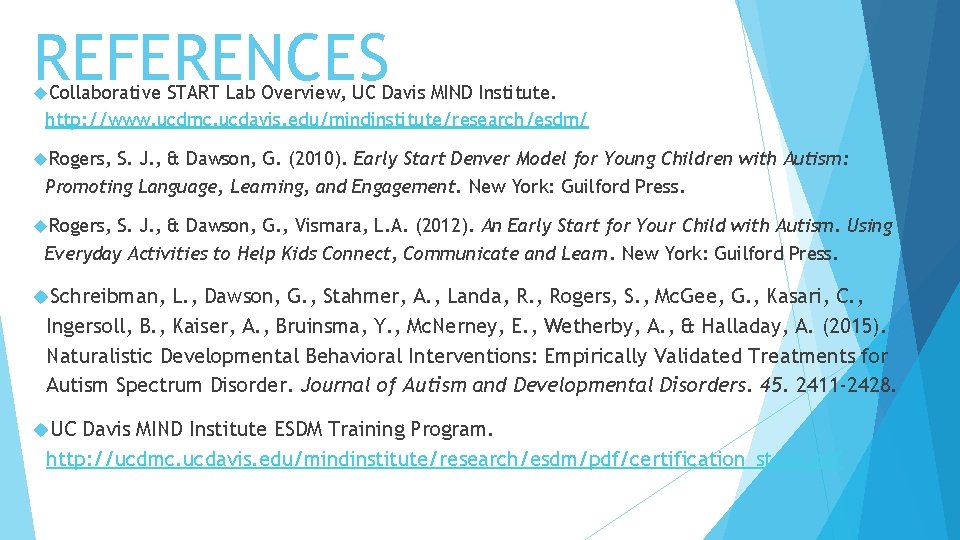
REFERENCES Collaborative START Lab Overview, UC Davis MIND Institute. http: //www. ucdmc. ucdavis. edu/mindinstitute/research/esdm/ Rogers, S. J. , & Dawson, G. (2010). Early Start Denver Model for Young Children with Autism: Promoting Language, Learning, and Engagement. New York: Guilford Press. Rogers, S. J. , & Dawson, G. , Vismara, L. A. (2012). An Early Start for Your Child with Autism. Using Everyday Activities to Help Kids Connect, Communicate and Learn. New York: Guilford Press. Schreibman, L. , Dawson, G. , Stahmer, A. , Landa, R. , Rogers, S. , Mc. Gee, G. , Kasari, C. , Ingersoll, B. , Kaiser, A. , Bruinsma, Y. , Mc. Nerney, E. , Wetherby, A. , & Halladay, A. (2015). Naturalistic Developmental Behavioral Interventions: Empirically Validated Treatments for Autism Spectrum Disorder. Journal of Autism and Developmental Disorders. 45. 2411 -2428. UC Davis MIND Institute ESDM Training Program. http: //ucdmc. ucdavis. edu/mindinstitute/research/esdm/pdf/certification_steps. pdf
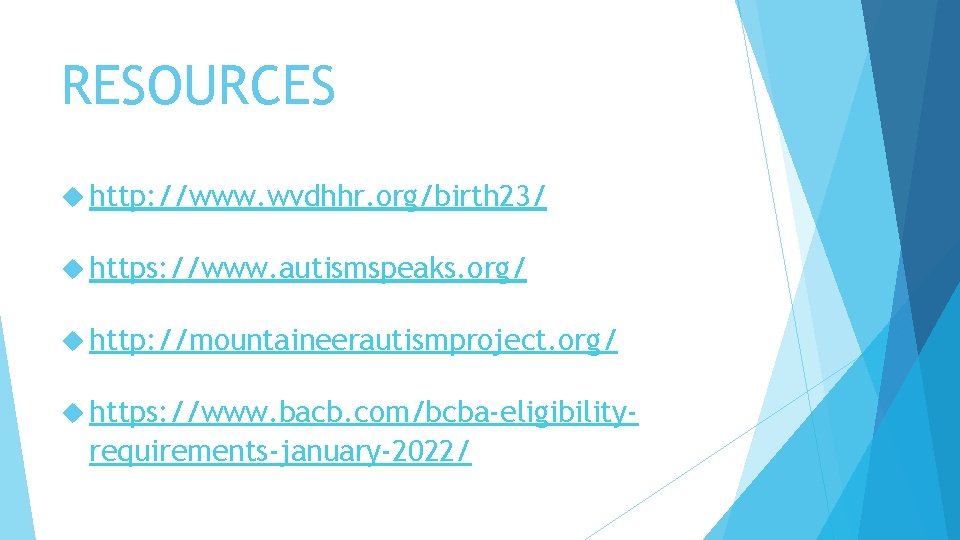
RESOURCES http: //www. wvdhhr. org/birth 23/ https: //www. autismspeaks. org/ http: //mountaineerautismproject. org/ https: //www. bacb. com/bcba-eligibility- requirements-january-2022/
Resources con’t • Center for Evidence Based Practice: Young Children With Challenging Behavior (TACSEI) www. challengingbehavior. org • The Center on the Social and Emotional Foundations for Early Learning (CSEFEL)www. CSEFEL. vanderbilt. edu • Zero to Threewww. zerotothree. org • CDC – Learn the Signs. Act Early www. cdc. gov/actearly
WE NEED MORE BEHAVIOR ANALYSTS https: //www. bacb. com/bcba-eligibility-requirements-january-2022/ BCBA Requirements (January 1, 2022) Eligibility Requirements: Pathway 1 – Association for Behavior Analysis International (ABAI) Accredited Program: A degree from an ABAI-accredited master’s or doctoral program Practical experience that meets the 2022 fieldwork requirements Pathway 2 – Coursework: 315 hours of specific graduate coursework in behavior analysis (see below) A master’s degree or higher in any field of study Practical experience that meets the 2022 fieldwork requirements
CONTACT INFORMATION Karen Randolph: kdrandolph 2@yahoo. com Cindy Le. Grand: cidole 2@gmail. com
MAP 2019 Conference: Early, Intensive, Effective Intervention Friday, April 12, 2019 at 8: 30 AM – 5: 30 PM The Blennerhassett Hotel 320 Market St, Parkersburg, West Virginia 26101