
An Overview of the ASWB Licensing Exam Corey
An Overview of the ASWB Licensing Exam Corey Beauford, LCSW-C, LICSW Inspired Consulting Group
Mission Statement The Mission Statement of Inspired Consulting Group is to provide challenging and enlightening staff development, education, and training opportunities to social workers, human service professionals, and students with the goal of enhancing their ability to provide quality services to consumers within their practice settings and their communities. 2
Part One: Registering for the ASWB Exam 3
District of Columbia Board of Social Work In order to apply for licensure in the District of Columbia, you will need to: 1. ) Submit a signed and completed District of Columbia Board of Social Work application 2. ) Submit two identical recent passport photos (2 X 2). These photos must be originals and not computer generated 3. ) Submit a valid government issued photo ID 4. ) Three character references in a sealed envelope. (two of the references must be from licensed social workers) 5. ) Pay the $230. 00 processing fee 6. ) An official transcript from your social work program 4
District of Columbia Board of Social Work Once your completed application is received and processed, you will receive an approval letter from the board (within 7 -10 days) authorizing you to sit for the ASWB exam. *You will have approximately 120 calendar days to take the exam once you’ve been approved through the DC Board of Social Work. *If you are taking the exam during your last semester and you pass, your license will not be issued until the DC Board receives your final transcript. 5
DC Criminal Background Check Requirement “As of January 3, 2011, each new applicant for licensure, registration or certification shall obtain a criminal background check. ” To schedule an appointment, please visit the following website: https: //dc. ibtfingerprint. com/ 6
DC Criminal Background Check Requirement Call Center Scheduling Available Monday - Friday, 9 am – 5 pm EST. Call (877) 783 -4187 and speak to one of the operators. *Operators will collect required information and schedule your appointment District residents who wish to go to MPD can call 202 -442 -9004 for further information 7
DC Board of Social Work Department of Health and Professional Licensing Board of Social Work 899 North Capitol Street, NE First Floor Washington, DC 20002 Phone: (877) 672 -2174 Fax: (202) 727 -8471 Website – http: //hpla. doh. dc. gov/hpla/cwp/view, A, 1195, Q, 488176, hpla. Nav, %7 C 30661%7 C, . asp 8
Maryland Board of Social Work Examiners In order to apply for licensure in the State of Maryland, you will need to: 1. ) Submit a signed and completed copy of the Maryland Board of Social Work Examiners Application. 2. ) Submit a valid government issued photo ID. 3. ) Submit three professional references in a sealed envelope. 4. ) Submit an official transcript – or a letter from your school verifying your enrollment status. 9
Maryland Board of Social Work Examiners 5. ) Pay the $100. 00 processing fee. An additional $75. 00 fee is required once the applicant passes the examination. DO NOT SUBMIT THIS FEE WITH THE APPLICATION 6. ) An official transcript from your social work program. “An applicant in their last semester may apply with a letter from the Dean’s or Registrar’s office confirming that the applicant is in his / her last semester / term and is expected to graduate. This letter must be included with the application. ” 10

Maryland Board of Social Work Examiners Once your completed application is received and processed, you will receive an approval letter from the board (within 7 -10 days) authorizing you to sit for the ASWB exam. *You will have approximately 2 years to take the exam once you’ve been approved through the Maryland Board of Social Work. *If you are taking the exam during your last semester and you pass, your license will not be issued until the Maryland Board receives your final transcript. 11
Maryland Board of Social Work Examiners 4201 Patterson Ave Baltimore, MD 21215 Ph 410 -764 -4788 Toll Free 1 -877 -526 -2541 Website – http: //dhmh. maryland. gov/bswe/ 12
Virginia Board of Social Work n n The Virginia Board of Social Work’s regulations governing the practice of social work requires applicants for licensure as a clinical social worker to have: No less than two years and no more than four years of post. MSW supervised clinical experience The supervisee must complete a minimum of 3, 000 hours of supervised post-master’s degree experience in the delivery of “clinical social work services”. An average of no less than 15 hours per week in face-to-face client contact for a minimum of 1, 380 hours shall be obtained. A minimum of one hour of face-to-face supervision must be provided each week for a total of at least 100 hours. No more than 50 of the 100 hours may be obtained in group supervision, nor shall there be more than six persons being supervised in a group unless approved in advance by the Board. 13
Virginia Board of Social Work Application Fee: Submit a $100. 00 check or money order made payable to the Treasurer of Virginia. This is a nonrefundable fee. A processing fee of $35 will be charged for any check or money order unpaid by your bank. The application fee can be used for one year from date of receipt. Verification of Education: An official transcript in the original sealed envelope submitted from the graduate school directly to the applicant showing your Master’s of Social Work degree and clinical courses taken. Copies of transcripts, certificates and diplomas are not acceptable. Verification of Supervised Experience: The Verification of Supervised Experience form should be completed by your supervisor, verifying 100 hours of face-to-face clinical supervision obtained under a licensed clinical social worker. 14
Virginia Board of Social Work Department of Health Professions 9960 Mayland Drive, Suite 300 Richmond, Virginia 23233 -1463 (804) 367 -4441 Website http: //www. dhp. virginia. gov/social 15
ASWB n In order to take an ASWB examination, you must register with ASWB and pay the required exam fee ($230 for the Bachelors or Masters exam; $260 for the Advanced Generalist or Clinical exam). Please allow three business days to receive email registration status. n In order to register, you MUST be eligible to take the social work examination. In most jurisdictions, this means that you must have received notification from your social work board that you may take the ASWB examination. 16
ASWB Visit the Association of Social Work Board’s website for detailed information about the licensing exam. http: //www. aswb. org/ 17
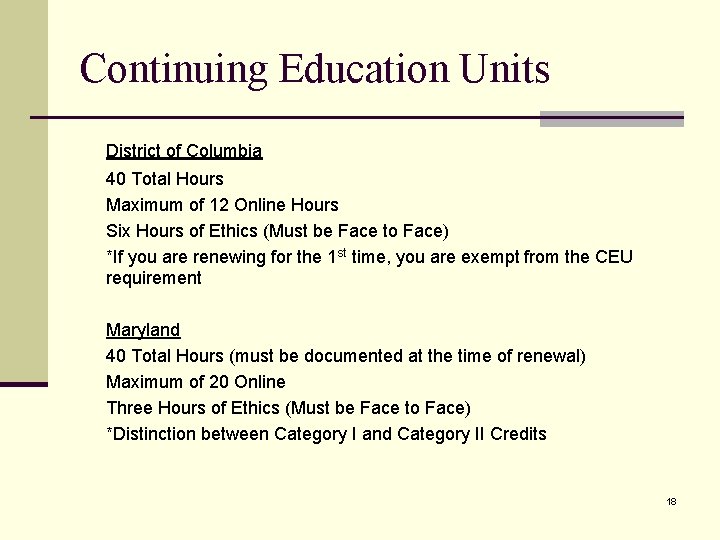
Continuing Education Units District of Columbia 40 Total Hours Maximum of 12 Online Hours Six Hours of Ethics (Must be Face to Face) *If you are renewing for the 1 st time, you are exempt from the CEU requirement Maryland 40 Total Hours (must be documented at the time of renewal) Maximum of 20 Online Three Hours of Ethics (Must be Face to Face) *Distinction between Category I and Category II Credits 18
Part Two: The Social Work Licensing Exam 19
Exam Content Over the course of this section, we will review information that you will need to study in order to be prepared to PASS the ASWB licensing exam. 20
Timing How much time will I have to take it? You will have four hours to complete the examination. If you have special needs which fall under the Americans with Disabilities Act (ADA), you may be allotted extra time. Check the ASWB website or their handbook for details on how to arrange for special accommodations. 21
Questions Who writes the questions? Social work practitioners across the country are contracted and trained by ASWB to write and edit potential items for the ASWB item pool. All examination items must meet with the approval of the ASWB Examination Committee before being pretested. All examination items are pretested before they are included as official scored items. 22
Scoring There approximately 170 questions on the exam, 150 of which are scored. The range of passing scores across all jurisdictions is 94 -107. 23
DSM-V Changes to the Exam Additional information about the ASWB exam modifications can be found on the following website: http: //www. aswb. org/SWLE/faqs 2011. asp 24
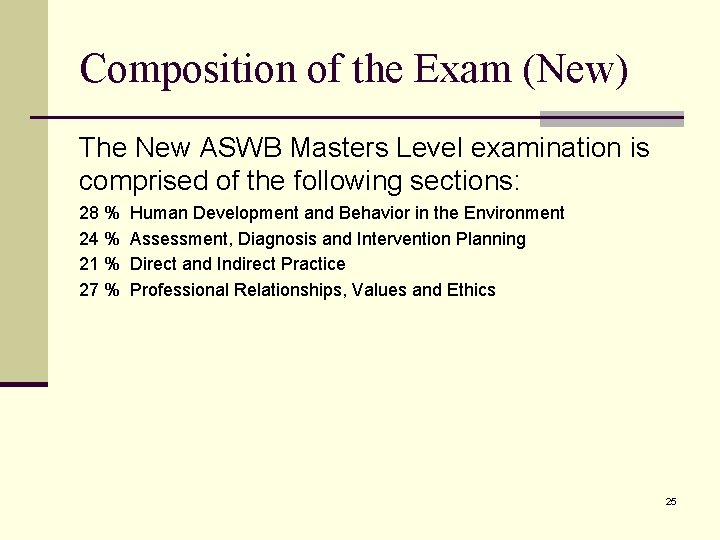
Composition of the Exam (New) The New ASWB Masters Level examination is comprised of the following sections: 28 % Human Development and Behavior in the Environment 24 % Assessment, Diagnosis and Intervention Planning 21 % Direct and Indirect Practice 27 % Professional Relationships, Values and Ethics 25
Developmental / Learning Theories Be familiar with the following developmental theories. n Piaget’s Theory of Cognitive Development n Erickson’s Stages of Development n Freud’s Theory of Psychosexual Development & *Ego Psychology n Social Learning Theory n Classical / Operant Conditioning 26
Other Applicable Theories n Attachment Theory n Stages of Alzheimer’s Disease n Signs and Symptoms of Child Abuse / Neglect and Elder Abuse / Neglect n Margaret Mahler’s Stages n Ecological Systems Theory 27
Assessment and Diagnosis n n n Be familiar with features of the following disorders. Schizophrenia Spectrum Disorders Bipolar and Bipolar-related Disorders Personality Disorders Oppositional Defiant Disorder Conduct Disorder n Adolescent vs Childhood Onset 28

Assessment and Diagnosis n Trauma and Trauma-related disorders n Somatoform Disorders n Paraphilic Disorders n Substance Use Disorders n Remission Categories n Autism n Feeding and Eating Disorders 29
Assessment / Diagnosis / Treatment Planning n Counter-transference n Treatment Planning (SMART Goals Model) n Stages of the Therapeutic Relationship n Social Work Interviewing Techniques 30
Psychopharmacology n Anti Psychotic Medications Atypical and Typical n Anti Depressants Medications SSRIs n Anti Anxiety Benzodiazepines n Mood Stabilizers 31
Medical Terminology QID – four times per day BID – two times per day TID – three times per day QD – once daily PRN – as needed 32
Additional Clinical Terms n Pica n Rumination Disorder n Enuresis n Encopresis n Rett Syndrome n Delirium n Korsakoff Syndrome 33
Additional Terms n. Hero n. Mascot n. Scapegoat n. Lost Child n. Parentified Child 34
Additional Terms n Stages of Change n Pre-contemplation, Contemplation, Preparation, Action, Maintenance, Relapse n Parenting Styles n Authoritarian, Authoritative, Permissive, Uninvolved 35

Intellectual Disabilities In preparation for the examination, study the stages of intellectual disabilities and the corresponding IQ scores. Additionally, be familiar with which tests are used to diagnose adults and children with MR. Mild Moderate Severe Profound Tests used to rate IQ include: WAIS (Wechsler Adult Intelligence Scale), WISC (Wechsler Intelligence Scale for Children) or Stanford-Binet. 36

Counseling Theories n Cognitive Behavioral Therapy n Psychoanalytic Therapy n Dialectical Behavioral Therapy n Structural Family Therapy n EMDR n Solution-Focused Therapy n Critical Incident Stress Debriefing 37
Stages of Grief n Elizabeth Kubler-Ross n Denial n Anger n Bargaining n Depression n Acceptance **Bereavement Disorder (DSM-V) 38
Ego Psychology You will encounter questions on your exam that will test your knowledge of: n Id n Ego n Superego n Ego Defense Mechanisms n Primary and Secondary Gain n Ego Syntonic and Ego Dystonic 39

Stages of Group Development The exam will also test your knowledge of the stages of group development and group theorists (Yalom, Emmanuel Tropp, Garland & Jones, etc). 40
Crisis Intervention and Suicide Assessment While taking the exam, expect to encounter questions that will test your knowledge of crisis intervention and suicide assessment. Moreover, you will need to know the warning signs for SI / HI and how to respond when working with a client who is suicidal or homicidal. 41
Cultural Diversity The ASWB exam is interested in assessing your readiness to work with clients from diverse cultures and backgrounds. To that end, you will be asked questions regarding the cultural values and beliefs of the following ethnicities: Latinos African Americans LGBTQ Native Americans Asian Americans 42
Cultural Diversity n Ethnocentrism n Cultural Pluralism n Institutional Racism / Discrimination 43
Managed Care You will be expected to know terms related to managed care that include but are not limited to: n Health Maintenance Organization n Preferred Provider Organization n Formulary n Utilization Review 44
Abuse and Neglect n Signs and Symptoms of: n Elder Abuse and Neglect n Child Abuse and Neglect n Duties of a Mandatory Reporter n Adoptions and Safe Families Act n Permanency Planning Goals **Domestic Violence n Power and Control Wheel and Safety Plans 45

Research n Levels of Measurement n Independent and Dependent Variables n Research Ethics (Section 5. 02) 46
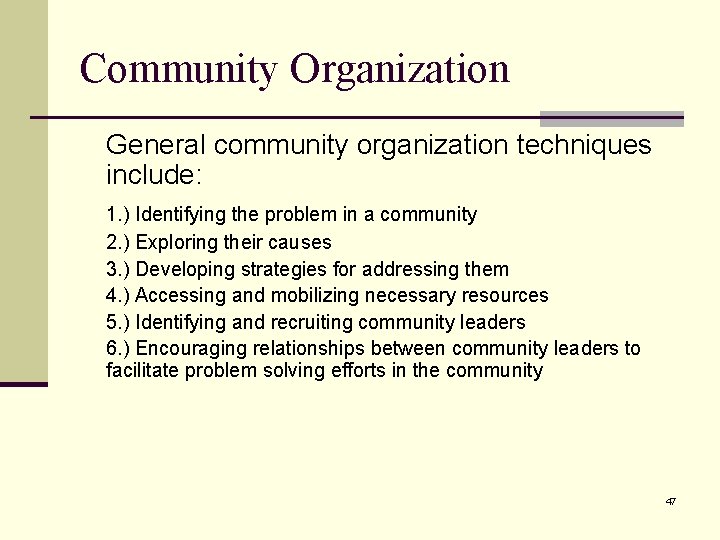
Community Organization General community organization techniques include: 1. ) Identifying the problem in a community 2. ) Exploring their causes 3. ) Developing strategies for addressing them 4. ) Accessing and mobilizing necessary resources 5. ) Identifying and recruiting community leaders 6. ) Encouraging relationships between community leaders to facilitate problem solving efforts in the community 47
Additional Terms n Prevention Strategies n Primary, Secondary, Tertiary n Harm Reduction Model 48
Social Work Code of Ethics Being familiar with the NASW Code of Ethics in its entirety is essential as it relates to your readiness to pass the ASWB exam. The exam will test your ability to apply the standards of the Code of Ethics to scenarios and case vignettes that are based on realistic workplace ethical dilemmas. 49
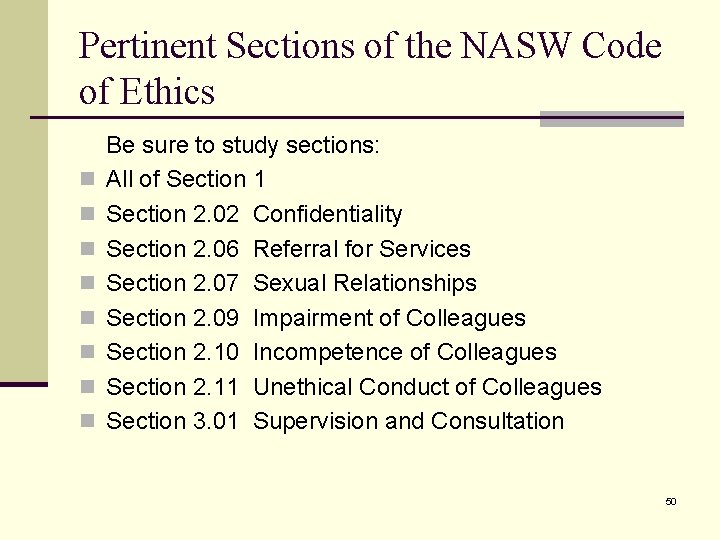
Pertinent Sections of the NASW Code of Ethics n n n n Be sure to study sections: All of Section 1 Section 2. 02 Confidentiality Section 2. 06 Referral for Services Section 2. 07 Sexual Relationships Section 2. 09 Impairment of Colleagues Section 2. 10 Incompetence of Colleagues Section 2. 11 Unethical Conduct of Colleagues Section 3. 01 Supervision and Consultation 50
Pertinent Sections of the NASW Code of Ethics n Section 3. 03 Performance Evaluation n Section 3. 04 Client Records n Section 3. 06 Client Transfer n Section 3. 07 Administration n Section 4. 03 Private Conduct n Section 4. 06 Misrepresentation n Section 5. 01 Integrity of the Profession n Section 5. 02 Research 51
Boundary Considerations Boundary violations & Boundary crossings Boundary violations occur when we KNOWINGLY engage in a dual or multiple relationship (see the NASW Code of Ethics) with a client. This includes: sexual relationships with clients, borrowing money from clients, and bartering services with clients. Boundary crossings occur when professional boundaries are breached accidentally. For instance, if your client notices that you belong to the same social group as he / she does on a social media site and sends you a friend request. 52

Study Tips 53
Worker’s Role Paying attention to this information can help you to arrive at the appropriate answer. If the questions states that you are working in a community based organization, you know that this questions focuses on Community Organization and theories associated with how to respond in this environment. 54

Worker’s Role You can expect to encounter questions that will place you in the position of a: n School Social Worker n Social Worker in a Community Organization n Social Worker in Private Practice n Supervisory Social Worker n Hospital Social Worker **Community Practice Roles 55
Factors to Consider When Answering Exam Prep Questions 1. )Is the client safe? (homicidal, suicidal, actively psychotic) 2. )Is the staff safe? This is a factor to take into consideration when you are faced with approaching a co worker regarding malfeasance and / or negligence. As it states in the NASW Code of Ethics, we have a duty to address unethical behavior and improper conduct with our colleagues when feasible. 3. )Is the integrity of the profession being upheld? 56
Factors to Consider When Answering Exam Prep Questions 4. ) Are you imposing your personal values on the client’s situation? (countertransference) 5. ) Have you thoroughly assessed the situation before offering an intervention? (What would you do first or next)? 6. ) Have you assessed: age of client, duration of symptoms, stage of the professional or therapeutic relationship, onset of symptoms, etc? 57
Factors to Consider When Answering Exam Prep Questions 7. ) At the beginning of a therapeutic relationship, the focus is mainly on assessment and building a rapport with the client. Motivational Interviewing, Active Listening and possibly Self Disclosure (when feasible) are often used at this stage of therapeutic relationship. 8. ) Duty to Warn – have you notified the proper authorities in cases that involve real or suspected child /elder abuse, neglect or exploitation (usually financial exploitation)? This also includes homicidal / suicidal ideations and / or threats. 9. ) Have you taken cultural factors into consideration? 10. ) Have you ruled out medical conditions before assigning a diagnosis or making a determination about alcohol / drug use? Always determine whether or not medical issues, sometimes termed as “organic” factors are ruled out. 58
Factors to Consider When Answering Exam Prep Questions 11. ) “Best answer” means: out of the answers that are listed, choose the most appropriate. The ideal situation may not be available but of the choices at your disposal, which choice is “best”? Furthermore, the “best” answer encompasses aspects of all potential interventions. “BEST” and “MOST” are synonymous. 12. ) What type of question are you answering? (service delivery, ethics, assessment / diagnosis, human behavior, etc) 13. ) Have confidentiality laws been observed? 59

Analyzing the Questions Many questions ask what you would do “first”, “next” or what the “best” answer is or what your “least” likely responses would be. Pay attention to these buzzwords. 60
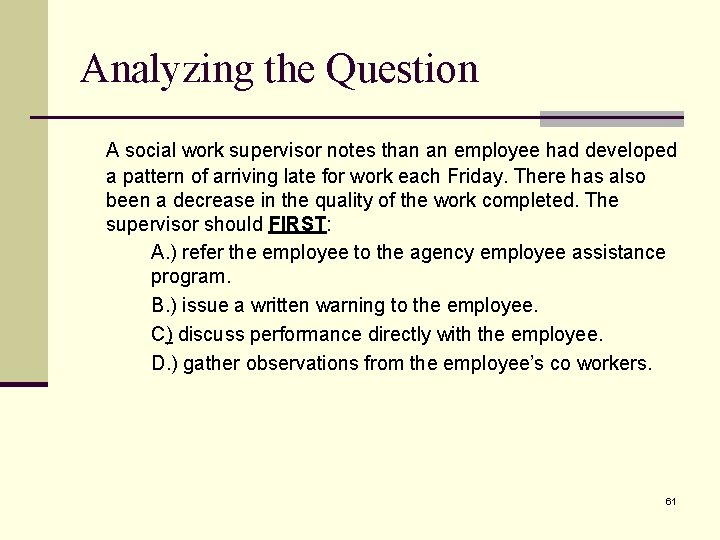
Analyzing the Question A social work supervisor notes than an employee had developed a pattern of arriving late for work each Friday. There has also been a decrease in the quality of the work completed. The supervisor should FIRST: A. ) refer the employee to the agency employee assistance program. B. ) issue a written warning to the employee. C) discuss performance directly with the employee. D. ) gather observations from the employee’s co workers. 61
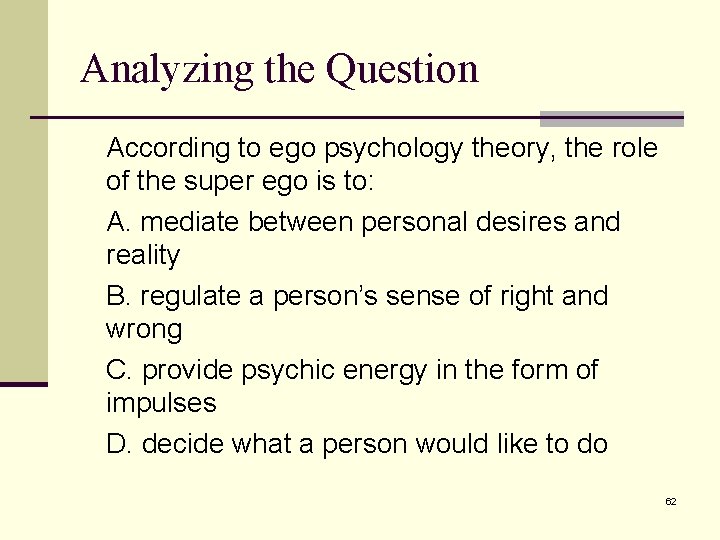
Analyzing the Question According to ego psychology theory, the role of the super ego is to: A. mediate between personal desires and reality B. regulate a person’s sense of right and wrong C. provide psychic energy in the form of impulses D. decide what a person would like to do 62

Analyzing the Question A social worker conducts a home visit to a 45 year old Latino client who’s young son was killed in a recent automobile accident. The social worker observes that a large altar has been made, which contains candles and pictures of his son as well as other deceased relatives. The client cries throughout the interview and tells the social worker that the boy has been communicating to the client nightly through angels. In order to most effectively work with the client, the social worker should FIRST: A. ) refer the client for a medical evaluation B. ) assess the client for psychotic symptoms C. ) explore mourning rituals of the client’s culture and family D. ) evaluate the potential for self harm. 63
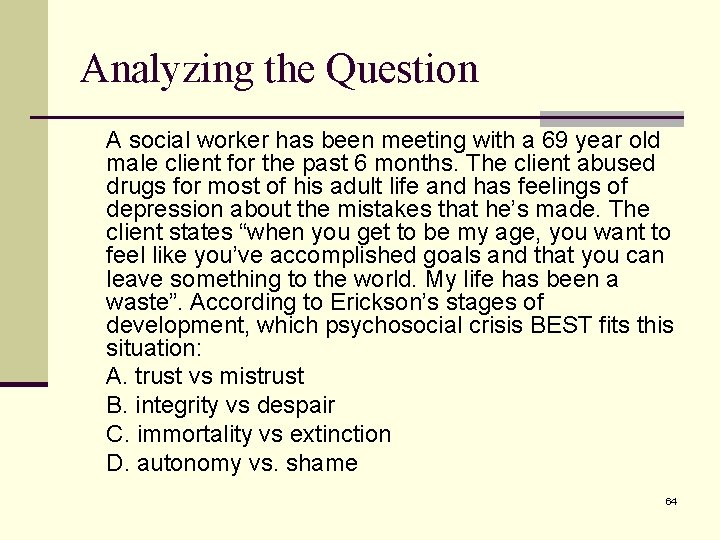
Analyzing the Question A social worker has been meeting with a 69 year old male client for the past 6 months. The client abused drugs for most of his adult life and has feelings of depression about the mistakes that he’s made. The client states “when you get to be my age, you want to feel like you’ve accomplished goals and that you can leave something to the world. My life has been a waste”. According to Erickson’s stages of development, which psychosocial crisis BEST fits this situation: A. trust vs mistrust B. integrity vs despair C. immortality vs extinction D. autonomy vs. shame 64
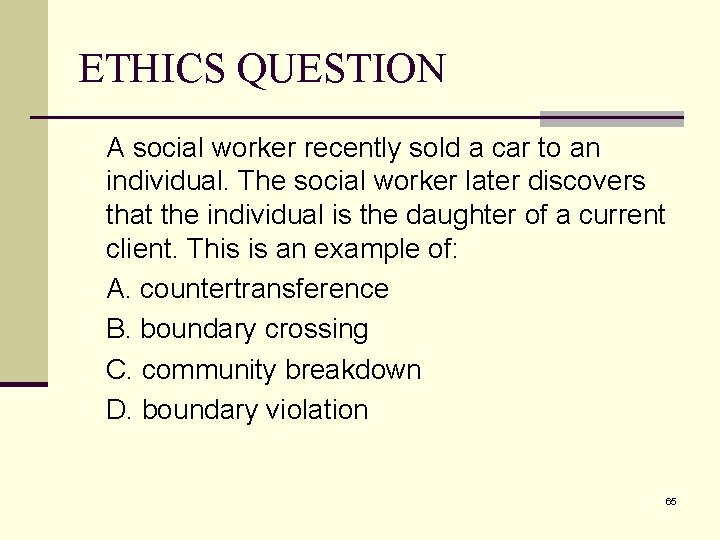
ETHICS QUESTION A social worker recently sold a car to an individual. The social worker later discovers that the individual is the daughter of a current client. This is an example of: A. countertransference B. boundary crossing C. community breakdown D. boundary violation 65
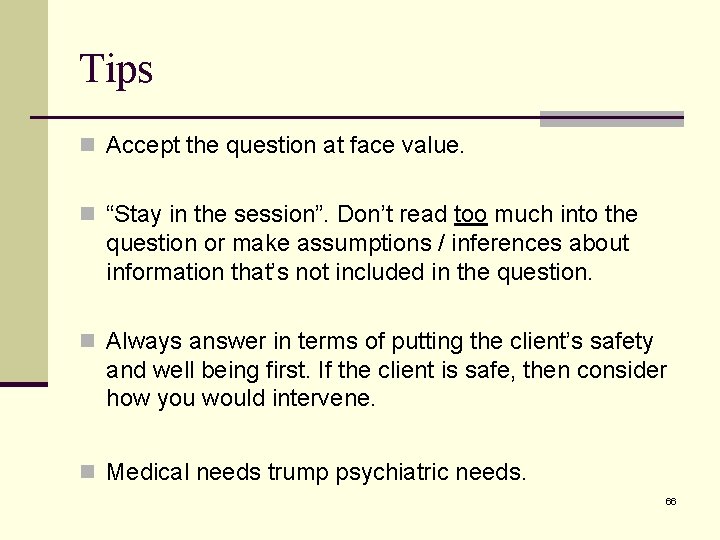
Tips n Accept the question at face value. n “Stay in the session”. Don’t read too much into the question or make assumptions / inferences about information that’s not included in the question. n Always answer in terms of putting the client’s safety and well being first. If the client is safe, then consider how you would intervene. n Medical needs trump psychiatric needs. 66
Tips n Consider covering up the responses as you read the question. n Try to anticipate the correct answer as you’re reading the question. n Don’t spend too much time on one question. FLAG IT! Also, if you’re not sure, don’t answer it. Changing your answers can hurt you! 67

Tips n Put your job experience aside and focus on the right answer. Don’t answer based on how you would respond in “the real world”. n Expect that there will be questions that you don’t know the answer to. n Assess what info is and is not important in the question. 68
Study Tips n Budget enough time to commute to your testing site. If you haven’t been to the site before, travel there at least a week before your scheduled test date so that you will be familiar with the route. n Inform the test proctor of any unusual conditions or distractions that are present at the site. This includes noise, temperature and malfunctioning equipment. 69
Study Tips Write the information that you can remember down before each study session. The more senses we involve in the process of remembering information, the more likely we are to recall it. For example, if you studied psychotropic medications, begin the next study session with writing down as many medications as you can. 70
Study Tips n Create a schedule that works best for you. Allow at least 45 days to study the content. n Conceptualize the information. n Don’t study too much information at one time. 71

Study Tips If necessary, invest in the online ASWB practice exam. All of the questions that you will encounter on practice exam are replicas of the types of questions that you will encounter on the actual exam. 72
Tips During the test, take a 5 minute break each hour, on the hour. Leave the exam room. Get a drink of water. Recite personal and / or spiritual affirmations – keep yourself centered. RELAX!!!!! 73
Tips for Choosing an Exam Prep Company n References n Passage Rate n Reputation of the Company n Relevance of the Exam Prep Content n Cost 74

Contact Us Visit us on the web at: www. inspiredconsultinggroup. net Contact us at: inspired. consulting@yahoo. com with questions. 75

Questions 76
- Slides: 76