
AN OVERVIEW of PROJECT PLANNING Contents Introduction to

![Reading • [Chapter 3] “Software Project Management by Bob Hughes and Mike Cotterell, Mc.](https://slidetodoc.com/presentation_image_h2/8b3dfdf675b14e769ccfaa71f3eb19b4/image-21.jpg "Reading • [Chapter 3] “Software Project Management by Bob Hughes and Mike Cotterell, Mc.")
- Slides: 21
AN OVERVIEW of PROJECT PLANNING
Contents • Introduction to step wise project planning • Ten steps of a project plan
Introduction to Step Wise project Planning • This section describes a framework of basic steps in project planning on which the following course contents are build. • The described framework is called the Step Wise Method.
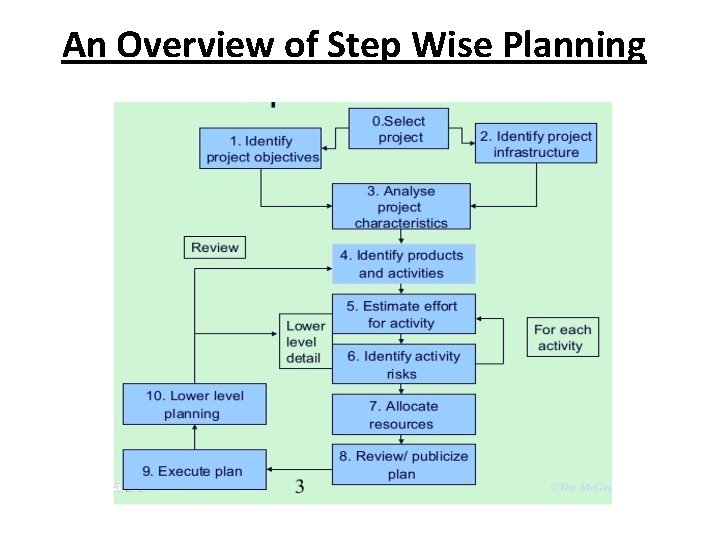
An Overview of Step Wise Planning
Case Study • Brigette has been working for the management services department of a local authority when she sees an advertisement for the position of information systems development officer at brightmouth college. She is attracted to the idea of being her own boss, working in a relatively small organization and helping them to setup appropriate information systems from scratch. She applies for the job and get it. One of the first tasks that confronts her is the implementation of independent payroll processing.
Step 0: Select Project • Called Step 0 because it is actually outside the main project planning steps. • While feasibility study suggests that there is a business case for the project, it would still need to be established that it should have priority over other projects. • This evaluation can be part of project portfolio management.
Step 1: Identify Project Scope and Objectives • Identify objectives and practical measures of the effectiveness in meeting those objectives • Establish a project authority • Stakeholder analysis – identify all stakeholders in the project and their interests • Modify objectives in the light of stakeholder analysis • Establish methods of communication with all parties
Step 1: Identify Project Scope and Objectives • Activity 1: List objectives and Identify the main stakeholders and project authority in the provided scenario.
Step 2: Identify Project Infrastructure • Identify relationship between the project and strategic planning • Identify installation standards and procedures • Identify project team organization • Activity 2: List some standards that brigette should identify and set before moving on further.
Step 3: Analyze Project Characteristics • Distinguish the project as either objective- or product-driven • Analyze other project characteristics • Identify high-level project risks • Take into account user requirements concerning implementation • Select development methodology and life- cycle approach • Review overall resource estimates
Step 3: Analyze Project Characteristics • Activity 3: Prepare a list of risks, that you think brigette will identify in this step.
Step 4: Identify Project Products & Activities • • • Identify and describe project products Document generic product flows Recognize product instances Produce ideal activity network Modify the ideal to take into account need for stages and checkpoints
Step 4: Identify Project Products & Activities • Activity 4: At brightmouth college, Brigette has decided that the finance department at the college should carry out acceptance testing of the new payroll system. The staff are not sure what test documents should look like, Brigette draws up a product description of a test case. Write the content for this product description.
Step 5: Estimate Effort for Each Activity • Carry out bottom-up estimates • Revise plan to create controllable activities
Step 6: Identify Activity Risks • Identify and quantify activity-based risks • Plan risk reduction and contingency measures where appropriate • Adjust overall plans and estimates to take account of risks • Activity 5: Brigette identifies as a risk the possible absence of key staff when investigating the user requirements, as this activity will take place over the holiday period. How can she reduce this risk?
Step 7: Allocate Resources • Identify and allocate resources • Revise plans and estimates to take into account resource constraints
Step 8: Review/Publicize Plan • Review quality aspects of the project plan • Document plans and obtain agreement
Steps 9/10: Execute Plan/ Lower Levels of Planning • Once the project is under way, plans will need to be drawn up in greater detail for each activity as it becomes due. • Detailed planning of the later stages will need to be delayed because more information will be available nearer the start of the stage. • It is necessary to make provisional plans for the more distant tasks.
Activity 6 • List the products created by the step wise planning process.
Summary • Any planning approach should have the following elements: – the establishment of project objectives – the analysis of the characteristics of the project – the establishment of an infrastructure consisting of an appropriate organization and set of standards, methods and tools – the identification of the products of the project and the activities needed to generate those products – the allocation of resources to activities – the establishment of quality controls – Project planning is an iterative process – As the time approaches for particular activities to be carried out they should be re-planned in more detail.
Reading • [Chapter 3] “Software Project Management by Bob Hughes and Mike Cotterell, Mc. Graw-Hill Education; 6 th Edition (2009). ISBN-10: 0077122798”