
An Overview of Portability Concepts Terminology Professor Peter

An Overview of Portability: Concepts & Terminology Professor Peter Swire Scheller College of Business, Georgia Tech Alston & Bird LLP FTC Data Portability Workshop September 22, 2020
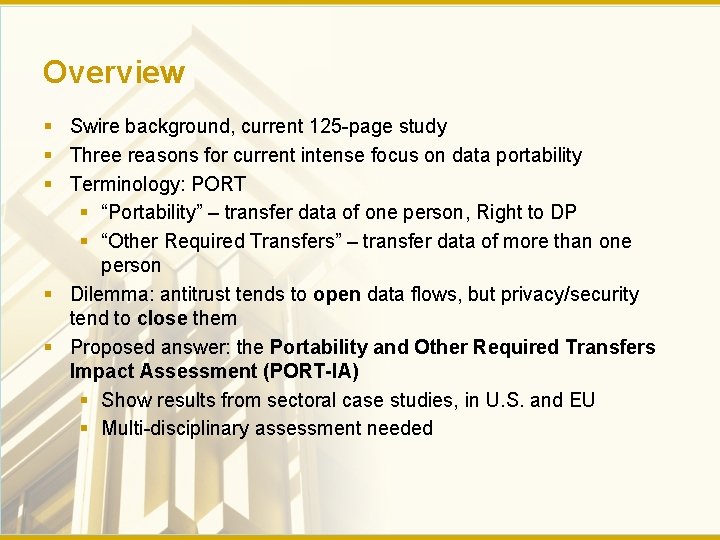
Overview § Swire background, current 125 -page study § Three reasons for current intense focus on data portability § Terminology: PORT § “Portability” – transfer data of one person, Right to DP § “Other Required Transfers” – transfer data of more than one person § Dilemma: antitrust tends to open data flows, but privacy/security tend to close them § Proposed answer: the Portability and Other Required Transfers Impact Assessment (PORT-IA) § Show results from sectoral case studies, in U. S. and EU § Multi-disciplinary assessment needed
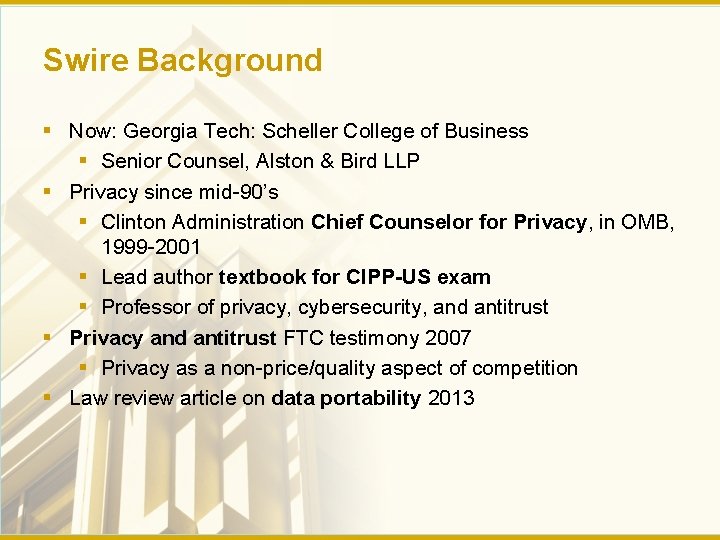
Swire Background § Now: Georgia Tech: Scheller College of Business § Senior Counsel, Alston & Bird LLP § Privacy since mid-90’s § Clinton Administration Chief Counselor for Privacy, in OMB, 1999 -2001 § Lead author textbook for CIPP-US exam § Professor of privacy, cybersecurity, and antitrust § Privacy and antitrust FTC testimony 2007 § Privacy as a non-price/quality aspect of competition § Law review article on data portability 2013
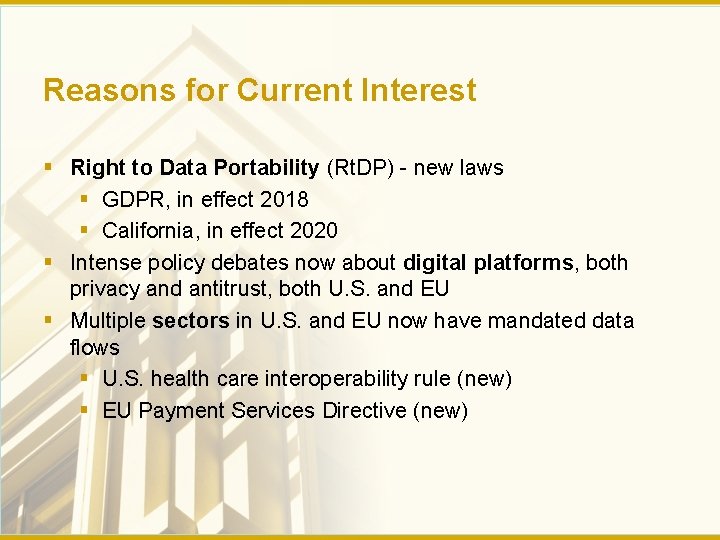
Reasons for Current Interest § Right to Data Portability (Rt. DP) - new laws § GDPR, in effect 2018 § California, in effect 2020 § Intense policy debates now about digital platforms, both privacy and antitrust, both U. S. and EU § Multiple sectors in U. S. and EU now have mandated data flows § U. S. health care interoperability rule (new) § EU Payment Services Directive (new)
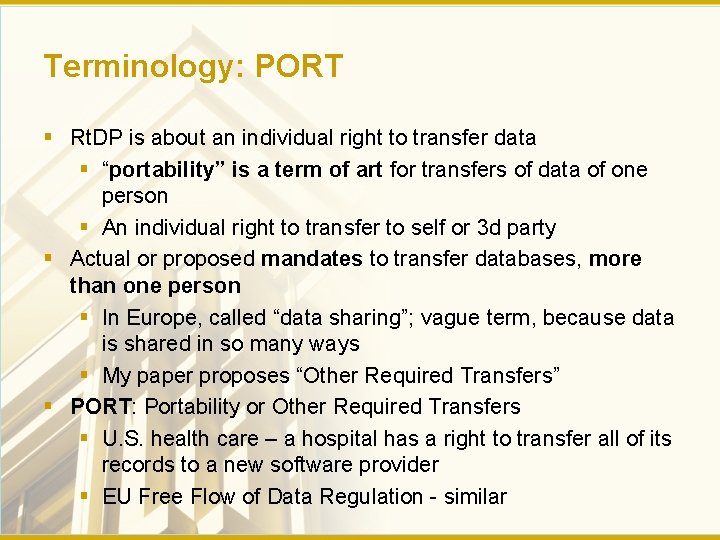
Terminology: PORT § Rt. DP is about an individual right to transfer data § “portability” is a term of art for transfers of data of one person § An individual right to transfer to self or 3 d party § Actual or proposed mandates to transfer databases, more than one person § In Europe, called “data sharing”; vague term, because data is shared in so many ways § My paper proposes “Other Required Transfers” § PORT: Portability or Other Required Transfers § U. S. health care – a hospital has a right to transfer all of its records to a new software provider § EU Free Flow of Data Regulation - similar
Terminology (2) § “Interoperability” § Proposed definition - the technical ability of two or more systems to exchange information § Common data formats § Common communications protocols § Other technical mechanisms to enable operation of two or more systems § HHS Interoperability Rule (2020) uses the term in 3 ways: § Term applies to the above § And individual portability of health records § And ORT, such as to new cloud provider
Rt. DP and Privacy: Existing General Laws § Article 20 GDPR Right to Data Portability (Rt. DP) § Data subjects have right to receive data they provided to controller § Transfer “without hindrance” to another controller § California Consumer Privacy Act, § 1798. 100 § Individual right to access data in a “portable” and “readily usable format” § Conclusion: since 2018 implementation of GDPR, Rt. DP widely mandated in E. U. and U. S.
The Dilemma: Open or Close Data Flows? § Antitrust/competition – many reasons to open data flows § Assume some large, valuable databases § Easy to assume that in our data economy § Idea: if more companies have access to commercially valuable data, then more innovation and competition § Privacy and Cybersecurity – close data flows § What if data gets to the “wrong” people? § Cybersecurity – focus on unauthorized access § Privacy – focus on what access should be authorized, and often be cautious unless there is user consent
Antitrust: Strong Interest in Portability § FTC Director of Competition, Ian Conner, in February: § “The breadth of additional relief that may be considered include obligations to provide … access or other rights [or] data … to one or more entrants on specified terms or a non-discriminatory basis. ” § Today’s FTC workshop § In Europe, Commissioner for Competition Margrethe Vestager discussed “the prominent position of data in digital markets” § “The need to ensure the possibility of entry may argue in favor of mandating access to data. ” § Portability prominent in new European Data Strategy
Responding to the Dilemma § Create a well-designed Portability and Other Required Transfers Impact Assessment (“PORT-IA”) § Similar to Privacy Impact Assessment (US) or Data Protection Impact Assessment (E. U. ) § New study: methodology § Draft “structured questions” for a systematic assessment § Test the draft questions against multiple case studies § Validate the structured questions based on the case studies
PORT-IA: Case Studies to Develop It § US/EU Phone number portability § Successful, but misleadingly easy case – most users want their (private) phone number made known to friends and colleagues § US/EU financial services § Dodd-Frank requires portability for customer records § US/EU health care § March 2020 HHS Inter-operability Rule § Individuals get portability to smartphone apps § Health IT requirements that a covered entity can PORT to a new health IT provider § Open Data for government databases § Arizona & other laws – auto dealers
PORT-IA: The Structured Questions § Q 1: Define the challenge or opportunity that leads to a possible data portability or other required transfers (“PORT”) § Where does the data come from? § Where does it go? § What types of data are covered? § What specifically are the legal requirements?
PORT-IA: (Top-Level Questions) § Data PORTability Benefits: Q 2: Assess PORT rationales based on competition Q 3: Assess innovation and other commercial benefits due to the PORT Q 4: Assess non-commercial benefits due to the PORT (user control) Q 5: Assess regulatory or legal benefits of the initiative Q 6: Assess any reduced benefits due to lack of technical or market feasibility § Q 7: Assess incentives for those presenting evidence of benefits
PORT-IA: Risks and Costs Data PORTability Risks and Costs: Q 8: Assess privacy risks from the PORT Q 9: Assess security risks from the PORT Q 10: Assess risks from the PORT that may arise for either security or privacy (onward transfer; discriminatory standards) Q 11: Assess risks to competition from the PORT Q 12: Assess regulatory or legal risks of the initiative Q 13: Assess any other significant costs or risks from the PORT, including obstacles to adoption Q 14: Assess incentives for those presenting evidence of risks or cost
Distinction 1: Before or After Violation? § Require portability before or after a violation occurs? § Ex ante regulation § No need to find an antitrust violation § US Dodd-Frank, portability for financial records § Ex post remedy § Much antitrust discussion in U. S. to date § If an antitrust violation, then court can order portability, which is less intrusive than breaking up the company
Distinction 2: General or Sectoral? § General PORTability rule – applies broadly § GDPR Rt. DP § CCPA Rt. DP § Sectoral, in U. S. § Phone number portability § Financial services § HHS interoperability rule § Arizona and other auto dealer statutes
Reasons to consider using a PORT-IA § Numerous PORT new laws and proposals § Most individuals are not expert in privacy, cybersecurity, and antitrust § Need a team to assess PORTability proposals § PORT-IA provides a systematic technique to assess § Antitrust regulators can realize privacy or security is not simply an excuse § Privacy regulators can realize how competition benefits individuals, and be open to consent for PORTability § Private sector can assess the most promising PORT initiatives
Conclusion § Opening up data flows – transferring data – can have great benefits, for competition, innovation, freedom of choice, etc. § Closing data flows – for privacy and cybersecurity – also can have great benefits § PORT-IA provides a method that is agnostic about each proposal § What are the benefits and costs from this required transfer? § Can we increase the benefits? (such as focusing transfers where will help competition) § Can we reduce the costs? (such as tailored privacy rules) § For this complex and increasingly important topic, the PORT-IA can assist policy-makers and companies to reach better decisions
- Slides: 18