
An Overview of NOAAs Fire Weather Products and
- Slides: 19
An Overview of NOAA’s Fire Weather Products and Services A Presentation to the NOAA Science Advisory Board’s Fire Weather Research Working Group Eli Jacks Chief – Fire and Public Weather Services Branch Office of Climate, Water and Weather Services NOAA/NWS October 1, 2007 1
WGA Issues: June 2005 Policy Resolution • An integrated fire weather research program is critical to effective forest management. • NOAA Office of the Federal Coordinator should assess fire weather needs and set a framework for meeting them. • New digital weather information and technology should be integrated into operational fire management and decision making 2
Purpose • Summarize NOAA’s Fire Weather Program. • Summarize NOAA’s current activities in fire weather-related research. • Discuss current research gaps as we see them and the associated potential for improved products and services. 3
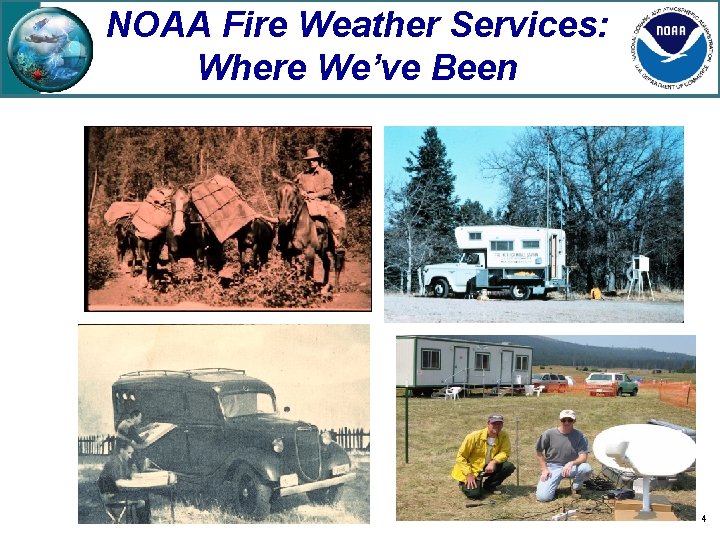
NOAA Fire Weather Services: Where We’ve Been 4
NOAA Collaboration: The Interagency Structure • National Interagency Fire Center (NIFC): - U. S. Forest Service - U. S. Bureau of Indian Affairs - U. S. Fish and Wildlife Service - U. S. National Park Service - U. S. Bureau of Land Management - National Association of State Foresters - U. S. Fire Administration • Other Partners: - U. S Geological Survey - Environmental Protection Agency - States - Universities - Private Sector (ESRI) 5
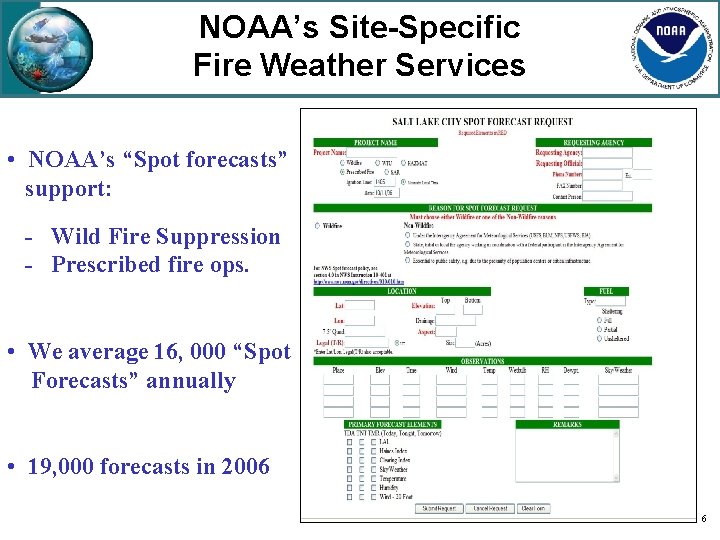
NOAA’s Site-Specific Fire Weather Services • NOAA’s “Spot forecasts” support: - Wild Fire Suppression - Prescribed fire ops. • We average 16, 000 “Spot Forecasts” annually • 19, 000 forecasts in 2006 6
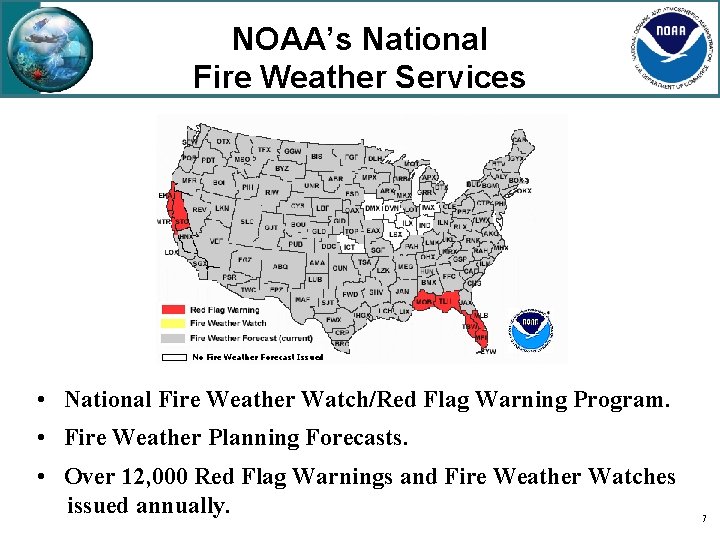
NOAA’s National Fire Weather Services No Fire Weather Forecast Issued • National Fire Weather Watch/Red Flag Warning Program. • Fire Weather Planning Forecasts. • Over 12, 000 Red Flag Warnings and Fire Weather Watches issued annually. 7
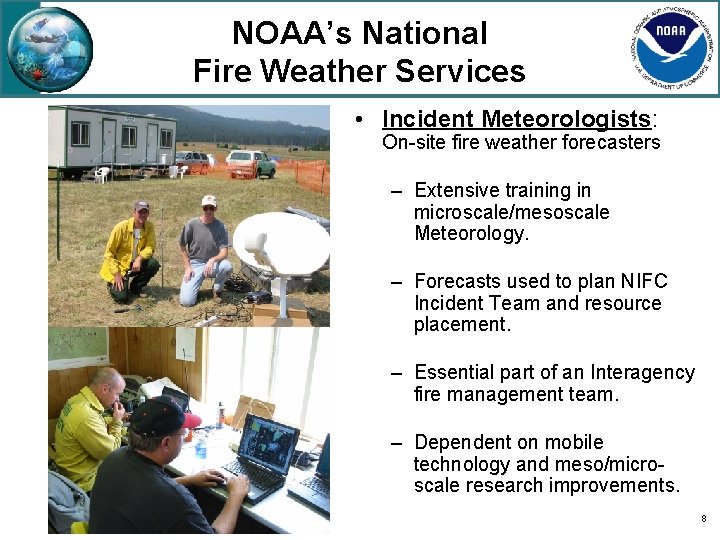
NOAA’s National Fire Weather Services • Incident Meteorologists: On-site fire weather forecasters – Extensive training in microscale/mesoscale Meteorology. – Forecasts used to plan NIFC Incident Team and resource placement. – Essential part of an Interagency fire management team. – Dependent on mobile technology and meso/microscale research improvements. 8
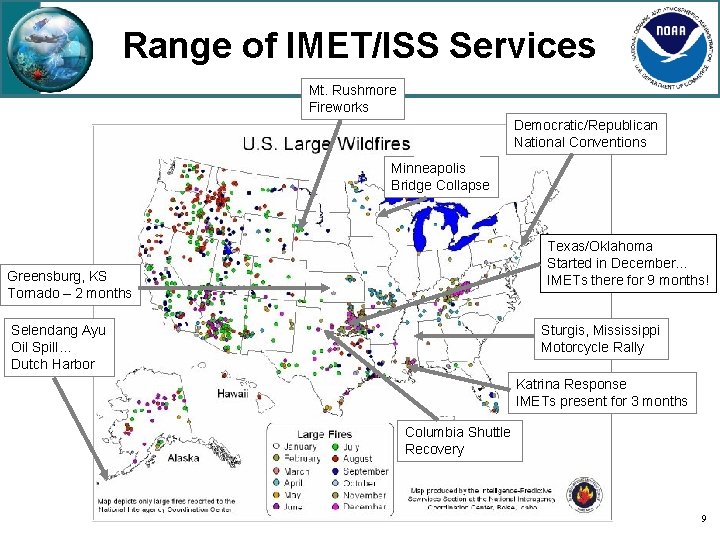
Range of IMET/ISS Services Mt. Rushmore Fireworks Democratic/Republican National Conventions Minneapolis Bridge Collapse Texas/Oklahoma Started in December… IMETs there for 9 months! Greensburg, KS Tornado – 2 months Selendang Ayu Oil Spill… Dutch Harbor Sturgis, Mississippi Motorcycle Rally Katrina Response IMETs present for 3 months Columbia Shuttle Recovery 9
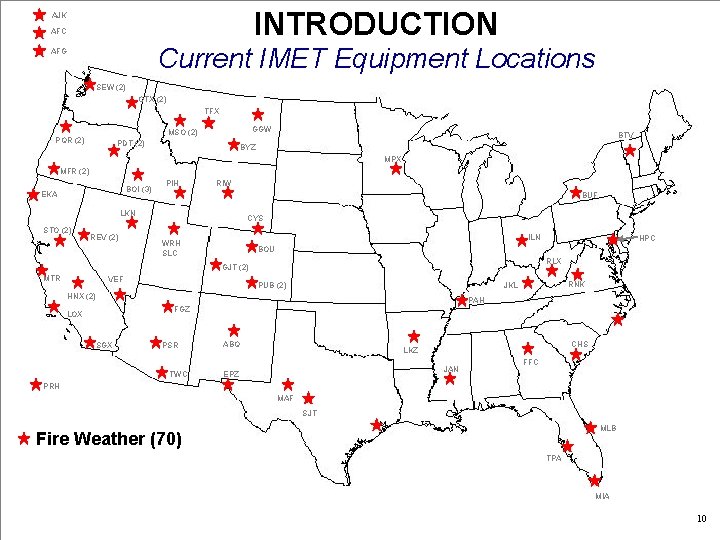
INTRODUCTION AJK AFC Current IMET Equipment Locations AFG SEW (2) OTX (2) TFX GGW MSO (2) PQR (2) PDT (2) BTV BYZ MPX MFR (2) BOI (3) EKA PIH RIW BUF LKN STO (2) REV (2) CYS ILN WRH SLC RLX GJT (2) MTR HPC BOU VEF PUB (2) RNK JKL HNX (2) PAH FGZ LOX MHX SGX PSR TWC ABQ CHS LKZ JAN EPZ FFC PRH MAF SJT Fire Weather (70) MLB (Trainee) HOU (Trainee) TBW MLB TPA MIA (Trainee) MIA 10
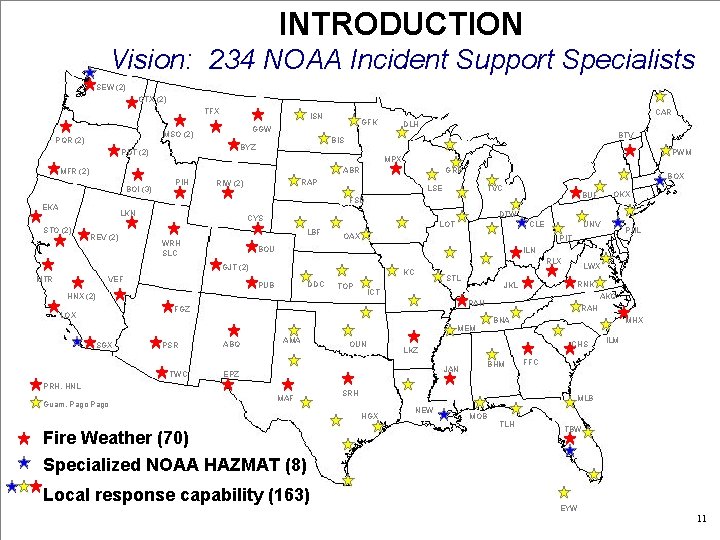
INTRODUCTION Vision: 234 NOAA Incident Support Specialists SEW (2) OTX (2) TFX GFK GGW MSO (2) PQR (2) CAR ISN BTV BIS BYZ PDT (2) DLH PWM MPX ABR MFR (2) BOI (3) PIH GRB RAP RIW (2) BOX LSE TVC LKN STO (2) REV (2) DTW CYS LBF WRH SLC LOT CLE OAX BOU VEF RLX KC DDC PUB TOP STL AKQ PAH RAH BNA MEM PSR TWC ABQ AMA OUN CHS JAN MAF BHM SRH ILM FFC MLB HGX Fire Weather (70) MHX LKZ EPZ PRH, HNL Guam, Pago LWX RNK JKL ICT FGZ SGX PHL ILN HNX (2) LOX UNV PIT GJT (2) MTR OKX BUF FSD EKA NEW MOB TLH TBW Specialized NOAA HAZMAT (8) Local response capability (163) EYW 11
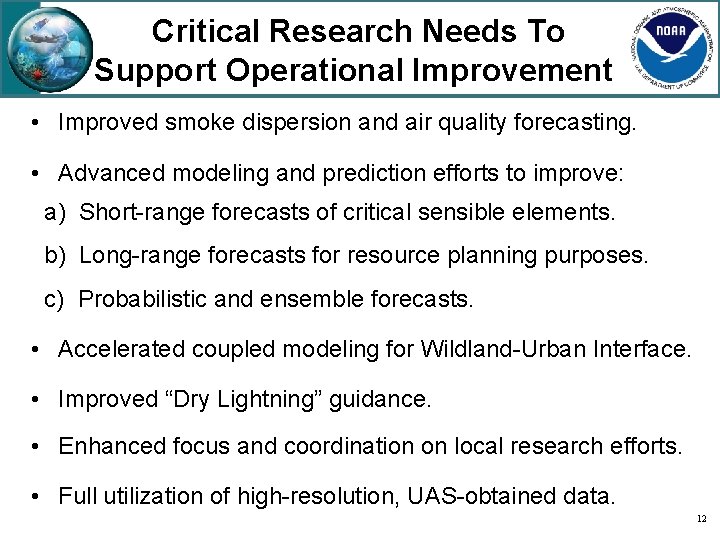
Critical Research Needs To Support Operational Improvement • Improved smoke dispersion and air quality forecasting. • Advanced modeling and prediction efforts to improve: a) Short-range forecasts of critical sensible elements. b) Long-range forecasts for resource planning purposes. c) Probabilistic and ensemble forecasts. • Accelerated coupled modeling for Wildland-Urban Interface. • Improved “Dry Lightning” guidance. • Enhanced focus and coordination on local research efforts. • Full utilization of high-resolution, UAS-obtained data. 12
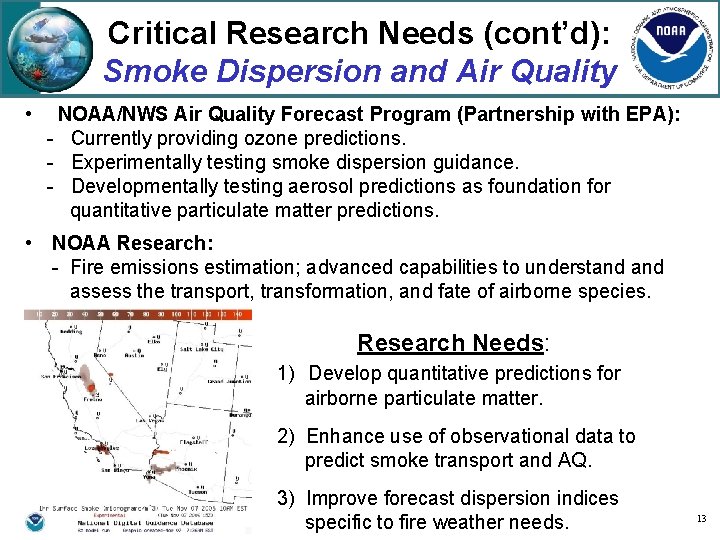
Critical Research Needs (cont’d): Smoke Dispersion and Air Quality • NOAA/NWS Air Quality Forecast Program (Partnership with EPA): - Currently providing ozone predictions. - Experimentally testing smoke dispersion guidance. - Developmentally testing aerosol predictions as foundation for quantitative particulate matter predictions. • NOAA Research: - Fire emissions estimation; advanced capabilities to understand assess the transport, transformation, and fate of airborne species. Research Needs: 1) Develop quantitative predictions for airborne particulate matter. 2) Enhance use of observational data to predict smoke transport and AQ. 3) Improve forecast dispersion indices specific to fire weather needs. 13
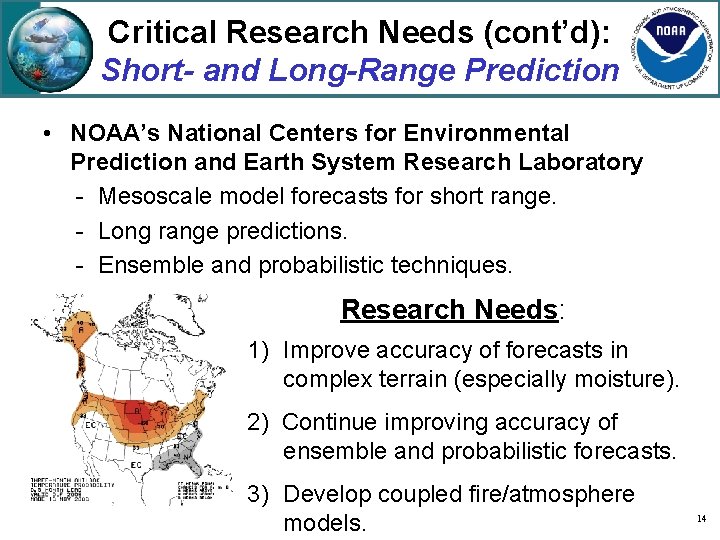
Critical Research Needs (cont’d): Short- and Long-Range Prediction • NOAA’s National Centers for Environmental Prediction and Earth System Research Laboratory - Mesoscale model forecasts for short range. - Long range predictions. - Ensemble and probabilistic techniques. Research Needs: 1) Improve accuracy of forecasts in complex terrain (especially moisture). 2) Continue improving accuracy of ensemble and probabilistic forecasts. 3) Develop coupled fire/atmosphere models. 14
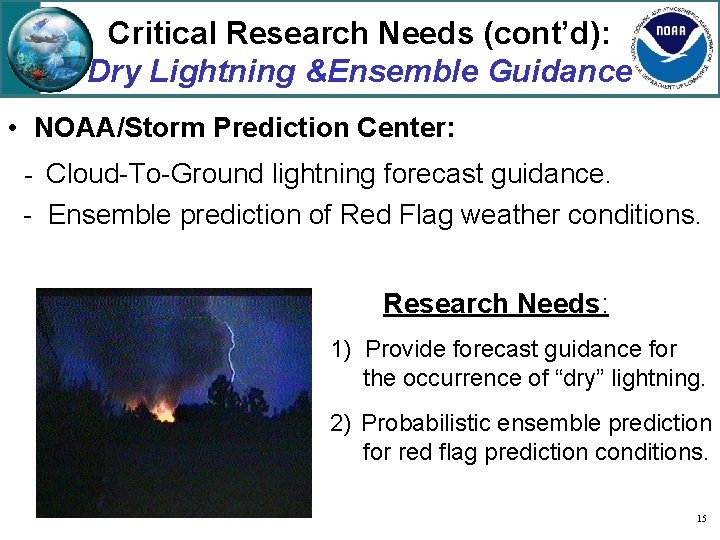
Critical Research Needs (cont’d): Dry Lightning &Ensemble Guidance • NOAA/Storm Prediction Center: - Cloud-To-Ground lightning forecast guidance. - Ensemble prediction of Red Flag weather conditions. Research Needs: 1) Provide forecast guidance for the occurrence of “dry” lightning. 2) Probabilistic ensemble prediction for red flag prediction conditions. 15
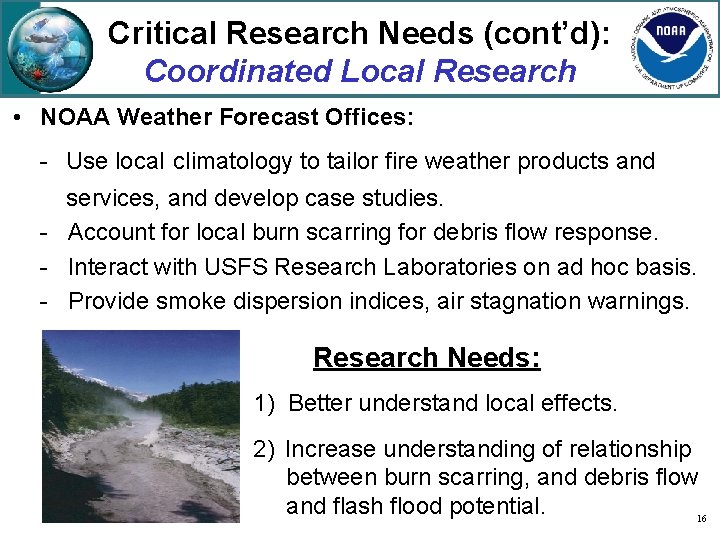
Critical Research Needs (cont’d): Coordinated Local Research • NOAA Weather Forecast Offices: - Use local climatology to tailor fire weather products and services, and develop case studies. - Account for local burn scarring for debris flow response. - Interact with USFS Research Laboratories on ad hoc basis. - Provide smoke dispersion indices, air stagnation warnings. Research Needs: 1) Better understand local effects. 2) Increase understanding of relationship between burn scarring, and debris flow and flash flood potential. 16
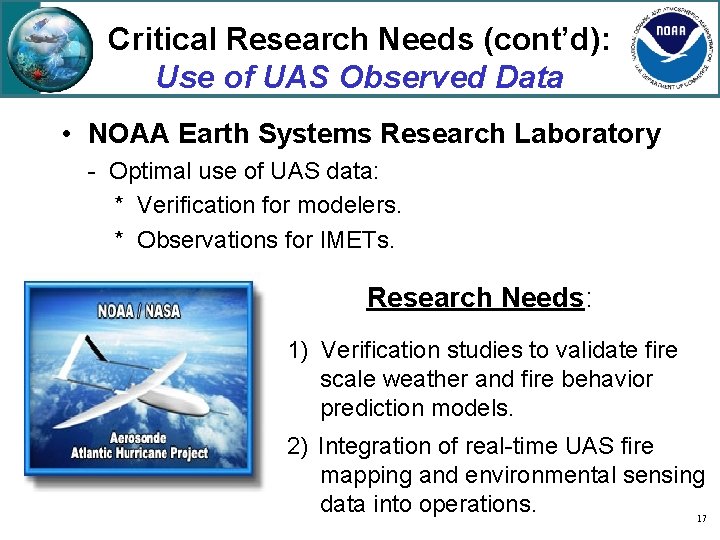
Critical Research Needs (cont’d): Use of UAS Observed Data • NOAA Earth Systems Research Laboratory - Optimal use of UAS data: * Verification for modelers. * Observations for IMETs. Research Needs: 1) Verification studies to validate fire scale weather and fire behavior prediction models. 2) Integration of real-time UAS fire mapping and environmental sensing data into operations. 17
NOAA Collaboration with Wildland Fire Research Groups • Joint Fire Science Program (JFSP) - Interagency partnership between DOI and DOA. - Proposals peer reviewed annually, $14 M available. - Focus on fire behavior, AQ, smoke, climate, weather. • Fire Consortia for Advanced Modeling of Meteorology and Smoke (FCAMMS) - Established by the National Fire Plan. - Focus on fire weather, behavior, danger and smoke. - Collaborates with NOAA and EPA. • Forest Service Fire Science Research Laboratories - Experts on fire behavior and danger models. - Work ad hoc with NOAA WFOs. 18
NOAA’s View • Our hydrometeorological expertise is critical to land management partners and researchers who focus on fire danger and fire behavior. • Improved hydrometeorological technology transfer is essential for the future success of managing wildland fire. • The scope of research activities in which we participate is growing - and of increasing importance. 19