
An Overview of NIH Policies on Human Subjects
An Overview of NIH Policies on Human Subjects Pamela Reed Kearney, M. D Director, Division of Human Subjects Research (NIH/OER) Lyndi Lahl, R. N. , M. S. Human Subjects Officer (NIH/OER)
Objectives • Identify NIH policies pertaining to research involving human subjects • Determine when research involving human subjects is a clinical trial • Review considerations when applying for an NIH award for research that involves human subjects • Identify NIH resources for investigators conducting research involving human subjects SLIDE | 2

Objectives • Identify NIH policies pertaining to research involving human subjects • Determine when research involving human subjects is a clinical trial • Review considerations when applying for NIH award for research that involves human subjects • Identify NIH resources for investigators conducting research involving human subjects SLIDE | 3
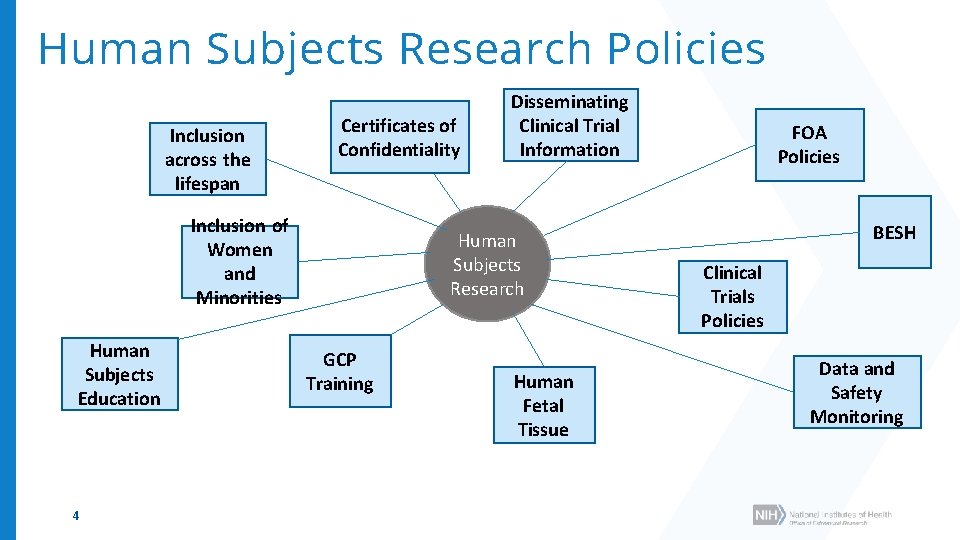
Human Subjects Research Policies Inclusion across the lifespan Certificates of Confidentiality Inclusion of Women and Minorities Human Subjects Education 4 Disseminating Clinical Trial Information Human Subjects Research GCP Training Human Fetal Tissue FOA Policies BESH Clinical Trials Policies Data and Safety Monitoring
When do NIH Human Subjects Policies Apply? • Research activities that involve Human Subjects (HS) • Human subjects defined in the Common Rule • Some HS policies apply to clinical research (e. g. , Inclusion) • Some HS policies apply only to clinical trials (e. g. , Data and Safety Monitoring) • NIH policies complementary or in addition to the Common Rule SLIDE | 5
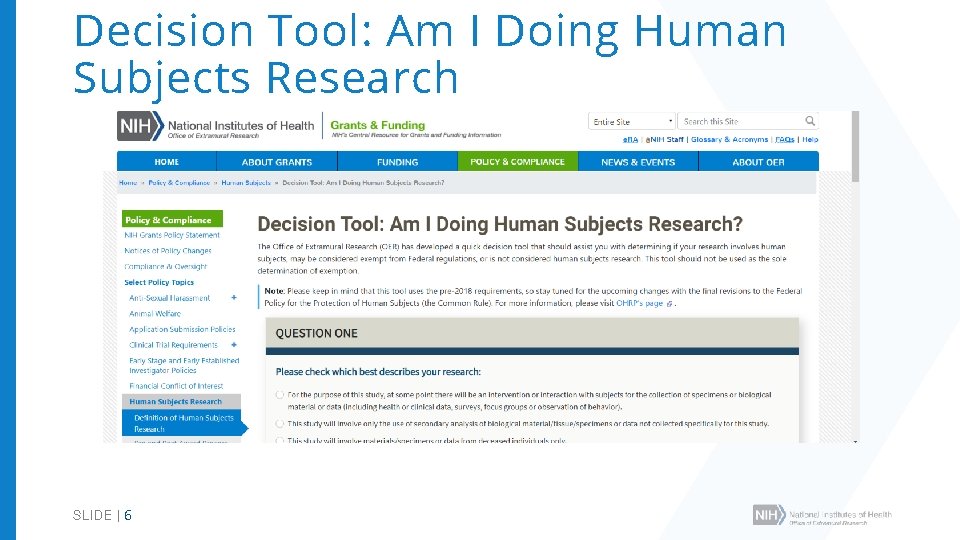
Decision Tool: Am I Doing Human Subjects Research SLIDE | 6
Required Education In the Protection of Human Research Participants • All key personnel must have education on the protection of human research participants: • Individuals responsible for design and conduct of the research • Also applies to key personnel at performance sites Guide Notices NOT-OD-00 -039 & NOT-OD-11 -061 • One-time training Published June 5, 2000 & September 5, 2001 SLIDE | 7
Certificates of Confidentiality (Co. C) • Applicable NIH research ongoing or awarded as of December 13, 2016 is deemed to be issued a Certificate • Must not disclose identifiable, sensitive information : • In any Federal, State, or local civil, criminal, administrative, legislative, or other proceeding • To any other person not connected with the research • Disclosure permitted only when: • Required by Federal, State, or local laws (e. g. , reporting child or elder abuse, mandatory disease reporting) Co. C • With participants’ consent • For other scientific research SLIDE | 8
Certificates of Confidentiality (Co. C) cont’d • Co. C protects “covered information” • Names or any information, documents, or biospecimens • If there is a small risk that covered information can be combined wither other data to determine individual’s identity • Co. C applies to all copies of the data • Secondary researchers must uphold Co. C protections • Covered information protected in perpetuity SLIDE | 9 Guide Notice NOT-OD-17 -109 Published September 7, 2017
Human Fetal Tissue (HFT) • NIH implemented the HHS Policy, effective June 5, 2019 Guide Notices • Applicants must provide: NOT-OD-19 -128 & NOT-OD-19 -137 • a justification of the use of HFT, Published July 26, 2019 & August 23, 2019 • details regarding procurement and costs, • information about how the applicant/contract offeror will use HFT • NIH will not accept modular budgets for applications for research involving HFT • Applications that do not address all required information will be administratively withdrawn and not reviewed SLIDE | 10

Inclusion • Inclusion of women and minorities in all NIH funded or supported clinical research mandated by law • Additional requirements for Phase III clinical trials • Can study be expected to identify potential differences by sex/gender, race, and/or ethnicity SLIDE | 11 11
Inclusion cont’d • Must include individuals across the lifespan when conducting clinical research, unless there is a scientific or ethical reason to exclude • Policies Goal: ensure individuals are included in clinical research in a manner appropriate to the scientific question under study SLIDE | 12 Guide Notices NOT-OD-16 -010, NOT-OD-18 -104 & NOT-OD-18 -116 Published October 13, 2015, November 28, 2017 & December 19, 2017
Objectives • Identify NIH policies pertaining to research involving human subjects • Determine when research involving human subjects is a clinical trial • Review considerations when applying for NIH award for research that involves human subjects • Identify NIH resources for investigators conducting research involving human subjects SLIDE | 13
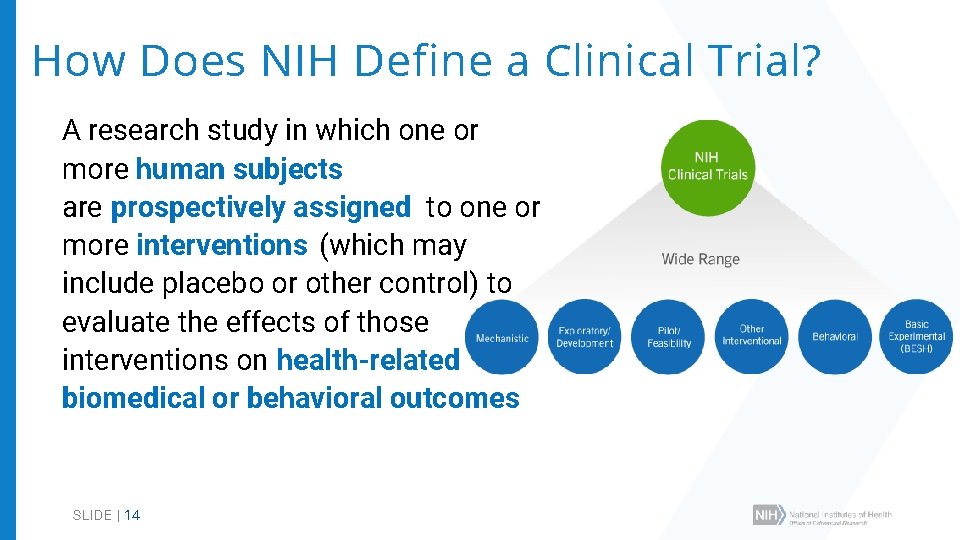
How Does NIH Define a Clinical Trial? A research study in which one or more human subjects are prospectively assigned to one or more interventions (which may include placebo or other control) to evaluate the effects of those interventions on health-related biomedical or behavioral outcomes SLIDE | 14
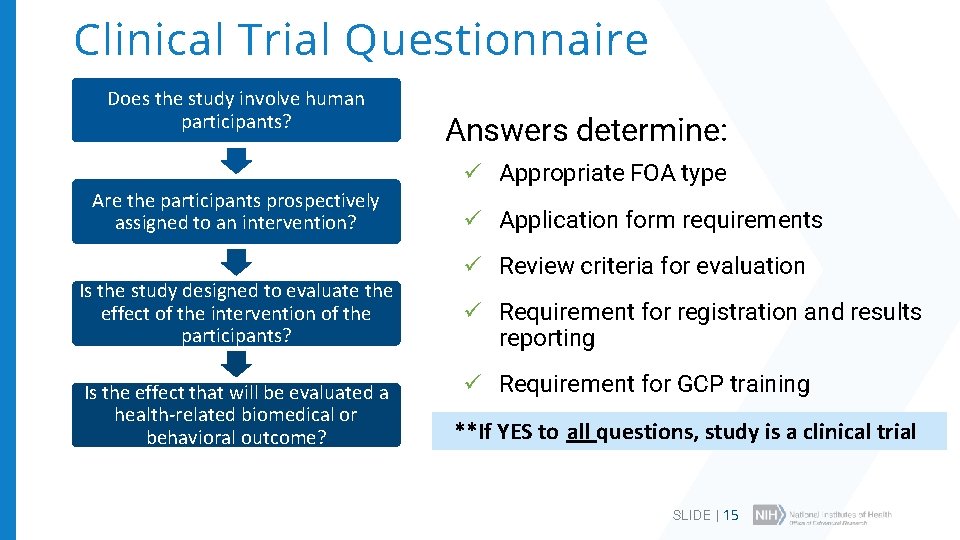
Clinical Trial Questionnaire Does the study involve human participants? Are the participants prospectively assigned to an intervention? Is the study designed to evaluate the effect of the intervention of the participants? Is the effect that will be evaluated a health-related biomedical or behavioral outcome? Answers determine: ü Appropriate FOA type ü Application form requirements ü Review criteria for evaluation ü Requirement for registration and results reporting ü Requirement for GCP training **If YES to all questions, study is a clinical trial SLIDE | 15
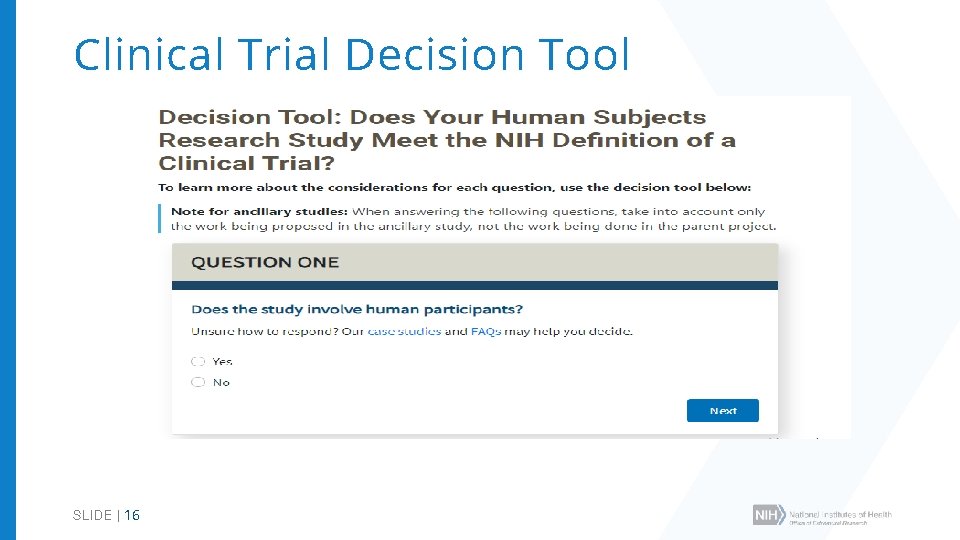
Clinical Trial Decision Tool SLIDE | 16
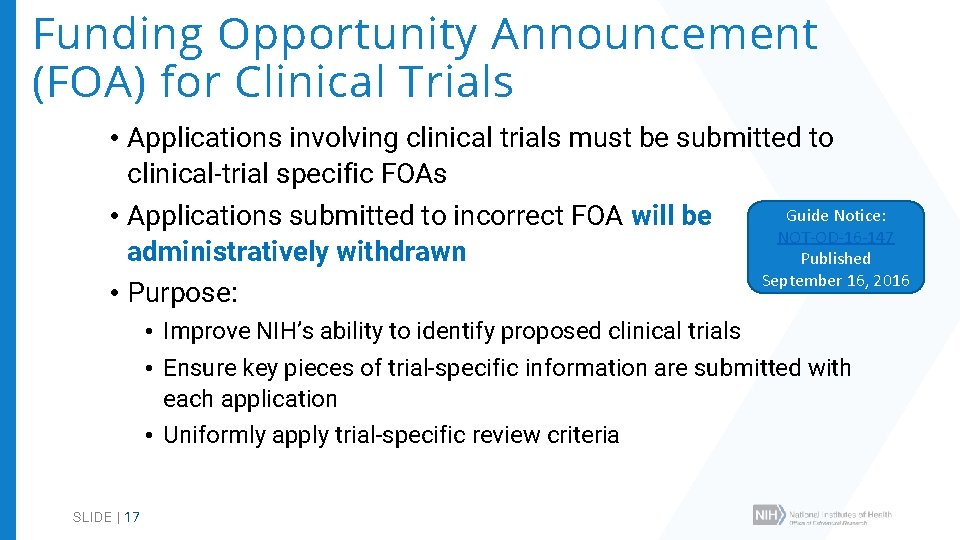
Funding Opportunity Announcement (FOA) for Clinical Trials • Applications involving clinical trials must be submitted to clinical-trial specific FOAs Guide Notice: • Applications submitted to incorrect FOA will be NOT-OD-16 -147 administratively withdrawn Published September 16, 2016 • Purpose: • Improve NIH’s ability to identify proposed clinical trials • Ensure key pieces of trial-specific information are submitted with each application • Uniformly apply trial-specific review criteria SLIDE | 17
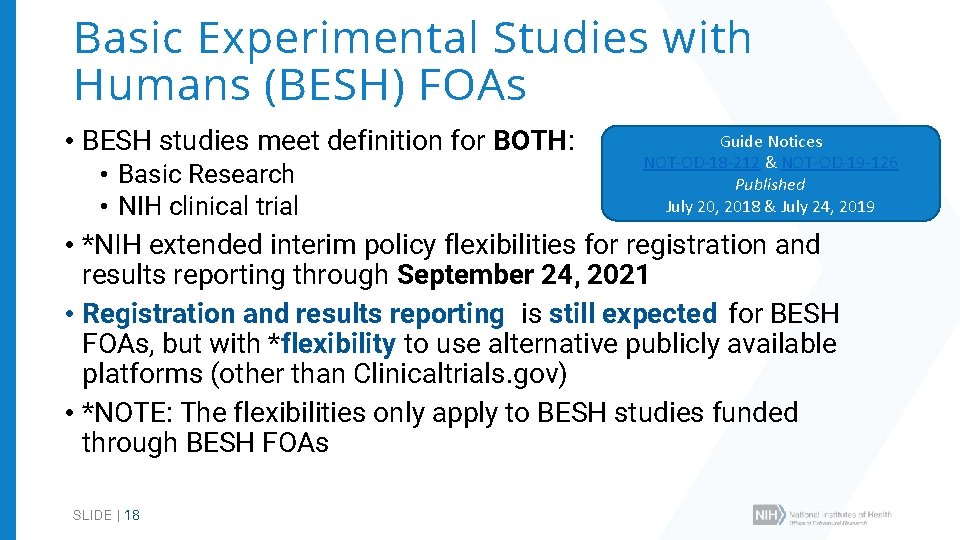
Basic Experimental Studies with Humans (BESH) FOAs • BESH studies meet definition for BOTH: • Basic Research • NIH clinical trial Guide Notices NOT-OD-18 -212 & NOT-OD-19 -126 Published July 20, 2018 & July 24, 2019 • *NIH extended interim policy flexibilities for registration and results reporting through September 24, 2021 • Registration and results reporting is still expected for BESH FOAs, but with *flexibility to use alternative publicly available platforms (other than Clinicaltrials. gov) • *NOTE: The flexibilities only apply to BESH studies funded through BESH FOAs SLIDE | 18
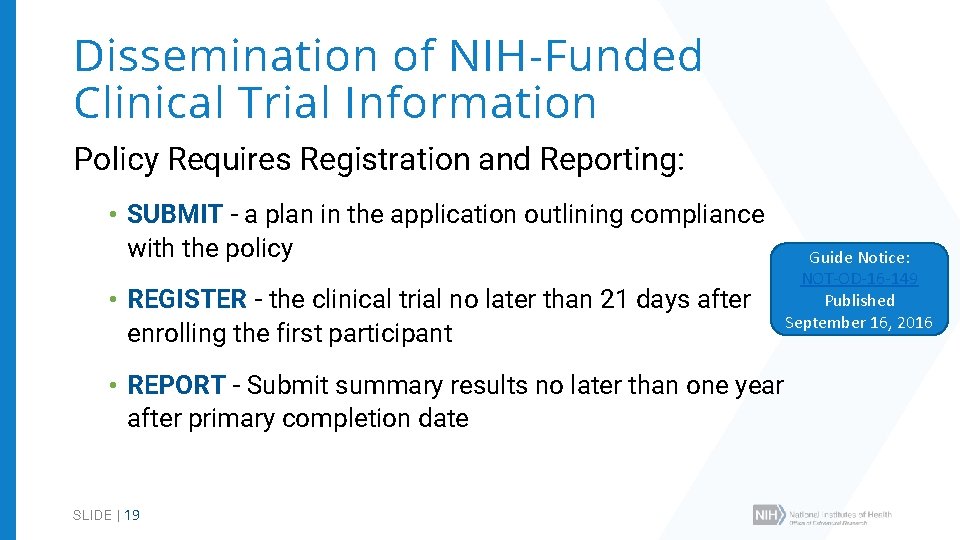
Dissemination of NIH-Funded Clinical Trial Information Policy Requires Registration and Reporting: • SUBMIT - a plan in the application outlining compliance with the policy • REGISTER - the clinical trial no later than 21 days after enrolling the first participant • REPORT - Submit summary results no later than one year after primary completion date SLIDE | 19 Guide Notice: NOT-OD-16 -149 Published September 16, 2016
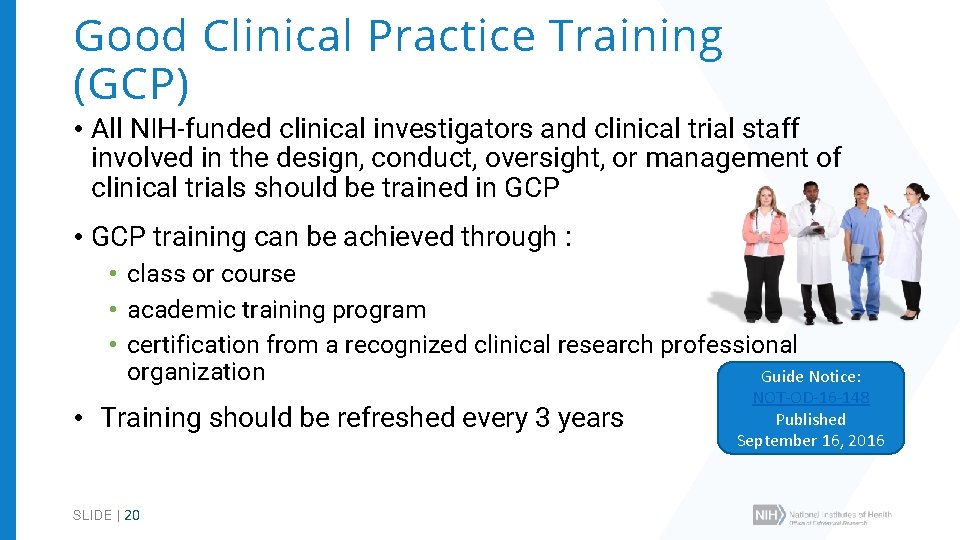
Good Clinical Practice Training (GCP) • All NIH-funded clinical investigators and clinical trial staff involved in the design, conduct, oversight, or management of clinical trials should be trained in GCP • GCP training can be achieved through : • class or course • academic training program • certification from a recognized clinical research professional organization Guide Notice: • Training should be refreshed every 3 years SLIDE | 20 NOT-OD-16 -148 Published September 16, 2016
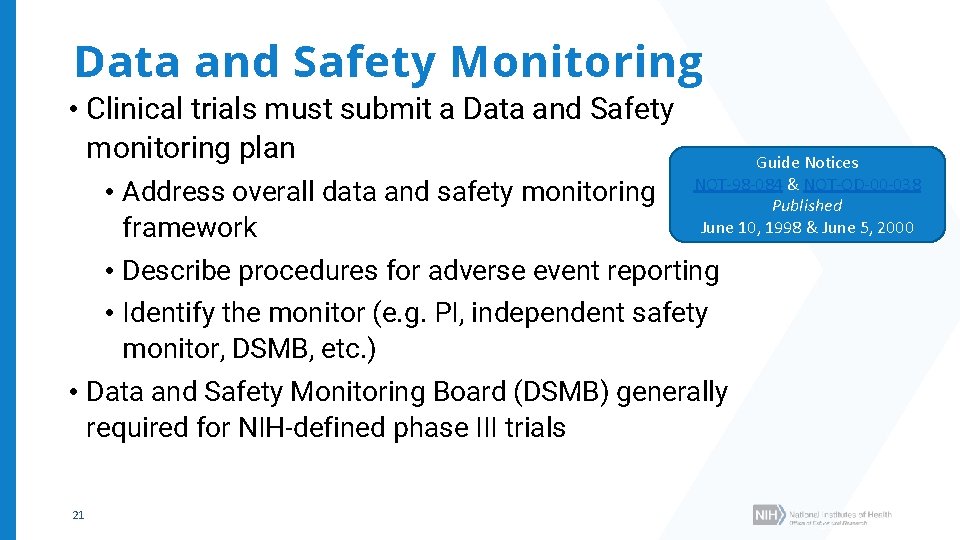
Data and Safety Monitoring • Clinical trials must submit a Data and Safety monitoring plan Guide Notices NOT-98 -084 & NOT-OD-00 -038 Published June 10, 1998 & June 5, 2000 • Address overall data and safety monitoring framework • Describe procedures for adverse event reporting • Identify the monitor (e. g. PI, independent safety monitor, DSMB, etc. ) • Data and Safety Monitoring Board (DSMB) generally required for NIH-defined phase III trials 21 21

Objectives • Identify NIH policies pertaining to research involving human subjects • Determine when research involving human subjects is a clinical trial • Review considerations when applying for an NIH award for research that involves human subjects • Identify NIH resources for investigators conducting research involving human subjects SLIDE | 22
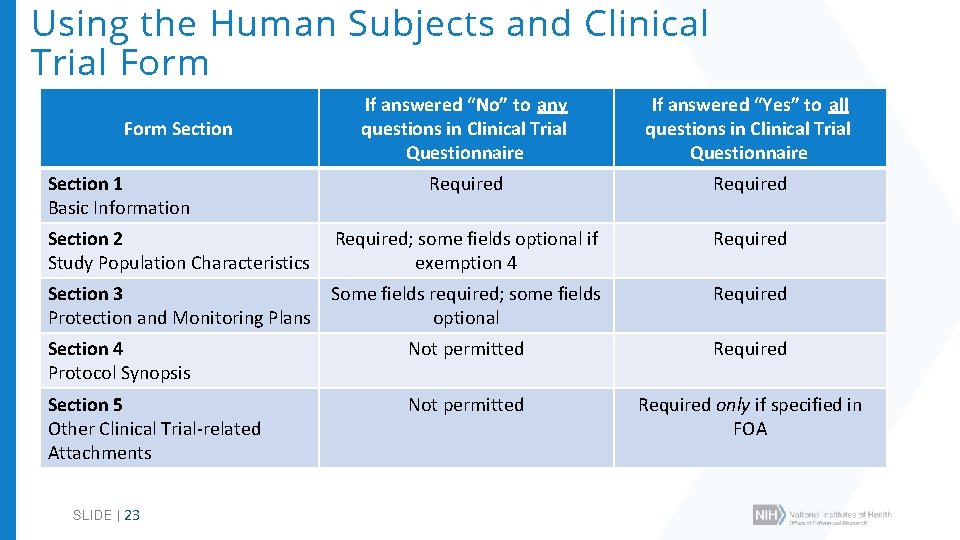
Using the Human Subjects and Clinical Trial Form If answered “No” to any questions in Clinical Trial Questionnaire If answered “Yes” to all questions in Clinical Trial Questionnaire Required Section 2 Study Population Characteristics Required; some fields optional if exemption 4 Required Section 3 Protection and Monitoring Plans Some fields required; some fields optional Required Section 4 Protocol Synopsis Not permitted Required Section 5 Other Clinical Trial-related Attachments Not permitted Required only if specified in FOA Form Section 1 Basic Information SLIDE | 23

Plan Protection of Human Subjects 1. Risks • Study population, assignment and procedures • Sources of materials –access to identifiers • Potential Risks for ALL research interventions: physical, psychological, social, legal 2. Adequacy of Protection Against Risks • The consenting process • Procedures to minimize identified risks, including protecting participant privacy • Additional protections for vulnerable subjects SLIDE | 24

Plan Protection of Human Subjects cont’d 3. Potential Benefits of Research to Human Subjects and Others • Discuss risks in relation to anticipated benefits • In some cases, there is no direct benefit to subjects • Do not include financial compensation 4. Importance of Knowledge to be Gained • Discuss in relation to risks SLIDE | 25
Plan Protection of Human Subjects cont’d • Don’t assume reviewers will understand what you mean • Explain how, what, when, where, why and who • Common human subject issues identified in peer review: • • • Physical or psychological risks not adequately addressed Inadequate protections for vulnerable populations Source of specimen and/or data Incidental findings not addressed Missing or inadequate Data & Safety Monitoring Plans SLIDE | 26
2 7 Multi-site Study Considerations • In general, funding recipient is considered engaged in human subjects (HS) research when nonexempt research involves HS • All engaged sites must have: • FWA (can be covered under recipient’s FWA) • http: //www. hhs. gov/ohrp/policy/guidanceonalternativetofwa. html • IRB Approval • U. S. sites to rely on one IRB under 45 CFR 46. 114 • Reliance agreement http: //www. hhs. gov/ohrp/assurances/forms/irbauthagree. html SLIDE | 27
Objectives • Identify NIH policies pertaining to research involving human subjects • Determine when research involving human subjects is a clinical trial • Review considerations when applying for an NIH award for research that involves human subjects • Identify NIH resources for investigators conducting research involving human subjects SLIDE | 28
Useful Resources: Human Subjects Protections and Inclusion • NIH OER Human Subjects website https: //humansubjects. nih. gov • OHRP website https: //www. hhs. gov/ohrp/ SLIDE | 29

Questions SLIDE | 30
- Slides: 30