
AN OVERVIEW OF NATURAL SELECTION Biol 303 Natural
AN OVERVIEW OF NATURAL SELECTION Biol 303 Natural Selection 1
READINGS for this lecture series: KREBS cpt 1. Introduction to the Science of Ecology KREBS cpt 2. Evolution and Ecology KREBS cpt 3. Methods for Analyzing Distributions KREBS Skim through cpts 4 - 8 Biol 303 Natural Selection 2
AN OVERVIEW OF NATURAL SELECTION FACT 1. Any species can increase its population geometrically. FACT 2. Population size remains constant over time. FACT 3. All organisms can be seen to be variable. Biol 303 Natural Selection 3
![EXCESS REPRODUCTION (# of offspring [eggs or seeds] per reproductive season) Starlings Bull frog](http://slidetodoc.com/presentation_image_h2/0eccb1452557f056336a56a4d7aee9dd/image-4.jpg "EXCESS REPRODUCTION (# of offspring [eggs or seeds] per reproductive season) Starlings Bull frog")
EXCESS REPRODUCTION (# of offspring [eggs or seeds] per reproductive season) Starlings Bull frog Trout Eastern Oyster 4– 6 6, 000 – 20, 000 200 – 6, 000 Up to 1, 000 Ragweed Up to 3, 000 Lamb’s Quarters 90 – 50, 000 Biol 303 Natural Selection 4
![EXCESS REPRODUCTION (# of offspring [eggs or seeds] per reproductive season) Starlings Bull frog](http://slidetodoc.com/presentation_image_h2/0eccb1452557f056336a56a4d7aee9dd/image-5.jpg "EXCESS REPRODUCTION (# of offspring [eggs or seeds] per reproductive season) Starlings Bull frog")
EXCESS REPRODUCTION (# of offspring [eggs or seeds] per reproductive season) Starlings Bull frog Trout Eastern Oyster 4– 6 6, 000 – 20, 000 200 – 6, 000 Up to 1, 000 Ragweed Up to 3, 000 Lamb’s Quarters 90 – 50, 000 Biol 303 Natural Selection 5
![EXCESS REPRODUCTION (# of offspring [eggs or seeds] per reproductive season) Starlings Bull frog](http://slidetodoc.com/presentation_image_h2/0eccb1452557f056336a56a4d7aee9dd/image-6.jpg "EXCESS REPRODUCTION (# of offspring [eggs or seeds] per reproductive season) Starlings Bull frog")
EXCESS REPRODUCTION (# of offspring [eggs or seeds] per reproductive season) Starlings Bull frog Trout Eastern Oyster 4– 6 6, 000 – 20, 000 200 – 6, 000 Up to 1, 000 Ragweed Up to 3, 000 Lamb’s Quarters 90 – 50, 000 Biol 303 Natural Selection Krebs p 298 6
AN OVERVIEW OF NATURAL SELECTION FACT 1. Any species can increase its population geometrically. FACT 2. Population size remains constant over time. FACT 3. All organisms can be seen to be variable. Biol 303 Natural Selection 7
AN OVERVIEW OF NATURAL SELECTION FACT 1. Any species can increase its population geometrically. FACT 2. Population size remains constant over time. FACT 3. All organisms can be seen to be variable. Biol 303 Natural Selection 8
AN OVERVIEW OF NATURAL SELECTION contd… POSTULATE 1. (from facts 1 and 2). There is competition amongst progeny for survival (differential mortality). POSTULATE 2. (from postulate 1 and fact 3). Because there is competition, some variants will be better adapted, compete more successfully and leave more offspring (differential reproduction). These variants will comprise the next generation. This is the process of natural selection Biol 303 Natural Selection 9
AN OVERVIEW OF NATURAL SELECTION contd… POSTULATE 1. (from facts 1 and 2). There is competition amongst progeny for survival (differential mortality). POSTULATE 2. (from postulate 1 and fact 3). Because there is competition, some variants will be better adapted, compete more successfully and leave more offspring (differential reproduction). These variants will comprise the next generation. This is the process of natural selection. Biol 303 Natural Selection 10
AN OVERVIEW OF NATURAL SELECTION contd… POSTULATE 1. (from facts 1 and 2). There is competition amongst progeny for survival (differential mortality). POSTULATE 2. (from postulate 1 and fact 3). Because there is competition, some variants will be better adapted, compete more successfully and leave more offspring (differential reproduction). These variants will comprise the next generation. This is the process of natural selection Biol 303 Natural Selection 11

OVERVIEW OF NATURAL SELECTION 1. Some individuals will produce more offspring that survive and reach maturity than others. 2. These individuals are those best able to survive and reproduce in a given environment. They are the best adapted. 3. The genes of such individuals will predominate in the following generations. Biol 303 Natural Selection 12

4. This is natural selection: It can be defined as ' reproductive success in the long term'. 5. When the environment changes the original types are now less adapted, and variant types, by chance, may be better adapted. If so, they will spread and the species changes. This is evolution. 6. Therefore: Adaptation is evolution. Biol 303 Natural Selection 13
FITNESS… is defined as "the relative reproductive success of an organism in the long-term", i. e. a organism's fitness is measured relative to another organism. Reproductive success includes both reproduction and survival to maturity of progeny. Biol 303 Natural Selection 14
GENETIC VARIATION 1. Where does it come from? 2. How much is there? 3. How is it maintained in populations? 4. How is it “selected”? Biol 303 Natural Selection 15
GENETIC VARIATION 1. Where does it come from? 2. How much is there? 3. How is it maintained in populations? 4. How is it “selected”? Biol 303 Natural Selection 16

Dr. Jeremy Burdon 22 Characteristics of White Clover (all with selective advantage) • 4 biochemical and pathological • 11 vegetative • 7 floral Biol 303 Natural Selection 17
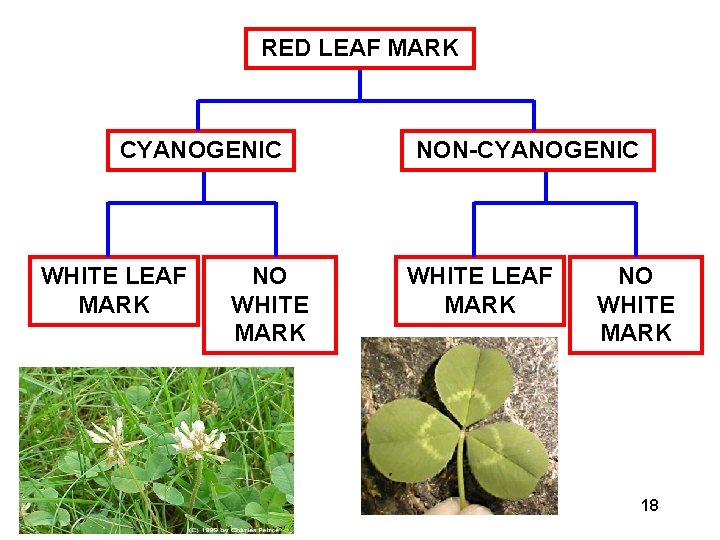
RED LEAF MARK CYANOGENIC WHITE LEAF MARK Biol 303 Natural Selection NO WHITE MARK NON-CYANOGENIC WHITE LEAF MARK NO WHITE MARK 18
GENETIC VARIATION 1. Where does it come from? 2. How much is there? 3. How is it maintained in populations? 4. How is it “selected”? Biol 303 Natural Selection 19
A POLYMORPHISM… is the occurrence together in the same habitat at the same time of two or more distinct forms of a species in such proportions the rarest of them cannot be maintained by recurrent mutation. Biol 303 Natural Selection 20
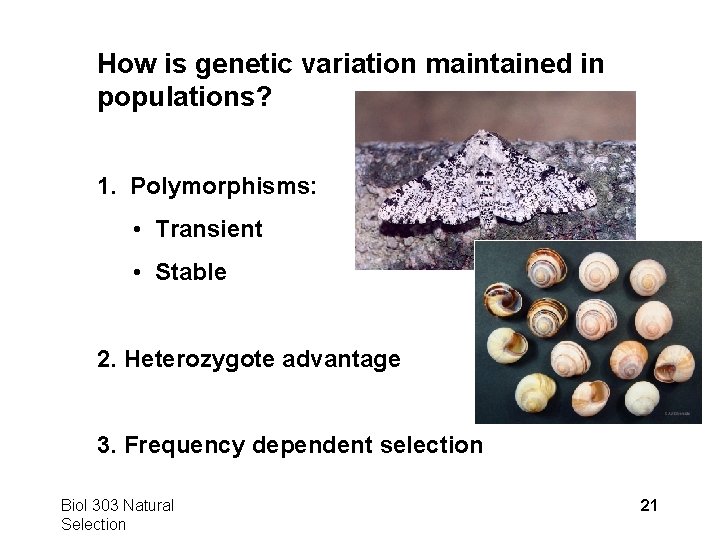
How is genetic variation maintained in populations? 1. Polymorphisms: • Transient • Stable 2. Heterozygote advantage 3. Frequency dependent selection Biol 303 Natural Selection 21
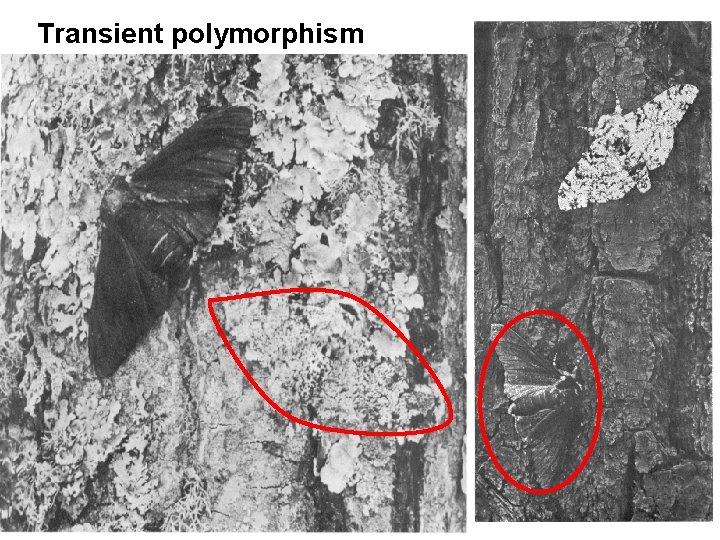
Transient polymorphism Biol 303 Natural Selection 22
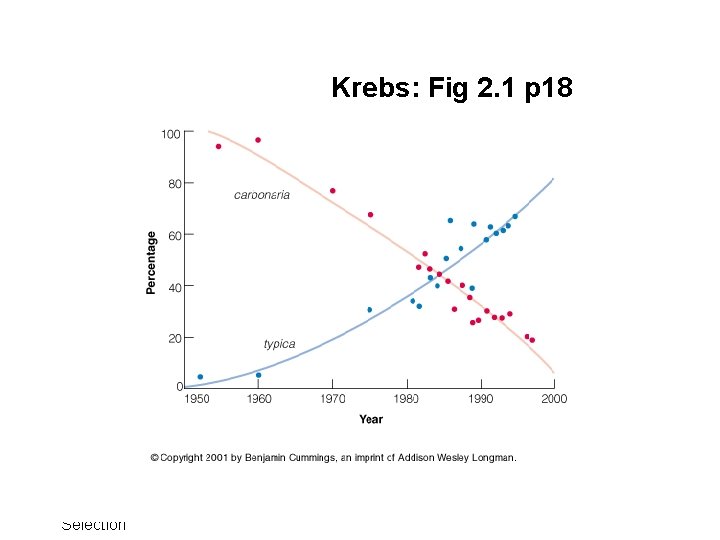
Krebs: Fig 2. 1 p 18 Biol 303 Natural Selection 23
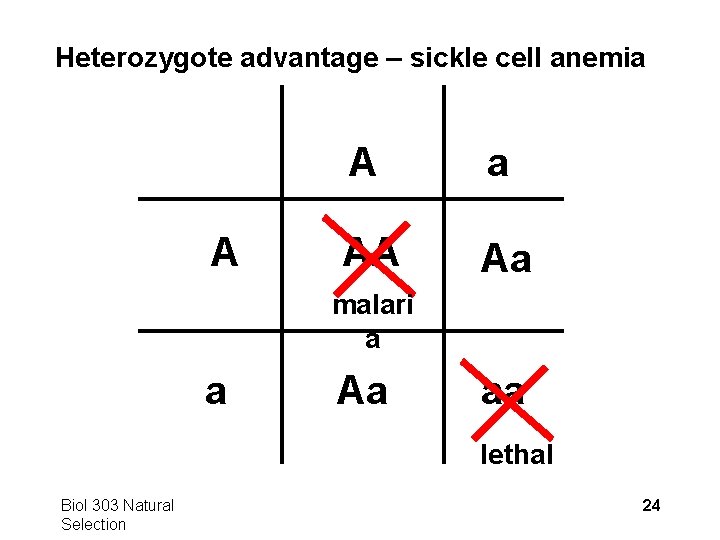
Heterozygote advantage – sickle cell anemia A A a AA Aa malari a a Aa aa lethal Biol 303 Natural Selection 24
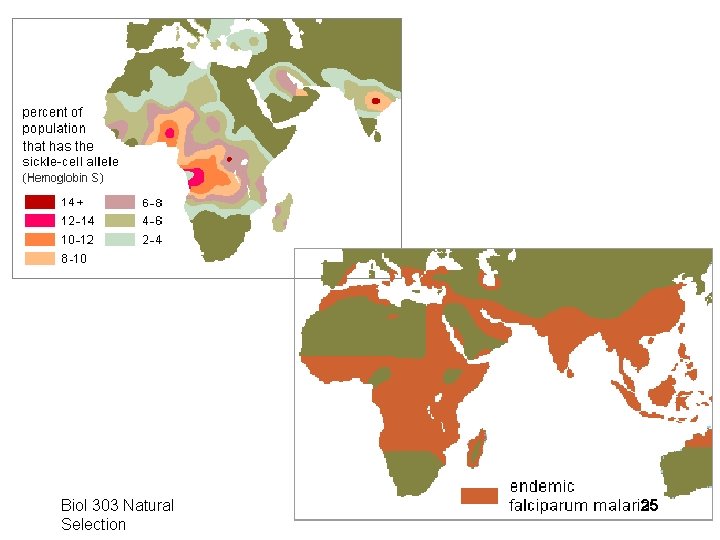
Biol 303 Natural Selection 25
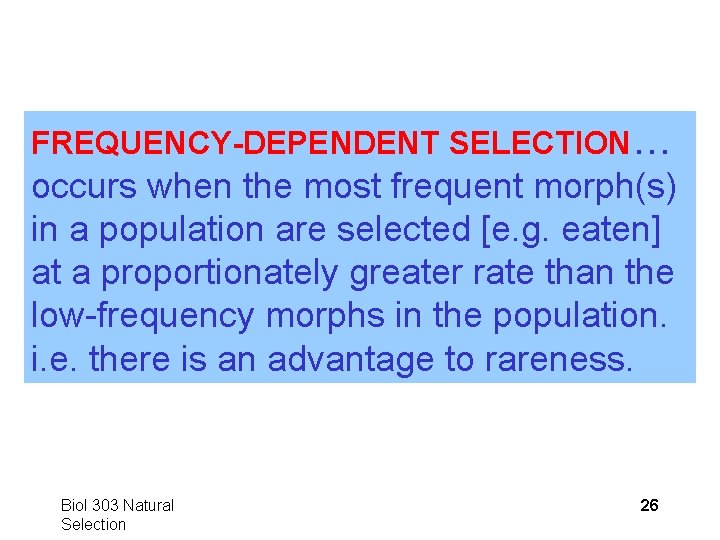
FREQUENCY-DEPENDENT SELECTION… occurs when the most frequent morph(s) in a population are selected [e. g. eaten] at a proportionately greater rate than the low-frequency morphs in the population. i. e. there is an advantage to rareness. Biol 303 Natural Selection 26
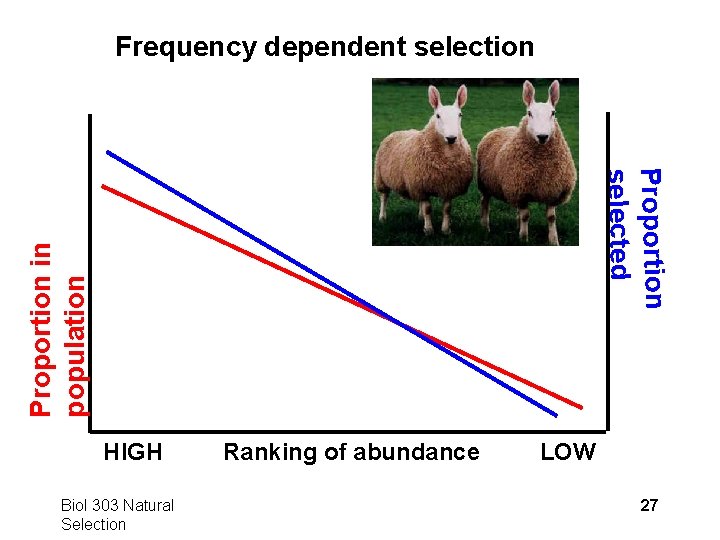
Frequency dependent selection Proportion in population Proportion selected HIGH Biol 303 Natural Selection Ranking of abundance LOW 27
GENETIC VARIATION 1. Where does it come from? 2. How much is there? 3. How is it maintained in populations? 4. How is it “selected”? Biol 303 Natural Selection 28
How is genetic variation “selected”? 1. Directional selection 2. Stabilizing selection 3. Disruptive selection Biol 303 Natural Selection 29
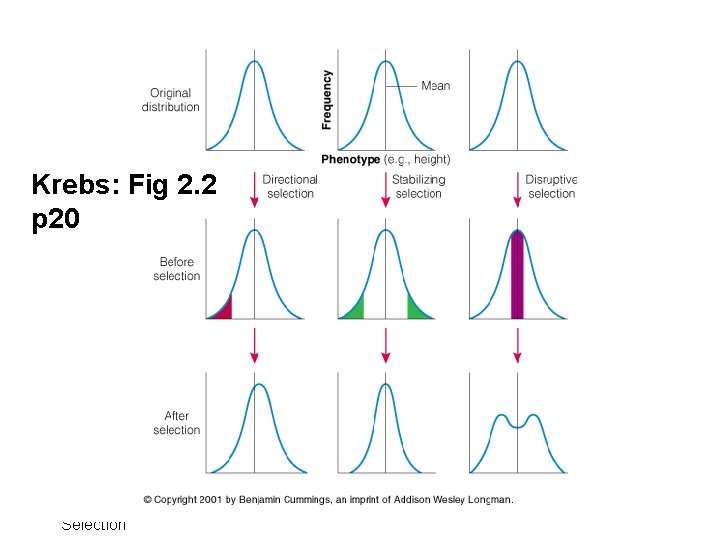
Krebs: Fig 2. 2 p 20 Biol 303 Natural Selection 30
1. DIRECTIONAL SELECTION • Peppered moth, and Krebs p 19 2. DISRUPTIVE SELECTION • Krebs p 21 Biol 303 Natural Selection 31
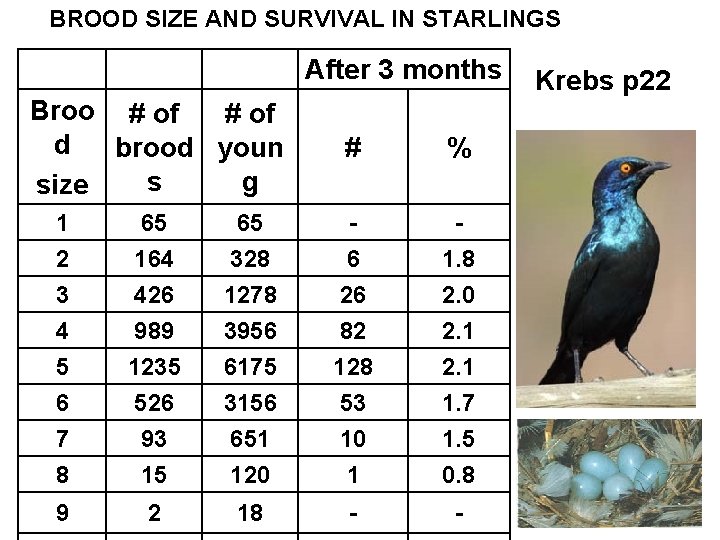
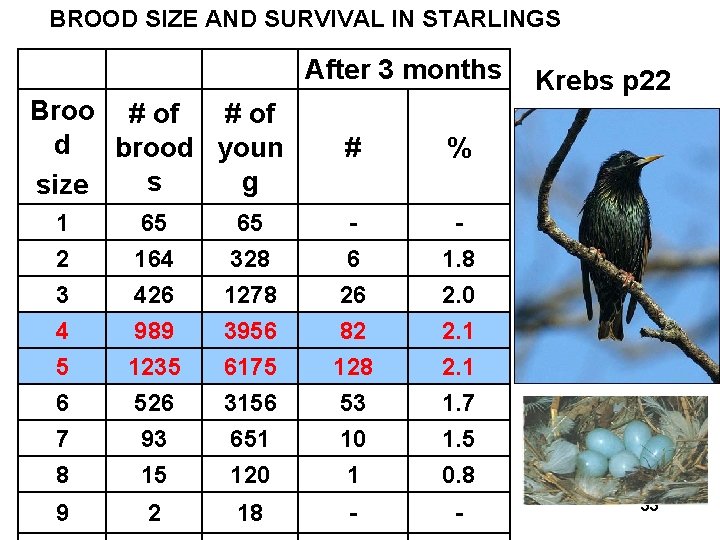
BROOD SIZE AND SURVIVAL IN STARLINGS After 3 months Broo # of d brood youn s g size # % 1 2 65 164 65 328 6 1. 8 3 4 5 6 7 8 426 989 1235 526 93 15 1278 3956 6175 3156 651 120 26 82 128 53 10 1 2. 0 2. 1 1. 7 1. 5 0. 8 18 - - 303 Natural 9 Biol 2 Selection Krebs p 22 32
BROOD SIZE AND SURVIVAL IN STARLINGS After 3 months Broo # of d brood youn s g size # % 1 2 65 164 65 328 6 1. 8 3 4 5 6 7 8 426 989 1235 526 93 15 1278 3956 6175 3156 651 120 26 82 128 53 10 1 2. 0 2. 1 1. 7 1. 5 0. 8 18 - - 303 Natural 9 Biol 2 Selection Krebs p 22 33
THE FUNDAMENTAL THEOREM OF NATURAL SELECTION 1. No selection is possible in a genetically uniform population. 2. The greater the variation (at a locus) the greater the rate of response to a constant selection pressure. 3. The greater the selection pressure the greater the rate of response. Biol 303 Natural Selection 34
THE FUNDAMENTAL THEOREM OF NATURAL SELECTION 1. No selection is possible in a genetically uniform population. 2. The greater the variation (at a locus) the greater the rate of response to a constant selection pressure. 3. The greater the selection pressure the greater the rate of response. Biol 303 Natural Selection 35
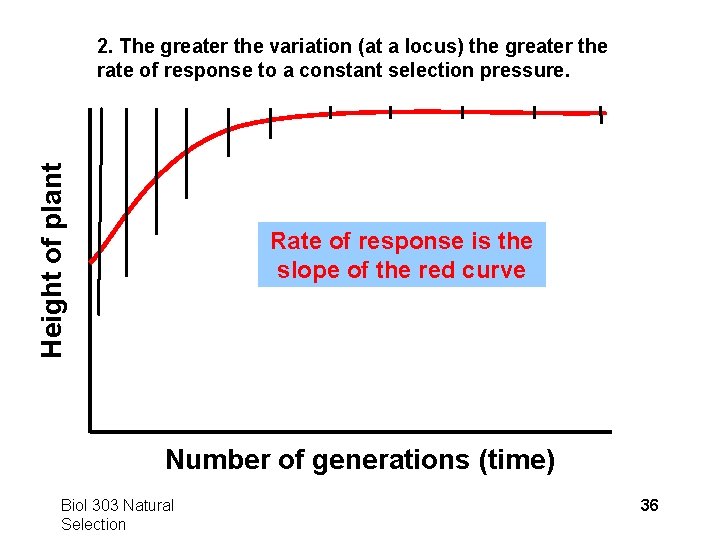
Height of plant 2. The greater the variation (at a locus) the greater the rate of response to a constant selection pressure. Rate of response is the slope of the red curve Number of generations (time) Biol 303 Natural Selection 36
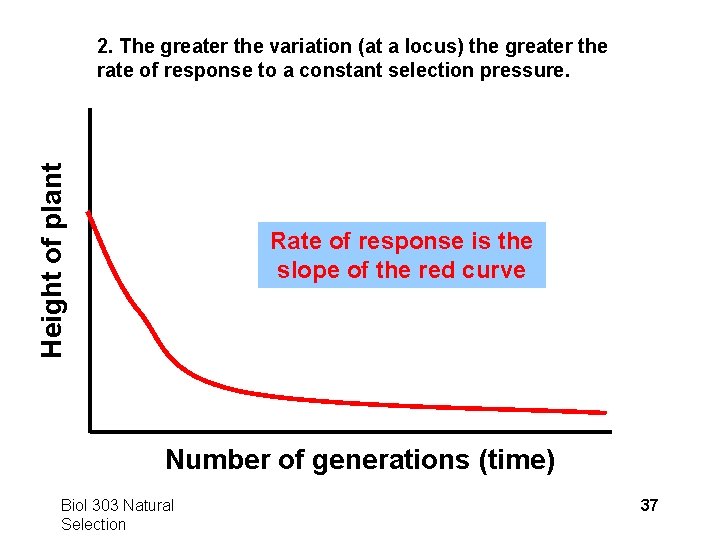
Height of plant 2. The greater the variation (at a locus) the greater the rate of response to a constant selection pressure. Rate of response is the slope of the red curve Number of generations (time) Biol 303 Natural Selection 37
THE FUNDAMENTAL THEOREM OF NATURAL SELECTION 1. No selection is possible in a genetically uniform population. 2. The greater the variation (at a locus) the greater the rate of response to a constant selection pressure. 3. The greater the selection pressure the greater the rate of response. Biol 303 Natural Selection 38
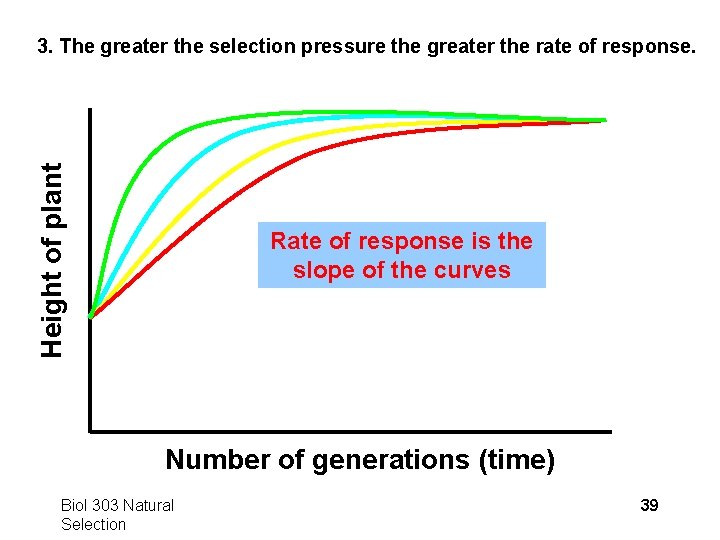
Height of plant 3. The greater the selection pressure the greater the rate of response. Rate of response is the slope of the curves Number of generations (time) Biol 303 Natural Selection 39
- Slides: 39