
An Overview of Motivational Strategies to Intervene with

- Slides: 19
An Overview of Motivational Strategies to Intervene with Obese Children: How School Counselors and Personnel Can Help Shane Haberstroh, Ed. D. Assistant Professor Department of Counseling, Educational Psychology, and Adult & Higher Education The University of Texas at San Antonio
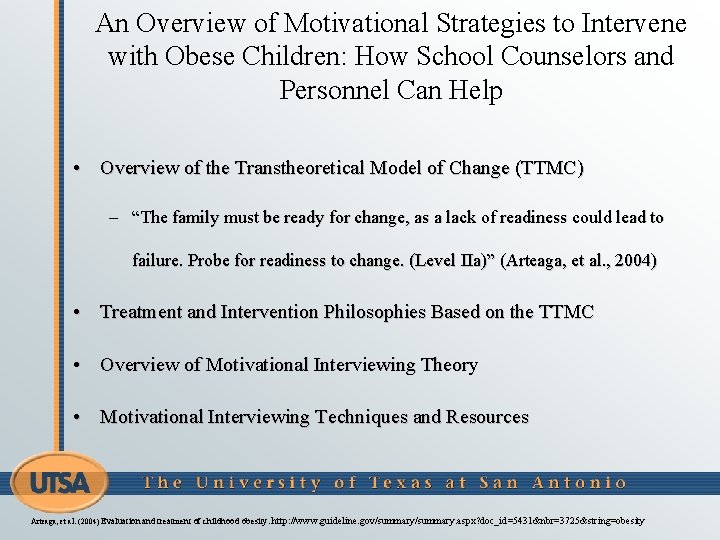
An Overview of Motivational Strategies to Intervene with Obese Children: How School Counselors and Personnel Can Help • Overview of the Transtheoretical Model of Change (TTMC) – “The family must be ready for change, as a lack of readiness could lead to failure. Probe for readiness to change. (Level IIa)” (Arteaga, et al. , 2004) • Treatment and Intervention Philosophies Based on the TTMC • Overview of Motivational Interviewing Theory • Motivational Interviewing Techniques and Resources Arteaga, et al. (2004) Evaluation and treatment of childhood obesity. http: //www. guideline. gov/summary. aspx? doc_id=5431&nbr=3725&string=obesity
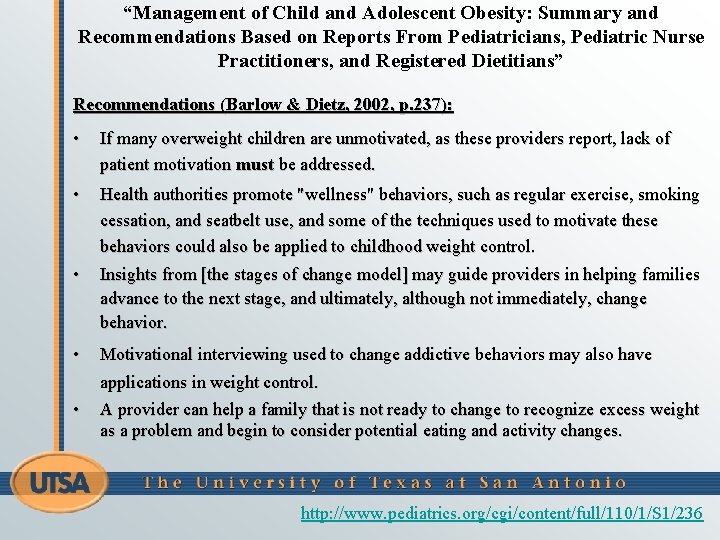
“Management of Child and Adolescent Obesity: Summary and Recommendations Based on Reports From Pediatricians, Pediatric Nurse Practitioners, and Registered Dietitians” Recommendations (Barlow & Dietz, 2002, p. 237): • If many overweight children are unmotivated, as these providers report, lack of patient motivation must be addressed. • Health authorities promote "wellness" behaviors, such as regular exercise, smoking cessation, and seatbelt use, and some of the techniques used to motivate these behaviors could also be applied to childhood weight control. • Insights from [the stages of change model] may guide providers in helping families advance to the next stage, and ultimately, although not immediately, change behavior. • Motivational interviewing used to change addictive behaviors may also have • applications in weight control. A provider can help a family that is not ready to change to recognize excess weight as a problem and begin to consider potential eating and activity changes. http: //www. pediatrics. org/cgi/content/full/110/1/S 1/236
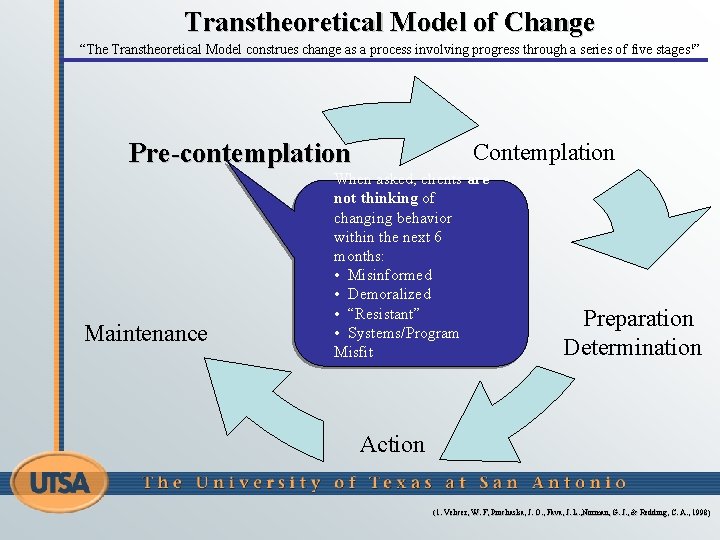
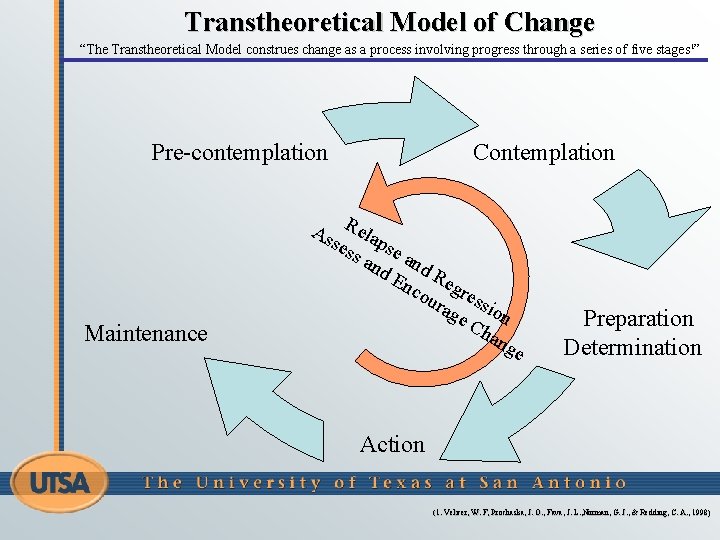
Transtheoretical Model of Change “The Transtheoretical Model construes change as a process involving progress through a series of five stages 1” Pre-contemplation Maintenance Contemplation When asked, clients are not thinking of changing behavior within the next 6 months: • Misinformed • Demoralized • “Resistant” • Systems/Program Misfit Preparation Determination Action (1. Velicer, W. F, Prochaska, J. O. , Fava, J. L. , Norman, G. J. , & Redding, C. A. , 1998)
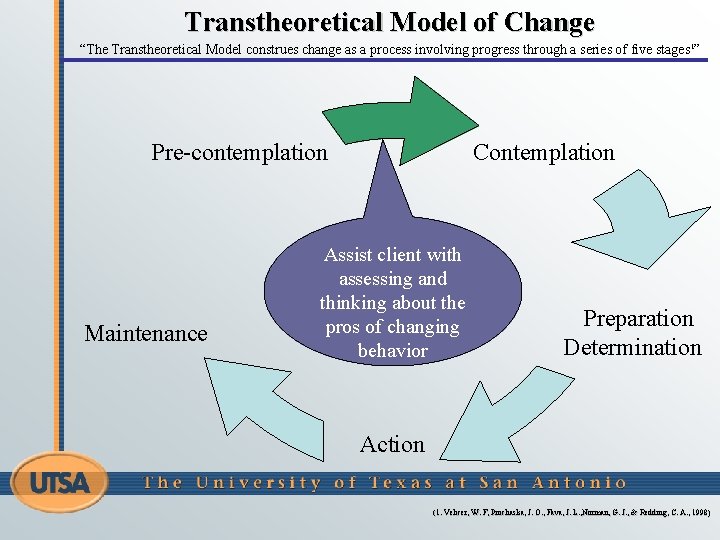
Transtheoretical Model of Change “The Transtheoretical Model construes change as a process involving progress through a series of five stages 1” Contemplation Pre-contemplation Maintenance Assist client with assessing and thinking about the pros of changing behavior Preparation Determination Action (1. Velicer, W. F, Prochaska, J. O. , Fava, J. L. , Norman, G. J. , & Redding, C. A. , 1998)
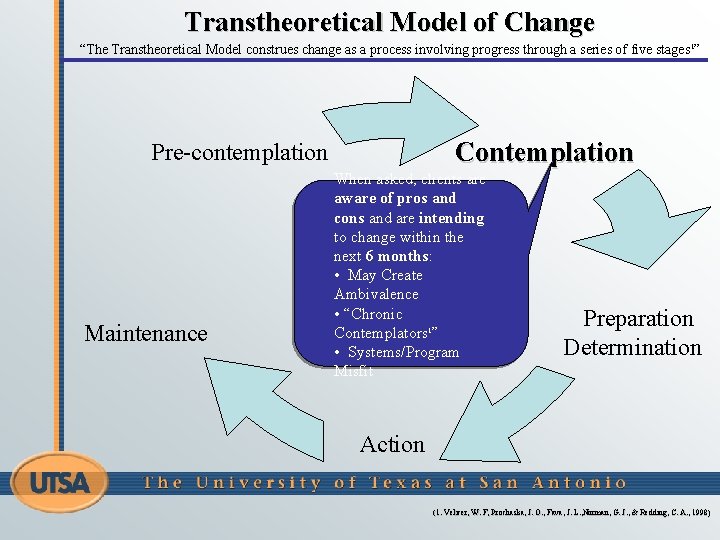
Transtheoretical Model of Change “The Transtheoretical Model construes change as a process involving progress through a series of five stages 1” Contemplation Pre-contemplation Maintenance When asked, clients are aware of pros and cons and are intending to change within the next 6 months: • May Create Ambivalence • “Chronic Contemplators 1” • Systems/Program Misfit Preparation Determination Action (1. Velicer, W. F, Prochaska, J. O. , Fava, J. L. , Norman, G. J. , & Redding, C. A. , 1998)
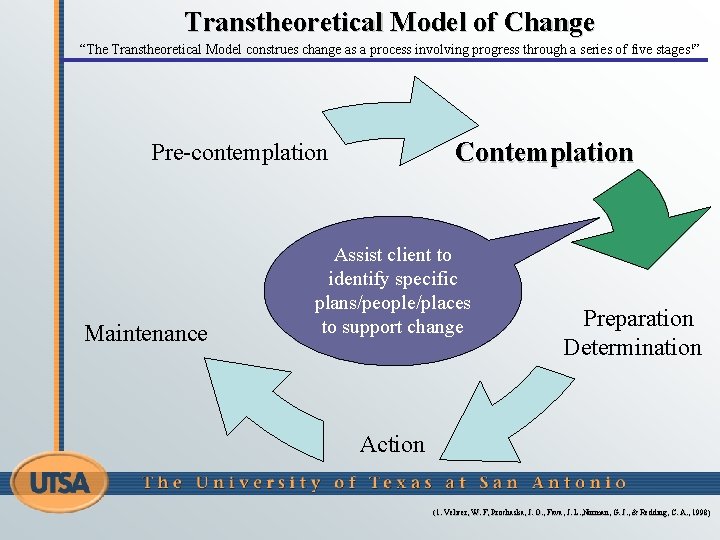
Transtheoretical Model of Change “The Transtheoretical Model construes change as a process involving progress through a series of five stages 1” Contemplation Pre-contemplation Maintenance Assist client to identify specific plans/people/places to support change Preparation Determination Action (1. Velicer, W. F, Prochaska, J. O. , Fava, J. L. , Norman, G. J. , & Redding, C. A. , 1998)
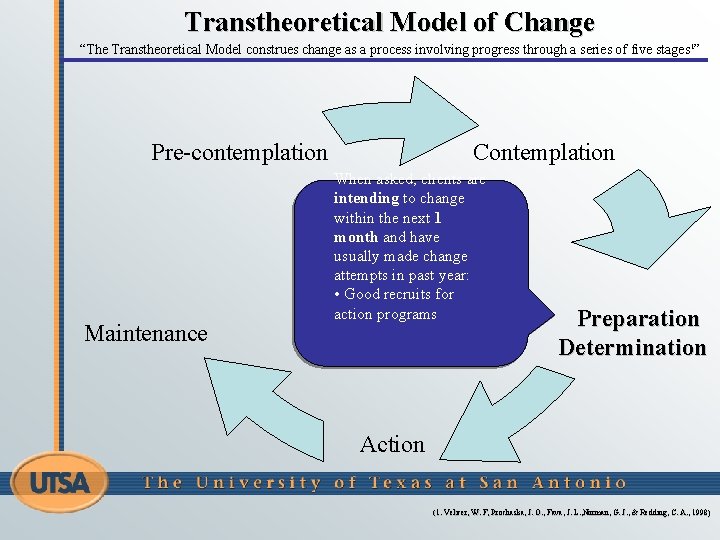
Transtheoretical Model of Change “The Transtheoretical Model construes change as a process involving progress through a series of five stages 1” Contemplation Pre-contemplation Maintenance When asked, clients are intending to change within the next 1 month and have usually made change attempts in past year: • Good recruits for action programs Preparation Determination Action (1. Velicer, W. F, Prochaska, J. O. , Fava, J. L. , Norman, G. J. , & Redding, C. A. , 1998)
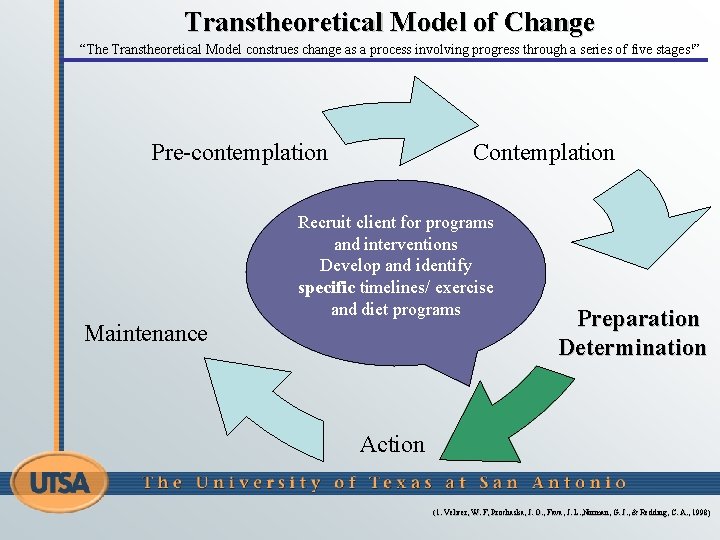
Transtheoretical Model of Change “The Transtheoretical Model construes change as a process involving progress through a series of five stages 1” Contemplation Pre-contemplation Recruit client for programs and interventions Develop and identify specific timelines/ exercise and diet programs Maintenance Preparation Determination Action (1. Velicer, W. F, Prochaska, J. O. , Fava, J. L. , Norman, G. J. , & Redding, C. A. , 1998)
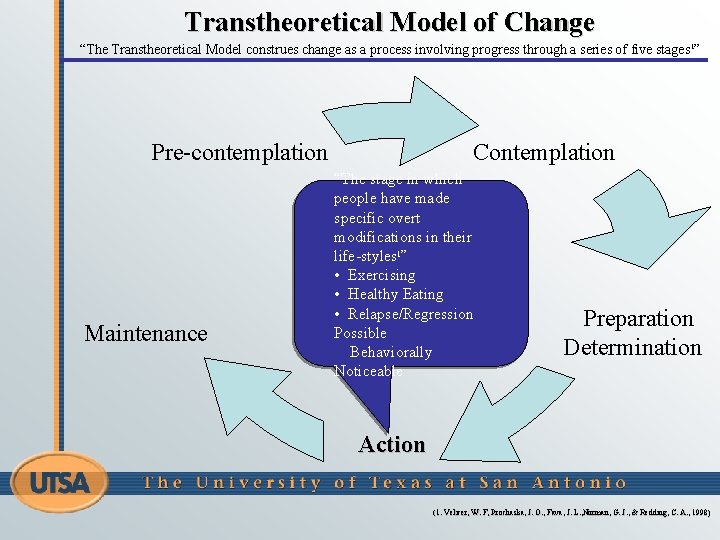
Transtheoretical Model of Change “The Transtheoretical Model construes change as a process involving progress through a series of five stages 1” Contemplation Pre-contemplation Maintenance “The stage in which people have made specific overt modifications in their life-styles 1” • Exercising • Healthy Eating • Relapse/Regression Possible Behaviorally Noticeable Preparation Determination Action (1. Velicer, W. F, Prochaska, J. O. , Fava, J. L. , Norman, G. J. , & Redding, C. A. , 1998)
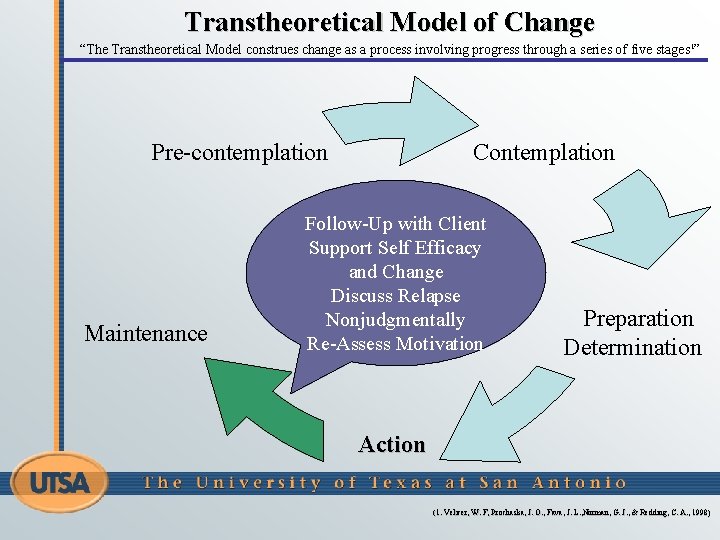
Transtheoretical Model of Change “The Transtheoretical Model construes change as a process involving progress through a series of five stages 1” Contemplation Pre-contemplation Maintenance Follow-Up with Client Support Self Efficacy and Change Discuss Relapse Nonjudgmentally Re-Assess Motivation Preparation Determination Action (1. Velicer, W. F, Prochaska, J. O. , Fava, J. L. , Norman, G. J. , & Redding, C. A. , 1998)
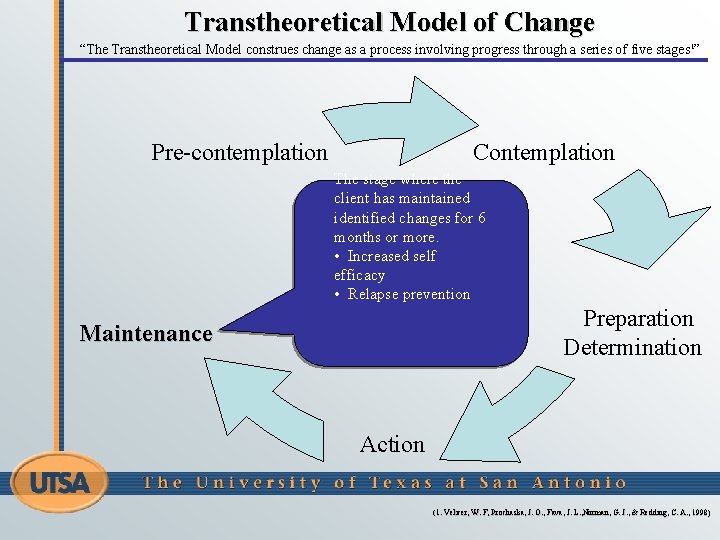
Transtheoretical Model of Change “The Transtheoretical Model construes change as a process involving progress through a series of five stages 1” Contemplation Pre-contemplation The stage where the client has maintained identified changes for 6 months or more. • Increased self efficacy • Relapse prevention Preparation Determination Maintenance Action (1. Velicer, W. F, Prochaska, J. O. , Fava, J. L. , Norman, G. J. , & Redding, C. A. , 1998)
Transtheoretical Model of Change “The Transtheoretical Model construes change as a process involving progress through a series of five stages 1” Contemplation Pre-contemplation Maintenance As Rela ses pse sa nd and R En cou egres rag sio e. C n han ge Preparation Determination Action (1. Velicer, W. F, Prochaska, J. O. , Fava, J. L. , Norman, G. J. , & Redding, C. A. , 1998)
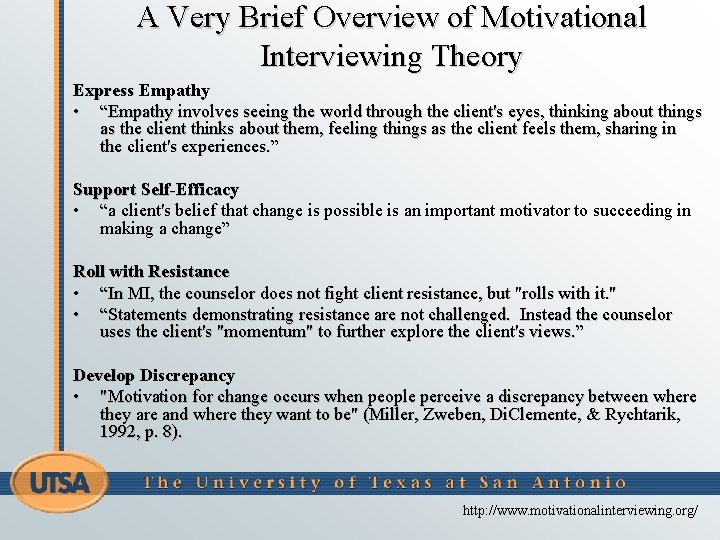
A Very Brief Overview of Motivational Interviewing Theory Express Empathy • “Empathy involves seeing the world through the client's eyes, thinking about things as the client thinks about them, feeling things as the client feels them, sharing in the client's experiences. ” Support Self-Efficacy • “a client's belief that change is possible is an important motivator to succeeding in making a change” Roll with Resistance • “In MI, the counselor does not fight client resistance, but "rolls with it. " • “Statements demonstrating resistance are not challenged. Instead the counselor uses the client's "momentum" to further explore the client's views. ” Develop Discrepancy • "Motivation for change occurs when people perceive a discrepancy between where they are and where they want to be" (Miller, Zweben, Di. Clemente, & Rychtarik, 1992, p. 8). http: //www. motivationalinterviewing. org/
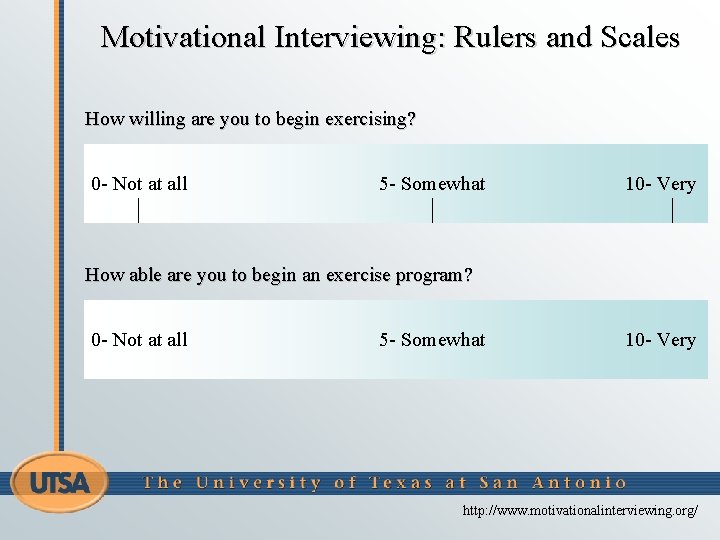
Motivational Interviewing: Rulers and Scales How willing are you to begin exercising? 0 - Not at all 5 - Somewhat 10 - Very How able are you to begin an exercise program? 0 - Not at all 5 - Somewhat 10 - Very http: //www. motivationalinterviewing. org/
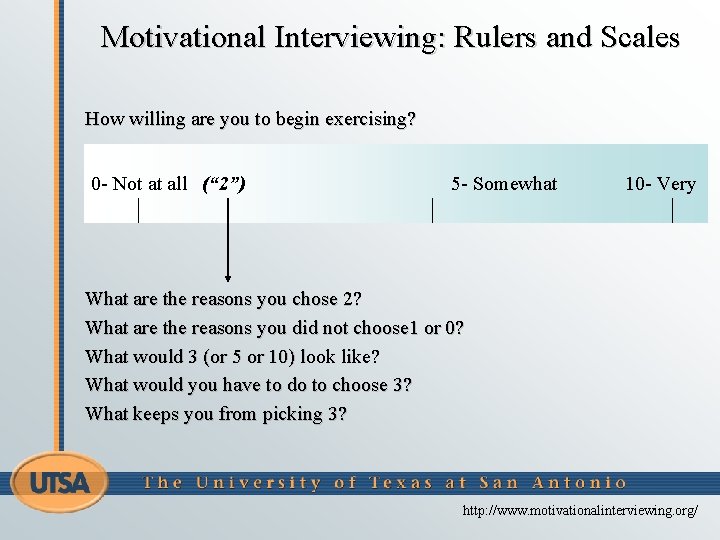
Motivational Interviewing: Rulers and Scales How willing are you to begin exercising? 0 - Not at all (“ 2”) 5 - Somewhat 10 - Very What are the reasons you chose 2? What are the reasons you did not choose 1 or 0? What would 3 (or 5 or 10) look like? What would you have to do to choose 3? What keeps you from picking 3? http: //www. motivationalinterviewing. org/
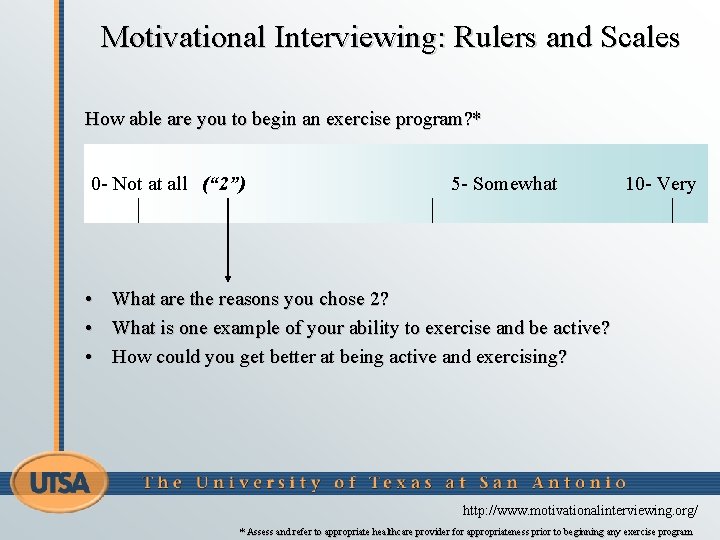
Motivational Interviewing: Rulers and Scales How able are you to begin an exercise program? * 0 - Not at all (“ 2”) 5 - Somewhat 10 - Very • What are the reasons you chose 2? • What is one example of your ability to exercise and be active? • How could you get better at being active and exercising? http: //www. motivationalinterviewing. org/ * Assess and refer to appropriate healthcare provider for appropriateness prior to beginning any exercise program
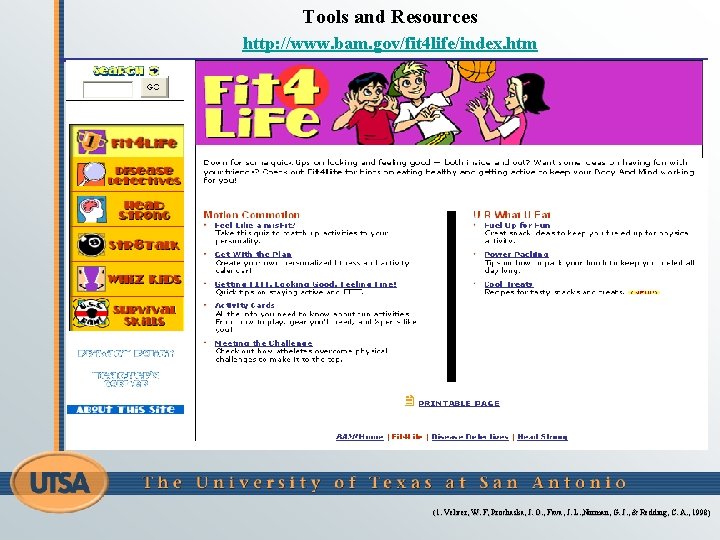
Tools and Resources http: //www. bam. gov/fit 4 life/index. htm Recruit client for programs and interventions Develop specific timelines/ exercise and diet programs (1. Velicer, W. F, Prochaska, J. O. , Fava, J. L. , Norman, G. J. , & Redding, C. A. , 1998)
An Overview of Motivational Strategies to Intervene with Obese Children: How School Counselors and Personnel Can Help Questions and Discussion