
An Overview of Lesson Study Day 3 From



- Slides: 25
An Overview of Lesson Study Day 3 From Lesson Study Step by Step: How Teacher Learning Communities Improve Instruction By Catherine C. Lewis and Jacqueline Hurd
Questions and Comments
Lesson Study Group Agenda • Become Familiar with Lesson Study • Consider Your Long-Term Goals and Common Research Theme • Identify Groups • Choose Roles • Develop Group Norms • Build a Timeline for the Lesson Study Cycle and Set a Schedule
Lesson Study: Exploring Resources Group A Do a little googling: Find three interesting and helpful resources on lesson study -- An article, an interview, a video, etc. Group B Read the excerpt from Chapter 3 on Planning a Lesson Study Group. Note any information you find particularly important or helpful in planning for our lesson study groups.
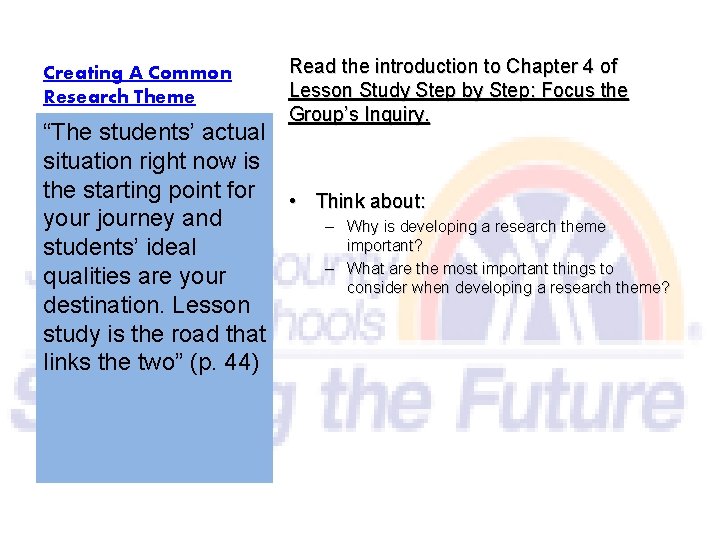
Creating A Common Research Theme Read the introduction to Chapter 4 of Lesson Study Step by Step: Focus the Group’s Inquiry. “The students’ actual situation right now is the starting point for • Think about: your journey and – Why is developing a research theme important? students’ ideal – What are the most important things to qualities are your consider when developing a research theme? destination. Lesson study is the road that links the two” (p. 44)
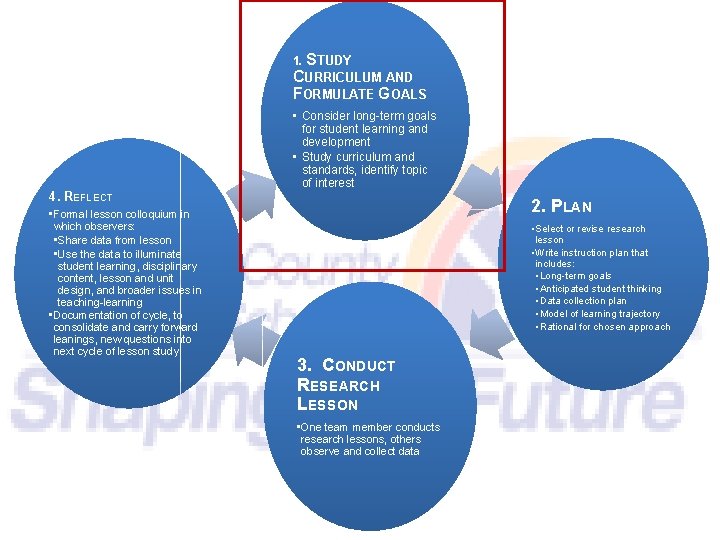
1. STUDY CURRICULUM AND FORMULATE GOALS 4. REFLECT • Formal lesson colloquium in which observers: • Share data from lesson • Use the data to illuminate student learning, disciplinary content, lesson and unit design, and broader issues in teaching-learning • Documentation of cycle, to consolidate and carry forward leanings, new questions into next cycle of lesson study. • Consider long-term goals for student learning and development • Study curriculum and standards, identify topic of interest 2. PLAN • Select or revise research lesson • Write instruction plan that includes: • Long-term goals • Anticipated student thinking • Data collection plan • Model of learning trajectory • Rational for chosen approach 3. CONDUCT RESEARCH LESSON • One team member conducts research lessons, others observe and collect data
Step 1: Study Curriculum and Formulate Goals Consider long-term goals for student learning and development Creating a Common Research Theme • The Goal, Research Focus, or Main Aim of the Lesson Study
Formulate Goals Creating a Common Research Theme • Captures long term goals for students • Developed collectively • Is broad enough to be compelling to teachers from all grade levels
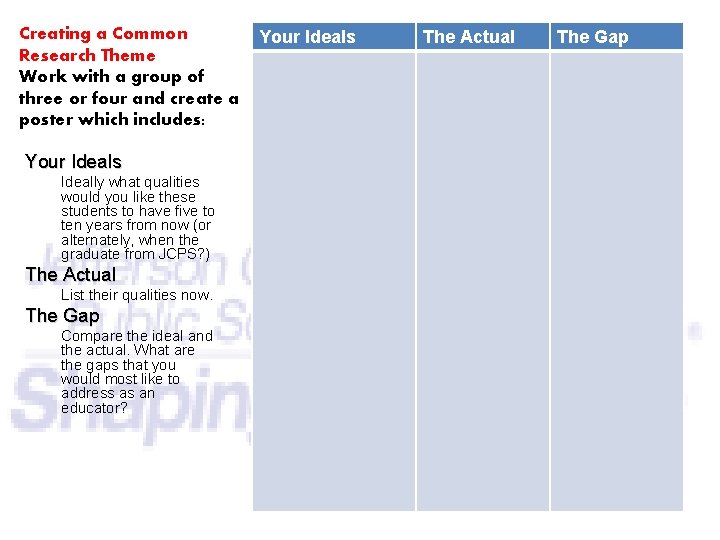
Creating a Common Research Theme Work with a group of three or four and create a poster which includes: Your Ideals Ideally what qualities would you like these students to have five to ten years from now (or alternately, when the graduate from JCPS? ) The Actual List their qualities now. The Gap Compare the ideal and the actual. What are the gaps that you would most like to address as an educator? Your Ideals The Actual The Gap
Our Common Research Theme • Gallery Walk – Review all the posters – Draft a possible common research theme based on what you see.
Our Common Research Theme • Our goal is for students to create themselves as empowered, proactive learners and critical thinkers, who communicate effectively and can work collaboratively for social and academic success in school and society.
Creating Lesson Study Groups
Lesson Study Groups Group #1 Group #2
Lesson Study Group Roles • Facilitator: keeps the conversation moving and fair. Involves all participants. Follows an agreed-upon agenda. • Note Taker: Takes the minutes of the meeting, copies and distributes them to members for review before the next meeting.
Lesson Study Group Roles • Member: supports others in their roles, actively contributes to the meeting’s running smoothly.
Lesson Study Group Roles • Recorder: records on chart paper, where all can see, important decisions of the group (helpful when brainstorming goals and planning the lesson design. ) • Typist: types up the lesson plan or any other documents as needed.
Guide to Developing Group Norms What would make this lesson study group a supportive and productive site for your learning? • Jot down a list of characteristics that are important to you. (It may help to think about characteristic of groups that have functioned well—or poorly—to support your professional learning in the past. ) You may want to consider some general norms (such as listening and taking responsibility) and some that have been identified as especially important to supporting learning of academic content, such as expressing agreement/disagreement and explaining your thinking.
Guide to Developing Group Norms • As a group, share and discuss the ideas generated by each member, taking particular care to identify and discuss any possible contradictions. For example, if one group member ask for “safe” and another for “challenging my thinking, ” talk about how both can be honored.
Guide to Developing Group Norms • Synthesize members’ ideas to a group list of about five key norms you all support. • Record the norms for future reference. • At the beginning of each meeting, choose one norm to monitor that day. At the end of your meeting, discuss whether you upheld it and what can be improved.
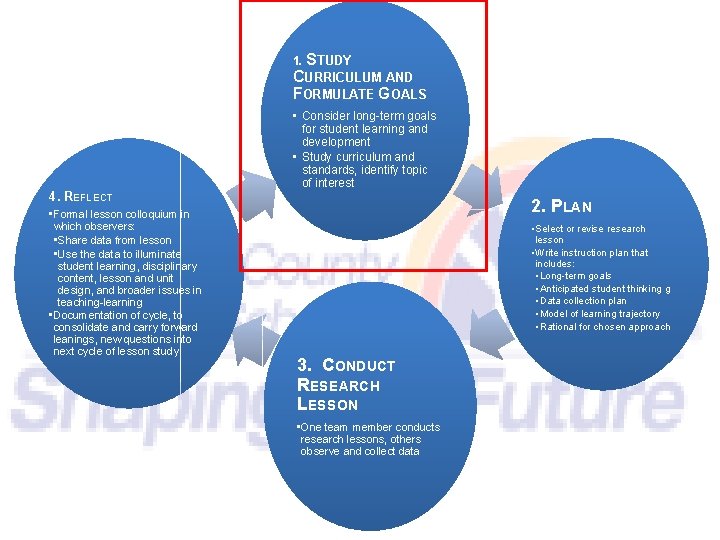
1. STUDY CURRICULUM AND FORMULATE GOALS 4. REFLECT • Formal lesson colloquium in which observers: • Share data from lesson • Use the data to illuminate student learning, disciplinary content, lesson and unit design, and broader issues in teaching-learning • Documentation of cycle, to consolidate and carry forward leanings, new questions into next cycle of lesson study. • Consider long-term goals for student learning and development • Study curriculum and standards, identify topic of interest 2. PLAN • Select or revise research lesson • Write instruction plan that includes: • Long-term goals • Anticipated student thinking g • Data collection plan • Model of learning trajectory • Rational for chosen approach 3. CONDUCT RESEARCH LESSON • One team member conducts research lessons, others observe and collect data
Step 1: Study Curriculum and Formulate Goals Study curriculum and standards, identify topic of interest Choose A Topic • What topics are persistently difficult for, or disliked by, students? • What topics do we as ESL teachers find most difficult to teach? • Is there a particular standard that we as ESL teachers want to understand master?
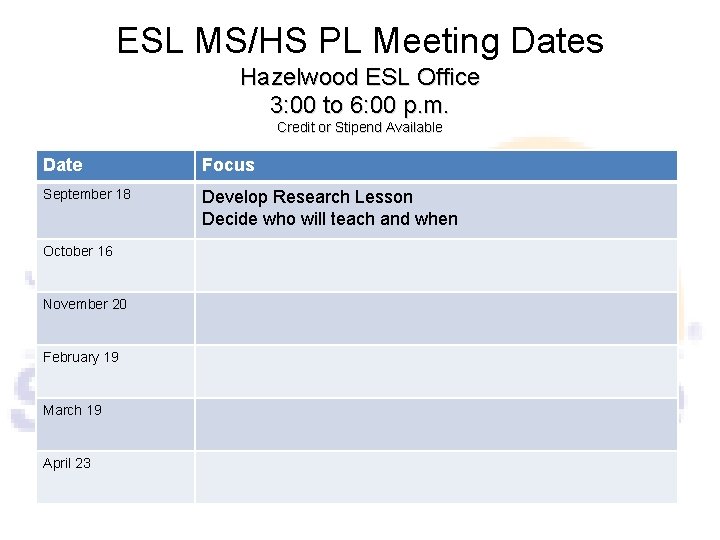
ESL MS/HS PL Meeting Dates Hazelwood ESL Office 3: 00 to 6: 00 p. m. Credit or Stipend Available Date Focus September 18 Develop Research Lesson Decide who will teach and when October 16 November 20 February 19 March 19 April 23
Wrap-Up • Do you have a next meeting date? • Did you identify roles? • Did you develop group norms?
Reflection • Three +++ and a wish (or question)
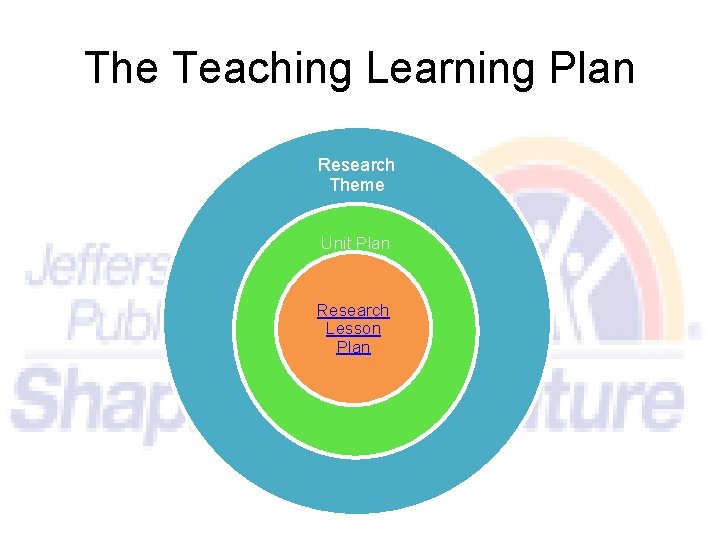
The Teaching Learning Plan Research Theme Unit Plan Research Lesson Plan