
An Overview of ISO 13485 2016 Medical DevicesQuality

- Slides: 32
An Overview of ISO 13485: 2016, Medical Devices—Quality Management Systems Presented by: Michelle Johnston Quality System Consultant August 28, 2018
Note to Self… "Make sure you have finished speaking before your audience has finished listening. " -- Dorothy Sarnoff (accomplished Broadway singer and Brooklyn native) 2
What is a Quality Management System? �People �Equipment �Processes �Components/Materials �Documentation �Products/Service 3
ISO 13485: 2016 �“Voluntary” standard—sort of �Generic in nature due to wide audience �This version was published in March 2016, there is a 3 year transition period for organizations registered to 2008 version �Applicable to finished medical device manufacturers, component manufacturers, and service providers 4
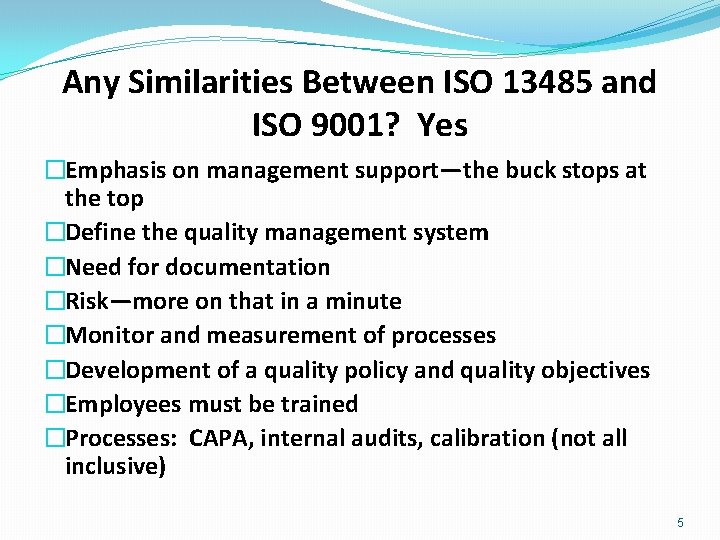
Any Similarities Between ISO 13485 and ISO 9001? Yes �Emphasis on management support—the buck stops at the top �Define the quality management system �Need for documentation �Risk—more on that in a minute �Monitor and measurement of processes �Development of a quality policy and quality objectives �Employees must be trained �Processes: CAPA, internal audits, calibration (not all inclusive) 5
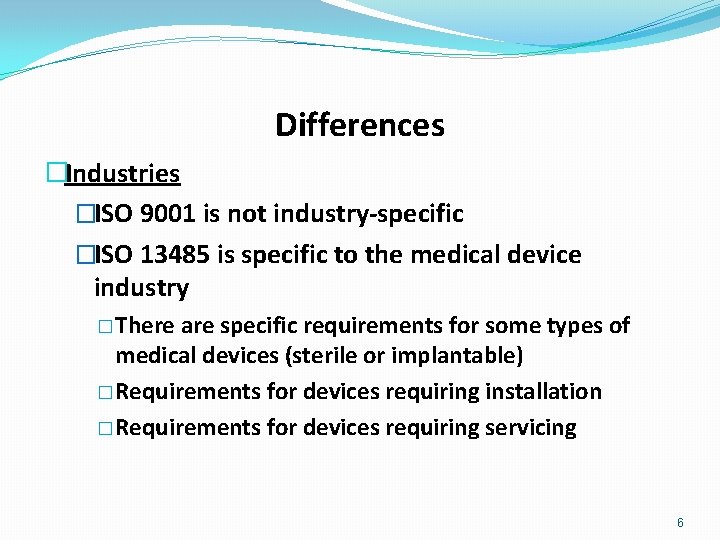
Differences �Industries �ISO 9001 is not industry-specific �ISO 13485 is specific to the medical device industry � There are specific requirements for some types of medical devices (sterile or implantable) � Requirements for devices requiring installation � Requirements for devices requiring servicing 6
Differences �Management Representative �No longer required by ISO 9001 �Quality Manual �No longer required by ISO 9001 7
Differences �Format of the Standards �ISO 9001 has 10 sections �ISO 13485 has 8 sections �Section Headings 8
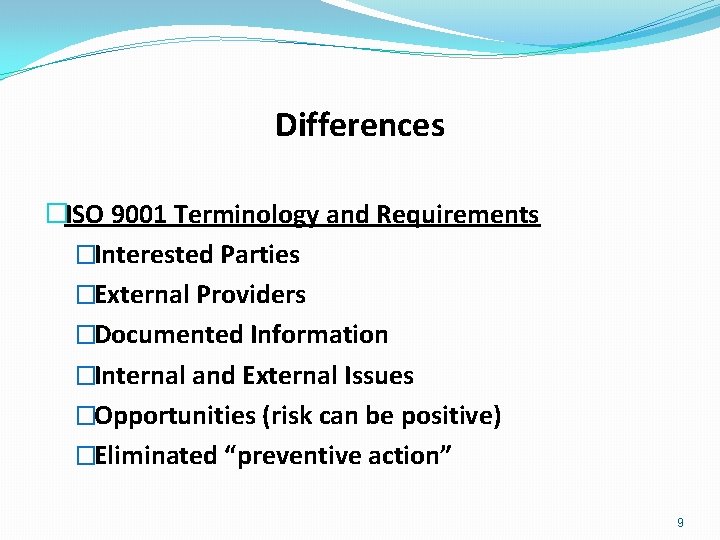
Differences �ISO 9001 Terminology and Requirements �Interested Parties �External Providers �Documented Information �Internal and External Issues �Opportunities (risk can be positive) �Eliminated “preventive action” 9
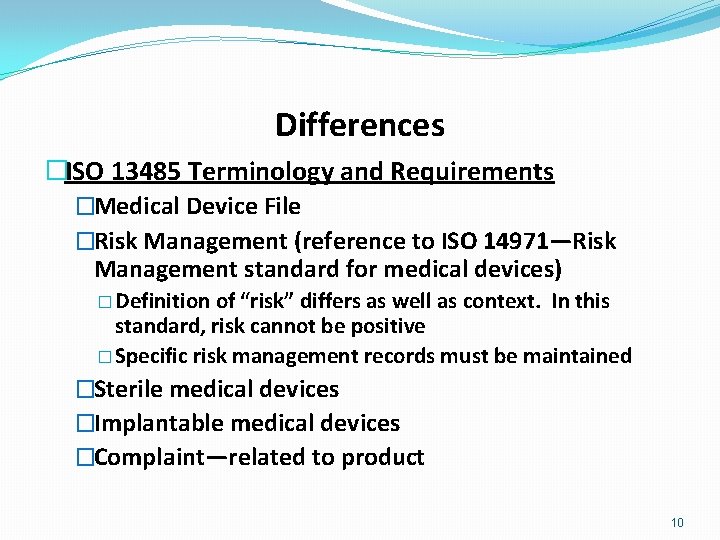
Differences �ISO 13485 Terminology and Requirements �Medical Device File �Risk Management (reference to ISO 14971—Risk Management standard for medical devices) � Definition of “risk” differs as well as context. In this standard, risk cannot be positive � Specific risk management records must be maintained �Sterile medical devices �Implantable medical devices �Complaint—related to product 10
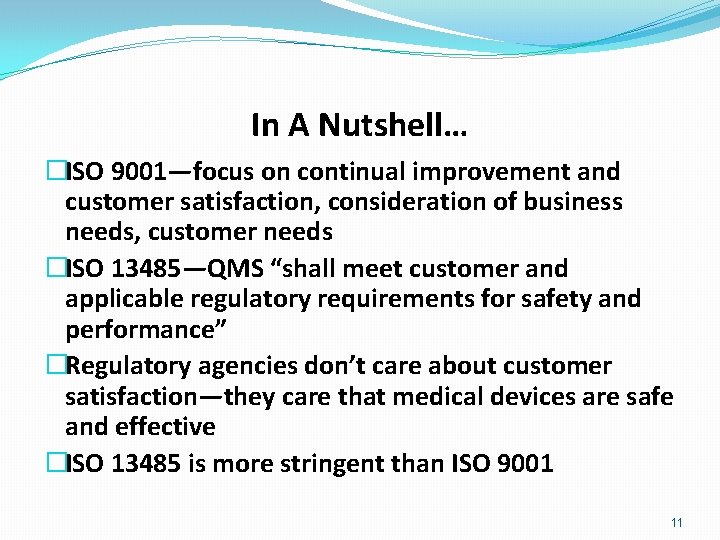
In A Nutshell… �ISO 9001—focus on continual improvement and customer satisfaction, consideration of business needs, customer needs �ISO 13485—QMS “shall meet customer and applicable regulatory requirements for safety and performance” �Regulatory agencies don’t care about customer satisfaction—they care that medical devices are safe and effective �ISO 13485 is more stringent than ISO 9001 11
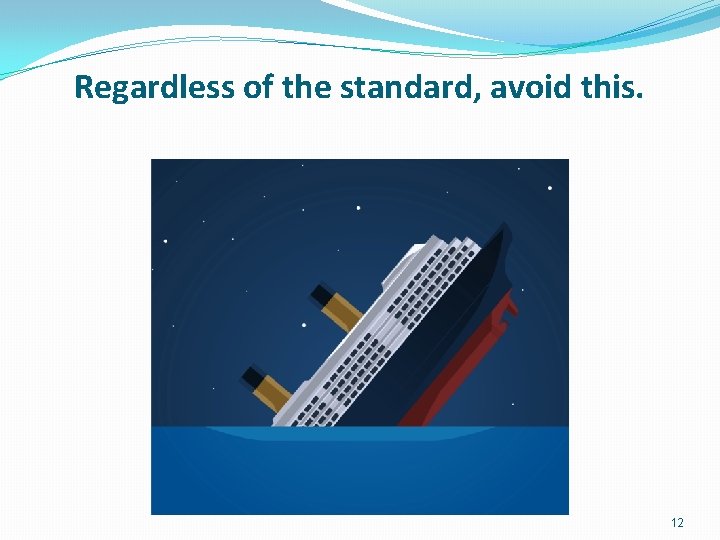
Regardless of the standard, avoid this. 12
A Closer Look at ISO 13485 13
General Comments �Again, this is a voluntary standard, it is not a regulation �Not a lot of significant changes from 2003 version �Clarifying text—removed ambiguity �Stronger linkage to regulatory requirements �Requirements are similar to FDA Quality System Regulation— not identical �Note: If a company does not place a medical device in commercial distribution, many regulatory requirements do not apply. For example, a machine shop who provides a plastic component for a ventilator which their customer places on the market. 14
Section 4: Quality Management System �Determine and implement processes, establish controls so that processes are effective �Monitor, measure, and analyze processes �Risk-based approach �Changes to processes must be evaluated for their impact on QMS and the medical devices �Software used in the QMS must be validated for their application—risk based determination 15
Section 4: Documentation Requirements �Quality Manual �Medical Device File �Control of Documents �Unlike ISO 9001, there are numerous required procedures. �Control of Records �Protect confidential patient information �Retention times can be driven by regulatory requirements or the lifetime of the device 16
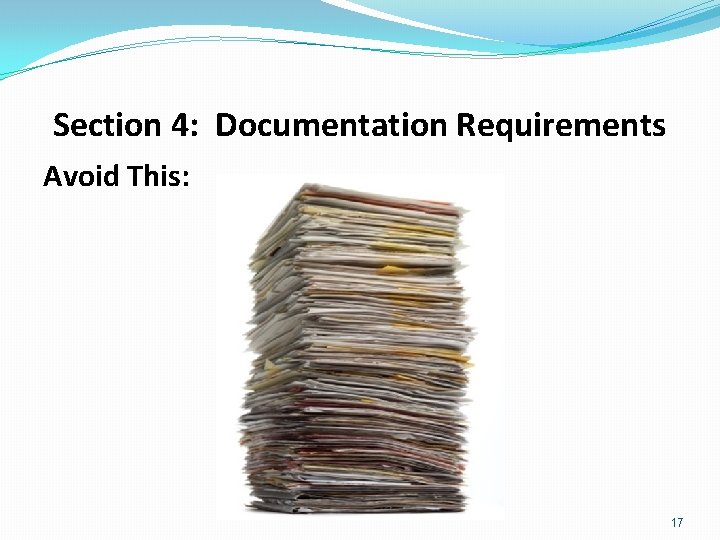
Section 4: Documentation Requirements Avoid This: 17
Section 5: Management Responsibility �Top management is responsible for the implementation and effectiveness of the QMS—activities can be delegated, responsibility for the QMS cannot �Appoint a management representative who reports to top management �Conduct management reviews at planned intervals (this is a comprehensive review of the QMS) Inputs and outputs are prescriptive �Quality planning—maintain the effectiveness of the QMS in spite of changes 18
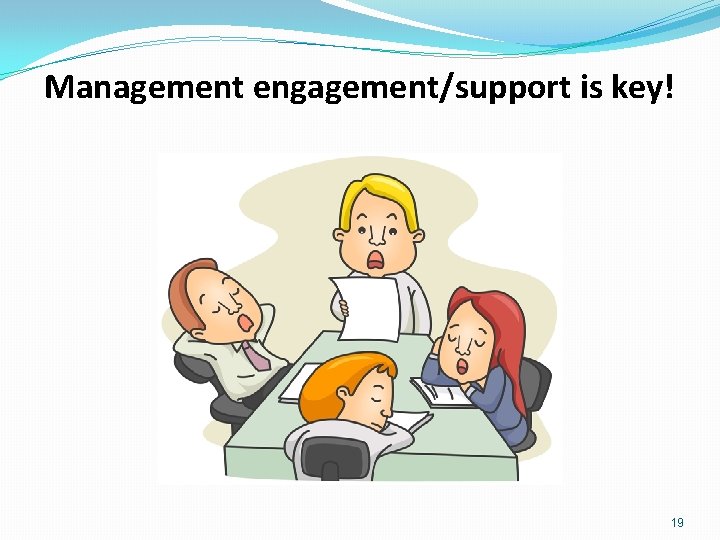
Management engagement/support is key! 19
Section 6: Resource Management �Provide appropriate resources �Employee competent to perform their job functions �Provide and document training �Evaluate the effectiveness of training �Appropriate infrastructure to perform QMS activities �Document work environment controls necessary to achieve product requirements �Monitor and control environment when it can impact product quality 20
Section 6: Resource Management �Control contamination �Sterile devices—control particulate, maintain cleanliness during packaging and labeling activities �Sterile devices are typically manufactured in a cleanroom or otherwise environmentally controlled area �Consider ESD controls 21
Section 7: Product Realization �Risk management during product realization—cradle to grave �Production planning �Required documents/records �Validation activities �Customer related requirements �What are the customer needs? �Can the organization meet these needs? �Identify user training needs 22
Section 7: Product Realization �Design and development activities: �Control the design activities � Define Responsibilities and authorities �Beefed up design inputs, must be able to verify � Consideration of human factors �Beefed up requirements for verification and validation— statistically valid sample sizes �Ensure design outputs are traceable to design inputs �Satisfy regulatory requirements �Maintain records (design file) 23
Section 7: Product Realization � Control suppliers � Evaluate and approve for use—responsible for outsourced processes � Controls over supplier based on risk of what they provide � Monitor performance � Ensure adequacy of specified requirements (supplier agreement, purchase order, etc) � Notification of changes by supplier so impact can be evaluated � Control of manufacturing and servicing requirements � Activities shall be planned, carried out, monitored and controlled to ensure product meets specifications � Records maintained, traceability identified � Requirements for sterile devices � Requirement for specific record for manufacturing history 24
Section 7: Product Realization �Installation and Servicing Activities �Validation of sterile devices and sterile barrier systems 25
Section 7: Product Realization �Validation of processes whose output cannot be fully verified. �Includes computer software—level of validation dependent upon risk �Requirements for sterilization validation �Product Identification, product status, and traceability requirements �Control customer property, this includes IP �Controls for the preservation of product �Control of measuring and test equipment 26
Section 8: Measurement, Analysis, and Improvement �Establish feedback process �Production and post-production �Feed info into risk management process �Complaint handling process—complaints may need to be reported to regulatory agencies �Conduct internal audits, corrective actions timely �Monitor and measure processes �Monitor and measurement of product (QC activities) �Recall requirements—may need to be reported to regulatory agencies 27
Section 8: Measurement, Analysis, and Improvement �Nonconforming Material �Specific requirements for rework, impact on finished device �Justification for Use As Is 28
Section 8: Measurement, Analysis, and Improvement �Analysis of data to determine that the QMS is functioning effectively �Defined inputs: product conformity, supplier data, internal audits, service reports, etc. �Implement changes (improvements) so that the QMS maintains effectiveness �Corrective/preventive actions to address QMS issues (can be processes or products) 29
Closing Thoughts/Questions? �ISO 13485 takes a risk-based approach to the controls needed within your QMS �Generic but prescriptive �Focus is different than ISO 9001 �Hard requirement for procedures throughout the standard �Bottom line—meet regulatory requirements 30
How to Reach Me Michelle Johnston Principal Consultant Advanced Quality System Solutions San Diego, CA 858. 722. 4471 www. advqss. com 31
Thanks for your time! 32