
AN OVERVIEW OF IP ASSET VALUATION Valuation of

- Slides: 26
AN OVERVIEW OF IP ASSET VALUATION Valuation of Intellectual Property Assets Christopher M. Kalanje, Consultant, Creative Industries Division, WIPO
IP VALUATION • Valuation is a process of determining value or worth of an asset • Valuation often combines objective and subjective considerations • IP valuation is a relatively new area • IP valuation is triggered by various factors
IP Valuation contd. • A Final valuation would depend on the following basic premises of value – Value in exchange: worth of the underlying IP asset in terms of its capacity to be exchanged in terms of money – Value in continued use: worth of the underlying IP asset to its owner on the basis that it continues to generate income to the owner
IP Valuation contd. – Acquisition value: strategic potential of the underlying IP asset e. g uses in M & A – Value in place: worth of the underlying IP asset as it is. i. e. the said IP asset is not in current use in the production of income
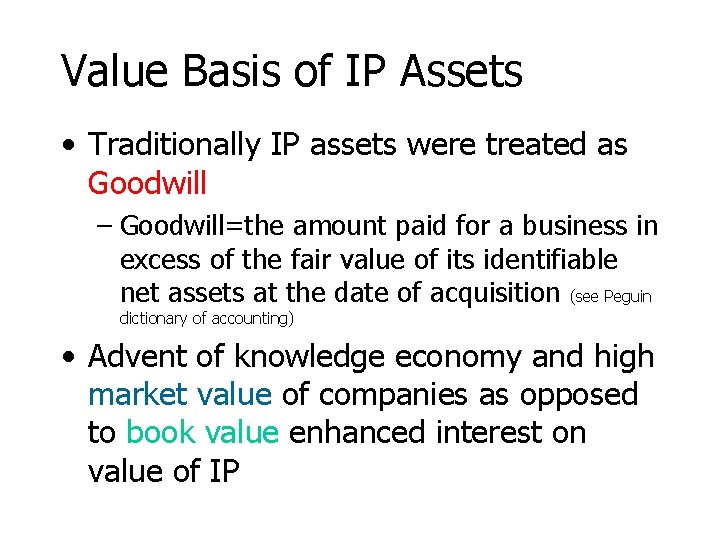
Value Basis of IP Assets • Traditionally IP assets were treated as Goodwill – Goodwill=the amount paid for a business in excess of the fair value of its identifiable net assets at the date of acquisition (see Peguin dictionary of accounting) • Advent of knowledge economy and high market value of companies as opposed to book value enhanced interest on value of IP
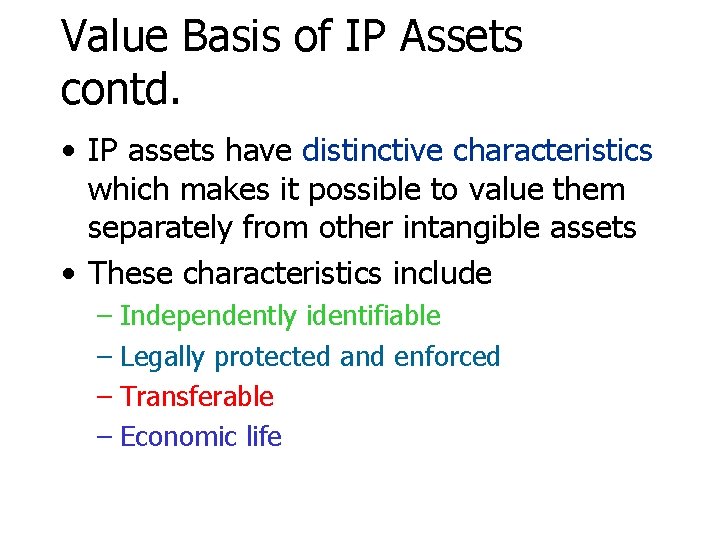
Value Basis of IP Assets contd. • IP assets have distinctive characteristics which makes it possible to value them separately from other intangible assets • These characteristics include – Independently identifiable – Legally protected and enforced – Transferable – Economic life
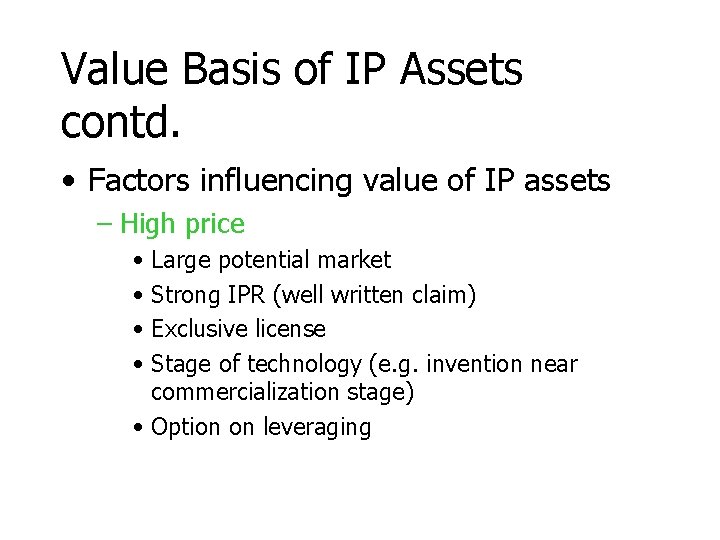
Value Basis of IP Assets contd. • Factors influencing value of IP assets – High price • Large potential market • Strong IPR (well written claim) • Exclusive license • Stage of technology (e. g. invention near commercialization stage) • Option on leveraging
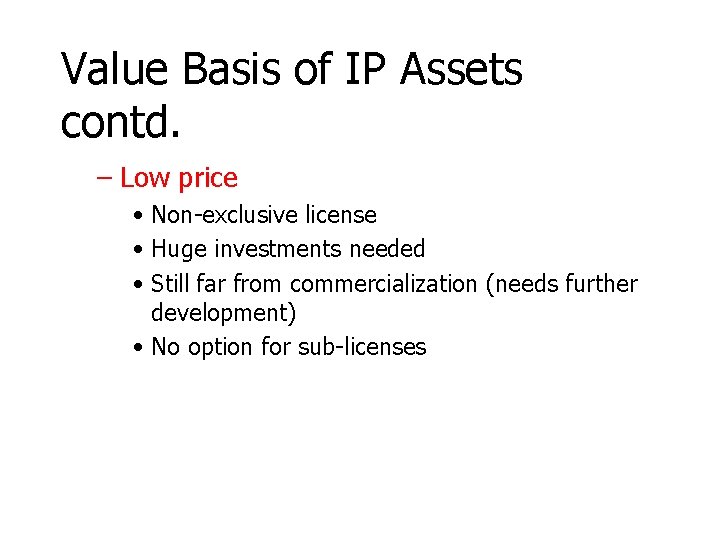
Value Basis of IP Assets contd. – Low price • Non-exclusive license • Huge investments needed • Still far from commercialization (needs further development) • No option for sub-licenses
IP Valuation Triggers • As IA in particular IP take the central stage in determining the value of enterprises decision makers have to answer the following – Are returns on R&D satisfactory? – Are patents worth renewing? – Are brands worth defending? etc.
IP Valuation Triggers contd. • Enterprises need to formulate a strategy which would make IP assets more profitable • IP valuation is imperative in facilitating decision making process on strategy to pursue • Several factors (triggers) lead to IP valuation
IP Valuation Triggers contd. • These include – Sale or Purchase of IP Assets – Licensing – Merger & Acquisition – Cost saving – IP asset donation – Joint venture arrangements/strategic alliances – Financing
Methods of IP Assets Valuation • Valuation models may be broadly divided into two – Static models • Estimate value of accumulated intellectual assets at a point in time • Does not differentiate temporal differences in the accumulated IP • Does not differentiate the differences among different categories of IA at the time of valuation
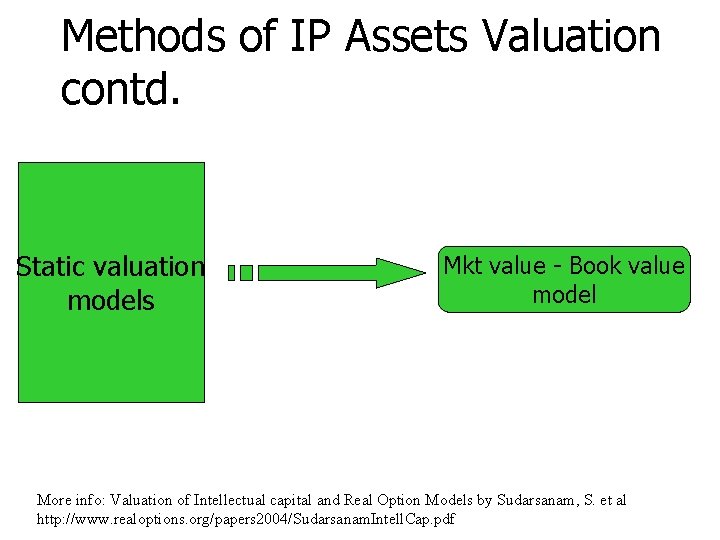
Methods of IP Assets Valuation contd. Static valuation models Mkt value - Book value model More info: Valuation of Intellectual capital and Real Option Models by Sudarsanam, S. et al http: //www. realoptions. org/papers 2004/Sudarsanam. Intell. Cap. pdf
Methods of IP Assets Valuation contd. – Dynamic models • Take into consideration the temporal difference in the accumulated intellectual assets (e. g. time value of money and riskiness of the forecast cash flow) • Value investments in intangibles each at a time
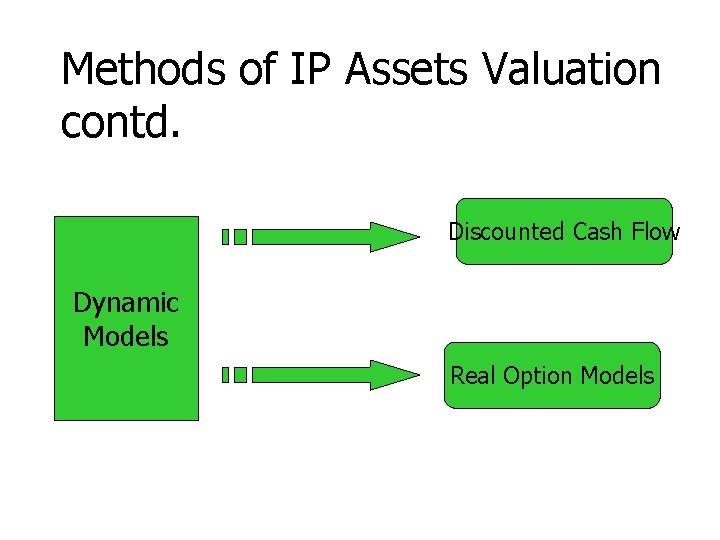
Methods of IP Assets Valuation contd. Discounted Cash Flow Dynamic Models Real Option Models
Methods of IP Assets Valuation contd. • Basic Methods – Cost Approach: Estimates the value of underlying IP asset basing on historical cost incurred in developing the asset • Replacement cost • Reproduction cost
Methods of IP assets Valuation contd. – Market Approach (sales comparison approach): • Based on the value of similar or comparable assets that have been exchanged, at arm’s length, in active market • second variant uses standard industrial royalty rates
Methods of IP assets Valuation contd. – Income Approach: Based on the incomeproducing capability of underlying IP asset • Seeks to establish the net present value (hence use of discounted cashflow) • Decision tree analysis (DTA)-based on an underlying DCF analysis and moves further to take into consideration flexibility available.
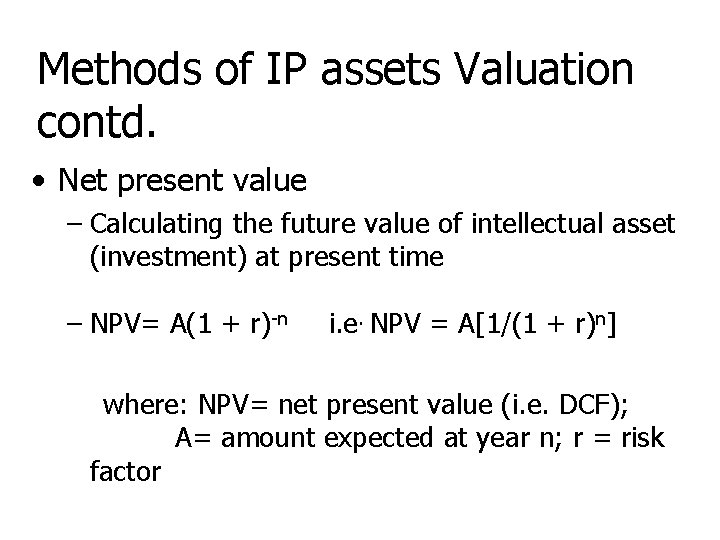
Methods of IP assets Valuation contd. • Net present value – Calculating the future value of intellectual asset (investment) at present time – NPV= A(1 + r)-n i. e. NPV = A[1/(1 + r)n] where: NPV= net present value (i. e. DCF); A= amount expected at year n; r = risk factor
Methods of IP assets Valuation contd. • Other IP valuation methods include – Monte Carlo simulation analysis – Option pricing theory
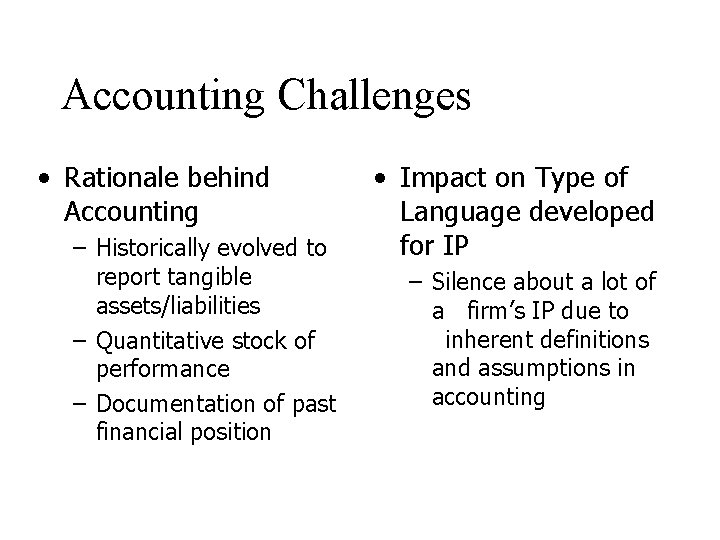
Accounting Challenges • Rationale behind Accounting – Historically evolved to report tangible assets/liabilities – Quantitative stock of performance – Documentation of past financial position • Impact on Type of Language developed for IP – Silence about a lot of a firm’s IP due to inherent definitions and assumptions in accounting
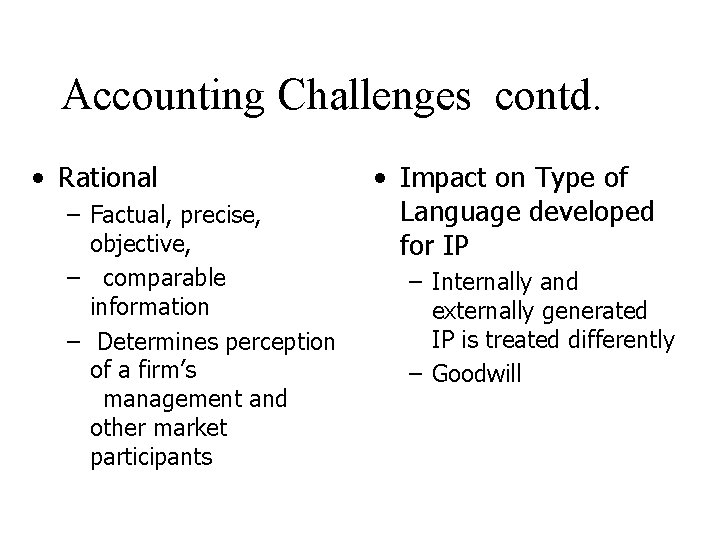
Accounting Challenges contd. • Rational – Factual, precise, objective, – comparable information – Determines perception of a firm’s management and other market participants • Impact on Type of Language developed for IP – Internally and externally generated IP is treated differently – Goodwill
Finally
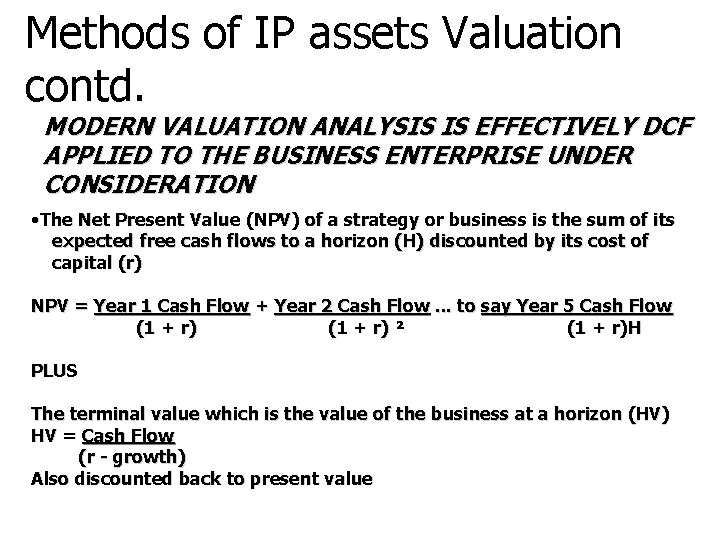
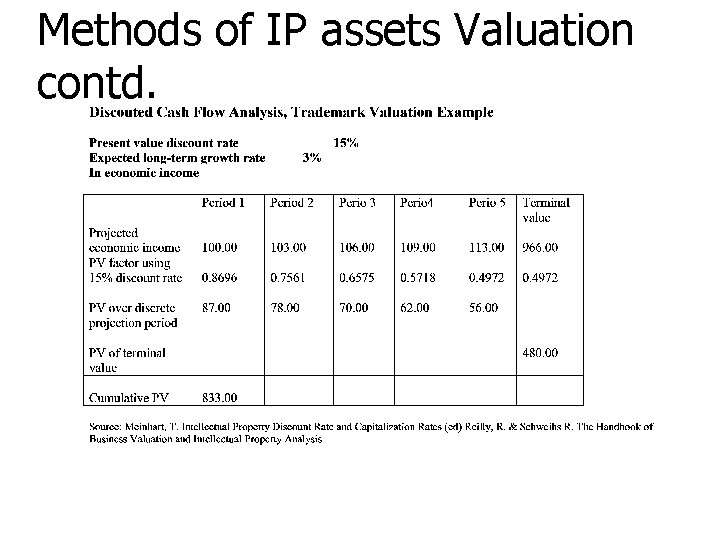
Methods of IP assets Valuation contd. MODERN VALUATION ANALYSIS IS EFFECTIVELY DCF APPLIED TO THE BUSINESS ENTERPRISE UNDER CONSIDERATION • The Net Present Value (NPV) of a strategy or business is the sum of its expected free cash flows to a horizon (H) discounted by its cost of capital (r) NPV = Year 1 Cash Flow + Year 2 Cash Flow. . . to say Year 5 Cash Flow (1 + r) ² (1 + r)H PLUS The terminal value which is the value of the business at a horizon (HV) HV = Cash Flow (r - growth) Also discounted back to present value
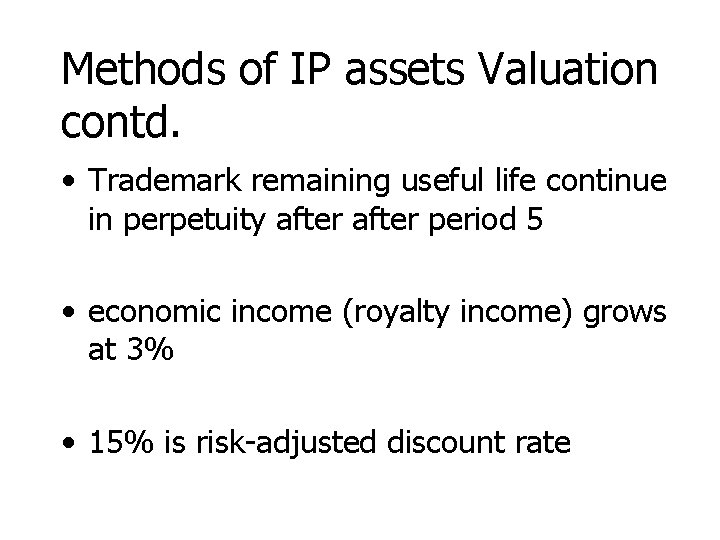
Methods of IP assets Valuation contd. • Trademark remaining useful life continue in perpetuity after period 5 • economic income (royalty income) grows at 3% • 15% is risk-adjusted discount rate
Methods of IP assets Valuation contd.