
An Overview of Echo Planar Imaging EPI Douglas

- Slides: 32
An Overview of Echo Planar Imaging (EPI) Douglas C. Noll, Ph. D. Depts. of Biomedical Engineering and Radiology University of Michigan, Ann Arbor Noll
Acknowledgements • • • Scott Peltier, Alberto Vazquez University of Michigan Drs. S. Lalith Talagala and Fernando Boada (University of Pittsburgh) • SMRT and ISMRM Noll
Objectives • Explain how EPI images are acquired and created • Describe hardware requirements • Describe EPI variants, terminology, and parameters • Demonstrate common EPI artifacts • Summarize applications of EPI Noll
Outline • • Pulse sequence basics Localization Variants on EPI Parameters EPI Artifacts EPI Hardware Applications Noll
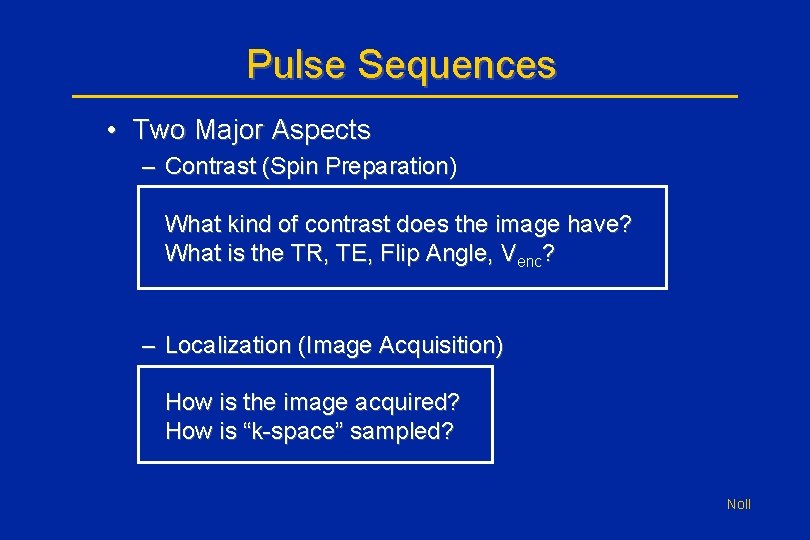
Pulse Sequences • Two Major Aspects – Contrast (Spin Preparation) What kind of contrast does the image have? What is the TR, TE, Flip Angle, Venc? – Localization (Image Acquisition) How is the image acquired? How is “k-space” sampled? Noll
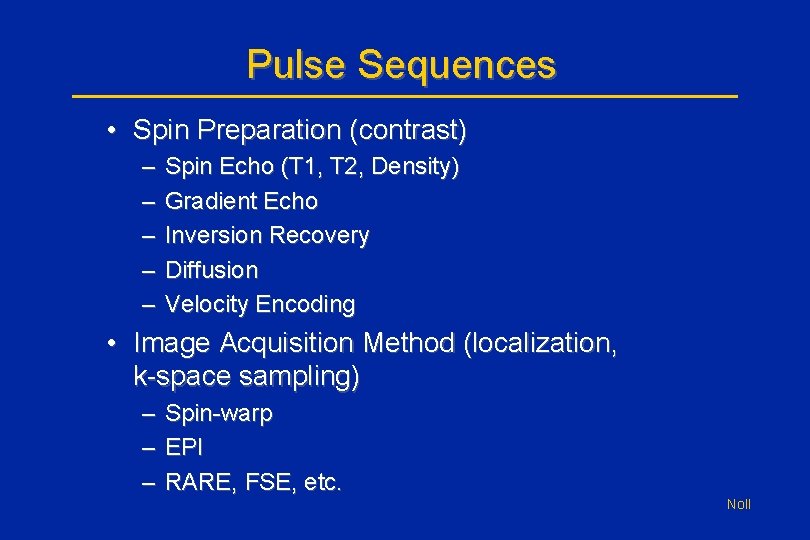
Pulse Sequences • Spin Preparation (contrast) – – – Spin Echo (T 1, T 2, Density) Gradient Echo Inversion Recovery Diffusion Velocity Encoding • Image Acquisition Method (localization, k-space sampling) – – – Spin-warp EPI RARE, FSE, etc. Noll
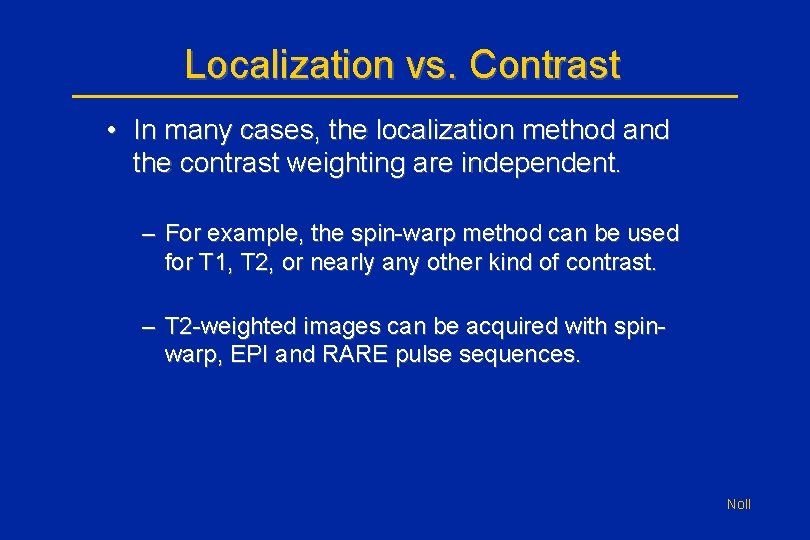
Localization vs. Contrast • In many cases, the localization method and the contrast weighting are independent. – For example, the spin-warp method can be used for T 1, T 2, or nearly any other kind of contrast. – T 2 -weighted images can be acquired with spinwarp, EPI and RARE pulse sequences. Noll
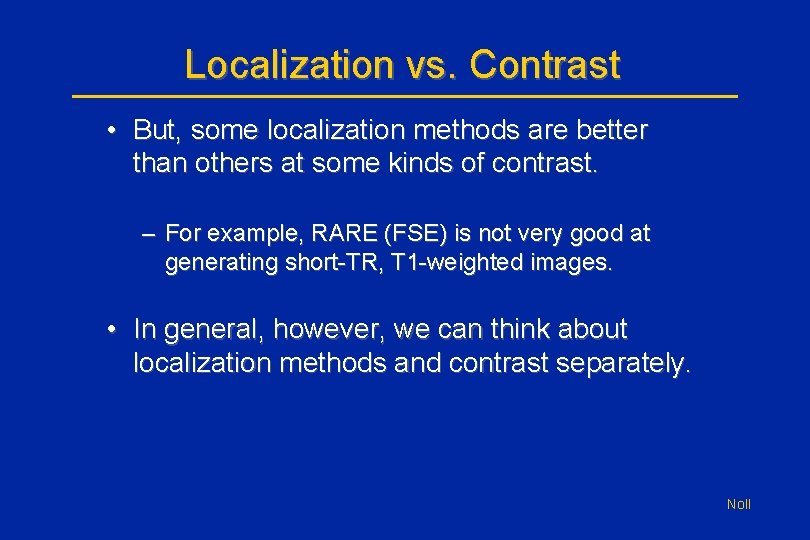
Localization vs. Contrast • But, some localization methods are better than others at some kinds of contrast. – For example, RARE (FSE) is not very good at generating short-TR, T 1 -weighted images. • In general, however, we can think about localization methods and contrast separately. Noll
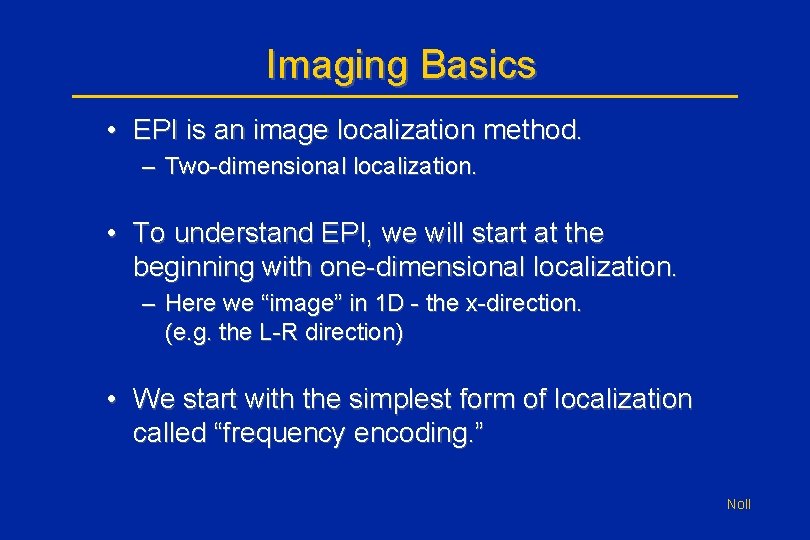
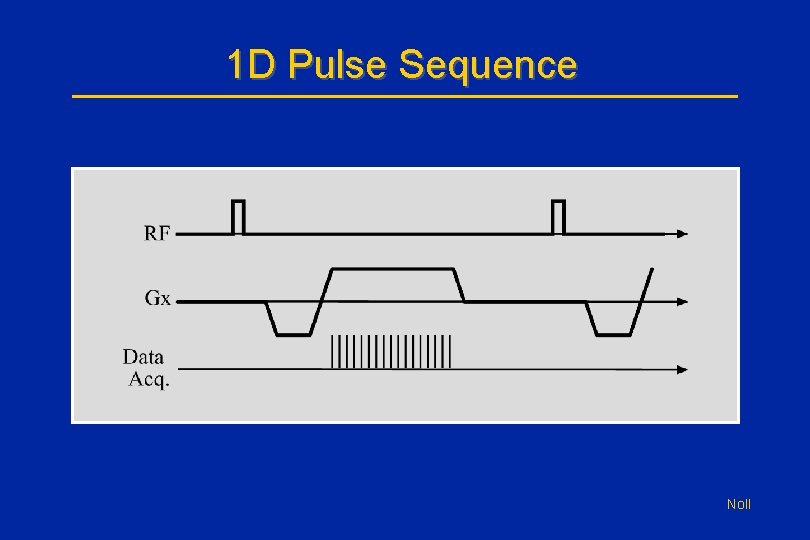
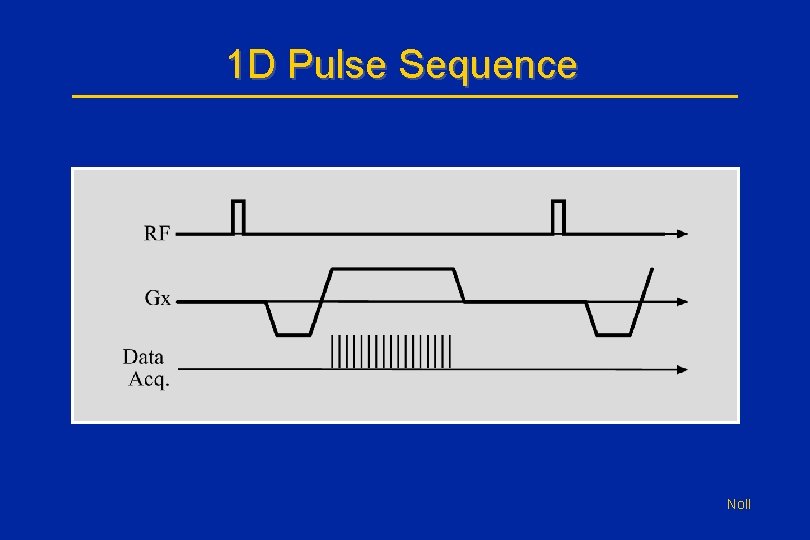
Imaging Basics • EPI is an image localization method. – Two-dimensional localization. • To understand EPI, we will start at the beginning with one-dimensional localization. – Here we “image” in 1 D - the x-direction. (e. g. the L-R direction) • We start with the simplest form of localization called “frequency encoding. ” Noll
1 D Pulse Sequence Noll
1 D Localization • We acquire data while the x-gradient (Gx) is turned on and has a constant strength. • Recall that a gradient makes the magnetic field vary in a particular direction. • In this case, having a positive x-gradient implies that the farther we move along in the x -direction (e. g. the farther right we move) the magnetic field will increase. Noll
1 D Pulse Sequence Noll
Frequency Encoding • A fundamental property of nuclear spins says that the frequency at which they precess (or emit signals) is proportional to the magnetic field strength: f = g. B - The Larmor Relationship • This says that precession frequency now increases as we move along the x-direction (e. g. as we move rightwards). Noll
Frequency Encoding Noll
Fourier Transforms • The last part of this story is the Fourier transform. • The Fourier transform is the computer program that breaks down each MR signal into its frequency components. • If we plot the strength of each frequency, it will form a representation (or image) of the object in one-dimension. Noll
Fourier Transforms Noll
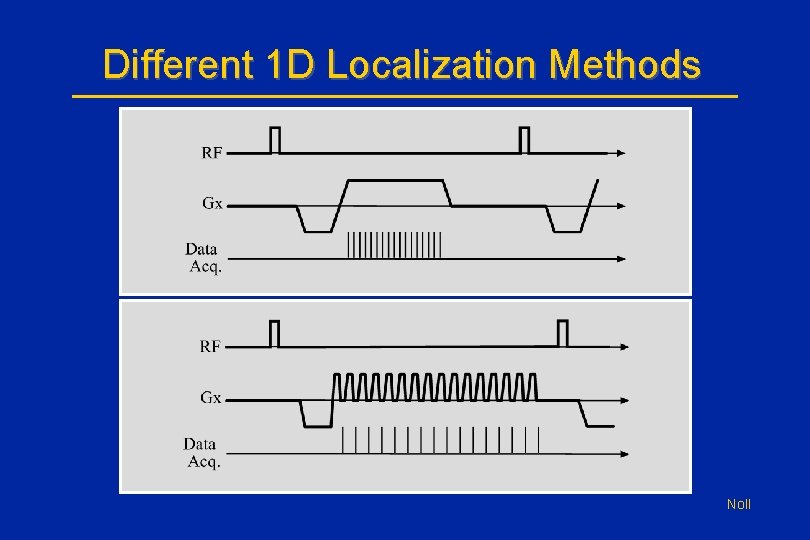
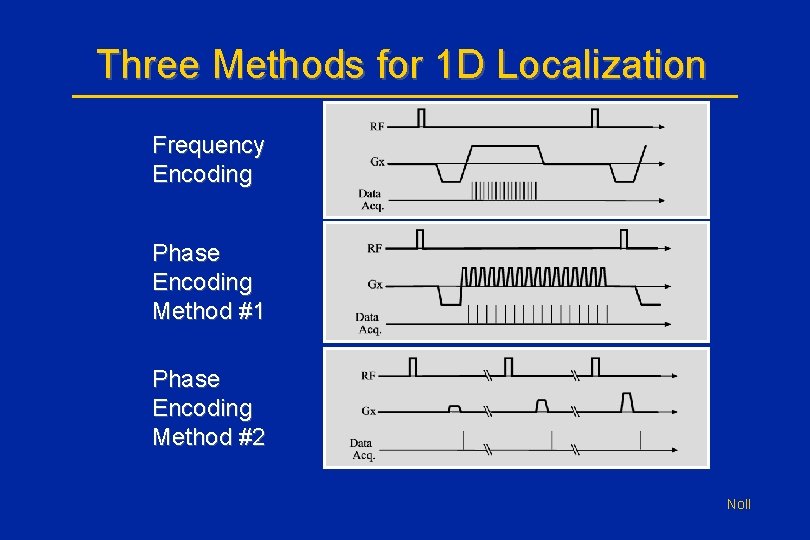
Alternate Method for 1 D Localization • In the case just described, the “frequency encoding” gradient was constant. – At different locations spins precessed at different frequencies. – This was true as long as the gradient was “on. ” • We now look at an alternate situation where the gradient is turned “on” and “off” rapidly. – At different locations spins will precess at different frequencies, but only during the times that the gradient is “on. ” Noll
Alternate Method for 1 D Localization Noll
On/Off Gradients in 1 D Localization • In the case previously described, the spins precessed smoothly. • In this case, the spins precess in a “stopaction” or jerky motion. • What is different here is that we sample the MR signal while it has stopped precessing. – At each step, the spatial information has been encoded into the phase. – This is a form of “phase encoding. ” Noll
Stop-Action Movement of Magnetization Sample 1 Sample 2 Sample 3 Noll
Different 1 D Localization Methods • Upper - smooth precession at different frequencies. (frequency encoding) • Lower - precession in small steps, phase contains location info. (phase encoding). • Sampled data is the same (if we neglect T 2). • The Fourier transform creates the 1 D image. Noll
Different 1 D Localization Methods Noll
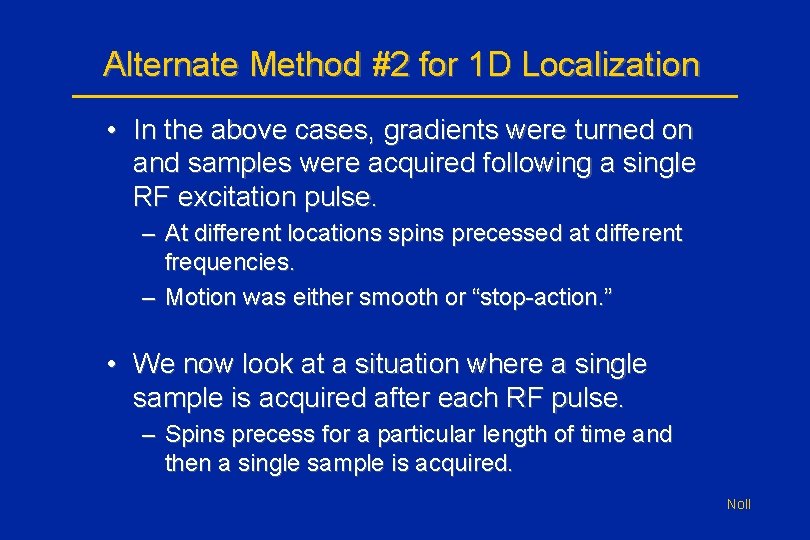
Alternate Method #2 for 1 D Localization • In the above cases, gradients were turned on and samples were acquired following a single RF excitation pulse. – At different locations spins precessed at different frequencies. – Motion was either smooth or “stop-action. ” • We now look at a situation where a single sample is acquired after each RF pulse. – Spins precess for a particular length of time and then a single sample is acquired. Noll
Alternate Method #2 for 1 D Localization Noll
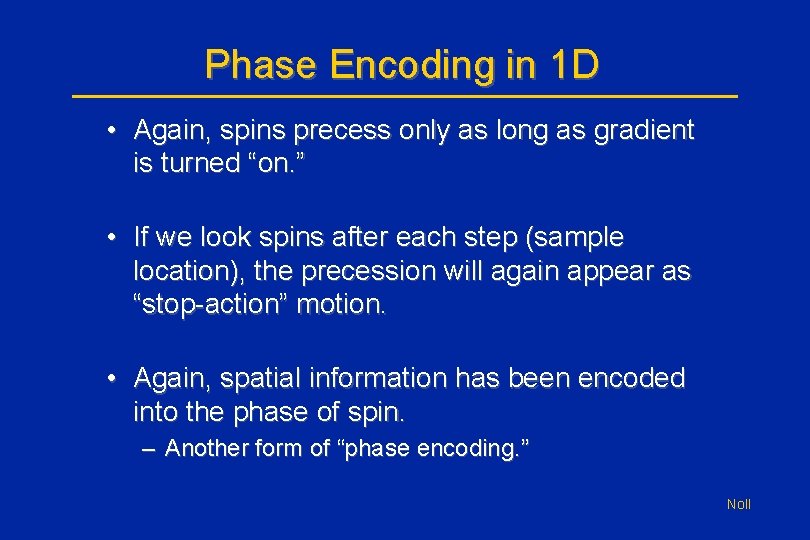
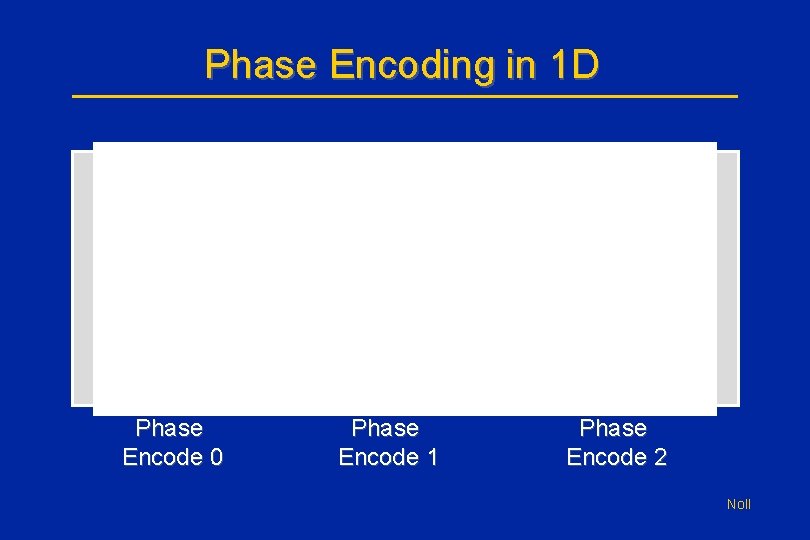
Phase Encoding in 1 D • Again, spins precess only as long as gradient is turned “on. ” • If we look spins after each step (sample location), the precession will again appear as “stop-action” motion. • Again, spatial information has been encoded into the phase of spin. – Another form of “phase encoding. ” Noll
Phase Encoding in 1 D Phase Encode 0 Phase Encode 1 Phase Encode 2 Noll
Three Methods for 1 D Localization • 1 D Localization: – – – Frequency encoding Phase encoding following a single RF pulse A single phase encode following each of many RF pulses • Sampled data is the same (if we neglect T 2). • The Fourier transform creates the 1 D image. Noll
Three Methods for 1 D Localization Frequency Encoding Phase Encoding Method #1 Phase Encoding Method #2 Noll
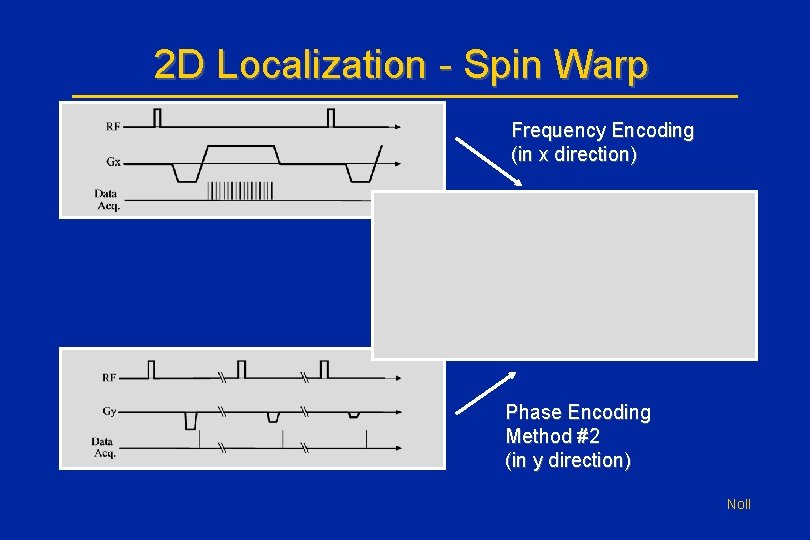
2 D Localization • In general, we will combine two 1 D localization methods to create localization in two dimensions (2 D). • The spin-warp method (used in almost all anatomical MRI) is a combination of : – Frequency encoding in one direction (e. g. Left. Right) – Phase encoding in the other direction (e. g. Anterior -Posterior) Noll
2 D Localization - Spin Warp Frequency Encoding (in x direction) Phase Encoding Method #2 (in y direction) Noll
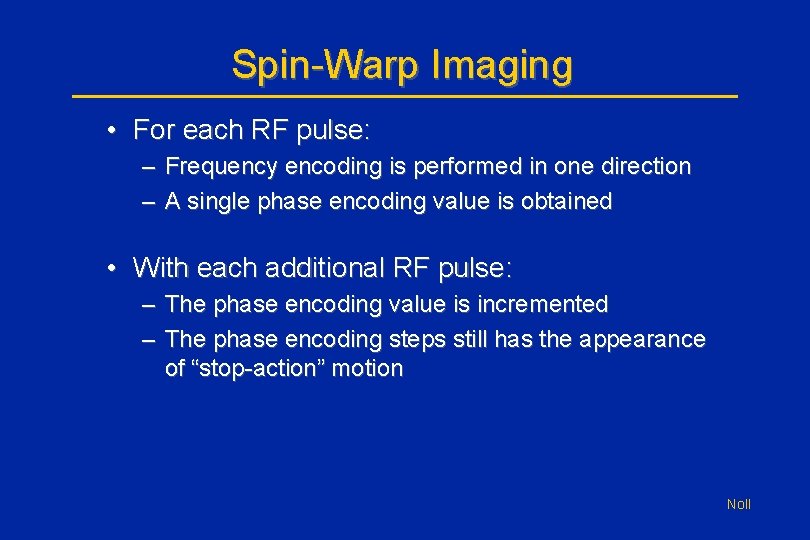
Spin-Warp Imaging • For each RF pulse: – Frequency encoding is performed in one direction – A single phase encoding value is obtained • With each additional RF pulse: – The phase encoding value is incremented – The phase encoding steps still has the appearance of “stop-action” motion Noll
Spin-Warp Pulse Sequence Noll