
An Overview of Distributed TopK Ranking Algorithms 30
An Overview of Distributed Top-K Ranking Algorithms 30 -min presentation by Demetris Zeinalipour Lecturer School of Pure and Applied Sciences Open University of Cyprus Friday, December 12 th, 2008, 16: 00 -16: 30 Communication Systems Group (CSG), ETH Zurich, Switzerland http: //www. cs. ucy. ac. cy/~dzeina/ 1

Top-k Queries: Introduction • Top-K Queries are a long studied topic in the database and information retrieval communities • The main objective has been to return the K highest-ranked answers quickly and efficiently. A Top-K query returns the subset of most relevant answers, in place of ALL answers, for two reasons: • – – i) to minimize the cost metric that is associated with the retrieval of all answers (e. g. , disk, network, etc. ) ii) to maximize the quality of the answer set, such that the user is not overwhelmed with irrelevant results Demetris Zeinalipour (Open University of Cyprus) 2

Top-k Queries: Then SELECT TOP-2 pictures FROM PICTURES WHERE SIMILAR(picture, { } ) Query Processing Assumptions • The data is available locally on disks or over a “highspeed”, “always-on” network Trade-off • • Clients want to get the right answers quickly Service Providers want to consume the least possible resources Demetris Zeinalipour (Open University of Cyprus) 3
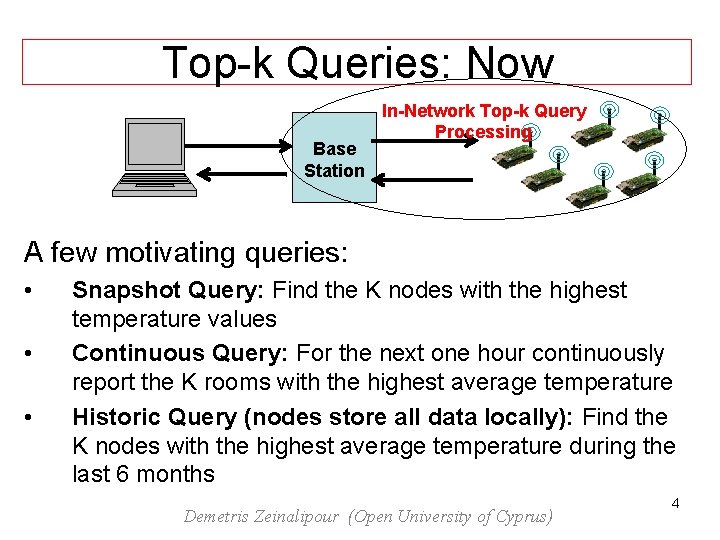
Top-k Queries: Now Base Station In-Network Top-k Query Processing A few motivating queries: • • • Snapshot Query: Find the K nodes with the highest temperature values Continuous Query: For the next one hour continuously report the K rooms with the highest average temperature Historic Query (nodes store all data locally): Find the K nodes with the highest average temperature during the last 6 months Demetris Zeinalipour (Open University of Cyprus) 4
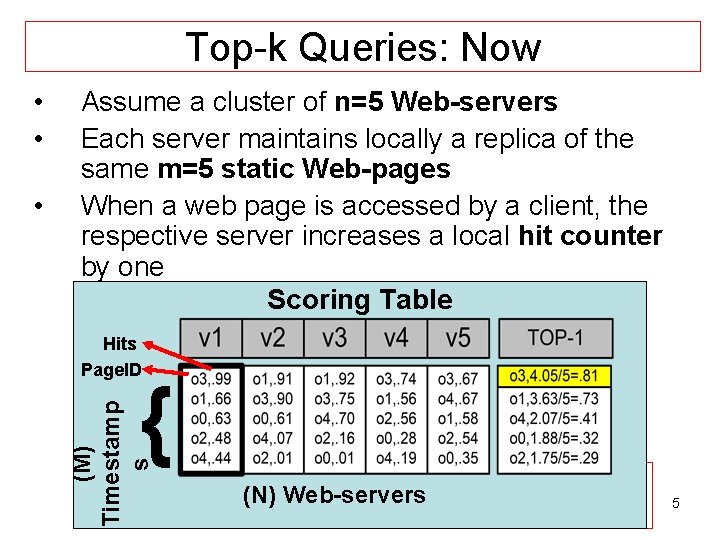
Top-k Queries: Now • Assume a cluster of n=5 Web-servers Each server maintains locally a replica of the same m=5 static Web-pages When a web page is accessed by a client, the respective server increases a local hit counter by one Scoring Table Hits++ Hits Page. ID { (M) Timestamp s • • client 5 TOP-1 Query: “Find the webpage with the highest (N) Web-servers number of hits across servers” Demetris Zeinalipourall(Open University of Cyprus) 5
Presentation Outline A. Introduction B. Centralized Top-K Query Processing • The Threshold Algorithm (TA) C. Distributed Top-K Query Processing • • The Threshold Join Algorithm (TJA) Experimentation using 75 workstations D. Other Applications of Top-K Queries • • Distributed Spatio-temporal Trajectory Retrieval In-Network Top-K Views (MINT Views) Demetris Zeinalipour (Open University of Cyprus) 6
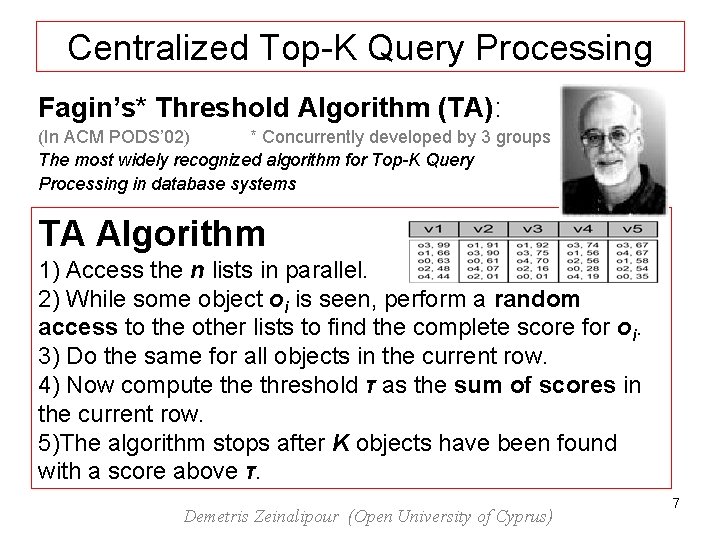
Centralized Top-K Query Processing Fagin’s* Threshold Algorithm (TA): (In ACM PODS’ 02) * Concurrently developed by 3 groups The most widely recognized algorithm for Top-K Query Processing in database systems ΤΑ Algorithm 1) Access the n lists in parallel. 2) While some object oi is seen, perform a random access to the other lists to find the complete score for oi. 3) Do the same for all objects in the current row. 4) Now compute threshold τ as the sum of scores in the current row. 5)The algorithm stops after K objects have been found with a score above τ. Demetris Zeinalipour (Open University of Cyprus) 7
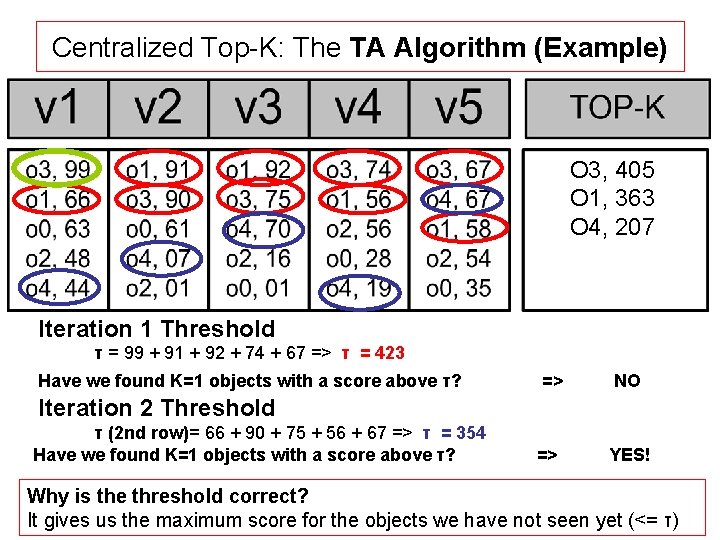
Centralized Top-K: The TA Algorithm (Example) O 3, 405 O 1, 363 O 4, 207 Iteration 1 Threshold τ = 99 + 91 + 92 + 74 + 67 => τ = 423 Have we found K=1 objects with a score above τ? => ΝΟ Iteration 2 Threshold τ (2 nd row)= 66 + 90 + 75 + 56 + 67 => τ = 354 Have we found K=1 objects with a score above τ? => YES! Why is the threshold correct? 8 Demetris Zeinalipour (Open University of Cyprus) It gives us the maximum score for the objects we have not seen yet (<= τ)
Presentation Outline A. Top-K Algorithms: Definitions B. Centralized Top-K Query Processing • The Threshold Algorithm (TA) C. Distributed Top-K Query Processing • • The Threshold Join Algorithm (TJA) Experimentation using 75 workstations D. Other Applications of Top-K Queries • • Distributed Spatio-temporal Trajectory Retrieval In-Network Top-K Views (MINT Views Demetris Zeinalipour (Open University of Cyprus) 9

The Centralized Join Algorithm (CJA) • Problem: To overcome the arbitrary phases of the Threshold Algorithm? • Naive solution: – Perform the computation in one phase: each node sends its complete list of scores – Each intermediate node forwards all received lists • Disadvantage – – Overwhelming amount of messages. Huge Query Response Time Demetris Zeinalipour (Open University of Cyprus) 10

The Staged Join Algorithm (SJA) • Improved Solution: Aggregate the lists before these are forwarded to the parent: • This is the In-network aggregation approach • Advantage: Only O(n) messages • Disadvantage: The size of each message is still very large in size (i. e. , the complete list) Demetris Zeinalipour (Open University of Cyprus) 11

Threshold Join Algorithm (TJA) • TJA is our 3 -phase algorithm that optimizes top-k query execution in distributed (hierarchical) environments. • Advantage: – It usually completes in 2 phases. – It never completes in more than 3 phases (LB Phase, HJ Phase and CL Phase) – It is therefore highly appropriate for distributed environments • “The Threshold Join Algorithm for Top-k Queries in Distributed Sensor Networks", D. Zeinalipour-Yazti et. al, In VLDB’s DMSN’ 05. • “Finding the K Highest-Ranked Answers in a Distributed Network”, D. Zeinalipour-Yazti et. al, Computer Networks, Elsevier, 2008. Demetris Zeinalipour (Open University of Cyprus) 12
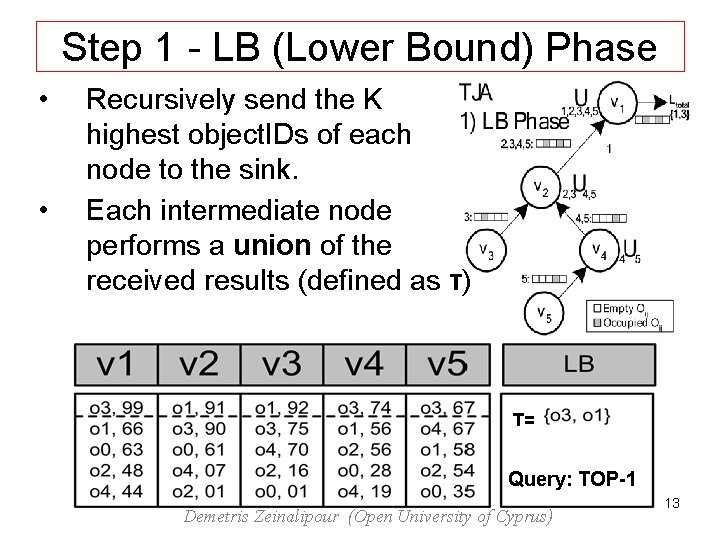
Step 1 - LB (Lower Bound) Phase • • Recursively send the K highest object. IDs of each node to the sink. Each intermediate node performs a union of the received results (defined as τ) Τ= Query: TOP-1 Demetris Zeinalipour (Open University of Cyprus) 13
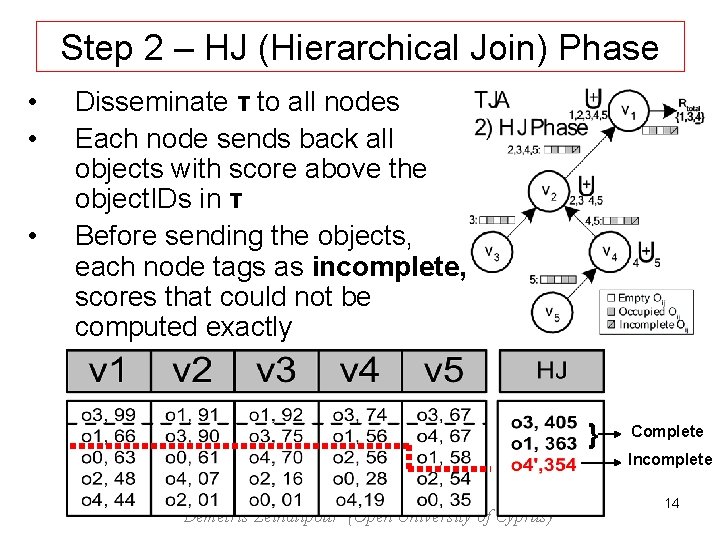
Step 2 – HJ (Hierarchical Join) Phase • • • Disseminate τ to all nodes Each node sends back all objects with score above the object. IDs in τ Before sending the objects, each node tags as incomplete, scores that could not be computed exactly } Complete Incomplete Demetris Zeinalipour (Open University of Cyprus) 14
Step 3 – CL (Cleanup) Phase • Have we found K objects with a complete score that is above all incomplete scores? – Yes: The answer has been found! – No: Find the complete score for each incomplete object (all in a single batch phase) • CL ensures correctness • This phase is rarely required in practice! Demetris Zeinalipour (Open University of Cyprus) 15
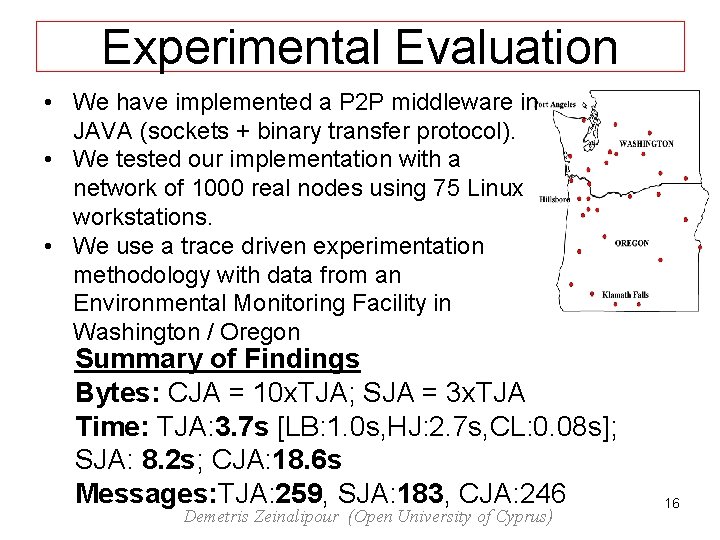
Experimental Evaluation • We have implemented a P 2 P middleware in JAVA (sockets + binary transfer protocol). • We tested our implementation with a network of 1000 real nodes using 75 Linux workstations. • We use a trace driven experimentation methodology with data from an Environmental Monitoring Facility in Washington / Oregon Summary of Findings Bytes: CJA = 10 x. TJA; SJA = 3 x. TJA Time: TJA: 3. 7 s [LB: 1. 0 s, HJ: 2. 7 s, CL: 0. 08 s]; SJA: 8. 2 s; CJA: 18. 6 s Messages: TJA: 259, SJA: 183, CJA: 246 Demetris Zeinalipour (Open University of Cyprus) 16
Presentation Outline A. Top-K Algorithms: Definitions B. Centralized Top-K Query Processing • The Threshold Algorithm (TA) C. Distributed Top-K Query Processing • • The Threshold Join Algorithm (TJA) Experimentation using 75 workstations D. Other Applications of Top-K Queries • • Distributed Spatio-temporal Trajectory Retrieval (UB-K and UBLB-K Algorithms) In-Network Top-K Views (MINT Views) Demetris Zeinalipour (Open University of Cyprus) 17
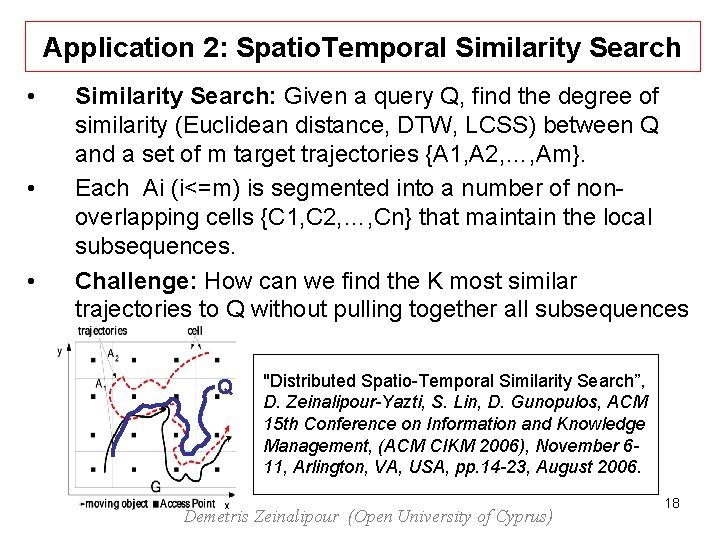
Application 2: Spatio. Temporal Similarity Search • • • Similarity Search: Given a query Q, find the degree of similarity (Euclidean distance, DTW, LCSS) between Q and a set of m target trajectories {A 1, A 2, …, Am}. Each Αi (i<=m) is segmented into a number of nonoverlapping cells {C 1, C 2, …, Cn} that maintain the local subsequences. Challenge: How can we find the K most similar trajectories to Q without pulling together all subsequences Q "Distributed Spatio-Temporal Similarity Search”, D. Zeinalipour-Yazti, S. Lin, D. Gunopulos, ACM 15 th Conference on Information and Knowledge Management, (ACM CIKM 2006), November 611, Arlington, VA, USA, pp. 14 -23, August 2006. Demetris Zeinalipour (Open University of Cyprus) 18
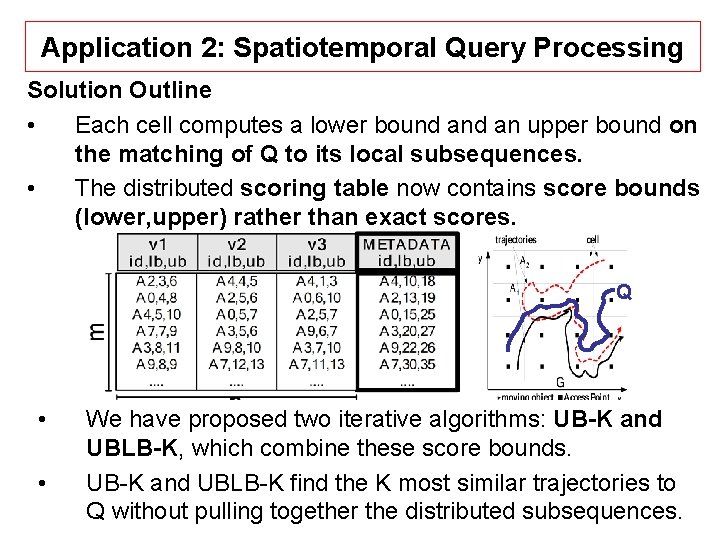
Application 2: Spatiotemporal Query Processing Solution Outline • Each cell computes a lower bound an upper bound on the matching of Q to its local subsequences. • The distributed scoring table now contains score bounds (lower, upper) rather than exact scores. Q • • We have proposed two iterative algorithms: UB-K and UBLB-K, which combine these score bounds. UB-K and UBLB-K find the K most similar trajectories to 19 Q without. Demetris pulling. Zeinalipour together(Open the. University distributed subsequences. of Cyprus)
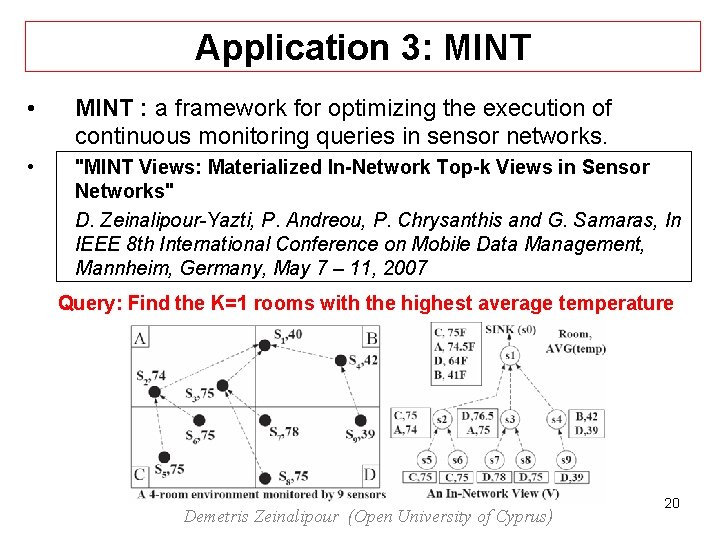
Application 3: ΜΙΝT • ΜΙΝΤ : a framework for optimizing the execution of continuous monitoring queries in sensor networks. • "MINT Views: Materialized In-Network Top-k Views in Sensor Networks" D. Zeinalipour-Yazti, P. Andreou, P. Chrysanthis and G. Samaras, In IEEE 8 th International Conference on Mobile Data Management, Mannheim, Germany, May 7 – 11, 2007 Query: Find the K=1 rooms with the highest average temperature Demetris Zeinalipour (Open University of Cyprus) 20
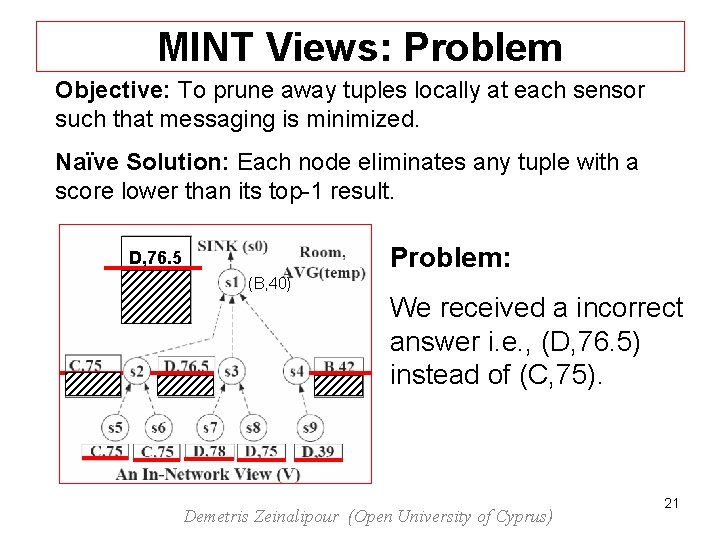
ΜΙΝΤ Views: Problem Objective: To prune away tuples locally at each sensor such that messaging is minimized. Naïve Solution: Each node eliminates any tuple with a score lower than its top-1 result. D, 76. 5 C, 75 B, 41 Problem: (B, 40) We received a incorrect answer i. e. , (D, 76. 5) instead of (C, 75). Demetris Zeinalipour (Open University of Cyprus) 21
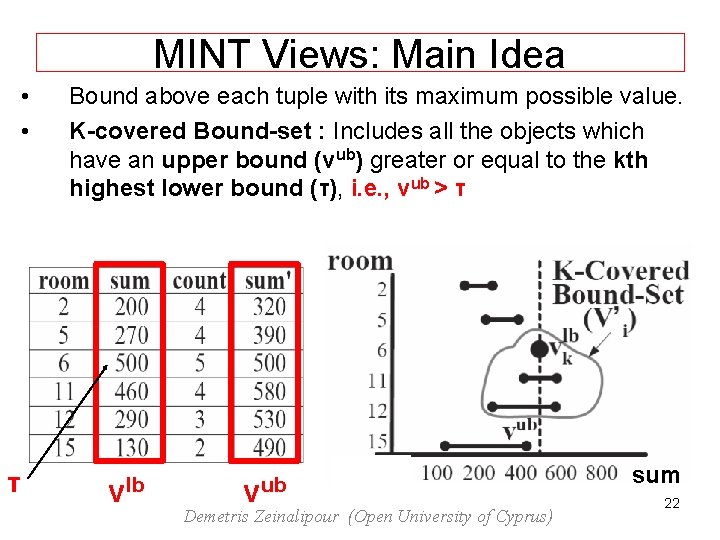
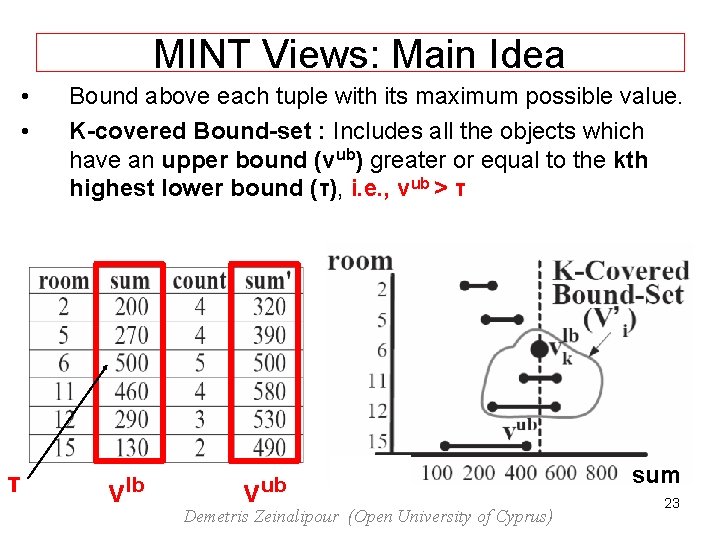
ΜΙΝΤ Views: Main Idea • • τ Bound above each tuple with its maximum possible value. K-covered Bound-set : Includes all the objects which have an upper bound (vub) greater or equal to the kth highest lower bound (τ), i. e. , vub > τ vlb vub Demetris Zeinalipour (Open University of Cyprus) sum 22
ΜΙΝΤ Views: Main Idea • • τ Bound above each tuple with its maximum possible value. K-covered Bound-set : Includes all the objects which have an upper bound (vub) greater or equal to the kth highest lower bound (τ), i. e. , vub > τ vlb vub Demetris Zeinalipour (Open University of Cyprus) sum 23
An Overview of Distributed Top-K Ranking Algorithms Thank you! Demetris Zeinalipour This presentation is available at: http: //www 2. cs. ucy. ac. cy/~dzeina/talks. html Related Publications available at: http: //www 2. cs. ucy. ac. cy/~dzeina/publications. htm 24
Backup Slides Main Findings: Dataset: Environmental Measurements from atmospheric monitoring stations in Washington & Oregon. (2003 -2004) Query: Find the K timestamps on which the average temperature across all stations was maximum. Network: Random Graph (degree=4, diameter 10) Evaluation Criterions: i) Bytes, ii) Time, iii) Messages
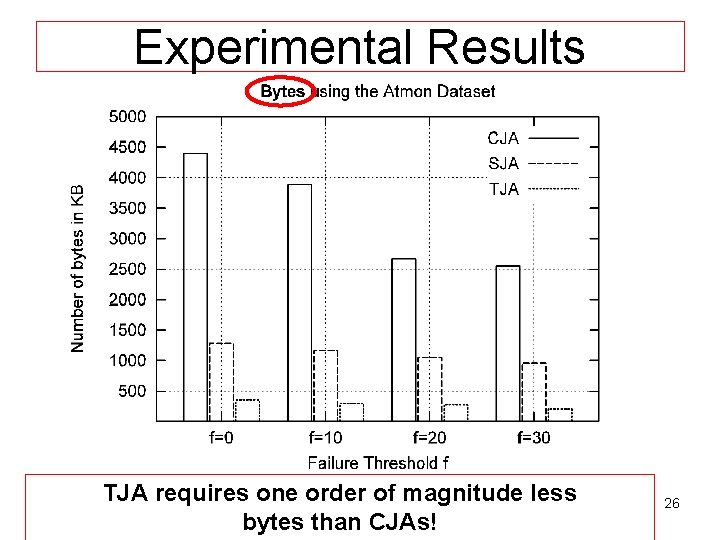
Experimental Results TJA requires one order of magnitude less Demetrisbytes Zeinalipour (Open University of Cyprus) than CJAs! 26
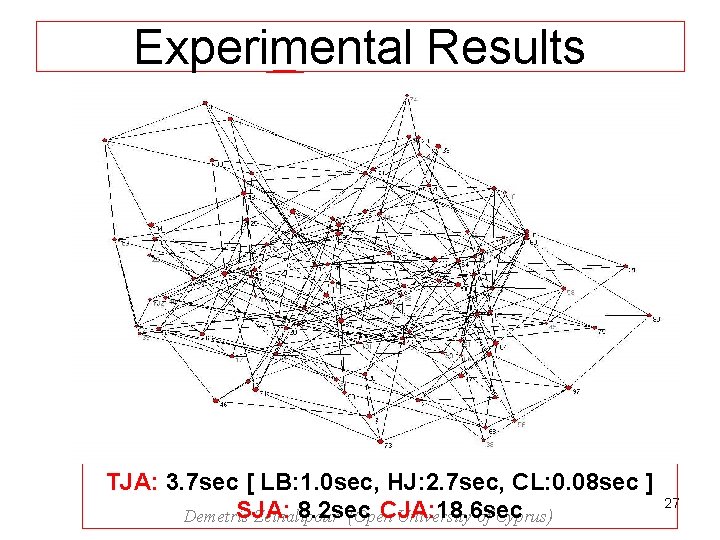
Experimental Results TJA: 3. 7 sec [ LB: 1. 0 sec, HJ: 2. 7 sec, CL: 0. 08 sec ] SJA: 8. 2 sec CJA: 18. 6 sec Demetris Zeinalipour (Open University of Cyprus) 27
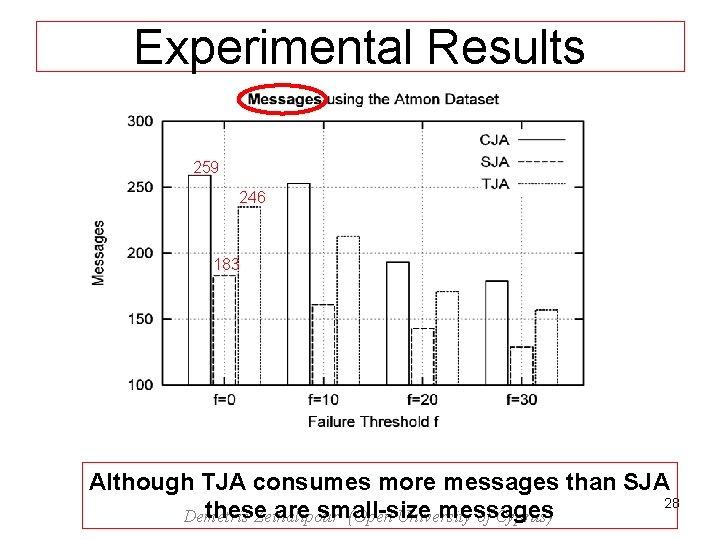
Experimental Results 259 246 183 Although TJA consumes more messages than SJA 28 these are small-size messages Demetris Zeinalipour (Open University of Cyprus)
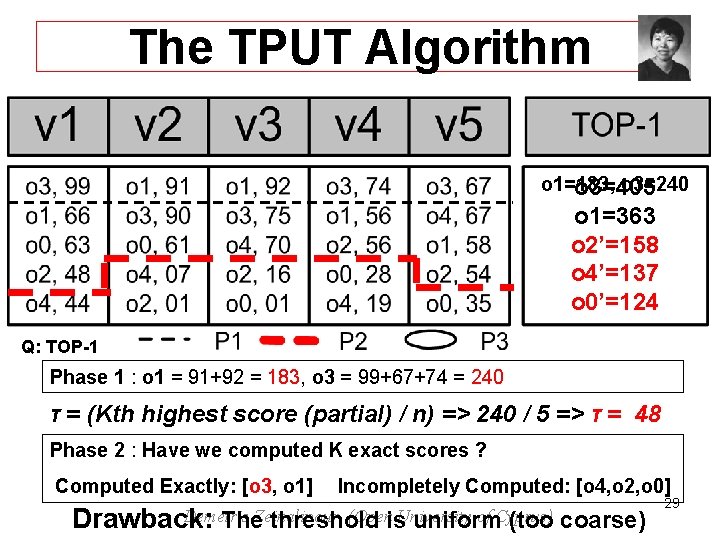
The TPUT Algorithm o 1=183, o 3=240 o 3=405 o 1=363 o 2’=158 o 4’=137 o 0’=124 Q: TOP-1 Phase 1 : o 1 = 91+92 = 183, o 3 = 99+67+74 = 240 τ = (Kth highest score (partial) / n) => 240 / 5 => τ = 48 Phase 2 : Have we computed K exact scores ? Computed Exactly: [o 3, o 1] Incompletely Computed: [o 4, o 2, o 0] Demetris (Openis. University of Cyprus) Drawback: The. Zeinalipour threshold uniform (too coarse) 29
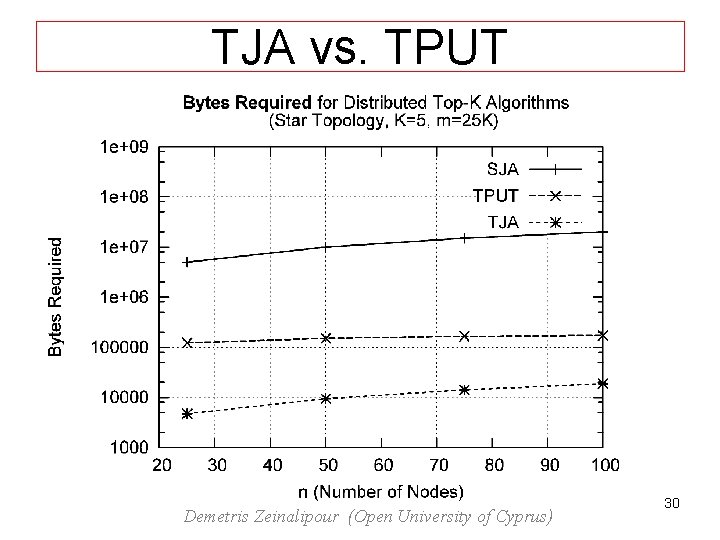
TJA vs. TPUT Demetris Zeinalipour (Open University of Cyprus) 30
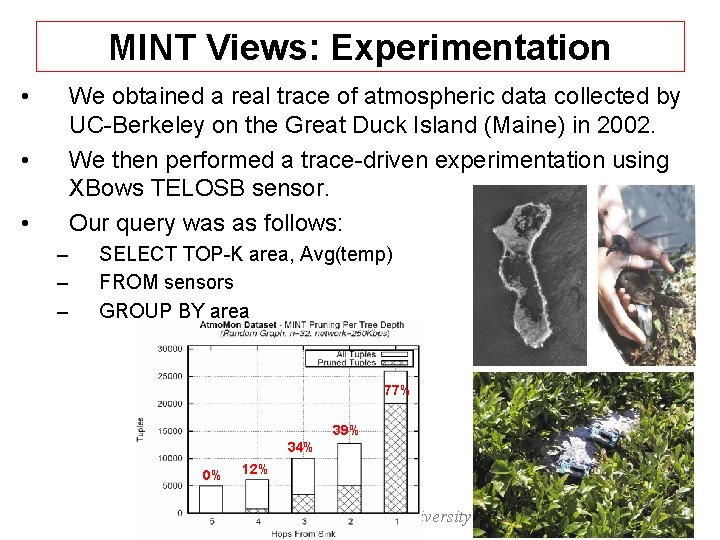
ΜΙΝΤ Views: Experimentation • We obtained a real trace of atmospheric data collected by UC-Berkeley on the Great Duck Island (Maine) in 2002. We then performed a trace-driven experimentation using XBows TELOSB sensor. Our query was as follows: • • – – – SELECT TOP-K area, Avg(temp) FROM sensors GROUP BY area 77% 39% 34% 0% 12% Demetris Zeinalipour (Open University of Cyprus) 31
- Slides: 31