
An Overview of Disruption Tolerant Networking and Applications
- Slides: 36
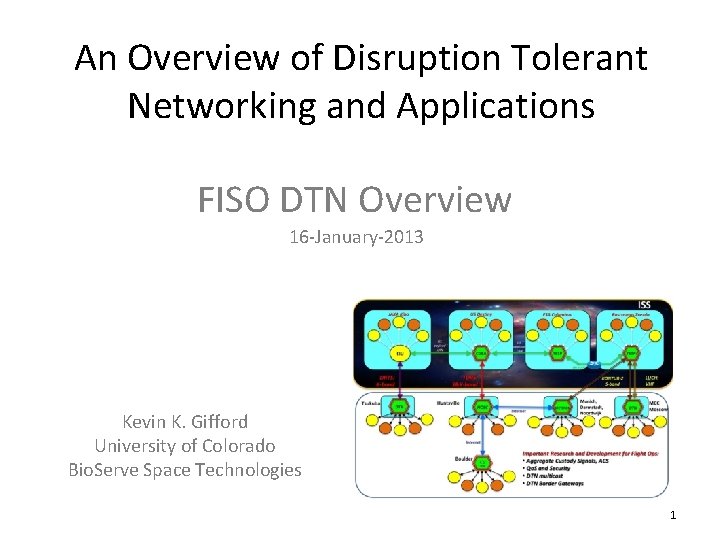
An Overview of Disruption Tolerant Networking and Applications FISO DTN Overview 16 -January-2013 Kevin K. Gifford University of Colorado Bio. Serve Space Technologies 1
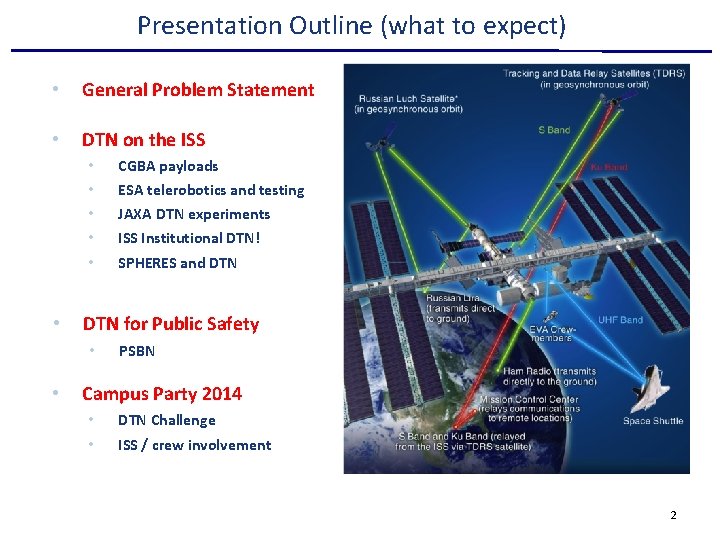
Presentation Outline (what to expect) • General Problem Statement • DTN on the ISS • • • ESA telerobotics and testing JAXA DTN experiments ISS Institutional DTN! SPHERES and DTN for Public Safety • • CGBA payloads PSBN Campus Party 2014 • • DTN Challenge ISS / crew involvement 2
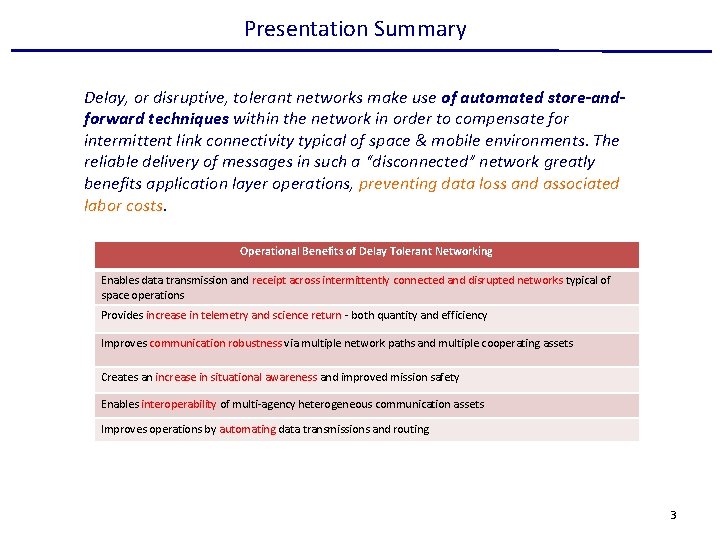
Presentation Summary Delay, or disruptive, tolerant networks make use of automated store-andforward techniques within the network in order to compensate for intermittent link connectivity typical of space & mobile environments. The reliable delivery of messages in such a “disconnected” network greatly benefits application layer operations, preventing data loss and associated labor costs. Operational Benefits of Delay Tolerant Networking Enables data transmission and receipt across intermittently connected and disrupted networks typical of space operations Provides increase in telemetry and science return - both quantity and efficiency Improves communication robustness via multiple network paths and multiple cooperating assets Creates an increase in situational awareness and improved mission safety Enables interoperability of multi-agency heterogeneous communication assets Improves operations by automating data transmissions and routing 3 3
Problem Statement Since the start of the space age, communications between spacecraft and ground stations has been characterized by simple, point-to-point data transmission. While Internet protocols this may work well for certain environments, they do not work well for many space-based and wireless mobile environments characterized by intermittent link connectivity, long or variable transmission delay, asymmetric data rates, and potentially high bit error rates (BER). Existing Internet protocols have not been augmented for extension for space communications and rely upon several fundamental assumptions built into the terrestrial Internet architecture. 4 4
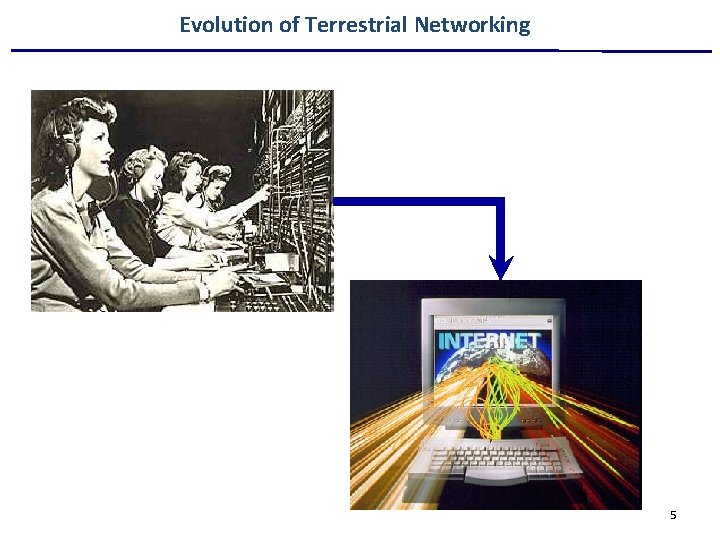
Evolution of Terrestrial Networking 5 5 09 -Aug-2011
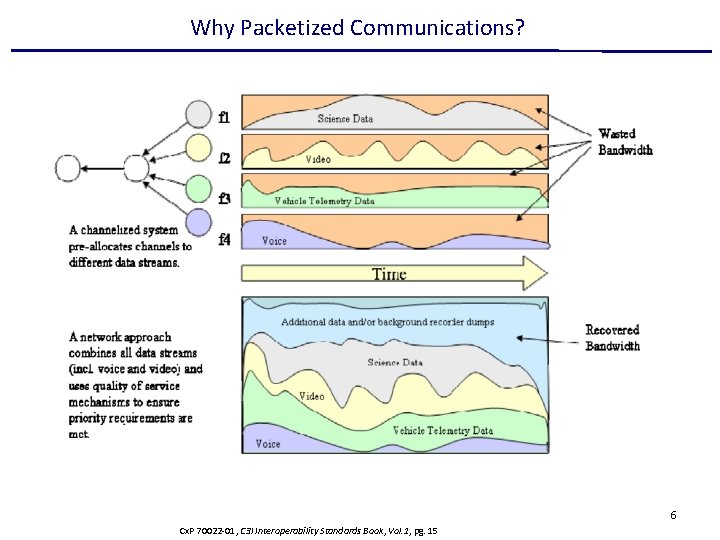
Why Packetized Communications? 6 6 Cx. P 70022 -01, C 3 I Interoperability Standards Book, Vol. 1, pg. 15
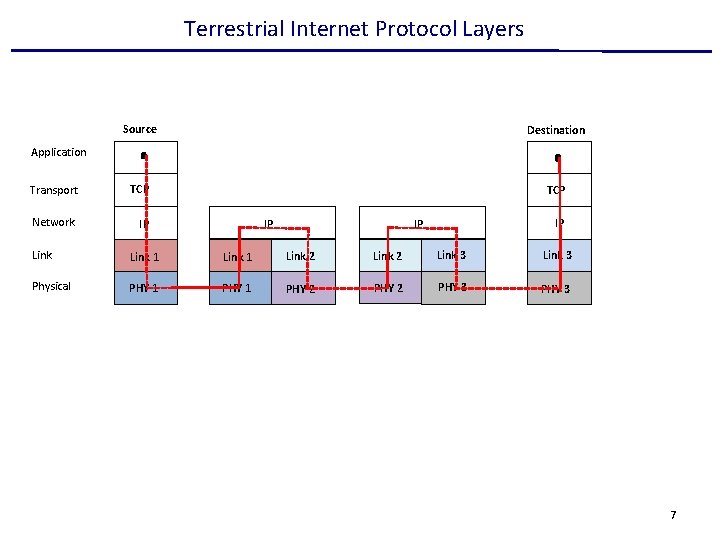
Terrestrial Internet Protocol Layers Source Destination TCP Application Transport Network IP IP Link 1 Link 2 Link 3 Physical PHY 1 PHY 2 PHY 3 7
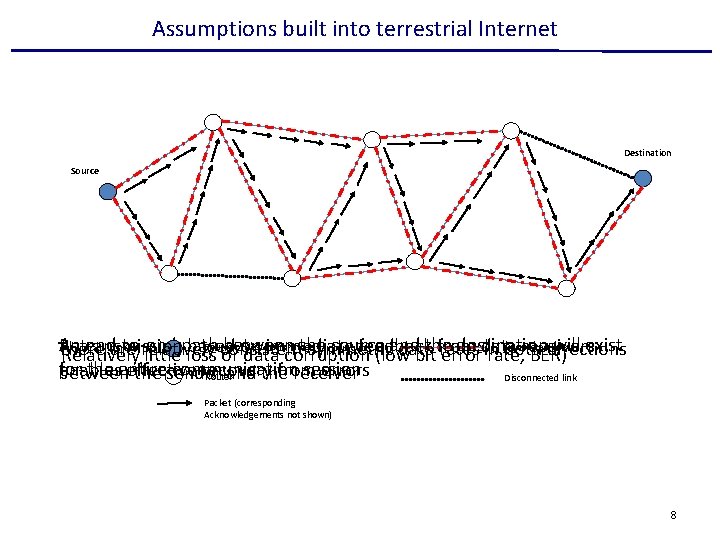
Assumptions built into terrestrial Internet Destination Source Key: Source oron destination node Connected link An end-to-end between the source and the destination will exist Retransmission based immediate feedback from data receivers There are relatively consistent symmetric data rates in both directions Relatively littlepath loss or data corruption (low bit error rate, BER) for the entire communication session enables effective recovery from errors between the sender and the receiver Router Disconnected link Packet (corresponding Acknowledgements not shown) 8 8 09 -Aug-2011
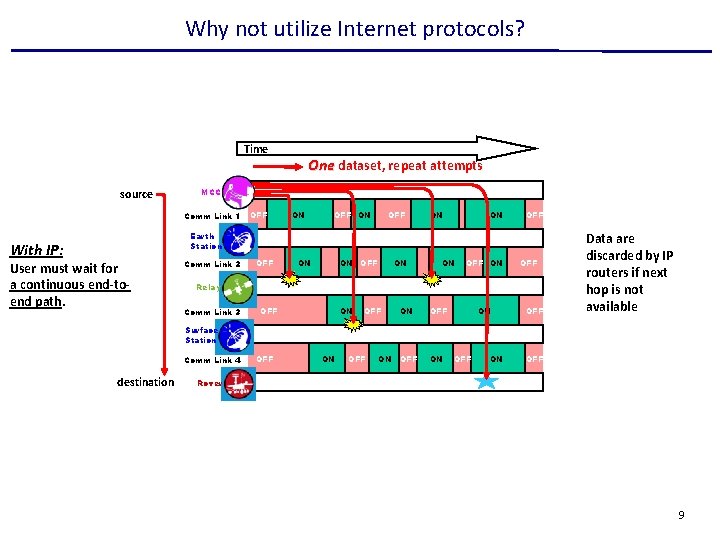
Why not utilize Internet protocols? Time source One dataset, repeat attempts MCC Comm Link 1 OFF ON ON OFF Earth Station With IP: User must wait for a continuous end-toend path. Comm Link 2 OFF ON ON OFF Relay Comm Link 3 OFF ON ON OFF Data are discarded by IP routers if next hop is not available Surface Station Comm Link 4 destination OFF ON OFF Rover 9 9
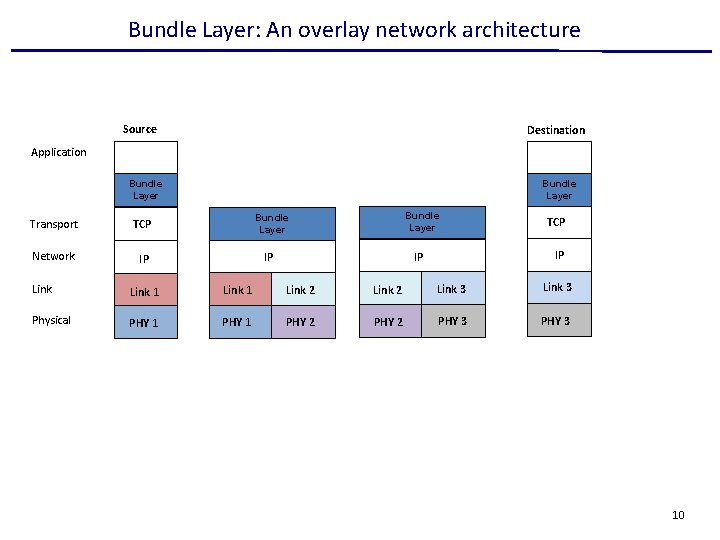
Bundle Layer: An overlay network architecture Source Destination Application Bundle Layer Transport TCP Network IP Bundle Layer IP TCP IP IP Link 1 Link 2 Link 3 Physical PHY 1 PHY 2 PHY 3 10
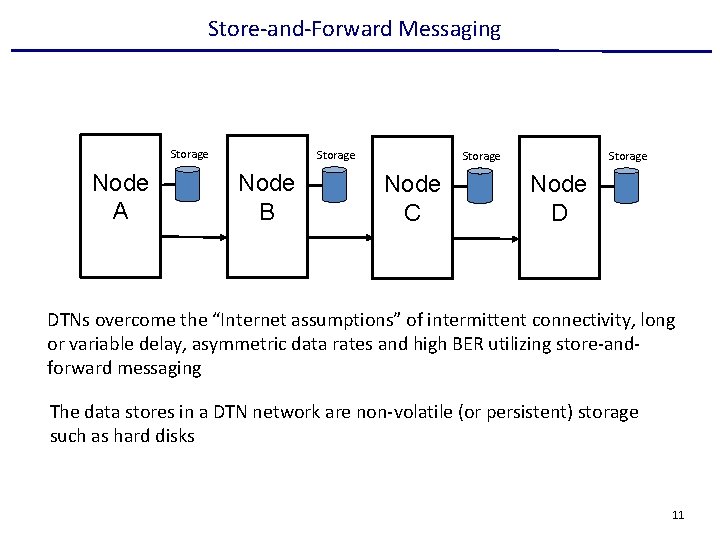
Store-and-Forward Messaging Storage Node A Storage Node B Storage Node C Node D DTNs overcome the “Internet assumptions” of intermittent connectivity, long or variable delay, asymmetric data rates and high BER utilizing store-andforward messaging The data stores in a DTN network are non-volatile (or persistent) storage such as hard disks 11
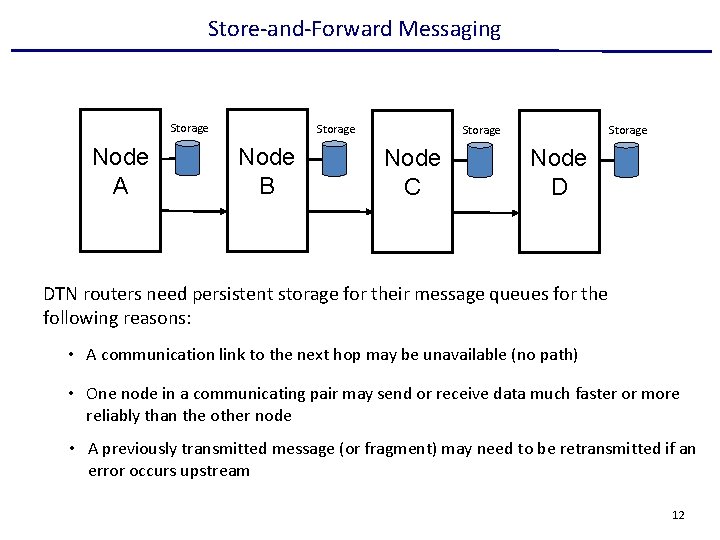
Store-and-Forward Messaging Storage Node A Storage Node B Storage Node C Node D DTN routers need persistent storage for their message queues for the following reasons: • A communication link to the next hop may be unavailable (no path) • One node in a communicating pair may send or receive data much faster or more reliably than the other node • A previously transmitted message (or fragment) may need to be retransmitted if an error occurs upstream 12
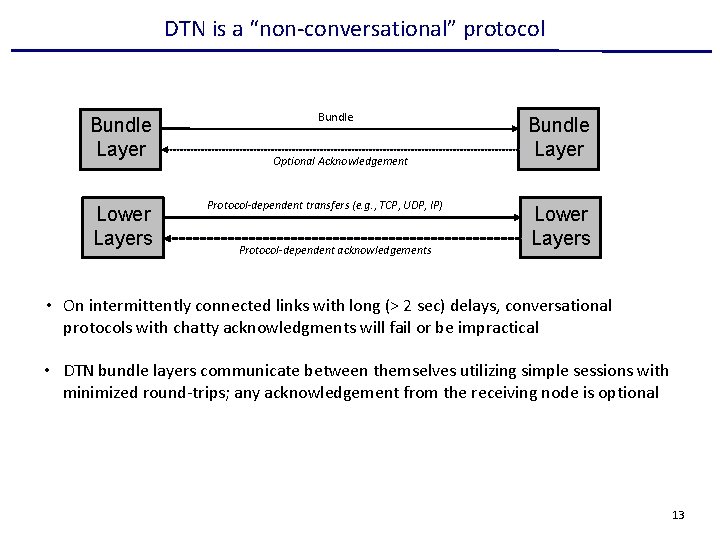
DTN is a “non-conversational” protocol Bundle Layer Lower Layers Bundle Optional Acknowledgement Protocol-dependent transfers (e. g. , TCP, UDP, IP) Protocol-dependent acknowledgements Bundle Layer Lower Layers • On intermittently connected links with long (> 2 sec) delays, conversational protocols with chatty acknowledgments will fail or be impractical • DTN bundle layers communicate between themselves utilizing simple sessions with minimized round-trips; any acknowledgement from the receiving node is optional 13
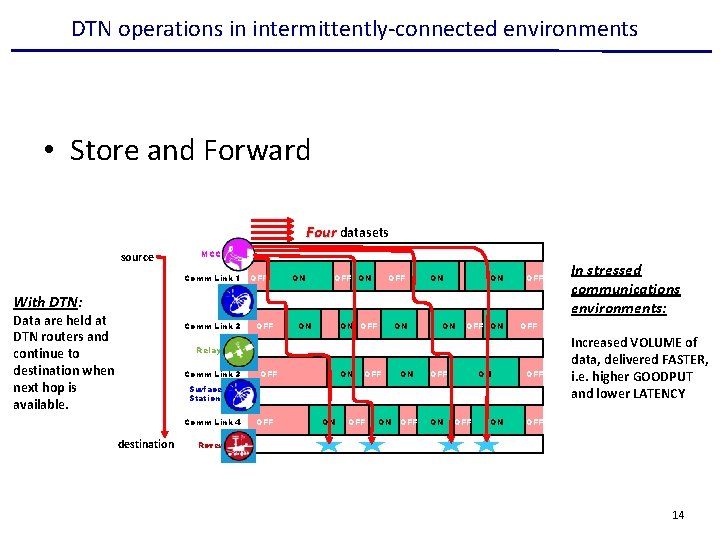
DTN operations in intermittently-connected environments • Store and Forward Four datasets source MCC Comm Link 1 OFF ON ON OFF With DTN: Data are held at DTN routers and continue to destination when next hop is available. Comm Link 2 OFF ON ON OFF Relay Comm Link 3 OFF ON ON OFF Surface Station Comm Link 4 destination OFF ON In stressed communications environments: Increased VOLUME of data, delivered FASTER, i. e. higher GOODPUT and lower LATENCY OFF Rover 14
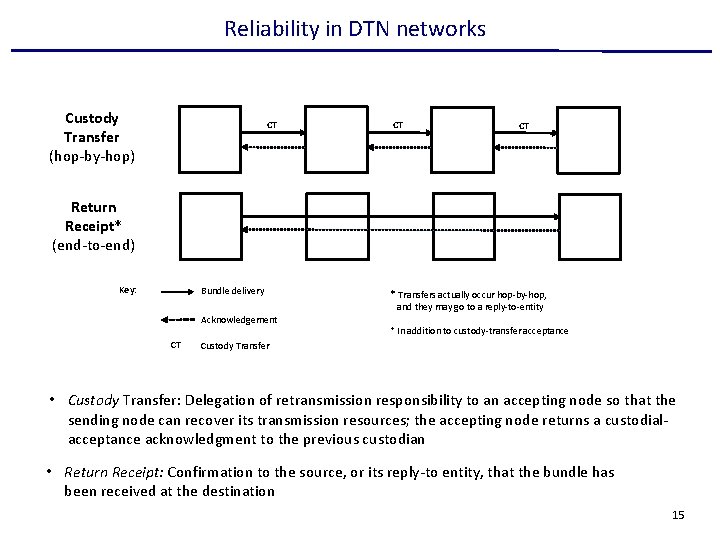
Reliability in DTN networks Custody Transfer (hop-by-hop) CT CT CT Return Receipt* (end-to-end) Key: Bundle delivery * Transfers actually occur hop-by-hop, and they may go to a reply-to-entity Acknowledgement CT + In addition to custody-transfer acceptance Custody Transfer • Custody Transfer: Delegation of retransmission responsibility to an accepting node so that the sending node can recover its transmission resources; the accepting node returns a custodialacceptance acknowledgment to the previous custodian • Return Receipt: Confirmation to the source, or its reply-to entity, that the bundle has been received at the destination 15
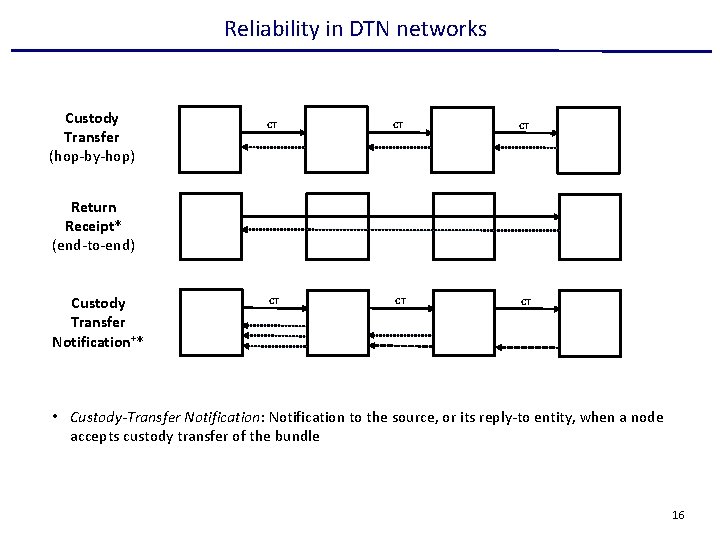
Reliability in DTN networks Custody Transfer (hop-by-hop) CT CT CT Return Receipt* (end-to-end) Custody Transfer Notification+* • Custody-Transfer Notification: Notification to the source, or its reply-to entity, when a node accepts custody transfer of the bundle 16
DTN and the Bundle Protocol IRTF RFCs • DTN Architecture – RFC 4838 – Bundle Protocol – RFC 5050 – Bundle Security Protocol – RFC 6257 – Licklider Transport Protocol – RFC 5327 – Other Drafts in progress • Experimental Drafts – Aggregate Custody Signals, ACS 17
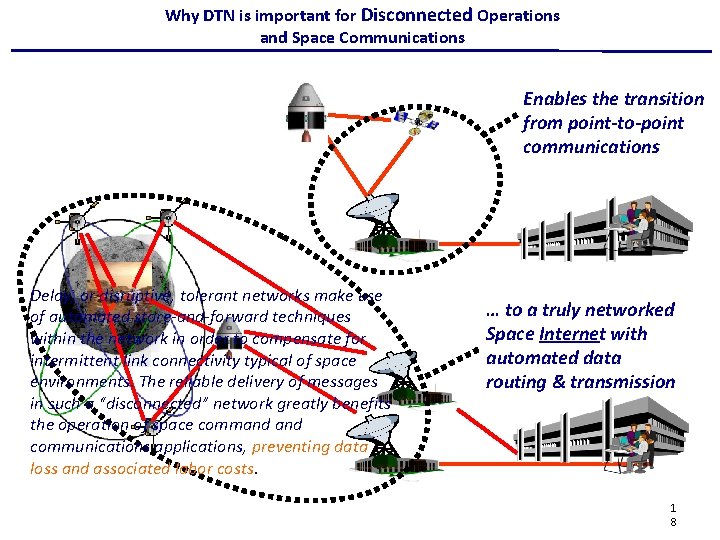
Why DTN is important for Disconnected Operations and Space Communications Enables the transition from point-to-point communications Delay, or disruptive, tolerant networks make use of automated store-and-forward techniques within the network in order to compensate for intermittent link connectivity typical of space environments. The reliable delivery of messages in such a “disconnected” network greatly benefits the operation of space command communications applications, preventing data loss and associated labor costs. 18 … to a truly networked Space Internet with automated data routing & transmission 1 8
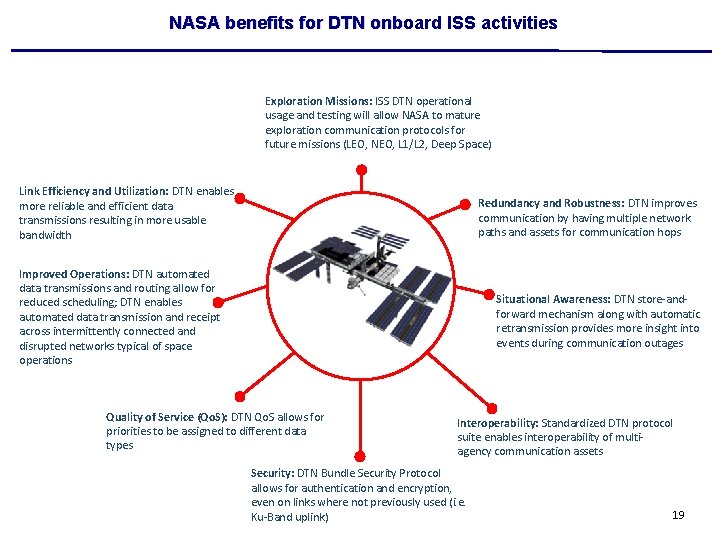
NASA benefits for DTN onboard ISS activities Exploration Missions: ISS DTN operational usage and testing will allow NASA to mature exploration communication protocols for future missions (LEO, NEO, L 1/L 2, Deep Space) Link Efficiency and Utilization: DTN enables more reliable and efficient data transmissions resulting in more usable bandwidth Redundancy and Robustness: DTN improves communication by having multiple network paths and assets for communication hops Improved Operations: DTN automated data transmissions and routing allow for reduced scheduling; DTN enables automated data transmission and receipt across intermittently connected and disrupted networks typical of space operations Situational Awareness: DTN store-andforward mechanism along with automatic retransmission provides more insight into events during communication outages Quality of Service (Qo. S): DTN Qo. S allows for priorities to be assigned to different data types Interoperability: Standardized DTN protocol suite enables interoperability of multiagency communication assets Security: DTN Bundle Security Protocol allows for authentication and encryption, even on links where not previously used (i. e. Ku-Band uplink) 19
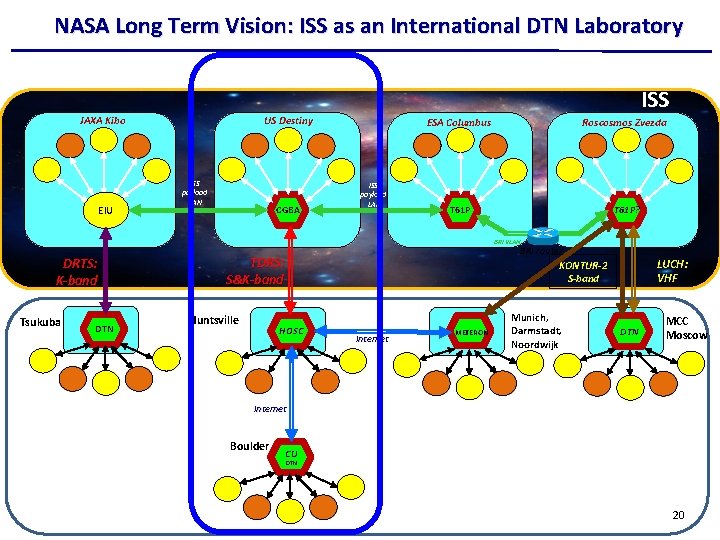
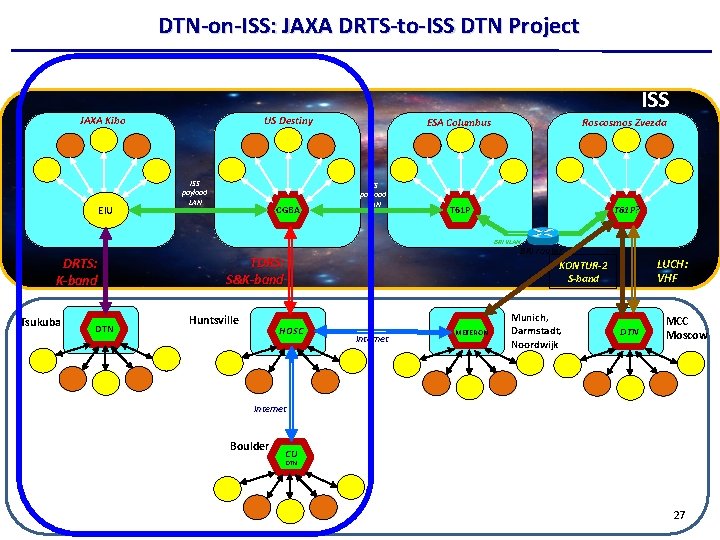
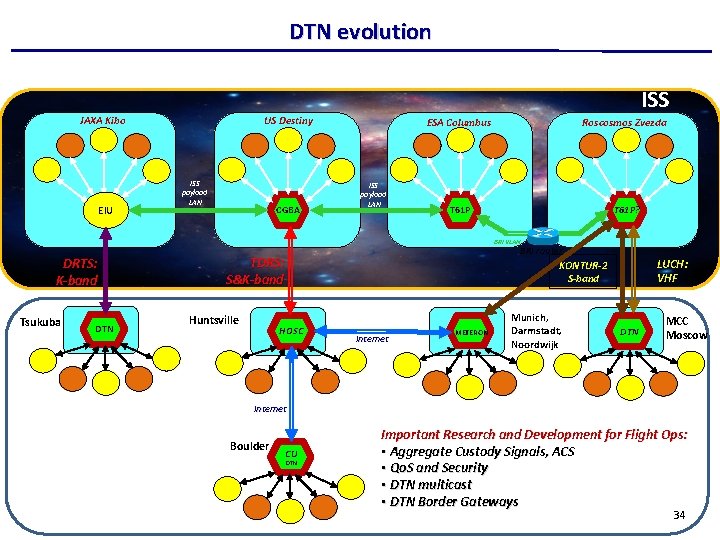
NASA Long Term Vision: ISS as an International DTN Laboratory ISS JAXA Kibo EIU US Destiny ISS payload LAN CGBA ISS payload LAN ESA Columbus Roscosmos Zvezda T 61 P? BRI VLAN DRTS: K-band Tsukuba DTN BRI router KONTUR-2 S-band TDRS: S&K-band Huntsville HOSC Internet METERON Munich, Darmstadt, Noordwijk LUCH: VHF DTN MCC Moscow Internet Boulder CU DTN 20
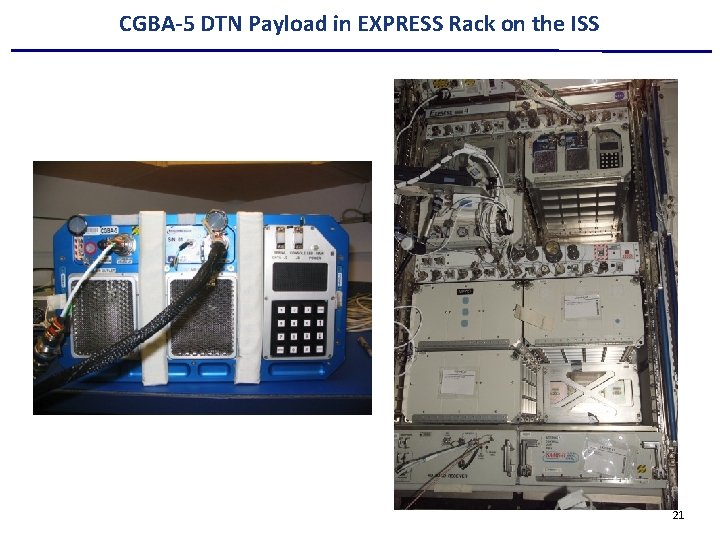
CGBA-5 DTN Payload in EXPRESS Rack on the ISS 21
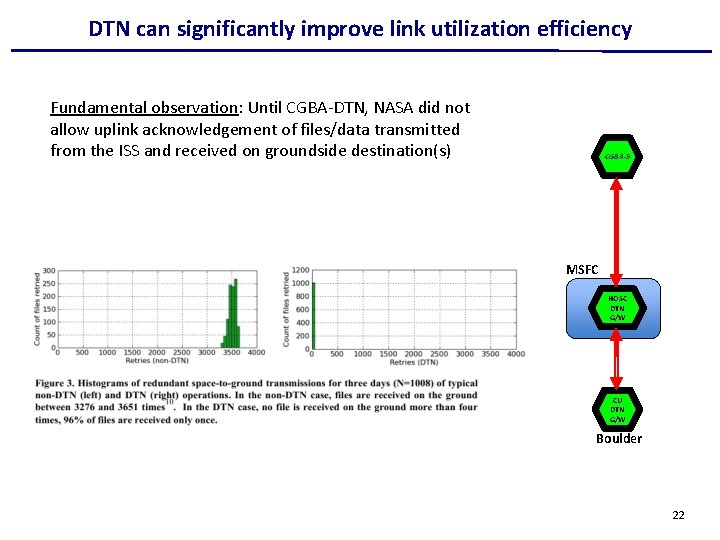
DTN can significantly improve link utilization efficiency Fundamental observation: Until CGBA-DTN, NASA did not allow uplink acknowledgement of files/data transmitted from the ISS and received on groundside destination(s) CGBA-5 TDRS MSFC HOSC DTN G/W CU DTN G/W Boulder 22
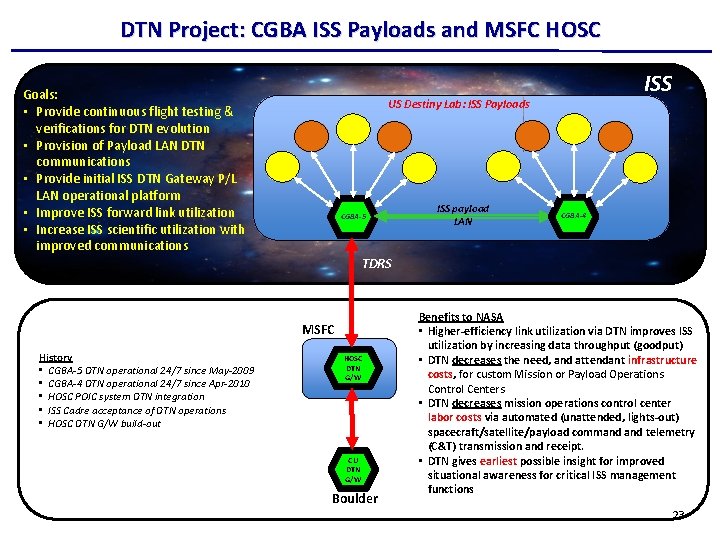
DTN Project: CGBA ISS Payloads and MSFC HOSC Goals: • Provide continuous flight testing & verifications for DTN evolution • Provision of Payload LAN DTN communications • Provide initial ISS DTN Gateway P/L LAN operational platform • Improve ISS forward link utilization • Increase ISS scientific utilization with improved communications ISS US Destiny Lab: ISS Payloads CGBA-5 ISS payload LAN CGBA-4 TDRS MSFC History • CGBA-5 DTN operational 24/7 since May-2009 • CGBA-4 DTN operational 24/7 since Apr-2010 • HOSC POIC system DTN integration • ISS Cadre acceptance of DTN operations • HOSC DTN G/W build-out HOSC DTN G/W CU DTN G/W Boulder Benefits to NASA • Higher-efficiency link utilization via DTN improves ISS utilization by increasing data throughput (goodput) • DTN decreases the need, and attendant infrastructure costs, for custom Mission or Payload Operations Control Centers • DTN decreases mission operations control center labor costs via automated (unattended, lights-out) spacecraft/satellite/payload command telemetry (C&T) transmission and receipt. • DTN gives earliest possible insight for improved situational awareness for critical ISS management functions 23
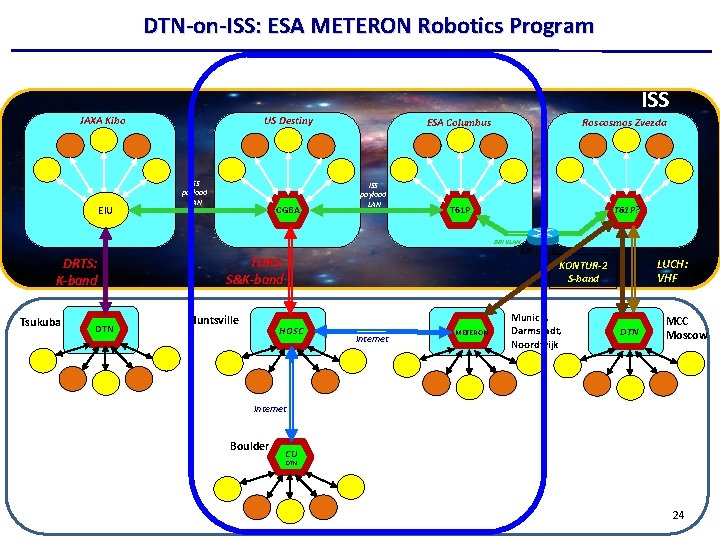
DTN-on-ISS: ESA METERON Robotics Program ISS JAXA Kibo EIU US Destiny ISS payload LAN CGBA ISS payload LAN ESA Columbus Roscosmos Zvezda T 61 P? BRI VLAN DRTS: K-band Tsukuba DTN BRI router KONTUR-2 S-band TDRS: S&K-band Huntsville HOSC Internet METERON Munich, Darmstadt, Noordwijk LUCH: VHF DTN MCC Moscow Internet Boulder CU DTN 24
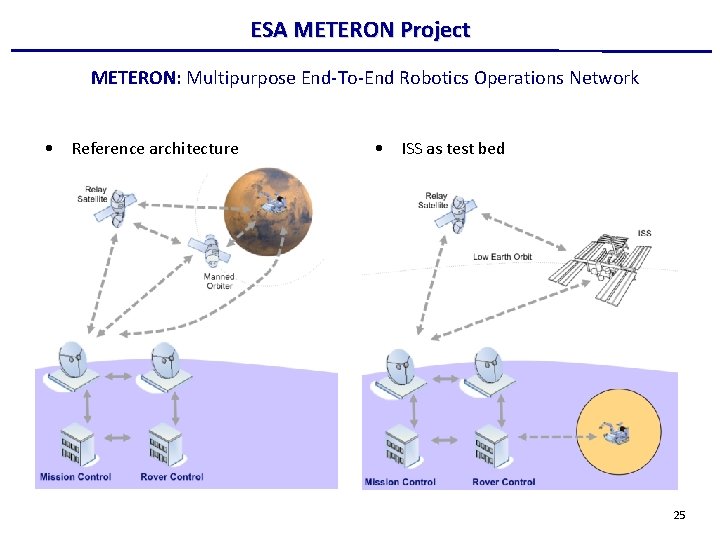
ESA METERON Project METERON: Multipurpose End-To-End Robotics Operations Network • Reference architecture • ISS as test bed 25
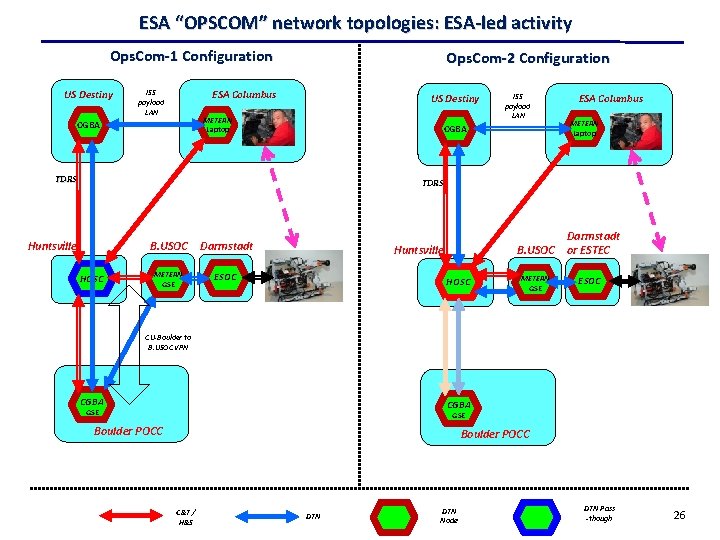
ESA “OPSCOM” network topologies: ESA-led activity Ops. Com-1 Configuration US Destiny Ops. Com-2 Configuration ESA Columbus ISS payload LAN US Destiny METERN Laptop CGBA ISS payload LAN CGBA TDRS ESA Columbus METERN Laptop TDRS Huntsville HOSC B. USOC Darmstadt METERN GSE ESOC Huntsville B. USOC HOSC METERN GSE Darmstadt or ESTEC ESOC CU-Boulder to B. USOC VPN CGBA GSE Boulder POCC C&T / H&S DTN Node DTN Pass -though 26
DTN-on-ISS: JAXA DRTS-to-ISS DTN Project ISS JAXA Kibo EIU US Destiny ISS payload LAN CGBA ISS payload LAN ESA Columbus Roscosmos Zvezda T 61 P? BRI VLAN DRTS: K-band Tsukuba DTN BRI router KONTUR-2 S-band TDRS: S&K-band Huntsville HOSC Internet METERON Munich, Darmstadt, Noordwijk LUCH: VHF DTN MCC Moscow Internet Boulder CU DTN 27
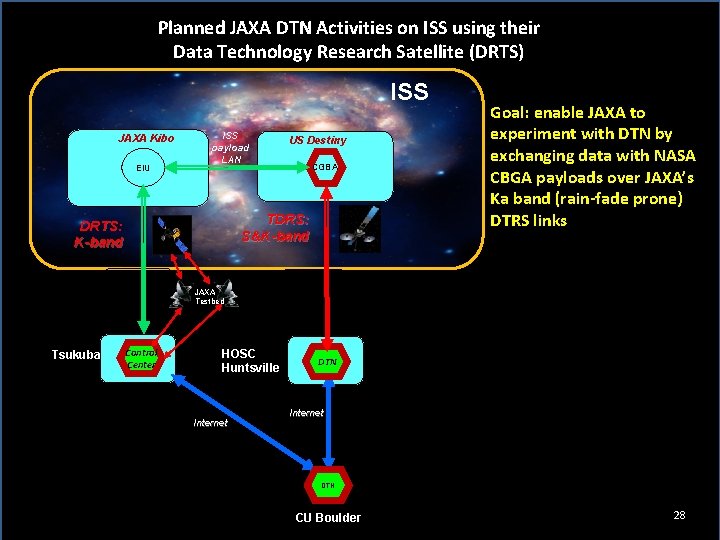
Planned JAXA DTN Activities on ISS using their Data Technology Research Satellite (DRTS) ISS JAXA Kibo EIU ISS payload LAN CGBA TDRS: S&K-band DRTS: K-band Huntsville Tsukuba US Destiny HOS C JAXA Testbed Control Center HOSC Huntsville Internet Goal: enable JAXA to experiment with DTN by exchanging data with NASA CBGA payloads over JAXA’s Ka band (rain-fade prone) DTRS links DTN Internet Boulder DTN CU Boulder 28
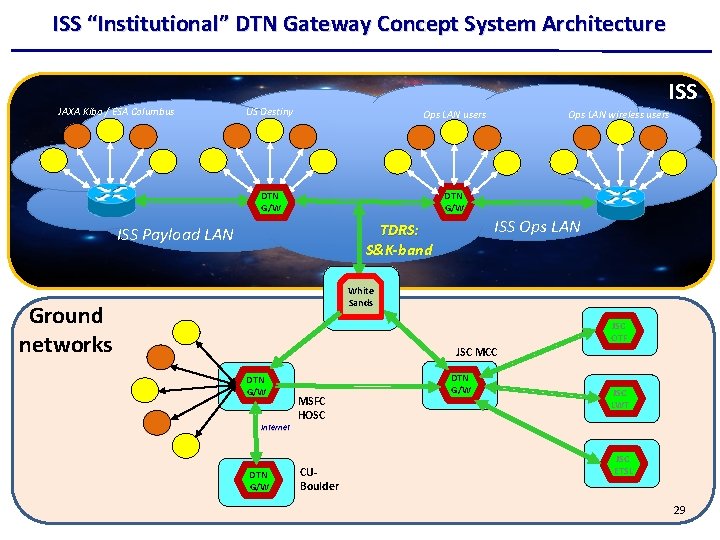
ISS “Institutional” DTN Gateway Concept System Architecture JAXA Kibo / ESA Columbus ISS US Destiny Ops LAN users DTN G/W ISS Ops LAN TDRS: S&K-band ISS Payload LAN Ops LAN wireless users White Sands Ground networks JSC OTF JSC MCC DTN G/W Internet DTN G/W MSFC HOSC CUBoulder DTN G/W JSC LWT JSC ETSL 29
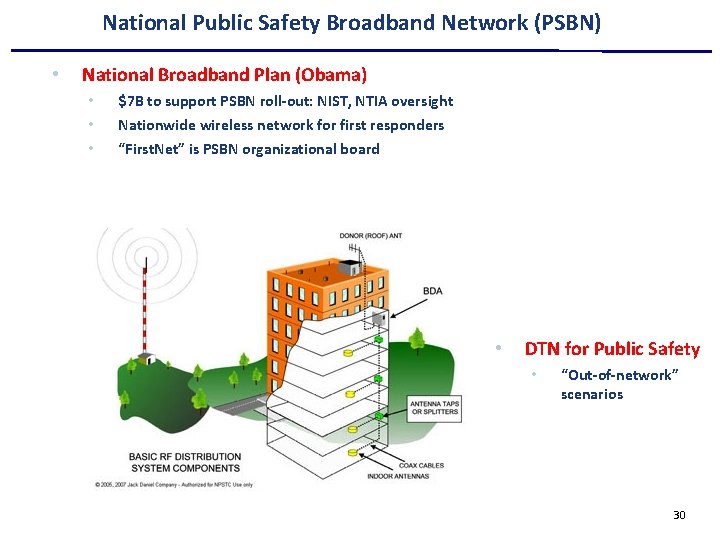
National Public Safety Broadband Network (PSBN) • National Broadband Plan (Obama) • • • $7 B to support PSBN roll-out: NIST, NTIA oversight Nationwide wireless network for first responders “First. Net” is PSBN organizational board • DTN for Public Safety • “Out-of-network” scenarios 30
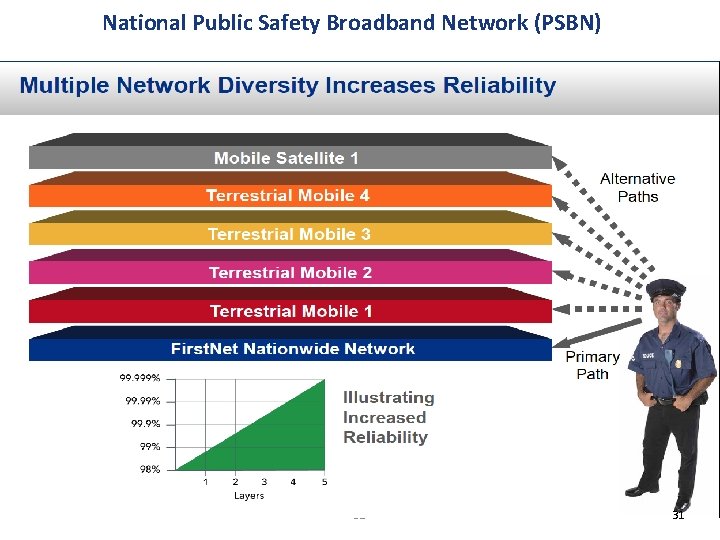
National Public Safety Broadband Network (PSBN) 31 31
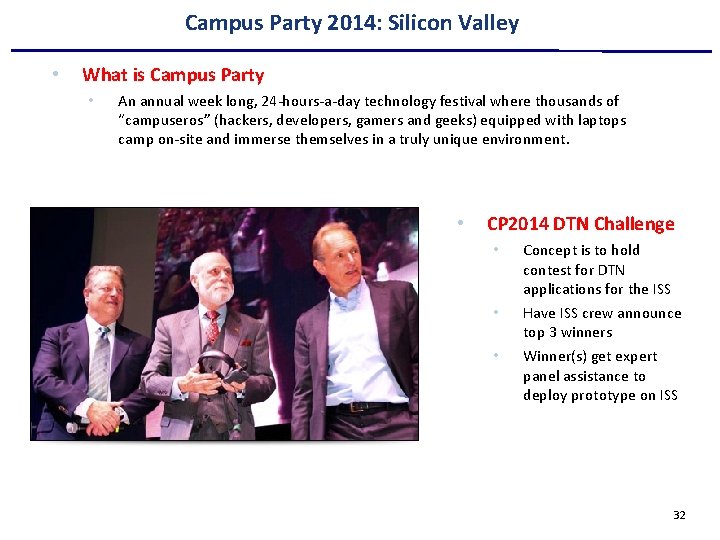
Campus Party 2014: Silicon Valley • What is Campus Party • An annual week long, 24 -hours-a-day technology festival where thousands of “campuseros” (hackers, developers, gamers and geeks) equipped with laptops camp on-site and immerse themselves in a truly unique environment. • CP 2014 DTN Challenge • Concept is to hold contest for DTN applications for the ISS • Have ISS crew announce top 3 winners • Winner(s) get expert panel assistance to deploy prototype on ISS 32
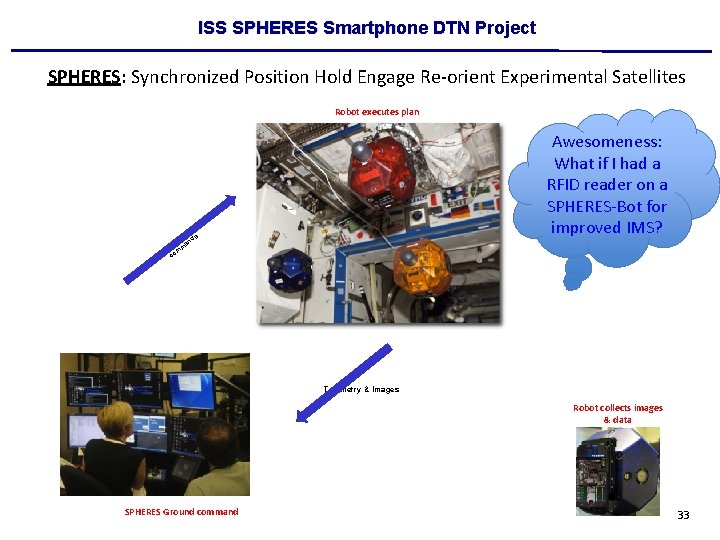
ISS SPHERES Smartphone DTN Project SPHERES: Synchronized Position Hold Engage Re-orient Experimental Satellites Robot executes plan Awesomeness: What if I had a RFID reader on a SPHERES-Bot for improved IMS? ds m om an c Telemetry & Images Robot collects images & data SPHERES Ground command 33
DTN evolution ISS JAXA Kibo EIU US Destiny ISS payload LAN CGBA ISS payload LAN ESA Columbus Roscosmos Zvezda T 61 P? BRI VLAN DRTS: K-band Tsukuba DTN BRI router KONTUR-2 S-band TDRS: S&K-band Huntsville HOSC Internet METERON Munich, Darmstadt, Noordwijk LUCH: VHF DTN MCC Moscow Internet Boulder CU DTN Important Research and Development for Flight Ops: • Aggregate Custody Signals, ACS • Qo. S and Security • DTN multicast • DTN Border Gateways 34
The PSBN is very important End of presentation
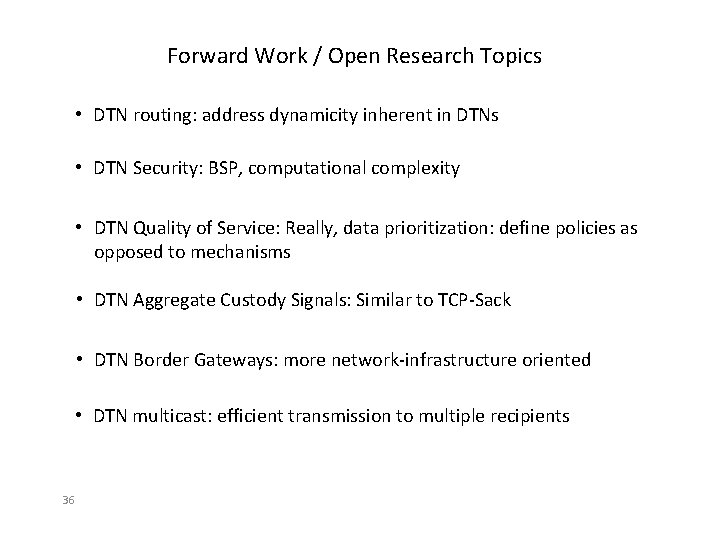
Forward Work / Open Research Topics • DTN routing: address dynamicity inherent in DTNs • DTN Security: BSP, computational complexity • DTN Quality of Service: Really, data prioritization: define policies as opposed to mechanisms • DTN Aggregate Custody Signals: Similar to TCP-Sack • DTN Border Gateways: more network-infrastructure oriented • DTN multicast: efficient transmission to multiple recipients 36 36