
An Overview of Control Theory and Digital Signal



- Slides: 86
An Overview of Control Theory and Digital Signal Processing Luca Matone Columbia Experimental Gravity group (GECo) LHO Jul 18 -22, 2011 LLO Aug 8 -12, 2011 LIGO-G 1100863
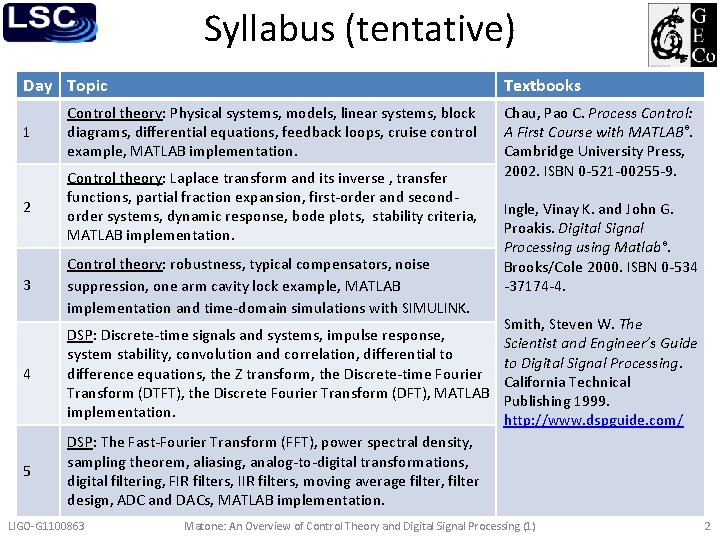
Syllabus (tentative) Day Topic Textbooks 1 Control theory: Physical systems, models, linear systems, block diagrams, differential equations, feedback loops, cruise control example, MATLAB implementation. 2 Control theory: Laplace transform and its inverse , transfer functions, partial fraction expansion, first-order and secondorder systems, dynamic response, bode plots, stability criteria, MATLAB implementation. 3 Control theory: robustness, typical compensators, noise suppression, one arm cavity lock example, MATLAB implementation and time-domain simulations with SIMULINK. 4 DSP: Discrete-time signals and systems, impulse response, system stability, convolution and correlation, differential to difference equations, the Z transform, the Discrete-time Fourier Transform (DTFT), the Discrete Fourier Transform (DFT), MATLAB implementation. 5 DSP: The Fast-Fourier Transform (FFT), power spectral density, sampling theorem, aliasing, analog-to-digital transformations, digital filtering, FIR filters, IIR filters, moving average filter, filter design, ADC and DACs, MATLAB implementation. LIGO-G 1100863 Chau, Pao C. Process Control: A First Course with MATLAB®. Cambridge University Press, 2002. ISBN 0 -521 -00255 -9. Ingle, Vinay K. and John G. Proakis. Digital Signal Processing using Matlab®. Brooks/Cole 2000. ISBN 0 -534 -37174 -4. Smith, Steven W. The Scientist and Engineer’s Guide to Digital Signal Processing. California Technical Publishing 1999. http: //www. dspguide. com/ Matone: An Overview of Control Theory and Digital Signal Processing (1) 2
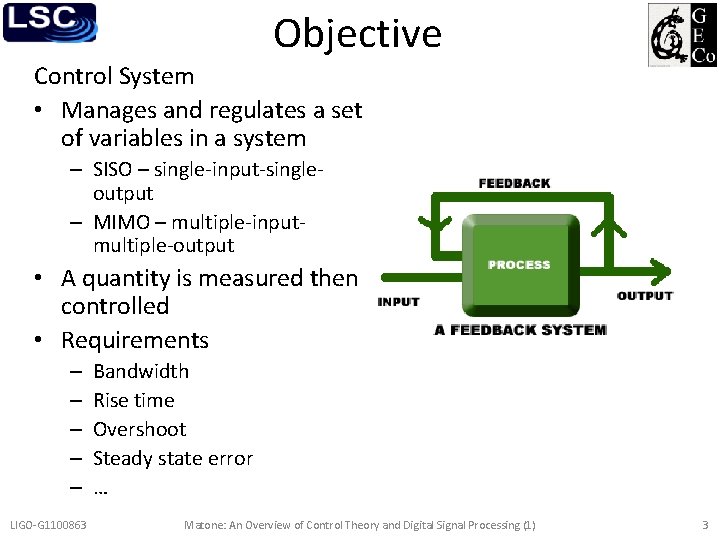
Objective Control System • Manages and regulates a set of variables in a system – SISO – single-input-singleoutput – MIMO – multiple-inputmultiple-output • A quantity is measured then controlled • Requirements – – – LIGO-G 1100863 Bandwidth Rise time Overshoot Steady state error … Matone: An Overview of Control Theory and Digital Signal Processing (1) 3
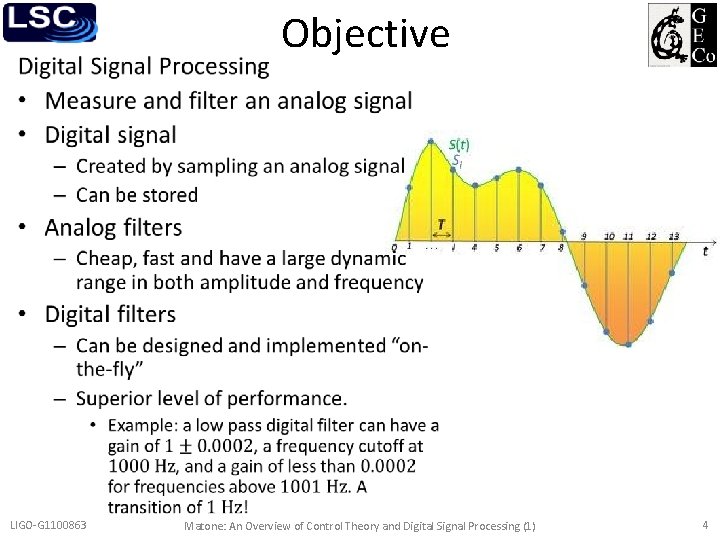
• LIGO-G 1100863 Objective Matone: An Overview of Control Theory and Digital Signal Processing (1) 4
Control Theory 1 • Given a physical system – Objective: sense and control a variable in the system • Examples – As basic as • a car’s cruise control (SISO) or – Not so basic as • Locking the full LIGO interferometer (MIMO) LIGO-G 1100863 Matone: An Overview of Control Theory and Digital Signal Processing (1) 5
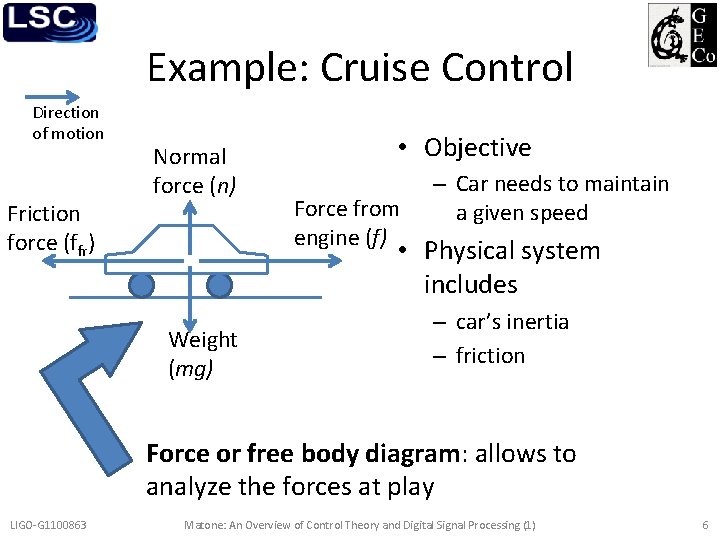
Example: Cruise Control Direction of motion Friction force (ffr) Normal force (n) • Objective Force from engine (f) – Car needs to maintain a given speed • Physical system includes Weight (mg) – car’s inertia – friction Force or free body diagram: allows to analyze the forces at play LIGO-G 1100863 Matone: An Overview of Control Theory and Digital Signal Processing (1) 6
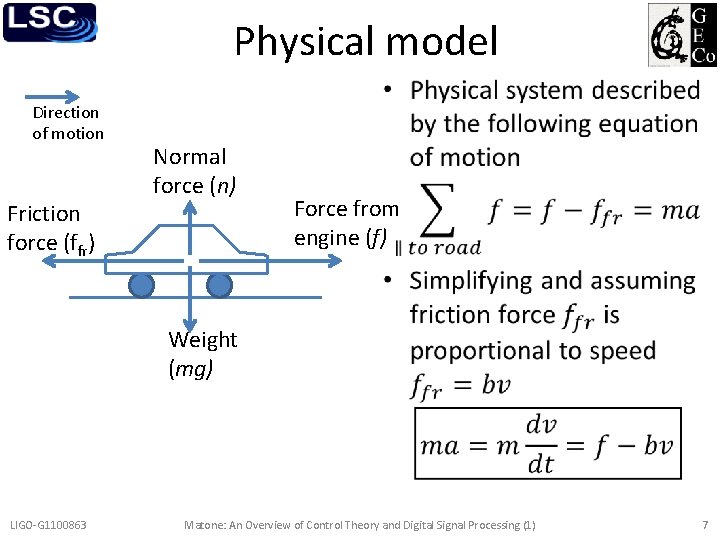
Physical model Direction of motion Friction force (ffr) • Normal force (n) Force from engine (f) Weight (mg) LIGO-G 1100863 Matone: An Overview of Control Theory and Digital Signal Processing (1) 7
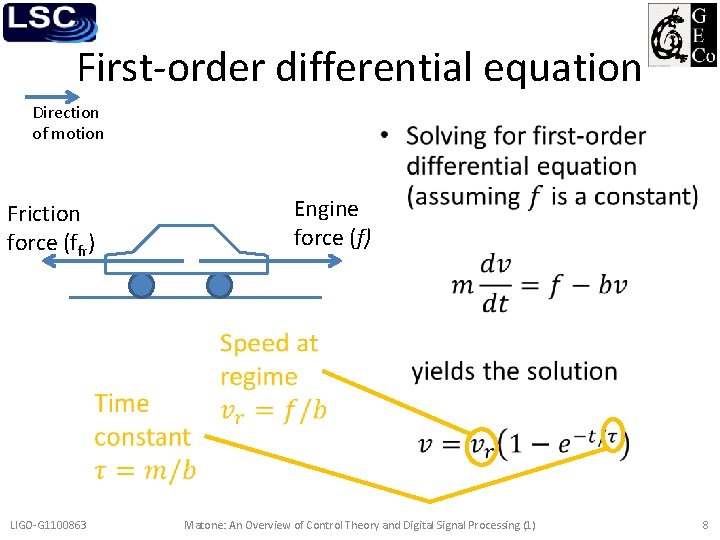
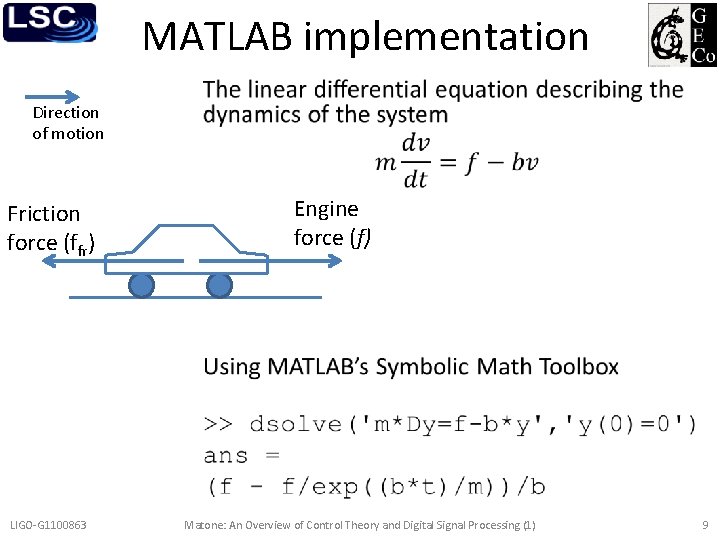
First-order differential equation Direction of motion • Engine force (f) Friction force (ffr) LIGO-G 1100863 Matone: An Overview of Control Theory and Digital Signal Processing (1) 8
MATLAB implementation Direction of motion Friction force (ffr) LIGO-G 1100863 • Engine force (f) Matone: An Overview of Control Theory and Digital Signal Processing (1) 9
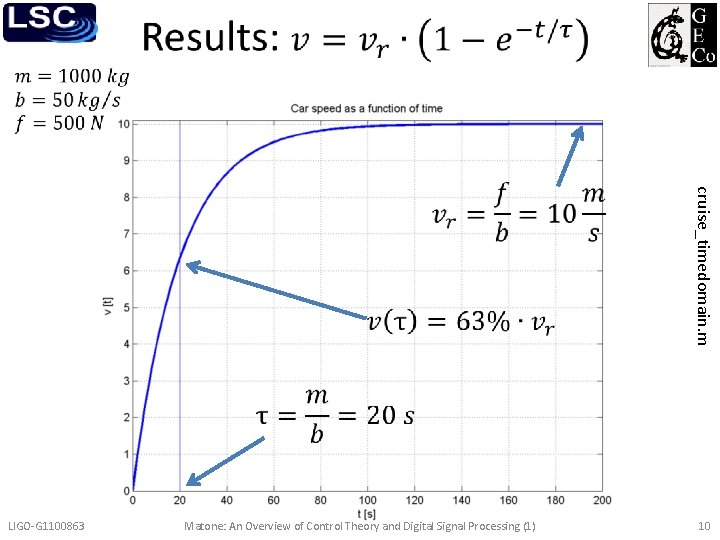
cruise_timedomain. m LIGO-G 1100863 Matone: An Overview of Control Theory and Digital Signal Processing (1) 10
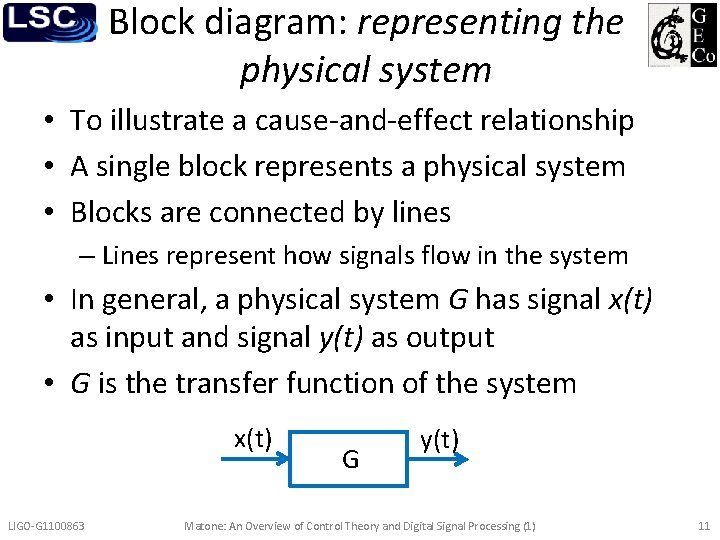
Block diagram: representing the physical system • To illustrate a cause-and-effect relationship • A single block represents a physical system • Blocks are connected by lines – Lines represent how signals flow in the system • In general, a physical system G has signal x(t) as input and signal y(t) as output • G is the transfer function of the system x(t) LIGO-G 1100863 G y(t) Matone: An Overview of Control Theory and Digital Signal Processing (1) 11
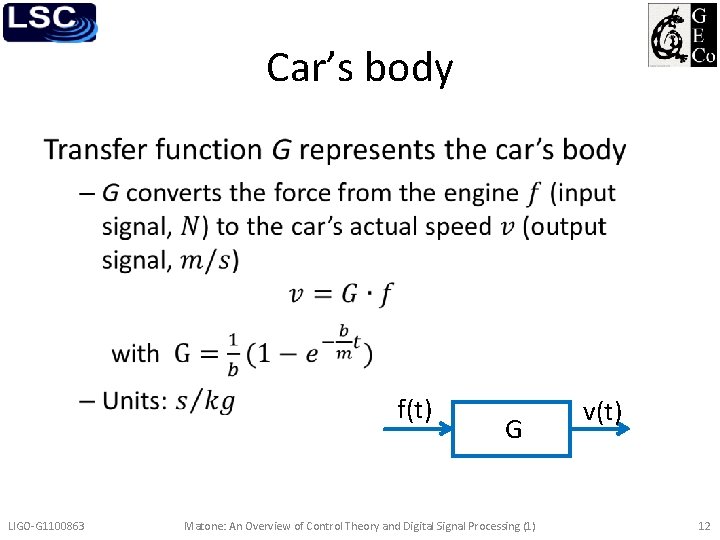
Car’s body • f(t) LIGO-G 1100863 G Matone: An Overview of Control Theory and Digital Signal Processing (1) v(t) 12
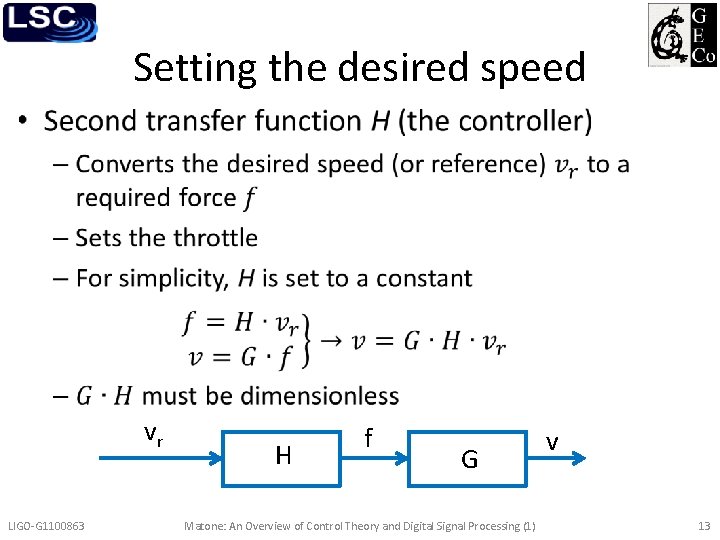
Setting the desired speed • vr LIGO-G 1100863 H f G Matone: An Overview of Control Theory and Digital Signal Processing (1) v 13
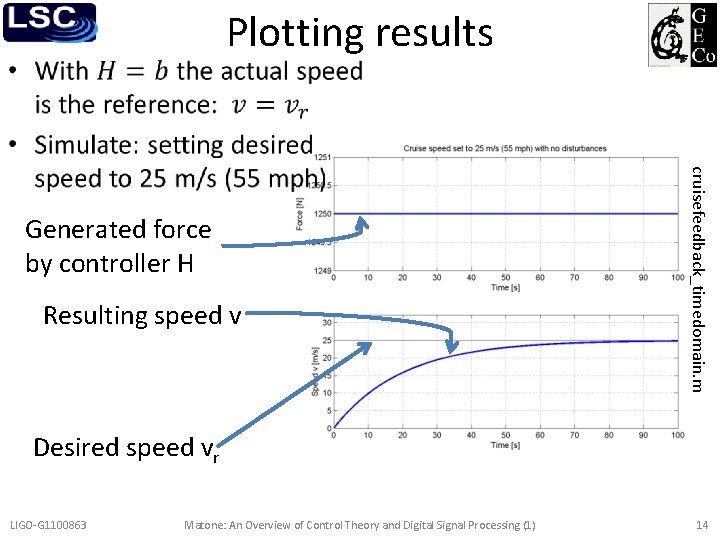
Plotting results • Resulting speed v cruisefeedback_timedomain. m Generated force by controller H Desired speed vr LIGO-G 1100863 Matone: An Overview of Control Theory and Digital Signal Processing (1) 14
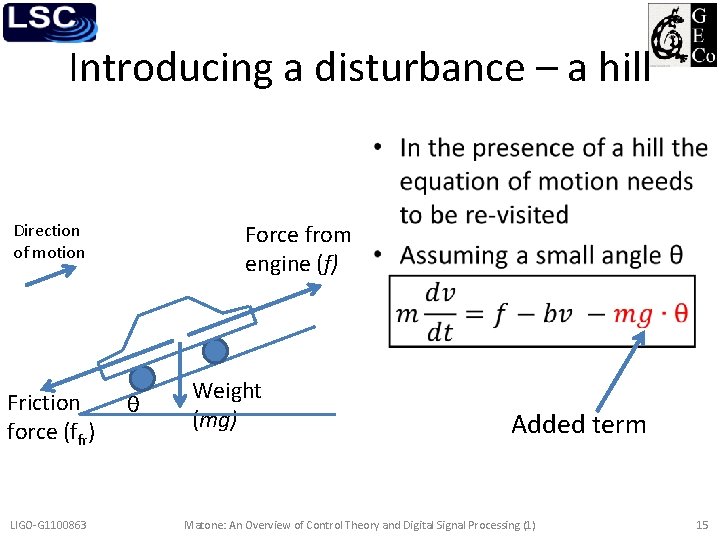
Introducing a disturbance – a hill • Force from engine (f) Direction of motion Friction force (ffr) LIGO-G 1100863 θ Weight (mg) Added term Matone: An Overview of Control Theory and Digital Signal Processing (1) 15
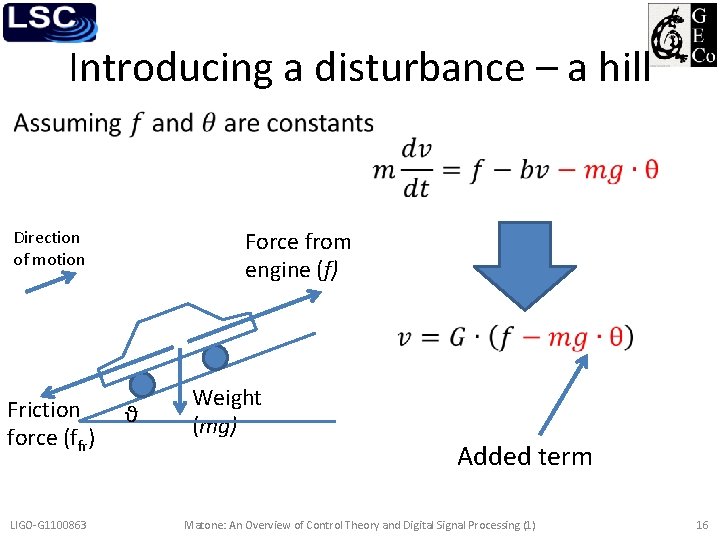
Introducing a disturbance – a hill • Force from engine (f) Direction of motion Friction force (ffr) LIGO-G 1100863 ϑ Weight (mg) Added term Matone: An Overview of Control Theory and Digital Signal Processing (1) 16
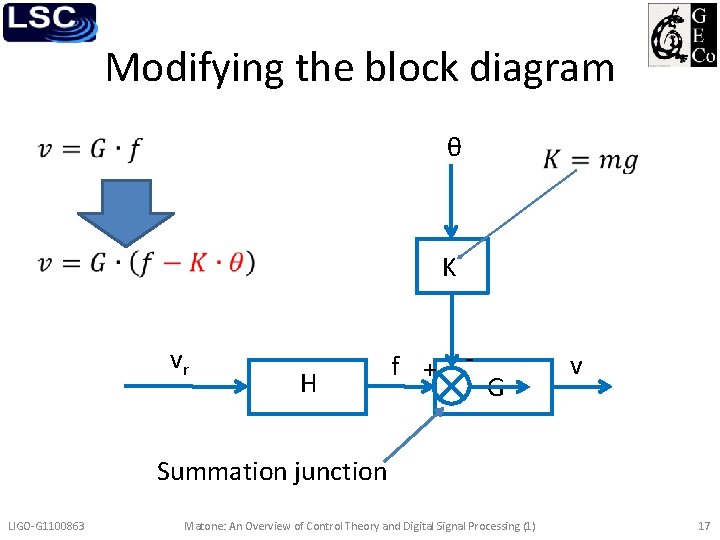
Modifying the block diagram • θ K vr H f + - G v Summation junction LIGO-G 1100863 Matone: An Overview of Control Theory and Digital Signal Processing (1) 17
Modifying the block diagram • θ K vr H f + - G v Summation junction LIGO-G 1100863 Matone: An Overview of Control Theory and Digital Signal Processing (1) 18
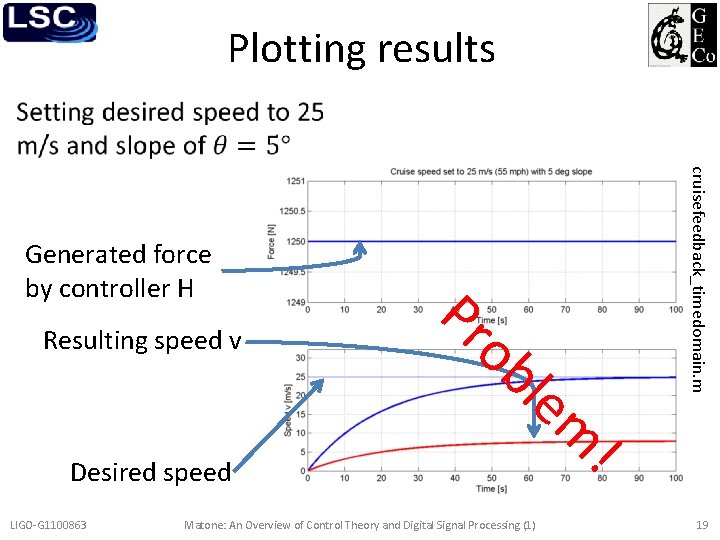
Plotting results • Resulting speed v Pr ob le m Desired speed LIGO-G 1100863 cruisefeedback_timedomain. m Generated force by controller H Matone: An Overview of Control Theory and Digital Signal Processing (1) ! 19
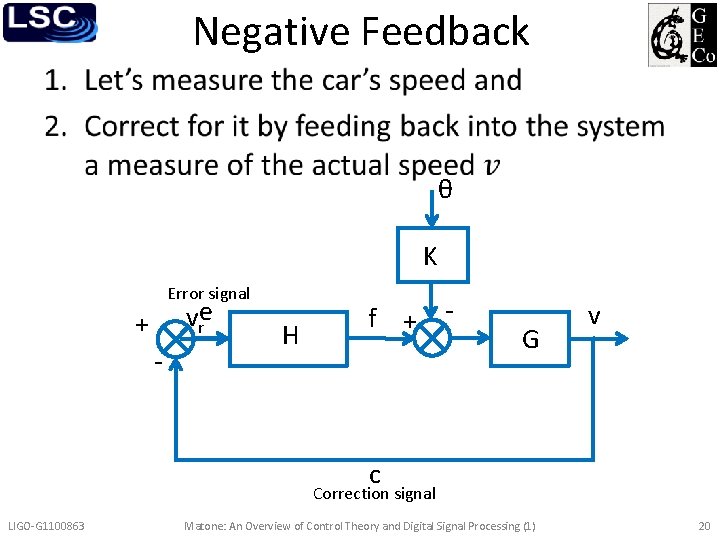
Negative Feedback • θ K Error signal vre + - H f + - G v c Correction signal LIGO-G 1100863 Matone: An Overview of Control Theory and Digital Signal Processing (1) 20
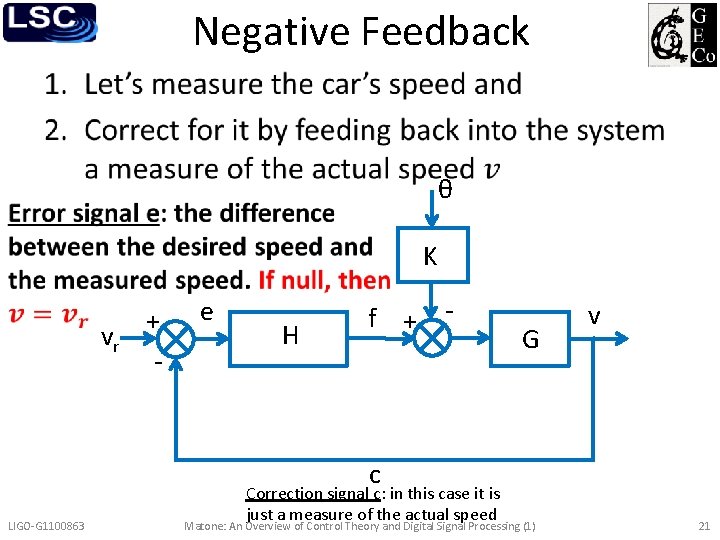
Negative Feedback • θ K vr + - e H f + - G v c LIGO-G 1100863 Correction signal c: in this case it is just a measure of the actual speed Matone: An Overview of Control Theory and Digital Signal Processing (1) 21
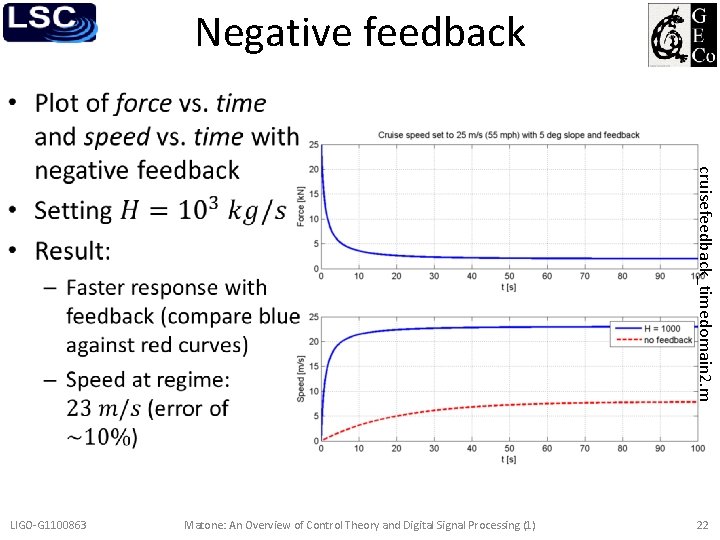
Negative feedback • cruisefeedback_timedomain 2. m LIGO-G 1100863 Matone: An Overview of Control Theory and Digital Signal Processing (1) 22
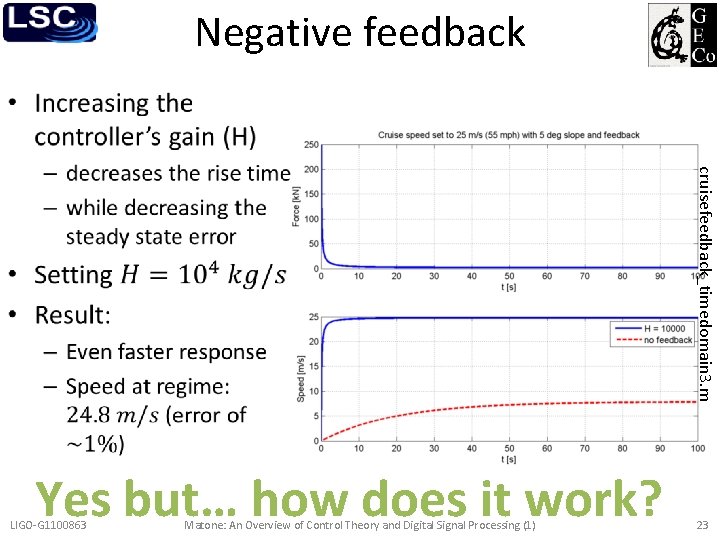
Negative feedback • cruisefeedback_timedomain 3. m Yes but… how does it work? LIGO-G 1100863 Matone: An Overview of Control Theory and Digital Signal Processing (1) 23
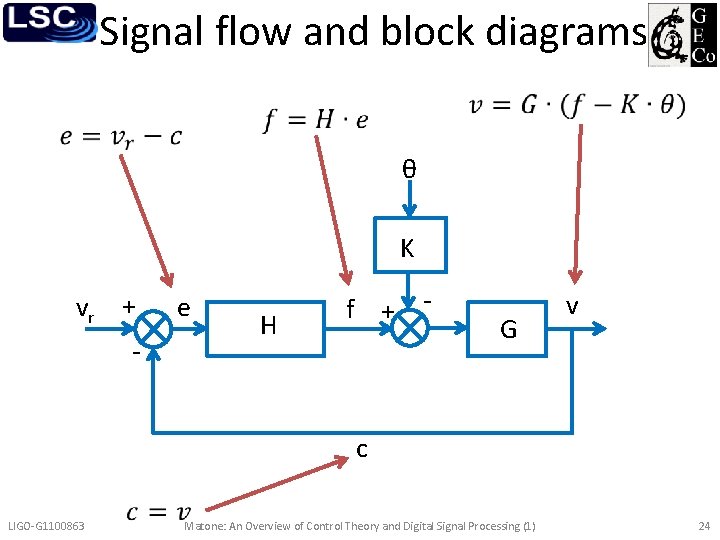
Signal flow and block diagrams θ K vr + - e H f + - G v c LIGO-G 1100863 Matone: An Overview of Control Theory and Digital Signal Processing (1) 24
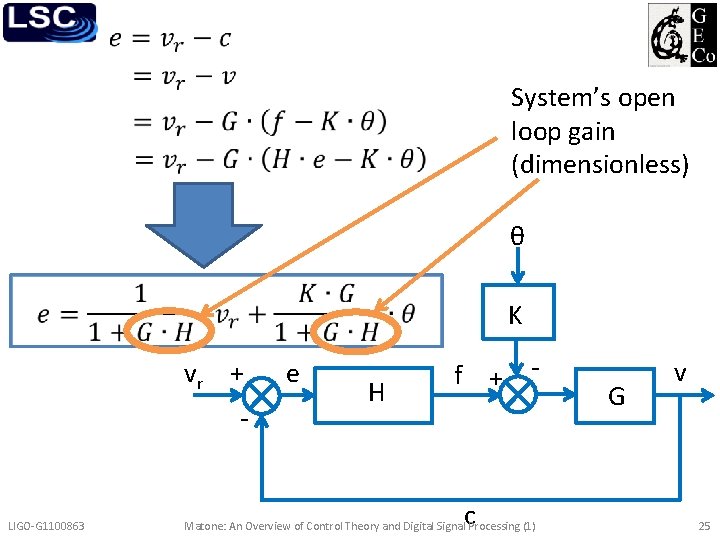
System’s open loop gain (dimensionless) θ K vr + - LIGO-G 1100863 e H f + c - Matone: An Overview of Control Theory and Digital Signal Processing (1) G v 25
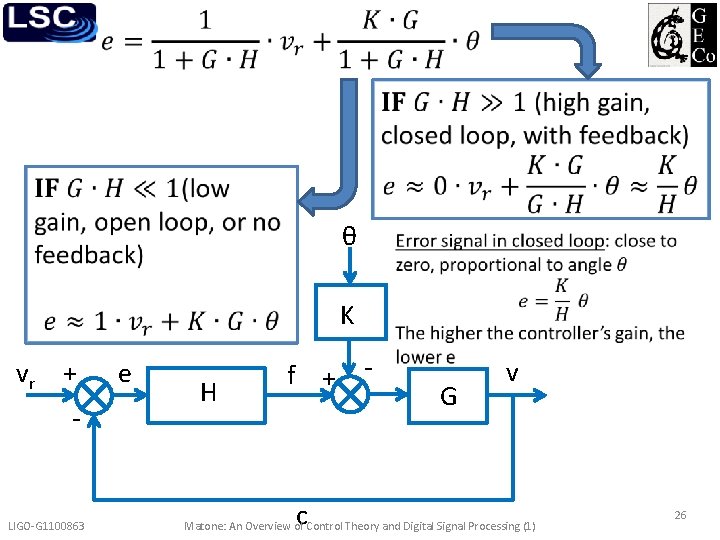
θ K vr + - LIGO-G 1100863 e H f + c - G v Matone: An Overview of Control Theory and Digital Signal Processing (1) 26
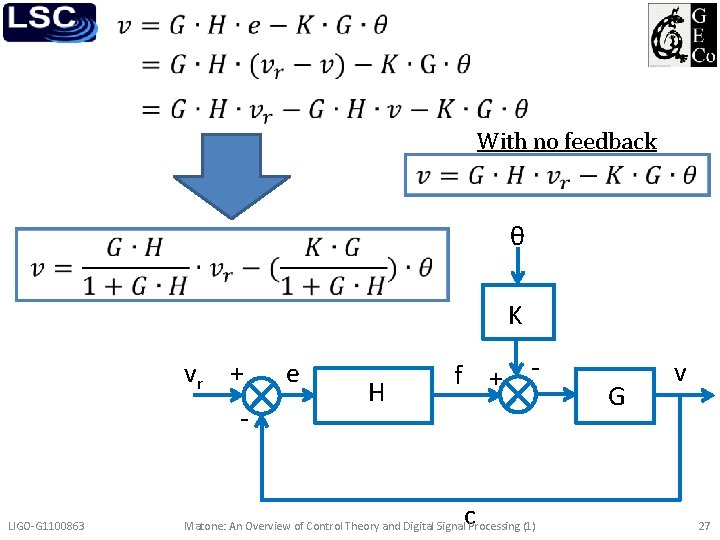
With no feedback θ K vr + - LIGO-G 1100863 e H f + c - Matone: An Overview of Control Theory and Digital Signal Processing (1) G v 27
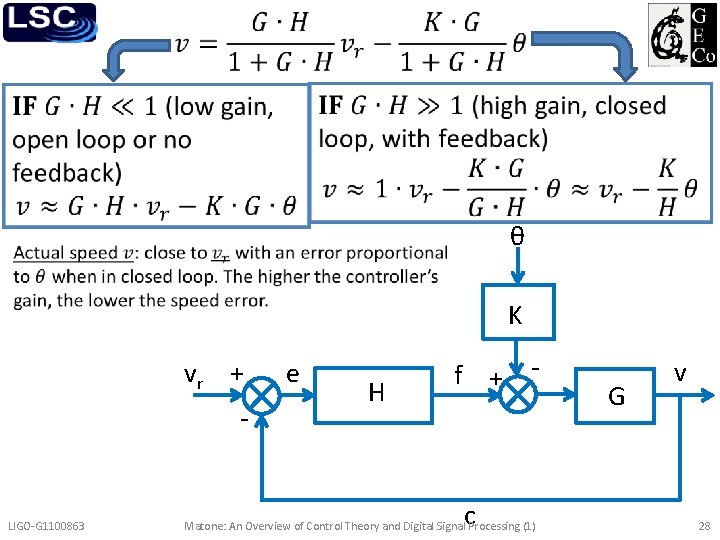
θ K vr + - LIGO-G 1100863 e H f + c - Matone: An Overview of Control Theory and Digital Signal Processing (1) G v 28
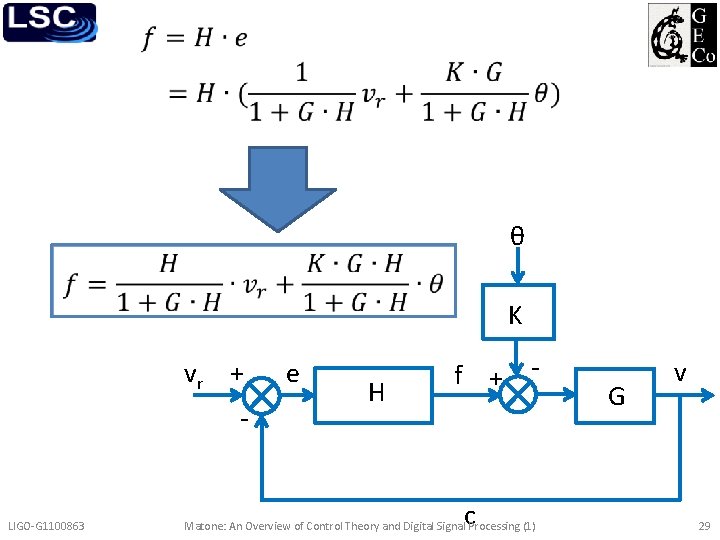
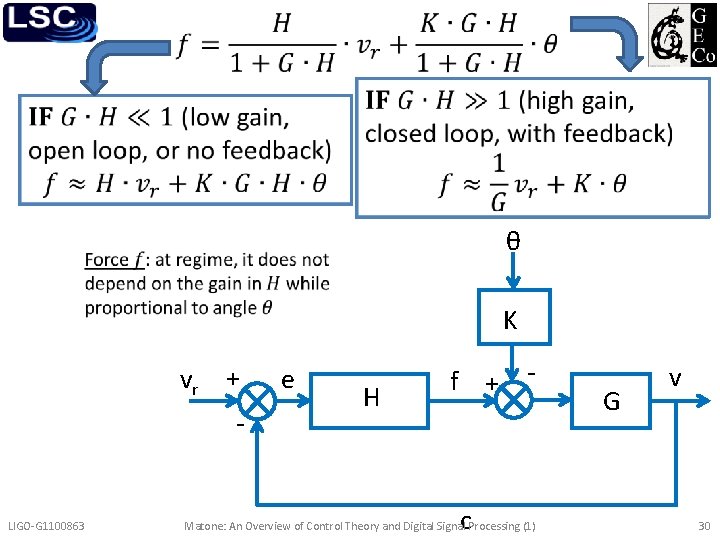
θ K vr + - LIGO-G 1100863 e H f + c - Matone: An Overview of Control Theory and Digital Signal Processing (1) G v 29
θ K vr + - LIGO-G 1100863 e H f + c - Matone: An Overview of Control Theory and Digital Signal Processing (1) G v 30
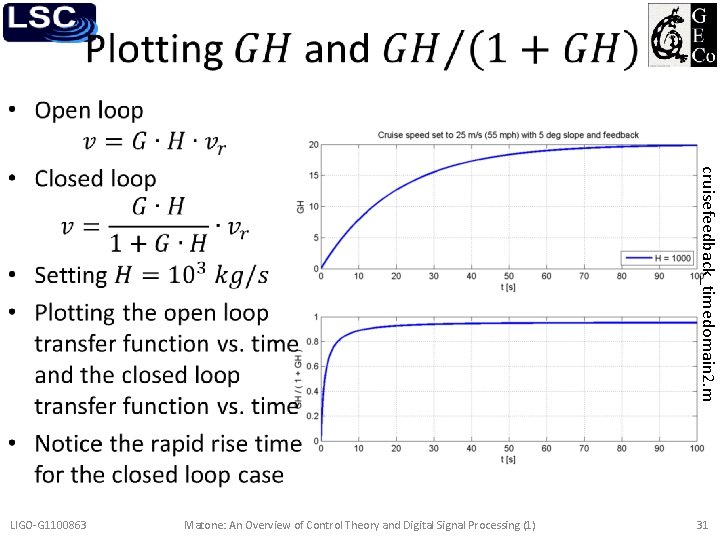
• cruisefeedback_timedomain 2. m LIGO-G 1100863 Matone: An Overview of Control Theory and Digital Signal Processing (1) 31
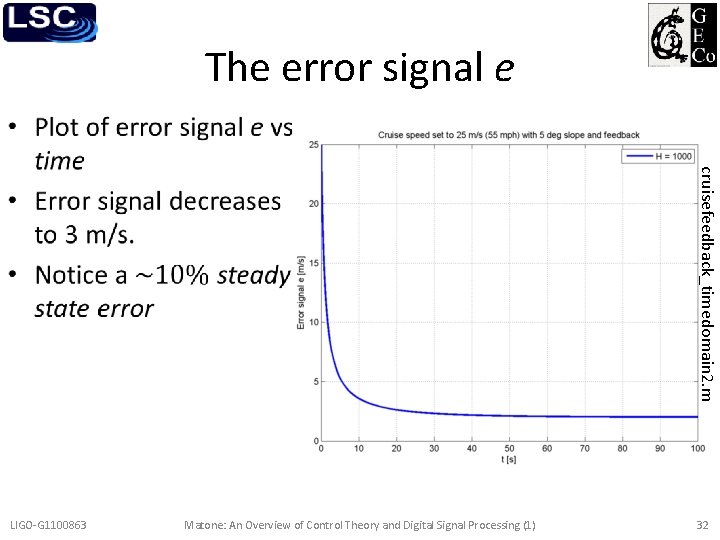
The error signal e • cruisefeedback_timedomain 2. m LIGO-G 1100863 Matone: An Overview of Control Theory and Digital Signal Processing (1) 32
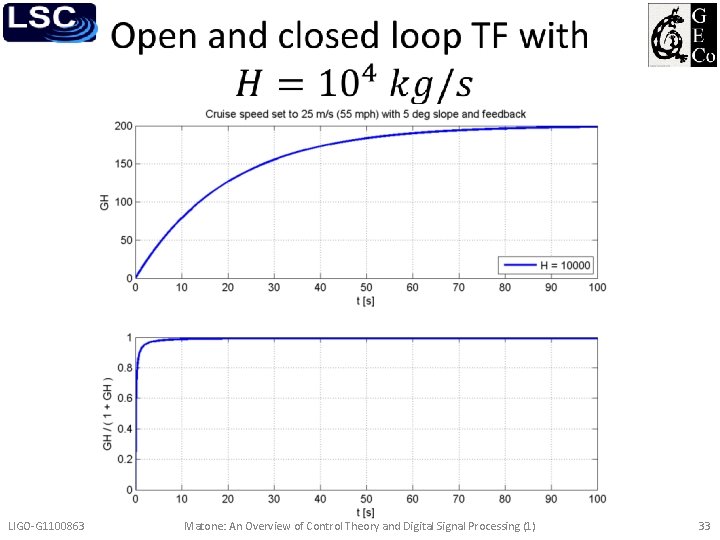
LIGO-G 1100863 Matone: An Overview of Control Theory and Digital Signal Processing (1) 33
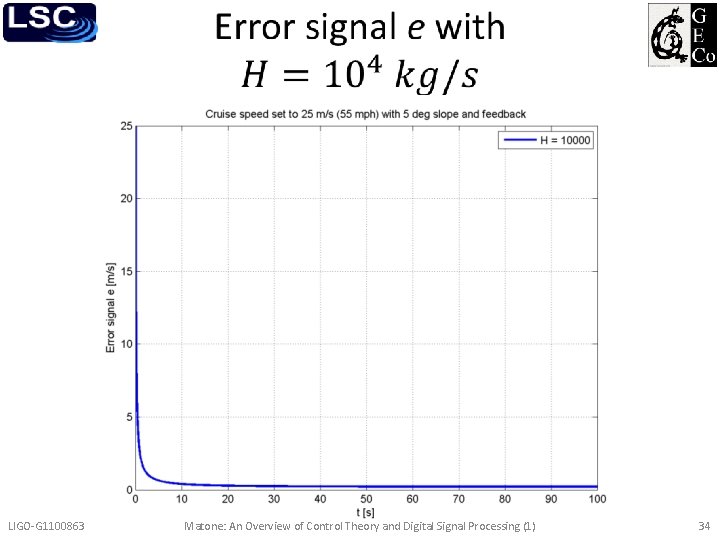
LIGO-G 1100863 Matone: An Overview of Control Theory and Digital Signal Processing (1) 34
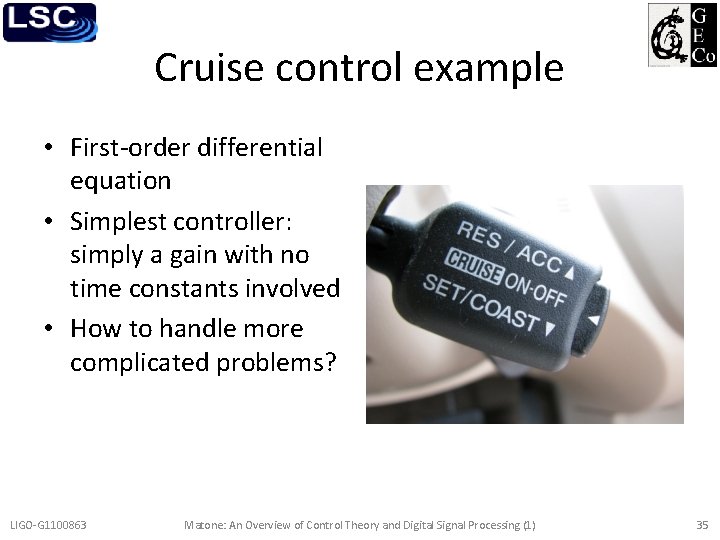
Cruise control example • First-order differential equation • Simplest controller: simply a gain with no time constants involved • How to handle more complicated problems? LIGO-G 1100863 Matone: An Overview of Control Theory and Digital Signal Processing (1) 35
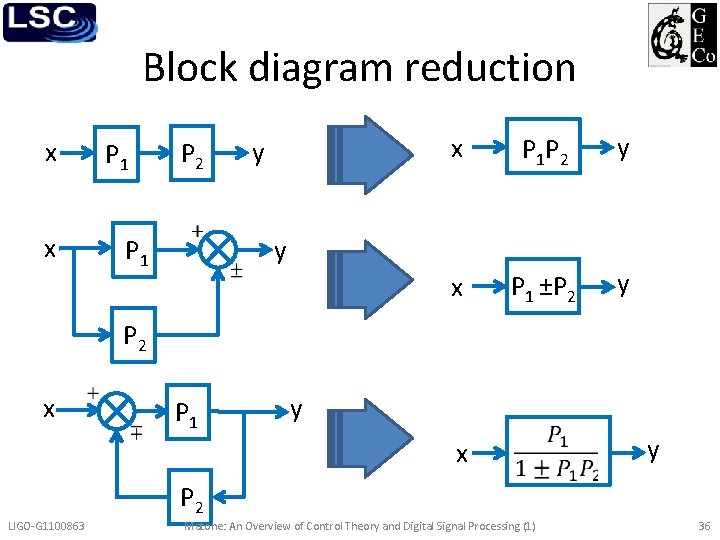
Block diagram reduction x x y P 2 P 1 x P 1 P 2 y x P 1 ±P 2 y y P 2 x P 1 y x y P 2 LIGO-G 1100863 Matone: An Overview of Control Theory and Digital Signal Processing (1) 36
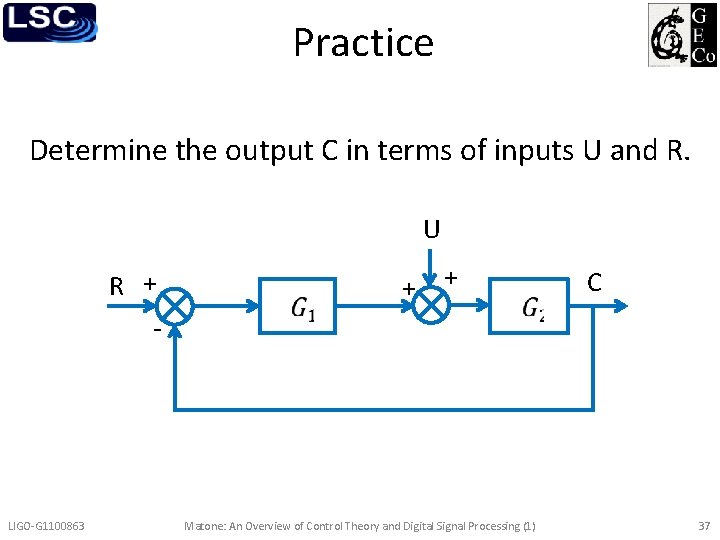
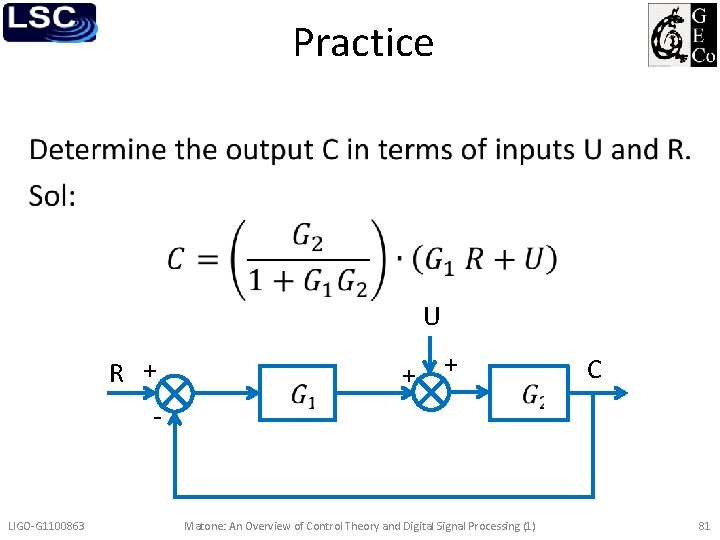
Practice Determine the output C in terms of inputs U and R. U R + - LIGO-G 1100863 + + Matone: An Overview of Control Theory and Digital Signal Processing (1) C 37
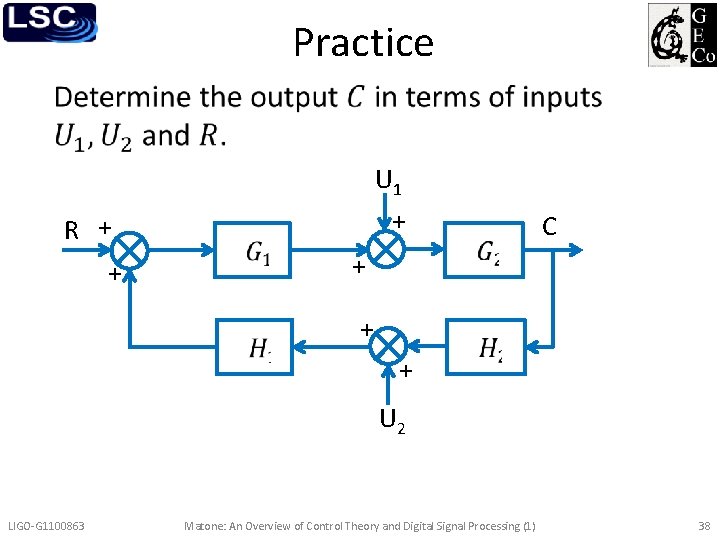
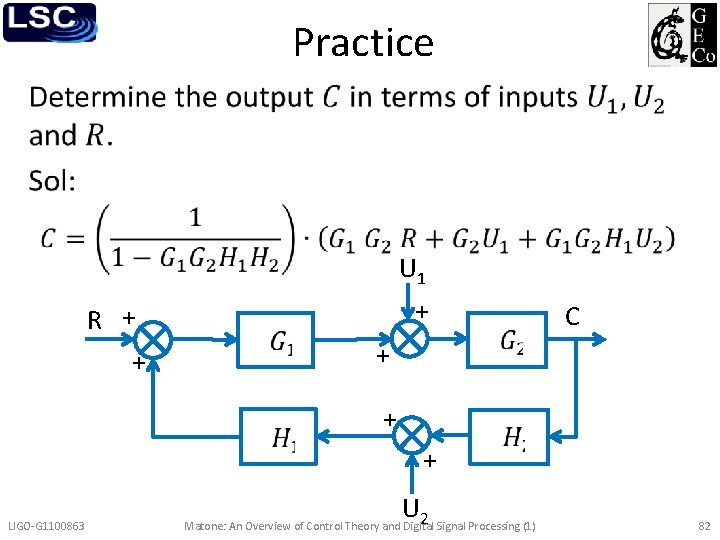
Practice • U 1 R + + + C + U 2 LIGO-G 1100863 Matone: An Overview of Control Theory and Digital Signal Processing (1) 38
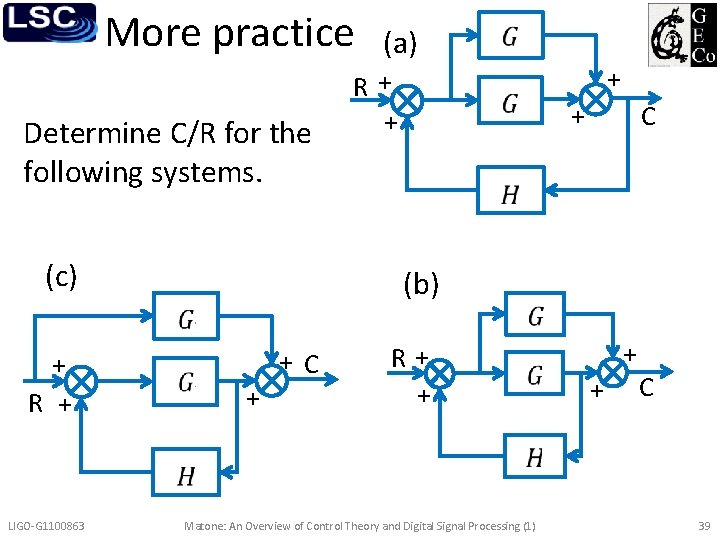
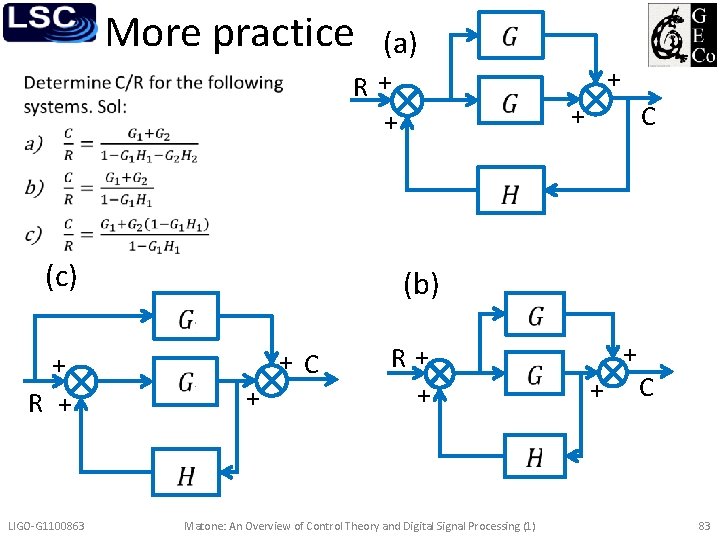
More practice Determine C/R for the following systems. (c) LIGO-G 1100863 R+ + + +C + + C (b) + R + (a) R+ + C Matone: An Overview of Control Theory and Digital Signal Processing (1) 39
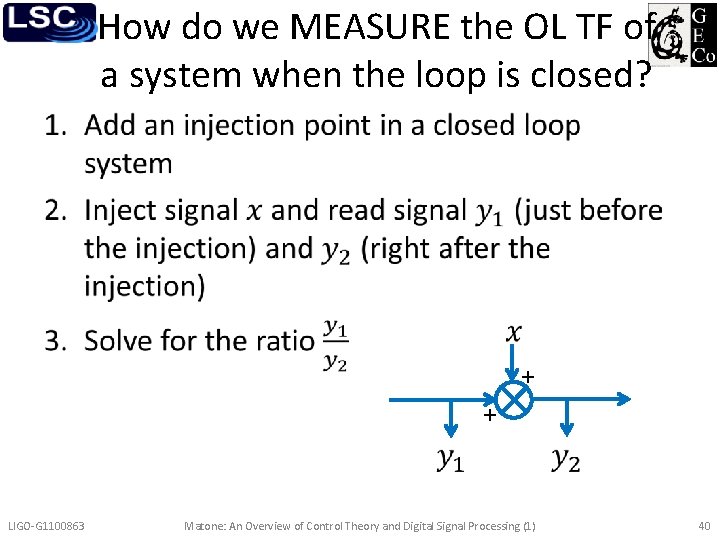
How do we MEASURE the OL TF of a system when the loop is closed? • + + LIGO-G 1100863 Matone: An Overview of Control Theory and Digital Signal Processing (1) 40
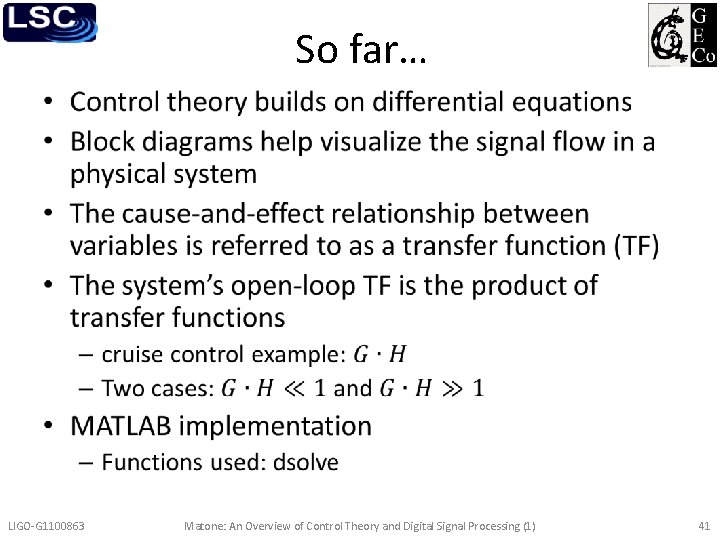
So far… • LIGO-G 1100863 Matone: An Overview of Control Theory and Digital Signal Processing (1) 41
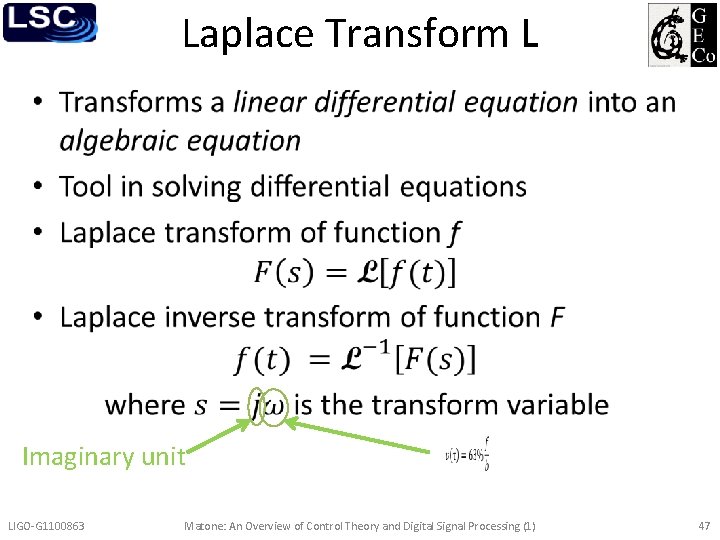
Laplace Transforms • The technique of Laplace transform (and its inverse) facilitates the solution of ordinary differential equations (ODE). • Transformation from the time-domain to the frequency-domain. • Functions are complex, often described in terms of magnitude and phase LIGO-G 1100863 Matone: An Overview of Control Theory and Digital Signal Processing (1) 42
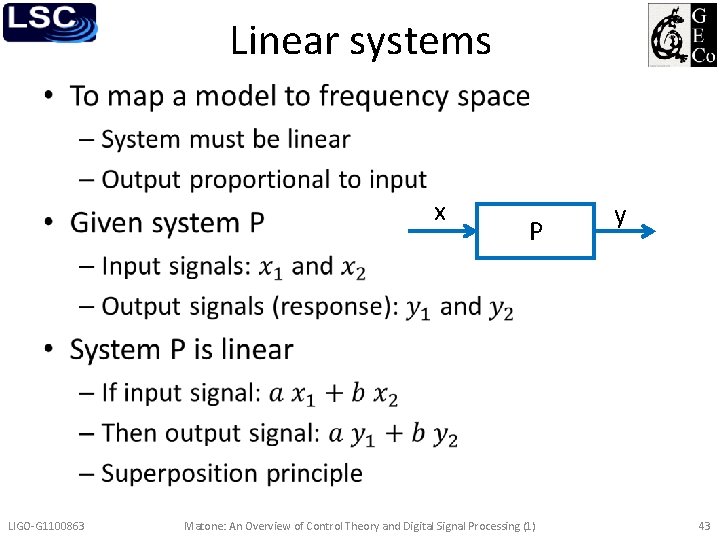
Linear systems • x LIGO-G 1100863 P Matone: An Overview of Control Theory and Digital Signal Processing (1) y 43
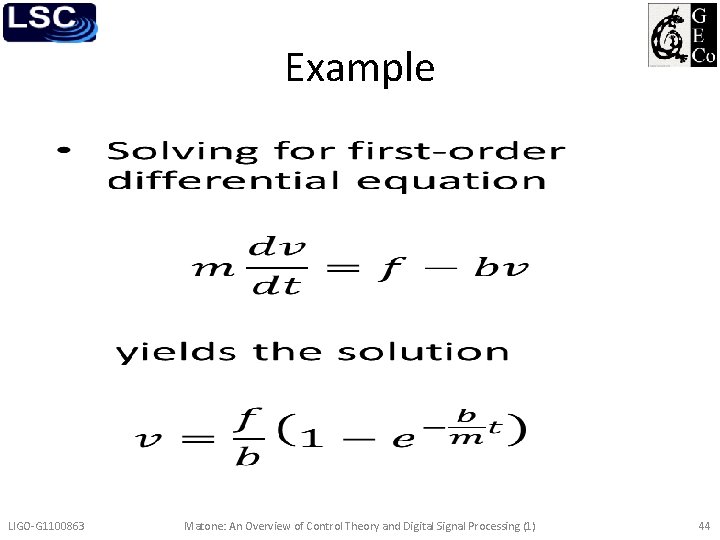
Example • LIGO-G 1100863 Matone: An Overview of Control Theory and Digital Signal Processing (1) 44
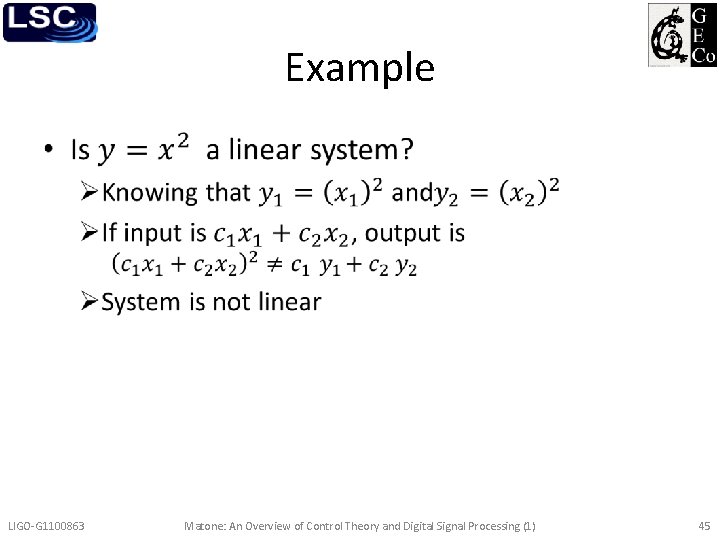
Example • LIGO-G 1100863 Matone: An Overview of Control Theory and Digital Signal Processing (1) 45
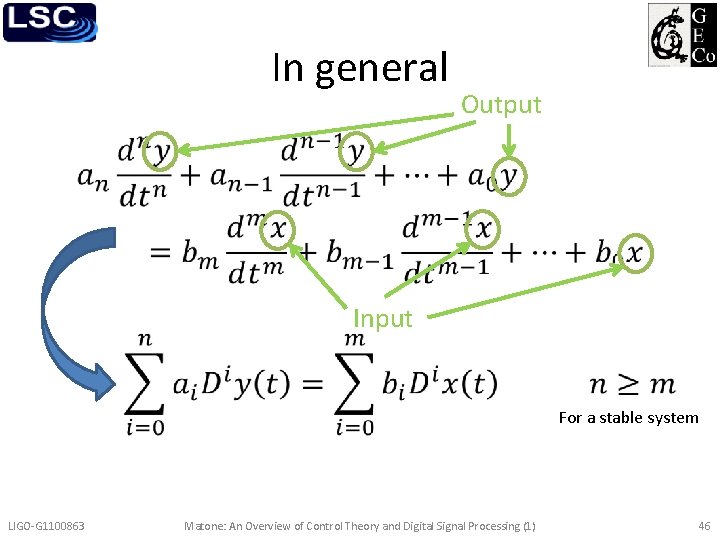
In general Output • Input For a stable system LIGO-G 1100863 Matone: An Overview of Control Theory and Digital Signal Processing (1) 46
Laplace Transform L • Imaginary unit LIGO-G 1100863 Matone: An Overview of Control Theory and Digital Signal Processing (1) 47
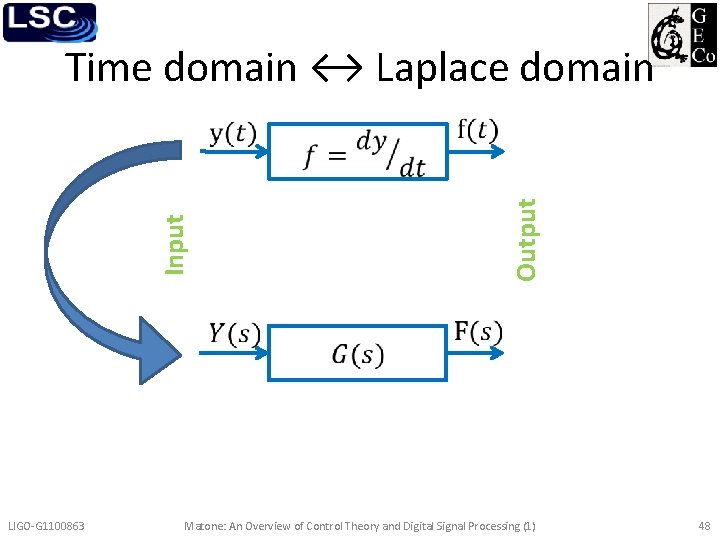
Time domain ↔ Laplace domain Input Output LIGO-G 1100863 Matone: An Overview of Control Theory and Digital Signal Processing (1) 48
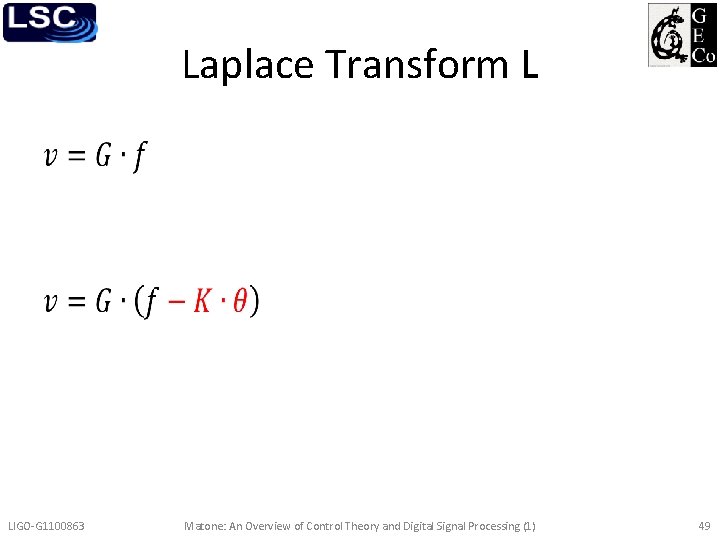
Laplace Transform L • LIGO-G 1100863 Matone: An Overview of Control Theory and Digital Signal Processing (1) 49
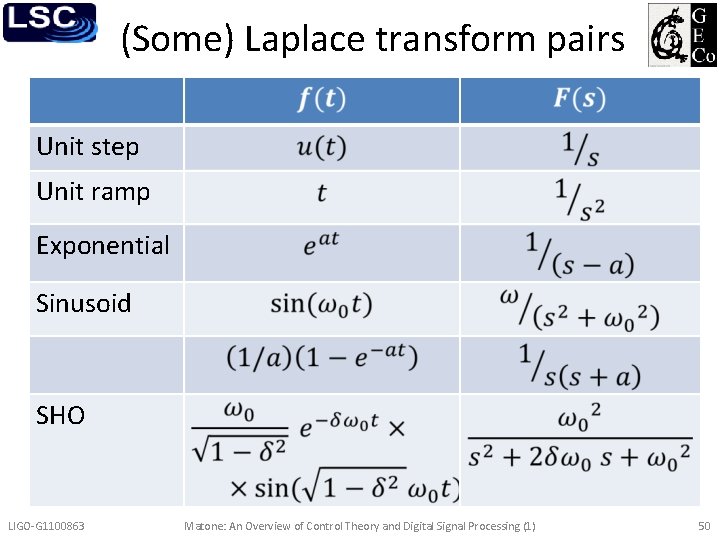
(Some) Laplace transform pairs Unit step Unit ramp Exponential Sinusoid SHO LIGO-G 1100863 Matone: An Overview of Control Theory and Digital Signal Processing (1) 50
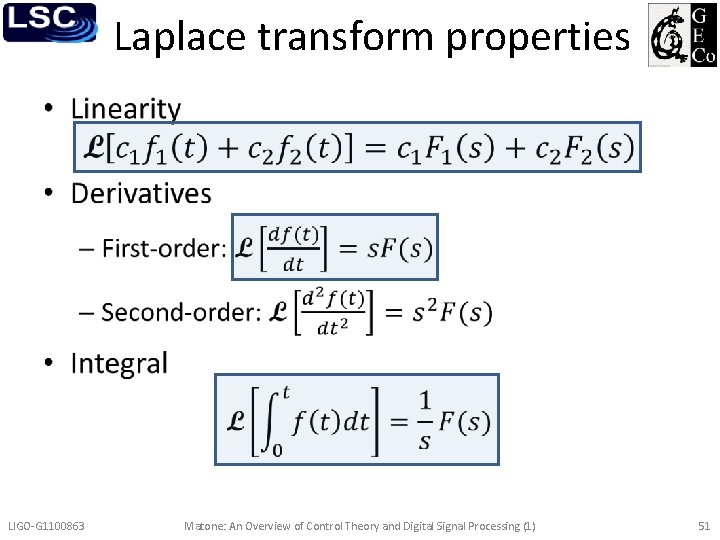
Laplace transform properties • LIGO-G 1100863 Matone: An Overview of Control Theory and Digital Signal Processing (1) 51
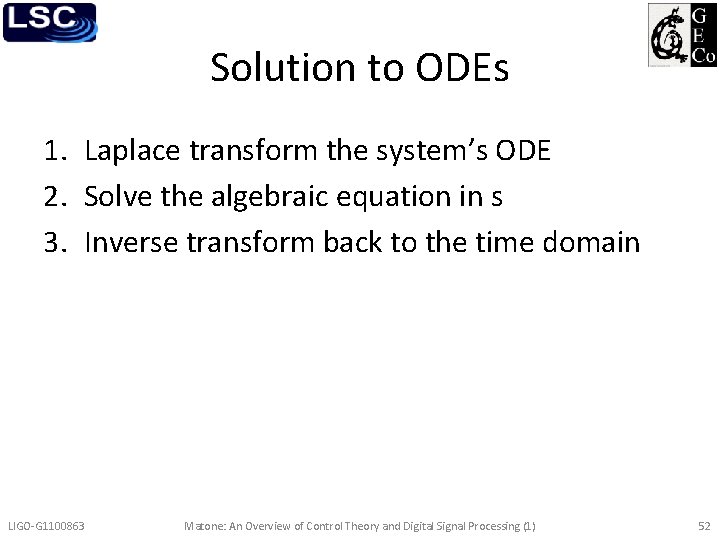
Solution to ODEs 1. Laplace transform the system’s ODE 2. Solve the algebraic equation in s 3. Inverse transform back to the time domain LIGO-G 1100863 Matone: An Overview of Control Theory and Digital Signal Processing (1) 52
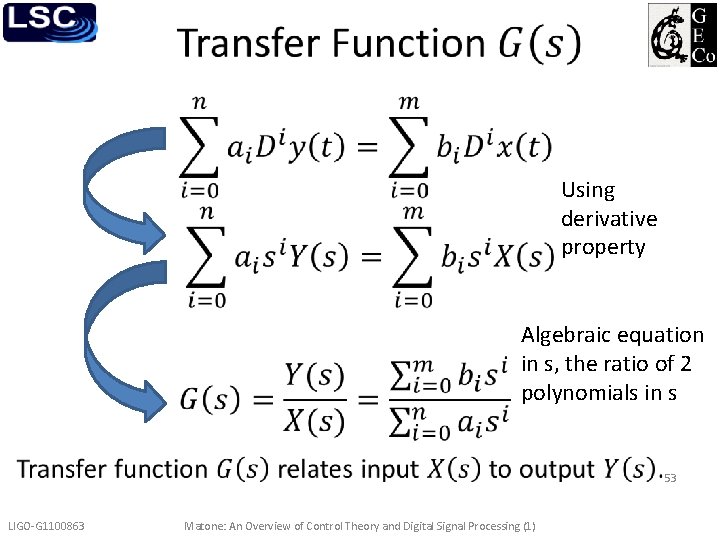
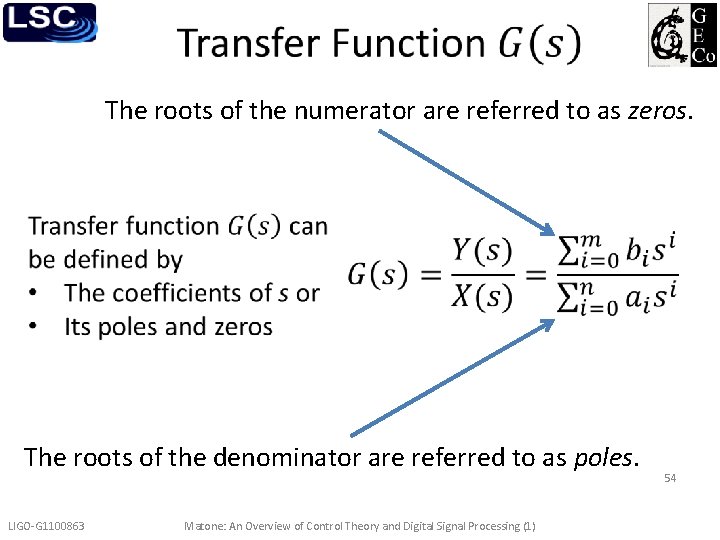
Using derivative property Algebraic equation in s, the ratio of 2 polynomials in s LIGO-G 1100863 53 Matone: An Overview of Control Theory and Digital Signal Processing (1)
The roots of the numerator are referred to as zeros. The roots of the denominator are referred to as poles. LIGO-G 1100863 Matone: An Overview of Control Theory and Digital Signal Processing (1) 54
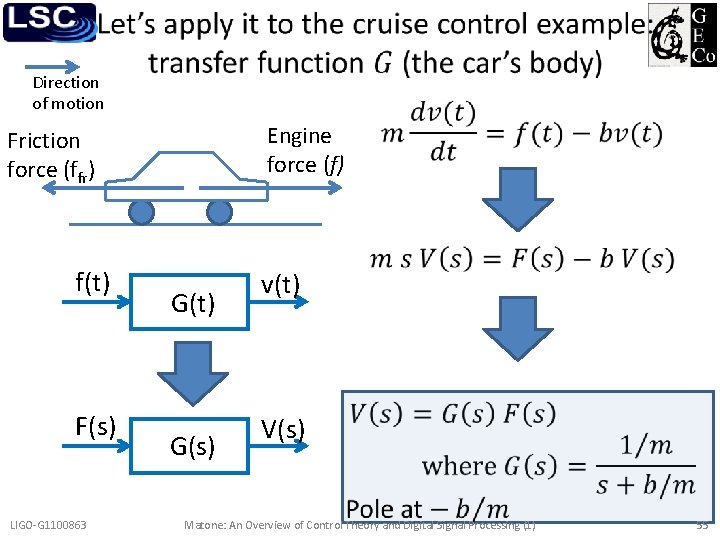
Direction of motion Engine force (f) Friction force (ffr) f(t) F(s) G(t) G(s) • v(t) V(s) LIGO-G 1100863 Matone: An Overview of Control Theory and Digital Signal Processing (1) 55
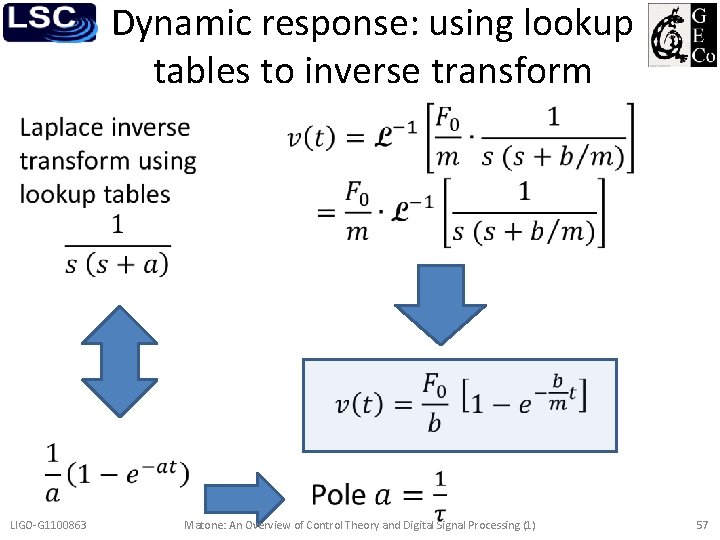
Dynamic response: using lookup tables to inverse transform • LIGO-G 1100863 • Matone: An Overview of Control Theory and Digital Signal Processing (1) 56
Dynamic response: using lookup tables to inverse transform • • LIGO-G 1100863 Matone: An Overview of Control Theory and Digital Signal Processing (1) 57
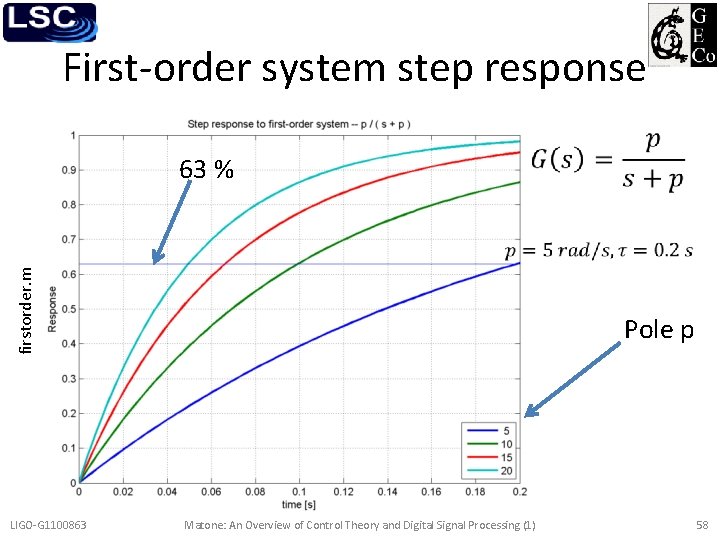
First-order system step response • 63 % firstorder. m LIGO-G 1100863 Pole p Matone: An Overview of Control Theory and Digital Signal Processing (1) 58
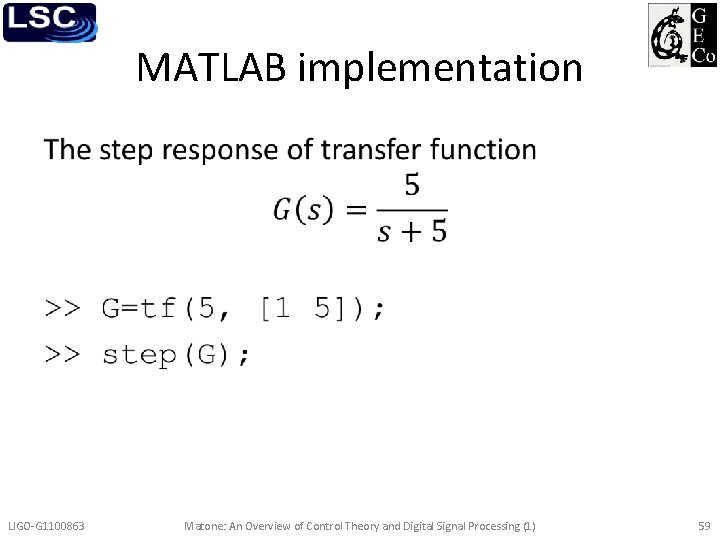
MATLAB implementation • LIGO-G 1100863 Matone: An Overview of Control Theory and Digital Signal Processing (1) 59
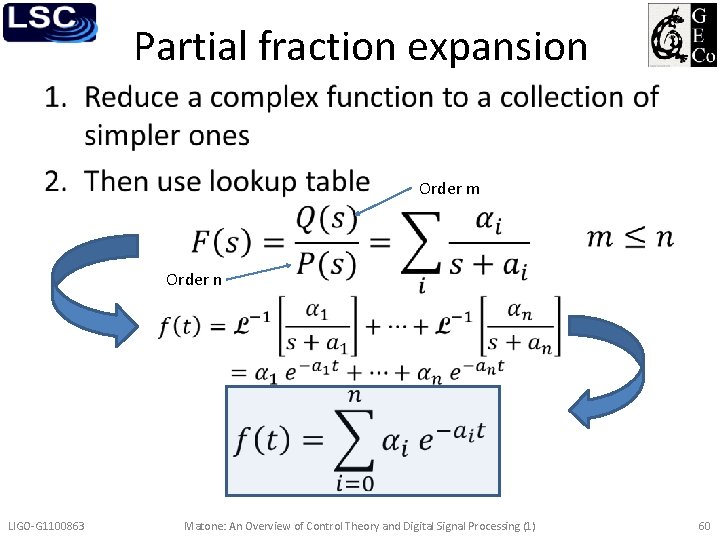
Partial fraction expansion • Order m Order n LIGO-G 1100863 Matone: An Overview of Control Theory and Digital Signal Processing (1) 60
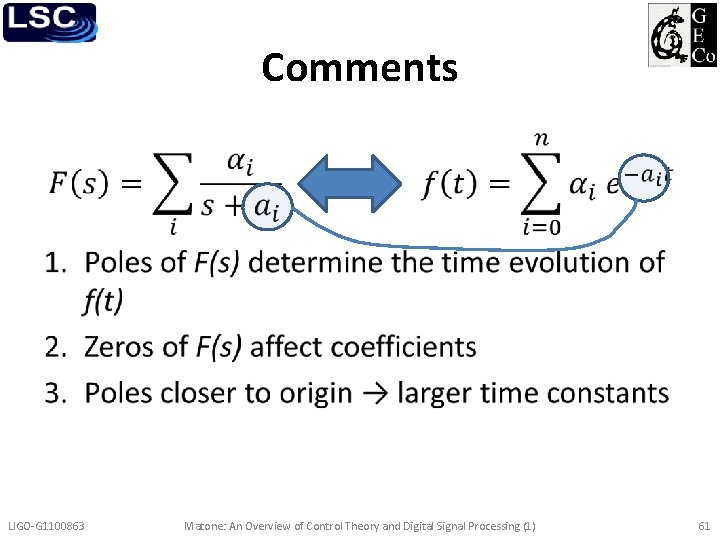
Comments • LIGO-G 1100863 Matone: An Overview of Control Theory and Digital Signal Processing (1) 61
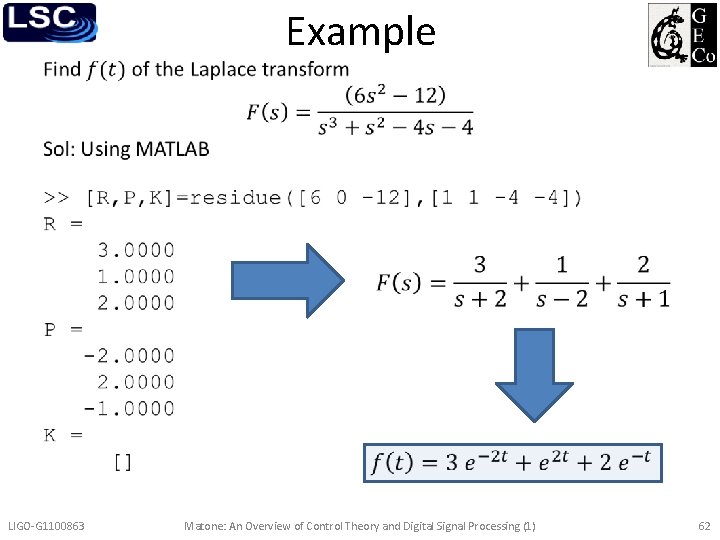
Example • LIGO-G 1100863 Matone: An Overview of Control Theory and Digital Signal Processing (1) 62
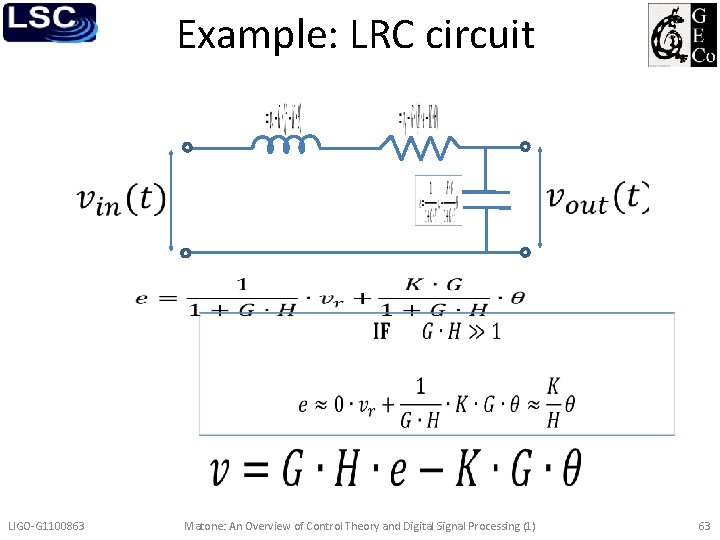
Example: LRC circuit LIGO-G 1100863 Matone: An Overview of Control Theory and Digital Signal Processing (1) 63
Example: LRC circuit LIGO-G 1100863 Matone: An Overview of Control Theory and Digital Signal Processing (1) 64
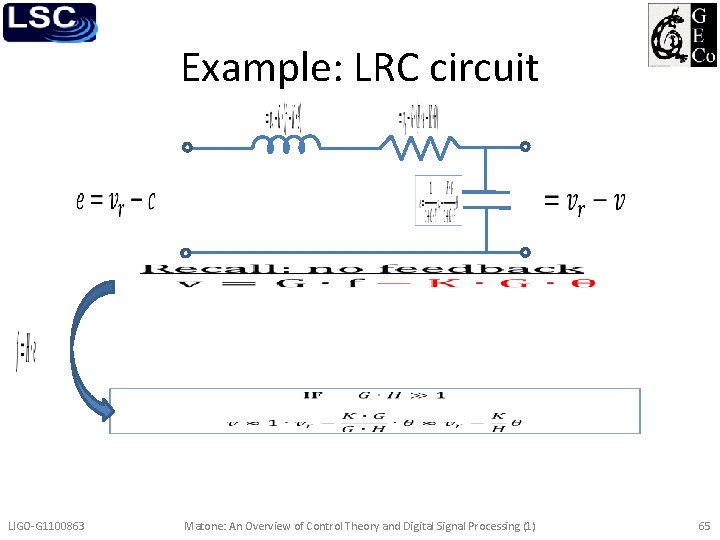
Example: LRC circuit LIGO-G 1100863 Matone: An Overview of Control Theory and Digital Signal Processing (1) 65
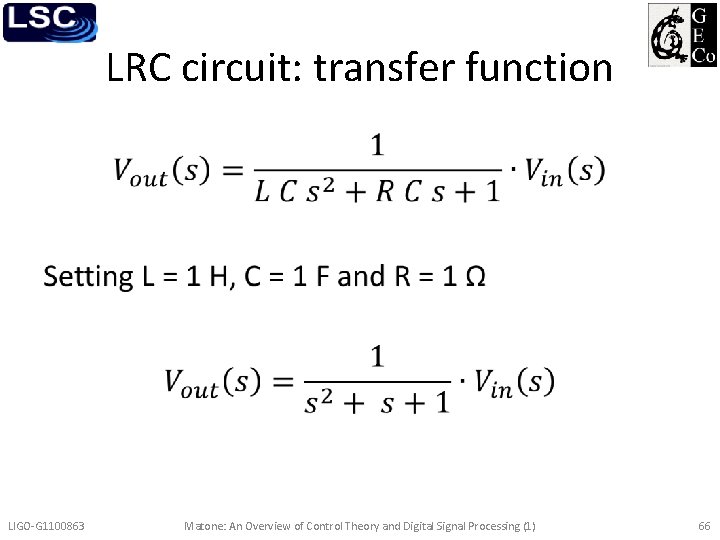
LRC circuit: transfer function • LIGO-G 1100863 Matone: An Overview of Control Theory and Digital Signal Processing (1) 66
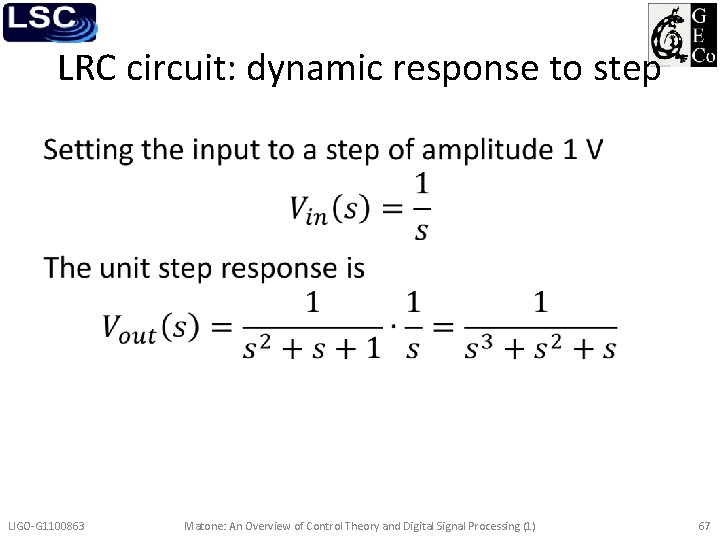
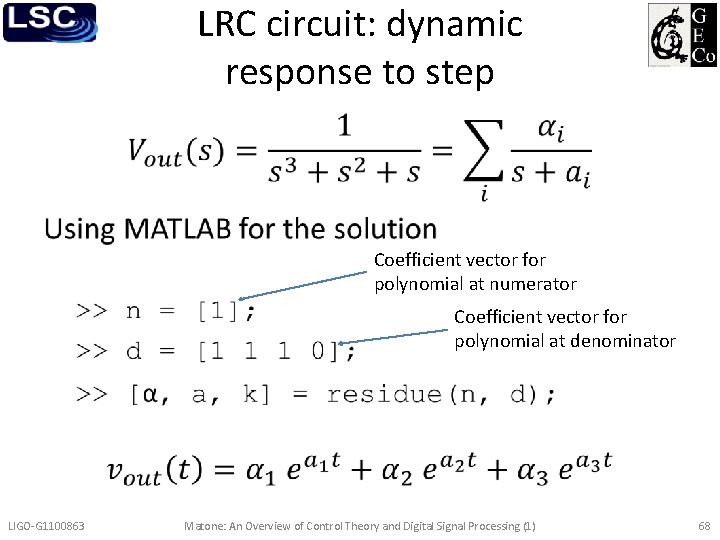
LRC circuit: dynamic response to step • LIGO-G 1100863 Matone: An Overview of Control Theory and Digital Signal Processing (1) 67
LRC circuit: dynamic response to step • Coefficient vector for polynomial at numerator Coefficient vector for polynomial at denominator LIGO-G 1100863 Matone: An Overview of Control Theory and Digital Signal Processing (1) 68
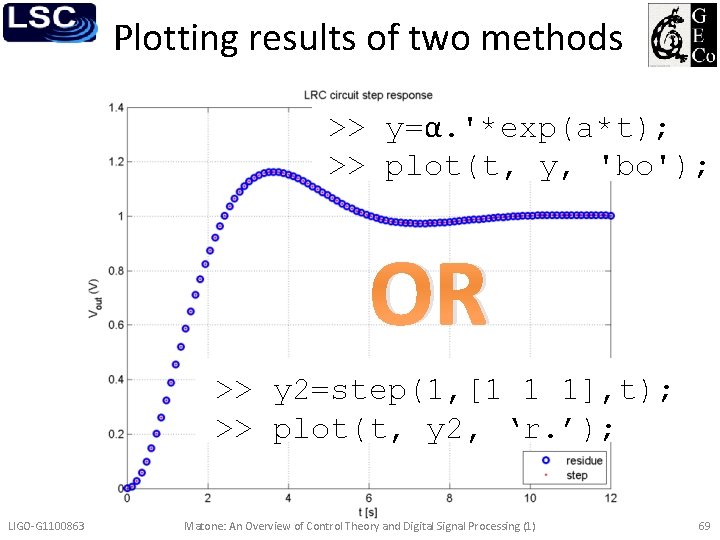
Plotting results of two methods >> y=α. '*exp(a*t); >> plot(t, y, 'bo'); OR >> y 2=step(1, [1 1 1], t); >> plot(t, y 2, ‘r. ’); LIGO-G 1100863 Matone: An Overview of Control Theory and Digital Signal Processing (1) 69
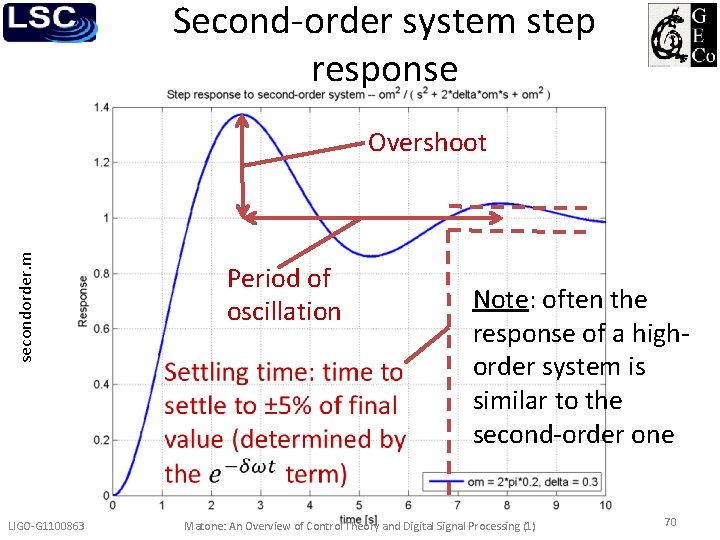
Second-order system step response secondorder. m Overshoot LIGO-G 1100863 Period of oscillation Note: often the response of a highorder system is similar to the second-order one Matone: An Overview of Control Theory and Digital Signal Processing (1) 70
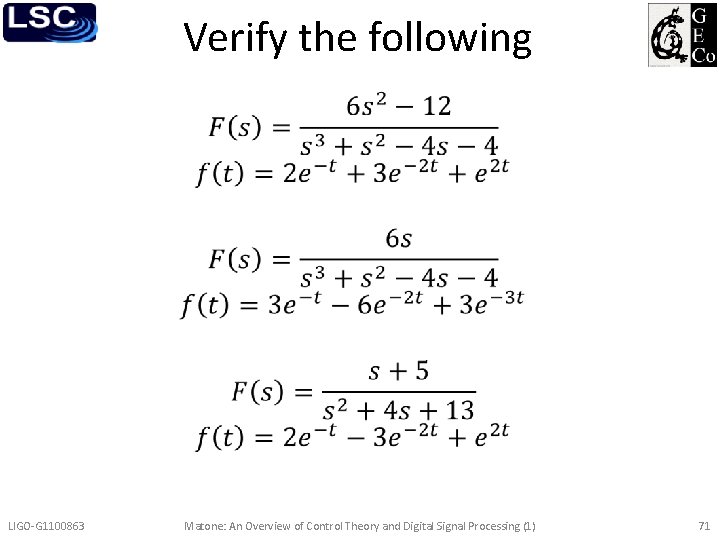
Verify the following • LIGO-G 1100863 Matone: An Overview of Control Theory and Digital Signal Processing (1) 71
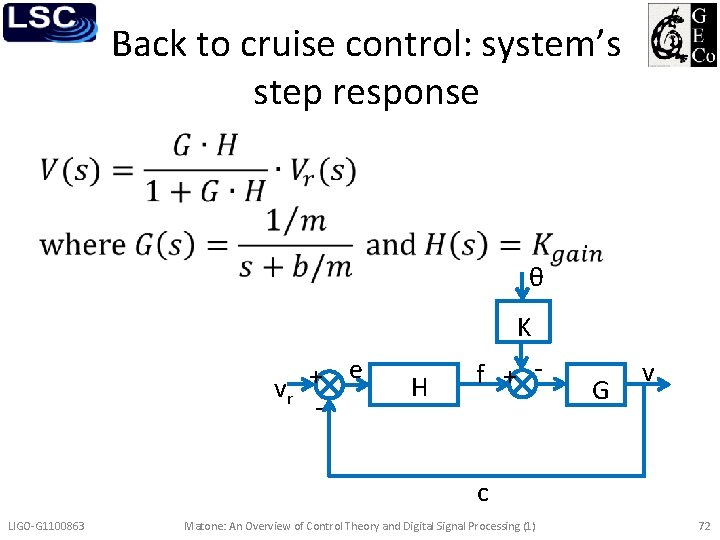
Back to cruise control: system’s step response • θ K e + vr - H f + - G v c LIGO-G 1100863 Matone: An Overview of Control Theory and Digital Signal Processing (1) 72
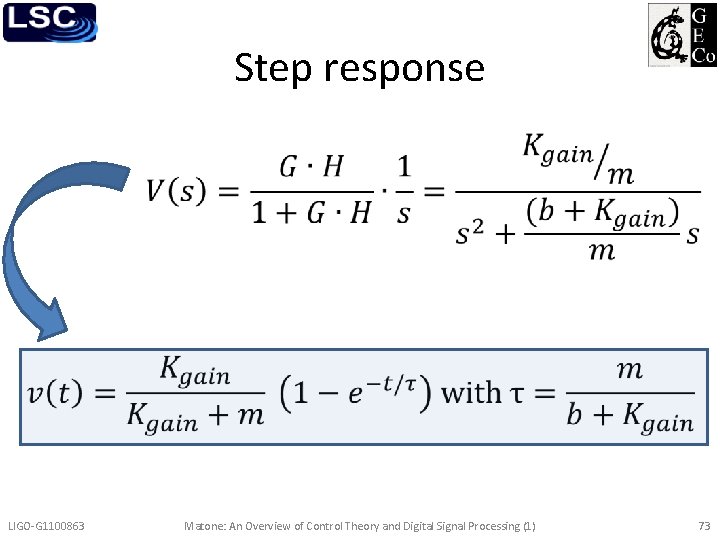
Step response • LIGO-G 1100863 Matone: An Overview of Control Theory and Digital Signal Processing (1) 73
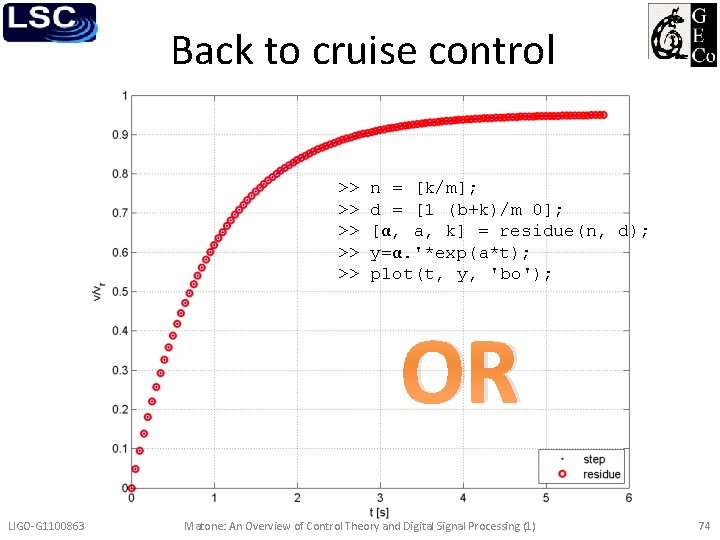
Back to cruise control >> >> >> n = [k/m]; d = [1 (b+k)/m 0]; [α, a, k] = residue(n, d); y=α. '*exp(a*t); plot(t, y, 'bo'); OR LIGO-G 1100863 Matone: An Overview of Control Theory and Digital Signal Processing (1) 74
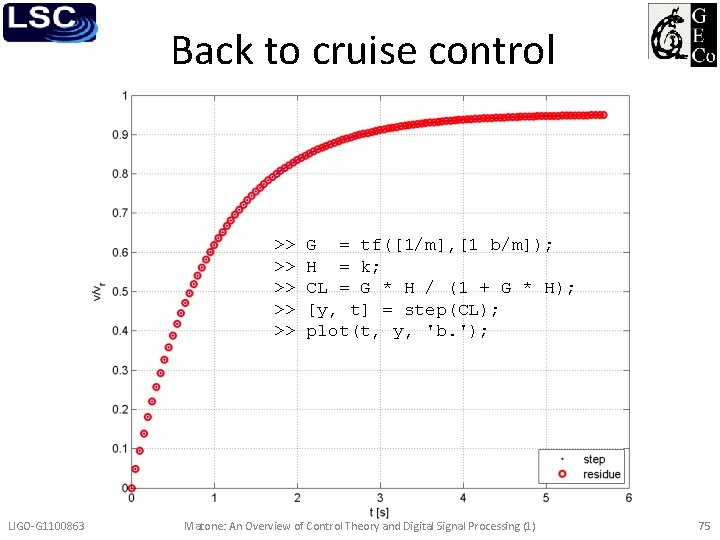
Back to cruise control >> >> >> LIGO-G 1100863 G = tf([1/m], [1 b/m]); H = k; CL = G * H / (1 + G * H); [y, t] = step(CL); plot(t, y, 'b. '); Matone: An Overview of Control Theory and Digital Signal Processing (1) 75
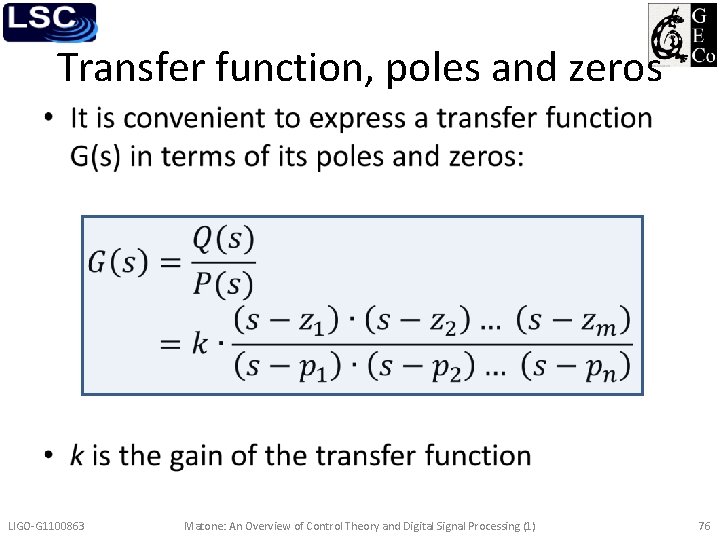
Transfer function, poles and zeros • LIGO-G 1100863 Matone: An Overview of Control Theory and Digital Signal Processing (1) 76
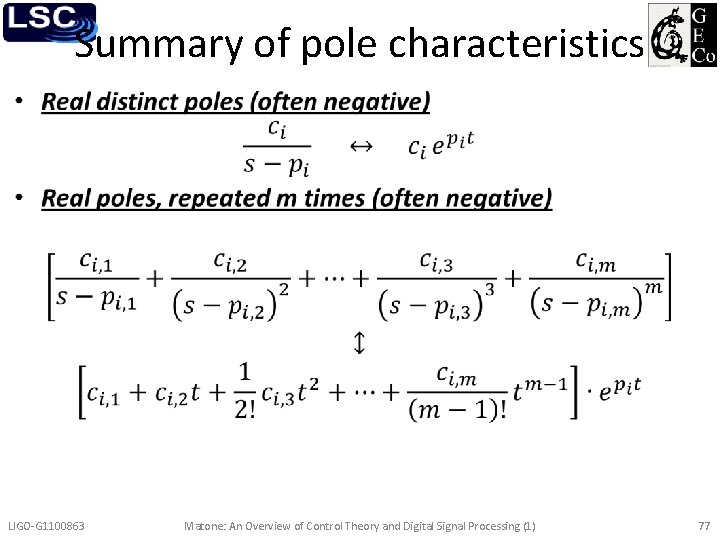
Summary of pole characteristics • LIGO-G 1100863 Matone: An Overview of Control Theory and Digital Signal Processing (1) 77
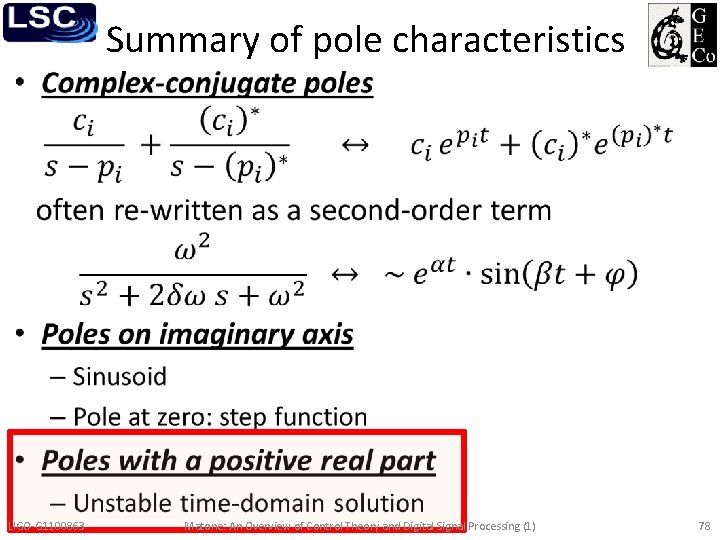
• LIGO-G 1100863 Summary of pole characteristics Matone: An Overview of Control Theory and Digital Signal Processing (1) 78
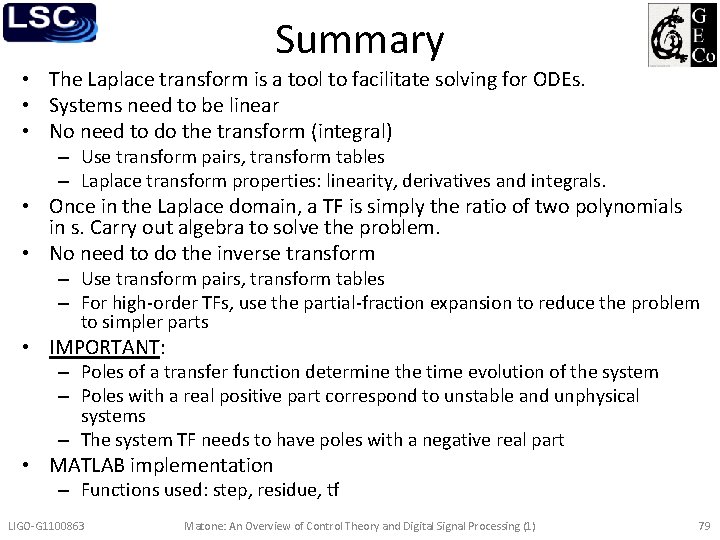
Summary • The Laplace transform is a tool to facilitate solving for ODEs. • Systems need to be linear • No need to do the transform (integral) – Use transform pairs, transform tables – Laplace transform properties: linearity, derivatives and integrals. • Once in the Laplace domain, a TF is simply the ratio of two polynomials in s. Carry out algebra to solve the problem. • No need to do the inverse transform – Use transform pairs, transform tables – For high-order TFs, use the partial-fraction expansion to reduce the problem to simpler parts • IMPORTANT: – Poles of a transfer function determine the time evolution of the system – Poles with a real positive part correspond to unstable and unphysical systems – The system TF needs to have poles with a negative real part • MATLAB implementation – Functions used: step, residue, tf LIGO-G 1100863 Matone: An Overview of Control Theory and Digital Signal Processing (1) 79
Solutions LIGO-G 1100863 Matone: An Overview of Control Theory and Digital Signal Processing (1) 80
Practice • U R + - LIGO-G 1100863 + + Matone: An Overview of Control Theory and Digital Signal Processing (1) C 81
Practice • U 1 R + + + C + LIGO-G 1100863 U 2 Matone: An Overview of Control Theory and Digital Signal Processing (1) 82
More practice (a) R+ + • + + C (c) (b) + R + LIGO-G 1100863 + +C R+ + C Matone: An Overview of Control Theory and Digital Signal Processing (1) 83
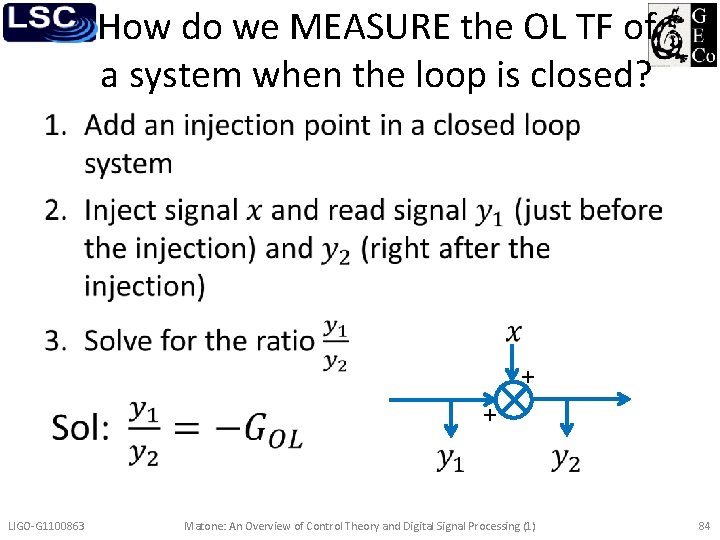
How do we MEASURE the OL TF of a system when the loop is closed? • + + LIGO-G 1100863 Matone: An Overview of Control Theory and Digital Signal Processing (1) 84
Partial-fraction examples • Denominator: has distinct, real roots – Example 2. 4, 2. 5, 2. 6 • Denominator: complex roots – Example 2. 7, 2. 8 • Denominator: repeated roots – Example 2. 9 LIGO-G 1100863 Matone: An Overview of Control Theory and Digital Signal Processing (1) 85
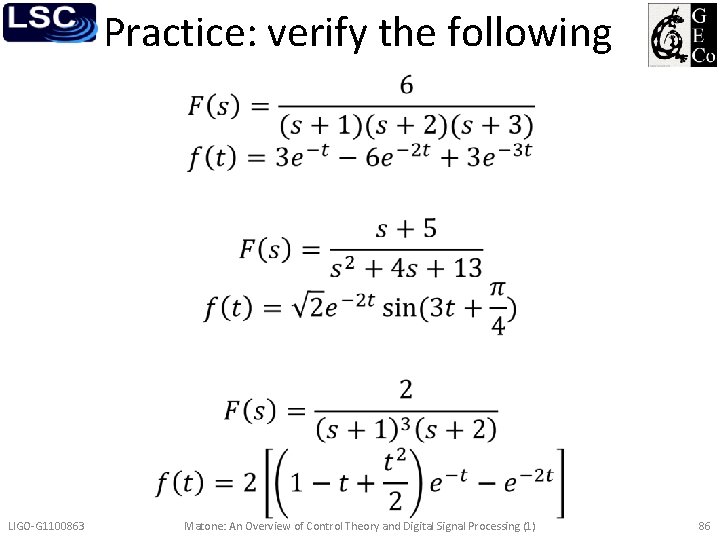
Practice: verify the following • LIGO-G 1100863 Matone: An Overview of Control Theory and Digital Signal Processing (1) 86