
An Overview of Behavior Screening Tools Using Data
An Overview of Behavior Screening Tools: Using Data to Inform Instruction New York, May 1, 2015 Kathleen Lynne Lane, Ph. D. , BCBA-D
Agenda • Comprehensive, Integrated, Three-tiered (CI 3 T) Models of Prevention • The Importance of Systematic Screening • Using Screening Data. . . – implications for primary prevention efforts – implications for teachers – implications for student-based interventions at Tier 2 and Tier 3
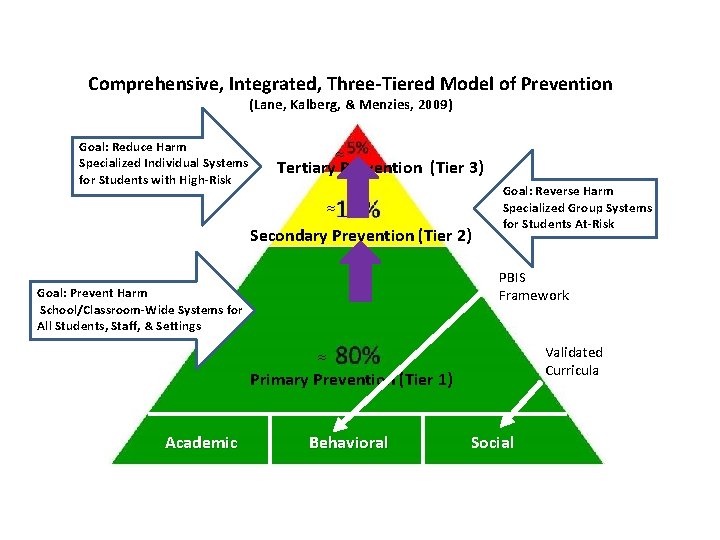
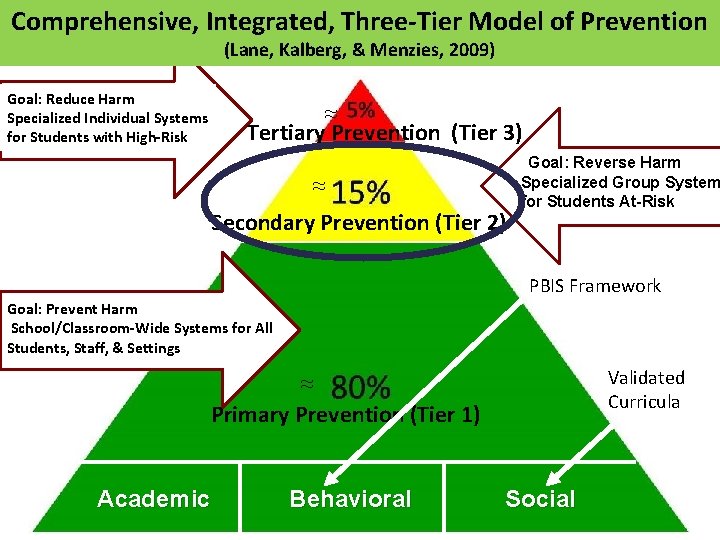
Comprehensive, Integrated, Three-Tiered Model of Prevention (Lane, Kalberg, & Menzies, 2009) Goal: Reduce Harm Specialized Individual Systems for Students with High-Risk ≈ Tertiary Prevention (Tier 3) ≈ Secondary Prevention (Tier 2) Goal: Reverse Harm Specialized Group Systems for Students At-Risk PBIS Framework Goal: Prevent Harm School/Classroom-Wide Systems for All Students, Staff, & Settings Validated Curricula ≈ Primary Prevention (Tier 1) Academic Behavioral Social
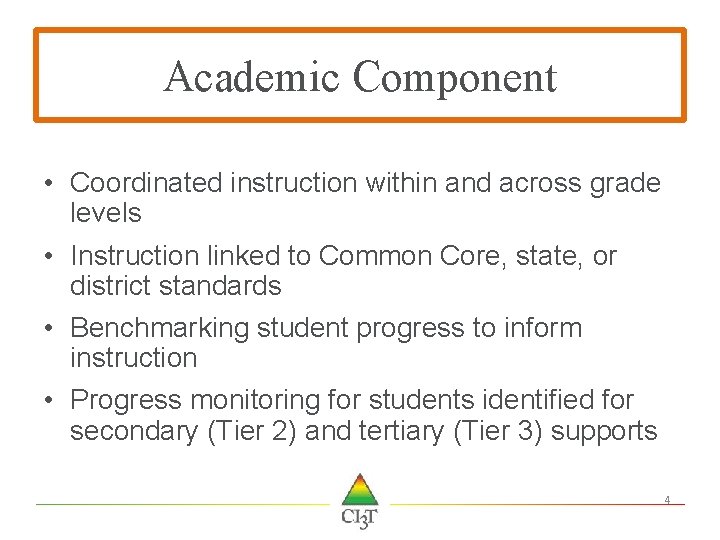
Academic Component • Coordinated instruction within and across grade levels • Instruction linked to Common Core, state, or district standards • Benchmarking student progress to inform instruction • Progress monitoring for students identified for secondary (Tier 2) and tertiary (Tier 3) supports 4
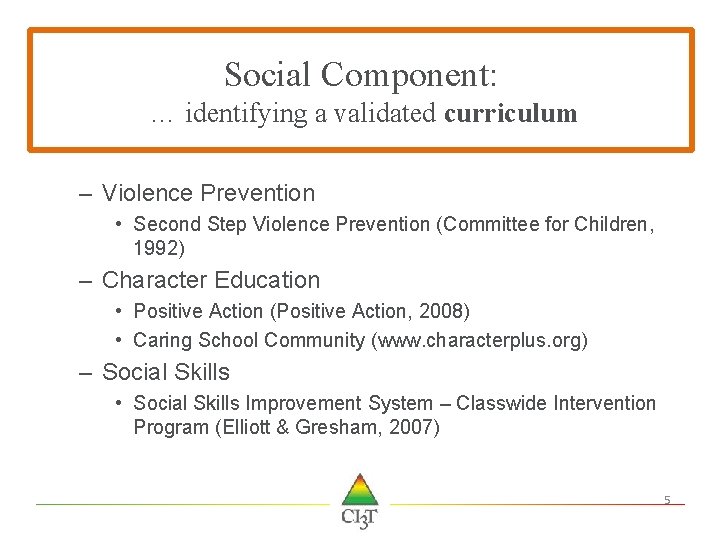
Social Component: … identifying a validated curriculum – Violence Prevention • Second Step Violence Prevention (Committee for Children, 1992) – Character Education • Positive Action (Positive Action, 2008) • Caring School Community (www. characterplus. org) – Social Skills • Social Skills Improvement System – Classwide Intervention Program (Elliott & Gresham, 2007) 5
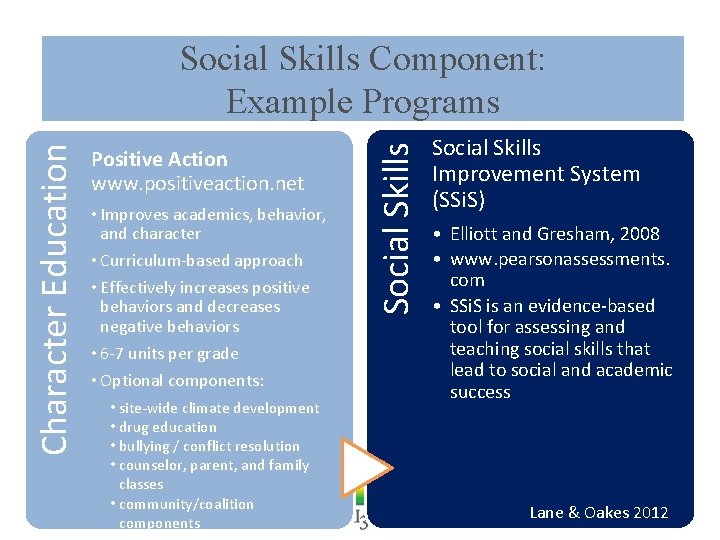
Positive Action www. positiveaction. net • Improves academics, behavior, and character • Curriculum-based approach • Effectively increases positive behaviors and decreases negative behaviors • 6 -7 units per grade • Optional components: • site-wide climate development • drug education • bullying / conflict resolution • counselor, parent, and family classes • community/coalition components Social Skills Character Education Social Skills Component: Example Programs Social Skills Improvement System (SSi. S) • Elliott and Gresham, 2008 • www. pearsonassessments. com • SSi. S is an evidence-based tool for assessing and teaching social skills that lead to social and academic success Lane & Oakes 2012
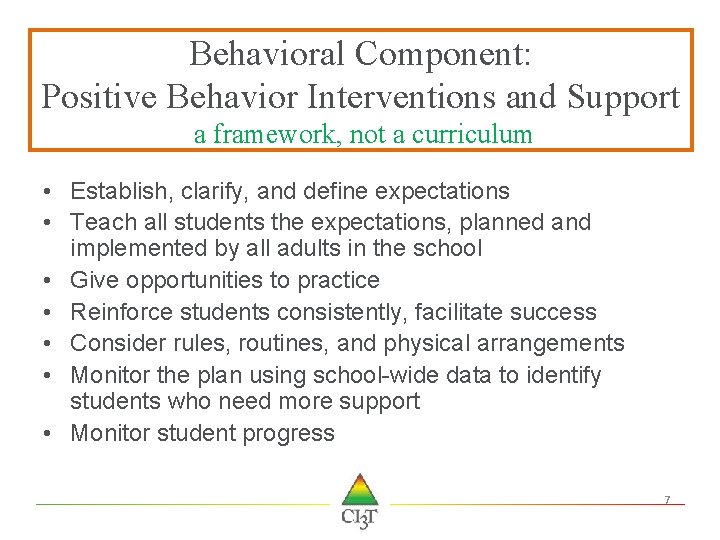
Behavioral Component: Positive Behavior Interventions and Support a framework, not a curriculum • Establish, clarify, and define expectations • Teach all students the expectations, planned and implemented by all adults in the school • Give opportunities to practice • Reinforce students consistently, facilitate success • Consider rules, routines, and physical arrangements • Monitor the plan using school-wide data to identify students who need more support • Monitor student progress 7
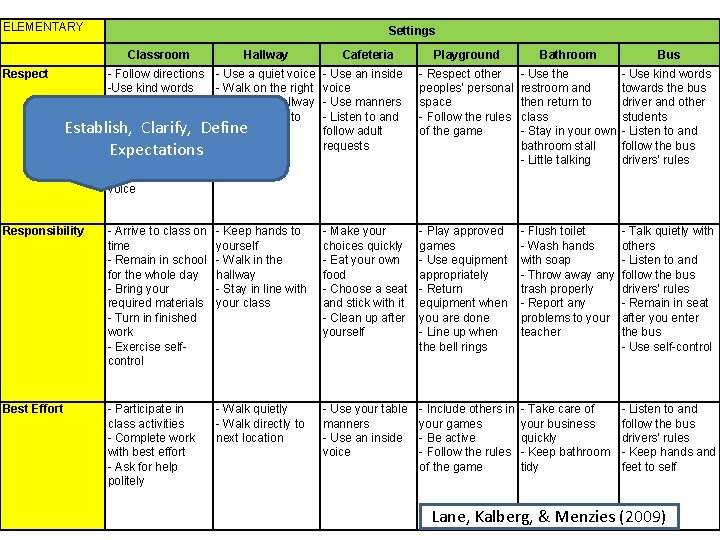
ELEMENTARY Settings Classroom Respect Hallway - Follow directions - Use a quiet voice -Use kind words - Walk on the right and actions side of the hallway - Control your - Keep hands to Establish, temper. Clarify, Define yourself -Expectations Cooperate with others - Use an inside voice Cafeteria Playground Bathroom Bus - Use an inside voice - Use manners - Listen to and follow adult requests - Respect other peoples’ personal space - Follow the rules of the game - Use the restroom and then return to class - Stay in your own bathroom stall - Little talking - Use kind words towards the bus driver and other students - Listen to and follow the bus drivers’ rules Responsibility - Arrive to class on time - Remain in school for the whole day - Bring your required materials - Turn in finished work - Exercise selfcontrol - Keep hands to yourself - Walk in the hallway - Stay in line with your class - Make your choices quickly - Eat your own food - Choose a seat and stick with it - Clean up after yourself - Play approved games - Use equipment appropriately - Return equipment when you are done - Line up when the bell rings - Flush toilet - Wash hands with soap - Throw away any trash properly - Report any problems to your teacher - Talk quietly with others - Listen to and follow the bus drivers’ rules - Remain in seat after you enter the bus - Use self-control Best Effort - Participate in class activities - Complete work with best effort - Ask for help politely - Walk quietly - Walk directly to next location - Use your table manners - Use an inside voice - Include others in your games - Be active - Follow the rules of the game - Take care of your business quickly - Keep bathroom tidy - Listen to and follow the bus drivers’ rules - Keep hands and feet to self Lane, Kalberg, & Menzies (2009)
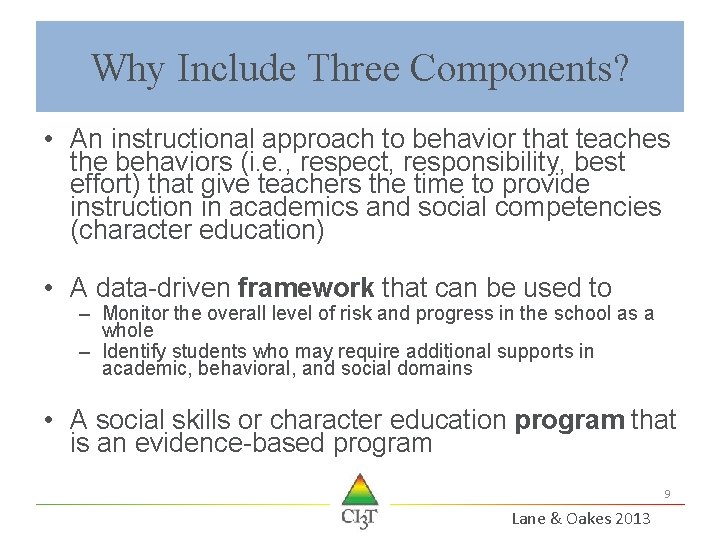
Why Include Three Components? • An instructional approach to behavior that teaches the behaviors (i. e. , respect, responsibility, best effort) that give teachers the time to provide instruction in academics and social competencies (character education) • A data-driven framework that can be used to – Monitor the overall level of risk and progress in the school as a whole – Identify students who may require additional supports in academic, behavioral, and social domains • A social skills or character education program that is an evidence-based program 9 Lane & Oakes 2013
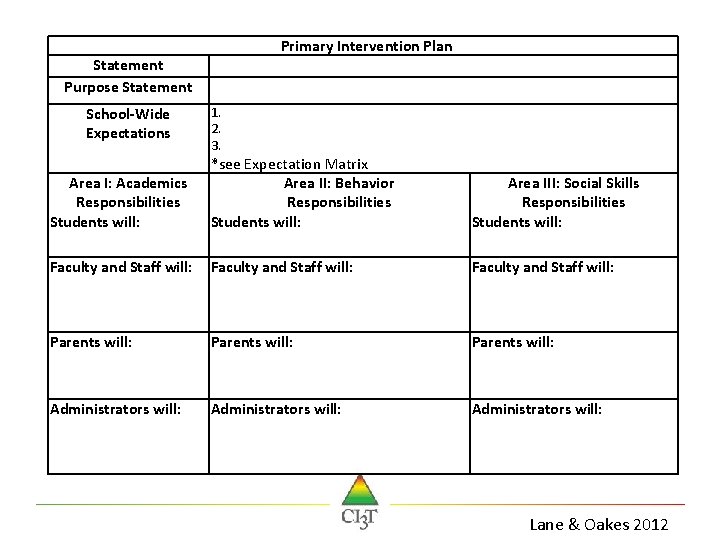
Primary Intervention Plan Statement Purpose Statement School-Wide Expectations 1. 2. 3. Area I: Academics Responsibilities Students will: *see Expectation Matrix Area II: Behavior Responsibilities Students will: Area III: Social Skills Responsibilities Students will: Faculty and Staff will: Parents will: Administrators will: Lane & Oakes 2012
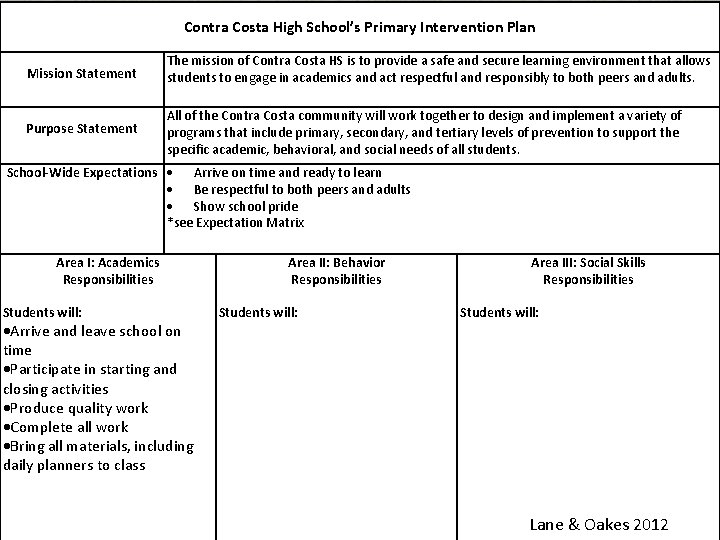
Contra Costa High School’s Primary Intervention Plan Mission Statement The mission of Contra Costa HS is to provide a safe and secure learning environment that allows students to engage in academics and act respectful and responsibly to both peers and adults. Purpose Statement All of the Contra Costa community will work together to design and implement a variety of programs that include primary, secondary, and tertiary levels of prevention to support the specific academic, behavioral, and social needs of all students. School-Wide Expectations Arrive on time and ready to learn Be respectful to both peers and adults Show school pride *see Expectation Matrix Area I: Academics Responsibilities Students will: Arrive and leave school on time Participate in starting and closing activities Produce quality work Complete all work Bring all materials, including daily planners to class Area II: Behavior Responsibilities Students will: Area III: Social Skills Responsibilities Students will: Lane & Oakes 2012
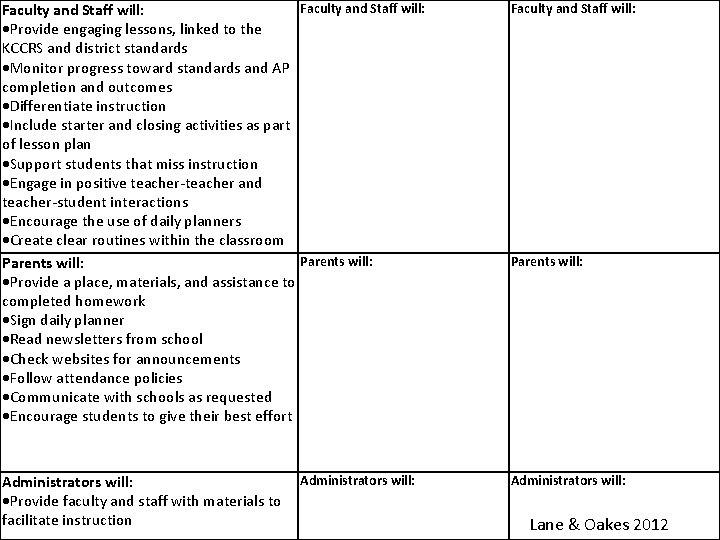
Faculty and Staff will: Provide engaging lessons, linked to the KCCRS and district standards Monitor progress toward standards and AP completion and outcomes Differentiate instruction Include starter and closing activities as part of lesson plan Support students that miss instruction Engage in positive teacher-teacher and teacher-student interactions Encourage the use of daily planners Create clear routines within the classroom Parents will: Provide a place, materials, and assistance to completed homework Sign daily planner Read newsletters from school Check websites for announcements Follow attendance policies Communicate with schools as requested Encourage students to give their best effort Faculty and Staff will: Administrators will: Provide faculty and staff with materials to facilitate instruction Administrators will: Parents will: Lane & Oakes 2012
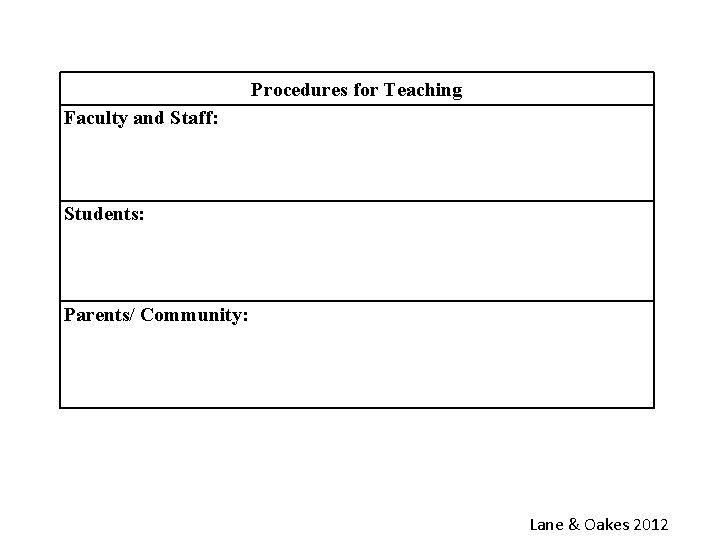
Procedures for Teaching Faculty and Staff: Students: Parents/ Community: Lane & Oakes 2012
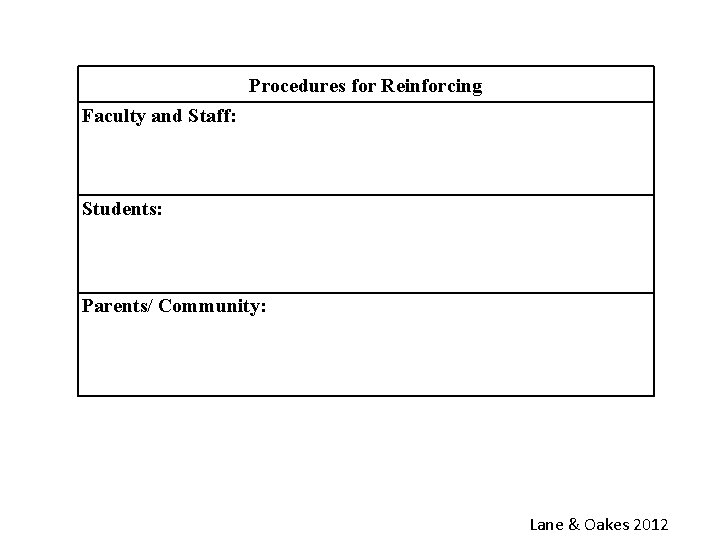
Procedures for Reinforcing Faculty and Staff: Students: Parents/ Community: Lane & Oakes 2012
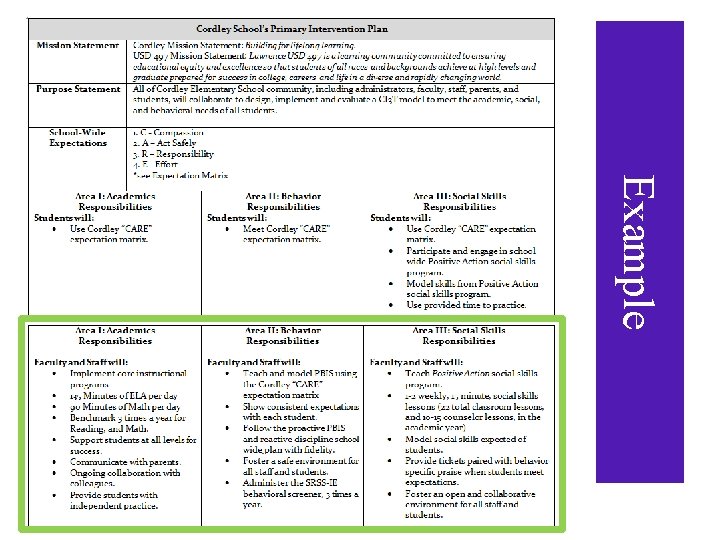
Example
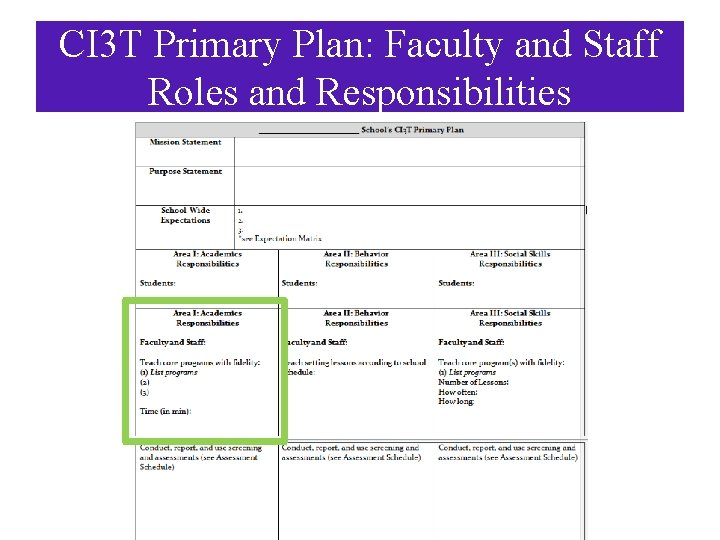
CI 3 T Primary Plan: Faculty and Staff Roles and Responsibilities
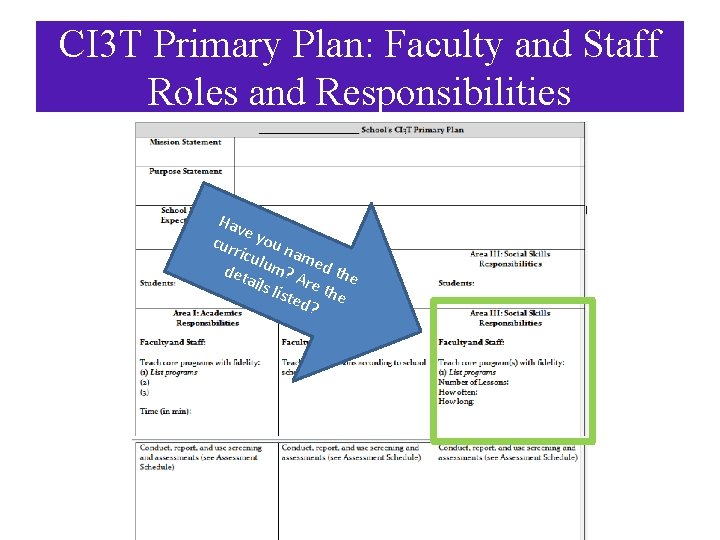
CI 3 T Primary Plan: Faculty and Staff Roles and Responsibilities Hav e cur you n ricu am l ed u m det ? Are the ails liste the d?
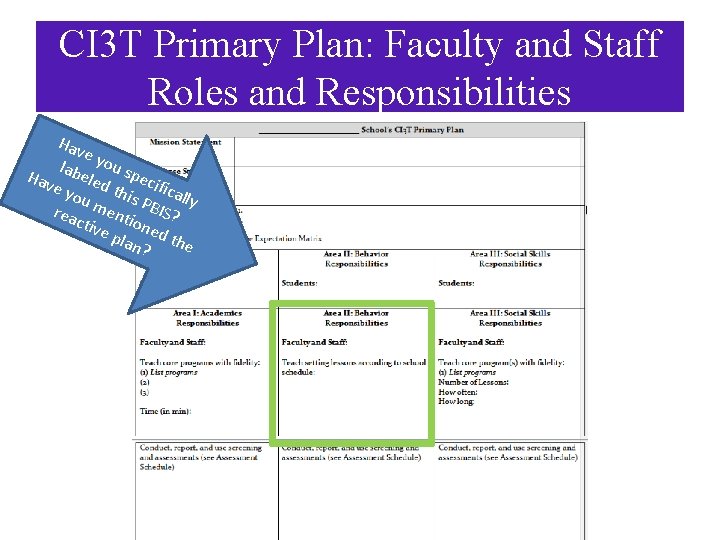
CI 3 T Primary Plan: Faculty and Staff Roles and Responsibilities Hav e labe you sp Hav e e yo led th cifica u m is PB lly IS e rea ctiv ntione ? ep lan? d the
Monitor Importance of Unified Systems of Measurement • Accurate measure of key variables to enable accurate decision making: – – – office discipline referrals (ODRs) attendance referrals to prereferral teams and special education academic progress (e. g. , curriculum-based measurement) behavior screenings • The ability to analyze academic and behavioral data in tandem • Information sharing regarding a) progress for schools as a whole and b) identification and support of students who require additional supports in the form of secondary (Tier 2) and tertiary (Tier 3) levels of prevention
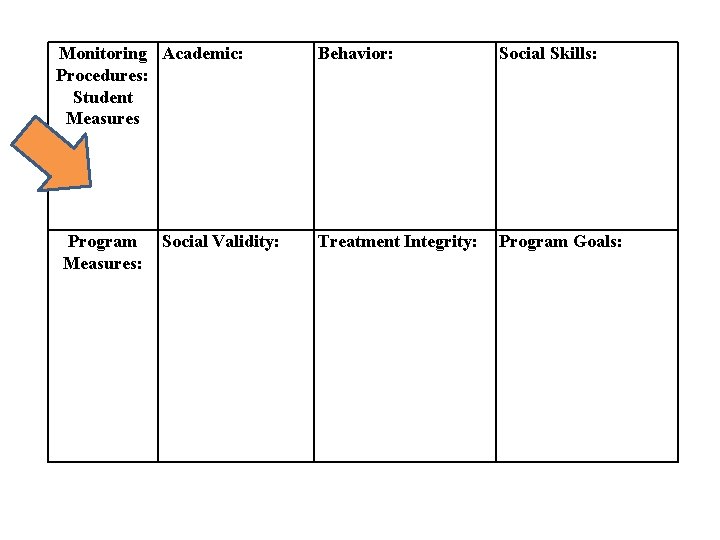
Program Measures: Social Validity: Behavior: Social Skills: Treatment Integrity: Program Goals: PROCEDURED FOR MONITORTING Monitoring Academic: Procedures: Student Measures
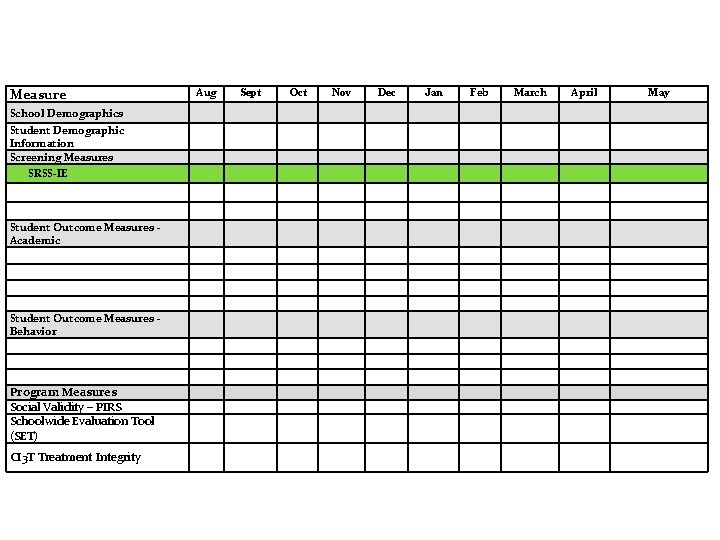
Measure School Demographics Student Demographic Information Screening Measures SRSS-IE Student Outcome Measures Academic Student Outcome Measures Behavior Program Measures Social Validity – PIRS Schoolwide Evaluation Tool (SET) CI 3 T Treatment Integrity Aug Sept Oct Nov Dec Jan Feb March April May
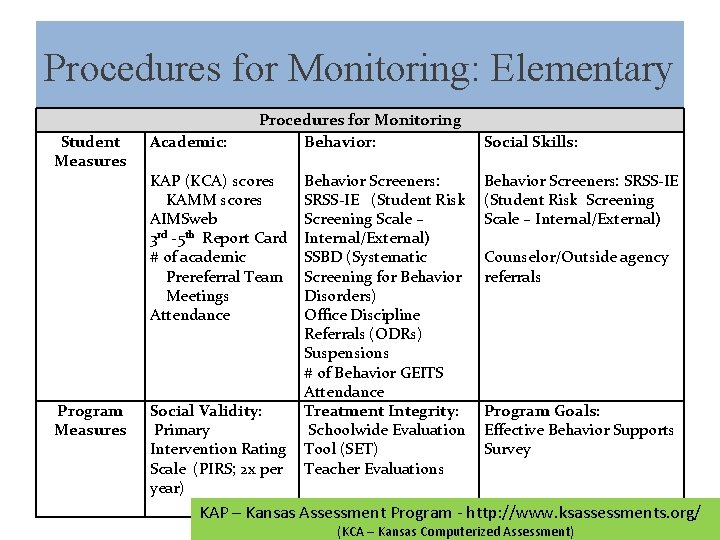
Procedures for Monitoring: Elementary Student Measures Program Measures Academic: Procedures for Monitoring Behavior: KAP (KCA) scores KAMM scores AIMSweb 3 rd -5 th Report Card # of academic Prereferral Team Meetings Attendance Social Validity: Primary Intervention Rating Scale (PIRS; 2 x per year) Behavior Screeners: SRSS-IE (Student Risk Screening Scale – Internal/External) SSBD (Systematic Screening for Behavior Disorders) Office Discipline Referrals (ODRs) Suspensions # of Behavior GEITS Attendance Treatment Integrity: Schoolwide Evaluation Tool (SET) Teacher Evaluations Social Skills: Behavior Screeners: SRSS-IE (Student Risk Screening Scale – Internal/External) Counselor/Outside agency referrals Program Goals: Effective Behavior Supports Survey KAP – Kansas Assessment Program - http: //www. ksassessments. org/ (KCA – Kansas Computerized Assessment)
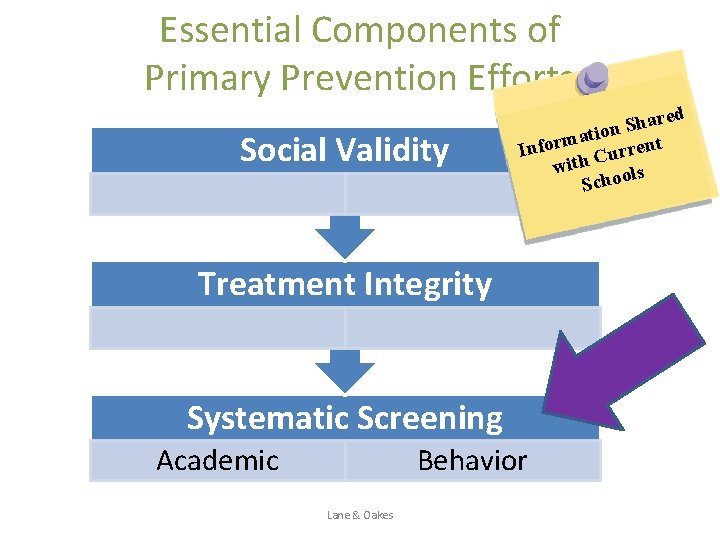
Essential Components of Primary Prevention Efforts Social Validity ared h S n tio a m r o nt e r Inf r u with C ols Scho Treatment Integrity Systematic Screening Academic & Oakes State of Tennessee DOE Technical Assistance Grant IRBLane # 090935 Behavior
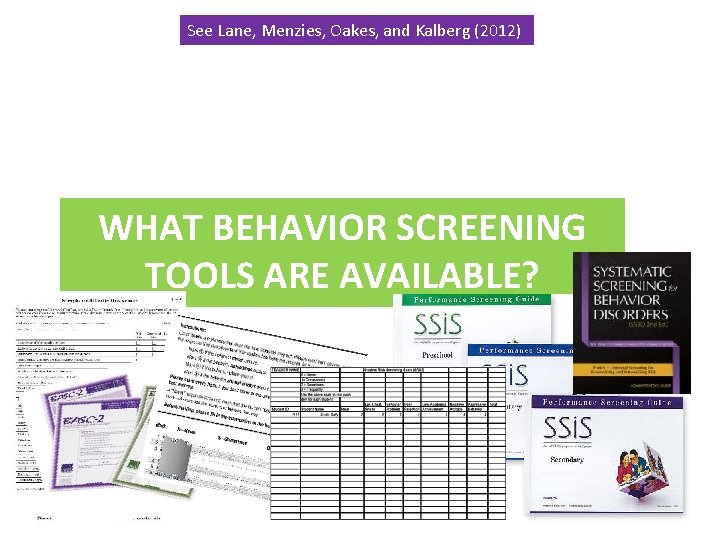
See Lane, Menzies, Oakes, and Kalberg (2012) WHAT BEHAVIOR SCREENING TOOLS ARE AVAILABLE?
SYSTEMATIC SCREENING FOR BEHAVIOR DISORDERS (SSBD; Walker, Severson & Feil, 2014) Walker, H. M. , Severson, H. H. , Feil, E. G. (2014). Systematic Screening for Behavioral Disorders (2 nd ed. ). Eugene, OR: Pacific Northwest Publishing.
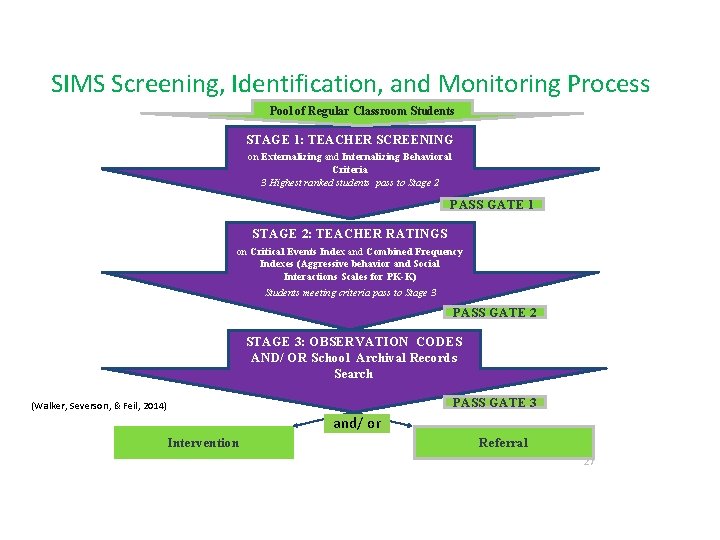
SIMS Screening, Identification, and Monitoring Process Pool of Regular Classroom Students STAGE 1: TEACHER SCREENING on Externalizing and Internalizing Behavioral Criteria 3 Highest ranked students pass to Stage 2 PASS GATE 1 STAGE 2: TEACHER RATINGS on Critical Events Index and Combined Frequency Indexes (Aggressive behavior and Social Interactions Scales for PK-K) Students meeting criteria pass to Stage 3 PASS GATE 2 STAGE 3: OBSERVATION CODES AND/ OR School Archival Records Search PASS GATE 3 (Walker, Severson, & Feil, 2014) and/ or Intervention Referral 27
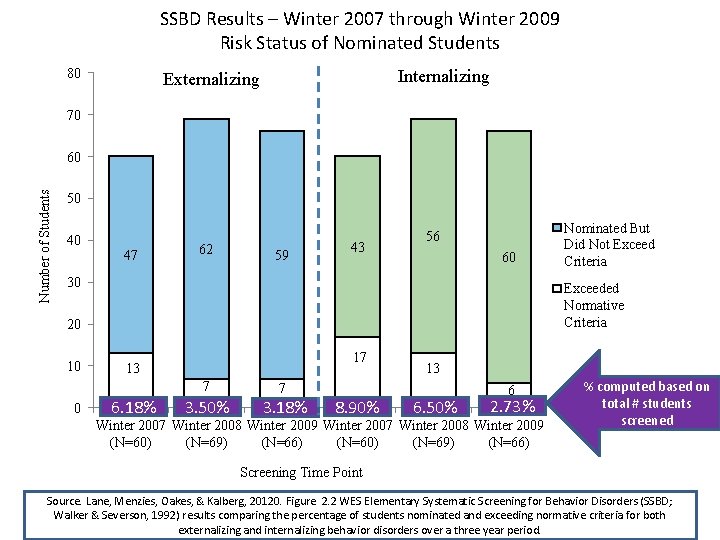
SSBD Results – Winter 2007 through Winter 2009 Risk Status of Nominated Students 80 70 Internalizing Externalizing Number of Students 60 50 40 47 62 59 43 56 60 30 Exceeded Normative Criteria 20 10 17 13 7 0 Nominated But Did Not Exceed Criteria 6. 18% 3. 50% 7 3. 18% 8. 90% 13 6. 50% 6 2. 73% Winter 2007 Winter 2008 Winter 2009 (N=60) (N=69) (N=66) (N=60) (N=69) 1. 44%(N=66) % computed based on total # students screened Screening Time Point Source. Lane, Menzies, Oakes, & Kalberg, 20120. Figure 2. 2 WES Elementary Systematic Screening for Behavior Disorders (SSBD; Walker & Severson, 1992) results comparing the percentage of students nominated and exceeding normative criteria for both externalizing and internalizing behavior disorders over a three year period.
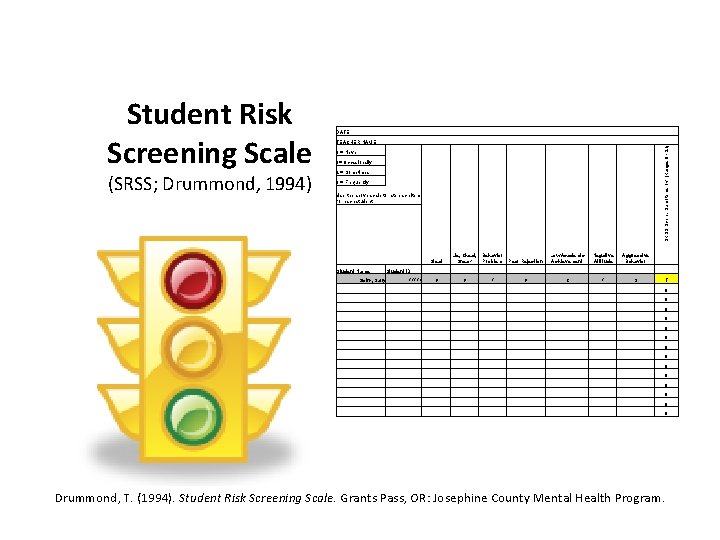
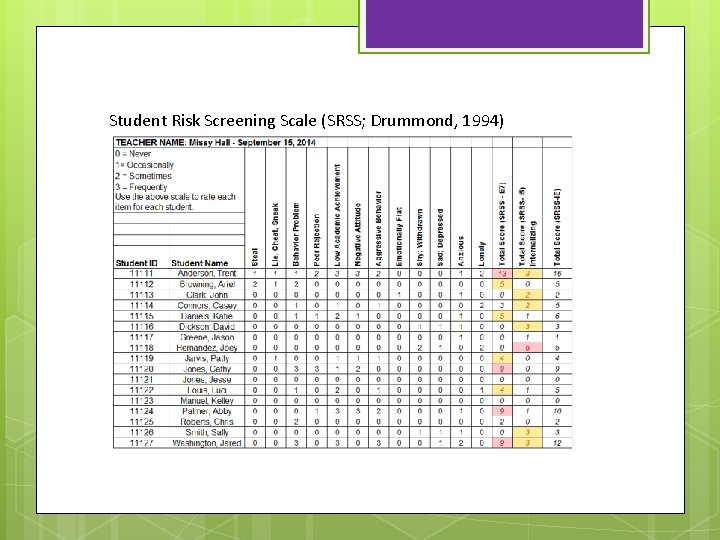
(SRSS; Drummond, 1994) DATE TEACHER NAME SRSS Score: Sum Items 1 -7 (Range 0 - 21) Student Risk Screening Scale 0 = Never 1= Occasionally 2 = Sometimes 3 = Frequently Use the above scale to rate each item for each student. Steal Student Name Smith, Sally Lie, Cheat, Behavior Sneak Problem Peer Rejection Low Academic Achievement Negative Attitude Aggressive Behavior 0 2 1 3 Student ID 11111 0 0 1 7 0 0 0 0 Drummond, T. (1994). Student Risk Screening Scale. Grants Pass, OR: Josephine County Mental Health Program.
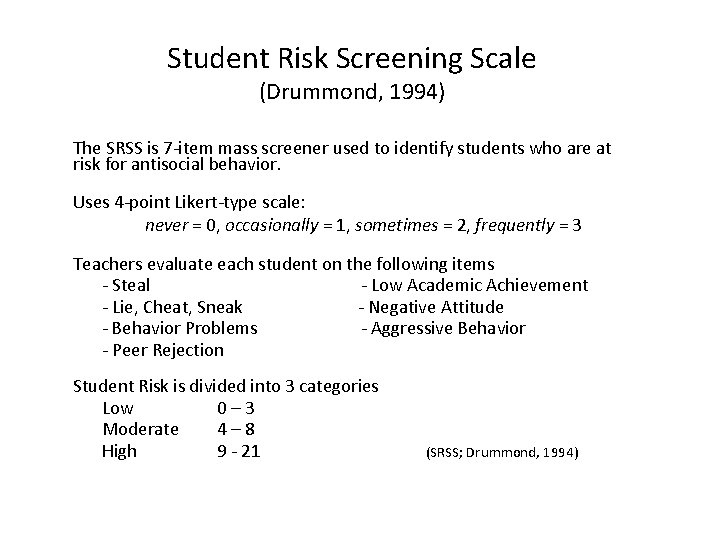
Student Risk Screening Scale (Drummond, 1994) The SRSS is 7 -item mass screener used to identify students who are at risk for antisocial behavior. Uses 4 -point Likert-type scale: never = 0, occasionally = 1, sometimes = 2, frequently = 3 Teachers evaluate each student on the following items - Steal - Low Academic Achievement - Lie, Cheat, Sneak - Negative Attitude - Behavior Problems - Aggressive Behavior - Peer Rejection Student Risk is divided into 3 categories Low 0– 3 Moderate 4– 8 High 9 - 21 (SRSS; Drummond, 1994)
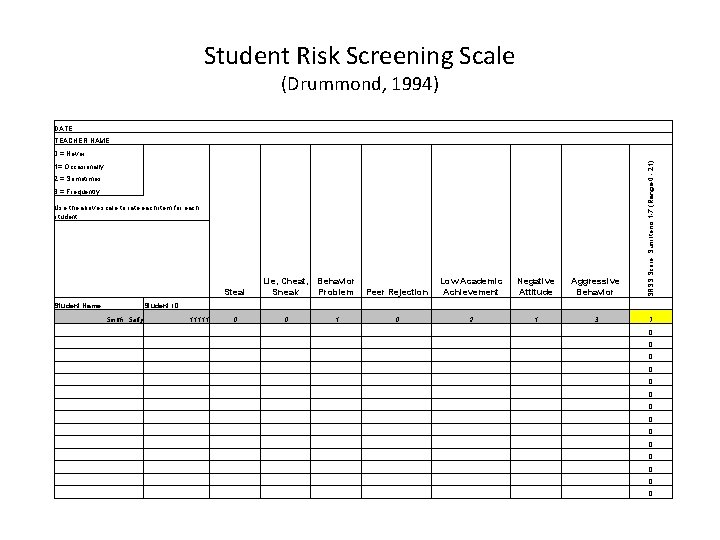
Student Risk Screening Scale (Drummond, 1994) DATE TEACHER NAME Steal Lie, Cheat, Sneak Behavior Problem Peer Rejection Low Academic Achievement Negative Attitude Aggressive Behavior SRSS Score: Sum Items 1 -7 (Range 0 - 21) 0 = Never 0 0 1 0 2 1 3 7 1= Occasionally 2 = Sometimes 3 = Frequently Use the above scale to rate each item for each student. Student Name Student ID Smith, Sally 11111 0 0 0 0
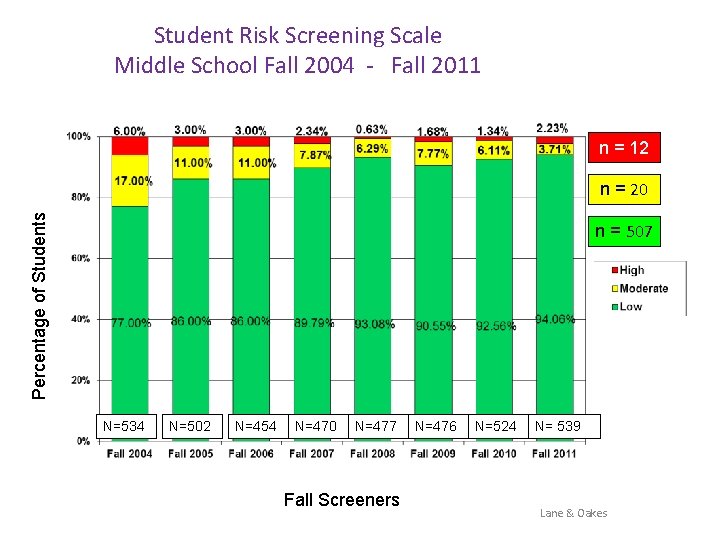
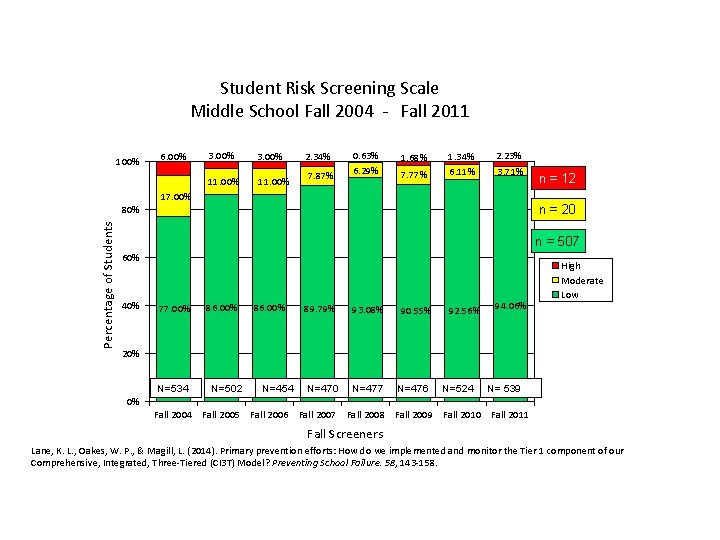
Student Risk Screening Scale Middle School Fall 2004 - Fall 2011 n = 12 Percentage of Students n = 20 n = 507 N=534 N=502 N=454 N=470 N=477 Fall Screeners N=476 N=524 N= 539 Lane & Oakes
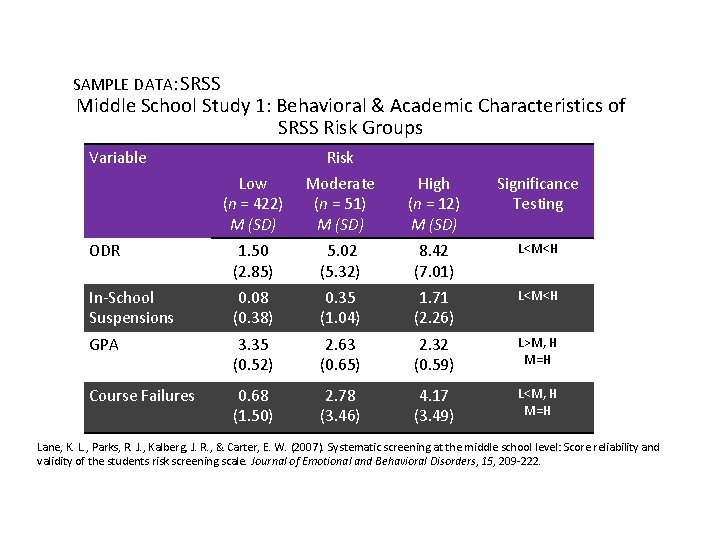
SAMPLE DATA: SRSS Middle School Study 1: Behavioral & Academic Characteristics of SRSS Risk Groups Variable Risk Low (n = 422) M (SD) Moderate (n = 51) M (SD) High (n = 12) M (SD) Significance Testing ODR 1. 50 (2. 85) 5. 02 (5. 32) 8. 42 (7. 01) L<M<H In-School Suspensions 0. 08 (0. 38) 0. 35 (1. 04) 1. 71 (2. 26) L<M<H GPA 3. 35 (0. 52) 2. 63 (0. 65) 2. 32 (0. 59) L>M, H M=H Course Failures 0. 68 (1. 50) 2. 78 (3. 46) 4. 17 (3. 49) L<M, H M=H Lane, K. L. , Parks, R. J. , Kalberg, J. R. , & Carter, E. W. (2007). Systematic screening at the middle school level: Score reliability and validity of the students risk screening scale. Journal of Emotional and Behavioral Disorders, 15, 209 -222.
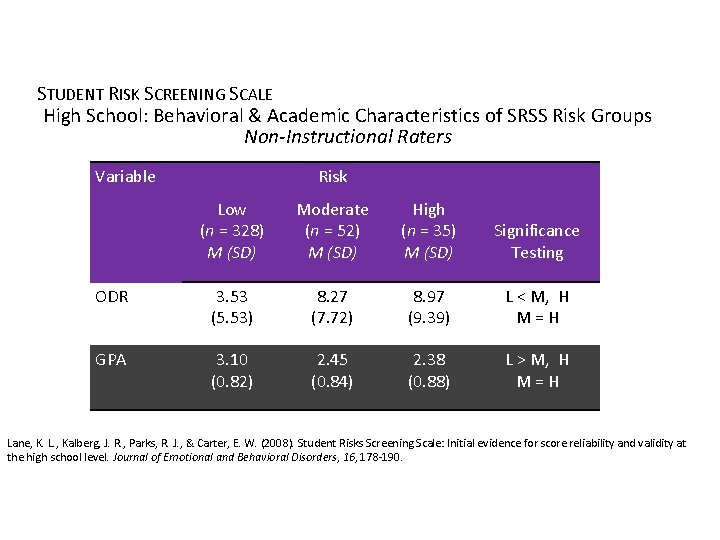
STUDENT RISK SCREENING SCALE High School: Behavioral & Academic Characteristics of SRSS Risk Groups Non-Instructional Raters Variable Risk Low (n = 328) M (SD) Moderate (n = 52) M (SD) High (n = 35) M (SD) Significance Testing ODR 3. 53 (5. 53) 8. 27 (7. 72) 8. 97 (9. 39) L < M, H M=H GPA 3. 10 (0. 82) 2. 45 (0. 84) 2. 38 (0. 88) L > M, H M=H Lane, K. L. , Kalberg, J. R. , Parks, R. J. , & Carter, E. W. (2008). Student Risks Screening Scale: Initial evidence for score reliability and validity at the high school level. Journal of Emotional and Behavioral Disorders, 16, 178 -190.
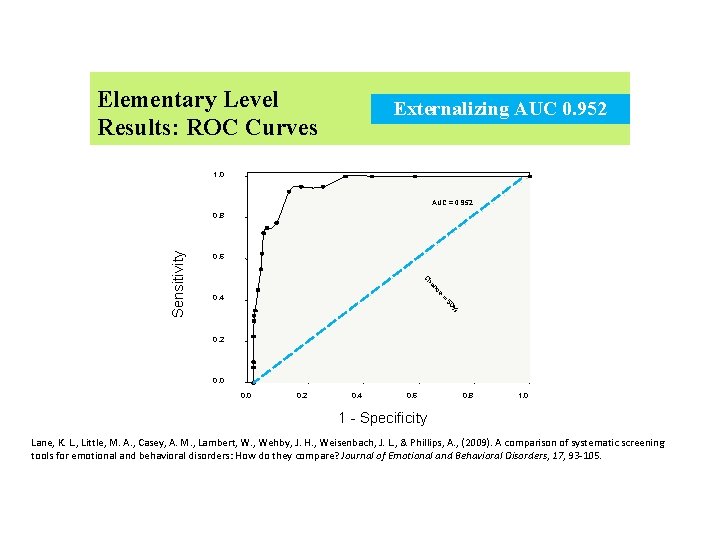
Elementary Level Results: ROC Curves Externalizing AUC 0. 952 1. 0 AUC = 0. 952 0. 6 ce an Ch 0. 4 = % 50 Sensitivity 0. 8 0. 2 0. 0 0. 2 0. 4 0. 6 0. 8 1. 0 1 - Specificity Lane, K. L. , Little, M. A. , Casey, A. M. , Lambert, W. , Wehby, J. H. , Weisenbach, J. L. , & Phillips, A. , (2009). A comparison of systematic screening tools for emotional and behavioral disorders: How do they compare? Journal of Emotional and Behavioral Disorders, 17, 93 -105.
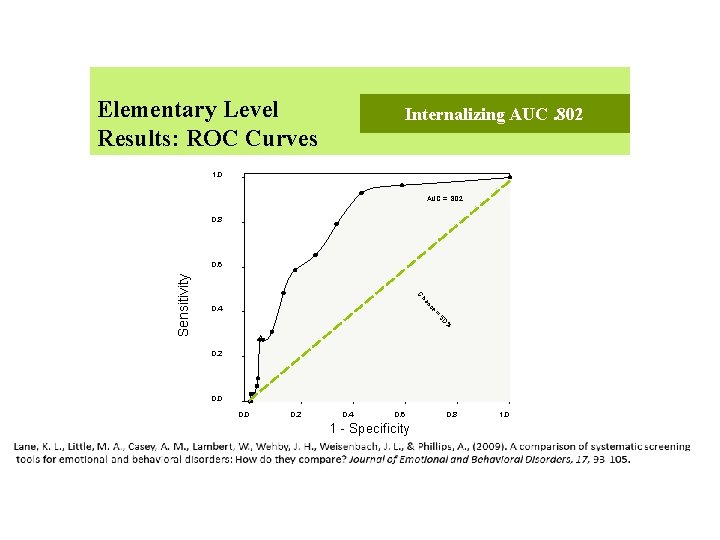
Elementary Level Results: ROC Curves Internalizing AUC. 802 1. 0 AUC =. 802 0. 8 an Ch 0. 4 ce = % 50 Sensitivity 0. 6 0. 2 0. 0 0. 2 0. 4 0. 6 1 - Specificity 0. 8 1. 0
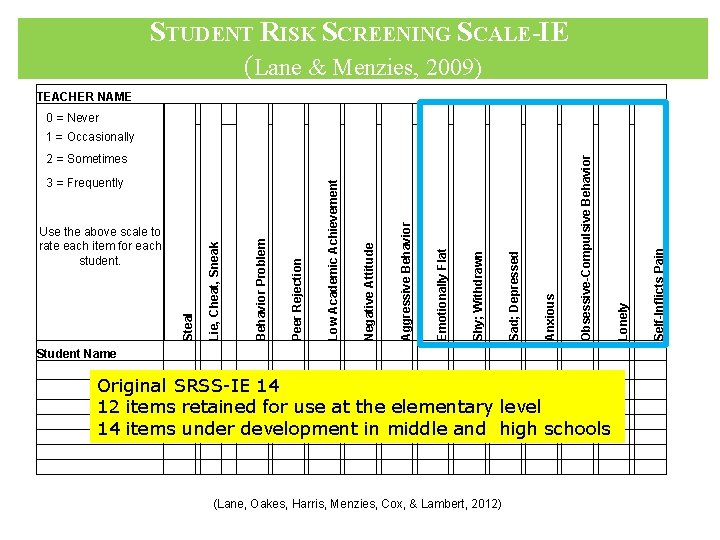
STUDENT RISK SCREENING SCALE-IE (Lane & Menzies, 2009) TEACHER NAME 0 = Never Student Name Original SRSS-IE 14 12 items retained for use at the elementary level 14 items under development in middle and high schools (Lane, Oakes, Harris, Menzies, Cox, & Lambert, 2012) Self-Inflicts Pain Lonely Anxious Sad; Depressed Shy; Withdrawn Emotionally Flat Aggressive Behavior Negative Attitude Peer Rejection Behavior Problem Steal Use the above scale to rate each item for each student. Lie, Cheat, Sneak 3 = Frequently Low Academic Achievement 2 = Sometimes Obsessive-Compulsive Behavior 1 = Occasionally
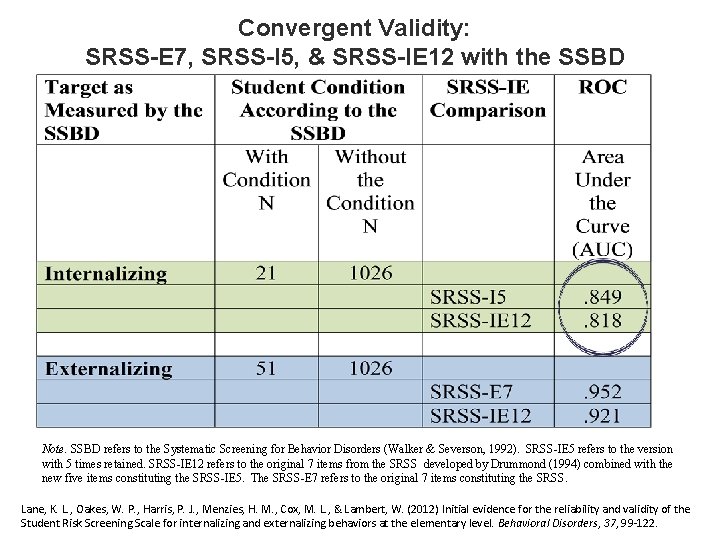
Convergent Validity: SRSS-E 7, SRSS-I 5, & SRSS-IE 12 with the SSBD Note. SSBD refers to the Systematic Screening for Behavior Disorders (Walker & Severson, 1992). SRSS-IE 5 refers to the version with 5 times retained. SRSS-IE 12 refers to the original 7 items from the SRSS developed by Drummond (1994) combined with the new five items constituting the SRSS-IE 5. The SRSS-E 7 refers to the original 7 items constituting the SRSS. Lane, K. L. , Oakes, W. P. , Harris, P. J. , Menzies, H. M. , Cox, M. L. , & Lambert, W. (2012) Initial evidence for the reliability and validity of the Student Risk Screening Scale for internalizing and externalizing behaviors at the elementary level. Behavioral Disorders, 37, 99 -122.
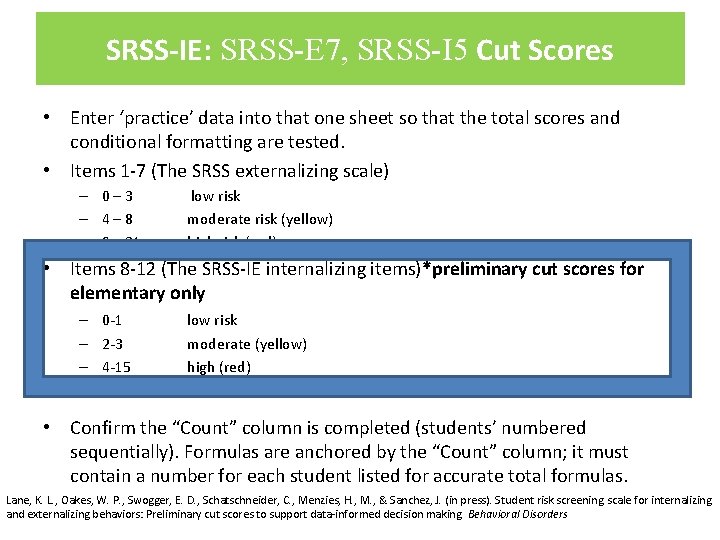
SRSS-IE: SRSS-E 7, SRSS-I 5 Cut Scores • Enter ‘practice’ data into that one sheet so that the total scores and conditional formatting are tested. • Items 1 -7 (The SRSS externalizing scale) – 0– 3 – 4– 8 – 9 – 21 low risk moderate risk (yellow) high risk (red) • Items 8 -12 (The SRSS-IE internalizing items)*preliminary cut scores for elementary only – 0 -1 – 2 -3 – 4 -15 low risk moderate (yellow) high (red) • Confirm the “Count” column is completed (students’ numbered sequentially). Formulas are anchored by the “Count” column; it must contain a number for each student listed for accurate total formulas. Lane, K. L. , Oakes, W. P. , Swogger, E. D. , Schatschneider, C. , Menzies, H. , M. , & Sanchez, J. (in press). Student risk screening scale for internalizing and externalizing behaviors: Preliminary cut scores to support data-informed decision making. Behavioral Disorders
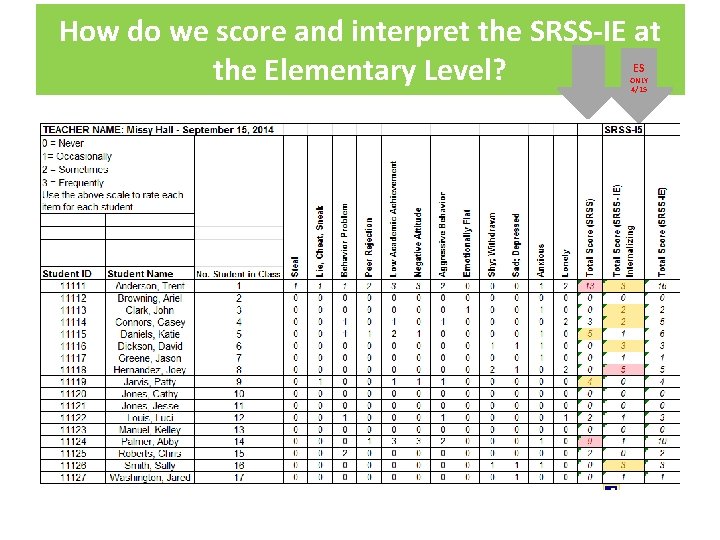
How do we score and interpret the SRSS-IE at the Elementary Level? ES ONLY 4/15 1. All scores will be automatically calculated. 2. SRSS scores are the sum of items 1 – 7 (range 0 – 21) 3. Internalizing scores are the sum of items 8 -12 (range 0 -15)
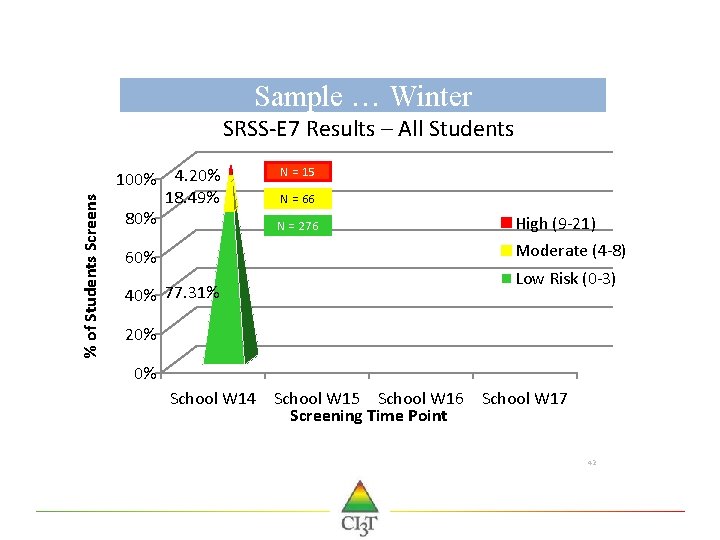
Sample … Winter SRSS-E 7 Results – All Students % of Students Screens 100% 80% 4. 20% 18. 49% N = 15 N = 66 N = 276 High (9 -21) Moderate (4 -8) 60% 40% 77. 31% Low Risk (0 -3) 20% 0% School W 14 School W 15 School W 16 School W 17 Screening Time Point 42
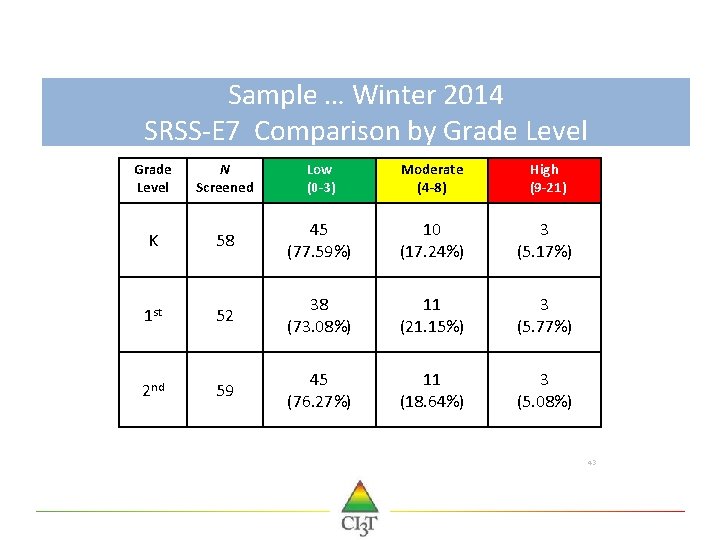
Sample … Winter 2014 SRSS-E 7 Comparison by Grade Level N Screened Low (0 -3) Moderate (4 -8) High (9 -21) K 58 45 (77. 59%) 10 (17. 24%) 3 (5. 17%) 1 st 52 38 (73. 08%) 11 (21. 15%) 3 (5. 77%) 2 nd 59 45 (76. 27%) 11 (18. 64%) 3 (5. 08%) 43
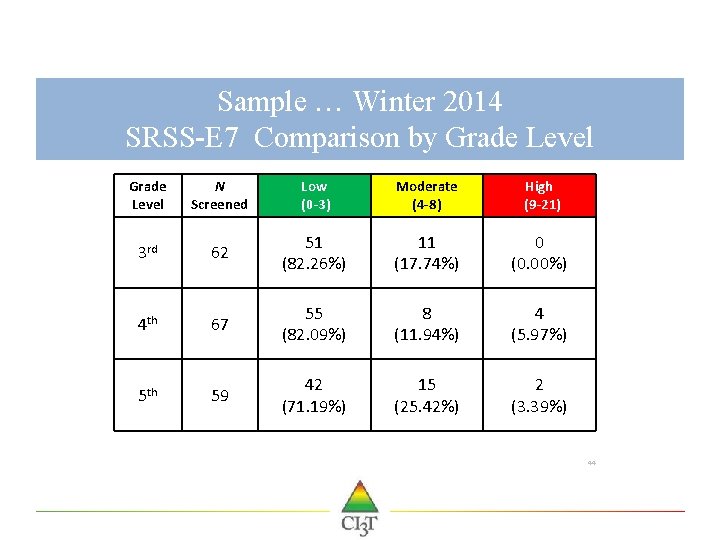
Sample … Winter 2014 SRSS-E 7 Comparison by Grade Level N Screened Low (0 -3) Moderate (4 -8) High (9 -21) 3 rd 62 51 (82. 26%) 11 (17. 74%) 0 (0. 00%) 4 th 67 55 (82. 09%) 8 (11. 94%) 4 (5. 97%) 5 th 59 42 (71. 19%) 15 (25. 42%) 2 (3. 39%) 44
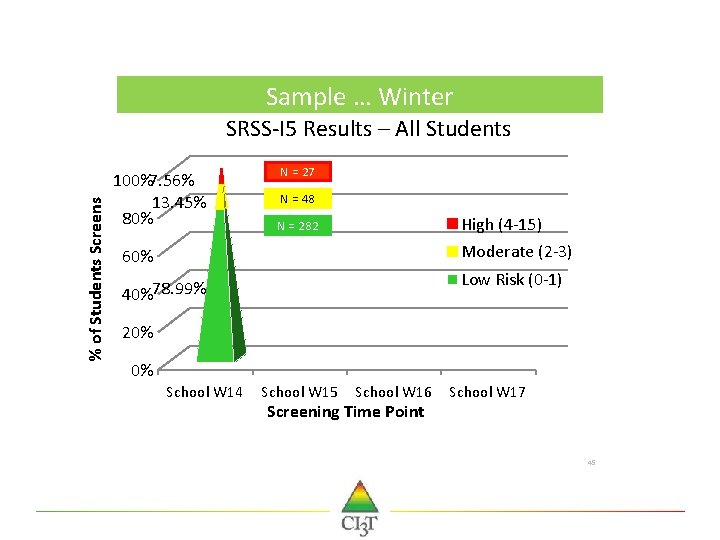
Sample … Winter % of Students Screens SRSS-I 5 Results – All Students 100%7. 56% 13. 45% 80% N = 27 N = 48 High (4 -15) N = 282 60% Moderate (2 -3) 40%78. 99% Low Risk (0 -1) 20% 0% School W 14 School W 15 School W 16 Screening Time Point School W 17 45
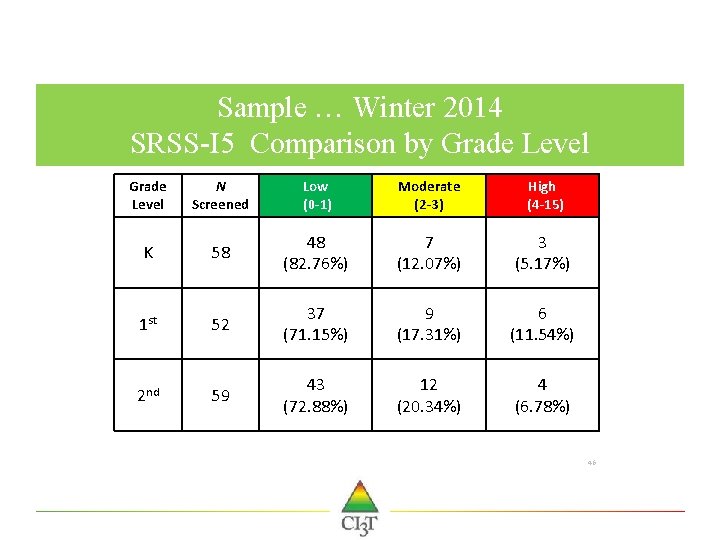
Sample … Winter 2014 SRSS-I 5 Comparison by Grade Level N Screened Low (0 -1) Moderate (2 -3) High (4 -15) K 58 48 (82. 76%) 7 (12. 07%) 3 (5. 17%) 1 st 52 37 (71. 15%) 9 (17. 31%) 6 (11. 54%) 2 nd 59 43 (72. 88%) 12 (20. 34%) 4 (6. 78%) 46
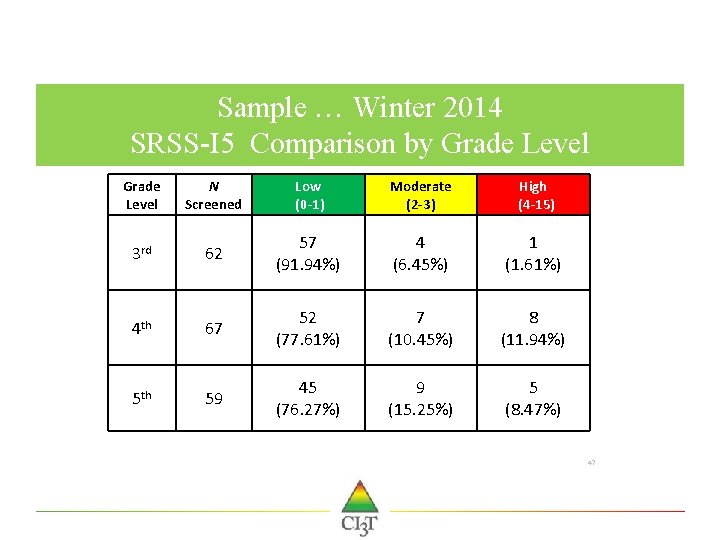
Sample … Winter 2014 SRSS-I 5 Comparison by Grade Level N Screened Low (0 -1) Moderate (2 -3) High (4 -15) 3 rd 62 57 (91. 94%) 4 (6. 45%) 1 (1. 61%) 4 th 67 52 (77. 61%) 7 (10. 45%) 8 (11. 94%) 5 th 59 45 (76. 27%) 9 (15. 25%) 5 (8. 47%) 47
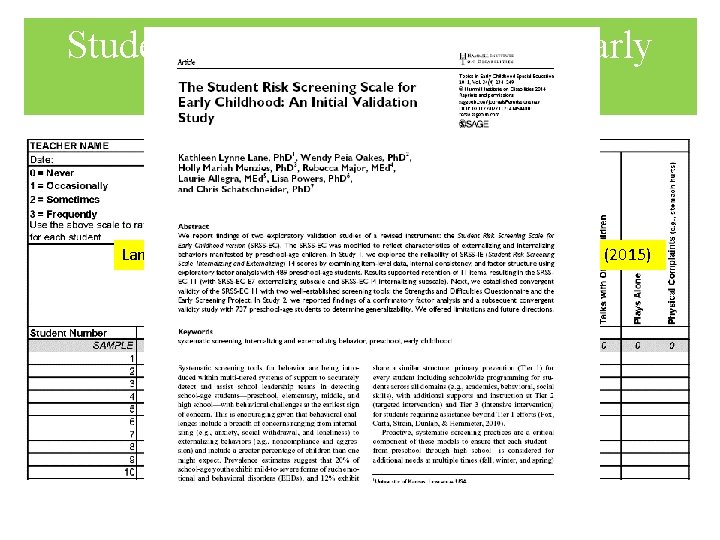
Student Risk Screening Scale –Early Childhood (SRSS-EC) Lane, Oakes, Menzies, Major, Allegra, Powers and Schatschneider (2015)
Strengths and Difficulties Questionnaire (SDQ; Goodman, 1997)
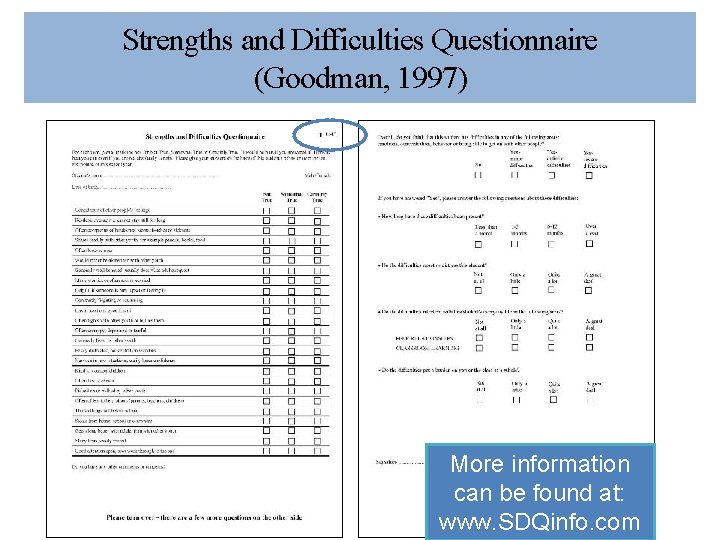
Strengths and Difficulties Questionnaire (Goodman, 1997) More information can be found at: www. SDQinfo. com
Strengths and Difficulties Questionnaire (Goodman, 1997) • 2 versions • (elementary T 4 -10 and middle/high T 11 -17) • One page is completed on EACH student • All versions of the SDQ ask about 25 attributes, both positive and negative • These 25 items are divided between 5 scales: • • • Emotional Symptoms Conduct Problems Hyperactivity / Inattention Peer Relationship Problems Prosocial Behavior www. SDQinfo. com • Total Difficulties (sum of first 4 scales)
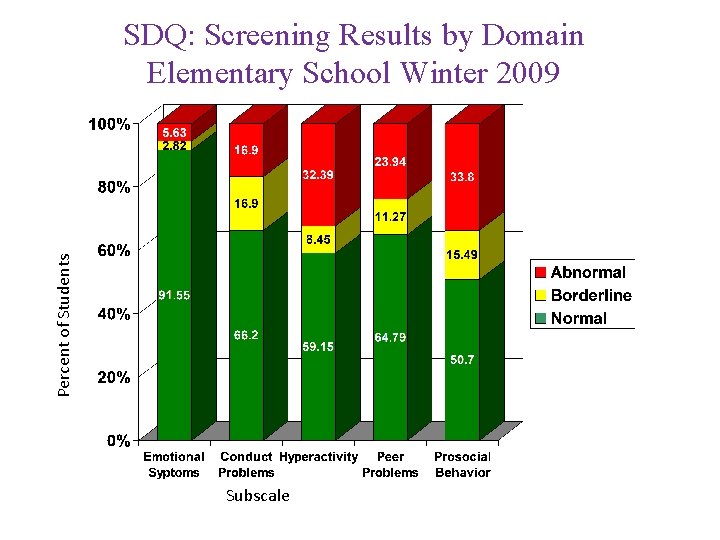
Percent of Students SDQ: Screening Results by Domain Elementary School Winter 2009 Subscale
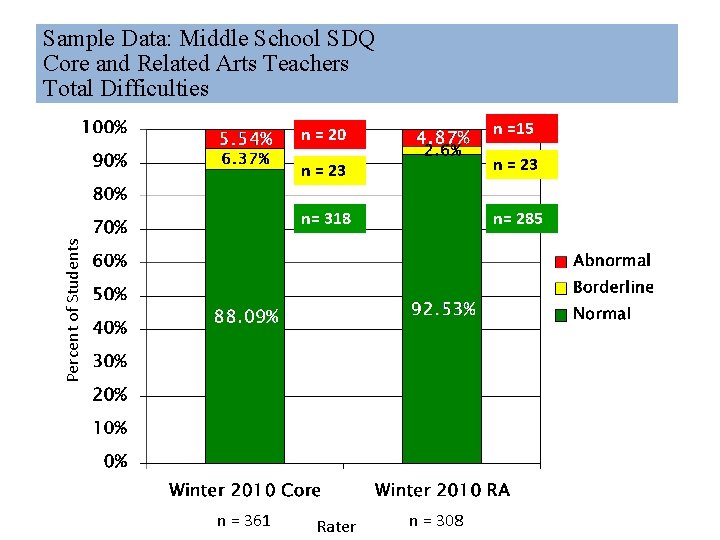
Sample Data: Middle School SDQ Core and Related Arts Teachers Total Difficulties n =15 n = 23 n= 318 n= 285 Percent of Students n = 20 n = 361 Rater n = 308
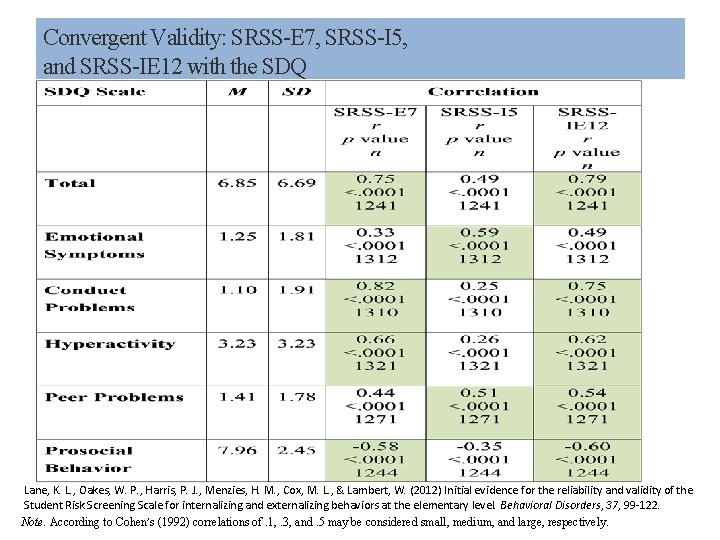
Convergent Validity: SRSS-E 7, SRSS-I 5, and SRSS-IE 12 with the SDQ Lane, K. L. , Oakes, W. P. , Harris, P. J. , Menzies, H. M. , Cox, M. L. , & Lambert, W. (2012) Initial evidence for the reliability and validity of the Student Risk Screening Scale for internalizing and externalizing behaviors at the elementary level. Behavioral Disorders, 37, 99 -122. Note. According to Cohen’s (1992) correlations of. 1, . 3, and. 5 may be considered small, medium, and large, respectively.
BASC 2 Behavioral and Emotional Screening Scale (BASC 2 BESS; Kamphaus & Reynolds, 2007) Copyright NCS Pearson, 2007
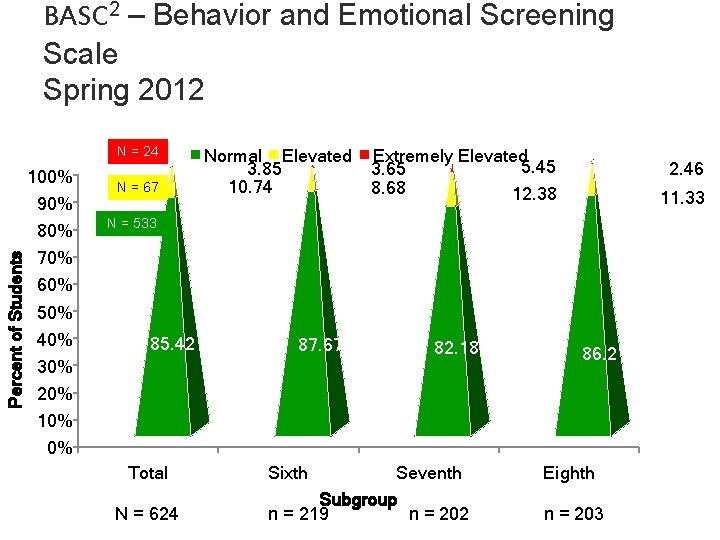
BASC 2 Behavioral and Emotional Screening Scale (Kamphaus & Reynolds, 2007) A brief, universal screening system for measuring behavioral and emotional strengths and weaknesses in children and adolescents. • Behavioral areas assessed include: • • Internalizing problems Externalizing problems School problems Adaptive skills • Includes 3 forms that can be used individually or in combination: • Teacher- Preschool and Child/ Adolescent • Student self-report- Child/ Adolescent • Parent- Preschool and Child/ Adolescent
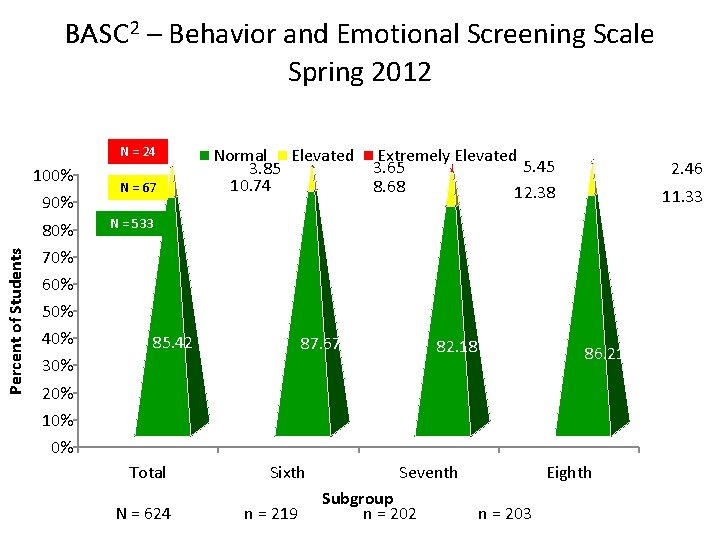
BASC 2 – Behavior and Emotional Screening Scale Spring 2012 N = 24 Percent of Students 100% 90% 80% 70% 60% 50% 40% 30% N = 67 Normal Elevated 3. 85 10. 74 Extremely Elevated 5. 45 3. 65 8. 68 12. 38 2. 46 11. 33 N = 533 85. 42 87. 67 82. 18 86. 21 20% 10% 0% Total N = 624 Sixth n = 219 Seventh Subgroup n = 202 Eighth n = 203
Social Skills Improvement System – Performance Screening Guide (SSi. S- PSG; Elliott & Gresham, 2007)
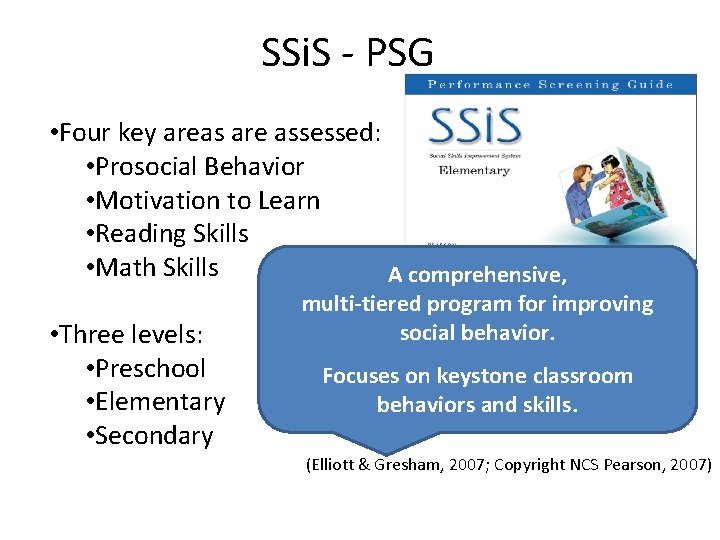
SSi. S - PSG • Four key areas are assessed: • Prosocial Behavior • Motivation to Learn • Reading Skills • Math Skills A comprehensive, • Three levels: • Preschool • Elementary • Secondary multi-tiered program for improving social behavior. Focuses on keystone classroom behaviors and skills. (Elliott & Gresham, 2007; Copyright NCS Pearson, 2007)
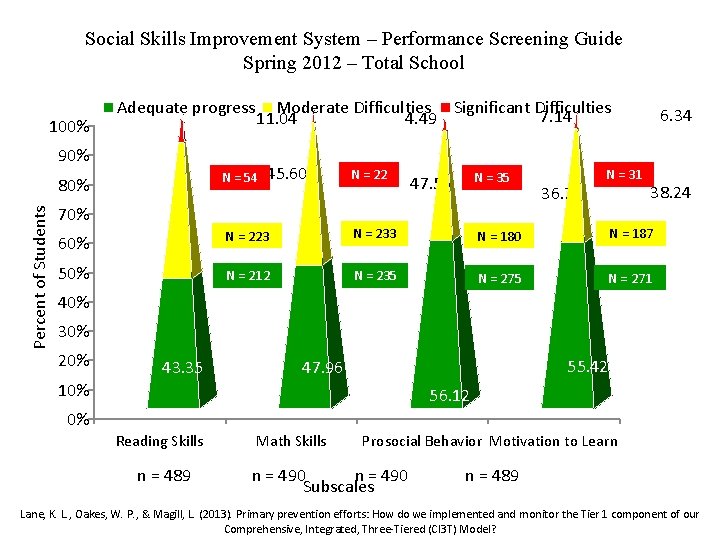
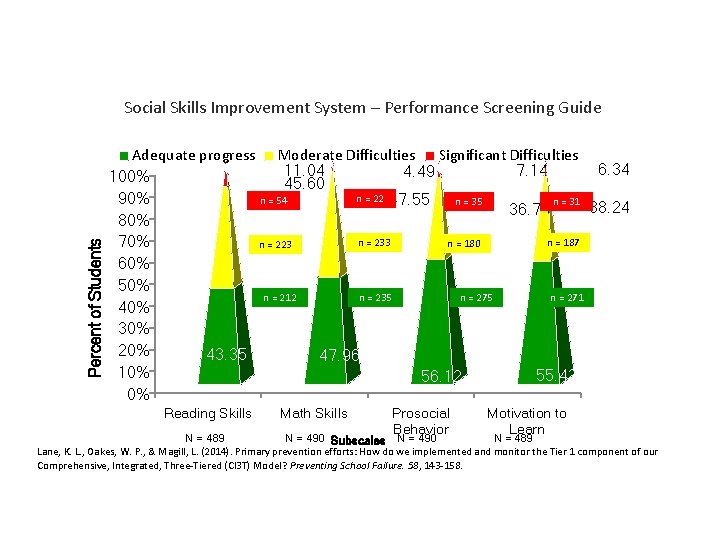
Social Skills Improvement System – Performance Screening Guide Spring 2012 – Total School 100% Adequate progress Moderate Difficulties Significant Difficulties 7. 14 11. 04 4. 49 90% N = 54 Percent of Students 80% 45. 60 N = 22 N = 35 47. 55 70% 36. 73 N = 31 6. 34 38. 24 60% N = 223 N = 233 N = 180 N = 187 50% N = 212 N = 235 N = 271 40% 30% 20% 43. 35 55. 42 47. 96 10% 56. 12 0% Reading Skills n = 489 Math Skills Prosocial Behavior Motivation to Learn n = 490 Subscales n = 489 Lane, K. L. , Oakes, W. P. , & Magill, L. (2013). Primary prevention efforts: How do we implemented and monitor the Tier 1 component of our Comprehensive, Integrated, Three-Tiered (CI 3 T) Model?
Examining your screening data … … implications for primary prevention efforts … implications for teachers … implications for student-based interventions See Lane, Menzies, Bruhn, and Crnobori (2011)
Percent of Students Social Skills Improvement System – Performance Screening Guide Adequate progress Moderate Difficulties Significant Difficulties 6. 34 11. 04 7. 14 4. 49 100% 45. 60 n = 22 47. 55 90% n = 54 n = 35 n = 31 38. 24 36. 73 80% n = 233 n = 187 70% n = 180 n = 223 60% 50% n = 212 n = 235 n = 271 40% 30% 20% 43. 35 47. 96 10% 55. 42 56. 12 0% Reading Skills Math Skills Prosocial Behavior Motivation to Learn N = 489 N = 490 Subscales N = 490 N = 489 Lane, K. L. , Oakes, W. P. , & Magill, L. (2014). Primary prevention efforts: How do we implemented and monitor the Tier 1 component of our Comprehensive, Integrated, Three-Tiered (CI 3 T) Model? Preventing School Failure. 58, 143 -158.
Student Risk Screening Scale Middle School Fall 2004 - Fall 2011 100% 6. 00% 3. 00% 11. 00% 2. 34% 7. 87% 0. 63% 6. 29% 1. 68% 7. 77% 1. 34% 6. 11% 2. 23% 3. 71% 17. 00% n = 20 80% Percentage of Students n = 12 n = 507 60% 40% 77. 00% 86. 00% 89. 79% 93. 08% N=470 N=477 90. 55% 92. 56% 94. 06% High Moderate Low 20% N=534 0% N=502 N=454 N=476 N=524 N= 539 Fall 2004 Fall 2005 Fall 2006 Fall 2007 Fall 2008 Fall 2009 Fall 2010 Fall 2011 Fall Screeners Lane, K. L. , Oakes, W. P. , & Magill, L. (2014). Primary prevention efforts: How do we implemented and monitor the Tier 1 component of our Comprehensive, Integrated, Three-Tiered (CI 3 T) Model? Preventing School Failure. 58, 143 -158.
Teacher-Level Considerations 1. Instructional Considerations 2. General Classroom Management 3. Low-intensity Strategies
Student Risk Screening Scale (SRSS; Drummond, 1994)
Examining Academic and Behavioral Data: Elementary Level Lane, K. L. , Menzies, H. M. , Ennis, R. P. , & Oakes, W. P. (2015). Supporting Behavior for School Success: A Step-by-Step Guide to Key Strategies. New York, NY: Guilford Press.
Examining Academic and Behavioral Data: Middle and High School Levels Lane, K. L. , Menzies, H. M. , Ennis, R. P. , & Oakes, W. P. (2015). Supporting Behavior for School Success: A Step-by-Step Guide to Key Strategies. New York, NY: Guilford Press.
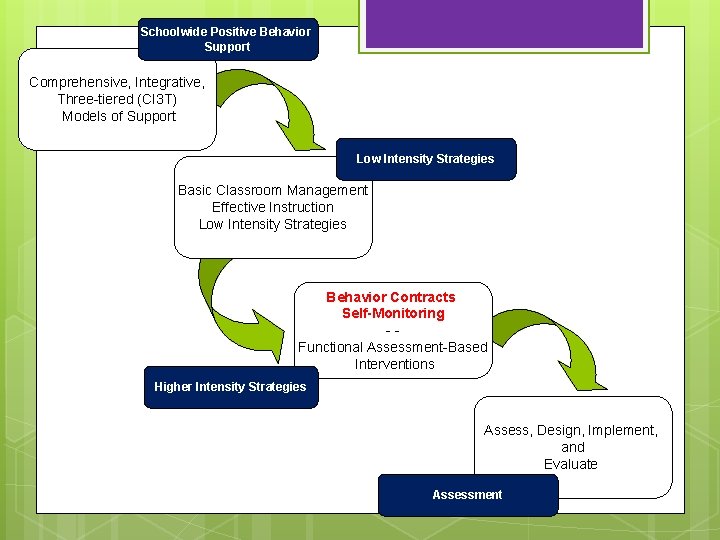
Schoolwide Positive Behavior Support Comprehensive, Integrative, Three-tiered (CI 3 T) Models of Support Low Intensity Strategies Basic Classroom Management Effective Instruction Low Intensity Strategies Behavior Contracts Self-Monitoring -Functional Assessment-Based Interventions Higher Intensity Strategies Assess, Design, Implement, and Evaluate Assessment
Consideration #1: Essential Components of Classroom Management Classroom Climate Physical Room Arrangement Routines and Procedures Managing Paper Work
Consideration # 2 Instructional Considerations § How motivating is my classroom? § § § Control – Challenge – Curiosity – Contextualization Am I using a variety of instructional strategies? How am I differentiating instruction? § Content – Process – Product
Consideration #3 Low-Intensity Strategies Active Supervision Proximity Pacing Appropriate use of Praise Opportunities to Respond Instructive Feedback Incorporating Choice
Self. Assessment How am I doing with … basic classroom management strategies? Instructional considerations? Low-intensity strategies?
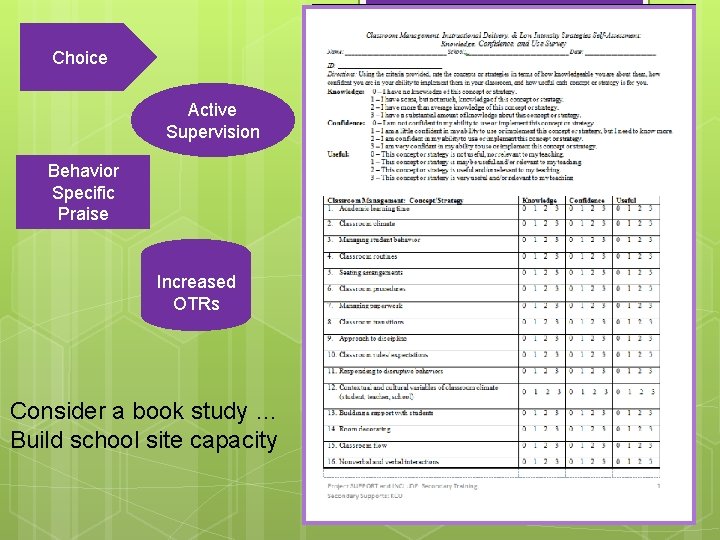
Choice Active Supervision Behavior Specific Praise Increased OTRs Consider a book study … Build school site capacity
Teacher-Level Considerations 1. Instructional Considerations 2. General Classroom Management 3. Low-intensity Strategies
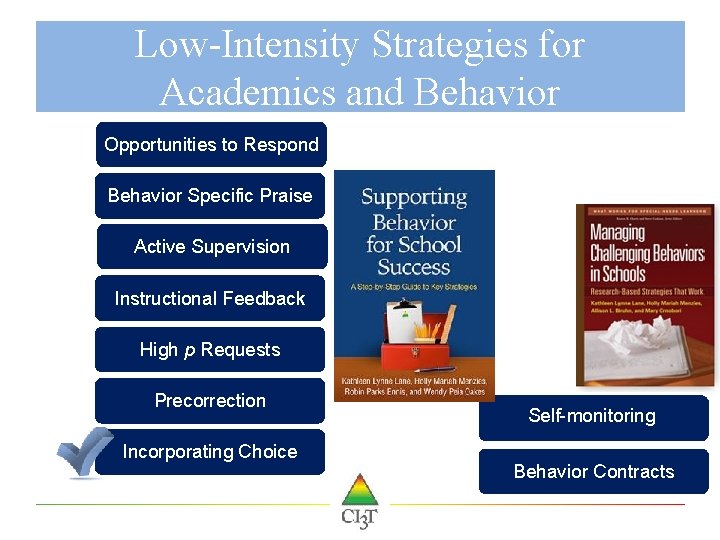
Low-Intensity Strategies for Academics and Behavior Opportunities to Respond Behavior Specific Praise Active Supervision Instructional Feedback High p Requests Precorrection Incorporating Choice Self-monitoring Behavior Contracts
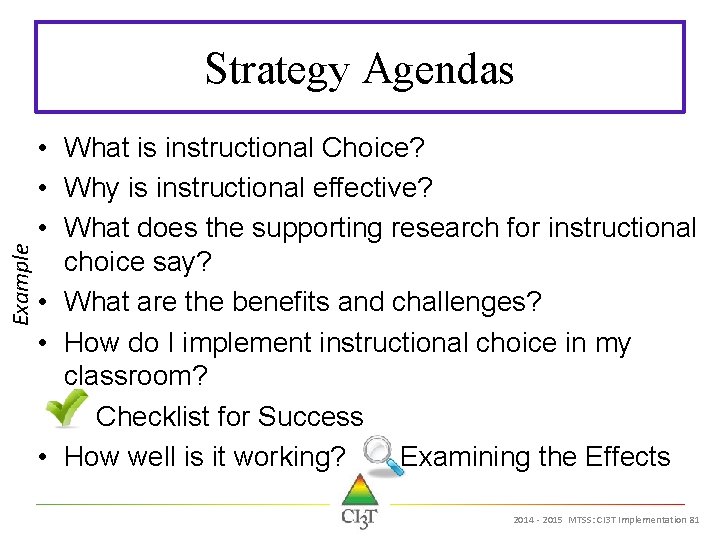
Example Strategy Agendas • What is instructional Choice? • Why is instructional effective? • What does the supporting research for instructional choice say? • What are the benefits and challenges? • How do I implement instructional choice in my classroom? Checklist for Success • How well is it working? Examining the Effects 2014 - 2015 MTSS: CI 3 T Implementation 81
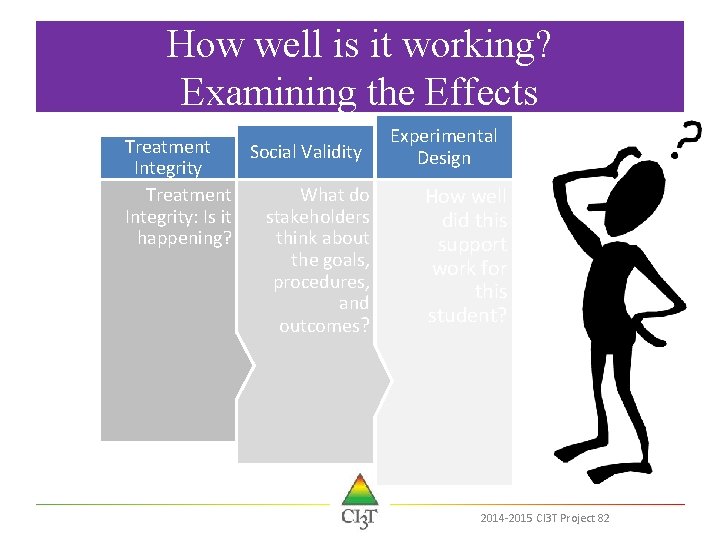
How well is it working? Examining the Effects Treatment Social Validity Integrity Treatment What do Integrity: Is it stakeholders happening? think about the goals, procedures, and outcomes? Experimental Design How well did this support work for this student? 2014 -2015 CI 3 T Project 82
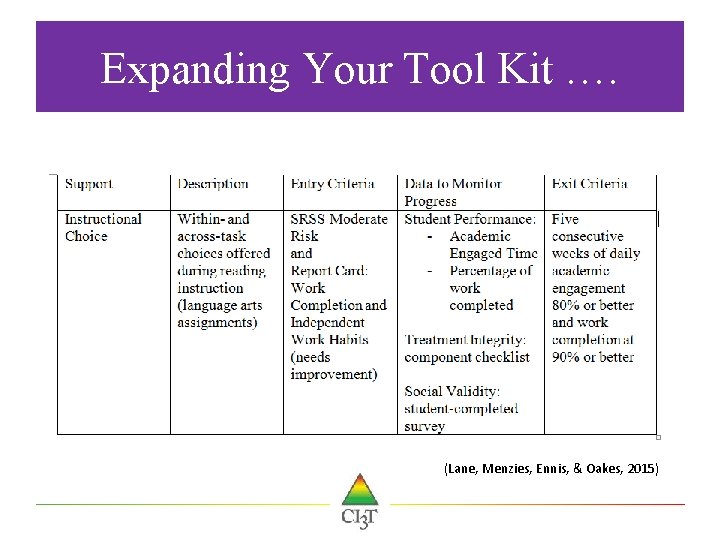
Expanding Your Tool Kit …. (Lane, Menzies, Ennis, & Oakes, 2015)
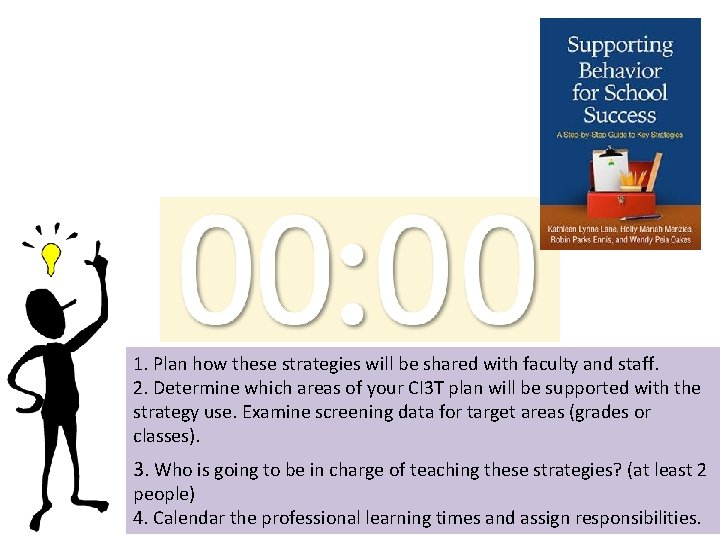
1. Plan how these strategies will be shared with faculty and staff. 2. Determine which areas of your CI 3 T plan will be supported with the strategy use. Examine screening data for target areas (grades or classes). 3. Who is going to be in charge of teaching these strategies? (at least 2 people) 4. Calendar the professional learning times and assign responsibilities.
Examining your screening data … … implications for primary prevention efforts … implications for teachers … implications for student-based interventions See Lane, Menzies, Bruhn, and Crnobori (2011)
Comprehensive, Integrated, Three-Tier Model of Prevention (Lane, Kalberg, & Menzies, 2009) Goal: Reduce Harm Specialized Individual Systems for Students with High-Risk ≈ Tertiary Prevention (Tier 3) ≈ Secondary Prevention (Tier 2) Goal: Reverse Harm Specialized Group System for Students At-Risk PBIS Framework Goal: Prevent Harm School/Classroom-Wide Systems for All Students, Staff, & Settings Validated Curricula ≈ Primary Prevention (Tier 1) Academic Behavioral Social
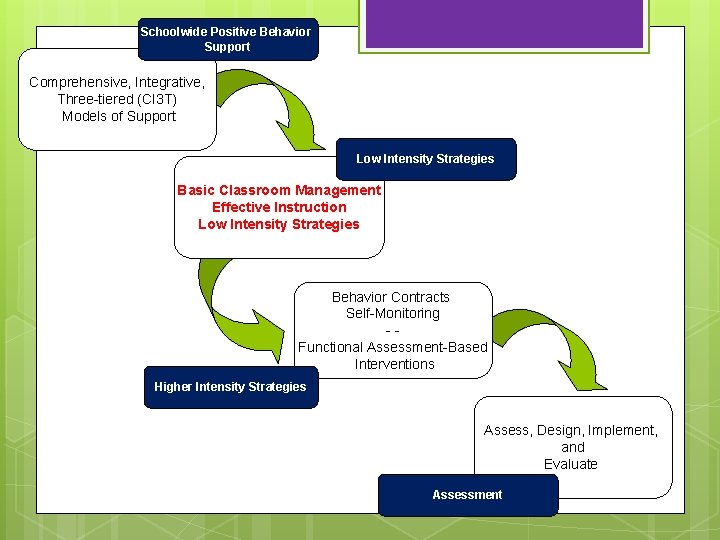
Schoolwide Positive Behavior Support Comprehensive, Integrative, Three-tiered (CI 3 T) Models of Support Low Intensity Strategies Basic Classroom Management Effective Instruction Low Intensity Strategies Behavior Contracts Self-Monitoring -Functional Assessment-Based Interventions Higher Intensity Strategies Assess, Design, Implement, and Evaluate Assessment
BASC 2 – Behavior and Emotional Screening Scale Spring 2012 Percent of Students N = 24 100% 90% 80% 70% 60% 50% 40% 30% 20% 10% 0% N = 67 Normal Elevated 3. 85 10. 74 Extremely Elevated 5. 45 3. 65 8. 68 12. 38 2. 46 11. 33 N = 533 85. 42 Total N = 624 87. 67 Sixth 82. 18 Seventh Subgroup n = 219 n = 202 86. 21 Eighth n = 203
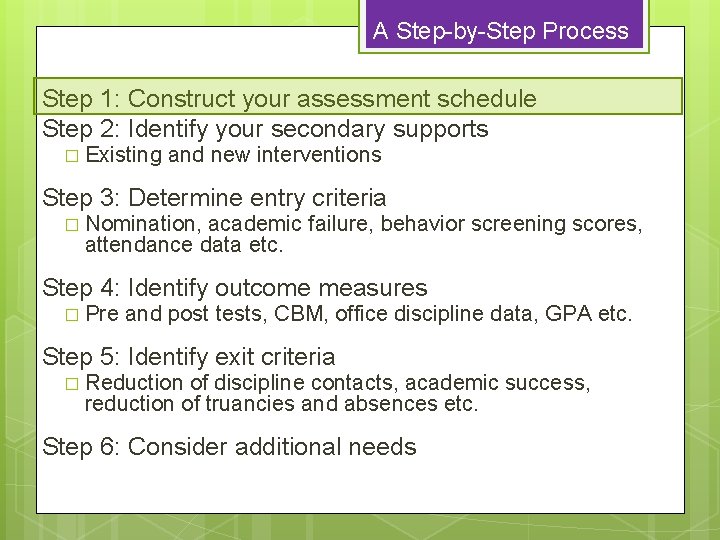
A Step-by-Step Process Step 1: Construct your assessment schedule Step 2: Identify your secondary supports � Existing and new interventions Step 3: Determine entry criteria � Nomination, academic failure, behavior screening scores, attendance data etc. Step 4: Identify outcome measures � Pre and post tests, CBM, office discipline data, GPA etc. Step 5: Identify exit criteria � Reduction of discipline contacts, academic success, reduction of truancies and absences etc. Step 6: Consider additional needs
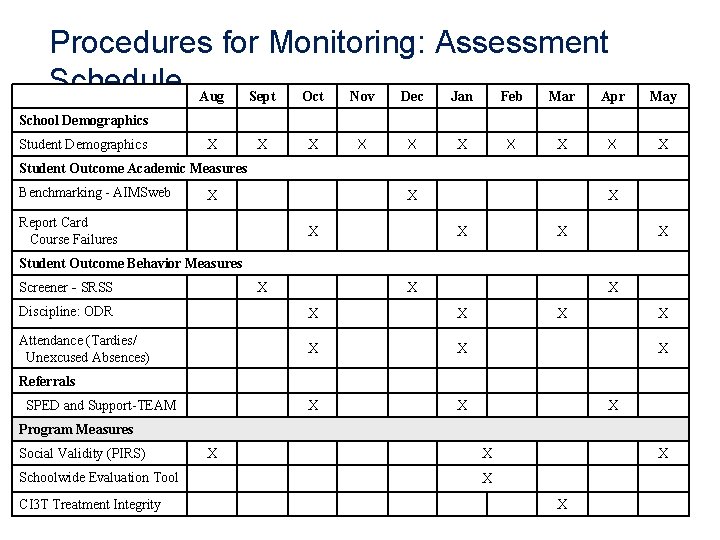
Procedures for Monitoring: Assessment Schedule Aug Sept Oct Nov Dec Jan Feb Mar Apr May School Demographics Student Demographics X X X X X Student Outcome Academic Measures Benchmarking - AIMSweb X X Report Card Course Failures X X X Student Outcome Behavior Measures Screener - SRSS X X X Discipline: ODR X X Attendance (Tardies/ Unexcused Absences) X X X X Referrals SPED and Support-TEAM X Program Measures Social Validity (PIRS) Schoolwide Evaluation Tool CI 3 T Treatment Integrity X X X
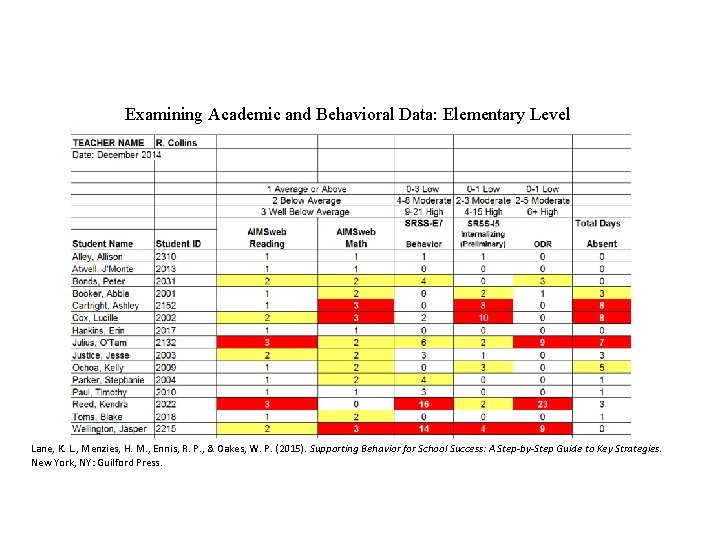
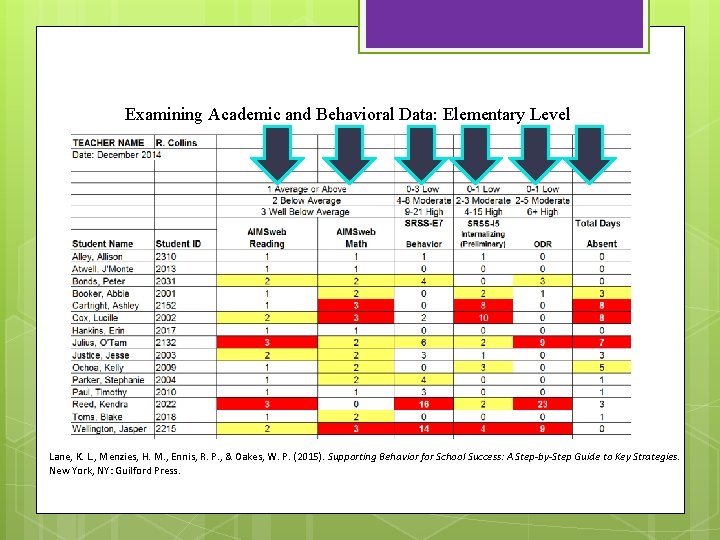
Examining Academic and Behavioral Data: Elementary Level Lane, K. L. , Menzies, H. M. , Ennis, R. P. , & Oakes, W. P. (2015). Supporting Behavior for School Success: A Step-by-Step Guide to Key Strategies. New York, NY: Guilford Press.
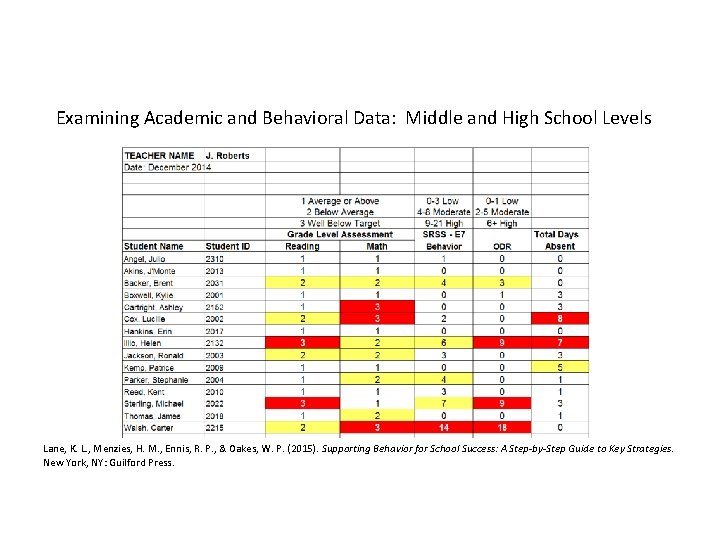
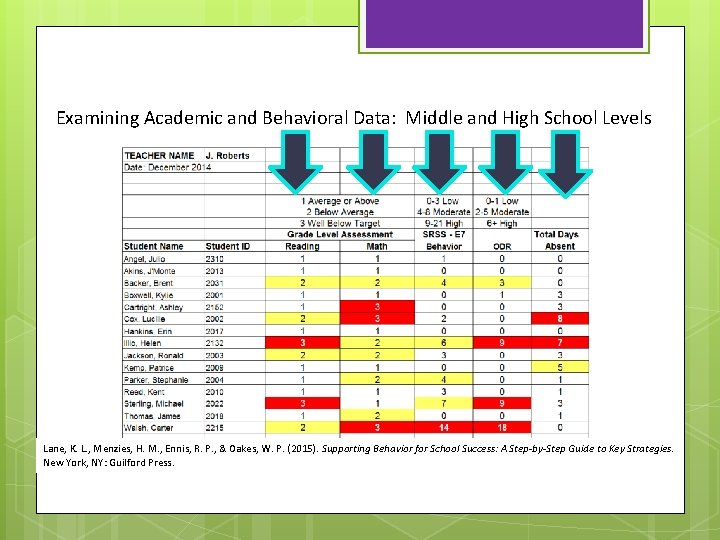
Examining Academic and Behavioral Data: Middle and High School Levels Lane, K. L. , Menzies, H. M. , Ennis, R. P. , & Oakes, W. P. (2015). Supporting Behavior for School Success: A Step-by-Step Guide to Key Strategies. New York, NY: Guilford Press.
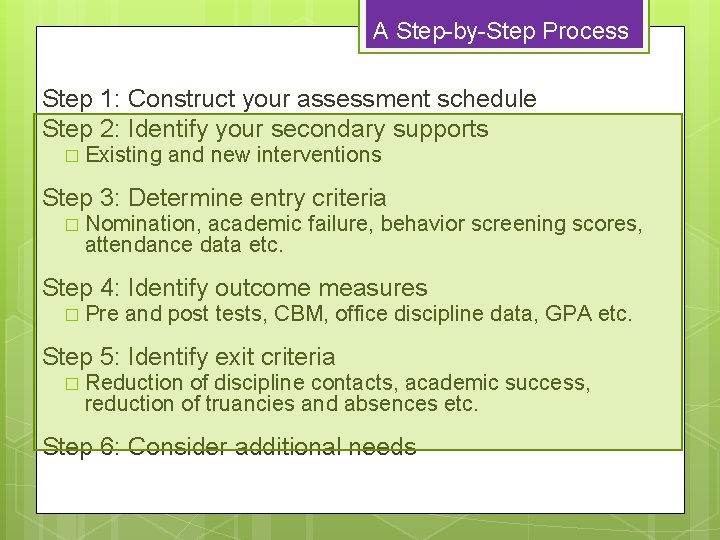
A Step-by-Step Process Step 1: Construct your assessment schedule Step 2: Identify your secondary supports � Existing and new interventions Step 3: Determine entry criteria � Nomination, academic failure, behavior screening scores, attendance data etc. Step 4: Identify outcome measures � Pre and post tests, CBM, office discipline data, GPA etc. Step 5: Identify exit criteria � Reduction of discipline contacts, academic success, reduction of truancies and absences etc. Step 6: Consider additional needs
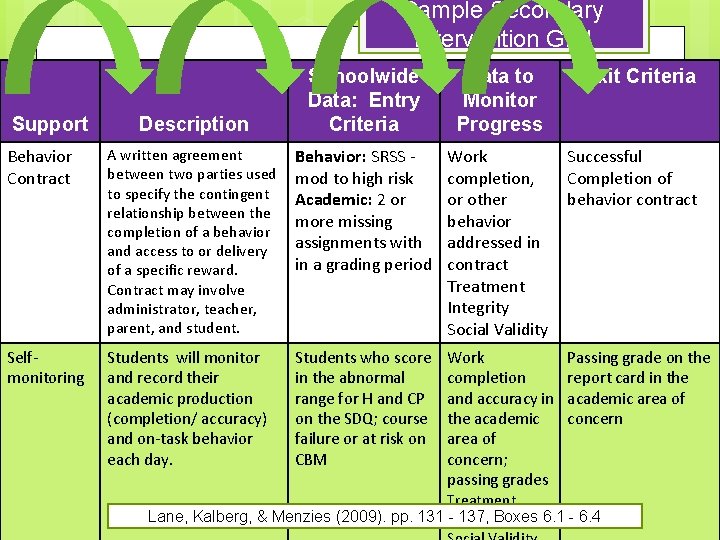
Sample Secondary Intervention Grid Support Description Schoolwide Data: Entry Criteria Data to Monitor Progress Exit Criteria mod to high risk Academic: 2 or more missing assignments with in a grading period completion, or other behavior addressed in contract Treatment Integrity Social Validity Completion of behavior contract Students who score in the abnormal range for H and CP on the SDQ; course failure or at risk on CBM Work completion and accuracy in the academic area of concern; passing grades Passing grade on the report card in the academic area of concern Sample Secondary Intervention Grid Behavior: SRSS Work Successful Behavior Contract A written agreement between two parties used to specify the contingent relationship between the completion of a behavior and access to or delivery of a specific reward. Contract may involve administrator, teacher, parent, and student. Selfmonitoring Students will monitor and record their academic production (completion/ accuracy) and on-task behavior each day. Treatment Lane, Kalberg, & Menzies (2009). pp. 131 Integrity - 137, Boxes 6. 1 - 6. 4
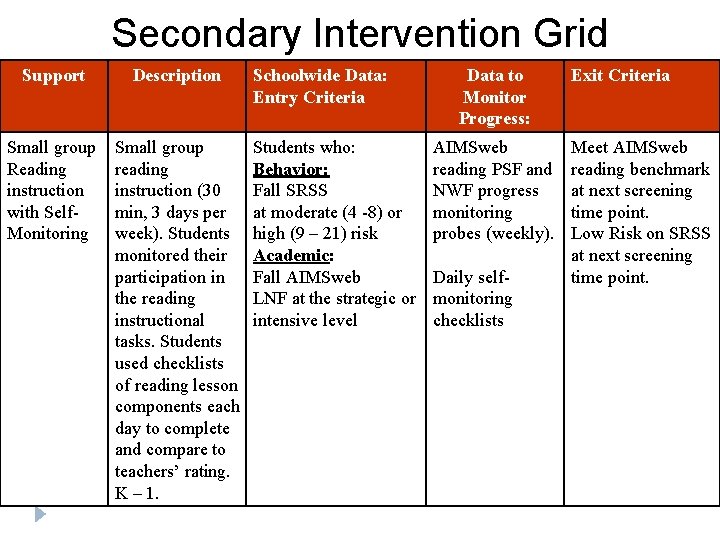
Secondary Intervention Grid Support Description Small group Reading instruction with Self. Monitoring Small group reading instruction (30 min, 3 days per week). Students monitored their participation in the reading instructional tasks. Students used checklists of reading lesson components each day to complete and compare to teachers’ rating. K – 1. Schoolwide Data: Entry Criteria Students who: Behavior: Fall SRSS at moderate (4 -8) or high (9 – 21) risk Academic: Fall AIMSweb LNF at the strategic or intensive level Data to Monitor Progress: AIMSweb reading PSF and NWF progress monitoring probes (weekly). Daily selfmonitoring checklists Exit Criteria Meet AIMSweb reading benchmark at next screening time point. Low Risk on SRSS at next screening time point.
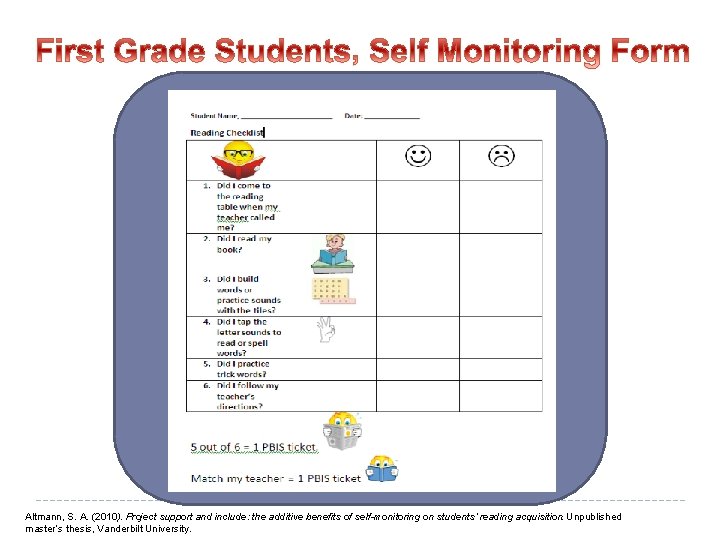
Altmann, S. A. (2010). Project support and include: the additive benefits of self-monitoring on students’ reading acquisition. Unpublished master’s thesis, Vanderbilt University.
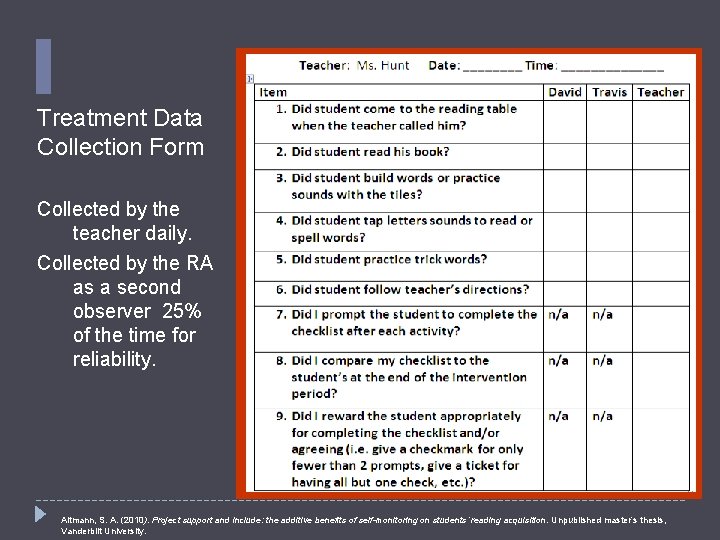
Treatment Data Collection Form Collected by the teacher daily. Collected by the RA as a second observer 25% of the time for reliability. Altmann, S. A. (2010). Project support and include: the additive benefits of self-monitoring on students’ reading acquisition. Unpublished master’s thesis, Vanderbilt University.

Illustration #2: Tier 2 Writing Ins truction for Student s with Writing and Behavior Challenges Lane, K. L. , H arris, K. , Gra ham, S. , Dris M. , House, E coll, S. A. , Sa. , & Schatsch ndmel, K. , M neider, C. (2 at tier-2 for orphy, P. , H 0 11). Self-reg second-grad ebert, ulated strate e students w randomized gy developm ith writing a control tria ent l. Journal of nd behavior Research on al difficultie s: A Educational Effectiveness – 353. , 4, 322
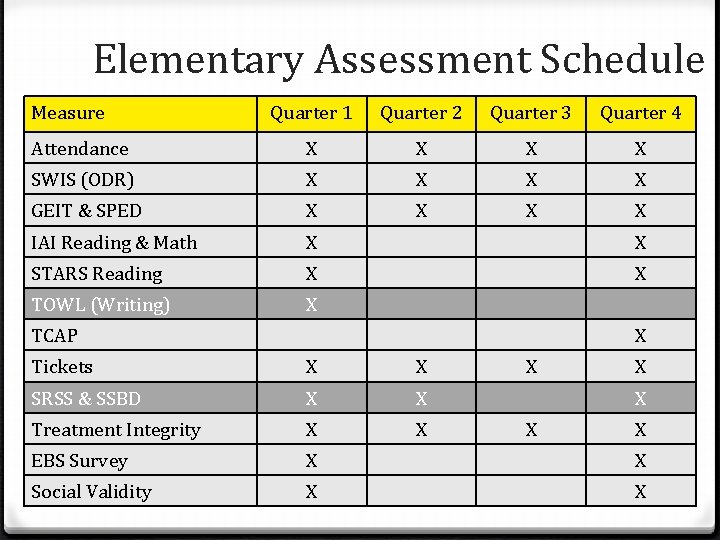
Elementary Assessment Schedule Measure Quarter 1 Quarter 2 Quarter 3 Quarter 4 Attendance X X SWIS (ODR) X X GEIT & SPED X X IAI Reading & Math X X STARS Reading X X TOWL (Writing) X TCAP X Tickets X X SRSS & SSBD X X Treatment Integrity X X EBS Survey X X Social Validity X X X
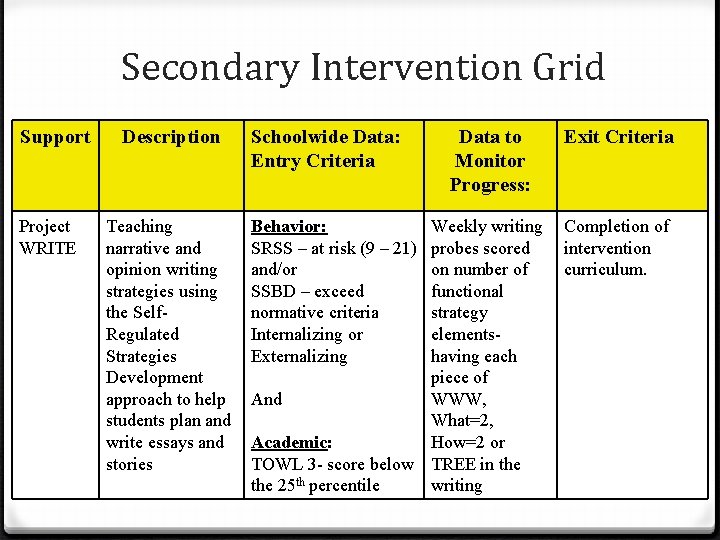
Secondary Intervention Grid Support Project WRITE Description Teaching narrative and opinion writing strategies using the Self. Regulated Strategies Development approach to help students plan and write essays and stories Schoolwide Data: Entry Criteria Behavior: SRSS – at risk (9 – 21) and/or SSBD – exceed normative criteria Internalizing or Externalizing Data to Monitor Progress: Weekly writing probes scored on number of functional strategy elementshaving each piece of And WWW, What=2, Academic: How=2 or TOWL 3 - score below TREE in the 25 th percentile writing Exit Criteria Completion of intervention curriculum.
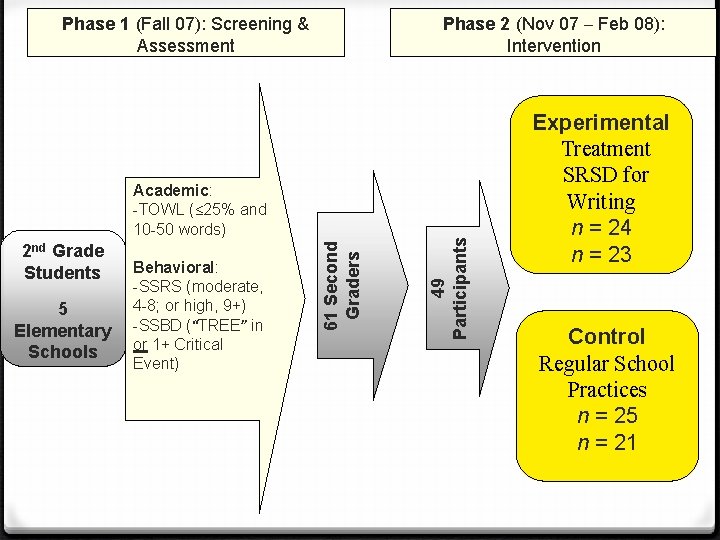
2 nd Grade Students 5 Elementary Schools Behavioral: -SSRS (moderate, 4 -8; or high, 9+) -SSBD (“TREE” in or 1+ Critical Event) 61 Second Graders Academic: -TOWL (≤ 25% and 10 -50 words) 49 Participants Phase 2 (Nov 07 – Feb 08): Intervention Phase 1 (Fall 07): Screening & Assessment Experimental Treatment SRSD for Writing n = 24 n = 23 Control Regular School Practices n = 25 n = 21
Intervention ØSelf-Regulated Strategy Development (SRSD; Harris & Graham, 1996) ØBehavioral Component Ø 3 days a week; 30 -min sessions delivered 1: 1 by a research assistant ØFidelity collected more than 33% of sessions Lane, K. L. , Harris, K. , Graham, S. , Driscoll, S. A. , Sandmel, K. , Morphy, P. , Hebert, M. , House, E. , & Schatschneider, C. (2011). Self-regulated strategy development at tier-2 for secondgrade students with writing and behavioral difficulties: A randomized control trial. Journal of Research on Educational Effectiveness, 4, 322 – 353.
Illustration #3: Conflict Resolution and Study Skills at Tier 2 for Middle School Students Kalberg, J. R. , Lane, K. L. , & Lambert, W. (2012). The utility of conflict resolution and study skills interventions with middle school students at risk for antisocial behavior: A methodological illustration. Remedial and Special Education, 22, 23 -38. doi: 10. 1177/0741932510362514
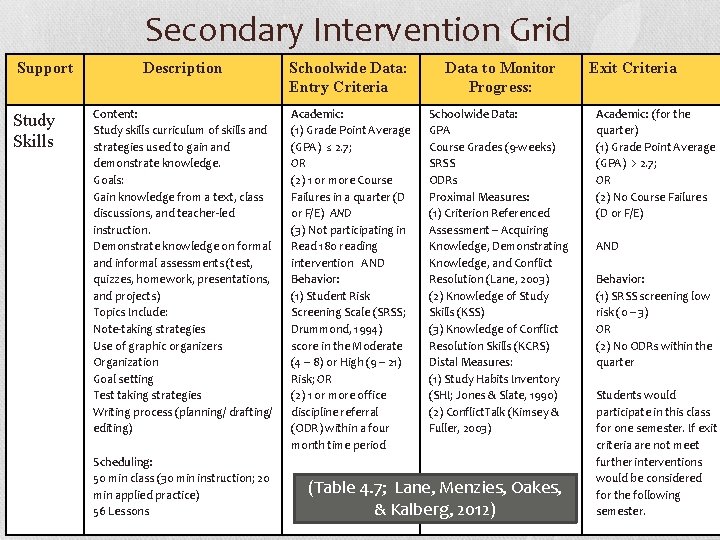
Secondary Intervention Grid Support Study Skills Description Schoolwide Data: Entry Criteria Data to Monitor Progress: Content: Study skills curriculum of skills and strategies used to gain and demonstrate knowledge. Goals: Gain knowledge from a text, class discussions, and teacher-led instruction. Demonstrate knowledge on formal and informal assessments (test, quizzes, homework, presentations, and projects) Topics Include: Note-taking strategies Use of graphic organizers Organization Goal setting Test taking strategies Writing process (planning/ drafting/ editing) Academic: (1) Grade Point Average (GPA) ≤ 2. 7; OR (2) 1 or more Course Failures in a quarter (D or F/E) AND (3) Not participating in Read 180 reading intervention AND Behavior: (1) Student Risk Screening Scale (SRSS; Drummond, 1994) score in the Moderate (4 – 8) or High (9 – 21) Risk; OR (2) 1 or more office discipline referral (ODR) within a four month time period Schoolwide Data: GPA Course Grades (9 -weeks) SRSS ODRs Proximal Measures: (1) Criterion Referenced Assessment – Acquiring Knowledge, Demonstrating Knowledge, and Conflict Resolution (Lane, 2003) (2) Knowledge of Study Skills (KSS) (3) Knowledge of Conflict Resolution Skills (KCRS) Distal Measures: (1) Study Habits Inventory (SHI; Jones & Slate, 1990) (2) Conflict. Talk (Kimsey & Fuller, 2003) Scheduling: 50 min class (30 min instruction; 20 min applied practice) 56 Lessons (Table 4. 7; Lane, Menzies, Oakes, & Kalberg, 2012) Exit Criteria Academic: (for the quarter) (1) Grade Point Average (GPA) > 2. 7; OR (2) No Course Failures (D or F/E) AND Behavior: (1) SRSS screening low risk (0 – 3) OR (2) No ODRs within the quarter Students would participate in this class for one semester. If exit criteria are not meet further interventions would be considered for the following semester.
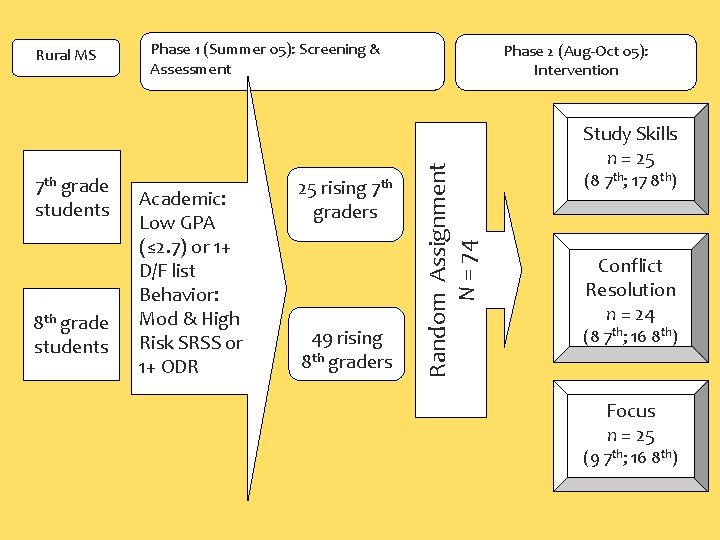
7 th grade students 8 th grade students Phase 1 (Summer 05): Screening & Assessment Academic: Low GPA (≤ 2. 7) or 1+ D/F list Behavior: Mod & High Risk SRSS or 1+ ODR 25 rising 7 th graders 49 rising 8 th graders Phase 2 (Aug-Oct 05): Intervention Random Assignment N = 74 Rural MS Study Skills n = 25 (8 7 th; 17 8 th) Conflict Resolution n = 24 (8 7 th; 16 8 th) Focus n = 25 (9 7 th; 16 8 th)
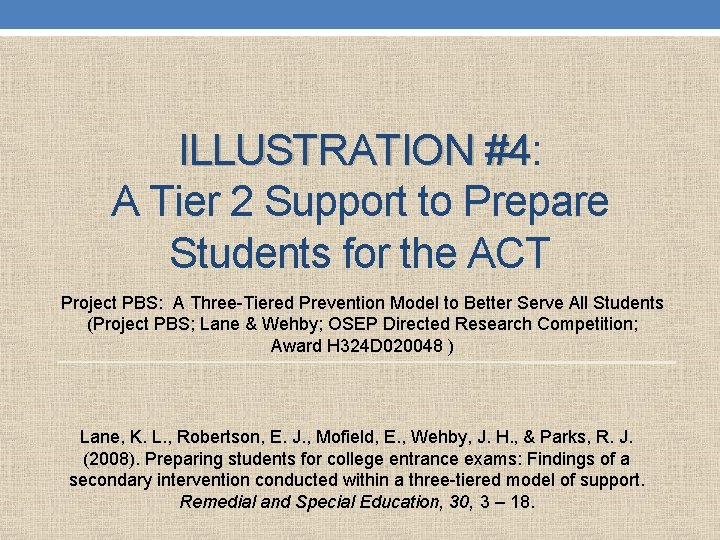
ILLUSTRATION #4: #4 A Tier 2 Support to Prepare Students for the ACT Project PBS: A Three-Tiered Prevention Model to Better Serve All Students (Project PBS; Lane & Wehby; OSEP Directed Research Competition; Award H 324 D 020048 ) Lane, K. L. , Robertson, E. J. , Mofield, E. , Wehby, J. H. , & Parks, R. J. (2008). Preparing students for college entrance exams: Findings of a secondary intervention conducted within a three-tiered model of support. Remedial and Special Education, 30, 3 – 18.
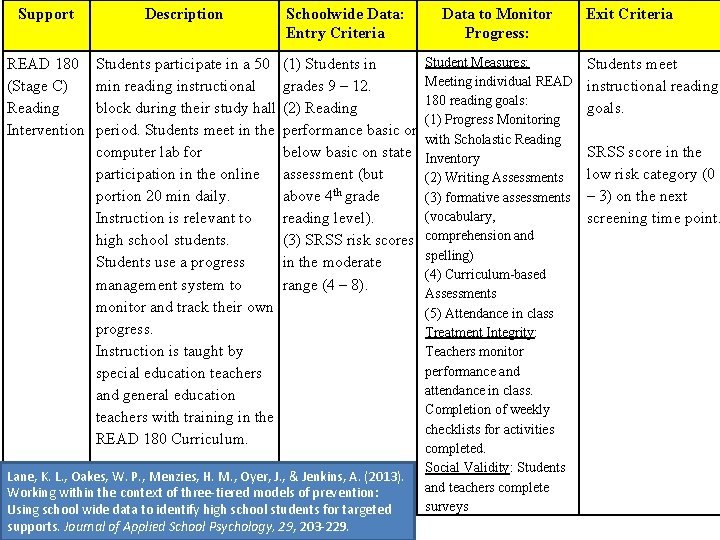
Support Description Schoolwide Data: Entry Criteria READ 180 (Stage C) Reading Intervention Students participate in a 50 min reading instructional block during their study hall period. Students meet in the computer lab for participation in the online portion 20 min daily. Instruction is relevant to high school students. Students use a progress management system to monitor and track their own progress. Instruction is taught by special education teachers and general education teachers with training in the READ 180 Curriculum. (1) Students in grades 9 – 12. (2) Reading performance basic or below basic on state assessment (but above 4 th grade reading level). (3) SRSS risk scores in the moderate range (4 – 8). Lane, K. L. , Oakes, W. P. , Menzies, H. M. , Oyer, J. , & Jenkins, A. (2013). Working within the context of three-tiered models of prevention: Using school wide data to identify high school students for targeted supports. Journal of Applied School Psychology, 29, 203 -229. Data to Monitor Progress: Student Measures: Meeting individual READ 180 reading goals: (1) Progress Monitoring with Scholastic Reading Inventory (2) Writing Assessments (3) formative assessments (vocabulary, comprehension and spelling) (4) Curriculum-based Assessments (5) Attendance in class Treatment Integrity: Teachers monitor performance and attendance in class. Completion of weekly checklists for activities completed. Social Validity: Students and teachers complete surveys Exit Criteria Students meet instructional reading goals. SRSS score in the low risk category (0 – 3) on the next screening time point.
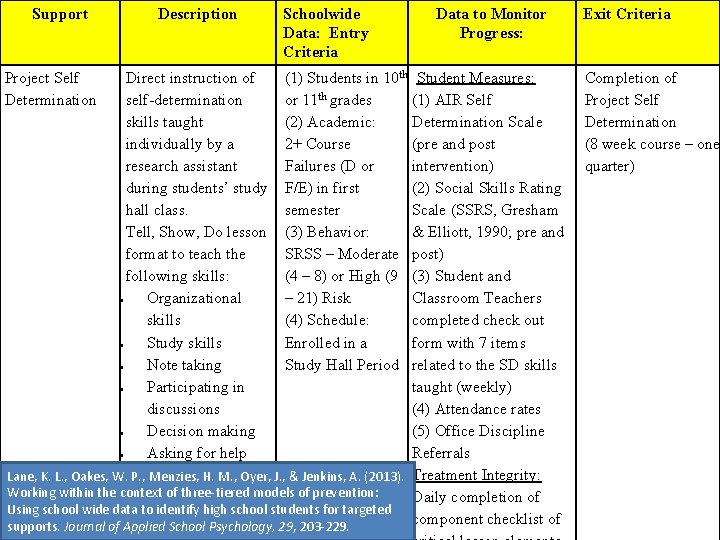
Support Description Schoolwide Data: Entry Criteria Project Self Determination Direct instruction of (1) Students in 10 th self-determination or 11 th grades skills taught (2) Academic: individually by a 2+ Course research assistant Failures (D or during students’ study F/E) in first hall class. semester Tell, Show, Do lesson (3) Behavior: format to teach the SRSS – Moderate following skills: (4 – 8) or High (9 Organizational – 21) Risk skills (4) Schedule: Study skills Enrolled in a Note taking Study Hall Period Participating in discussions Decision making Asking for help per week; 30 J. , & Jenkins, A. (2013). Lane, K. L. , Oakes, W. 3 P. , days Menzies, H. M. , Oyer, Working within the context of three-tiered min lesson; 8 weeksmodels of prevention: Using school wide data to identify high school students for targeted supports. Journal of Applied School Psychology, 29, 203 -229. Data to Monitor Progress: Student Measures: (1) AIR Self Determination Scale (pre and post intervention) (2) Social Skills Rating Scale (SSRS, Gresham & Elliott, 1990; pre and post) (3) Student and Classroom Teachers completed check out form with 7 items related to the SD skills taught (weekly) (4) Attendance rates (5) Office Discipline Referrals Treatment Integrity: Daily completion of component checklist of Exit Criteria Completion of Project Self Determination (8 week course – one quarter)
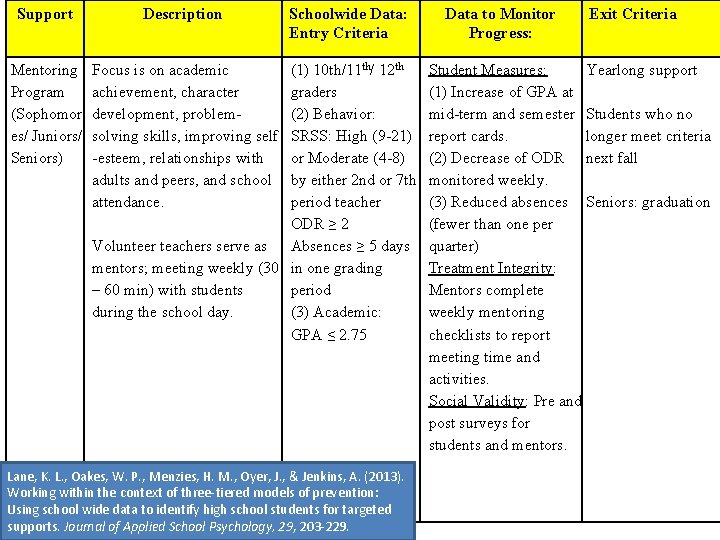
Support Description Mentoring Program (Sophomor es/ Juniors/ Seniors) Focus is on academic achievement, character development, problemsolving skills, improving self -esteem, relationships with adults and peers, and school attendance. Schoolwide Data: Entry Criteria (1) 10 th/11 th/ 12 th graders (2) Behavior: SRSS: High (9 -21) or Moderate (4 -8) by either 2 nd or 7 th period teacher ODR ≥ 2 Volunteer teachers serve as Absences ≥ 5 days mentors; meeting weekly (30 in one grading – 60 min) with students period during the school day. (3) Academic: GPA ≤ 2. 75 Lane, K. L. , Oakes, W. P. , Menzies, H. M. , Oyer, J. , & Jenkins, A. (2013). Working within the context of three-tiered models of prevention: Using school wide data to identify high school students for targeted supports. Journal of Applied School Psychology, 29, 203 -229. Data to Monitor Progress: Exit Criteria Student Measures: Yearlong support (1) Increase of GPA at mid-term and semester Students who no report cards. longer meet criteria (2) Decrease of ODR next fall monitored weekly. (3) Reduced absences Seniors: graduation (fewer than one per quarter) Treatment Integrity: Mentors complete weekly mentoring checklists to report meeting time and activities. Social Validity: Pre and post surveys for students and mentors.
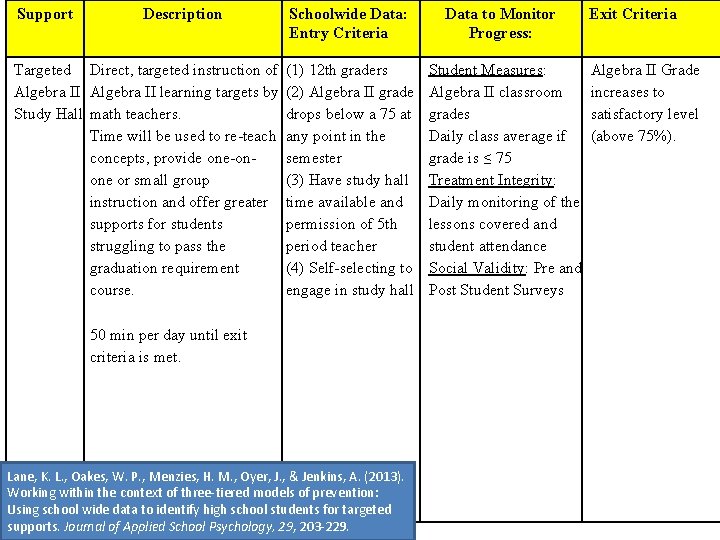
Support Description Targeted Direct, targeted instruction of Algebra II learning targets by Study Hall math teachers. Time will be used to re-teach concepts, provide one-onone or small group instruction and offer greater supports for students struggling to pass the graduation requirement course. Schoolwide Data: Entry Criteria Data to Monitor Progress: (1) 12 th graders (2) Algebra II grade drops below a 75 at any point in the semester (3) Have study hall time available and permission of 5 th period teacher (4) Self-selecting to engage in study hall Student Measures: Algebra II classroom grades Daily class average if grade is ≤ 75 Treatment Integrity: Daily monitoring of the lessons covered and student attendance Social Validity: Pre and Post Student Surveys 50 min per day until exit criteria is met. Lane, K. L. , Oakes, W. P. , Menzies, H. M. , Oyer, J. , & Jenkins, A. (2013). Working within the context of three-tiered models of prevention: Using school wide data to identify high school students for targeted supports. Journal of Applied School Psychology, 29, 203 -229. Exit Criteria Algebra II Grade increases to satisfactory level (above 75%).
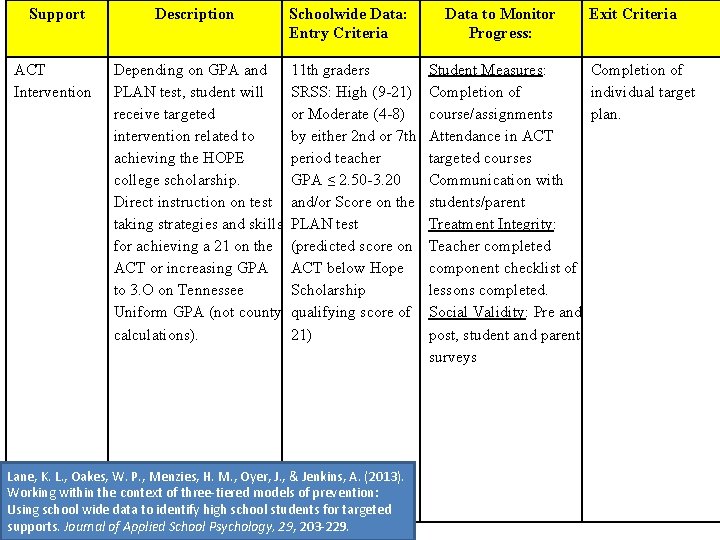
Support Description Schoolwide Data: Entry Criteria ACT Intervention Depending on GPA and PLAN test, student will receive targeted intervention related to achieving the HOPE college scholarship. Direct instruction on test taking strategies and skills for achieving a 21 on the ACT or increasing GPA to 3. O on Tennessee Uniform GPA (not county calculations). 11 th graders SRSS: High (9 -21) or Moderate (4 -8) by either 2 nd or 7 th period teacher GPA ≤ 2. 50 -3. 20 and/or Score on the PLAN test (predicted score on ACT below Hope Scholarship qualifying score of 21) Lane, K. L. , Oakes, W. P. , Menzies, H. M. , Oyer, J. , & Jenkins, A. (2013). Working within the context of three-tiered models of prevention: Using school wide data to identify high school students for targeted supports. Journal of Applied School Psychology, 29, 203 -229. Data to Monitor Progress: Exit Criteria Student Measures: Completion of individual target course/assignments plan. Attendance in ACT targeted courses Communication with students/parent Treatment Integrity: Teacher completed component checklist of lessons completed. Social Validity: Pre and post, student and parent surveys
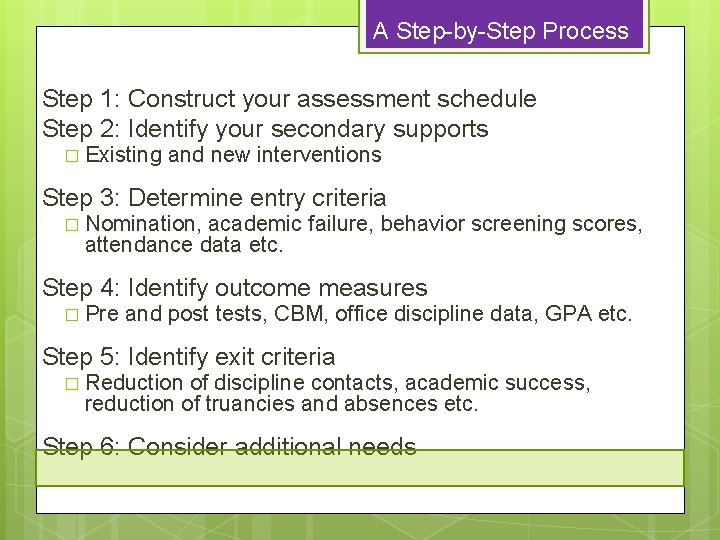
A Step-by-Step Process Step 1: Construct your assessment schedule Step 2: Identify your secondary supports � Existing and new interventions Step 3: Determine entry criteria � Nomination, academic failure, behavior screening scores, attendance data etc. Step 4: Identify outcome measures � Pre and post tests, CBM, office discipline data, GPA etc. Step 5: Identify exit criteria � Reduction of discipline contacts, academic success, reduction of truancies and absences etc. Step 6: Consider additional needs
What other evidence-based practices are available? 2014 - 2015 MTSS: CI 3 T Implementation 117
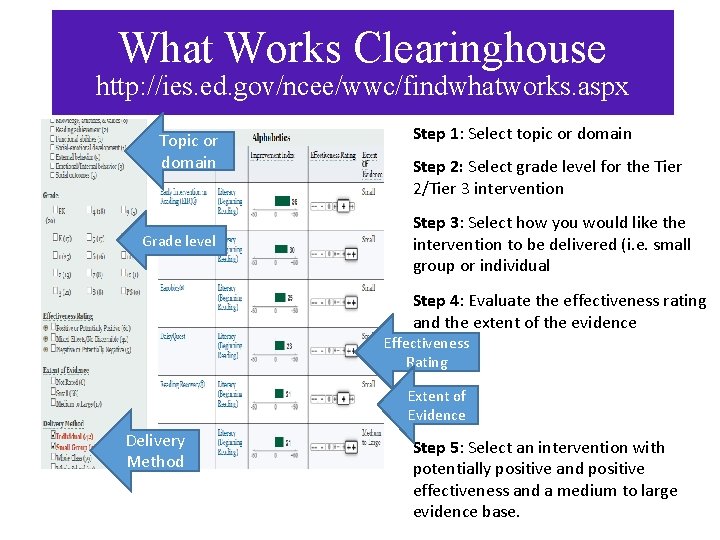
What Works Clearinghouse http: //ies. ed. gov/ncee/wwc/findwhatworks. aspx Topic or domain Grade level Step 1: Select topic or domain Step 2: Select grade level for the Tier 2/Tier 3 intervention Step 3: Select how you would like the intervention to be delivered (i. e. small group or individual Step 4: Evaluate the effectiveness rating and the extent of the evidence Effectiveness Rating Extent of Evidence Delivery Method Step 5: Select an intervention with potentially positive and positive effectiveness and a medium to large evidence base.
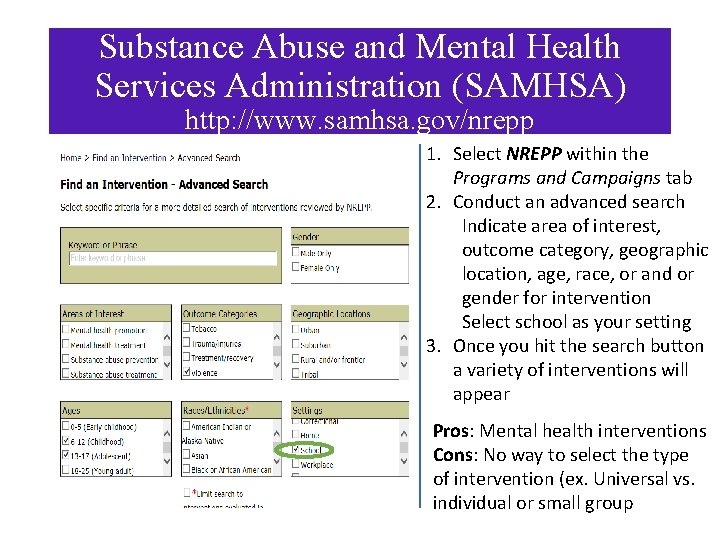
Substance Abuse and Mental Health Services Administration (SAMHSA) http: //www. samhsa. gov/nrepp 1. Select NREPP within the Programs and Campaigns tab 2. Conduct an advanced search Indicate area of interest, outcome category, geographic location, age, race, or and or gender for intervention Select school as your setting 3. Once you hit the search button a variety of interventions will appear Pros: Mental health interventions Cons: No way to select the type of intervention (ex. Universal vs. individual or small group
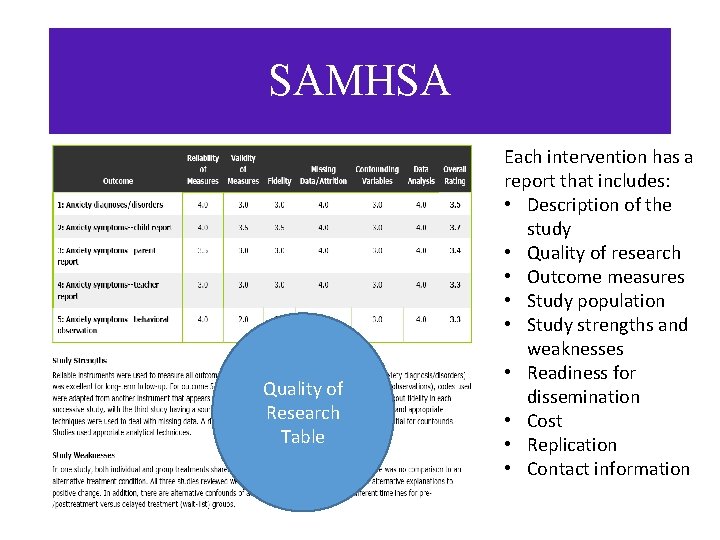
SAMHSA Quality of Research Table Each intervention has a report that includes: • Description of the study • Quality of research • Outcome measures • Study population • Study strengths and weaknesses • Readiness for dissemination • Cost • Replication • Contact information
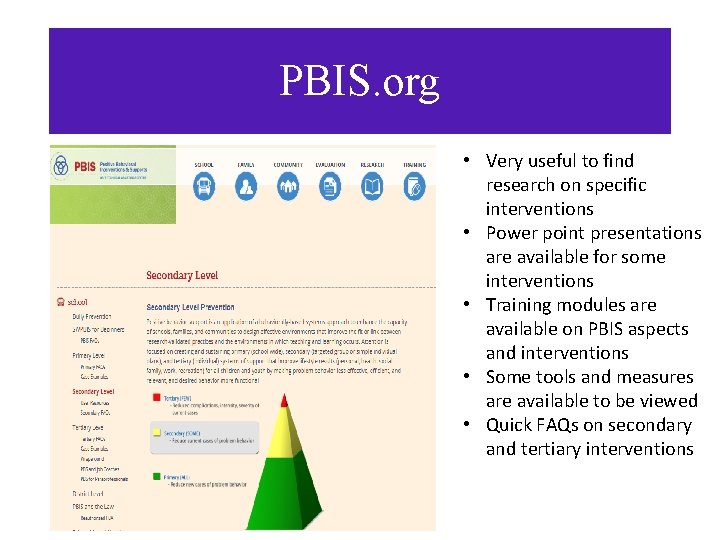
PBIS. org • Very useful to find research on specific interventions • Power point presentations are available for some interventions • Training modules are available on PBIS aspects and interventions • Some tools and measures are available to be viewed • Quick FAQs on secondary and tertiary interventions
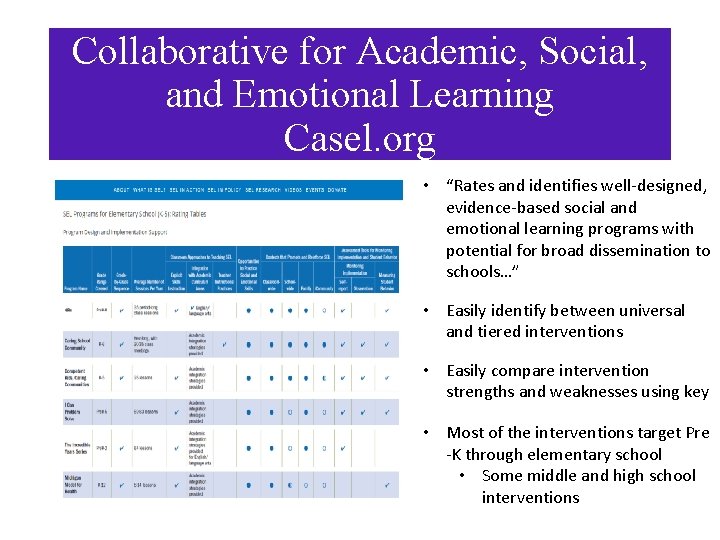
Collaborative for Academic, Social, and Emotional Learning Casel. org • “Rates and identifies well-designed, evidence-based social and emotional learning programs with potential for broad dissemination to schools…” • Easily identify between universal and tiered interventions • Easily compare intervention strengths and weaknesses using key • Most of the interventions target Pre -K through elementary school • Some middle and high school interventions
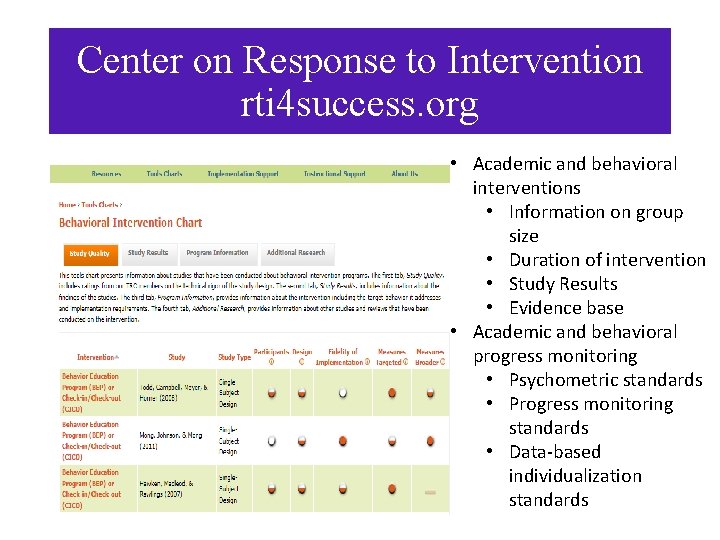
Center on Response to Intervention rti 4 success. org • Academic and behavioral interventions • Information on group size • Duration of intervention • Study Results • Evidence base • Academic and behavioral progress monitoring • Psychometric standards • Progress monitoring standards • Data-based individualization standards
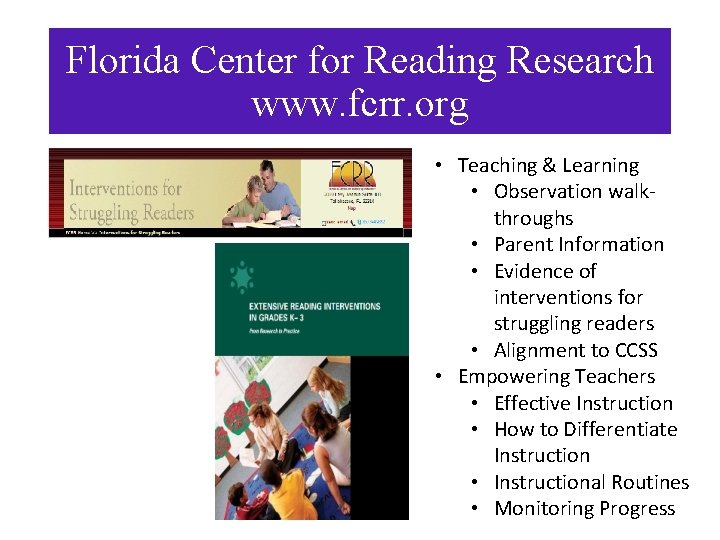
Florida Center for Reading Research www. fcrr. org • Teaching & Learning • Observation walkthroughs • Parent Information • Evidence of interventions for struggling readers • Alignment to CCSS • Empowering Teachers • Effective Instruction • How to Differentiate Instruction • Instructional Routines • Monitoring Progress
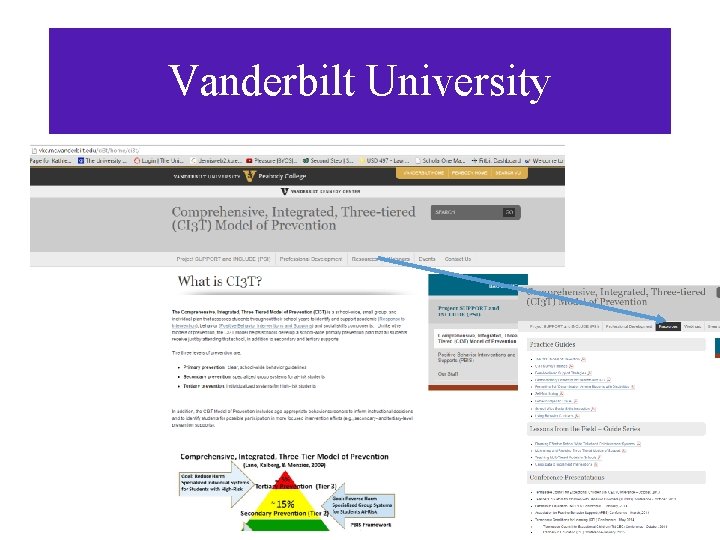
Vanderbilt University
CI 3 T. org
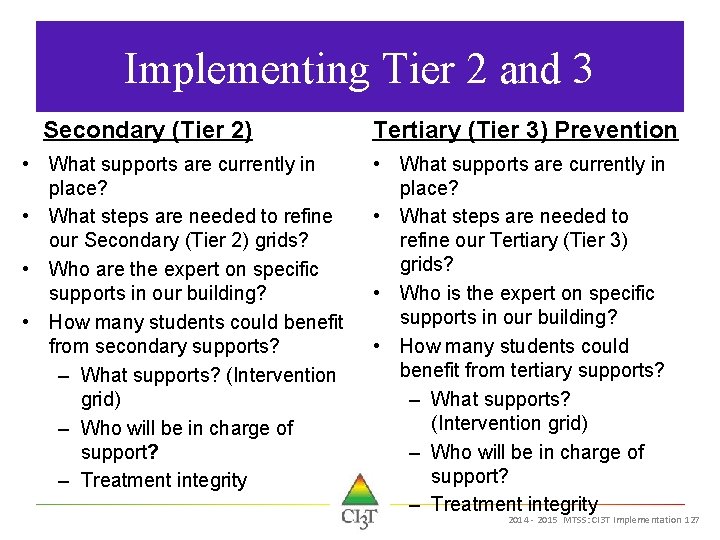
Implementing Tier 2 and 3 Secondary (Tier 2) • What supports are currently in place? • What steps are needed to refine our Secondary (Tier 2) grids? • Who are the expert on specific supports in our building? • How many students could benefit from secondary supports? – What supports? (Intervention grid) – Who will be in charge of support? – Treatment integrity Tertiary (Tier 3) Prevention • What supports are currently in place? • What steps are needed to refine our Tertiary (Tier 3) grids? • Who is the expert on specific supports in our building? • How many students could benefit from tertiary supports? – What supports? (Intervention grid) – Who will be in charge of support? – Treatment integrity 2014 - 2015 MTSS: CI 3 T Implementation 127
2014 - 2015 MTSS: CI 3 T Implementation 128
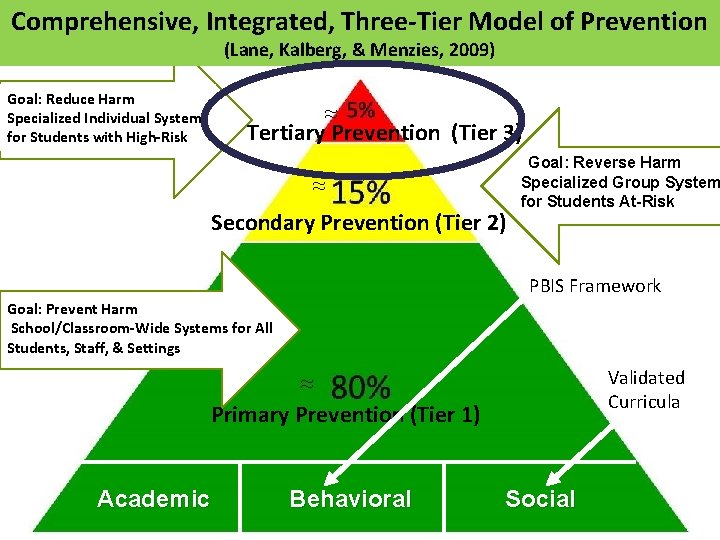
Comprehensive, Integrated, Three-Tier Model of Prevention (Lane, Kalberg, & Menzies, 2009) Goal: Reduce Harm Specialized Individual Systems for Students with High-Risk ≈ Tertiary Prevention (Tier 3) ≈ Secondary Prevention (Tier 2) Goal: Reverse Harm Specialized Group System for Students At-Risk PBIS Framework Goal: Prevent Harm School/Classroom-Wide Systems for All Students, Staff, & Settings Validated Curricula ≈ Primary Prevention (Tier 1) Academic Behavioral Social
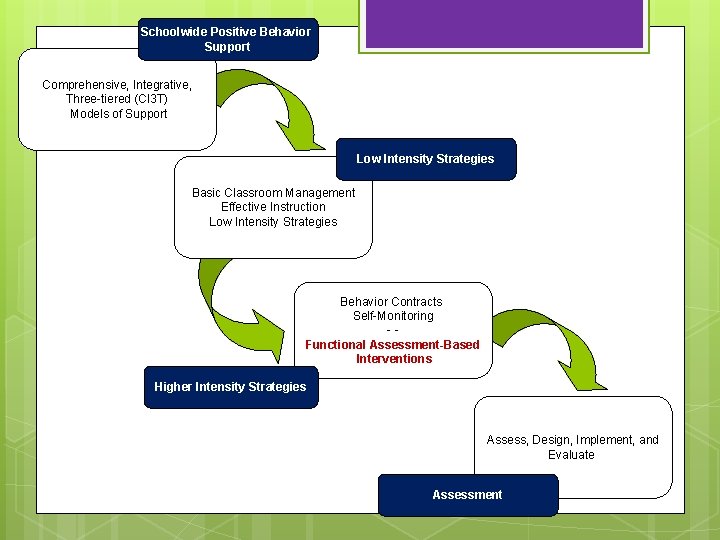
Schoolwide Positive Behavior Support Comprehensive, Integrative, Three-tiered (CI 3 T) Models of Support Low Intensity Strategies Basic Classroom Management Effective Instruction Low Intensity Strategies Behavior Contracts Self-Monitoring -Functional Assessment-Based Interventions Higher Intensity Strategies Assess, Design, Implement, and Evaluate Assessment
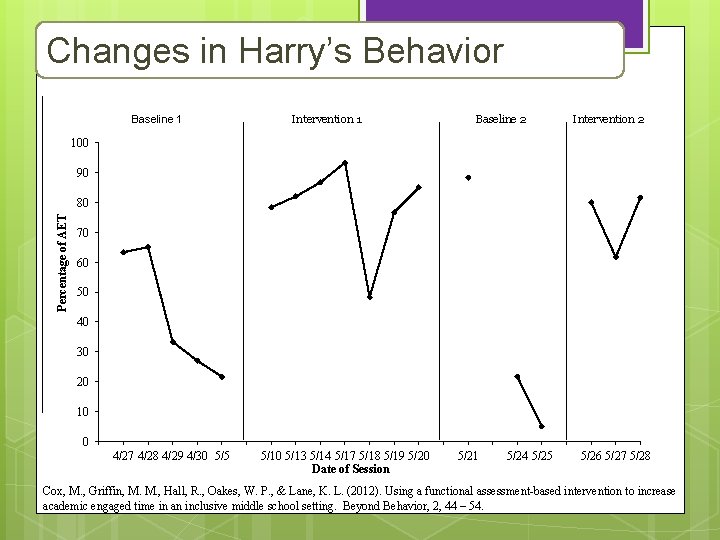
Changes in Harry’s Behavior Baseline 1 Intervention 1 Baseline 2 Intervention 2 100 90 Percentage of AET 80 70 60 50 40 30 20 10 0 4/27 4/28 4/29 4/30 5/5 5/10 5/13 5/14 5/17 5/18 5/19 5/20 Date of Session 5/21 5/24 5/25 5/26 5/27 5/28 Cox, M. , Griffin, M. M. , Hall, R. , Oakes, W. P. , & Lane, K. L. (2012). Using a functional assessment-based intervention to increase academic engaged time in an inclusive middle school setting. Beyond Behavior, 2, 44 – 54.
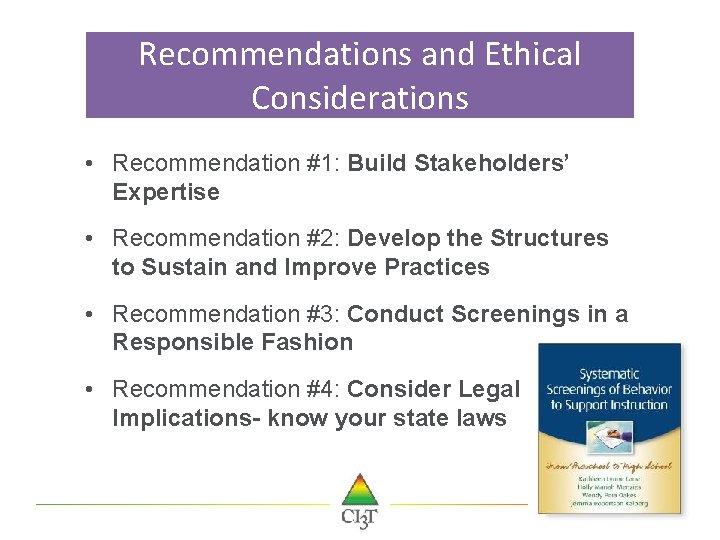
Recommendations and Ethical Considerations • Recommendation #1: Build Stakeholders’ Expertise • Recommendation #2: Develop the Structures to Sustain and Improve Practices • Recommendation #3: Conduct Screenings in a Responsible Fashion • Recommendation #4: Consider Legal Implications- know your state laws
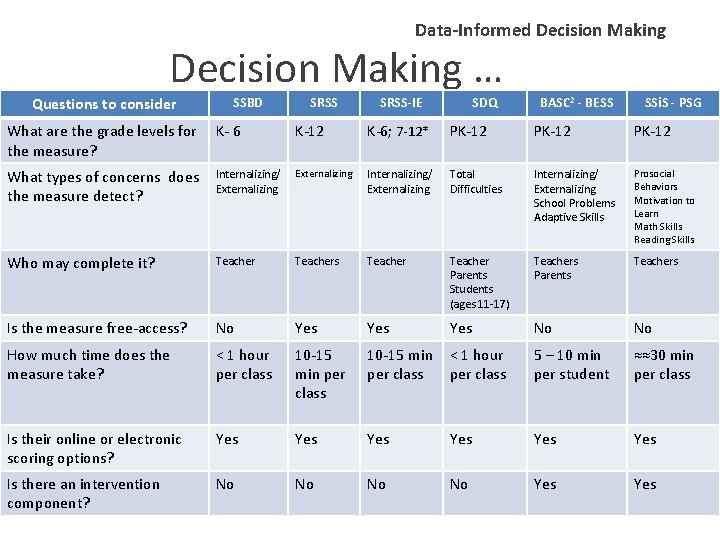
Data-Informed Decision Making … Questions to consider SSBD SRSS-IE SDQ BASC 2 - BESS SSi. S - PSG What are the grade levels for the measure? K- 6 K-12 K-6; 7 -12* PK-12 What types of concerns does Questions to the measure detect? Internalizing/ Externalizing Total Difficulties Internalizing/ Externalizing School Problems Adaptive Skills Prosocial Behaviors Motivation to Learn Math Skills Reading Skills Teacher Parents Students (ages 11 -17) Teachers Parents Teachers Yes No No 10 -15 min per class < 1 hour per class 5 – 10 min per student ≈≈30 min per class Consider … What grade level/ student age was the measure designed for? • What types of concerns does this Teachers Who may complete it? screening tool detect? • Who may complete this tool? • Is this a free-access tool? Is the measure Yes • Howfree-access? much time does. Nothe measure take to complete? How much time does the < 1 hour 10 -15 • Is there an online or computermeasure take? per class min per based scoring option? class • Is there an intervention component? • Is their online or electronic scoring options? Yes Yes Yes Is there an intervention component? No No Yes
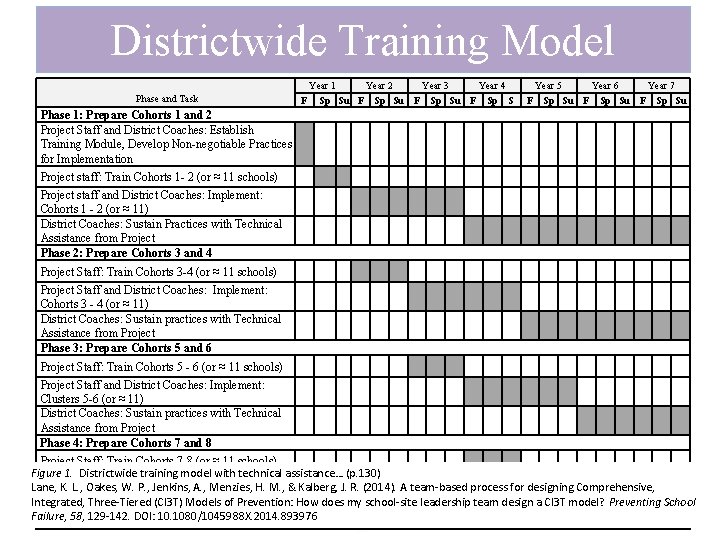
Districtwide Training Model Phase and Task F Year 1 Year 2 Sp Su F Year 3 Sp Su F Year 4 Sp S F Year 5 Sp Su F Year 6 Sp Su F Year 7 Sp Su Phase 1: Prepare Cohorts 1 and 2 Project Staff and District Coaches: Establish Training Module, Develop Non-negotiable Practices for Implementation Project staff: Train Cohorts 1 - 2 (or ≈ 11 schools) Project staff and District Coaches: Implement: Cohorts 1 - 2 (or ≈ 11) District Coaches: Sustain Practices with Technical Assistance from Project Phase 2: Prepare Cohorts 3 and 4 Project Staff: Train Cohorts 3 -4 (or ≈ 11 schools) Project Staff and District Coaches: Implement: Cohorts 3 - 4 (or ≈ 11) District Coaches: Sustain practices with Technical Assistance from Project Phase 3: Prepare Cohorts 5 and 6 Project Staff: Train Cohorts 5 - 6 (or ≈ 11 schools) Project Staff and District Coaches: Implement: Clusters 5 -6 (or ≈ 11) District Coaches: Sustain practices with Technical Assistance from Project Phase 4: Prepare Cohorts 7 and 8 Project Staff: Train Cohorts 7 -8 (or ≈ 11 schools) Figure 1. Districtwide training model with technical assistance… (p. 130) Project Staff and District Coaches: Implement: Lane, K. L. , Oakes, W. P. , Jenkins, A. , Menzies, H. M. , & Kalberg, J. R. (2014). A team-based process for designing Comprehensive, Cohorts 7 - 8 (or ≈ 11) Integrated, Three-Tiered (CI 3 T) Models of Prevention: How does my school-site leadership team design a CI 3 T model? School 2014 -2015 STL CI 3 TPreventing Training Project District Coaches: Sustain practices with Technical Failure, 58, 129 -142. DOI: 10. 1080/1045988 X. 2014. 893976 136 Assistance from Project
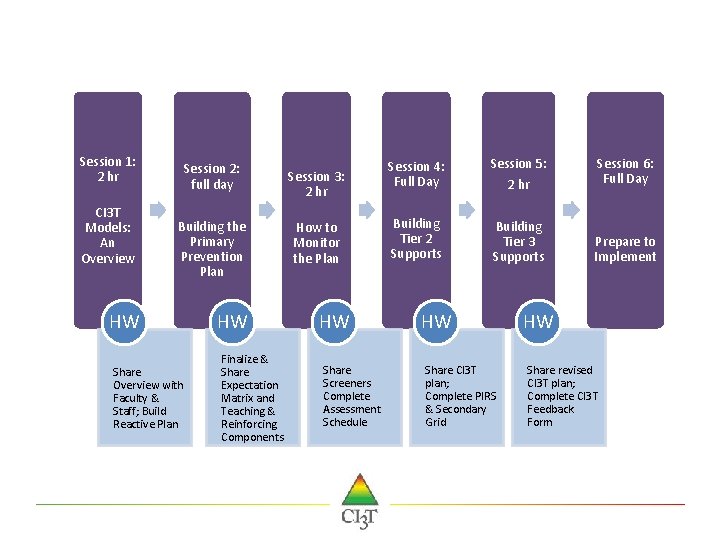
Session 1: 2 hr CI 3 T Models: An Overview Session 2: full day Building the Primary Prevention Plan HW Share Overview with Faculty & Staff; Build Reactive Plan HW Finalize & Share Expectation Matrix and Teaching & Reinforcing Components Session 3: 2 hr How to Monitor the Plan HW Share Screeners Complete Assessment Schedule Session 4: Full Day Session 5: 2 hr Session 6: Full Day Building Tier 2 Supports Building Tier 3 Supports Prepare to Implement HW Share CI 3 T plan; Complete PIRS & Secondary Grid HW Share revised CI 3 T plan; Complete CI 3 T Feedback Form
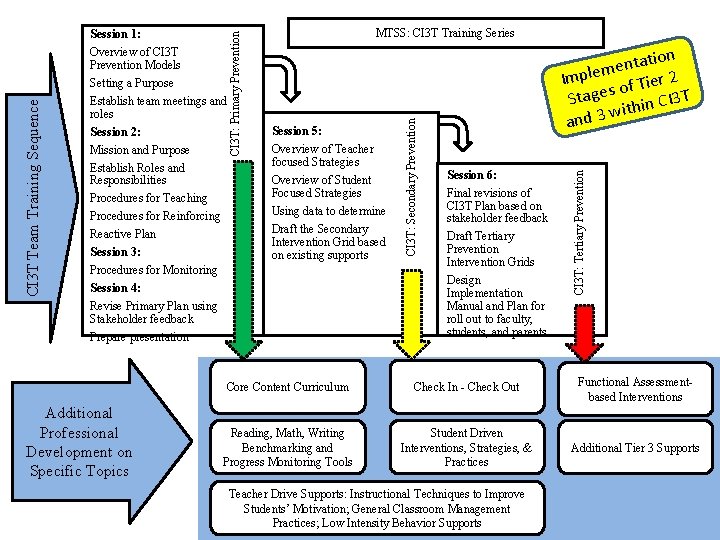
MTSS: CI 3 T Training Series Overview of Teacher focused Strategies Overview of Student Focused Strategies Using data to determine Draft the Secondary Intervention Grid based on existing supports Session 4: Revise Primary Plan using Stakeholder feedback Prepare presentation Additional Professional Development on Specific Topics tation n e m Imple f Tier 2 o Stages hin CI 3 T wit and 3 Session 6: Final revisions of CI 3 T Plan based on stakeholder feedback Draft Tertiary Prevention Intervention Grids Design Implementation Manual and Plan for roll out to faculty, students, and parents CI 3 T: Tertiary Prevention Session 5: CI 3 T: Secondary Prevention Overview of CI 3 T Prevention Models Setting a Purpose Establish team meetings and roles Session 2: Mission and Purpose Establish Roles and Responsibilities Procedures for Teaching Procedures for Reinforcing Reactive Plan Session 3: Procedures for Monitoring CI 3 T: Primary Prevention CI 3 T Team Training Sequence Session 1: Core Content Curriculum Check In - Check Out Functional Assessmentbased Interventions Reading, Math, Writing Benchmarking and Progress Monitoring Tools Student Driven Interventions, Strategies, & Practices Additional Tier 3 Supports Teacher Drive Supports: Instructional Techniques to Improve Students’ Motivation; General Classroom Management Practices; Low Intensity Behavior Supports
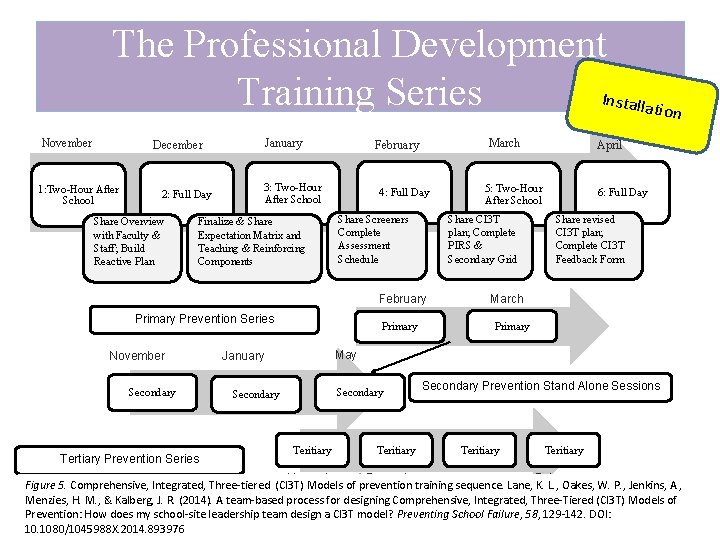
The Professional Development Installa Training Series tion November January December 1: Two-Hour After School 2: Full Day Share Overview with Faculty & Staff; Build Reactive Plan 3: Two-Hour After School Finalize & Share Expectation Matrix and Teaching & Reinforcing Components March February 4: Full Day Share Screeners Complete Assessment Schedule Primary Prevention Series November Secondary Tertiary Prevention Series Primary 5: Two-Hour After School Share CI 3 T plan; Complete PIRS & Secondary Grid February April 6: Full Day Share revised CI 3 T plan; Complete CI 3 T Feedback Form March Primary May January Secondary Teritiary Secondary Prevention Stand Alone Sessions Teritiary November December February January Figure 5. Comprehensive, Integrated, Three-tiered (CI 3 T) Models of prevention training sequence. Lane, K. L. , Oakes, W. P. , Jenkins, A. , Menzies, H. M. , & Kalberg, J. R. (2014). A team-based process for designing Comprehensive, Integrated, Three-Tiered (CI 3 T) Models of CI 3 TDOI: Training Project 139 Prevention: How does my school-site leadership team design a CI 3 T model? Preventing School Failure, 2014 -2015 58, 129 -142. 1080/1045988 X. 2014. 893976
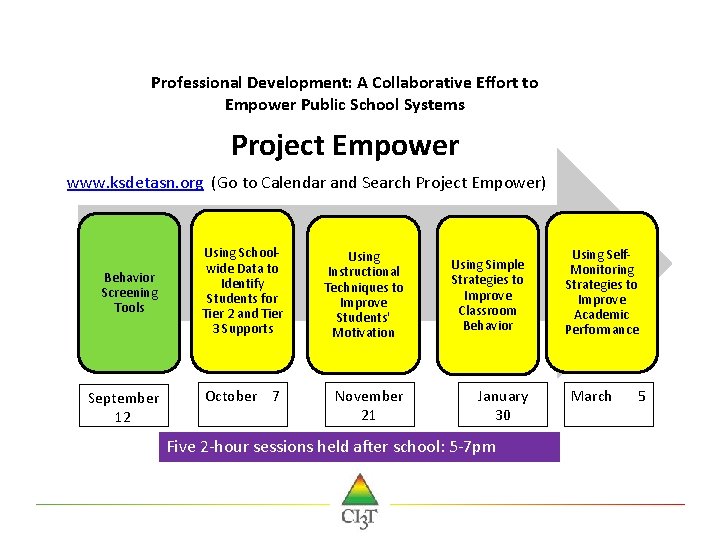
Professional Development: A Collaborative Effort to Empower Public School Systems Project Empower www. ksdetasn. org (Go to Calendar and Search Project Empower) Behavior Screening Tools September 12 Using Schoolwide Data to Identify Students for Tier 2 and Tier 3 Supports Using Instructional Techniques to Improve Students' Motivation Using Simple Strategies to Improve Classroom Behavior October 7 November 21 January 30 Five 2 -hour sessions held after school: 5 -7 pm Using Self. Monitoring Strategies to Improve Academic Performance March 5

Thank you! Moving Forward … Resources Questions: Kathleen. Lane@ku. edu
- Slides: 141