
An Overview of Aspect J Gregor Kiczales UBC

An Overview of Aspect. J Gregor Kiczales, UBC Erik Hilsdale, Jim Hugunin, Mik Kersten, Jeffrey Palm, Xerox PARC William G. Griswold, UCSD talk will focus on key semantic elements of the language ECOOP 2001

Aspect. J is… • a general-purpose AO language – just as Java is a general-purpose OO language – unlike examples in ECOOP’ 97 talk • an integrated extension to Java – – outputs. class files compatible with any JVM accepts all java programs as input integrated with tools programming feels like Java • enables two kinds of crosscutting – static (introduction) – similar to, but weaker than Hyper. J – dynamic – focus of today’s talk ECOOP 2001
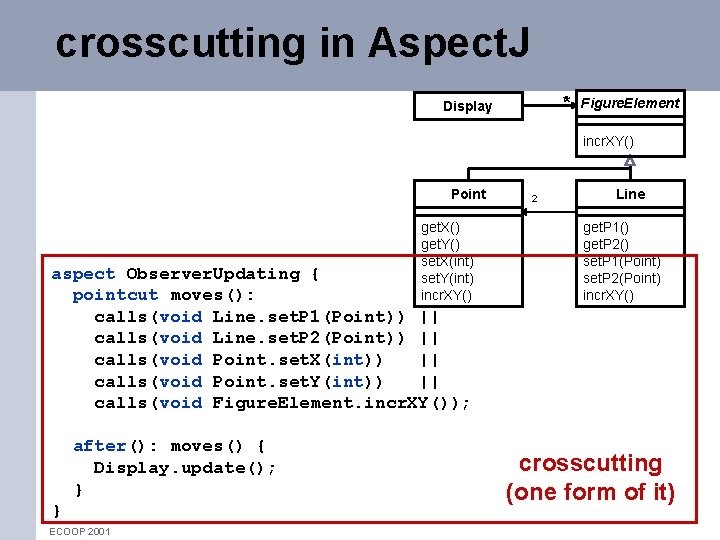
crosscutting in Aspect. J ** Figure. Element Display incr. XY() Point get. X() get. Y() set. X(int) set. Y(int) incr. XY() aspect Observer. Updating { pointcut moves(): calls(void Line. set. P 1(Point)) || calls(void Line. set. P 2(Point)) || calls(void Point. set. X(int)) || calls(void Point. set. Y(int)) || calls(void Figure. Element. incr. XY()); after(): moves() { Display. update(); } } ECOOP 2001 2 Line get. P 1() get. P 2() set. P 1(Point) set. P 2(Point) incr. XY() crosscutting (one form of it)
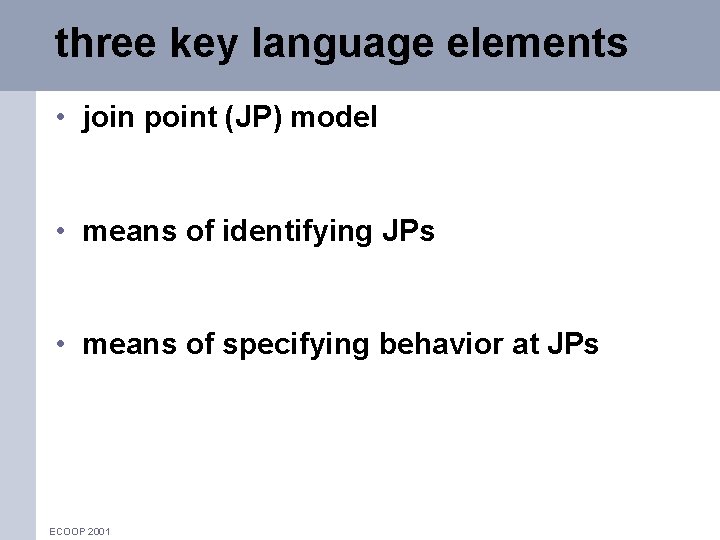
three key language elements • join point (JP) model • means of identifying JPs • means of specifying behavior at JPs ECOOP 2001
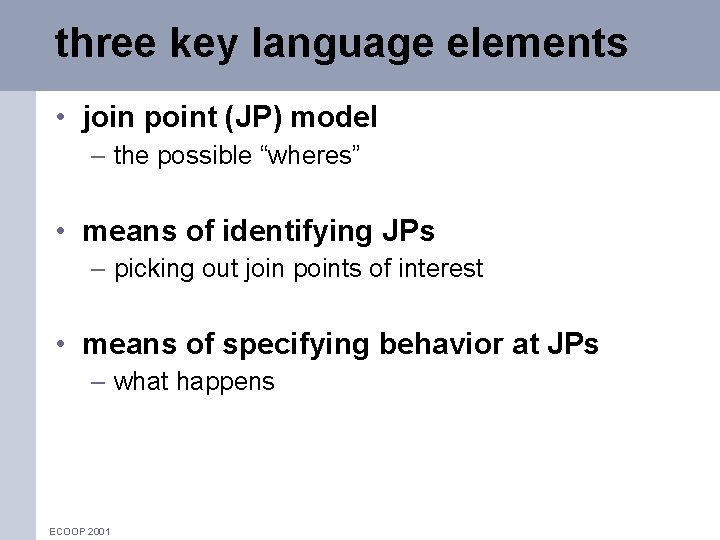
three key language elements • join point (JP) model – the possible “wheres” • means of identifying JPs – picking out join points of interest • means of specifying behavior at JPs – what happens ECOOP 2001
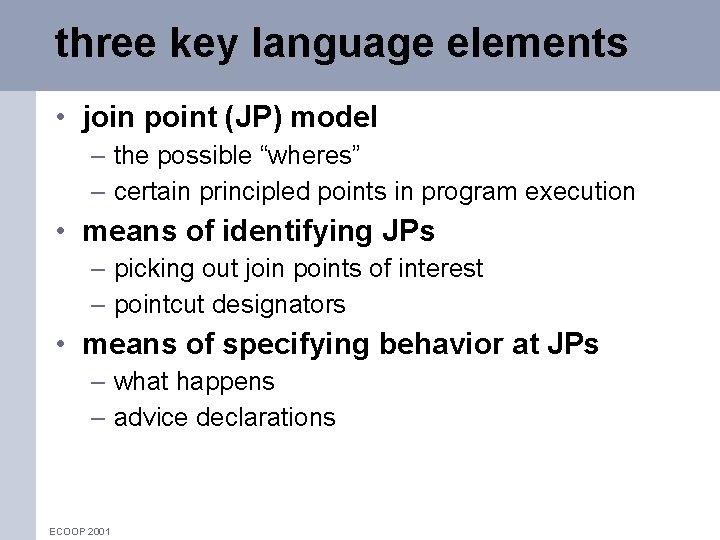
three key language elements • join point (JP) model – the possible “wheres” – certain principled points in program execution • means of identifying JPs – picking out join points of interest – pointcut designators • means of specifying behavior at JPs – what happens – advice declarations ECOOP 2001
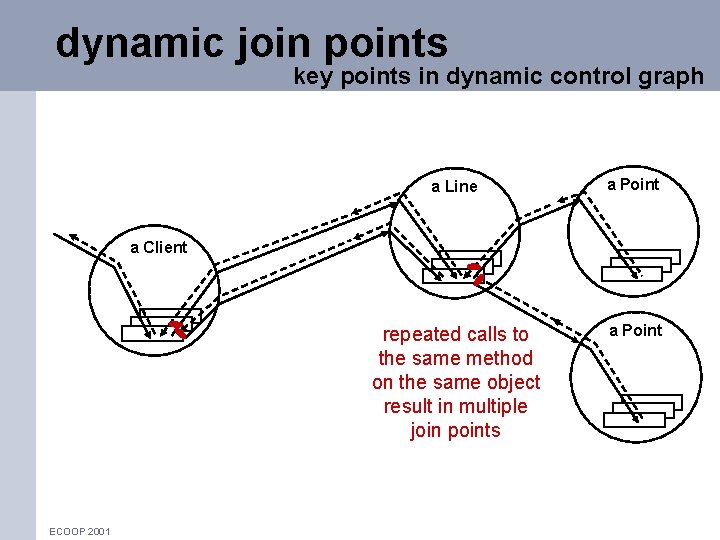
dynamic join points key points in dynamic control graph a Line a Point repeated calls to the same method on the same object result in multiple join points a Point a Client ECOOP 2001
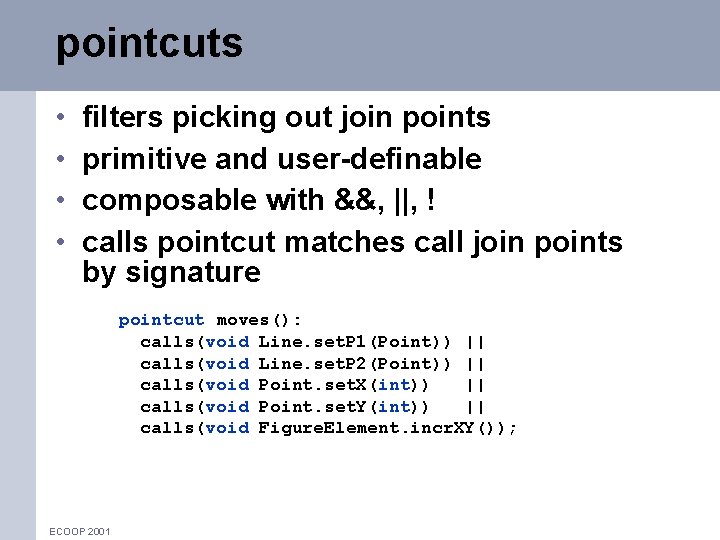
pointcuts • • filters picking out join points primitive and user-definable composable with &&, ||, ! calls pointcut matches call join points by signature pointcut moves(): calls(void Line. set. P 1(Point)) || calls(void Line. set. P 2(Point)) || calls(void Point. set. X(int)) || calls(void Point. set. Y(int)) || calls(void Figure. Element. incr. XY()); ECOOP 2001
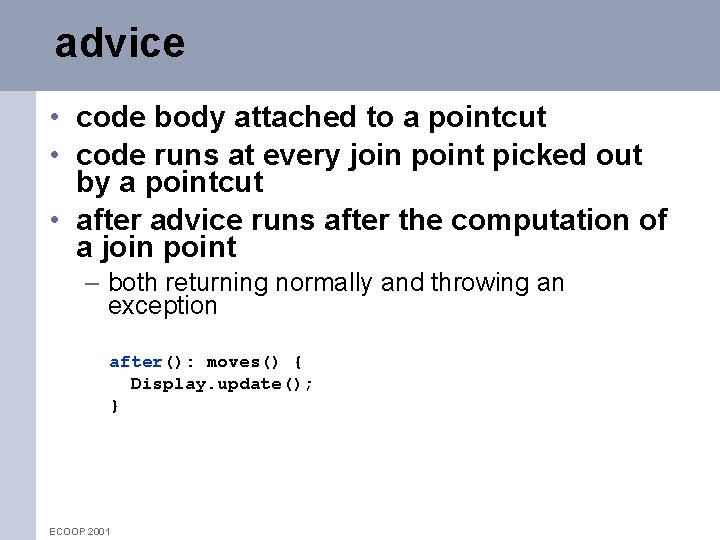
advice • code body attached to a pointcut • code runs at every join point picked out by a pointcut • after advice runs after the computation of a join point – both returning normally and throwing an exception after(): moves() { Display. update(); } ECOOP 2001
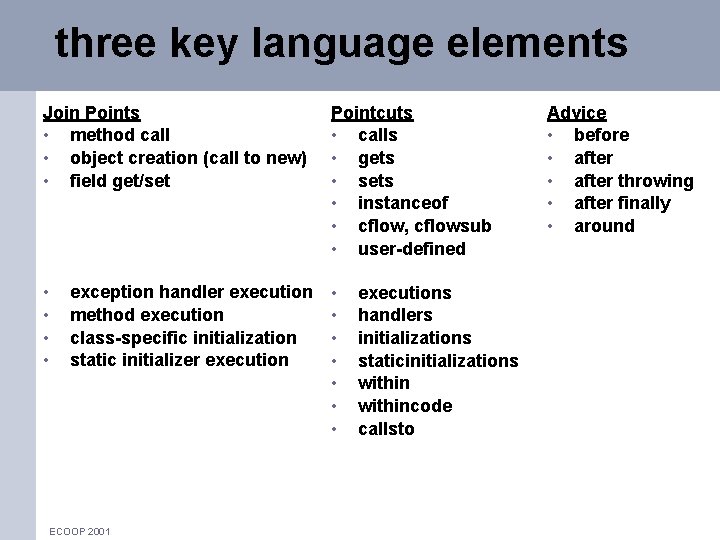
three key language elements Join Points • method call • object creation (call to new) • field get/set Pointcuts • calls • gets • sets • instanceof • cflow, cflowsub • user-defined • • • exception handler execution method execution class-specific initialization static initializer execution ECOOP 2001 executions handlers initializations staticinitializations withincode callsto Advice • before • after throwing • after finally • around
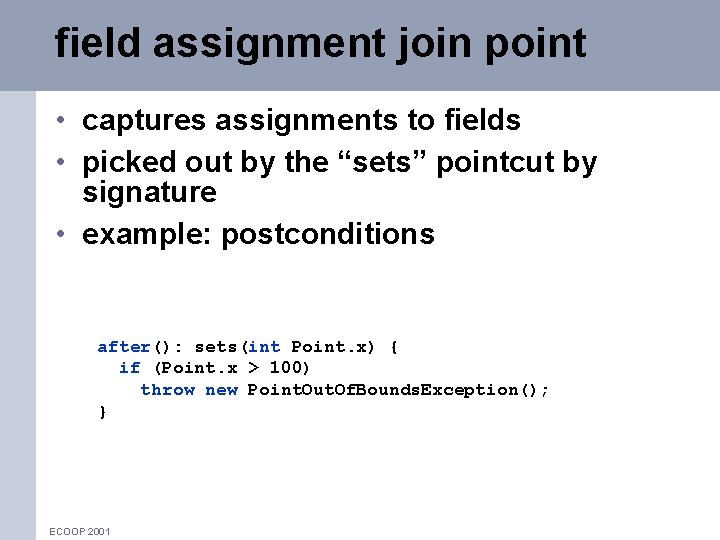
field assignment join point • captures assignments to fields • picked out by the “sets” pointcut by signature • example: postconditions after(): sets(int Point. x) { if (Point. x > 100) throw new Point. Out. Of. Bounds. Exception(); } ECOOP 2001
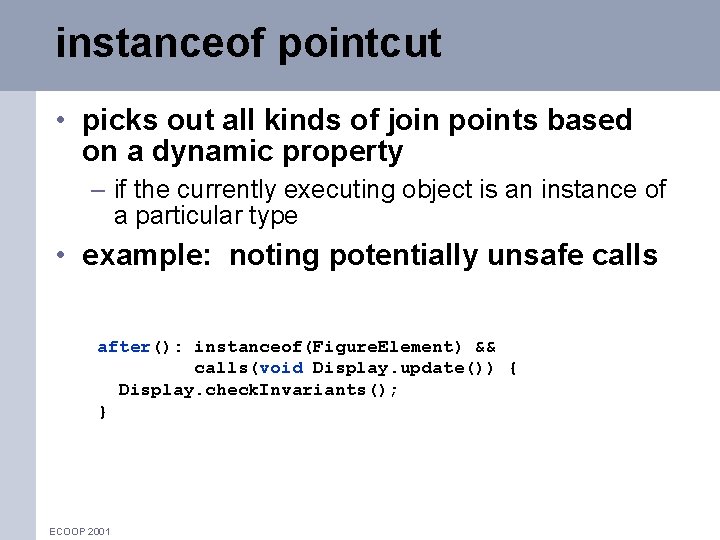
instanceof pointcut • picks out all kinds of join points based on a dynamic property – if the currently executing object is an instance of a particular type • example: noting potentially unsafe calls after(): instanceof(Figure. Element) && calls(void Display. update()) { Display. check. Invariants(); } ECOOP 2001
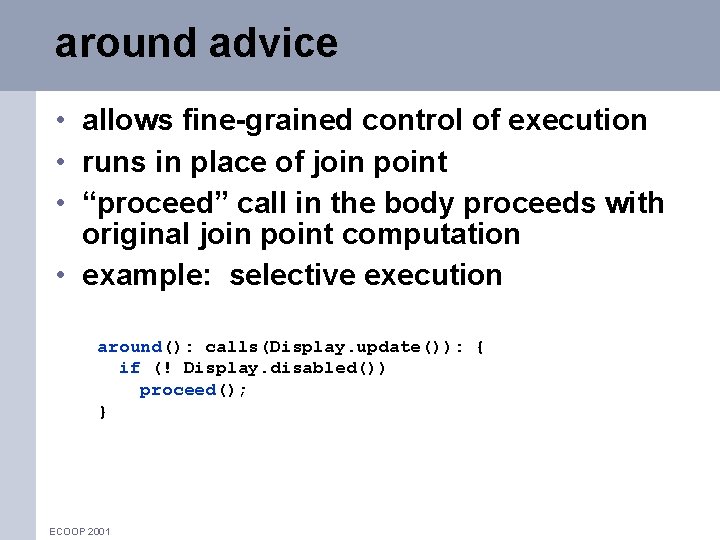
around advice • allows fine-grained control of execution • runs in place of join point • “proceed” call in the body proceeds with original join point computation • example: selective execution around(): calls(Display. update()): { if (! Display. disabled()) proceed(); } ECOOP 2001
orthogonality • any join point • works with any pointcut • works with any advice • special-purpose constructs aren’t special ECOOP 2001
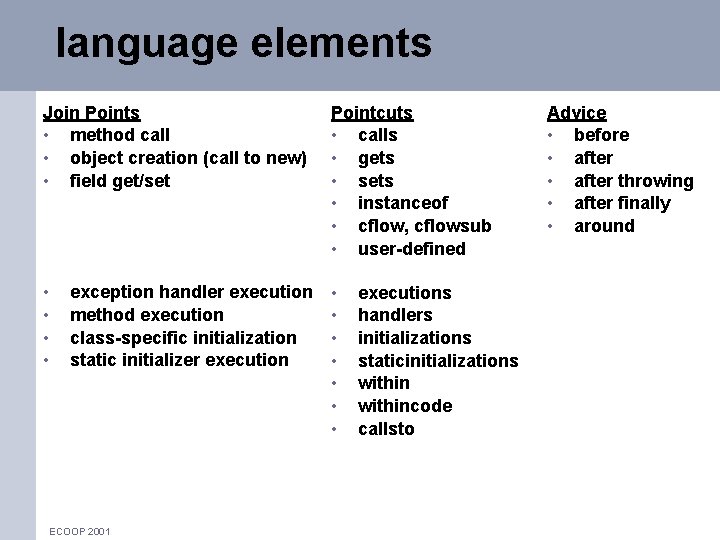
language elements Join Points • method call • object creation (call to new) • field get/set Pointcuts • calls • gets • sets • instanceof • cflow, cflowsub • user-defined • • • exception handler execution method execution class-specific initialization static initializer execution ECOOP 2001 executions handlers initializations staticinitializations withincode callsto Advice • before • after throwing • after finally • around
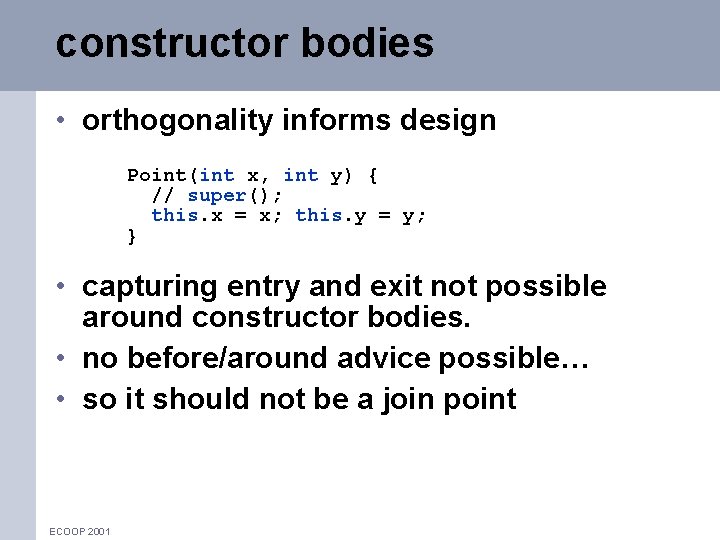
constructor bodies • orthogonality informs design Point(int x, int y) { // super(); this. x = x; this. y = y; } • capturing entry and exit not possible around constructor bodies. • no before/around advice possible… • so it should not be a join point ECOOP 2001
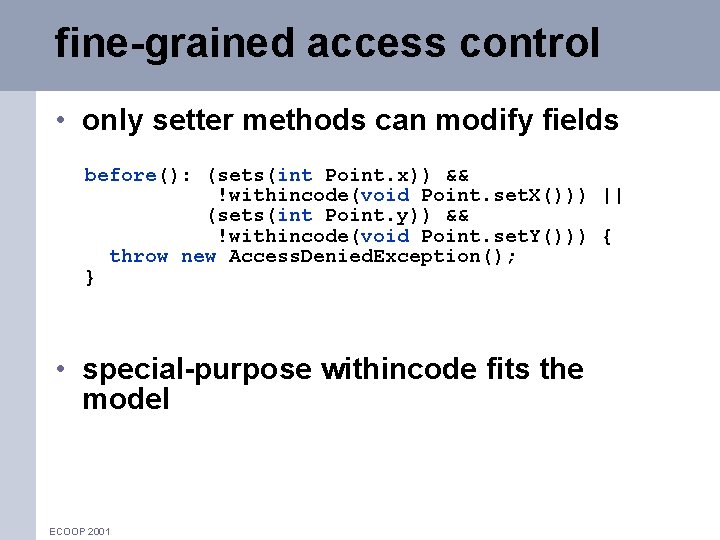
fine-grained access control • only setter methods can modify fields before(): (sets(int Point. x)) && !withincode(void Point. set. X())) || (sets(int Point. y)) && !withincode(void Point. set. Y())) { throw new Access. Denied. Exception(); } • special-purpose withincode fits the model ECOOP 2001
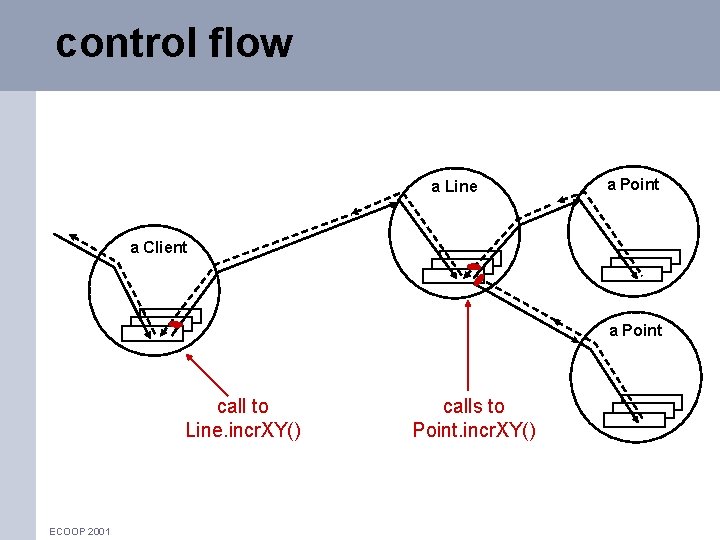
control flow a Line a Point a Client a Point call to Line. incr. XY() ECOOP 2001 calls to Point. incr. XY()
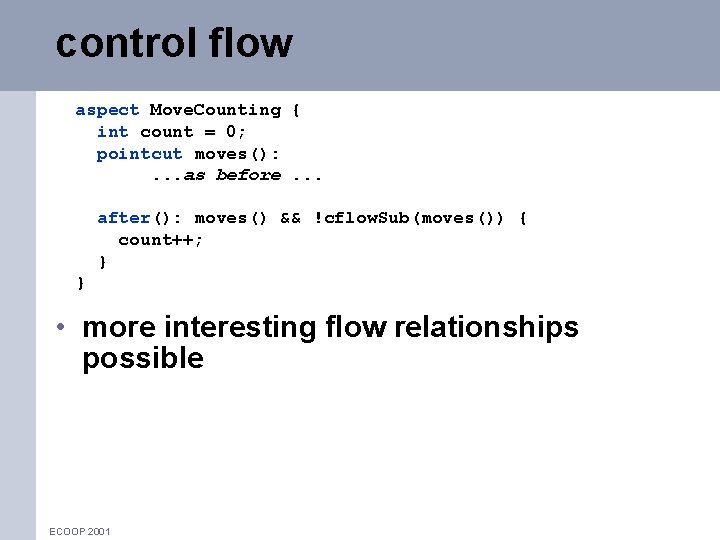
control flow aspect Move. Counting { int count = 0; pointcut moves(): . . . as before. . . after(): moves() && !cflow. Sub(moves()) { count++; } } • more interesting flow relationships possible ECOOP 2001
conclusions • • dynamic join point model orthogonal join points, pointcuts, advice open source compiler … ECOOP 2001
Aspect. J is… • a general-purpose AO language • an integrated extension to Java • has static and dynamic crosscutting – looked at kernel of dynamic crosscutting – skipped: values at join points, aspects, reuse, reflection static crosscutting, compiler implementation… • freely available implementation – compiler & tools are Open Source, MPL • includes IDE support – emacs, JBuilder, Forte 4 J • currently at 0. 8 release – 1. 0 planned for September 2001 ECOOP 2001
- Slides: 21