
An Overview Grid Computing and Applications Subject Code
An Overview Grid Computing and Applications Subject Code: 433 -498 Rajkumar Buyya Grid Computing and Distributed Systems (GRIDS) Lab. The University of Melbourne, Australia www. gridbus. org WW Grid
Overview Computing platforms and how the Grid is different ? n Towards global (Grid) computing. n Grid resource management and scheduling. n Application development challenges. n Approaches to Grid computing. Grid applications Grid Projects in GRIDS Lab@ Melbourne n Summary and conclusions n
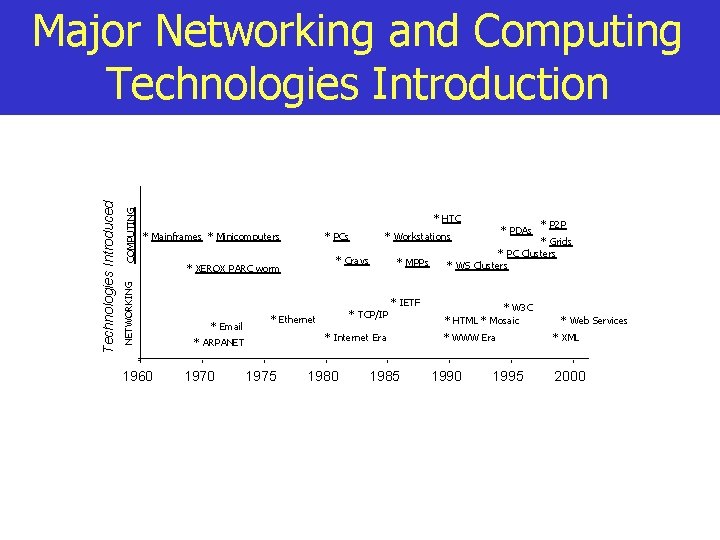
COMPUTING * HTC * Mainframes * Minicomputers NETWORKING Technologies Introduced Major Networking and Computing Technologies Introduction 1960 * PCs * Crays * XEROX PARC worm * Email * MPPs * IETF * Internet Era * ARPANET 1970 * TCP/IP * Ethernet 1975 1980 * PDAs * Workstations 1985 * P 2 P * Grids * PC Clusters * WS Clusters * W 3 C * HTML * Mosaic * WWW Era 1990 1995 * Web Services * XML 2000

Internet: Past, Present, Future Number of hosts (millions) 140 120 100 The 'Network Effect’ kicks in, and the web goes critical' 80 60 40 20 0 1965 1970 1975 1980 1985 1990 1995 2000 2005 2010 TCP/IP HTML Mosaic XML PHASE 1. Packet Switching Networks 1969: 4 US Universities linked to form ARPANET 1972: First e-mail program created 1976: Robert Metcalfe develops Ethernet 2. The Internet is Born TCP/IP becomes core protocol Domain Name System created IETF created (1986) 3. The World Wide Web HTML hypertext system created CERN launch World Wide Web NCSA launch Mosaic interface 4. with XML 5. The Grid
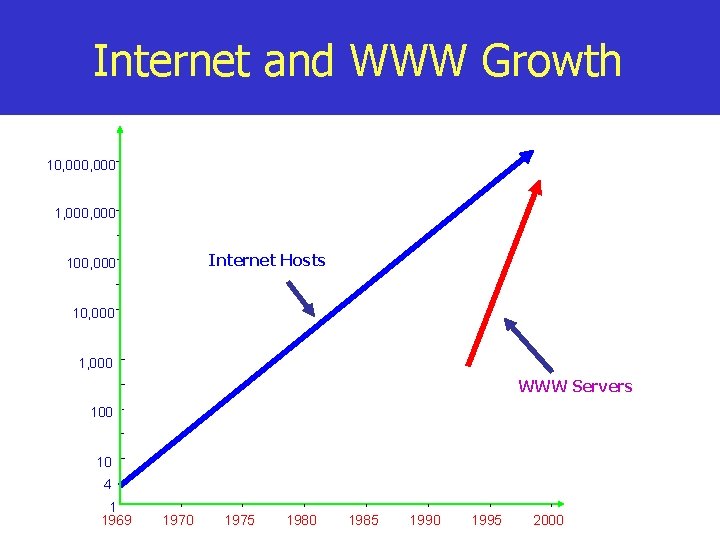
Internet and WWW Growth 10, 000 1, 000 Internet Hosts 100, 000 1, 000 WWW Servers 100 10 4 1 1969 1970 1975 1980 1985 1990 1995 2000
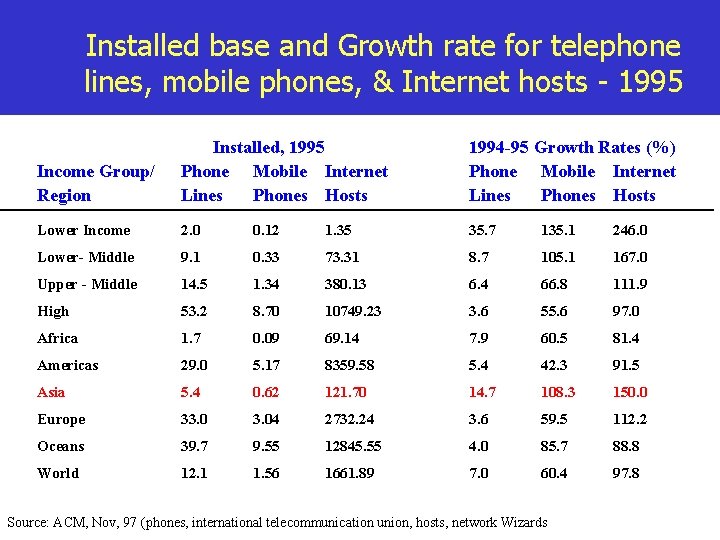
Installed base and Growth rate for telephone lines, mobile phones, & Internet hosts - 1995 Income Group/ Region Installed, 1995 Phone Mobile Internet Lines Phones Hosts 1994 -95 Growth Rates (%) Phone Mobile Internet Lines Phones Hosts Lower Income 2. 0 0. 12 1. 35 35. 7 135. 1 246. 0 Lower- Middle 9. 1 0. 33 73. 31 8. 7 105. 1 167. 0 Upper - Middle 14. 5 1. 34 380. 13 6. 4 66. 8 111. 9 High 53. 2 8. 70 10749. 23 3. 6 55. 6 97. 0 Africa 1. 7 0. 09 69. 14 7. 9 60. 5 81. 4 Americas 29. 0 5. 17 8359. 58 5. 4 42. 3 91. 5 Asia 5. 4 0. 62 121. 70 14. 7 108. 3 150. 0 Europe 33. 04 2732. 24 3. 6 59. 5 112. 2 Oceans 39. 7 9. 55 12845. 55 4. 0 85. 7 88. 8 World 12. 1 1. 56 1661. 89 7. 0 60. 4 97. 8 Source: ACM, Nov, 97 (phones, international telecommunication union, hosts, network Wizards
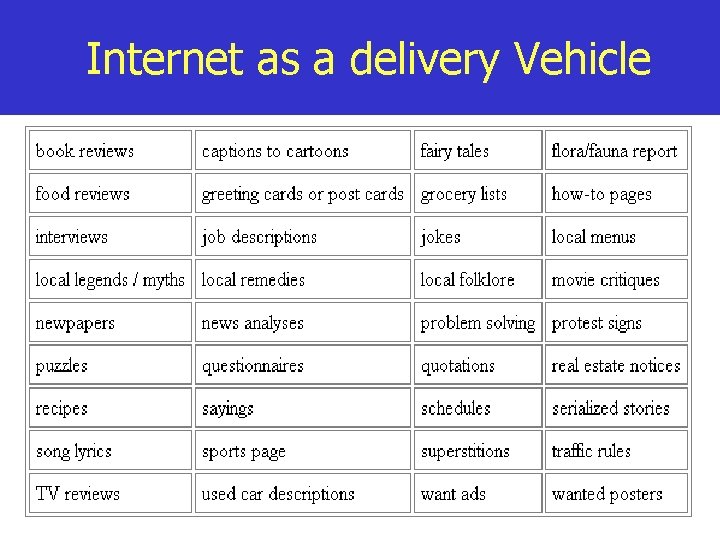
Internet as a delivery Vehicle
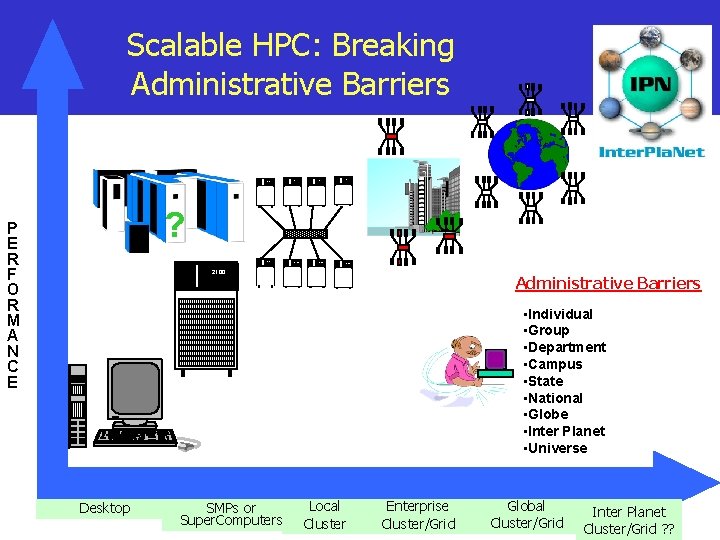
Scalable HPC: Breaking Administrative Barriers 2100 2100 ? P E R F O R M A N C E 2100 Administrative Barriers • Individual • Group • Department • Campus • State • National • Globe • Inter Planet • Universe Desktop SMPs or Super. Computers Local Cluster Enterprise Cluster/Grid Global Cluster/Grid Inter Planet Cluster/Grid ? ?
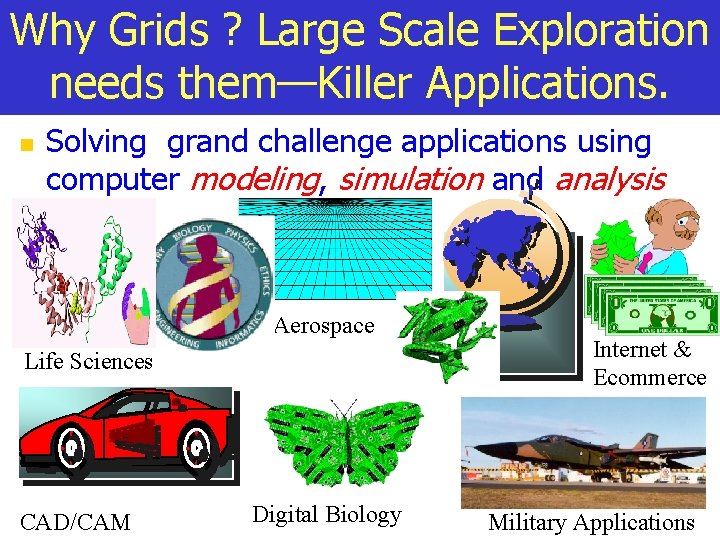
Why Grids ? Large Scale Exploration needs them—Killer Applications. n Solving grand challenge applications using computer modeling, simulation and analysis Aerospace Life Sciences CAD/CAM Digital Biology Internet & Ecommerce Military Applications

Cluster of Clusters - Hyperclusters Cluster 1 Scheduler Master Daemon LAN/WAN Cluster 3 Submit Graphical Control Execution Daemon Scheduler Clients Master Daemon Cluster 2 Submit Graphical Control Scheduler Master Daemon Execution Daemon Clients Submit Graphical Control Execution Daemon Clients
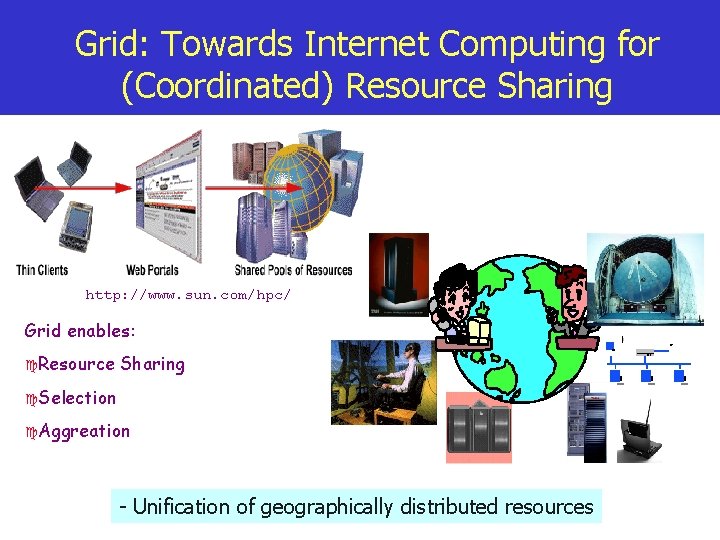
Grid: Towards Internet Computing for (Coordinated) Resource Sharing http: //www. sun. com/hpc/ Grid enables: c. Resource Sharing c. Selection c. Aggreation - Unification of geographically distributed resources
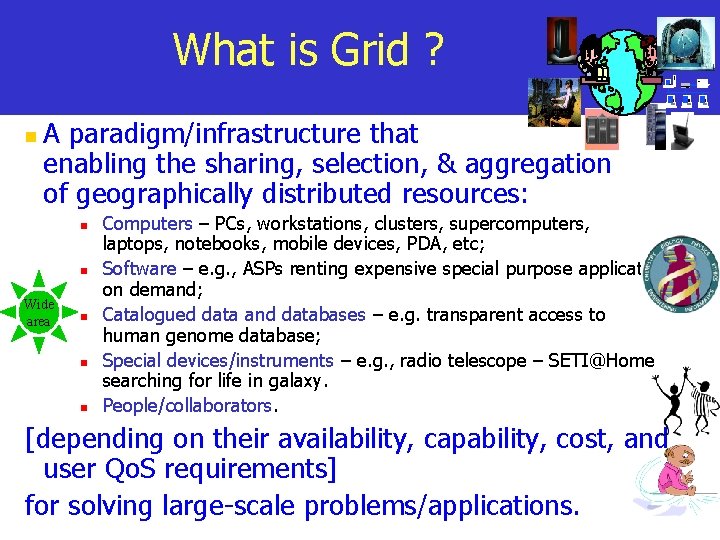
What is Grid ? n A paradigm/infrastructure that enabling the sharing, selection, & aggregation of geographically distributed resources: n n Wide area n n n Computers – PCs, workstations, clusters, supercomputers, laptops, notebooks, mobile devices, PDA, etc; Software – e. g. , ASPs renting expensive special purpose applications on demand; Catalogued data and databases – e. g. transparent access to human genome database; Special devices/instruments – e. g. , radio telescope – SETI@Home searching for life in galaxy. People/collaborators. [depending on their availability, capability, cost, and user Qo. S requirements] for solving large-scale problems/applications.
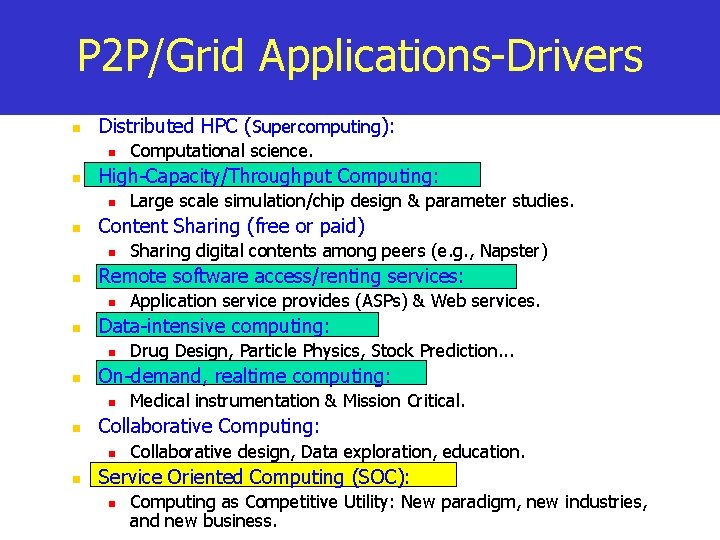
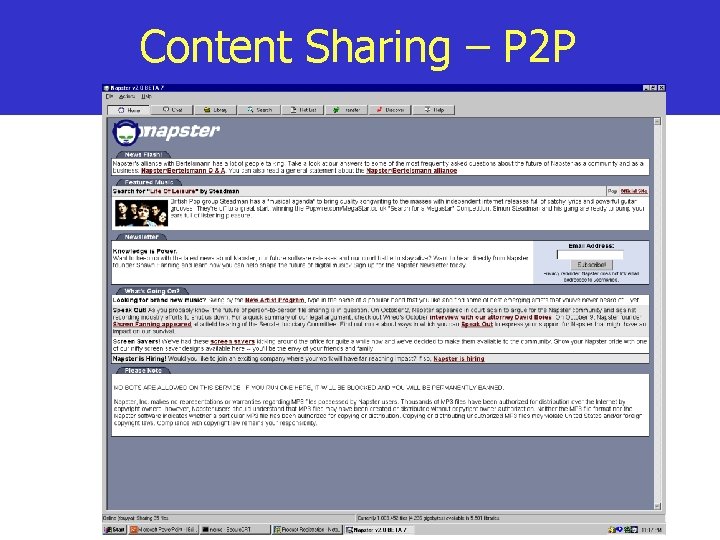
P 2 P/Grid Applications-Drivers n Distributed HPC (Supercomputing): n n High-Capacity/Throughput Computing: n n Medical instrumentation & Mission Critical. Collaborative Computing: n n Drug Design, Particle Physics, Stock Prediction. . . On-demand, realtime computing: n n Application service provides (ASPs) & Web services. Data-intensive computing: n n Sharing digital contents among peers (e. g. , Napster) Remote software access/renting services: n n Large scale simulation/chip design & parameter studies. Content Sharing (free or paid) n n Computational science. Collaborative design, Data exploration, education. Service Oriented Computing (SOC): n Computing as Competitive Utility: New paradigm, new industries, and new business.
Building and Using Grids requires. . . n n n Services that make our systems Grid Ready! Security mechanisms that permit resources to be accessed only by authorized users. (New) programming tools that make our applications Grid Ready!. Tools that can translate the requirements of an application into requirements for computers, networks, and storage. Tools that perform resource discovery, trading, composition, scheduling and distribution of jobs and collects results.
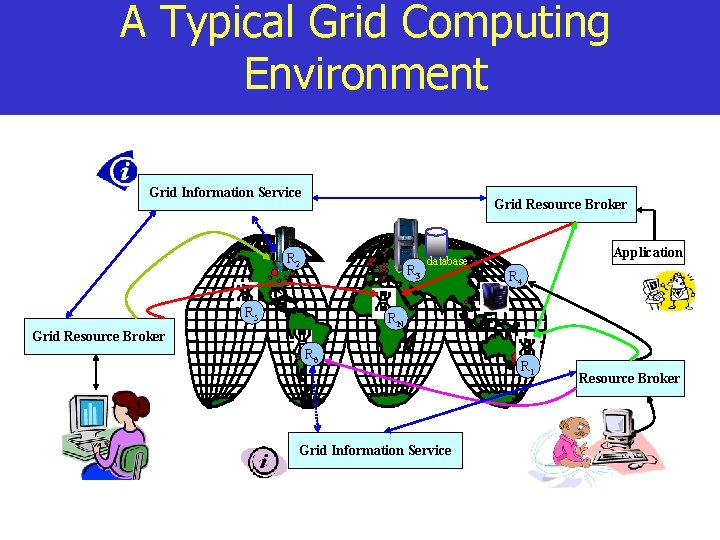
A Typical Grid Computing Environment Grid Information Service Grid Resource Broker R 2 R 3 R 5 Application database R 4 RN Grid Resource Broker R 6 Grid Information Service R 1 Resource Broker
Issues in Grid Technology Development
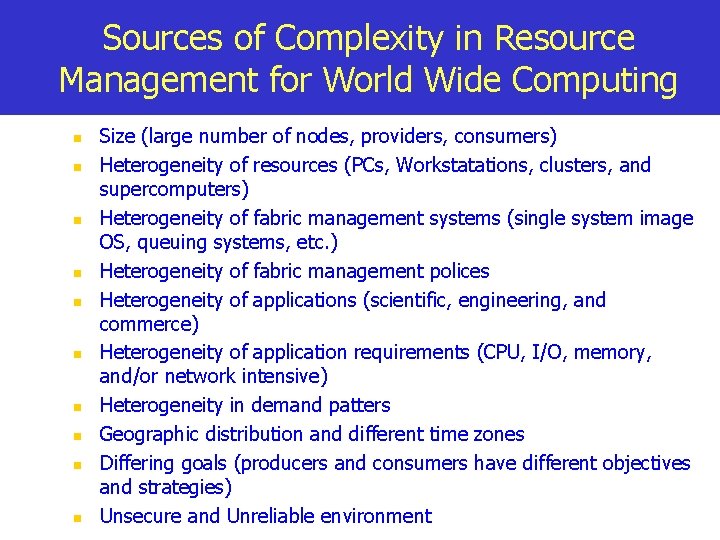
Sources of Complexity in Resource Management for World Wide Computing n n n n n Size (large number of nodes, providers, consumers) Heterogeneity of resources (PCs, Workstatations, clusters, and supercomputers) Heterogeneity of fabric management systems (single system image OS, queuing systems, etc. ) Heterogeneity of fabric management polices Heterogeneity of applications (scientific, engineering, and commerce) Heterogeneity of application requirements (CPU, I/O, memory, and/or network intensive) Heterogeneity in demand patters Geographic distribution and different time zones Differing goals (producers and consumers have different objectives and strategies) Unsecure and Unreliable environment
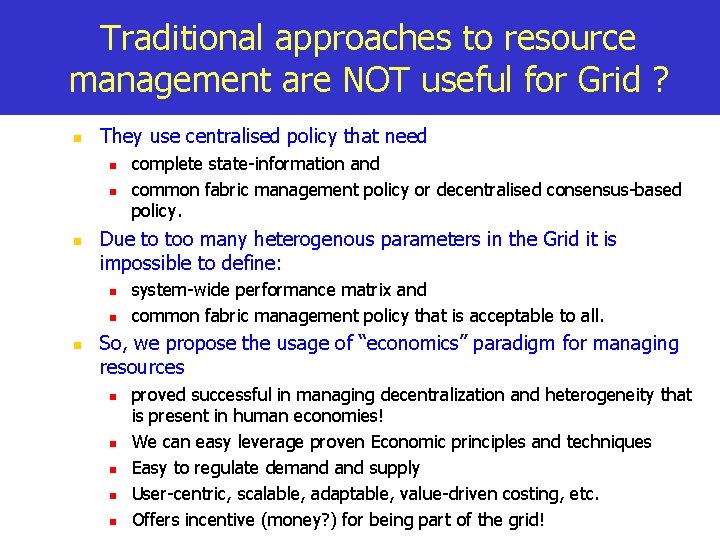
Traditional approaches to resource management are NOT useful for Grid ? n They use centralised policy that need n n n Due to too many heterogenous parameters in the Grid it is impossible to define: n n n complete state-information and common fabric management policy or decentralised consensus-based policy. system-wide performance matrix and common fabric management policy that is acceptable to all. So, we propose the usage of “economics” paradigm for managing resources n n n proved successful in managing decentralization and heterogeneity that is present in human economies! We can easy leverage proven Economic principles and techniques Easy to regulate demand supply User-centric, scalable, adaptable, value-driven costing, etc. Offers incentive (money? ) for being part of the grid!
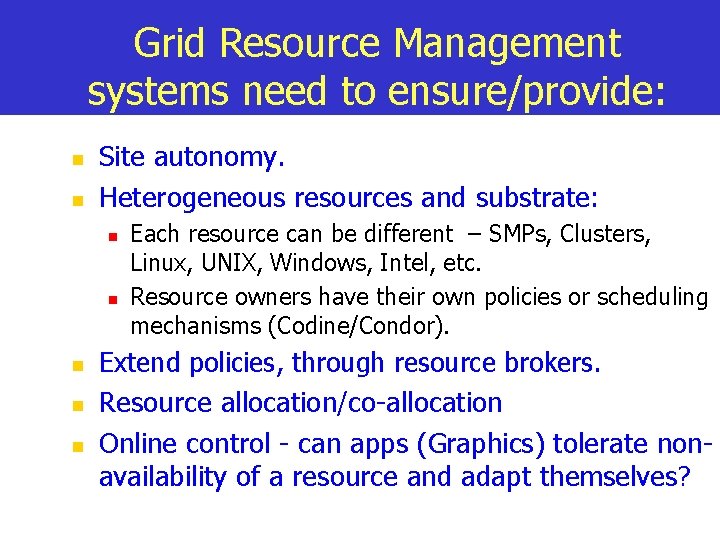
Grid Resource Management systems need to ensure/provide: n n Site autonomy. Heterogeneous resources and substrate: n n n Each resource can be different – SMPs, Clusters, Linux, UNIX, Windows, Intel, etc. Resource owners have their own policies or scheduling mechanisms (Codine/Condor). Extend policies, through resource brokers. Resource allocation/co-allocation Online control - can apps (Graphics) tolerate nonavailability of a resource and adapt themselves?
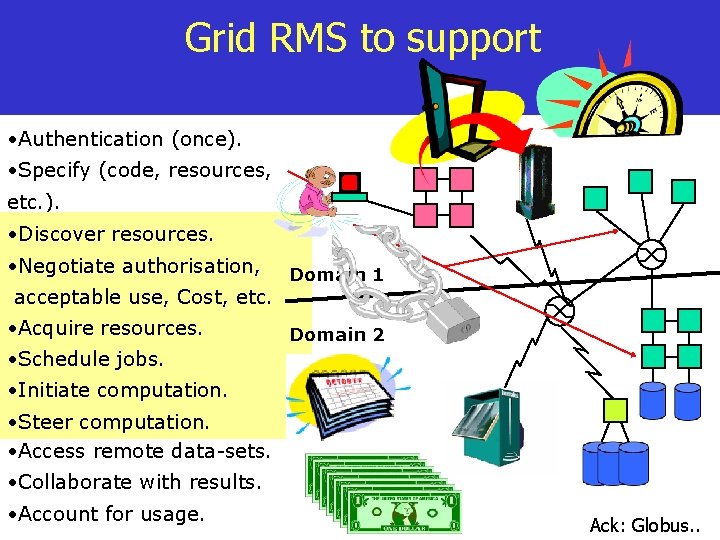
Grid RMS to support • Authentication (once). • Specify (code, resources, etc. ). • Discover resources. • Negotiate authorization, authorisation, Domain 1 acceptableuse, Cost, etc. • Acquire resources. Domain 2 • Schedule Jobs. jobs. • Initiate computation. • Steer computation. • Access remote data-sets. • Collaborate with results. • Account for usage. Ack: Globus. .
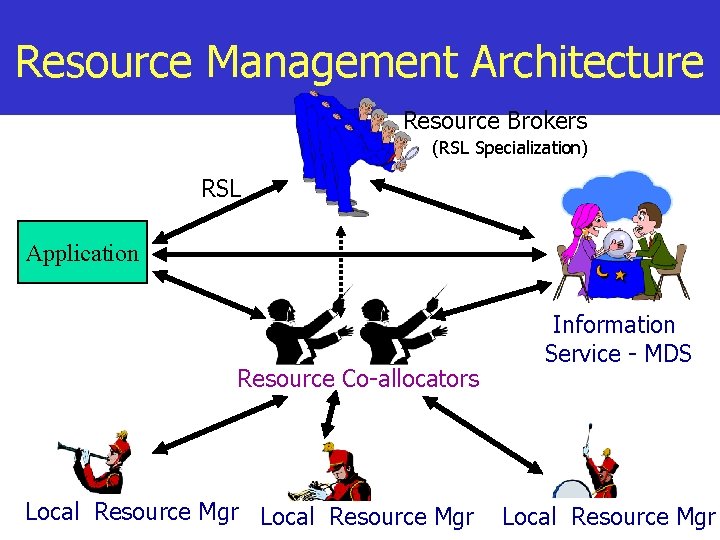
Resource Management Architecture Resource Brokers (RSL Specialization) RSL Application Resource Co-allocators Local Resource Mgr Information Service - MDS Local Resource Mgr
Major Grid Projects and Initiatives
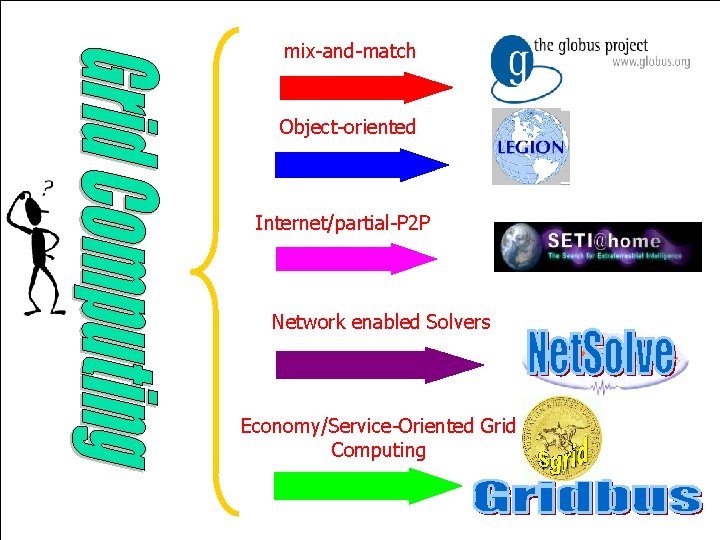
mix-and-match Object-oriented Internet/partial-P 2 P Network enabled Solvers Economy/Service-Oriented Grid Computing
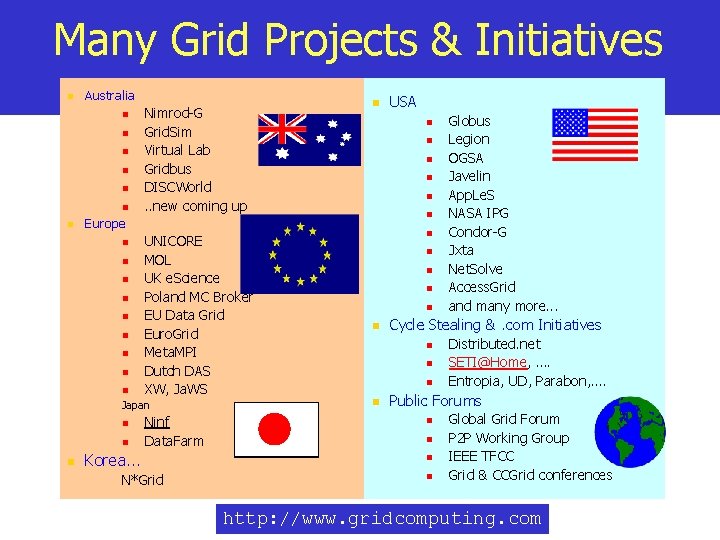
Many Grid Projects & Initiatives n Australia n n n n Nimrod-G Grid. Sim Virtual Lab Gridbus DISCWorld. . new coming up n n n n UNICORE MOL UK e. Science Poland MC Broker EU Data Grid Euro. Grid Meta. MPI Dutch DAS XW, Ja. WS Japan n n Ninf Data. Farm Korea. . . N*Grid USA n n n Europe n n n n n Cycle Stealing &. com Initiatives n n Globus Legion OGSA Javelin App. Le. S NASA IPG Condor-G Jxta Net. Solve Access. Grid and many more. . . Distributed. net SETI@Home, …. Entropia, UD, Parabon, …. Public Forums n n Global Grid Forum P 2 P Working Group IEEE TFCC Grid & CCGrid conferences http: //www. gridcomputing. com
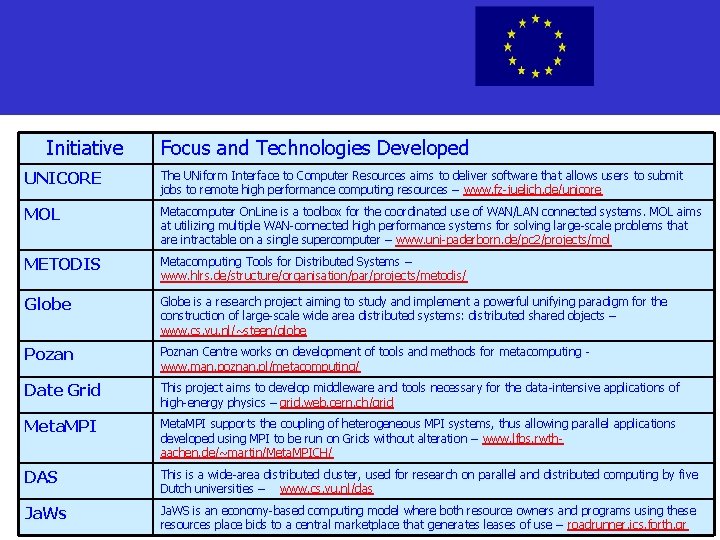
Initiative Focus and Technologies Developed UNICORE The UNiform Interface to Computer Resources aims to deliver software that allows users to submit jobs to remote high performance computing resources – www. fz-juelich. de/unicore MOL Metacomputer On. Line is a toolbox for the coordinated use of WAN/LAN connected systems. MOL aims at utilizing multiple WAN-connected high performance systems for solving large-scale problems that are intractable on a single supercomputer – www. uni-paderborn. de/pc 2/projects/mol METODIS Metacomputing Tools for Distributed Systems – www. hlrs. de/structure/organisation/par/projects/metodis/ Globe is a research project aiming to study and implement a powerful unifying paradigm for the construction of large-scale wide area distributed systems: distributed shared objects – www. cs. vu. nl/~steen/globe Pozan Poznan Centre works on development of tools and methods for metacomputing www. man. poznan. pl/metacomputing/ Date Grid This project aims to develop middleware and tools necessary for the data-intensive applications of high-energy physics – grid. web. cern. ch/grid Meta. MPI supports the coupling of heterogeneous MPI systems, thus allowing parallel applications developed using MPI to be run on Grids without alteration – www. lfbs. rwthaachen. de/~martin/Meta. MPICH/ DAS This is a wide-area distributed cluster, used for research on parallel and distributed computing by five Dutch universities – www. cs. vu. nl/das Ja. WS is an economy-based computing model where both resource owners and programs using these resources place bids to a central marketplace that generates leases of use – roadrunner. ics. forth. gr
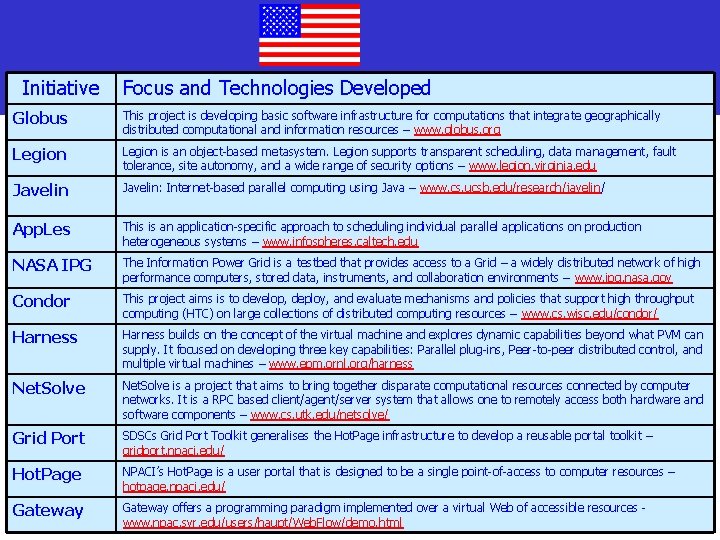
Initiative Focus and Technologies Developed Globus This project is developing basic software infrastructure for computations that integrate geographically distributed computational and information resources – www. globus. org Legion is an object-based metasystem. Legion supports transparent scheduling, data management, fault tolerance, site autonomy, and a wide range of security options – www. legion. virginia. edu Javelin: Internet-based parallel computing using Java – www. cs. ucsb. edu/research/javelin/ App. Les This is an application-specific approach to scheduling individual parallel applications on production heterogeneous systems – www. infospheres. caltech. edu NASA IPG The Information Power Grid is a testbed that provides access to a Grid – a widely distributed network of high performance computers, stored data, instruments, and collaboration environments – www. ipg. nasa. gov Condor This project aims is to develop, deploy, and evaluate mechanisms and policies that support high throughput computing (HTC) on large collections of distributed computing resources – www. cs. wisc. edu/condor/ Harness builds on the concept of the virtual machine and explores dynamic capabilities beyond what PVM can supply. It focused on developing three key capabilities: Parallel plug-ins, Peer-to-peer distributed control, and multiple virtual machines – www. epm. ornl. org/harness Net. Solve is a project that aims to bring together disparate computational resources connected by computer networks. It is a RPC based client/agent/server system that allows one to remotely access both hardware and software components – www. cs. utk. edu/netsolve/ Grid Port SDSCs Grid Port Toolkit generalises the Hot. Page infrastructure to develop a reusable portal toolkit – gridport. npaci. edu/ Hot. Page NPACI’s Hot. Page is a user portal that is designed to be a single point-of-access to computer resources – hotpage. npaci. edu/ Gateway offers a programming paradigm implemented over a virtual Web of accessible resources www. npac. syr. edu/users/haupt/Web. Flow/demo. html
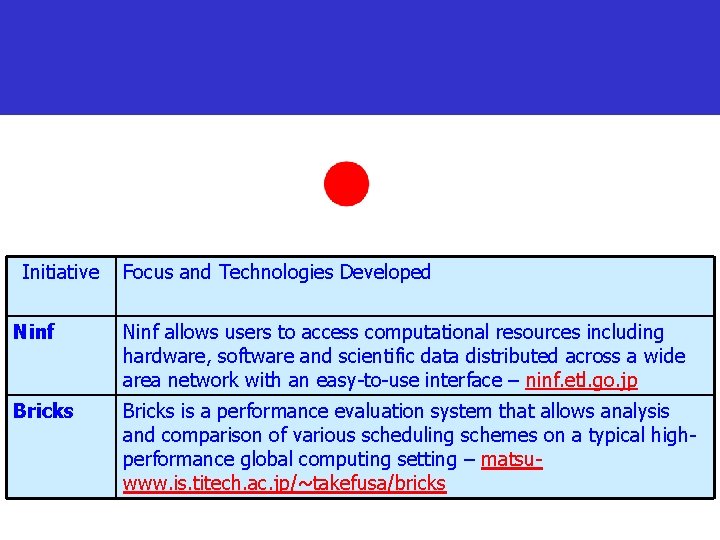
Initiative Focus and Technologies Developed Ninf allows users to access computational resources including hardware, software and scientific data distributed across a wide area network with an easy-to-use interface – ninf. etl. go. jp Bricks is a performance evaluation system that allows analysis and comparison of various scheduling schemes on a typical highperformance global computing setting – matsuwww. is. titech. ac. jp/~takefusa/bricks
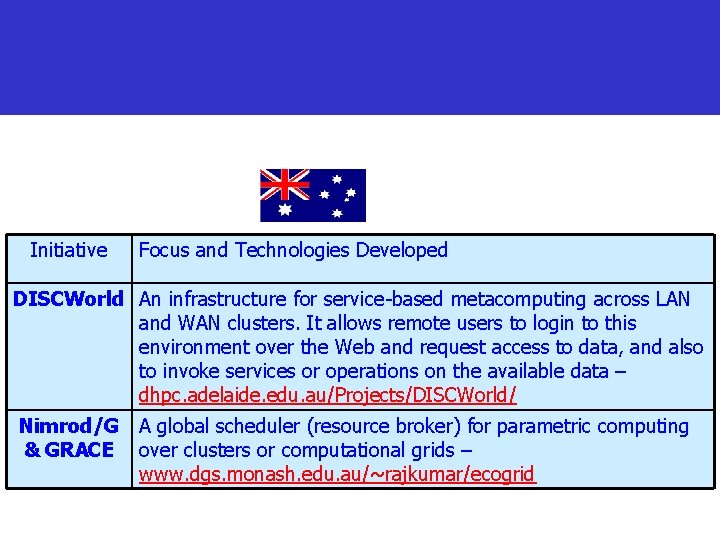
Initiative Focus and Technologies Developed DISCWorld An infrastructure for service-based metacomputing across LAN and WAN clusters. It allows remote users to login to this environment over the Web and request access to data, and also to invoke services or operations on the available data – dhpc. adelaide. edu. au/Projects/DISCWorld/ Nimrod/G A global scheduler (resource broker) for parametric computing & GRACE over clusters or computational grids – www. dgs. monash. edu. au/~rajkumar/ecogrid
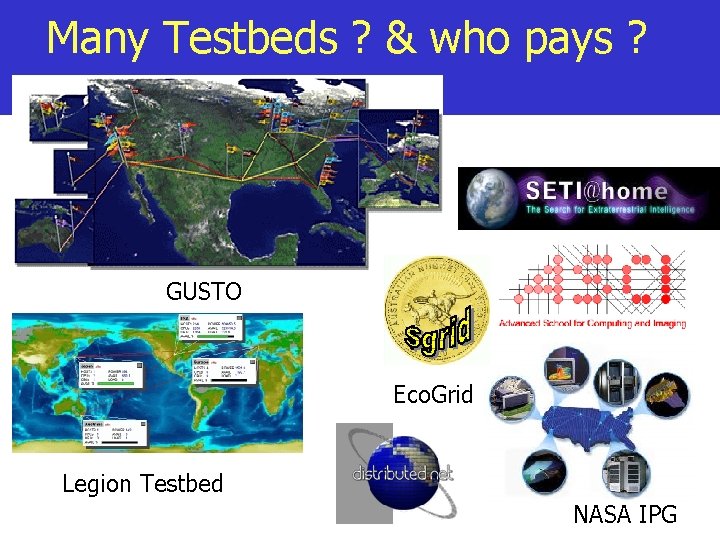
Many Testbeds ? & who pays ? GUSTO Eco. Grid Legion Testbed NASA IPG
Some GRID APPLICATIONS
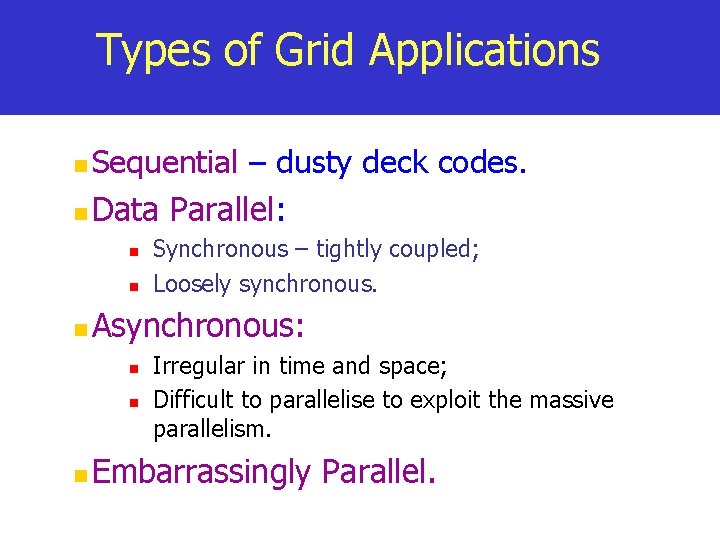
Types of Grid Applications Sequential – dusty deck codes. n Data Parallel: n n Asynchronous: n n n Synchronous – tightly coupled; Loosely synchronous. Irregular in time and space; Difficult to parallelise to exploit the massive parallelism. Embarrassingly Parallel.
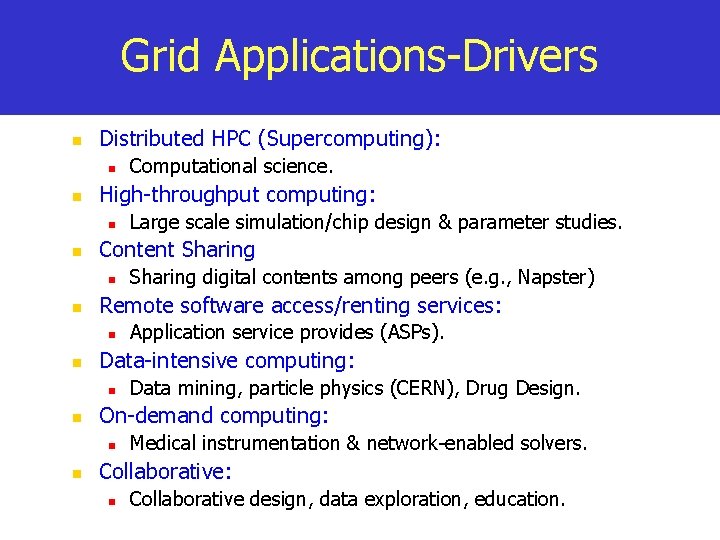
Grid Applications-Drivers n Distributed HPC (Supercomputing): n n High-throughput computing: n n Data mining, particle physics (CERN), Drug Design. On-demand computing: n n Application service provides (ASPs). Data-intensive computing: n n Sharing digital contents among peers (e. g. , Napster) Remote software access/renting services: n n Large scale simulation/chip design & parameter studies. Content Sharing n n Computational science. Medical instrumentation & network-enabled solvers. Collaborative: n Collaborative design, data exploration, education.
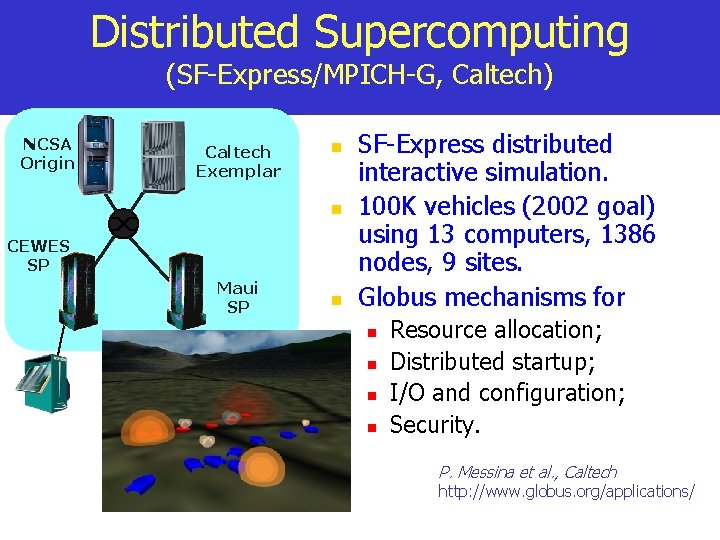
Distributed Supercomputing (SF-Express/MPICH-G, Caltech) NCSA Origin Caltech Exemplar n n CEWES SP Maui SP n SF-Express distributed interactive simulation. 100 K vehicles (2002 goal) using 13 computers, 1386 nodes, 9 sites. Globus mechanisms for n n Resource allocation; Distributed startup; I/O and configuration; Security. P. Messina et al. , Caltech http: //www. globus. org/applications/
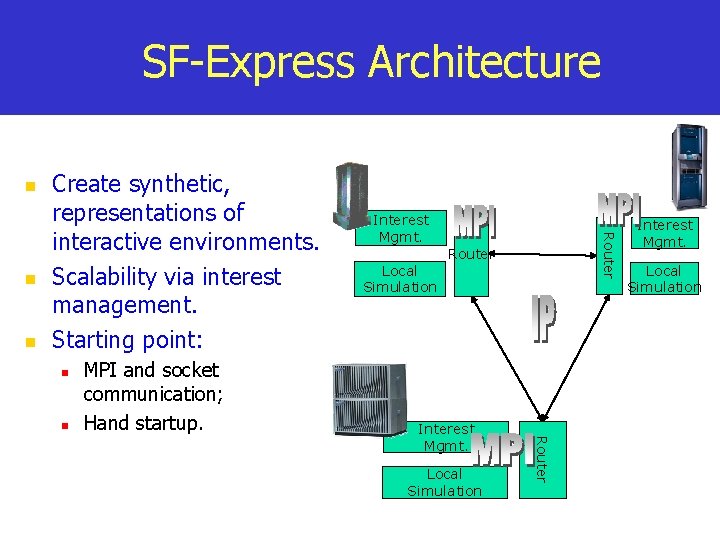
SF-Express Architecture n n MPI and socket communication; Hand startup. Interest Mgmt. Local Simulation Router n Create synthetic, representations of interactive environments. Scalability via interest management. Starting point: Router Local Simulation Router Interest Mgmt. Local Simulation
High Throughput Computing (parameter sweep applications) n n n A study involving exploration of possible scenarios i. e. , execution of the same program for various design alternatives (data). It consists of large number of tasks (1000 s). Generally, no inter-task communication (task farming). Large size data (MBytes+) files and I/O constraints A large class of application areas: n n n Parameter explorations and simulations (Monte Carlo); A large number of science, engineering, and commercial applications: Astrophysics, Drug Design, Nero. Science, Network simulation, structural engineering, automobiles crash simulation, aerospace modeling, financial risk analysis Condor, Nimrod/G, Design. Drug@Home, SETI@Home, FOLD@Home, Distributed. net.
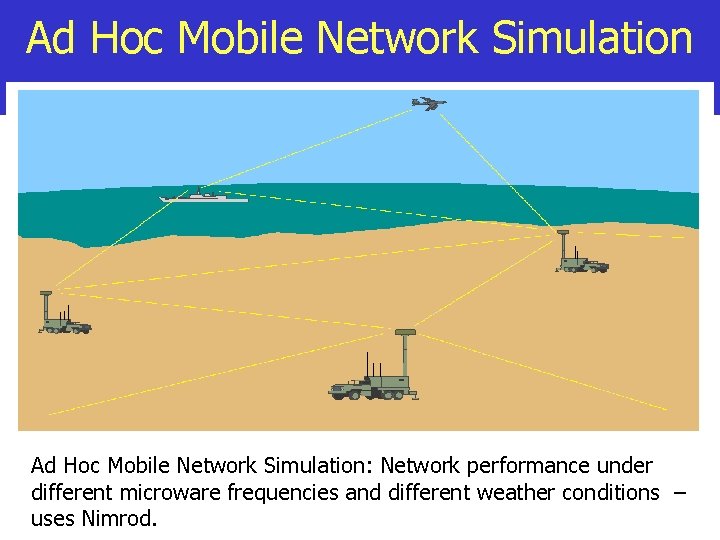
Ad Hoc Mobile Network Simulation: Network performance under different microware frequencies and different weather conditions – uses Nimrod.
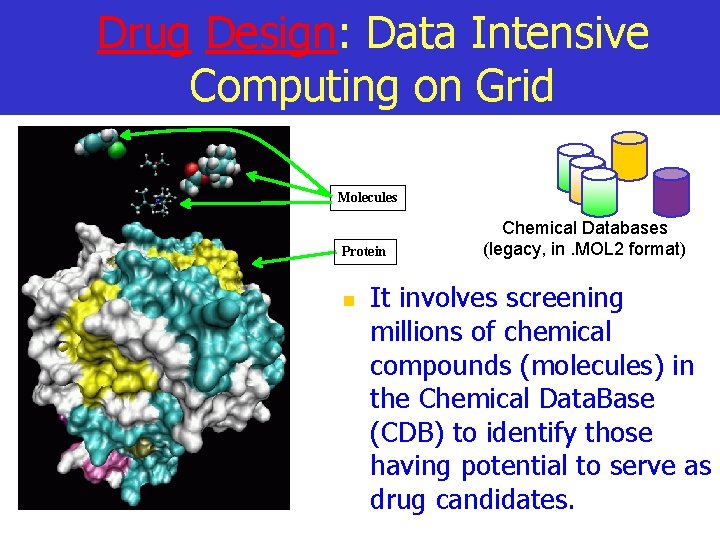
Drug Design: Data Intensive Computing on Grid Molecules Protein n Chemical Databases (legacy, in. MOL 2 format) It involves screening millions of chemical compounds (molecules) in the Chemical Data. Base (CDB) to identify those having potential to serve as drug candidates.
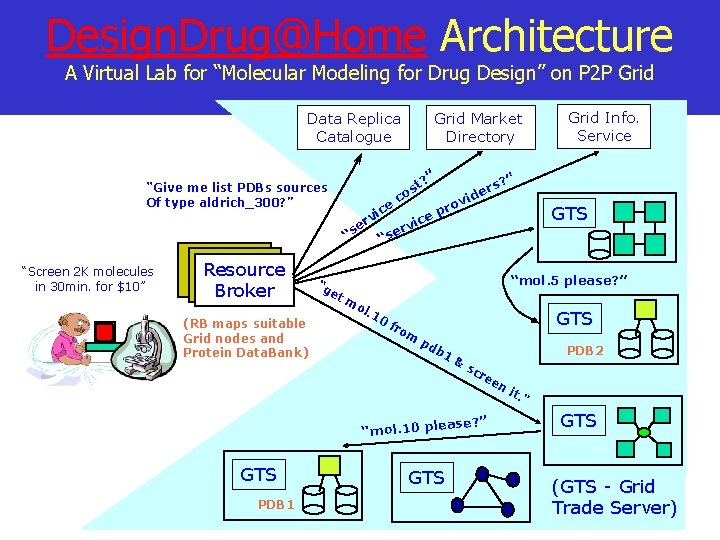
Design. Drug@Home Architecture A Virtual Lab for “Molecular Modeling for Drug Design” on P 2 P Grid Market Directory Data Replica Catalogue ? ” “Give me list PDBs sources Of type aldrich_300? ” v er “s “Screen 2 K molecules in 30 min. for $10” Resource Broker (RB maps suitable Grid nodes and Protein Data. Bank) e ic t os c ? ” s r e id e ov pr ic erv PDB 1 GTS “s “mol. 5 please? ” “g et m ol. 10 fro m GTS pd b 1 & PDB 2 sc re ase? ” “mol. 10 ple GTS Grid Info. Service GTS en it. ” GTS (GTS - Grid Trade Server)
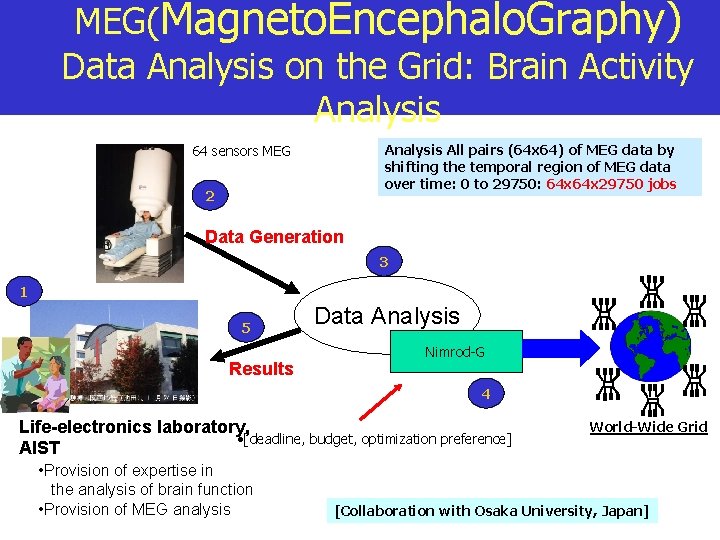
MEG(Magneto. Encephalo. Graphy) Data Analysis on the Grid: Brain Activity Analysis All pairs (64 x 64) of MEG data by shifting the temporal region of MEG data over time: 0 to 29750: 64 x 29750 jobs 64 sensors MEG 2 Data Generation 3 1 5 Results Data Analysis Nimrod-G 4 Life-electronics laboratory, • [deadline, budget, optimization preference] AIST • Provision of expertise in the analysis of brain function • Provision of MEG analysis World-Wide Grid [Collaboration with Osaka University, Japan]
SETI@home: Search for Extraterrestrial Intelligence at Home
Content Sharing – P 2 P
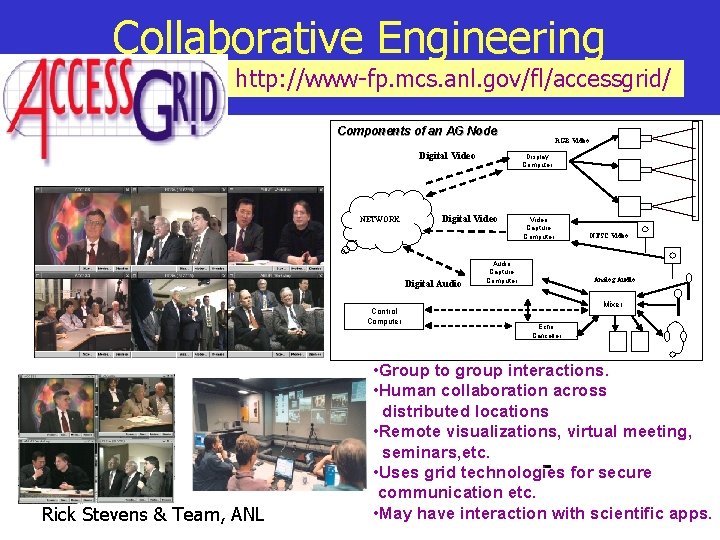
Collaborative Engineering Access GRID: http: //www-fp. mcs. anl. gov/fl/accessgrid/ Components of an AG Node Digital Video NETWORK Control Computer Rick Stevens & Team, ANL Display Computer Digital Video Digital Audio RGB Video Capture Computer Audio Capture Computer NTSC Video Analog Audio Mixer Echo Canceller • Group to group interactions. • Human collaboration across distributed locations • Remote visualizations, virtual meeting, seminars, etc. • Uses grid technologies for secure communication etc. • May have interaction with scientific apps.
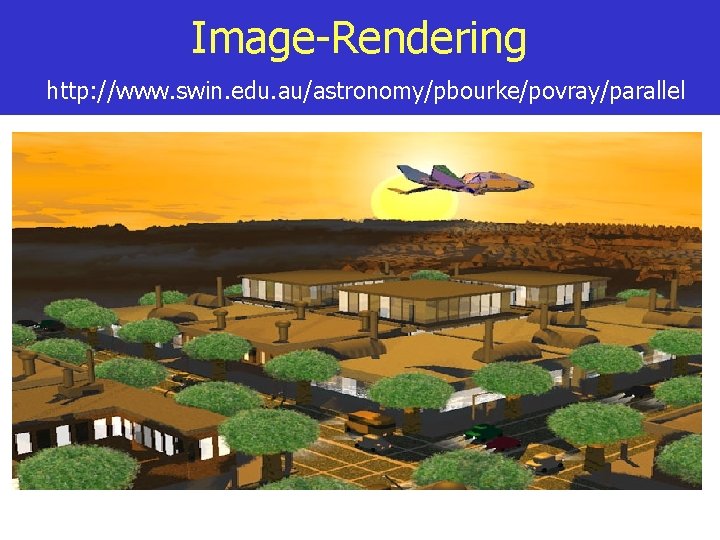
Image-Rendering http: //www. swin. edu. au/astronomy/pbourke/povray/parallel
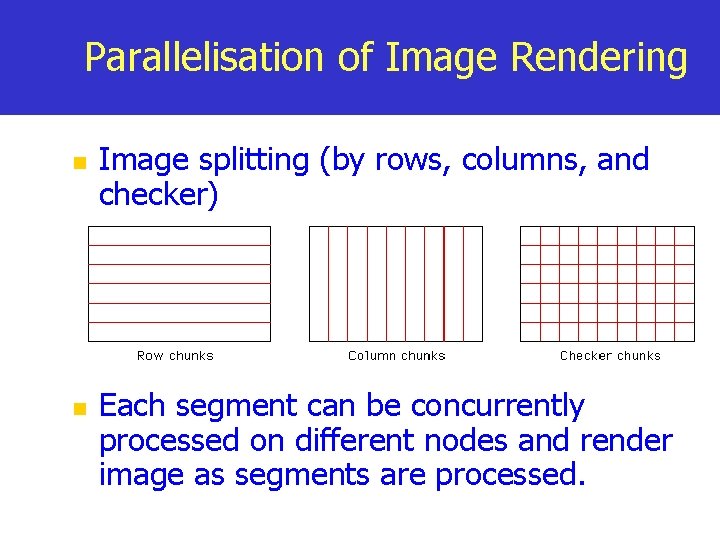
Parallelisation of Image Rendering n n Image splitting (by rows, columns, and checker) Each segment can be concurrently processed on different nodes and render image as segments are processed.
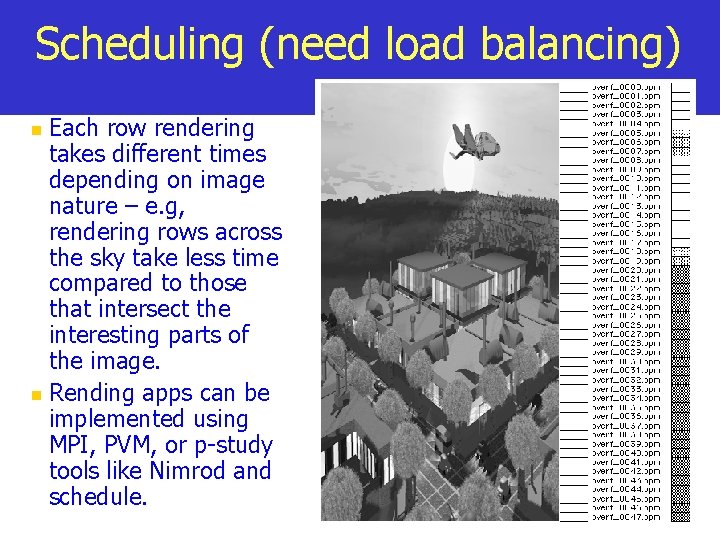
Scheduling (need load balancing) Each row rendering takes different times depending on image nature – e. g, rendering rows across the sky take less time compared to those that intersect the interesting parts of the image. n Rending apps can be implemented using MPI, PVM, or p-study tools like Nimrod and schedule. n
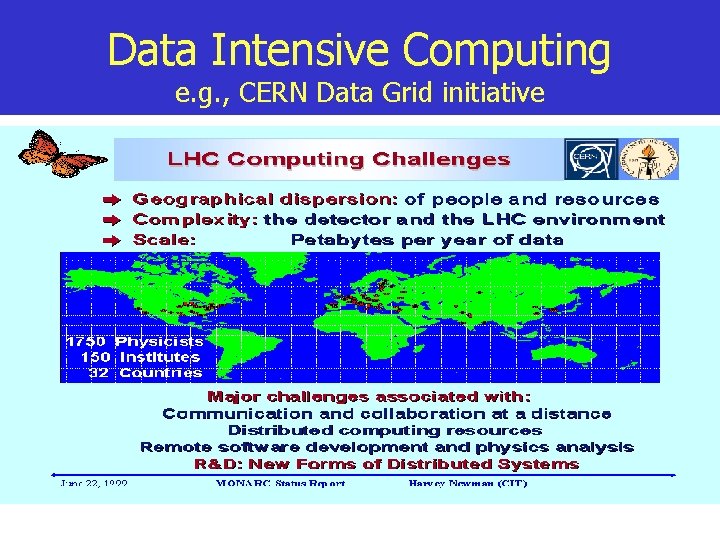
Data Intensive Computing e. g. , CERN Data Grid initiative
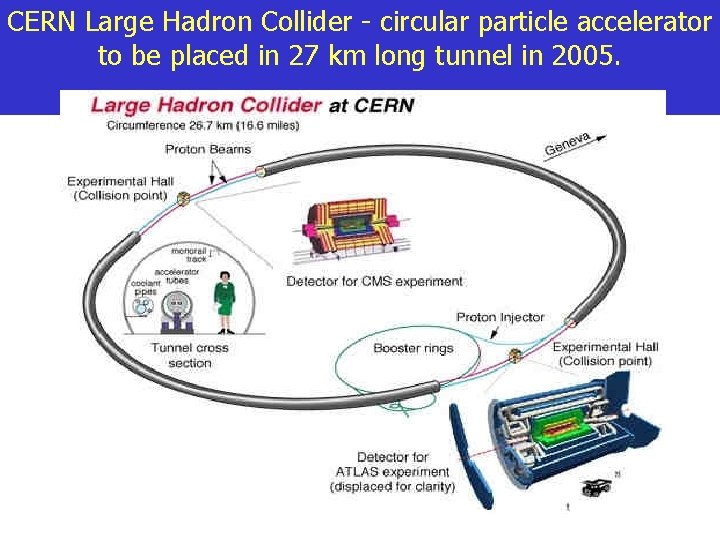
CERN Large Hadron Collider - circular particle accelerator to be placed in 27 km long tunnel in 2005.
Conclude with a comparison with the Electrical Grid………. . Where we are ? ?
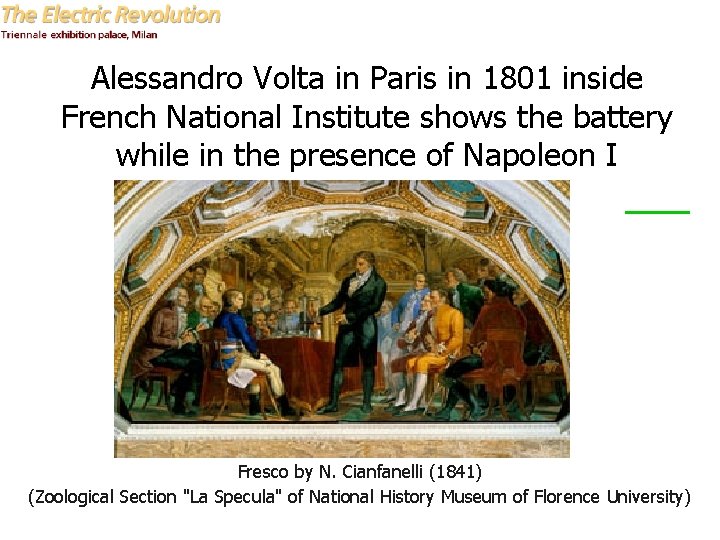
Alessandro Volta in Paris in 1801 inside French National Institute shows the battery while in the presence of Napoleon I Fresco by N. Cianfanelli (1841) (Zoological Section "La Specula" of National History Museum of Florence University)
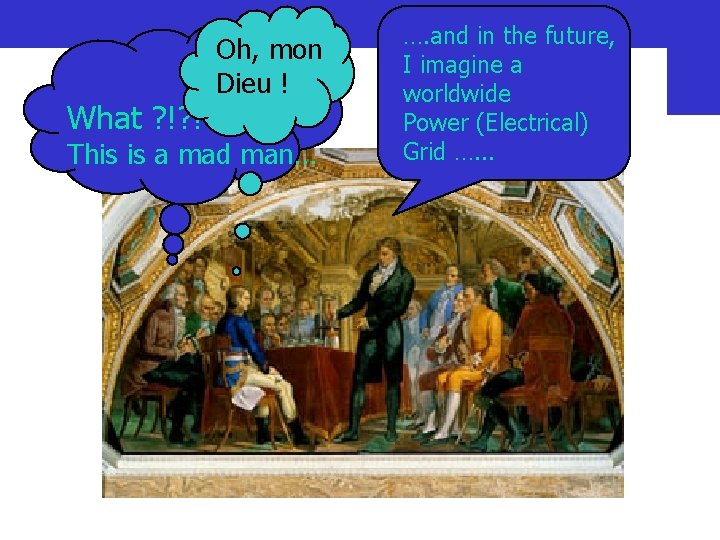
What ? !? ! Oh, mon Dieu ! This is a mad man… …. and in the future, I imagine a worldwide Power (Electrical) Grid …. . .
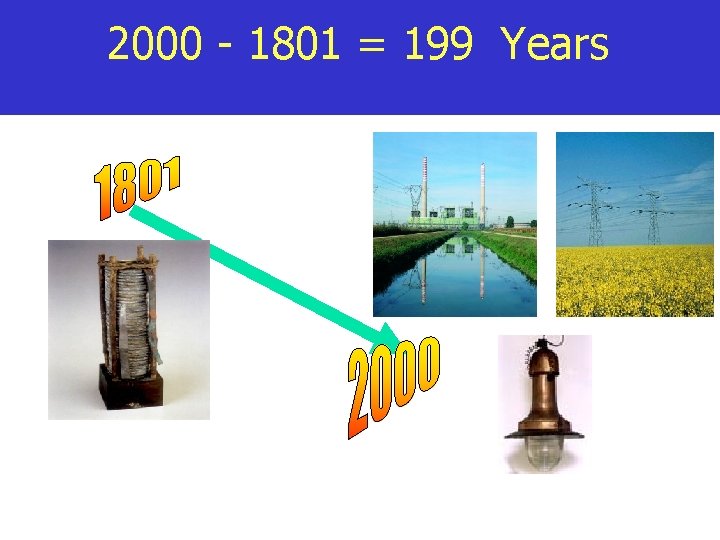
2000 - 1801 = 199 Years
What will be the dominant Grid approach in the next future ? ?
”The Computational Grid” is analogous to Electricity (Power) Grid and the vision is to offer a (almost) dependable, consistent, pervasive, and inexpensive access to high-end resources irrespective their location of physical existence and the location of access.
Trends It is very difficult to predict the future and this is particular true in a field such as Information Technology “I think there is a world market for about five computers. ” Thomas J. Watson Sr. , IBM Founder, 1943
Trends Grid The time is exciting but the way ahead may be hard and long…. !
The Grid Impact! “The global computational grid is expected to drive the economy of the 21 st century similar to the electric power grid that drove the economy of the 20 th century”
Future Grid Scenarios n n n Access to any resources, for anyone, anywhere, anytime, from any platform – portal (super) computing. Application access to resources from the wall socket! Many applications provide solutions in real-time. Choice of working: office vs home vs. . . Collaboratories for distributed teams. Monitoring and steering applications through wireless devices (PDAs etc. ).
Final Summary n n There are currently a large number of projects and diverse range of emerging Grid developmental approaches being pursued. These range from metacomputing frameworks to application testbeds, and from collaborative environments to batch submission mechanisms.
Conclusions n n n The HPC will be dominated by Peer-to-Peer Grid of clusters. Adaptive, scalable, and easy to use Systems and End-User applications will be prominent. Access electricity, internet, entertainment (music, movie, …), etc. from the wall socket! An Economics –based Service Oriented Grid Computing computing needed for eventual success of Grids! The impact of Grid on 21 st century economy will be the same as electricity on 20 th century economy.
Further Information n Books: n n n IEEE Task Force on Cluster Computing n n High Performance Cluster Computing, V 1, V 2, R. Buyya (Ed), Prentice Hall, 1999. The GRID, I. Foster and C. Kesselman (Eds), Morgan-Kaufmann, 1999. http: //www. ieeetfcc. org GRID Forums n www. gridforum. org, www. egrid. org CCGRID 2001, www. ccgrid. org n GRID Meeting - www. gridcomputing. org n
Further Information n Cluster Computing Infoware: n n Grid Computing Infoware: n n http: //www. gridcomputing. com IEEE DS Online - Grid Computing area: n n http: //www. buyya. com/cluster/ http: //computer. org/dsonline/gc Millennium Compute Power Grid/Market Project n http: //www. Compute. Power. com

Thank You… Any ? ?
- Slides: 64